

The popular advice to take alpha lipoic acid 600 mg for nerve health skips the most important question: what benefit should you expect from the product you're taking? A familiar dose isn't a guarantee of pain relief, and a capsule isn't interchangeable with an intravenous treatment. The useful decision involves the amount, release form, treatment goal, and medicines already in your routine.
Table of Contents
- What 600 mg of Alpha Lipoic Acid Means
- Typical 600 mg Dosing Ranges at a Glance
- How Immediate and Controlled Release Change Timing
- What the Evidence Shows for Nerve Pain and Other Claims
- Who May Benefit and Who Should Avoid 600 mg
- Safety, Interactions and Choosing a 600 mg Product
What 600 mg of Alpha Lipoic Acid Means
The amount on an alpha lipoic acid label is like a car's listed engine size. It describes something about what's inside, but it doesn't tell you how that car will perform on your road.
Say you're comparing bottles because you've noticed burning or tingling in your feet. Matching the amount printed on the front doesn't answer whether the products release their ingredient the same way, whether either fits your medical situation, or whether your symptoms need a diagnosis first.
Alpha lipoic acid, often shortened to ALA, is a sulfur-containing compound your body makes and uses in mitochondria, the parts of cells involved in releasing energy from food. It functions in water and fat environments, which helps explain the interest in studying its biological effects.
The key distinction: An ingredient amount describes what you take, not the outcome you'll get.
Read the amount in context
ALA is also sold as a dietary supplement. On a bottle, distinguish the amount in an individual capsule or tablet from the amount in a complete serving, then read the directions separately.
These label details answer different questions:
- Serving size: How many capsules or tablets make up the stated serving?
- Ingredient amount: How much ALA does that serving provide?
- Directions: How does the manufacturer instruct you to use that product?
- Release wording: Does the label identify an immediate-release or modified-release formulation?
A guide to reading a supplement label can help you separate those details rather than relying on the front-panel claim.
The familiar dose comes from clinical investigation, not from proof that everyone needs the same amount. Treat it as a starting point for evaluating the evidence, not as a universal daily requirement or a measure of antioxidant effectiveness.
Typical 600 mg Dosing Ranges at a Glance
600 mg alpha lipoic acid by context
| Context | Dose | Timing or route | What it tells you |
|---|---|---|---|
| Oral trials in diabetic neuropathy | 600 mg per day | Oral; follow the individual study protocol | Most-studied oral dose; evidence mostly poor quality |
| Intravenous use in clinical studies | 600 mg per day for 3 weeks | Given by a clinician | Pain reduction found in a meta-analysis |
| Oral supplement label | 600 mg per capsule or tablet when explicitly stated | Per label directions | Label amount, not a proven treatment dose |
| Oral doses above 600 mg per day | More than 600 mg per day | Oral; no universal schedule established | Clinical relevance of extra benefit remains uncertain |
Read this as a comparison of contexts, not a dosing prescription. The oral and intravenous rows describe different ways of administering ALA, while the supplement-label row describes information you must verify on the actual bottle.
Separate research use from personal directions
For oral neuropathy trials, the daily amount identifies the exposure investigators tested. It doesn't establish a universal meal schedule, a best time of day, or a reason to continue indefinitely.
Intravenous treatment belongs in a clinical setting. Don't convert a finding about administered treatment into an assumption about what a retail capsule will accomplish.
For everyday shopping, read the Supplement Facts panel alongside the directions. A front-panel amount alone won't tell you whether you're looking at an amount per tablet, an amount per serving, or a recommended daily total.
The higher-dose row is especially important if you're disappointed with your response. Increasing the amount isn't an evidence-based substitute for reviewing the diagnosis, treatment goal, and response.
Record what you actually take
Use a medication list, phone note, or paper log to record the product name, serving size, directions, and time taken. Include combination supplements, not just the bottle labeled alpha lipoic acid.
Bring that list to a pharmacist if different labels seem to conflict. Don't resolve the disagreement by combining instructions or adding another ALA-containing product.
A missing timing detail isn't permission to invent one. If a study summary or label doesn't answer your question about meals or other medicines, ask for product-specific advice.
Take the amount your clinician or the product label specifies, and don't stack products without checking the total daily intake.
How Immediate and Controlled Release Change Timing
Immediate-release products make the ingredient available quickly. Controlled-release products are designed to release it more slowly. That distinction changes the timing of exposure even when the stated ingredient amount is identical.
The visual comparison illustrates why release wording deserves attention alongside the amount on the bottle.
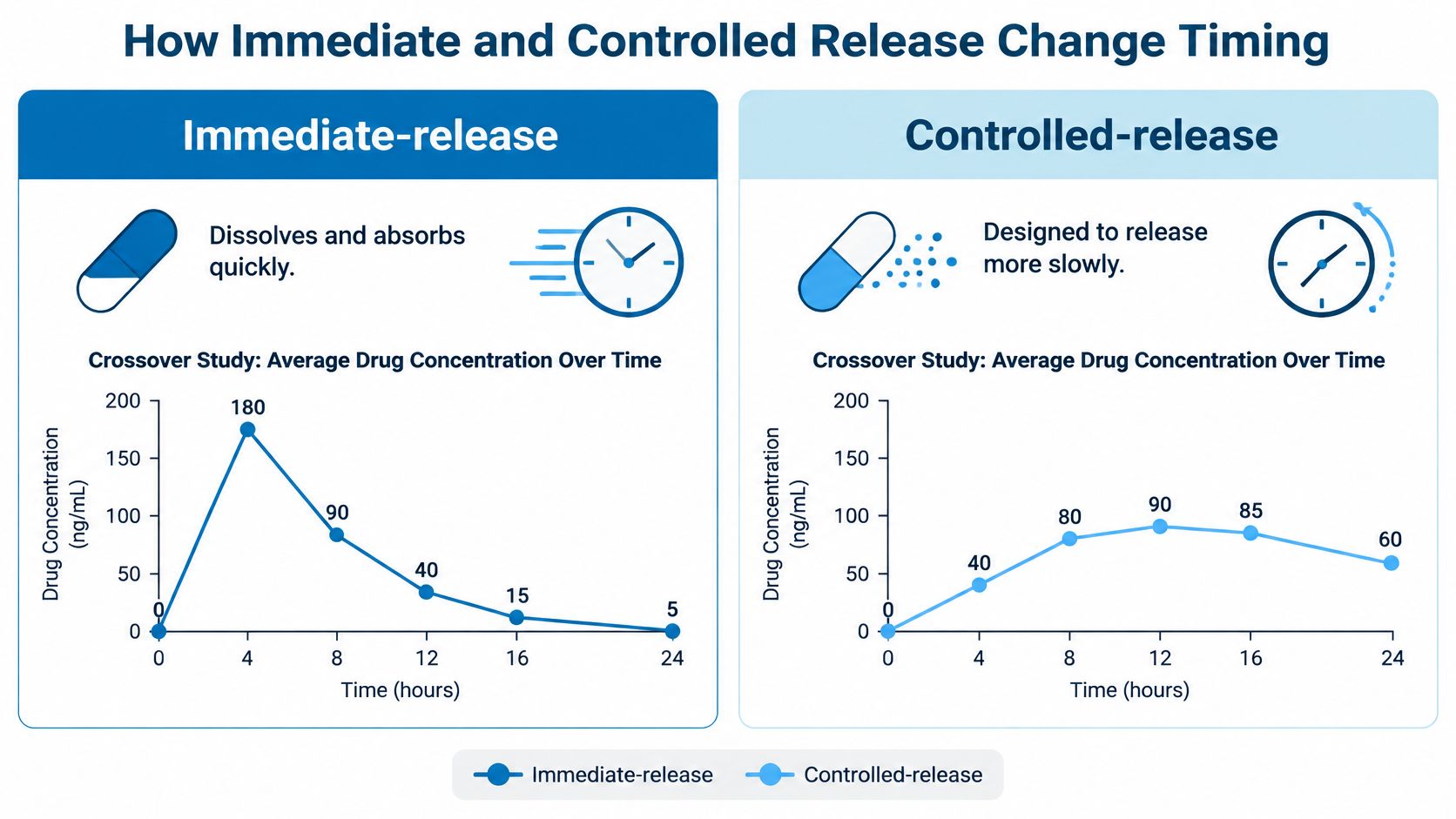
In a crossover pharmacokinetic study indexed in PubMed, 12 healthy adults received formulations in which immediate-release 600 mg reached maximum plasma concentration at approximately 0.5 hours, while controlled-release 600 mg peaked at about 1.25 hours, roughly 2.5 times later. These are formulation-specific observations, not guaranteed timings for every product on the market.
Immediate-release vs controlled-release 600 mg
| Release form | Time to peak plasma level | Total ALA per dose | What to check on the label |
|---|---|---|---|
| Immediate-release 600 mg | About 0.5 hours | 600 mg | Immediate-release wording on the bottle |
| Controlled-release 600 mg | About 1.25 hours, about 2.5 times later | 600 mg | Controlled or modified-release wording on the bottle |
A later peak isn't a stronger treatment
The important comparison is timing, not strength. A delayed maximum concentration doesn't establish better pain relief, more nerve repair, or a longer-lasting clinical benefit.
Likewise, a faster peak doesn't prove that a person will feel an effect sooner. Measuring ALA in blood and measuring a meaningful change in symptoms are different tasks.
The study reported no severe adverse effects or clinically significant changes in liver, kidney, or blood measurements after dosing. That's reassuring within the study's scope, but it doesn't establish long-term safety for every person with diabetes or other medical conditions.
Use release information when comparing bottles
Check the complete label rather than guessing the release profile from whether a product is a capsule or tablet. If the release type isn't stated clearly, ask the manufacturer or a pharmacist before assuming it matches a studied formulation.
A person considering a faster peak and someone considering a slower release profile may have different preferences. Neither preference establishes which option will improve symptoms.
This video provides additional context for the topic.
Choose a release form for a defined reason, not because slower or faster sounds better.
What the Evidence Shows for Nerve Pain and Other Claims
The strongest positive finding needs its route attached: a meta-analysis discussed in a review of ALA clinical evidence and safety found that intravenous ALA at 600 mg per day for three weeks produced a statistically significant and clinically relevant reduction in neuropathic pain in diabetic peripheral neuropathy. The same evidence summary describes uncertain clinical relevance for benefits from oral doses above that daily amount.
That's not a reason to dismiss oral ALA outright. It's a reason to avoid treating an intravenous result as proof for an oral supplement.
A separate systematic review described potential improvements in nerve-conduction velocity and positive neuropathic symptoms, but characterized the overall evidence as mainly poor quality. Positive neuropathic symptoms are troublesome sensations, not a favorable outcome.
Commonly studied doesn't mean reliably effective
The American Academy of Family Physicians evidence summary reports moderate-certainty evidence that ALA produced little or no improvement in diabetic peripheral neuropathy symptoms versus placebo at six months or 24 months. That finding matters to someone considering an open-ended purchase because short-term findings don't establish durable symptom relief.
These conclusions aren't necessarily contradictory. Investigators can evaluate different routes, durations, patient groups, and outcomes and reach different answers to different questions.
For a shopper, the practical conclusion is narrower than a product claim about nerve health: ALA has been studied for diabetic neuropathy, but dependable long-term relief from an oral product isn't established.
A treatment can change a measurement without producing a change you can feel or use in daily life.
Separate biomarkers, symptoms, and daily function
A biomarker is a measured biological value, such as a glucose result. A symptom is something you experience, such as burning discomfort. A functional outcome concerns what you can do, such as sleep comfortably or walk without pain interrupting you.
These outcomes aren't interchangeable. A small laboratory change doesn't automatically justify continuing a supplement if your intended goal was meaningful pain relief.
Broader claims about weight, inflammation, and glucose deserve the same caution. Statistical significance alone doesn't establish that an effect is large enough to matter clinically, and antioxidant activity isn't proof of a useful outcome for every condition.
If you're also reading about other nutrients, the discussion of vitamin B12 and nerve health is a separate topic. Don't use a general nerve-support label to assume that different nutrients address the same problem or should automatically be combined.
Decide what would justify continuing
Before starting, agree on a goal and a review date with your clinician. Avoid a plan whose only endpoint is finishing the bottle.
Use a short tracking checklist:
- Pain relief: Record the same symptom score consistently and note whether pain interrupts sleep or ordinary activities.
- Glucose management: Use the monitoring plan your diabetes clinician recommends, and record changes in medicines or meals that could affect interpretation.
- Clinical assessment: Let your clinician decide whether examination findings or nerve measurements need follow-up.
- Tolerability: Record unwanted effects and whether they affect eating, daily routines, or willingness to continue.
- Review decision: Decide in advance what improvement would support continuing and what lack of benefit would prompt stopping.
If symptoms don't meaningfully improve, don't assume that increasing the dose or extending the trial will solve the problem. The studied amount isn't a proven nerve-repair dose, and ALA doesn't replace diabetes treatment or assessment of progressive neuropathy.
Who May Benefit and Who Should Avoid 600 mg
Adults with diabetic peripheral neuropathy are the group most directly connected to the evidence discussed here. Even for that group, suitability depends on the treatment goal and the medicines already being used, not on the presence of tingling alone.
For someone taking ALA for general wellness, the decision is different. Evidence from people with a defined complication of diabetes doesn't establish that a healthy adult will gain more energy, prevent nerve problems, or feel better.
Symptoms need assessment before supplement selection
Burning, tingling, or numbness is a reason to seek assessment rather than diagnose yourself from a supplement description. Worsening symptoms deserve clinical attention even if you're already taking a product marketed for nerve health.
Pregnancy, nursing, an existing medical condition, and prescription medicine use are reasons to arrange professional review before starting. That review is particularly important when diabetes or thyroid treatment is involved.
This isn't a claim that everyone in these groups must permanently avoid ALA. It means the decision shouldn't be made from a retail label alone.
Match your next step to your situation
- Diabetic neuropathy symptoms: Discuss whether a supervised trial fits your current treatment plan and how you'll judge the result.
- Glucose-lowering medicines: Ask your diabetes clinician to define a monitoring and response plan before adding the supplement.
- Thyroid treatment: Ask whether your thyroid management needs review and who will interpret any follow-up testing.
- Pregnancy or nursing: Get individualized advice before purchasing or starting.
- No medical condition or regular medicines: Ask a pharmacist what specific goal would justify taking this amount at all.
The most useful candidate is not someone who matches a marketing description. It's someone with a clear clinical question, realistic expectations, and a plan for deciding whether the supplement earns a place in their routine.
Safety, Interactions and Choosing a 600 mg Product
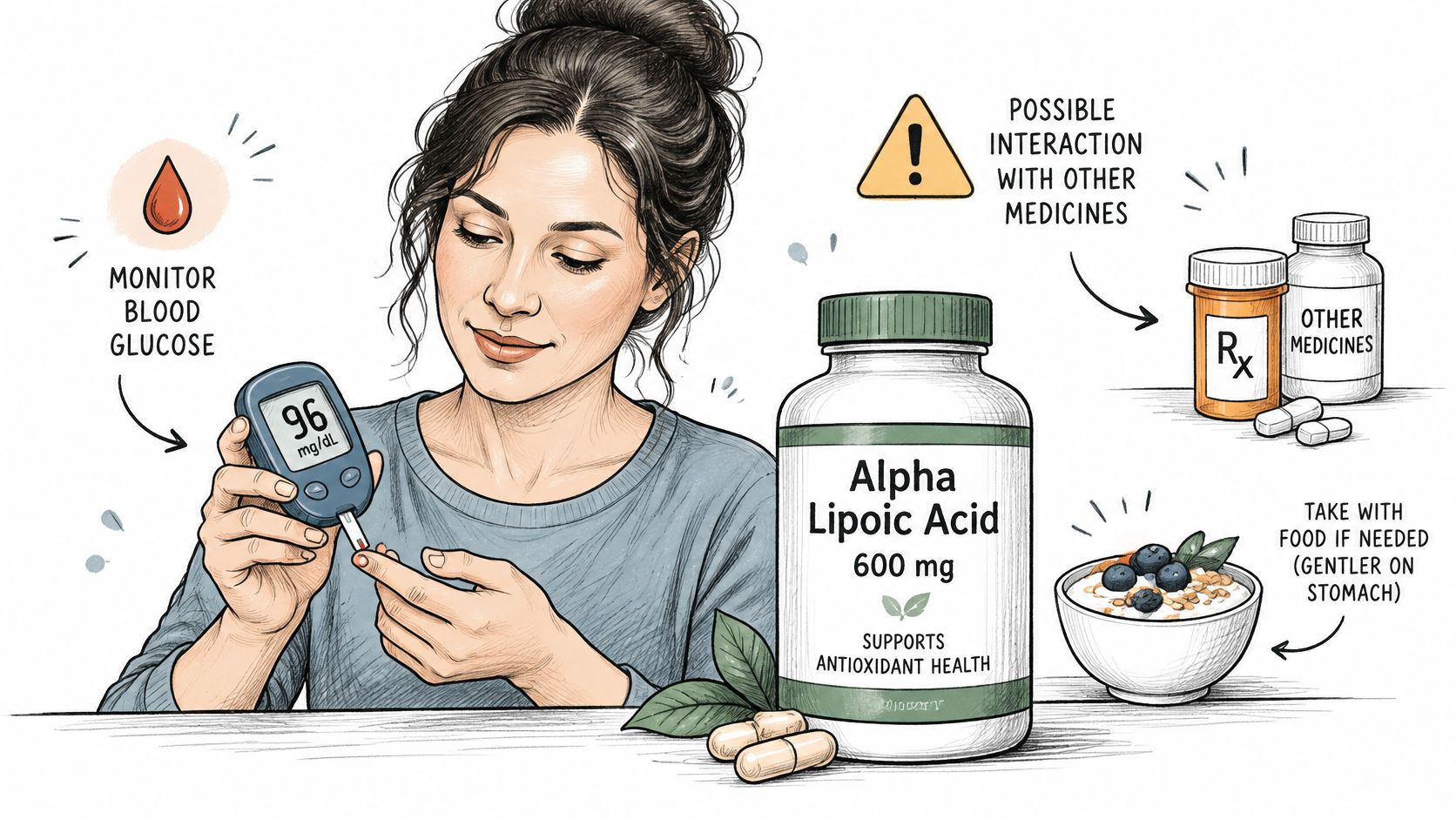
The most practical interaction questions concern blood glucose and thyroid treatment. A clinical review of ALA describes glucose-lowering concerns and a possible interaction with thyroid hormone, making professional review important for people using insulin, oral diabetes medicines, or synthetic thyroid hormone.
These are reasons to plan monitoring, not reasons to change prescribed treatment yourself. A supplement may be optional, but the medicines managing your condition shouldn't be adjusted without the prescribing clinician.
For someone managing diabetes, checking the bottle and checking glucose belong in the same conversation.
Don't invent a medication separation interval
If you take levothyroxine, ask your pharmacist to review your full morning routine, including meals, medicines, and supplements. Don't assume that moving ALA to another time automatically resolves every interaction concern.
The available evidence doesn't establish a universally correct separation schedule for ALA with thyroid medicine, diabetes treatment, or biotin. A precise interval offered without a product-specific and medication-specific assessment can create false reassurance.
Bring concrete questions rather than asking only whether the supplement is safe:
- Medication timing: Where would this exact product fit alongside my prescribed medicines?
- Monitoring: Should I change when I check glucose, and who should review unexpected results?
- Thyroid follow-up: Is any change to clinical follow-up appropriate before or after starting?
- Testing disclosure: Which supplements should I report before blood tests, including any biotin-containing products?
- Response plan: Whom should I contact if a reading or symptom changes?
Possible competition between ALA and biotin for cellular transport remains uncertain in its importance for humans. Don't turn that theoretical concern into a diagnosis of deficiency, a reason to add more biotin, or proof that ALA will distort a particular laboratory test.
Bring the actual bottles: A complete ingredient list is more useful than a remembered product name.
Use a buying checklist that addresses the whole formula
Confirm the serving before comparing products. Read the amount per serving and the number of capsules or tablets in that serving. Don't assume a large number on the front panel describes an individual unit.
Next, work through the details that affect whether the product fits your plan:
Identify the release type. Look for immediate-release, controlled-release, or modified-release wording. If it's missing, don't infer it from the dosage form or marketing language.
Record the named ALA form. If the label specifies R-ALA or another form description, copy it into your medication list. Don't assume a form designation proves superior symptom relief or justifies substituting a different product without review.
Check independent quality information. Look for identifiable third-party testing or a quality seal, then verify what it covers. A quality claim should help you evaluate manufacturing or contents, not be mistaken for proof that the supplement treats neuropathy.
Read every active ingredient. A combination formula creates more questions than an ALA-only product because you must account for the other ingredients too.
Audit your existing routine. Put your multivitamin, nerve-support formula, and other supplements beside the proposed purchase. Check for overlapping ALA rather than relying on the product names.
For example, our NOW EVE Superior Women's Multivitamin with alpha lipoic acid illustrates why an ALA review shouldn't stop at a standalone bottle. Check the complete current label before deciding whether another product belongs alongside it.
Know how to respond to unwanted effects
Stomach upset, heartburn, diarrhea, or reduced appetite can occur with ALA. Broadly reassuring trial safety findings don't mean that an individual should tolerate persistent symptoms to complete a bottle.
If stomach symptoms develop, record when they started, what product you used, and any other changes in your routine. Ask a pharmacist whether stopping is appropriate rather than repeatedly changing the timing and obscuring what happened.
For glucose concerns, follow your established diabetes response plan and contact your care team. Don't compensate for an unexpected reading by independently reducing insulin or another prescribed medicine.
Confirm the plan before the first dose
Bring the proposed bottle, a current medicine list, and the goal you want to achieve to a pharmacist or clinician. Ask them to confirm the daily amount, release form, timing, monitoring responsibilities, and review date.
A useful plan also includes an exit decision. If there's no meaningful benefit, you should know whether to stop rather than assume that continued spending is necessary for protection you can't measure.
Stop ALA and seek medical advice if symptoms worsen, glucose falls unexpectedly, or stomach symptoms persist. Seek urgent care for severe symptoms or a low-glucose episode that doesn't respond to your established treatment plan.
CalVitamin offers dietary supplements and wellness products, with product pages you can use to compare ingredient lists and dosage forms. Visit CalVitamin to review your options, then bring the exact label to your pharmacist before adding alpha lipoic acid to your routine.


