

No clock hour has been proven best for magnesium glycinate. For sleep, take it 30 to 60 minutes before bed, or with an evening meal 1 to 2 hours before bed. For daytime calm, take it in the morning or midday. For everything else, pick one fixed time each day, ideally with food.
Most guides treat the best time of day to take magnesium glycinate as if one hour on the clock were the answer. What if that hour is the least important part? A bottle that says "take at night" can sound precise when the things that change your result are whether you take it every day, whether your stomach tolerates it, and whether the dose lines up with the symptom you want to change.
People often chase a perfect bedtime and then skip half the week. A calmer frame works better. Match the window to your goal, stay inside adult supplement limits, and judge the result after weeks, not after one night.
Table of Contents
- Best Time to Take Magnesium Glycinate by Goal
- Why Consistency Beats the Clock
- What the Evidence Shows
- Morning and Midday Dosing for Daytime Calm
- Meals, Dose Size and Side-Effect Limits
- Timing Magnesium Glycinate for Cramp Prevention
- Medication and Supplement Timing Checks
- Settle on Your Timing Over Four Weeks
Best Time to Take Magnesium Glycinate by Goal
No trial has shown one clock hour is best for everyone. The right window is the one that matches your goal and that you can keep.
| Goal | Best window | Take with food? | Main reason |
|---|---|---|---|
| Sleep support | 30-60 minutes before bed, or with an evening meal 1-2 hours before bed | Yes, if your stomach is sensitive | Calming bedtime routine; sleep evidence is modest |
| Daytime calm or muscle tension | Morning or midday | Yes | Fits daytime tension or anxiety goals and avoids evening drowsiness |
| Cramp prevention | Same time every day; split into two doses if needed | Yes | Steady intake matters more than the hour; timing evidence is limited |
| Daily maintenance | One fixed time each day | Yes | Consistency is the main driver of results |
| Sensitive digestion | Any fixed time with a meal, split into smaller doses | Yes | Smaller single doses lower the chance of diarrhea and cramping |
The sleep row has two valid options. Take it with the evening meal when that meal is 1 to 2 hours before bed, or take a separate dose 30 to 60 minutes before lights out. Use the meal if an empty stomach bothers you. Use the shorter pre-bed window if dinner is early and you still want a wind-down cue.
Three lines are enough to save.
- Sleep: evening, with dinner or 30 to 60 minutes before bed.
- Daytime calm: morning or midday, with a real meal.
- Everything else: one fixed time, with food.
Night cramps that keep returning deserve a conversation with a clinician, not only a new alarm.
Why Consistency Beats the Clock
Watering a plant matters more than the hour you water it, as long as the soil stays moist. Magnesium glycinate works in a similar way. Your body uses magnesium all day for muscle and nerve function. A missed week does more harm to the habit than taking Tuesday's dose at breakfast instead of at 9 p.m.
Most research has followed people who took magnesium for weeks. Those trials rarely put morning dosing head to head with evening dosing. A clock-time tip is a practical default, not a proven edge. Claims that bedtime produces better absorption are not backed by the evidence reviewed for this guide.
Say a teacher takes one capsule at 7 a.m. with breakfast every weekday and on weekends. A neighbor takes the same product at midnight and skips it whenever bedtime runs late. The teacher is the one building a steady intake. The neighbor is mostly testing whether they remember.
Best time, defined here: the hour that supports daily use, fits your goal, and causes the fewest side effects.
That definition is what the rest of this guide applies, one goal at a time.
What the Evidence Shows
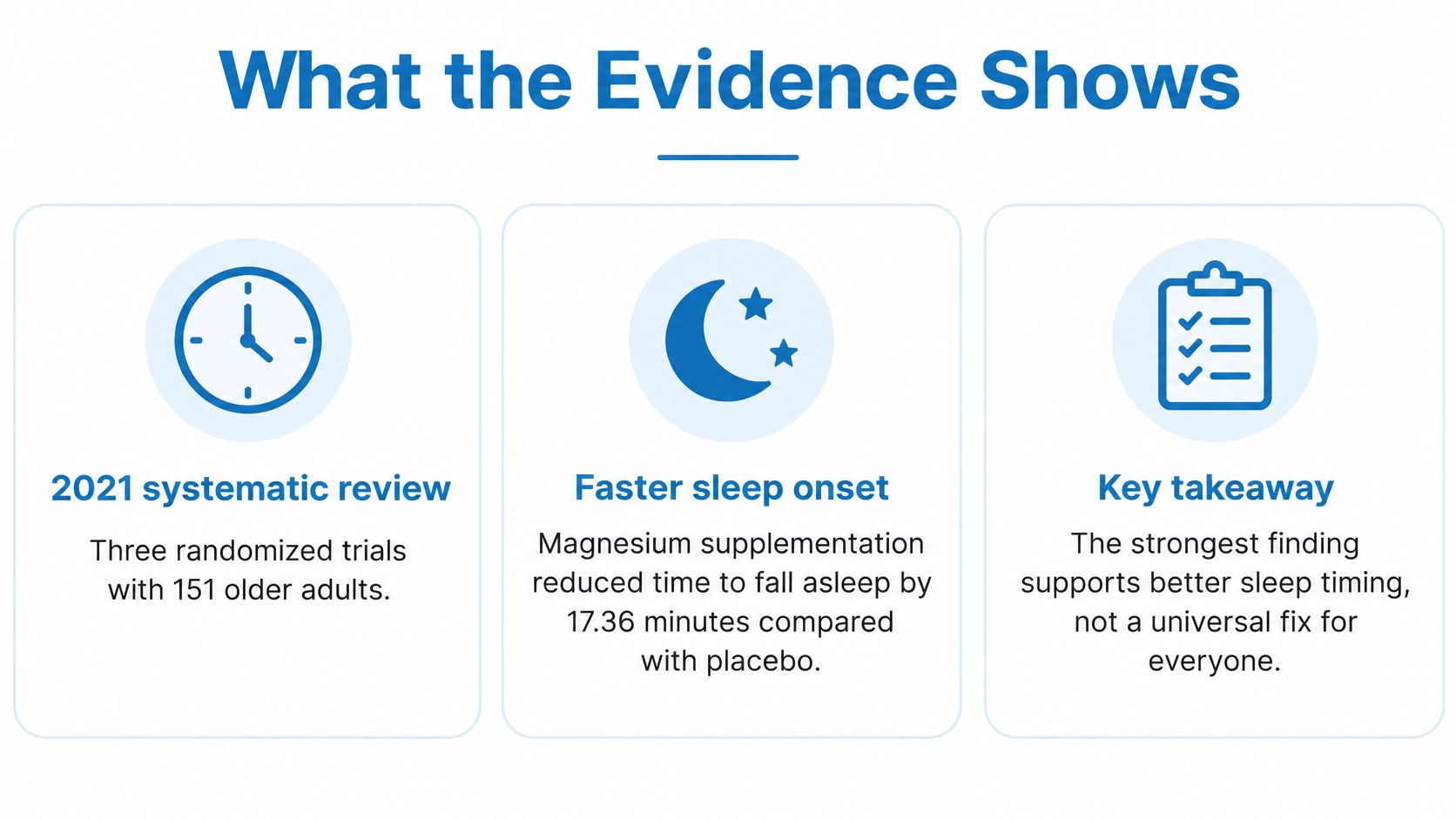
The clearest sleep finding is about falling asleep faster, not about a magic hour. A 2021 systematic review pooled 3 randomized controlled trials with 151 older adults in three countries. Magnesium supplementation cut sleep-onset latency by 17.36 minutes versus placebo, with a 95% confidence interval of 7.44 to 27.27 minutes and p = 0.0006, according to the summary from the National Center for Complementary and Integrative Health. The gain in total sleep time, 16.06 minutes, was not statistically significant.
What those trials do not prove
That same NCCIH summary calls the overall evidence limited. The review of 3 studies and 151 participants suggested less time to fall asleep in older adults with insomnia, and the studies were low quality. A broader review of 9 studies and 7,582 participants found conflicting results, especially for diagnosed sleep disorders. None of this compares 8 a.m. with 10 p.m.
An evening dose is a reasonable sleep routine if you notice you settle more easily. It does not prove night is biologically better than morning. Broader reasons people try this form are covered in our guide to magnesium glycinate benefits.
Say someone takes 200 mg of elemental magnesium at 9 p.m. with dinner. After two weeks they fall asleep a bit sooner. That is a fair personal result. It still does not show that 9 p.m. beats breakfast inside the body. If the evening dose leaves you groggy the next morning, move it earlier and keep the new time steady.
Morning and Midday Dosing for Daytime Calm

Daytime dosing fits when the problem shows up while you are awake. Jaw tension at your desk, tight shoulders by mid-afternoon, or a wired feeling during work hours will not be helped by a capsule you only meet at midnight.
A 2025 Verywell Health clinical guidance article suggests morning dosing when the goal is daytime muscle tension or anxiety support, and it reserves the 30 to 60 minutes before bedtime window for sleep support. That is clinical guidance, not a head-to-head trial of morning versus night.
A breakfast or lunch rule
Picture an office worker who wakes with a tight jaw. By 3 p.m. the shoulders are up near the ears. They take the capsule with breakfast for seven days and jot a one-line note each afternoon. The next week they move the same dose to evening and keep the same notes. Whichever week shows less daytime strain, without next-morning fog, is the one they keep.
A short video walks through how people usually pair a capsule with a daily meal.
Use breakfast if that meal is substantial. Use lunch if breakfast is coffee only or you skip it. Some people feel drowsy after an evening dose, which is a reason to move earlier. If you need to stay sharp for a commute or a shift, notice how the first dose lands before you lock the time in. Then stay with the slot that matches the symptom you are tracking.
Meals, Dose Size and Side-Effect Limits
Does magnesium glycinate need to be taken with dinner, or at a particular hour, to work well? The practical answer is to pair it with food if that feels easier on your stomach, then choose a time you can repeat. Meal timing can support comfort, but it does not establish that evening dosing improves absorption or sleep.
How to pair it with a meal
- Use real food: Take it with a meal or a solid snack if an empty stomach causes discomfort.
- Avoid a troublesome combination: If a very heavy or spicy meal tends to upset your stomach, do not pair it with a large dose.
- Keep the routine predictable: Repeating the same meal pairing can make the habit easier to maintain.
The 350 mg ceiling
Dose and safety are separate from the question of timing. The NIH Office of Dietary Supplements fact sheet sets the adult tolerable upper intake level for magnesium from supplements and medications at 350 mg per day. This limit excludes magnesium from food. It is a safety benchmark, not a dose to aim for.
Check the label for elemental magnesium, rather than the weight of the entire compound, and compare that amount with the 350 mg limit. Higher supplemental amounts can cause diarrhea, nausea, and abdominal cramping, which may make a bedtime routine uncomfortable. NIH materials describe magnesium aspartate, citrate, lactate, and chloride as more readily absorbed than some other forms. That information does not establish a special nighttime schedule for glycinate or an hour when it absorbs better.
The NIH guidance also discusses diuretics and prolonged proton-pump-inhibitor use in relation to magnesium status and medication handling. If you take either type of medicine, or have impaired kidney function, ask a clinician about your dose and schedule rather than adjusting them on your own.
For example, someone who develops loose stools after taking 400 mg on an empty stomach could ask a clinician whether a lower amount or divided doses would be appropriate. Someone else taking 400 mg at bedtime and waking with cramps should also review the total dose, rather than assuming the clock time caused the problem. A meal may change comfort; it does not by itself determine whether magnesium will support a sleep or cramp goal.
If diarrhea, nausea, or cramping continues after you adjust timing and dose, lower the amount and talk with a clinician. Severe or unusual symptoms need urgent care.
Timing Magnesium Glycinate for Cramp Prevention
Cramp prevention tracks steady daily intake more than a special hour. Timing evidence here is thin, so the routine rests on consistency, not on a trial that proved 8 p.m. stops calf cramps.
- Pick one fixed time you already keep, such as breakfast or dinner.
- Split only for comfort. If one dose upsets your stomach, divide the same daily total into two smaller doses at set times, for example breakfast and dinner.
- Wait four weeks before you decide whether nights are calmer. A few random good nights do not settle the question.
A runner who gets calf cramps after late miles takes one steady dose with dinner every day for four weeks and writes down each night cramp. The pattern is steadier than the month they grabbed a capsule whenever they remembered. That is a practical default. It does not prove any hour prevents cramps. Comparing forms for this goal is covered in our notes on the best magnesium supplement for muscle cramps.
A schedule tweak is not a diagnosis. Persistent night cramps need a clinician, especially if you use diuretics, a long-term proton-pump inhibitor, or your kidneys do not clear minerals well. Check medicine spacing in the next section before you move any dose.
Medication and Supplement Timing Checks
Do not change the timing of a prescription or another mineral on your own. A pharmacist or prescriber should set the gap.
| Medicine or supplement | Timing concern | What to do |
|---|---|---|
| Diuretics | Can change magnesium handling and status | Keep your prescribed schedule; ask your clinician about monitoring |
| Long-term proton-pump inhibitors | Can affect magnesium status | Ask your clinician about monitoring; do not change timing alone |
| Tetracycline or fluoroquinolone antibiotics | Magnesium can reduce absorption of the antibiotic | Space doses apart; confirm the gap with your pharmacist |
| Calcium, iron or zinc supplements | Compete with magnesium for absorption | Separate by a few hours; confirm with a pharmacist |
| Bisphosphonates for bone conditions | Mineral supplements can reduce absorption | Space doses apart; confirm with your prescriber |
| Reduced kidney function | Magnesium clearance can be impaired | Get professional advice before starting |
| Other sleep or anxiety medicines | Interaction timing varies by drug | Check with your pharmacist before adding magnesium at bedtime |
Antibiotics in the tetracycline and fluoroquinolone families can bind magnesium in the gut, so the usual fix is space, not "take them together at dinner." Calcium, iron, and zinc compete for absorption. Our walkthrough on how to take calcium supplements is the companion piece if calcium is already on your list. Bisphosphonates for bone conditions also need a gap from minerals.
Bring the full list of medicines and supplements to your pharmacist and ask for a written daily schedule that includes magnesium. Exact hours belong on that note, not in a general article.
Settle on Your Timing Over Four Weeks
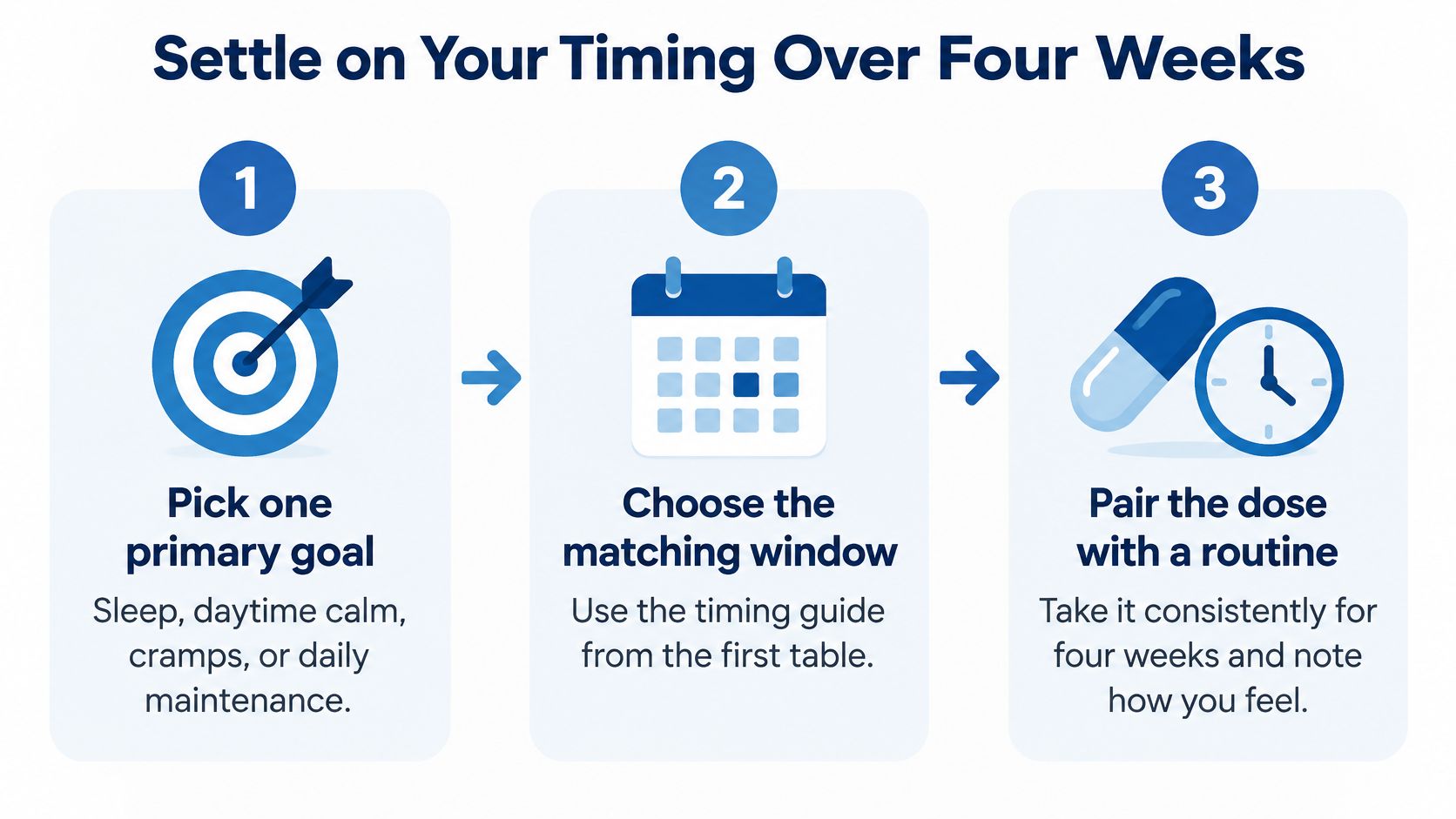
Pick a plan and stop moving it every few nights.
- Name one primary goal, sleep, daytime calm, cramps, or daily maintenance, so you are not scoring four outcomes at once.
- Choose the matching window from the goal table and write it on the bottle.
- Pair it with the same meal so stomach comfort stays predictable.
- Log 14 days: time to fall asleep, morning grogginess, digestive comfort, and cramps. One line a day is enough.
- Change one variable only. Move the dose an hour earlier, or split it. Do not do both in the same week.
- Clear medicines first. A pharmacist should sign off before you shift a dose around antibiotics, bone drugs, or other minerals.
- Hold the time for four weeks. Research has mainly watched magnesium over weeks, so a three-night trial cannot tell you much.
If the log shows steady improvement and no side effects, keep that time. If sleep is still slow or cramps continue, adjust one variable or talk with a clinician. Switching the clock every few nights only resets the experiment.
CalVitamin carries magnesium and other daily minerals in capsule and gummy forms, with label details you can match to an elemental dose and a meal-time habit. If you are setting a four-week routine, browse current options and reviews at CalVitamin, then confirm the serving with your clinician or pharmacist before you start.


