

The most popular advice about magnesium for cramps starts with the wrong question: which form absorbs best? Better absorption can matter when you need to improve magnesium intake, but it doesn't establish that a supplement will prevent your cramps. A product can deliver magnesium effectively without treating the reason your calf tightens at night.
The best magnesium supplement for muscle cramps isn't a universally superior salt. It's a product with an appropriate elemental dose, tolerable ingredients and a clear reason for use, after you've considered whether magnesium is relevant to the symptom at all.
Table of Contents
- Magnesium Forms Compared for Cramp Products
- What Clinical Trials Say About Cramp Relief
- Reading Elemental Magnesium on Labels
- Daily Upper Limits by Age Group
- Who Gets Cramps and What to Do Differently
- Label Checks for Gelatin-Free and Halal Products
- Confirm the Cause Before You Buy a Supplement
Magnesium Forms Compared for Cramp Products
A magnesium salt name describes what the mineral is bound to. It says little reliable about how much elemental magnesium sits in one tablet, and nothing at all about whether your gut will tolerate the dose. Both answers live elsewhere: the Supplement Facts panel for the amount, your own response at the labeled dose for the tolerance.
| Form | What the label must show | Fits when |
|---|---|---|
| Magnesium oxide | Elemental magnesium per tablet and the total tablet count | The labeled dose and price suit your needs |
| Magnesium citrate | Elemental magnesium per serving, with laxative potential stated | Inadequate intake when constipation is also a consideration |
| Magnesium glycinate | Elemental magnesium and the complete ingredient list | You can verify dose and excipients on the panel |
| Magnesium chloride | Elemental magnesium per measured serving plus measuring instructions | A liquid product fits your routine |
| Magnesium taurate | Elemental magnesium taken from Supplement Facts | The formulation meets a nutritional need you have identified |
These are buying criteria, not a cramp-prevention ranking. The evidence doesn't establish a winning magnesium form for ordinary cramps, and elemental percentages shift from product to product even within the same salt.
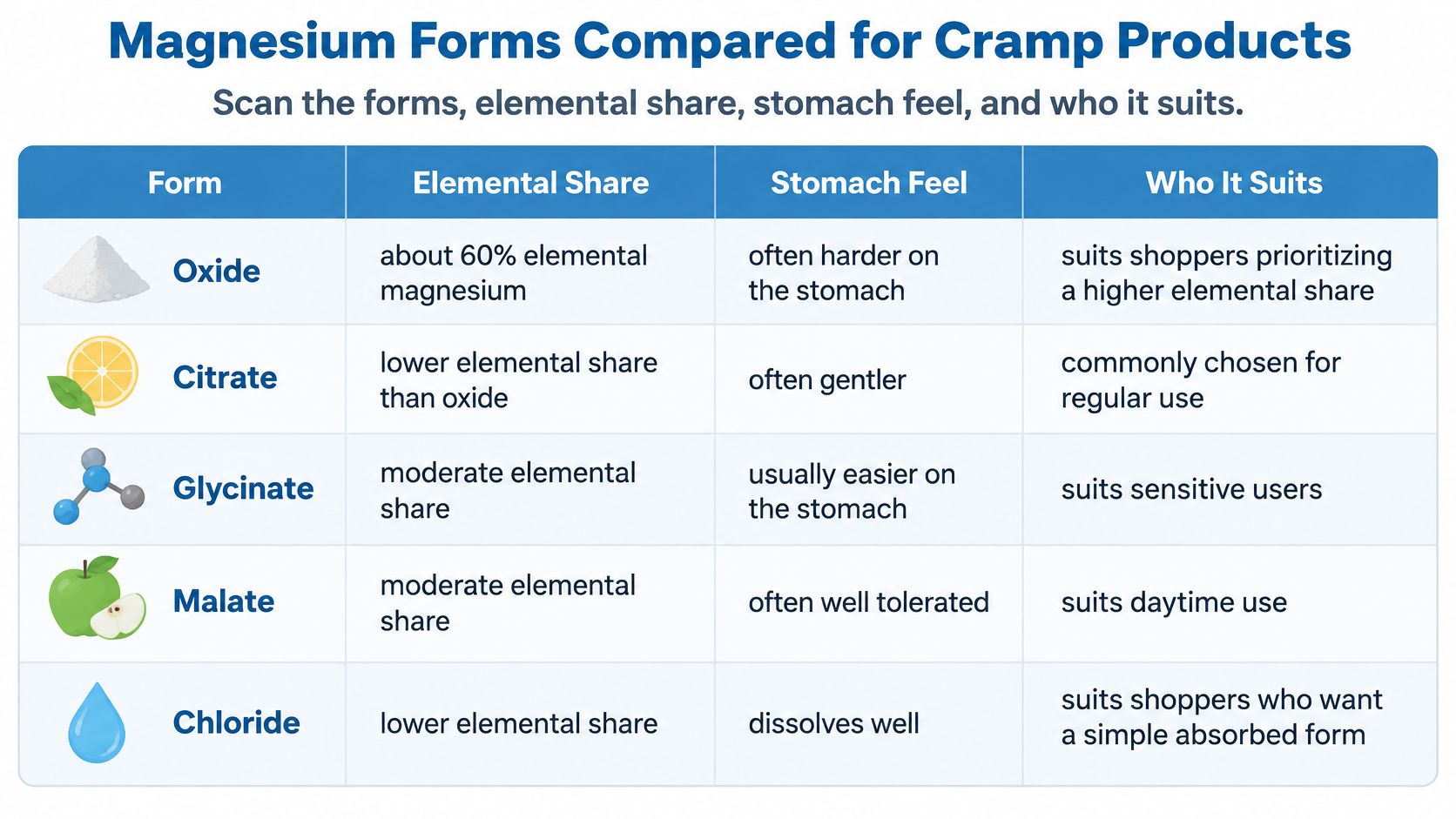
Match the product to the practical problem
Citrate deserves consideration when bowel effects matter. Its laxative effect may be useful for someone with constipation and unwelcome for someone already passing loose stools. Treat that as a separate selection issue, not evidence of stronger muscle-cramp relief. Someone choosing citrate to loosen stool is solving a different problem than someone choosing it to top up intake.
For glycinate, separate the product's positioning from your own experience. Our guide to magnesium glycinate benefits can help you examine the form without treating an evening-use or sensitive-stomach claim as a clinical guarantee. What you can check on the bottle is the elemental amount per capsule and whether the excipients are ones you accept.
Oxide and chloride get the same scrutiny as any other formulation. Compare elemental serving, directions and inactive ingredients instead of deciding from the compound name. A liquid may make measuring convenient for one person and add steps for another.
Taurate's heart-focused positioning doesn't answer the cramp question. Don't pay a premium for an unrelated claim unless the product also meets a nutritional need you have identified.
Buying rule: Choose a formulation you can tolerate and measure accurately, then compare labeled elemental doses rather than front-label promises.
What Clinical Trials Say About Cramp Relief
Magnesium hasn't demonstrated a clinically meaningful preventive benefit for typical idiopathic cramps in older adults. Idiopathic means no specific cause has been identified, not that a magnesium deficiency has been established.
A systematic review indexed by the EPA's Health and Environmental Research Online database included seven randomized trials involving 406 participants, with pregnancy-associated cramps examined separately from largely older adults with idiopathic cramps. The pregnancy findings conflicted, while differences between magnesium and placebo for idiopathic cramps were small and weren't statistically significant.
That distinction matters. An inconclusive result in pregnancy doesn't establish benefit, and a disappointing result in older adults shouldn't be transformed into a recommendation to try a more expensive salt.
What a negative result means for shoppers
The trials don't prove that magnesium can never help anyone who experiences cramps. They do weaken the case for taking it automatically when no deficiency or other magnesium-related explanation has been identified.
There's also a cost beyond the purchase price. The Cochrane evidence summary on magnesium for muscle cramps reports minor gastrointestinal effects in approximately 11% to 37% of magnesium users across studies. Diarrhea or nausea can make an uncertain benefit a poor trade-off.
Keep these distinctions clear:
- Nutritional correction: Improving inadequate magnesium intake addresses a nutritional problem.
- Symptom treatment: Preventing cramps requires evidence that the intervention changes cramp outcomes.
- Form comparison: Better absorption doesn't independently prove better symptom relief.
A supplement can be reasonable for inadequate intake and still be an unreliable treatment for the cramps that prompted you to buy it.
The useful conclusion isn't that every magnesium product is worthless. It's that cramps alone don't identify the right product or establish a reason to supplement. Persistent, severe or newly occurring symptoms deserve assessment for medication effects, hydration problems, circulation issues, nerve disorders and other causes.
That approach also prevents a common shopping error: interpreting failure with one form as proof that you need another. Without a reason to suspect magnesium is involved, switching salts may repeat the same unsupported experiment.
Reading Elemental Magnesium on Labels
Start with the Supplement Facts panel, not the large milligram claim on the front. Elemental magnesium is the amount of magnesium itself, whereas the full compound includes the material it's bound to.
The NIH Office of Dietary Supplements consumer fact sheet identifies aspartate, citrate, lactate and chloride as more readily absorbed forms than some alternatives. That makes them reasonable candidates for improving inadequate intake, but doesn't establish superior cramp relief.
Use the label-reading process below before comparing bottles.
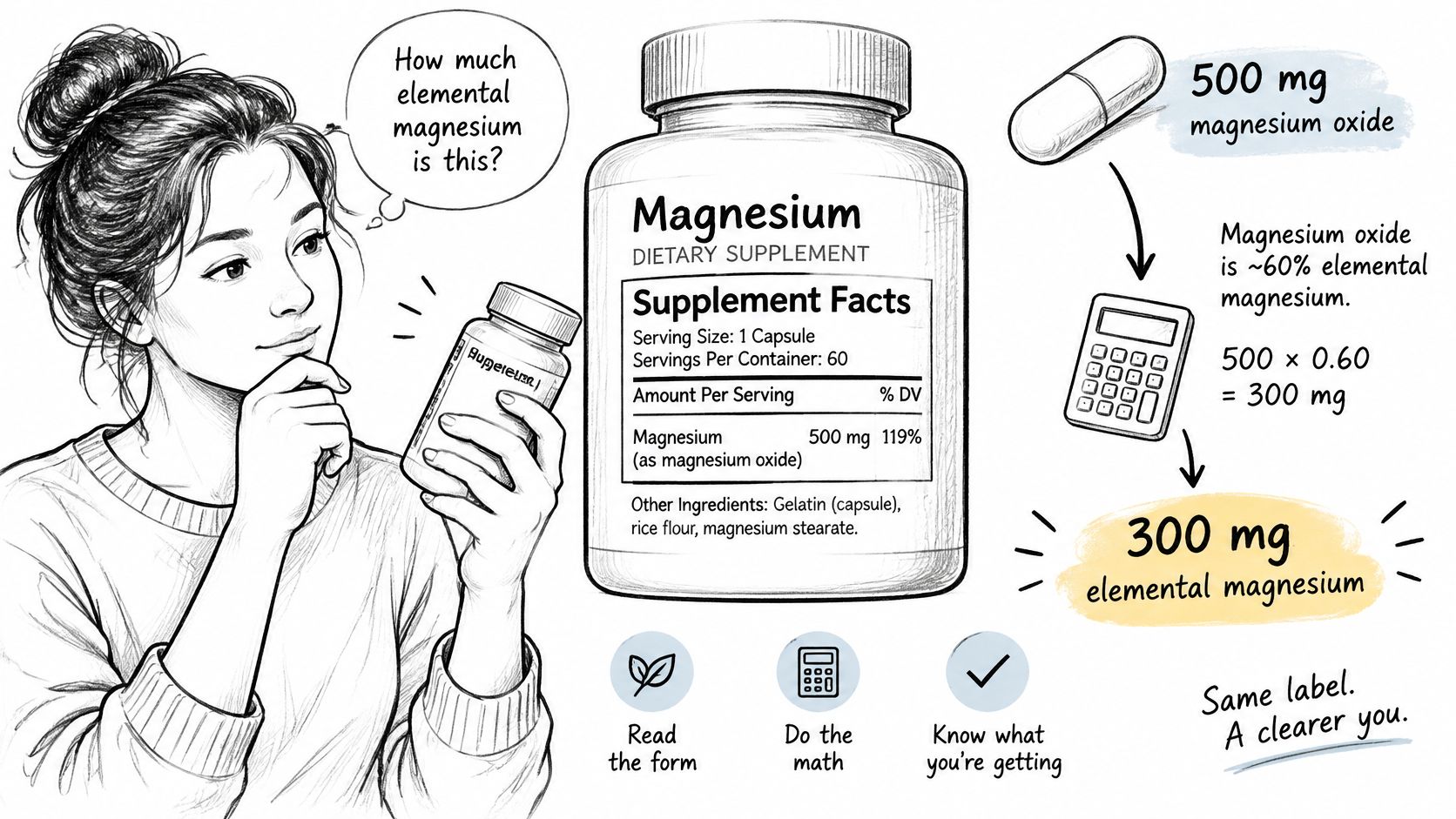
Turn the label into a usable comparison
Find the serving size first. Then find the magnesium amount for that serving and check whether the instructions call for that serving once or repeatedly during the day.
Don't multiply the labeled elemental amount by a generic absorption percentage. The amount swallowed and the amount absorbed aren't interchangeable, and a product label doesn't predict your individual absorption.
For a clearly hypothetical example, suppose a bottle contains 60 servings, each supplying 100 mg elemental magnesium, and costs $18. Its total elemental content would be 6,000 mg, so its cost per 100 mg would be $0.30. These are illustrative inputs, not a product listing or a suggested dose.
The reusable calculation is:
Price per chosen elemental unit = bottle price ÷ total elemental magnesium in the bottle × chosen unit.
Compare daily use, not capsule count alone
A bottle with many capsules isn't automatically better value. You need to know how many capsules make a serving, how often you'll take that serving and whether the bottle supplies a suitable amount for your purpose.
Likewise, a product requiring more capsules doesn't automatically cost more per day. That conclusion requires the price, capsule count and elemental dose together.
Write down these details before choosing:
- Elemental magnesium per serving: Copy the magnesium amount from Supplement Facts.
- Planned servings per day: Use the intended schedule, not the bottle's maximum by default.
- Cost per equivalent elemental amount: Compare like with like, using actual bottle prices and serving counts.
- Practical burden: Include capsule size, measuring requirements and ingredients you need to avoid.
A low unit price is useful only if the product is appropriate and tolerable. Paying less for magnesium you can't comfortably take isn't a saving.
Daily Upper Limits by Age Group
The NIH Office of Dietary Supplements sets the adult upper limit at 350 mg daily from supplements and medications, excluding magnesium naturally present in food; its age-specific limits are shown below. This is a safety ceiling, not a recommended daily intake or a target dose.
A supplement that reaches the adult ceiling leaves no room under that ceiling for additional magnesium-containing medicines. Count antacids, laxatives, multivitamins and other mineral products before deciding what to add.
Upper intake limits for magnesium from supplements
| Group | Upper limit (mg/day) | Above this limit | Notes |
|---|---|---|---|
| Adults 19 and older | 350 | Increased risk of diarrhea, nausea and abdominal cramping | Includes supplements and medications |
| Ages 9–18 | 350 | Same gastrointestinal concerns | Same ceiling as adults |
| Children 4–8 | 110 | Same gastrointestinal concerns | Confirm use with a pediatrician |
| Children 1–3 | 65 | Same gastrointestinal concerns | Confirm use with a pediatrician |
| Infants 0–12 months | Not established | Don't use the absence of a ceiling as evidence of safety | Ask a pediatrician |
Add the whole routine
A modest-looking capsule doesn't make a daily schedule modest. Repeated servings and overlapping products can increase the total even when none looks especially strong on its own.
Make a written inventory rather than relying on memory:
- Daily supplements: Include multivitamins, mineral blends and standalone magnesium.
- As-needed medicines: Check products used for constipation or indigestion.
- Serving instructions: Distinguish an amount per capsule from an amount per full serving.
- Professional instructions: If a clinician recommends a different regimen, clarify the reason and monitoring plan.
Kidney function changes the decision
The NIH health professional fact sheet warns that severe magnesium excess can cause low blood pressure, breathing problems and irregular heartbeat, with greater concern when kidney function is impaired. People with kidney impairment shouldn't self-dose magnesium.
Don't treat diarrhea as evidence that the product is working. It's an adverse effect, and increasing the dose despite gastrointestinal symptoms can make the decision less safe rather than more effective.
Safety checkpoint: Before adding magnesium, ask a pharmacist to review the total from supplements and medicines, along with your medication list and kidney history.
If supplementation is appropriate, use a conservative, clearly measured regimen. More magnesium isn't an evidence-based answer to persistent cramps.
Who Gets Cramps and What to Do Differently
The timing and context of a cramp should change your next action. Someone with pregnancy-associated leg cramps needs a different discussion from someone whose symptoms began after a prescription change.
Use the situations below to decide whom to contact and what information to bring.

Match the response to the situation
- Nighttime cramps in an older adult: Arrange a medication and symptom review rather than assuming a mineral shortage. Bring notes about sleep disruption, affected muscles and any associated numbness or weakness, and ask whether gentle stretching or other non-drug measures suit you.
- Leg cramps during pregnancy: Contact your obstetric provider before starting a supplement. Bring your prenatal label so the discussion includes what you're already taking.
- Cramps during or after exercise: Review fluid intake, sweating conditions and recent changes in training load. If you're considering a replacement drink, use our guide to electrolyte supplements to compare ingredients without assuming every exercise cramp reflects an electrolyte deficiency.
- Symptoms after a new medicine: Ask a pharmacist to review the exact drug, dose and timing. Don't stop a prescribed medicine or add magnesium to counter a suspected effect without that review.
- Documented inadequate intake or deficiency: Discuss a correction plan and whether the cause also needs investigation. Diet, supplementation and follow-up should address the nutritional problem rather than just chase the cramp.
A global review published in 2025 estimated that 2.4 billion people, approximately 31% of the world's population, don't meet recommended magnesium intake levels. That population estimate supports attention to nutrition, but it doesn't diagnose an individual deficiency or show that magnesium causes a particular person's cramps.
Don't turn an intake shortfall into a diagnosis
Low intake and clinically established deficiency aren't interchangeable labels. A clinician can decide whether your history calls for dietary assessment, blood testing or investigation of another cause.
This video offers another format for reviewing muscle-cramp care.
Seek urgent assessment when cramping accompanies one-sided calf swelling, redness or new weakness. Don't postpone evaluation while trying a new supplement.
Label Checks for Gelatin-Free and Halal Products
A magnesium product can meet your dose requirements and still conflict with your dietary or religious preferences. Check the complete formulation, including the shell and other ingredients, rather than assuming the mineral name tells you everything.
Use this checklist on the package and the matching online product page.
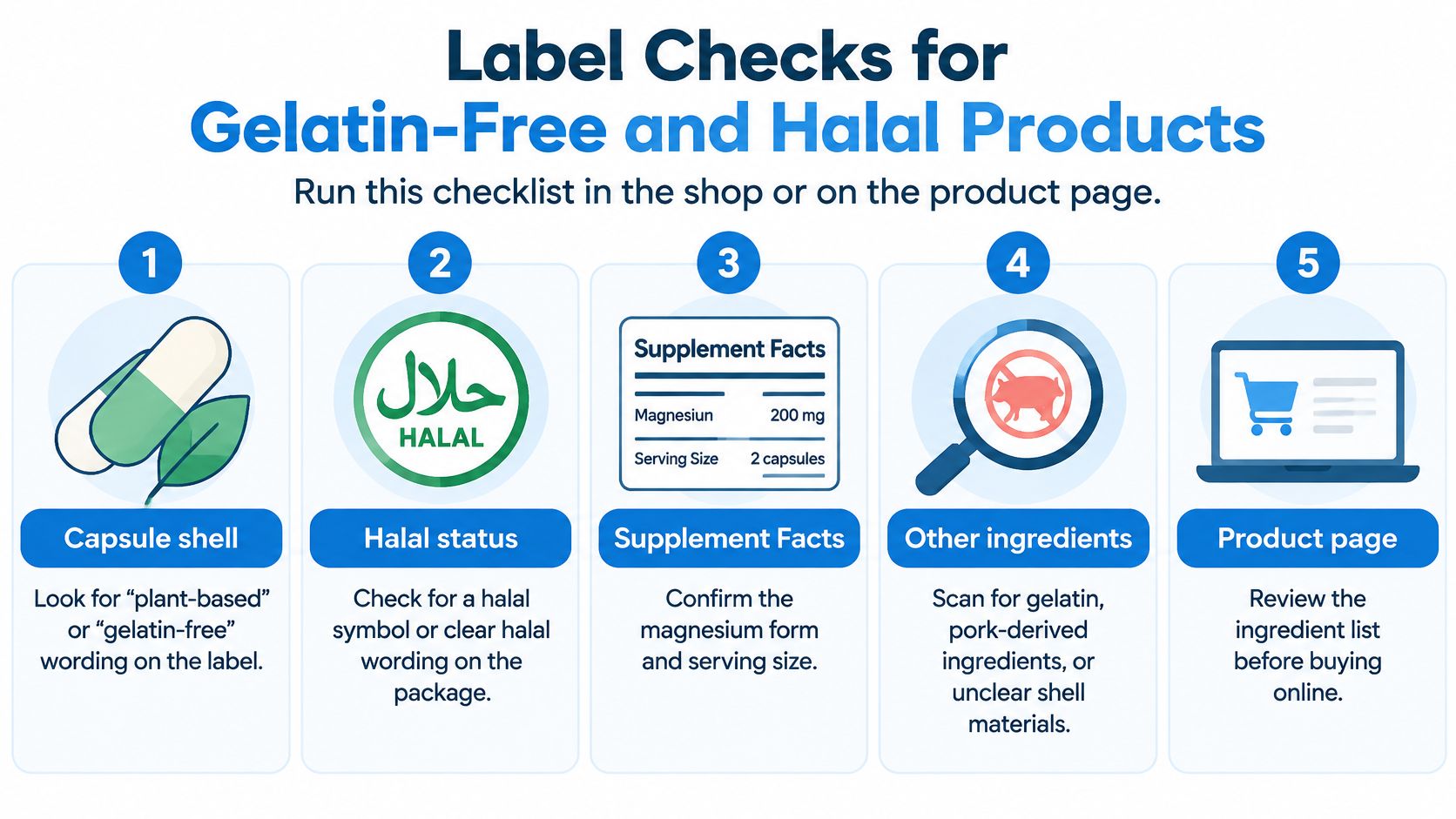
Separate the claims you need verified
- Capsule shell: Look for explicit plant-based or gelatin-free wording. If the material isn't clear, don't infer its source from the appearance of the capsule.
- Halal status: Check the stated certification and certifying body when certification matters to you. Gelatin-free wording alone doesn't answer every halal question.
- Vegan and cruelty-free wording: Treat these as separate claims. Confirm the attribute you need rather than substituting another label term.
- Other ingredients: Read the complete list, including magnesium stearate, silicon dioxide, colors and flavors when present. An unfamiliar ingredient name isn't proof of an animal source or a safety problem, but it may require clarification for your requirements.
- Product-page consistency: Match the formulation, serving size and package description to the item you're buying. Don't assume a different flavor or dosage form has identical ingredients.
Our guide to gelatin-free vitamins provides additional help with identifying the wording to check. At CalVitamin, select items carry halal, gelatin-free or cruelty-free attributes, so confirm the designation on the individual listing rather than extending it across the catalog.
Check usability and quality separately
Choose a dosage form you can use accurately. Tablets and capsules require counting; powders and liquids require careful measurement with the specified device. For gummies, inspect both the elemental serving and the added ingredients rather than assuming equivalence to a capsule.
If independent testing matters to you, identify the organization and what it verified. A quality mark shouldn't be interpreted as evidence that the product prevents cramps.
Finally, check storage directions, expiry information and whether you can read the full label before ordering. Dietary suitability, manufacturing quality and clinical effectiveness are different questions. A product must meet your requirements in each relevant area; success in one doesn't establish the others.
Confirm the Cause Before You Buy a Supplement
A useful decision starts with the symptom, not the shopping cart. Your aim is to identify whether a supplement has a reasonable role and how you'll judge that decision, rather than continuing indefinitely because the label mentions muscle function.
Build a plan you can evaluate
Record the pattern. Note when cramps occur, which muscles are involved, how long they last, what preceded them and whether they interrupt sleep. Include swelling, numbness or weakness rather than recording pain alone.
Bring every product to a medication review. Take photographs of labels or bring the containers to a pharmacist. Include occasional medicines and combination supplements, not just prescriptions taken every day.
Request assessment when the symptoms warrant it. Persistent, severe or new cramps deserve a clinical conversation. Ask whether your diet, medical history and medicines suggest a reason to evaluate magnesium status or investigate another explanation.
Define the purpose before choosing a product. If you're correcting inadequate intake, make that the stated goal. If a clinician recommends a supplement trial for symptoms, agree on what improvement would count and when to reassess.
Choose a measurable regimen. Select a clearly labeled elemental serving that fits the agreed plan and your existing routine. Introduce the product without simultaneously adding unrelated supplements, so you can interpret changes more sensibly.
Reassess instead of escalating. Keep recording symptoms and adverse effects. If there's no useful improvement, discuss stopping or changing the plan rather than treating a lack of response as an instruction to take more.
Make the purchase answer a defined need
Before ordering, you should be able to explain why you're taking magnesium, how much elemental magnesium the intended serving supplies and whether the ingredients meet your requirements. If any answer is missing, resolve it before buying.
The strongest product comparison may end with no purchase. That isn't a failure to find the best magnesium supplement for muscle cramps; it's a better decision when the symptom calls for assessment rather than another bottle.
We offer dietary supplements and mineral products for direct online purchase with secure checkout. Visit CalVitamin to compare individual labels for elemental magnesium, serving size and dietary attributes, then ask a pharmacist to confirm that your choice fits your medicines and daily routine.


