
They don't need another electrolyte powder. They need a reality check. If you sit at a desk, eat regular meals, and aren't sweating hard, plain water and food usually do the job. The category is huge, though, and it's getting bigger. An April 2026 market-trends report estimated electrolyte supplements at $7.65 billion for that month, with $29.50 billion in year-to-date sales and +4.6% growth. It also said powders held 48.0% of market share, ahead of isotonic RTD drinks at 34.8% (market-trends report). So yes, the space is massive. That still doesn't mean you need the flashy bottle on every shelf.
The smarter question is simpler. Do you lose enough fluid and sodium to need replacement, or are you just buying marketing? If you train for long periods, work in heat, get sick with vomiting or diarrhea, or follow a low-carb plan that changes sodium handling, electrolyte supplementation can be useful. If none of that sounds like you, you're probably paying for flavored salt water you didn't need.
Table of Contents
- Do You Actually Need an Electrolyte Supplement
- The Core Electrolytes and How They Work
- Comparing Supplement Formats and Delivery Methods
- Reading the Label Like a Sports Nutritionist
- Choosing the Right Formula for Your Use Case
- Dietary Restrictions and Certification Checklist
- Smart Shopping Strategies for Electrolyte Supplements
Do You Actually Need an Electrolyte Supplement
Many who reach for electrolyte powders are solving the wrong problem. They're not mineral depleted, they're under-informed, and marketing loves that confusion. The practical threshold is pretty clear, electrolytes become relevant when fluid and sodium loss is measurable, not when you feel vaguely tired after a normal day.
Who actually benefits
A controlled hydration study found that adding electrolytes in sports-drink-like ranges produced the greatest absolute net effect on Beverage Hydration Index, over 12%, compared with water, and when electrolyte concentrations were equivalent, there was no meaningful difference in short-term hydration status among beverages (PMC study). That points to the use case, replacement after actual loss, not casual sipping at your desk.
Practical rule: If you're not sweating much, not exercising long, and not losing fluids to illness, start with water and food.
ACSM-based guidance cited in a consumer-health article says athletes exercising for more than 2 hours or sweating heavily may need 300 to 600 mg of sodium per hour (PMC study). That's the kind of threshold that makes electrolyte products matter. You're no longer talking about wellness vibes, you're talking about measurable replacement.
The people who do need more than water
Heavy sweaters, endurance athletes, people training in heat, and anyone dealing with vomiting or diarrhea have a legitimate reason to use electrolytes. A sports nutrition review also notes that longer exercise, hot conditions, and illness are the situations where electrolyte replacement makes the most sense (Truemed review). That's the lens I use with clients.
Cleveland Clinic also warns it's easy to overconsume electrolyte drinks and suggests limiting intake to 16 fluid ounces maximum throughout a normal active day (Cleveland Clinic). That doesn't mean electrolytes are bad. It means they're tools, and tools are supposed to match a job.
If you're asking whether you need a supplement at all, use this blunt filter. Desk worker, casual exerciser, normal appetite, no heat exposure, no illness, no. Endurance athlete, heavy sweater, hot-weather worker, sick with fluid loss, probably yes.
The Core Electrolytes and How They Work
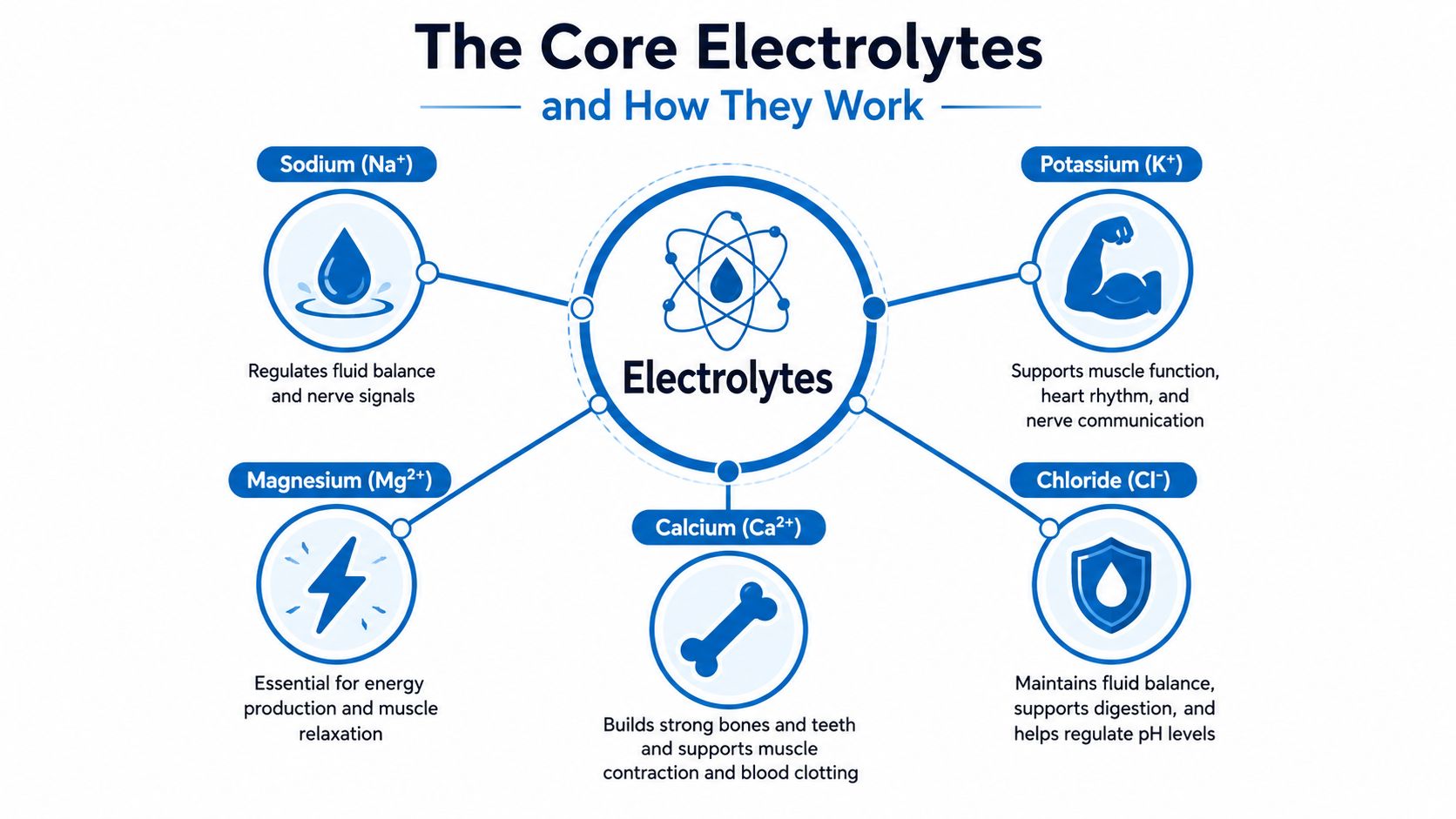
Electrolyte labels are easy to misunderstand because brands love to spotlight the mineral they can talk about most loudly. In practice, the job is shared. Sodium drives fluid retention, potassium supports cellular balance, magnesium helps the body use those minerals, calcium contributes to muscle function, and chloride helps maintain fluid and acid-base balance (Truemed review). If you want better hydration decisions, you need to know what each one does.
Why sodium dominates performance formulas
Sodium is the mineral you lose most in sweat, which is why it shows up in serious training formulas. A major review recommends roughly 200 to 500 mg sodium per serving for general use, and about 1,000 mg sodium per serving for heavy sweaters, endurance athletes, or hot-climate training (Treeline Review). That's not marketing fluff, that's formulation logic.
Sodium is the water magnet. If the formula is too light on sodium, it may taste nice and still fail at the one job that matters.
Potassium and magnesium are the parts many brands underdose. Expert reviews note potassium is usually a secondary ingredient at about 100 to 300 mg per serving, while magnesium is often most useful at 50 to 100 mg per serving in absorbable forms such as citrate or glycinate (Treeline Review). Cheap magnesium oxide is more likely to cause digestive trouble and gives you less useful mineral support.
Read the label for function, not vibes
Sodium and potassium work together, but they don't play the same role. Sodium helps keep fluid where you need it during sweat loss, while potassium matters more for the balance inside cells. Magnesium is the quiet fixer that helps the whole system work without turning your stomach into a problem.
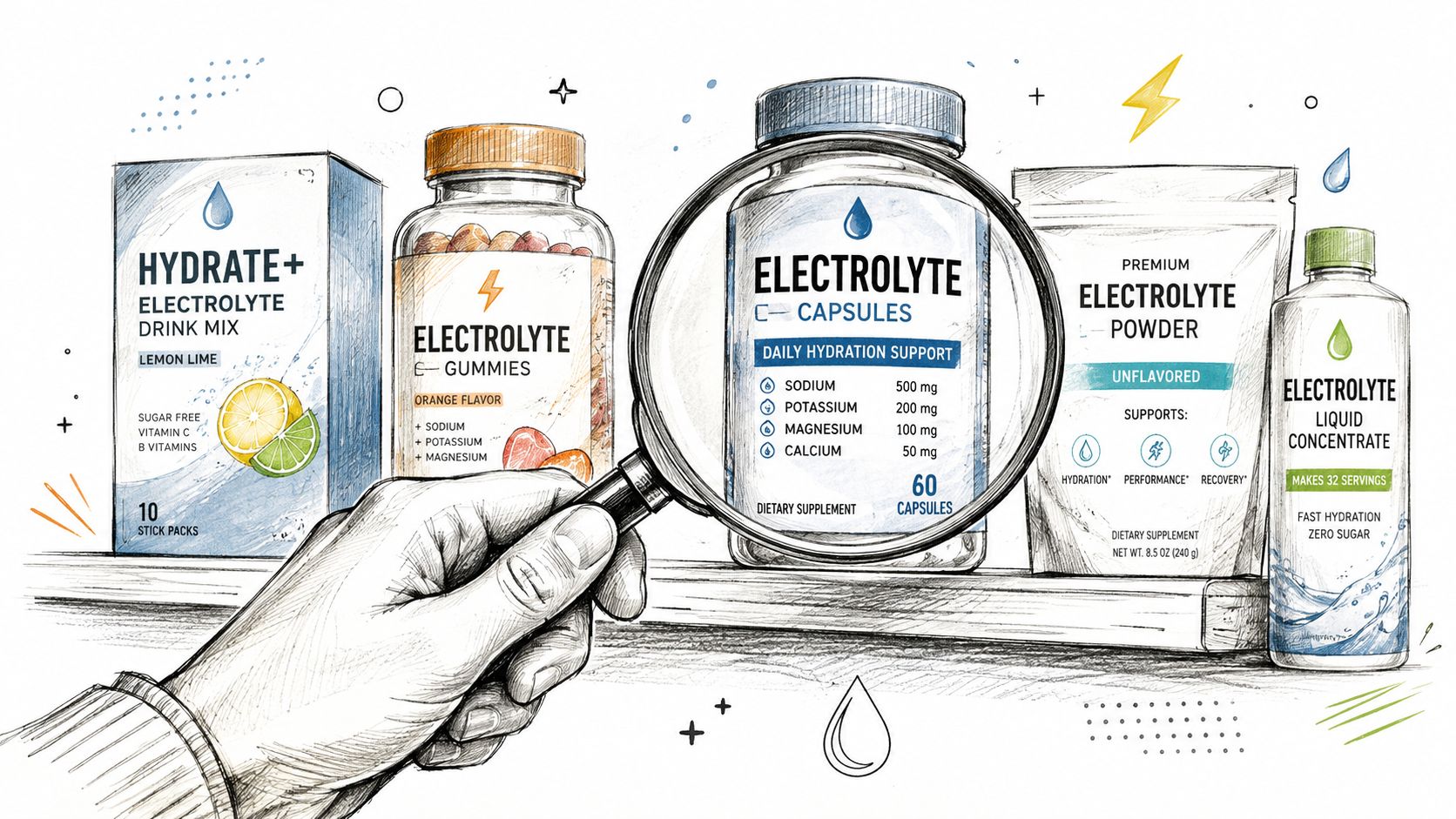
If you're comparing labels, look for sodium first, then check whether potassium and magnesium are present in meaningful amounts. For a practical example of how a mineral blend is presented on a retail product page, see this electrolyte blend listing. Ignore brand theatrics. Read the actual mineral panel.
Comparing Supplement Formats and Delivery Methods
Powders lead the market for a reason. The April 2026 market-trends report put powders at 48.0% share, well ahead of isotonic ready-to-drink beverages at 34.8% (market-trends report). Powders win on flexibility and scale, but they're not always the best choice. Travel, office use, and convenience can make a tablet or bottle smarter than a tub.
For a straightforward example of single-serve stick format, see this hydration packet product page. The format matters as much as the formula when you have to carry it.
Electrolyte Supplement Formats Compared
| Format | Dosage Control | Portability | Cost Per Serving | Best For |
|---|---|---|---|---|
| Powder tubs | Strong, adjustable | Moderate | Usually better for regular use | Home mixing, training routines |
| Single-serve packets | Precise, pre-portioned | High | Usually higher | Travel, gym bags, office drawers |
| Effervescent tablets | Fairly precise | High | Varies | Water bottles, minimal mess |
| Ready-to-drink bottles | Fixed | High | Usually highest | Convenience, no mixing |
| Concentrated shots | Moderate | Very high | Varies | Fast use, small bags |
| Gummies | Low to moderate | High | Varies | People who dislike drinks |
Which format actually fits real life
Powders are the best all-around choice if you use electrolytes often and want control over strength. They're easy to dose up or down, and that matters when your sweat loss changes by season or session length. The trade-off is obvious, you need a bottle, a scoop, and a little discipline.
Ready-to-drink bottles are for people who value frictionless convenience more than economy. Tablets are better when portability matters and you don't want to haul powder through airports or into meetings. Gummies are the least technical option, which can be useful for casual users but is usually not the right answer for hard training.
Bottom line: choose the format you'll actually use consistently, not the one that looks most “serious” on the shelf.
Reading the Label Like a Sports Nutritionist
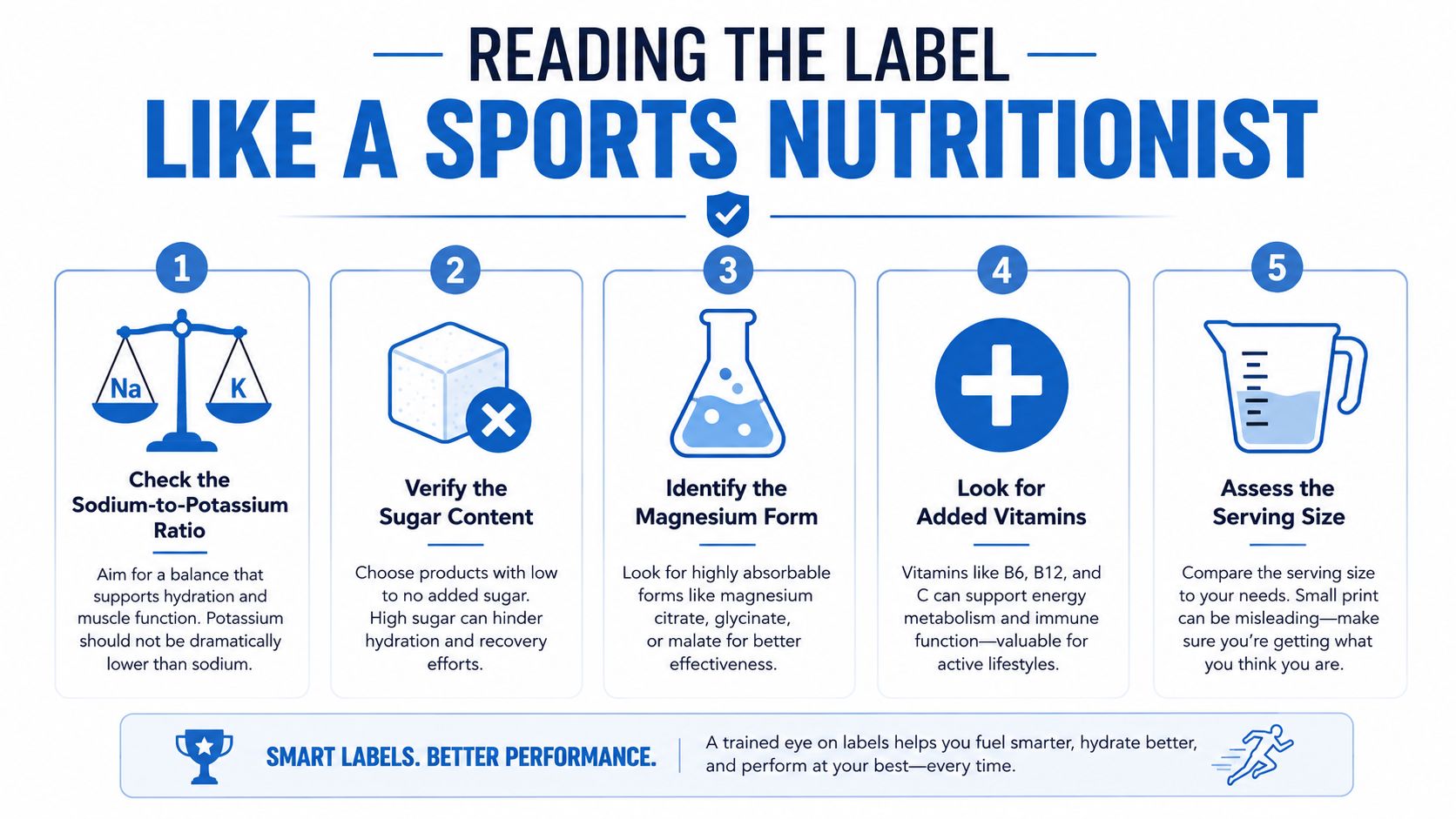
A good electrolyte label should tell you exactly what it's doing. If it hides behind proprietary blends, loaded sweetness, or a long list of filler ingredients, that's a bad sign. Benchmark evaluation data from 2025 to 2026 shows higher-performing powders often cluster around 1,000 mg sodium, 0 g sugar, and a profile that appeals to athletes, keto users, and people in hot environments (Nutrola app). That doesn't make every high-sodium product right, it just shows what serious replacement formulas look like.
The numbers that matter most
Look at the sodium line first. Then inspect potassium and magnesium, because many products overbuild sodium and underdeliver the rest. Independent comparison data highlighted one aggressive formula in the 1,000 mg sodium / 200 mg potassium / 60 mg magnesium / 0 g sugar range, while other top products sat closer to 500 to 800 mg sodium with varying carbohydrate content (Nutrola app).
That spread tells you something important. Carbohydrate-free doesn't mean superior. It means specialized. A zero-sugar formula can be ideal for fasting, keto, or people who just want sodium replacement. A carb-inclusive formula can make more sense during longer endurance work because it supports hydration and fuel at the same time.
What to avoid without excuses
A nutritionist-led review recommends checking for unnecessary fillers, artificial dyes, and overly vague ingredient lists, and it highlights the five core electrolytes, sodium, potassium, magnesium, calcium, and chloride (Nutrola app). That's the right mindset. Buy a formula because its label matches a real use case, not because the packaging looks clean.
If you want a sports-friendly product, third-party testing matters. If you want a daily hydration product, sugar and flavor tolerance matter more than hype. The wrong formula can be counterproductive, especially if you're sedentary or already watching sodium intake.
Choosing the Right Formula for Your Use Case
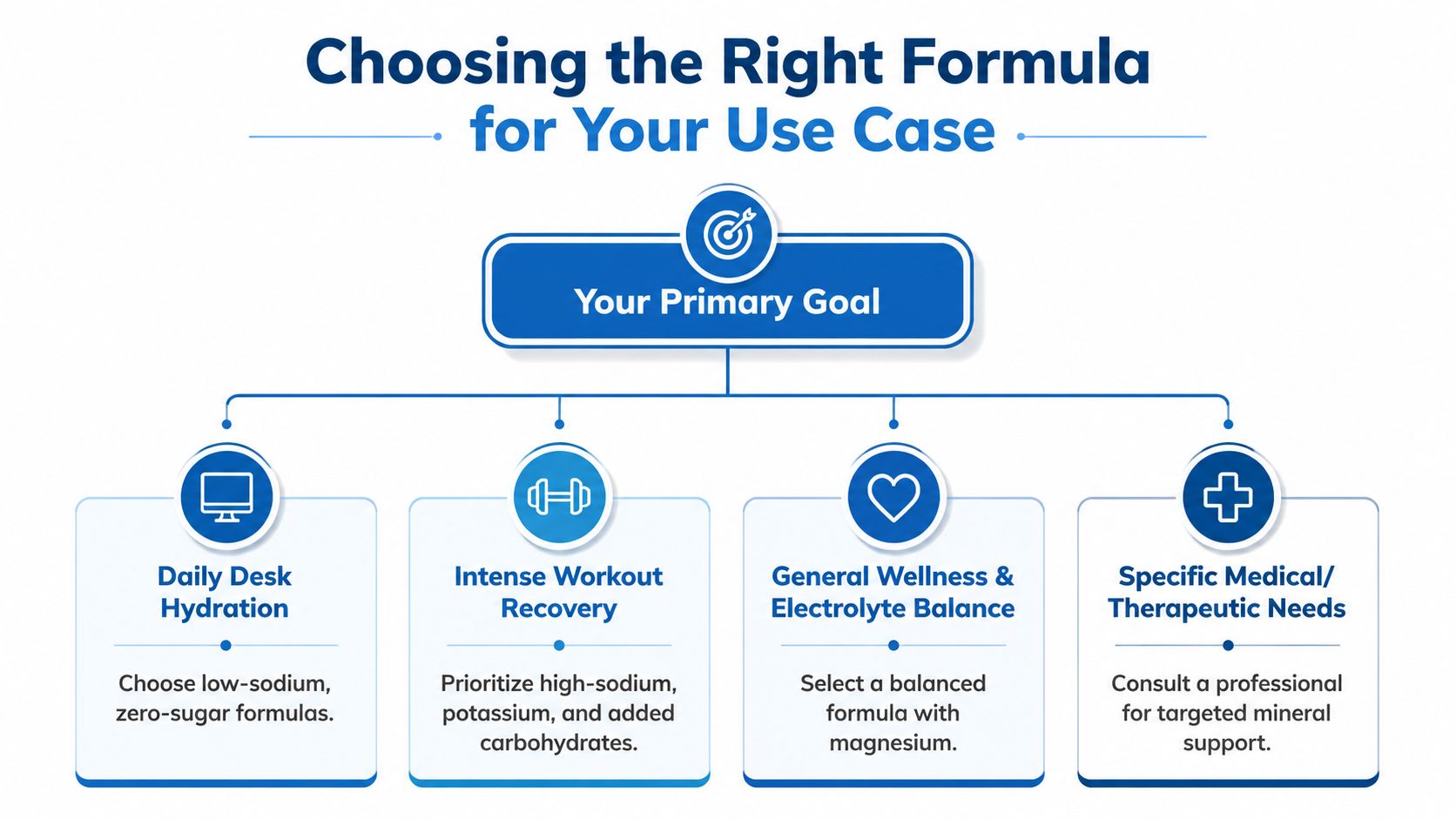
There is no single best electrolyte supplement for everyone, and anyone saying otherwise is selling something. The right choice depends on sweat rate, session length, health context, and whether you need replacement, fuel, or both. The fastest way to shop well is to match the formula to the job.
Desk worker and gym-goer
If you sit most of the day and do short workouts, keep it simple. A low-sodium, zero-sugar formula is the right default for desk workers who want a hydration nudge without overdoing minerals. For a 45-minute gym session, water is often enough, but a lighter electrolyte mix can help if you sweat more than average or train in a hot room.
Endurance athlete and heavy sweater
If you're training hard for long periods, choose a high-sodium powder. The best technical range here is the one that gets sodium back into the system fast enough to matter, with a formula built for sweat replacement rather than casual sipping. That's where the 200 to 500 mg per serving general-use range gives way to heavier formulas that can climb much higher (Treeline Review).
For long sessions, stop shopping for “hydration.” Start shopping for replacement.
Illness recovery, travel, and fasting
If you're recovering from vomiting or diarrhea, a more clinical formula is the better move. Brands modeled after oral rehydration logic are designed for fluid loss, not performance vanity. Travel falls into the same bucket only when heat, activity, or illness are involved, because flying alone doesn't automatically justify electrolyte loading.
For fasting, choose a zero-sugar, zero-calorie option. The goal is mineral support without breaking the fast or adding unnecessary ingredients. If you're trying to use electrolytes for daily wellness instead of athletic replacement, a balanced formula with magnesium is usually the cleaner compromise.
Dietary Restrictions and Certification Checklist
A lot of shoppers are looking for more than electrolytes. They need a formula that fits vegan, gelatin-free, halal, gluten-free, or cruelty-free standards without forcing them to read every line of a label from scratch. CalVitamin's catalog includes products with labeled attributes like halal, gelatin-free, and cruelty-free on select items, which is the right kind of filtering for people who don't want surprises after checkout.
A relevant example of a product page that sits in this kind of attribute-driven shopping path is this elderberry hydration gummy listing. The lesson isn't to buy that product blindly. The lesson is to inspect the ingredient and attribute fields before you commit.
What to verify before buying
Start with the capsule or gummy base if the product uses one. Gelatin hides in capsules and chewy formats, and that's a common miss for vegan shoppers. Then scan for artificial colorings, hidden sweeteners, and flavor systems that don't match your tolerance or dietary needs.
Third-party testing is still worth checking, especially if you're an athlete or you care about contamination control. A retailer filter is useful, but the product page should still back up the claim. If the label feels vague, keep moving.
The cleanest checklist
- Check the source of the capsule or gummy base: Gelatin is the obvious issue, but it's not the only one.
- Confirm any certification claims: Don't assume halal, gluten-free, or cruelty-free unless the product page says it clearly.
- Inspect added color and flavor systems: These are often the first place unnecessary additives show up.
- Look for transparent mineral amounts: A label should show actual dosages, not a fluffy blend name.
- Use retailer filters aggressively: If the store offers attribute filters, use them before you read reviews.
The point is to avoid buying twice. If a formula fits your hydration goal but misses your dietary requirements, it's the wrong product.
Smart Shopping Strategies for Electrolyte Supplements
Don't shop by sticker price. Shop by cost per serving, sodium content, and whether the format fits how you live. A big tub can be cheaper in the long run, but a packet can be smarter if you travel, commute, or train outside the house. The cheapest product on the shelf is useless if you don't reach for it.
How to buy without wasting money
Use wish lists and saved items to compare formulas over time instead of buying on impulse. That's especially useful if you're toggling between a daily hydration product and a higher-sodium training formula. Reviews matter too, but read them for mixability, flavor, and stomach tolerance, not just star ratings.
Avoid the common mistake of over-concentrating a mix because you want “more electrolytes.” Too much powder can make the drink harder to tolerate and can push sodium higher than your actual sweat loss justifies. Better formula, better timing, better dose beats “more” every time.
Timing and practical use
Take electrolytes around the thing that creates the loss. If you're exercising, use them before, during, or after the session based on duration and sweat rate. If you're sick, use them to support replacement as tolerated. If you're fasting, keep the formula clean and simple so you're not adding unnecessary calories or sugar.
One more shopping rule matters. Pick the formula that matches your use case first, then check flavor and packaging. That order keeps you from falling for marketing when the decision is about sodium, sugar, and form.
CalVitamin gives you a practical place to compare supplements by form, label attributes, and product type instead of chasing marketing claims. If you want to narrow your search for electrolyte support, visit CalVitamin and look for the formulas that match your sweat rate, dietary needs, and daily routine.






