
Taking vitamin D3 with K2 isn't a proven cardiovascular insurance policy. The advice sounds convincing because these nutrients participate in calcium regulation, but a plausible partnership inside the body doesn't establish that a combined supplement prevents heart attacks, clears arteries, or works better than vitamin D alone. The most defensible vitamin D3 K2 benefits concern nutritional adequacy and bone-related measures, with important limits on what those findings mean.
Table of Contents
- Why the D3 and K2 Combination Deserves a Closer Look
- How Vitamin D3 and Vitamin K2 Work Together in the Body
- The Bone Health Evidence You Can Actually Trust
- What the Heart Health Claims Rest On
- Choosing a Practical Dose and Form That Fits Your Routine
- Safety, Interactions, and Who Should Talk to a Clinician First
- Putting It All Together With a Smart Buying Checklist
Why the D3 and K2 Combination Deserves a Closer Look
The strongest supplement claims often skip a key question: what did researchers measure? A change in a protein involved in bone metabolism isn't the same outcome as a prevented fracture. Likewise, a biological mechanism related to vascular mineralization doesn't demonstrate cardiovascular protection.
That distinction matters when evaluating D3 and K2 together. A product can contain nutrients with complementary functions without having demonstrated that the finished combination prevents disease. Adding an ingredient creates a different formulation, not automatic proof of a better clinical result.
Different claims require different evidence
Consider the distance between these statements:
- Nutrient function: A vitamin participates in a normal biological process.
- Biomarker response: Supplementation changes a laboratory measurement associated with that process.
- Clinical benefit: People experience fewer fractures, cardiovascular events, or other meaningful health problems.
Each statement requires its own supporting evidence. A convincing explanation of nutrient function can justify investigating a supplement, but it can't replace trials measuring patient outcomes.
Evidence rule: Ask whether the study measured the outcome you want, not merely something biologically related to it.
For a consumer concerned about low vitamin D, correcting an established nutritional problem is a concrete objective. For someone hoping to prevent arterial disease, the evidentiary requirement is different. The combination shouldn't be evaluated as though those goals were interchangeable.
Better expectations lead to better decisions
My interpretation is that D3–K2 deserves consideration as a targeted nutritional tool, not a default upgrade for every adult. The useful questions concern nutritional status, bone-health priorities, medication compatibility, and whether a particular formulation matches an identified need.
A careful label review should follow that clinical reasoning, not substitute for it. Choosing a recognizable K2 form or an impressive-looking dose doesn't answer whether you need the combination. Nor does a familiar ingredient pairing establish that paying for both vitamins delivers more benefit than addressing the actual deficiency or health concern.
How Vitamin D3 and Vitamin K2 Work Together in the Body
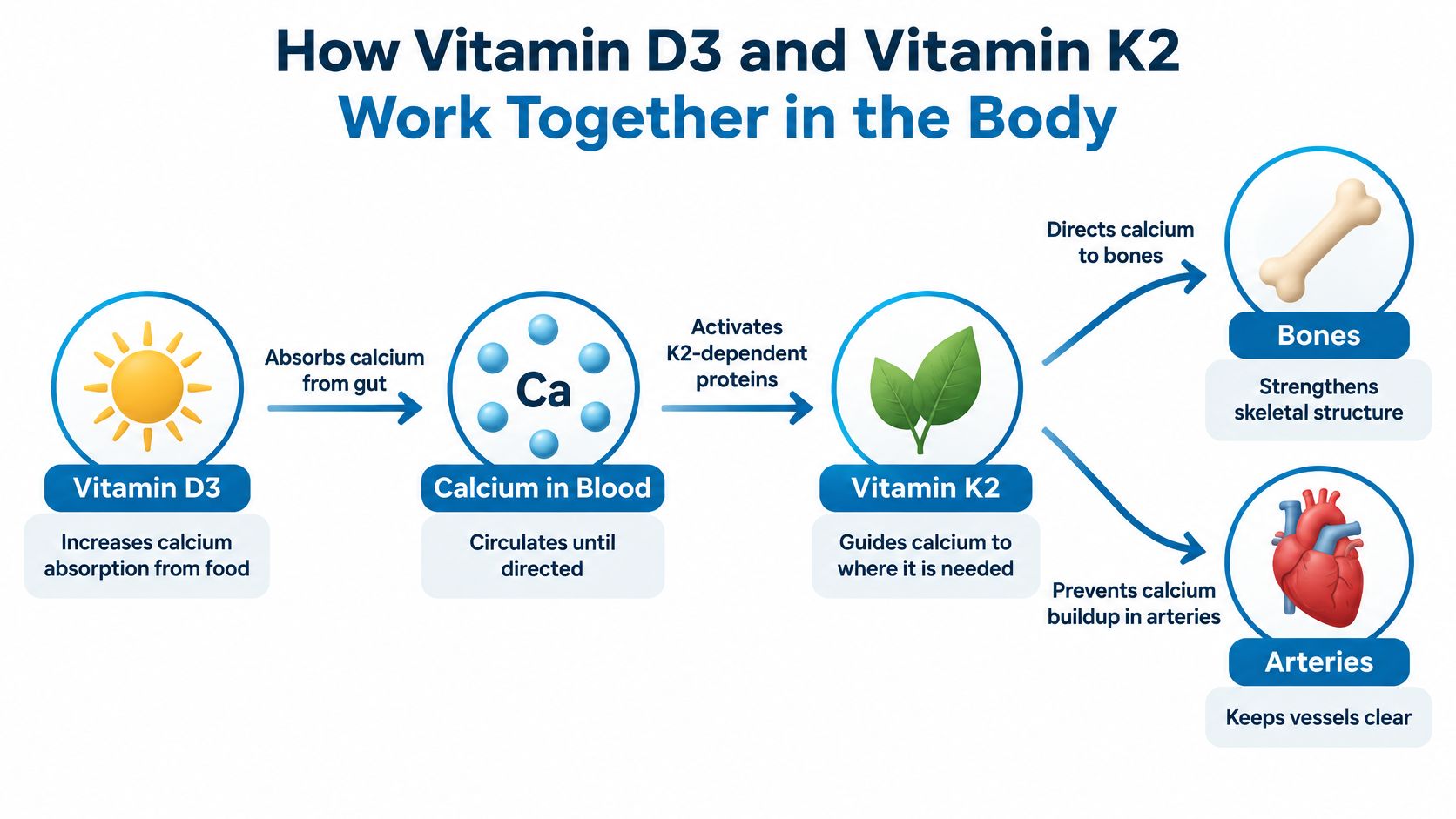
Vitamin D3, also called cholecalciferol, supports intestinal calcium absorption. Vitamin K participates in activating proteins involved in bone and vascular biology, including osteocalcin and matrix Gla protein. These functions provide the rationale for studying the nutrients together.
A courier-and-doorman analogy helps, provided it isn't taken at face value. D3 helps make calcium available, like a courier bringing building materials to a site. Vitamin-K-dependent proteins participate in how those materials are handled, more like workers preparing the receiving area than a traffic controller choosing every calcium molecule's destination.
The diagram illustrates that proposed relationship, not a guarantee that supplementation keeps arteries clear.
Activation isn't the same as clinical protection
Osteocalcin is relevant to calcium incorporation into bone. Matrix Gla protein is relevant to inhibiting pathological vascular mineralization. Activating these proteins is biologically meaningful, but it doesn't establish that taking extra K2 improves every downstream outcome.
The popular phrase “directs calcium into bones and away from arteries” becomes too definite. It compresses a complex mechanism into what sounds like a guaranteed treatment effect. A more accurate description is that vitamin K supports proteins involved in these processes.
For terminology, the guide to whether vitamin D3 is the same as vitamin D can help you interpret ingredient names before comparing products.
Comparing the Main Forms of Vitamin K2
K2 includes MK-4 and MK-7, but a shared vitamin category doesn't make their research formulations interchangeable. The NIH review of vitamin K evidence describes an MK-4 bone study using 45 mg daily for 12 months, alongside other treatment groups, and an MK-7 cardiovascular study using 180 or 360 micrograms daily for three months.
| Form | Half-Life | Common Sources | Research Dose Range |
|---|---|---|---|
| MK-4 | Don't infer clinical superiority from duration of circulation alone | Check the declared ingredient and formulation | Pharmacological dosing appears in bone research |
| MK-7 | Persistence alone doesn't establish better health outcomes | Check the declared ingredient and formulation | Microgram dosing appears in cardiovascular research |
The table deliberately avoids supplying a universal dosing range or treating food sources as equivalent to research products. Form, dose, population, and outcome all matter. A result obtained with one preparation shouldn't be transferred automatically to another.
The Bone Health Evidence You Can Actually Trust
Bone health is the strongest area for a measured discussion of D3–K2. Even here, the appropriate conclusion is narrower than “the combination prevents broken bones.”
A 2020 meta-analysis of eight randomized trials involving 971 participants found that combined vitamin K and vitamin D increased total bone mineral density, with a pooled effect size of 0.316, a 95% confidence interval of 0.031–0.601, and a reduction in undercarboxylated osteocalcin of 0.945 standardized units; subgroup findings favored vitamin K2 or unspecified vitamin K below 500 micrograms daily alongside vitamin D.
Those results support further consideration of the combination for bone-related goals. They don't establish a universal supplement prescription.
What the effect size does, and doesn't, tell you
The pooled effect size is a standardized comparison between groups. It isn't a percentage increase in bone density, and it doesn't tell an individual reader how much their own scan will improve.
Similarly, reduced undercarboxylated osteocalcin supports an effect on vitamin-K-dependent protein activation. It's evidence that supplementation affected a relevant biological process, not proof that a participant avoided a fracture.
The subgroup finding also needs restraint. A favorable result within a dose category doesn't identify the ideal dose for everyone, establish a fixed D3-to-K2 ratio, or show that increasing the dose would improve results.
Better bone measurements are useful findings. They aren't interchangeable with fewer broken hips.
Who has a clearer reason to consider supplementation
The clearest starting point is documented nutritional inadequacy, rather than an assumption that everyone lacks vitamin D. The NIH vitamin D evidence review reports that U.S. population measurements found 18% at risk of inadequacy and 5% at risk of deficiency; it also summarizes a preventive-services review of 11 trials involving 51,419 adults aged 50 and older without osteoporosis, known deficiency, or previous fractures, in which vitamin D didn't reduce total, hip, or nonvertebral fractures.
That contrast matters. Results in generally healthy adults don't eliminate the reason to correct deficiency, but they challenge blanket fracture-prevention promises.
Postmenopausal women appear in the vitamin K research discussed earlier, yet participation in trials doesn't mean every postmenopausal woman needs K2. Someone with low bone density needs a broader assessment, not just a combination capsule. The guide to how to improve bone density offers a useful starting point for organizing that conversation.
What the Heart Health Claims Rest On
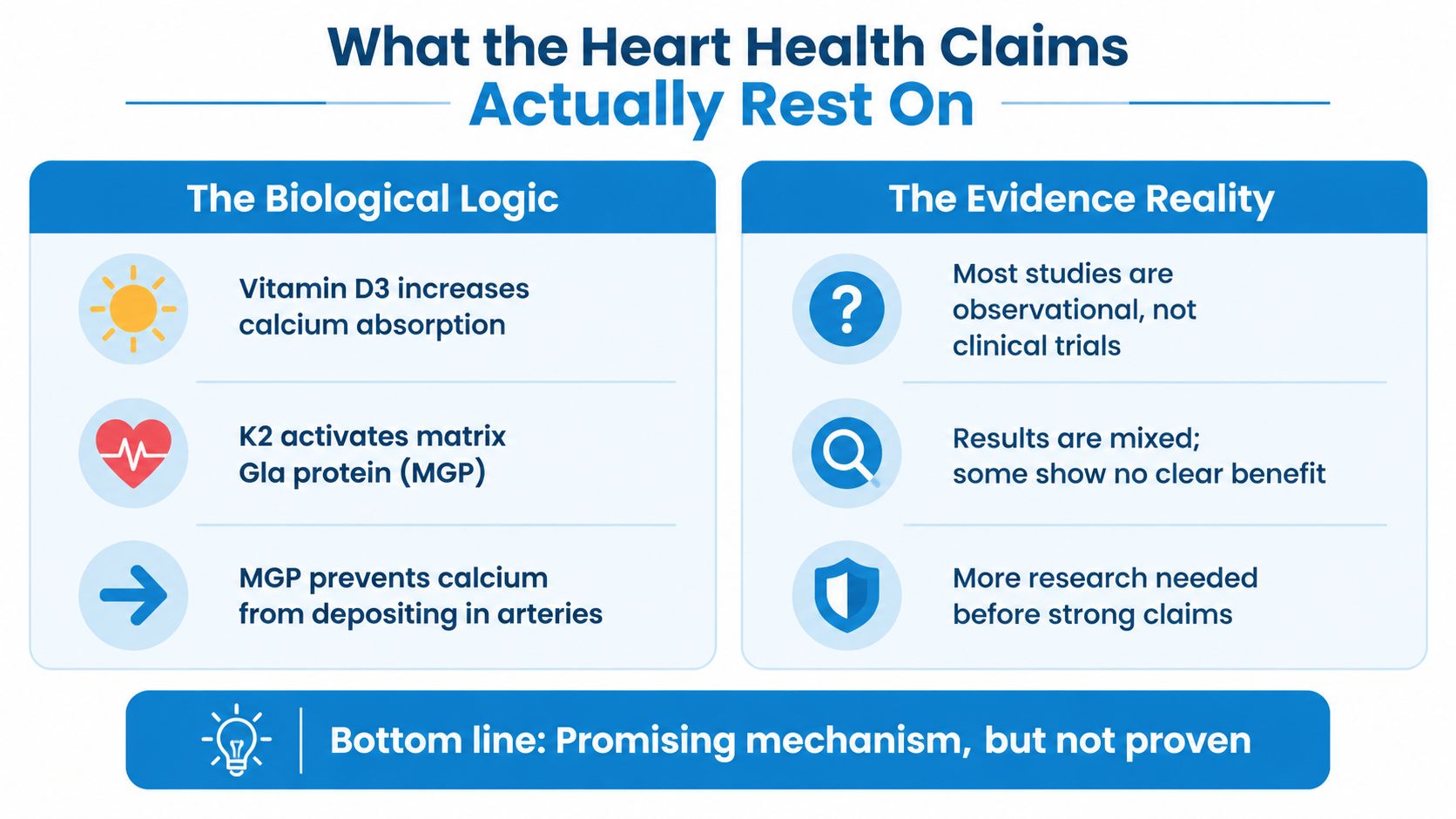
The cardiovascular case for combining D3 and K2 is biologically plausible, but that does not establish that the combination prevents heart disease or outperforms D3 alone.
The infographic contrasts a proposed mechanism with clinical evidence. Its artery-related language describes the hypothesis, not a proven supplement benefit.
What happened when researchers measured calcification
A review of combined vitamin K and vitamin D evidence describes a two-year trial in which participants took 720 micrograms of MK-7 daily with 25 micrograms of vitamin D. The combination did not slow aortic-valve-calcification progression. A separate randomized study also found no significant reduction in coronary-artery-calcium progression after two years of combined supplementation.
These results do not rule out the biological hypothesis. They do show why a plausible pathway should not be presented as a clinical benefit: activating a relevant pathway did not produce a measurable improvement in the outcomes researchers tested.
The small MK-7 primary-prevention trial discussed earlier found no effect on blood pressure or lipid levels, either. Evidence of biological activity is not evidence that a supplement treats cardiovascular risk.
A combined product has not earned a cardiovascular claim simply because its ingredients have complementary biological roles.
The comparison consumers need
The relevant question is whether adding K2 to D3 improves outcomes compared with D3 alone. Current evidence does not establish that advantage.
An ingredient diagram or change in a surrogate measurement cannot answer the question. To support a claim of fewer cardiovascular events, a trial would need to measure those events and compare the combination directly with D3 alone.
The video below summarizes the same two-year MK-7 trial visually. Use it to follow the study design and findings, then rely on the trial evidence cited above for the details.
My clinical interpretation is straightforward: cardiovascular marketing should be more restrained than discussion of bone health. A D3–K2 supplement is not a reason to delay assessment or treatment of established cardiovascular risk factors.
Choosing a Practical Dose and Form That Fits Your Routine
Start with the reason for taking the supplement, not a ratio printed on the bottle. A product designed for convenience may not match a plan intended to correct low vitamin D, and a research formulation may not resemble a routine nutritional supplement.
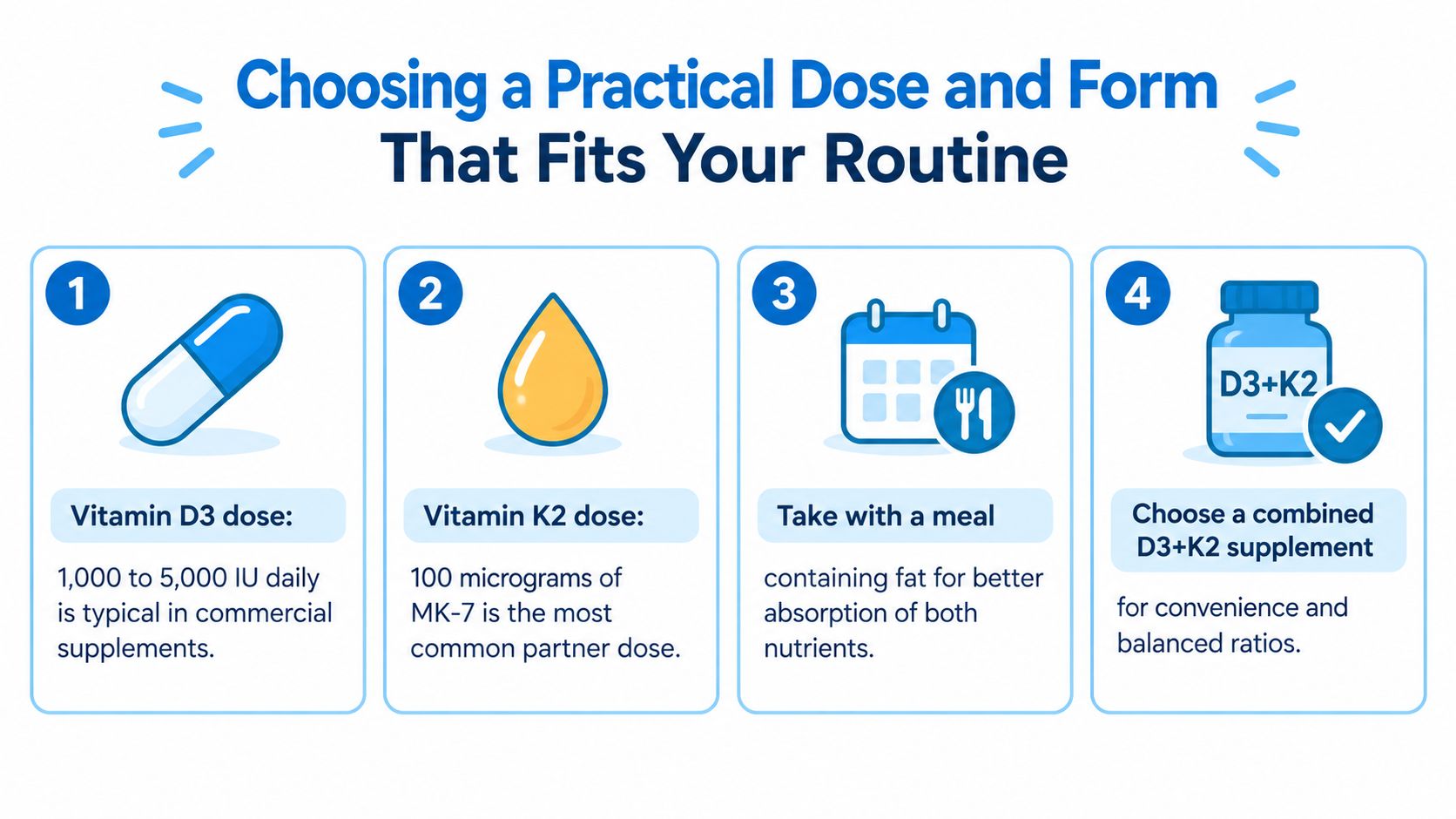
The routine graphic includes commercial-dose and convenience suggestions. Treat those as label-reading prompts, not individualized prescriptions or proof that the illustrated amounts are necessary, optimal, or appropriate for you.
Separate a convenient formulation from an appropriate dose
A combined capsule offers practical simplicity only if both ingredients fit the intended plan. If a clinician wants to adjust vitamin D independently, separate products may make that easier. Convenience isn't evidence of a biologically “balanced” ratio.
Before selecting a product, clarify the decision:
- Purpose: Are you addressing measured low vitamin D, discussing low bone density, or buying on a general wellness assumption?
- Formulation: Does the label specify cholecalciferol and identify the menaquinone form?
- Adjustability: Would changing one nutrient require unnecessarily changing the other?
- Follow-up: What result would justify continuing, modifying, or stopping supplementation?
Don't turn the lower-dose subgroup finding from the bone meta-analysis into a personal target. It doesn't establish a universally effective D3–K2 ratio. Nor should a pharmacological MK-4 research dose be treated as a routine shopping recommendation.
Compare forms without overstating the differences
| Decision criterion | MK-4 | MK-7 |
|---|---|---|
| Evidence to examine | Whether the study used a comparable preparation and dose | Whether the study measured your intended outcome |
| Routine fit | Review the actual product instructions | Review the actual product instructions |
| Cost comparison | Compare the full labeled serving | Compare the full labeled serving |
There's no defensible basis here for declaring one form universally preferable or assigning a general cost advantage. Compare actual labels rather than assuming the form name settles the decision.
Finally, avoid judging a bone-health strategy by how you feel shortly after starting it. Agree on a clinically relevant follow-up plan instead of treating subjective changes as evidence that bone density has improved.
Safety, Interactions, and Who Should Talk to a Clinician First
K2 isn't an antidote to excessive vitamin D. Adding it to a high-dose regimen doesn't establish that the regimen is safe, and a combined label shouldn't reassure you about an otherwise questionable intake.
The NIH consumer guidance on vitamin D warns that excessive supplementation can contribute to hypercalcemia and kidney problems. The evidence doesn't support using K2 as a protective mechanism that permits excess vitamin D or calcium intake.
Warfarin requires a separate conversation
The NIH consumer guidance on vitamin K states that vitamin K can reduce warfarin's effectiveness and advises consultation before using vitamin-K-containing supplements. Changes in intake matter to anticoagulation management, so consistency and prescriber oversight are more important than whether a product is marketed as natural.
The interaction warning is especially relevant when a familiar vitamin D product is replaced with a combination containing K2.

Don't independently stop, start, or substantially change vitamin K supplements while taking warfarin. If you take another anticoagulant, have a pharmacist or prescriber identify whether this particular interaction applies rather than assuming all blood thinners behave alike.
Situations that warrant individualized review
Seek advice before starting a combination when any of the following applies:
- Kidney disease or a kidney-stone history: Ask whether supplementation, testing, and monitoring are appropriate for your circumstances.
- Known high calcium: Don't self-treat with a calcium-related supplement strategy.
- Pregnancy or supplementation for a child: Request age- and situation-specific guidance rather than copying an adult routine.
- Prescription treatment or overlapping supplements: Bring the full medication and supplement list, including combination products.
Long-term safety evidence for high-dose combinations remains limited. That uncertainty isn't proof that ordinary use is harmful, but it argues against assuming that more ingredients or larger doses provide greater protection.
A useful appointment question is: “What problem are we treating, and how will we know this dose remains appropriate?” That keeps the discussion focused on your circumstances rather than a popular online protocol.
Putting It All Together With a Smart Buying Checklist
A sensible purchase begins with a defined goal and ends with a label you can explain. You should know what each ingredient contributes to the plan, why the serving size fits, and which claims extend beyond demonstrated outcomes.
Use this checklist while comparing actual products. The guide to how to read a supplement label can help you distinguish the serving information from the claims on the front of the package.
What to verify before buying
- D3 identity and serving amount: Find cholecalciferol and check the amount in the full serving, not just the amount per capsule.
- K2 form: Look for an explicitly named menaquinone rather than treating all vitamin K descriptions as interchangeable.
- Quality documentation: If a product advertises third-party testing or certification, check what was assessed. Quality verification isn't proof of clinical effectiveness.
- Other ingredients: Review carrier oils, allergens, and additional active ingredients against your preferences and clinician's advice.
- Marketing boundaries: Be cautious when a product presents arterial protection or fracture prevention as established.
- A review plan: Know who will reassess the regimen and what findings would prompt a change.
The most useful distinction isn't premium versus basic packaging. It's a supplement chosen for an identified need versus a supplement chosen for a promised outcome that hasn't been demonstrated.
Frequently Asked Questions
How long should I trial the combination?
Agree on timing with your clinician based on the reason for use and the measurement being followed. The trials discussed above don't establish a universal consumer trial period, and feeling different isn't a reliable substitute for evaluating the intended outcome.
Can dietary K2 alone be enough?
Don't assume that everyone needs a K2 supplement or that dietary intake can be judged from a single food. Review your overall diet and clinical goal before deciding that a combined product fills a genuine gap.
What blood tests should I ask about?
Ask whether serum 25-hydroxyvitamin D would help evaluate your vitamin D status. Depending on your history and proposed regimen, discuss whether calcium and kidney-function assessment are relevant rather than requesting a standard panel without a clinical reason.
CalVitamin offers an online selection of vitamins, minerals, and other wellness products, alongside supplement education. Visit to compare labeled ingredients and serving amounts, then bring any D3–K2 product you're considering to your clinician or pharmacist for a review against your goals and medications.