

Calcium citrate is generally absorbed more reliably than calcium carbonate because it depends less on stomach acid, but the biggest practical gains come from taking 500 mg or less of elemental calcium per dose and splitting larger amounts. Take calcium carbonate with a meal; calcium citrate can be taken with or without food.
The popular advice to “choose the most absorbable form” misses what often matters more: how much you take at once, whether you take it with food, your stomach's acidity, and what medicines or supplements share your schedule. The useful question isn't which label wins in isolation. It's which form and routine fit your needs, and whether you need a supplement at all.
| What to consider | Calcium citrate | Calcium carbonate |
|---|---|---|
| Elemental calcium by weight | About 21% | About 40% |
| Stomach acid dependence | Lower | Higher |
| Food | Can be taken with or without food | Generally taken with food |
| Practical fit | Low stomach acid or flexible timing | Fewer tablets may be needed to provide elemental calcium |
Four questions to ask before buying
Check the form, the amount of elemental calcium in each serving, whether a meal is part of the plan, and whether the dose conflicts with anything else you take. A supplement's compound weight isn't the same as its elemental-calcium content, so read the Supplement Facts panel rather than comparing tablet weights.
The practical verdict: Choose a form you can take correctly and consistently. A highly absorbable label won't compensate for a dose that's too large at once or a schedule that clashes with medication.
Table of Contents
- Four questions to ask before buying
- Why Best Absorbed Is the Wrong Question
- What Each Calcium Form Delivers
- Citrate Versus Carbonate Head to Head
- Four Levers That Change How Much Gets In
- Timing Around Food, Other Supplements, and Medications
- Who Should Pick Which Form
- Do You Actually Need a Supplement at All
- Your Shortlist and Dosing Checklist
Why Best Absorbed Is the Wrong Question
“Best absorbed” sounds like a product contest, but absorption isn't determined by the label alone. The amount of elemental calcium in one dose, stomach acid, and whether you take the supplement with food all change the practical comparison. For many shoppers, getting those details right matters more than chasing one universally superior form.
The U.S. National Institutes of Health summarizes evidence showing that the fraction of calcium absorbed falls as the single dose gets larger. That makes dose size a real buying decision: a product serving that delivers a large amount at once may be less efficient than dividing the amount across separate administrations. The same source reports mean fractional absorption of approximately 25% across adults, with one study of healthy adults reporting a mean of 24.9% and a standard deviation of 12.4%. These figures describe variation, not a guaranteed result for any individual. (NIH Office of Dietary Supplements' calcium guidance)
Form matters, but context determines how useful that difference is. Citrate is less dependent on stomach acid and can be a better fit for people with reduced gastric acidity, including some older adults and people taking acid-suppressing medicines. Carbonate is more concentrated in elemental calcium, but it's generally taken with food to support dissolution.
The questions that guide a good choice
Before you buy, ask:
- Which form is it? Citrate offers more flexibility around stomach acid; carbonate delivers more elemental calcium by weight.
- How much elemental calcium is in one dose? The supplement label should make this clear.
- Does it need a meal? That's particularly important for carbonate.
- What else is in your schedule? Prescription medicines and mineral supplements can affect timing.
The right product is the one that fits the person taking it. If you're choosing based only on “most absorbable,” you're skipping the decisions that determine whether the supplement is practical, appropriately dosed, and worth taking.
What Each Calcium Form Delivers
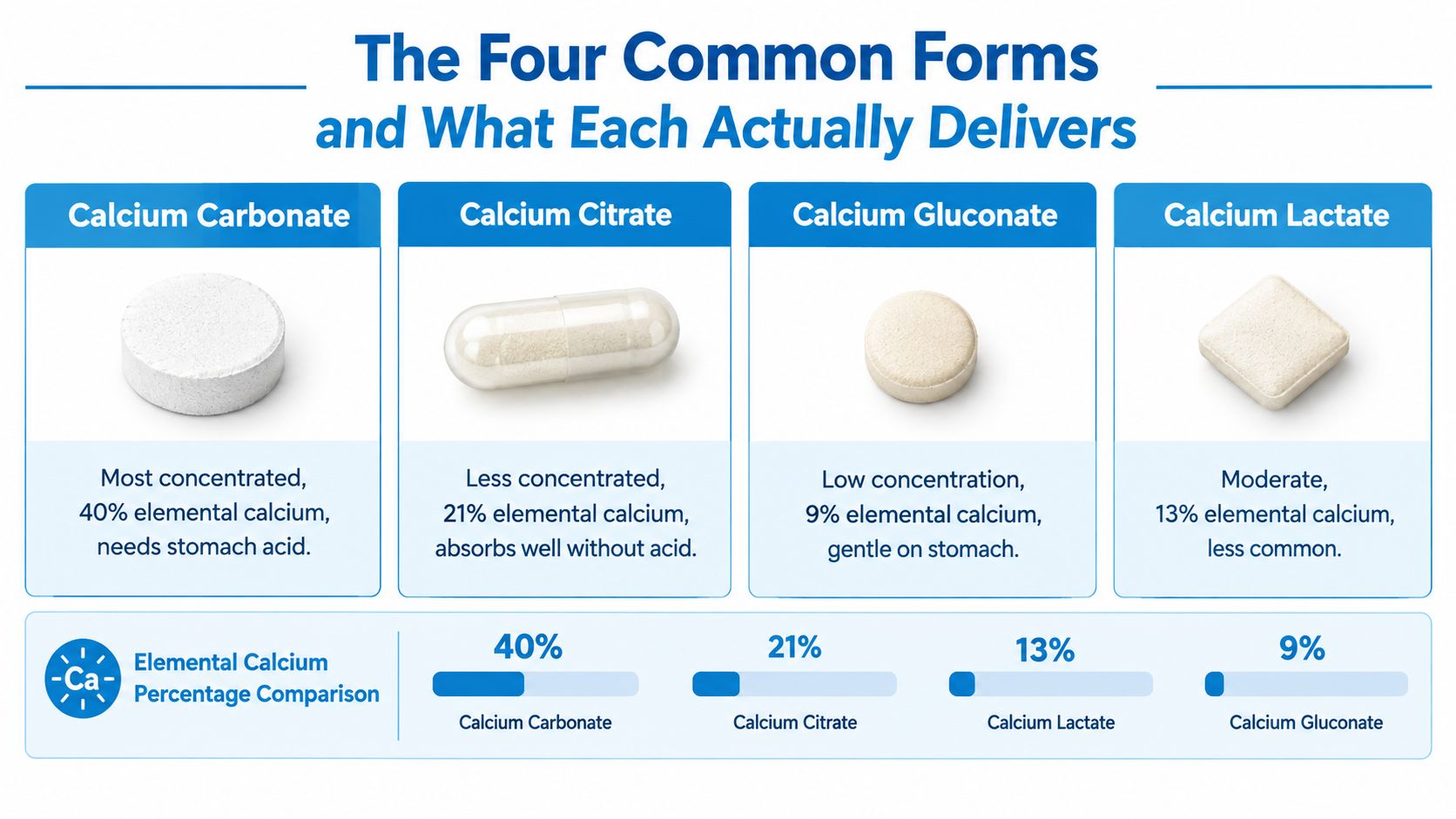
Read the compound name for two things: how much elemental calcium each serving gives you, and how many pills it takes to get there. Elemental calcium is the only number worth comparing across products. Everything else on the front label is compound weight.
Calcium carbonate carries the highest elemental fraction of the common forms, so it reaches a target dose in the fewest tablets. Run the math on a 500 mg elemental goal: carbonate gets there in roughly 1,250 mg of compound, while citrate needs close to 2,400 mg for the same amount. That gap is why citrate products so often land at two tablets per serving where carbonate manages one.
Calcium citrate costs you more compound and usually more pills per dose. What you buy back is a form that does not hinge on a well-timed meal the way carbonate does. If your eating schedule is erratic, the extra tablets are the price of a dose you will take consistently.
Less common forms and the label check
Calcium gluconate and calcium lactate sit at the lean end of the group, with the lowest elemental fraction per gram. They turn up in chewable tablets, liquids, and pediatric or combination products, all places where a bulky dose is workable, and gluconate is the form used in injectable calcium. For an adult trying to reach a full daily target, they pile on compound mass fast, so they rarely make sense as a primary supplement.
The line to trust is elemental calcium per serving inside the Supplement Facts panel, never the milligram figure splashed across the front. A bottle reading "calcium 1,000 mg" is usually quoting compound weight. Once you have the elemental number, the form question comes down to two practical points: how many pills that dose costs, and whether you will take them the way the form demands.
Citrate Versus Carbonate Head to Head
If absorption reliability is the priority, calcium citrate has the stronger case. A meta-analysis of 15 studies involving 184 participants found citrate absorption roughly 22% to 27% higher than carbonate across dosing conditions, fasting and fed alike, with fractional absorption of 0.402 versus 0.314 in a controlled comparison. The same body of research includes a striking dose-comparison result: 0.5 g of calcium from citrate was absorbed better than 2.0 g from carbonate. Four times the calcium on the label, less of it getting through. (Meta-analysis comparing calcium citrate and carbonate)
Now the counterweight: tablet count. Reaching 500 mg of elemental calcium takes roughly 2,400 mg of calcium citrate compound, which on most labels means two or three tablets per dose. Carbonate reaches the same 500 mg in about 1,250 mg of compound, often a single tablet. If your daily supplemental target is higher, that gap widens fast, and citrate's absorption edge starts costing you a palmful of pills. Adherence decides real-world results more often than a percentage point does.
Match the form to your routine
- Take citrate if you use acid-suppressing medication such as a proton pump inhibitor, if stomach acid is already reduced, or if your doses will often land away from meals.
- Take carbonate if dinner is a reliable anchor meal, if you want the fewest tablets per day, or if a lower pill burden keeps you consistent.
- Rethink supplementing entirely if neither routine is one you will really follow. A bottle you never open absorbs at 0%.
Neither form wins across the board. Citrate buys reliability when acid or meal timing is unpredictable. Carbonate buys compact doses you can realistically swallow. If a prescription or medical condition is part of the picture, have a pharmacist check the specific product against your medication schedule before you commit.
Four Levers That Change How Much Gets In
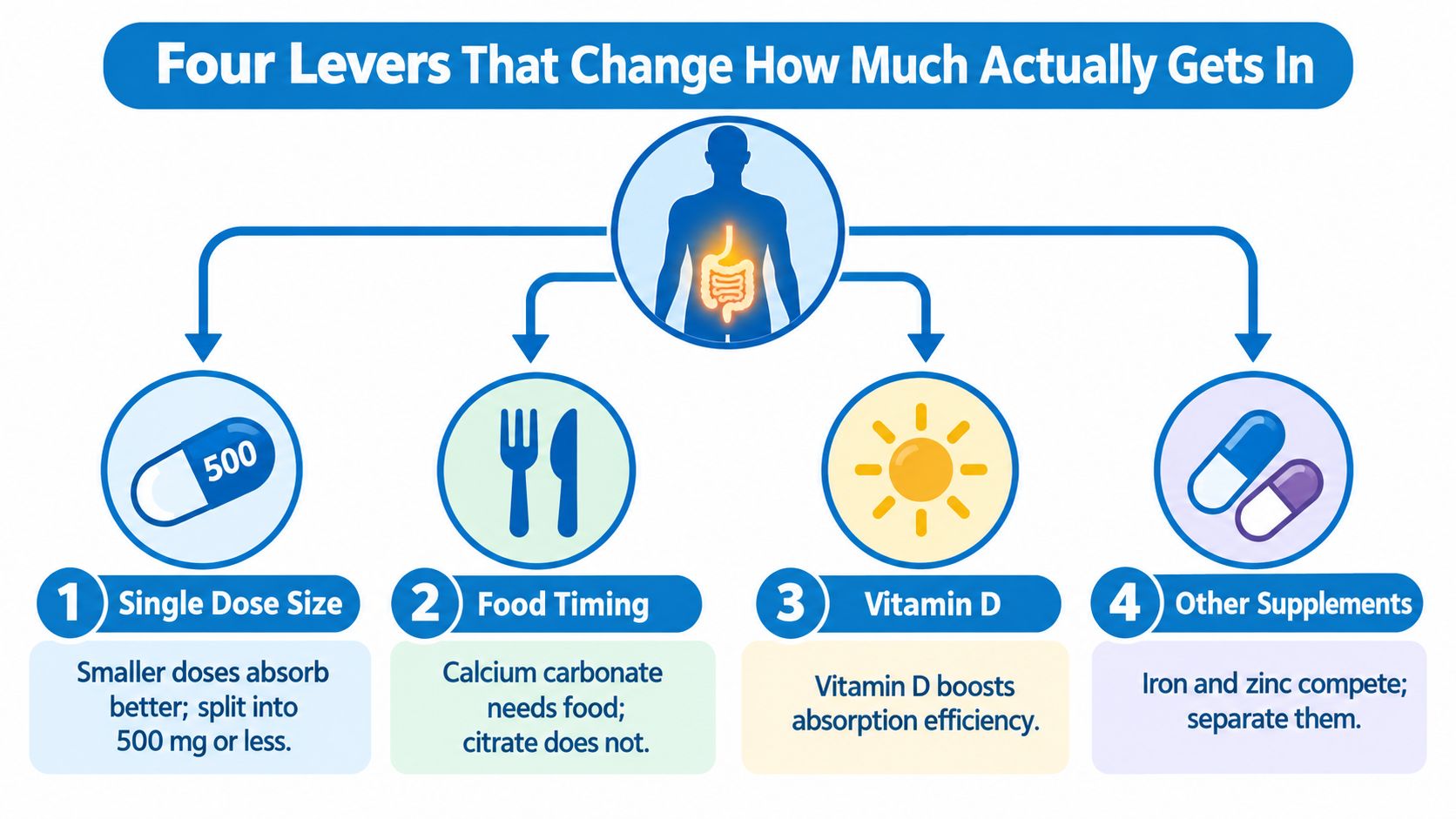
Absorption is a dosing problem as much as a form problem. Four levers decide how much calcium your body pulls out of each tablet: dose size, meal timing, vitamin D status, and stomach acid.
Dose size is the biggest lever. The fraction of calcium absorbed drops as each sitting gets larger, which is why the standard guidance is to divide intake into separate administrations. Say your clinician puts you on a 1,000 mg daily supplement. Two 500 mg doses taken at separate meals fit that advice. One 1,000 mg tablet at breakfast does not, and part of what you paid for passes through unabsorbed. Check the label for elemental calcium, not compound weight, before you plan the split.
Meal timing is a form-specific lever. Carbonate needs food in the stomach because it depends on acid to dissolve. Citrate does not, which is why it wins for irregular schedules. Pick the form that matches the meal you can count on every day, then set the rest of the schedule around it.
Vitamin D and stomach acid
Vitamin D status sets the ceiling on how much calcium you can absorb. That is not a blanket reason to add a vitamin D product. Check your diet, existing supplements, and any lab results before stacking one. If you decide to add it, this guide to vitamin D supplement options covers how to compare formats and doses.
Stomach acid decides whether carbonate dissolves in the first place. Some older adults and anyone on acid-suppressing medication produce less of it, which pushes the choice toward citrate. That is a reason to switch forms, and it never means adjusting a prescribed medication on your own.
Practical rule: Check elemental calcium per dose first. Then build your meal and medication schedule around the form you chose.
Timing Around Food, Other Supplements, and Medications
A calcium routine can look sensible on the bottle and still interfere with another medicine. Plan the schedule around both the calcium form and the prescriptions you take. If you use several medicines, have a pharmacist review your actual timetable rather than relying on a generic chart.
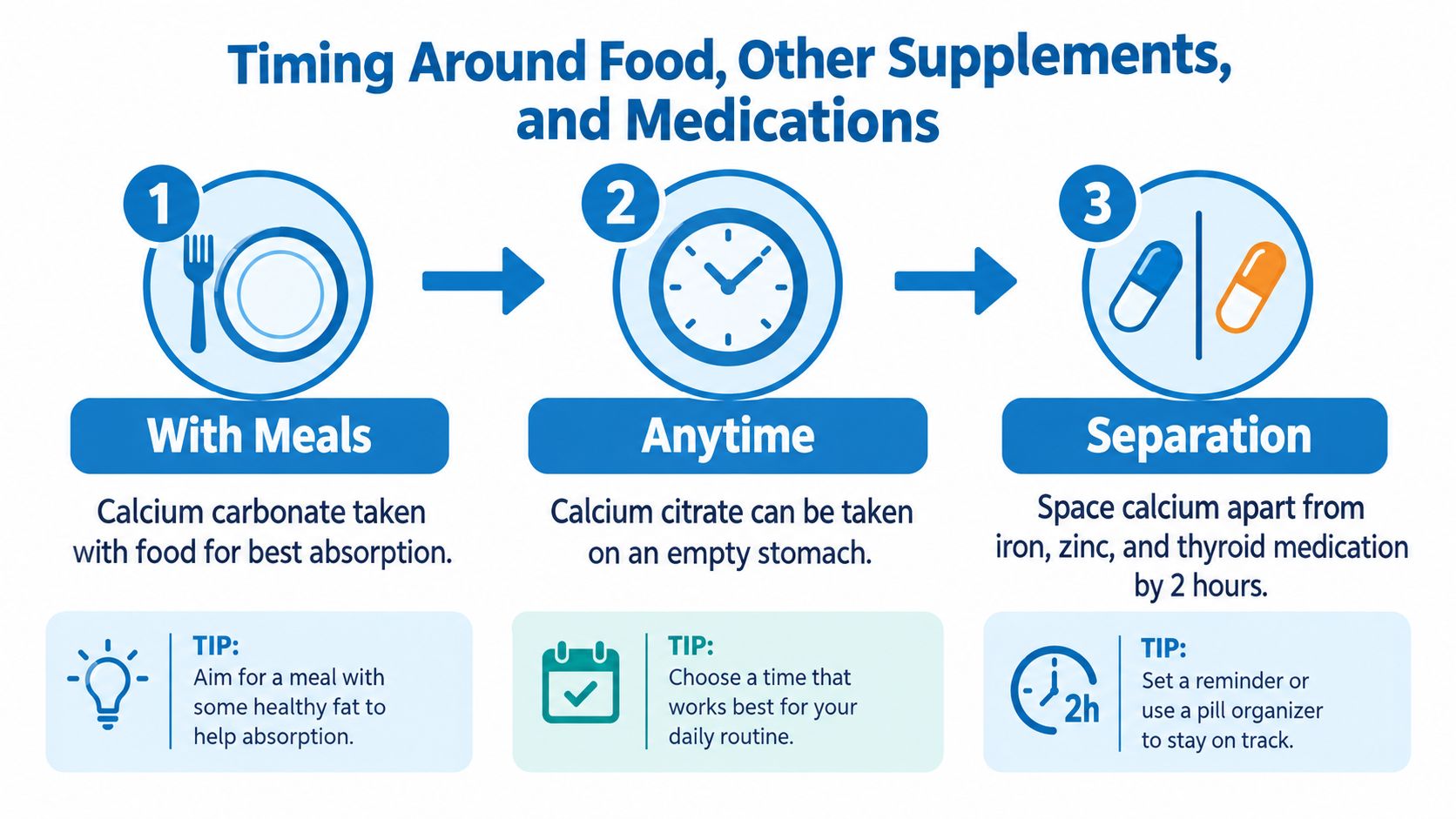
For food, keep the rule simple: carbonate goes with a meal; citrate can be taken with or without food. Calcium can reduce levothyroxine absorption when taken within four hours. Dolutegravir requires calcium to be separated by at least two hours before or six hours after. Calcium can also interfere with certain quinolone antibiotics, so confirm the specific spacing instructions with your pharmacist or the medicine label. (NIH Office of Dietary Supplements' consumer calcium guidance)
Build a timetable around your prescriptions
Use this as a planning method, then check it against your medication instructions:
- Morning medicine: If you take levothyroxine, keep calcium outside the required four-hour interval.
- Meal-linked dose: Put carbonate with a meal that doesn't conflict with medication timing.
- Flexible dose: Citrate can fit a time when you're not eating, but it still needs to be spaced appropriately from interacting medicines.
- Mineral products: Calcium may compete with iron, zinc, and magnesium. Ask a pharmacist how to space these products for your specific regimen.
- Antibiotics or dolutegravir: Follow the medicine-specific separation instructions, not a general calcium schedule.
There's no universally correct morning or evening slot. Choose a consistent time that respects the product's food requirements and the medication intervals. If the instructions for a medicine and a supplement seem to conflict, don't guess or move a prescription on your own. Ask your pharmacist to help arrange the day.
Who Should Pick Which Form
No form is right for everyone. Match the choice to stomach acid, meal habits, medical history, and the reason you're considering calcium.

Start with acid status and digestive history
For people with reduced gastric acidity, including some older adults and people taking acid-suppressing medicines, citrate is the more dependable starting point. It's less reliant on stomach acid and doesn't need to be paired with a meal. If you use carbonate instead, take it with food and confirm with a clinician that it suits your circumstances.
People who have had Roux-en-Y gastric bypass should discuss calcium choice with their care team. A randomized crossover study in patients after the procedure reported serum-calcium Cmax of 9.4 versus 9.2 mg/dL and AUC of 55 versus 54 mg/dL for citrate versus carbonate, respectively. Those measures support citrate as a more dependable option when gastrointestinal absorption may be compromised, but your clinician should guide your supplement plan. (Roux-en-Y gastric bypass study of calcium citrate and carbonate)
Consider why you're supplementing
Postmenopausal women focused on bone health shouldn't choose a calcium form as a substitute for an individualized plan. Check dietary intake, review vitamin D with a clinician, and split supplemental calcium into smaller administrations if supplementation is recommended.
Vegans can assess calcium intake from fortified foods and other dietary sources before buying a tablet. Pregnant people and athletes shouldn't assume that pregnancy or heavy sweating alone establishes a need for calcium supplementation. Ask a clinician to evaluate diet, health history, and any other supplements or medicines you use.
Shortlist: Citrate is a reasonable first choice when stomach acid is a concern or flexible timing matters. Carbonate remains practical when a meal is reliable and its concentration fits your tablet preference. For surgery-related absorption issues or complex medical needs, let your care team make the final call.
Do You Actually Need a Supplement at All
The most absorbable supplement still may not be useful if you don't need one. Start by looking at your usual food intake and discuss the gap with a clinician before adding a product. Supplements can help meet an identified need, but taking more calcium doesn't guarantee better bone outcomes.
The Women's Health Initiative trial gave 36,282 postmenopausal women either 1,000 mg of calcium plus 400 IU of vitamin D daily or placebo. It found no statistically significant reduction in hip fractures; the reported hazard ratio was 0.88, with a 95% confidence interval of 0.72 to 1.08. (USPSTF evidence summary on calcium and vitamin D supplementation)
A broader review reported 2,102 fractures, or 11.6%, in the combined-supplement group, compared with 2,158, or 11.9%, with placebo. These results don't prove that supplements never help an individual. They do make a strong case against assuming that every healthy adult benefits from routine calcium and vitamin D supplementation.
Close a real dietary gap
Write down your regular calcium sources before shopping, including foods and any fortified products you use. Then ask a clinician or pharmacist whether a supplement is appropriate for your diet, health history, and medications. If your goal is bone health, calcium is only one part of the conversation; see this overview of approaches to improving bone density.
Be especially careful about self-prescribing when you have a medical condition or take medicines that interact with calcium. A supplement should fill a specific need, not become a default purchase because bone health feels important. When the need is unclear, assess intake and ask for individualized advice before starting.
Your Shortlist and Dosing Checklist
Buy for the routine you can follow, not the most impressive front-label claim. Check the elemental-calcium amount per serving, then decide whether the form fits your meals and prescriptions. If you're comparing products, this guide to reading a supplement label can help you focus on the facts that matter.
- Choose the form: Prefer citrate if stomach acid is reduced or you need flexible meal timing. Consider carbonate if you can take it with food and want a more concentrated form.
- Check the dose: Aim for about 500 mg or less of elemental calcium per administration. Split a larger recommended daily amount rather than taking it all at once.
- Match the meal: Take carbonate with food. Citrate can be taken with or without food.
- Review vitamin D: Consider whether you already get vitamin D from food or another supplement, and ask a clinician whether you need more.
- Check interactions: Keep calcium at least four hours from levothyroxine, and follow the specific separation instructions for dolutegravir and quinolone antibiotics.
- Confirm the need: Review dietary calcium and your medical situation before starting a supplement.
Bottom line: When in doubt about stomach acid, choose citrate; keep each dose to about 500 mg or less of elemental calcium, and build a schedule that fits food, vitamin D, and medication instructions.
CalVitamin offers an online catalog of vitamins and minerals, including calcium-containing products and vitamin D options, so you can compare forms and serving details. Review each label and check your planned dose with a pharmacist or clinician before buying through CalVitamin.






