You're standing in front of a shelf of bottles that all promise better energy, sharper performance, stronger immunity, or more restful sleep. Two products may feature similar words on the front, yet one serving could mean a single capsule while the other requires several. A blend may list familiar herbs without showing how much of each one you're taking.
Learning how to read a supplement label turns that shelf into a series of practical decisions. You can check what one dose contains, compare products fairly, recognize ingredients that lack an established Daily Value, and question claims that sound stronger than the label supports. The aim isn't to memorize every vitamin or botanical. It's to use the label as a filter for safety, transparency, and value.
Table of Contents
- Why Supplement Labels Feel Confusing at First Glance
- Anatomy of a Supplement Facts Panel You Can Trust
- How Serving Size and Servings Per Container Change the Math
- Decoding Active Ingredients Forms and Percent Daily Value
- Spotting Claims Warnings and Marketing Language That Misleads
- Your Confident Choice Checklist Before You Buy
Why Supplement Labels Feel Confusing at First Glance
The front of a bottle is designed to attract attention. It may emphasize words such as “advanced,” “maximum strength,” “clean,” or “supports performance.” Those phrases can help you identify a product's intended use, but they don't tell you enough to compare it with the bottle beside it.
The useful information usually appears elsewhere. In the United States, the modern supplement label framework began with the Dietary Supplement Health and Education Act, signed on October 25, 1994. The law defined dietary supplements and established specific labeling requirements, while FDA guidance explains the information shoppers should find on the product label, including identity, manufacturer details, a Supplement Facts panel, other ingredients, and net quantity of contents (FDA's Dietary Supplement Labeling Guide).
That standardization gives you a reliable starting point. The front may make the promise, but the Supplement Facts panel shows the serving size, servings per container, ingredient amounts, and % Daily Value where applicable. Directions and warnings then tell you how the manufacturer expects the product to be used.
Key takeaway: Read the front to understand the product's purpose. Read the rest of the label to decide whether the product makes sense for you.
A simple reading order prevents most beginner mistakes:
- Find the serving size.
- Check servings per container.
- Read each active ingredient and its amount per serving.
- Interpret % Daily Value, or note when no Daily Value has been established.
- Examine ingredient forms and proprietary blends.
- Finish with directions, warnings, other ingredients, and the claims.
By the time you finish, you should be able to compare a capsule, gummy, powder, or liquid without assuming that a larger bottle or louder promise means better value.
Anatomy of a Supplement Facts Panel You Can Trust
You are holding a bottle that promises energy, focus, or daily wellness. Turn it around before judging the front label. A U.S. supplement label has several parts, and each answers a different question about identity, quantity, use, and value.
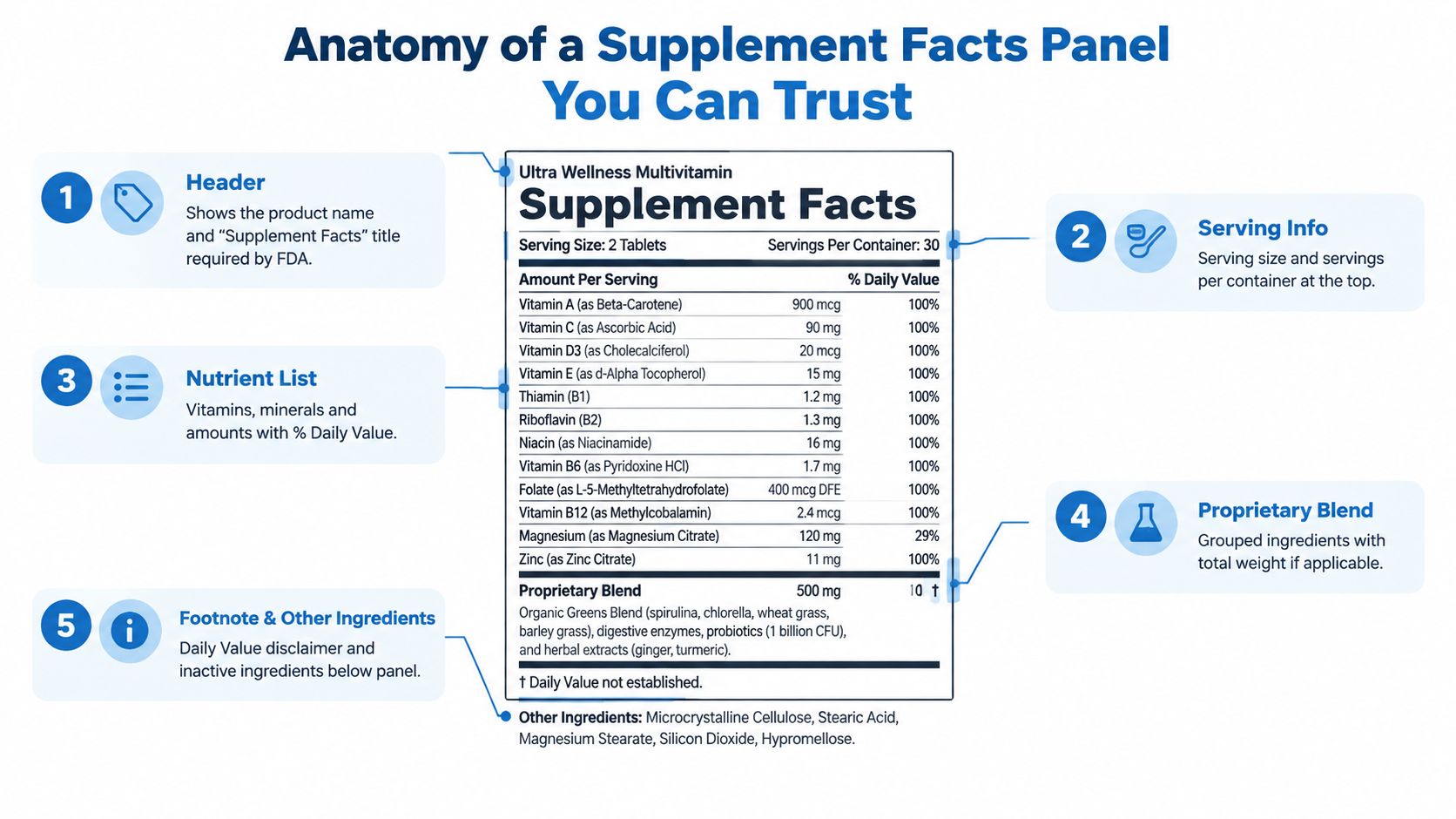
The product identity should state what the package contains and identify it as a dietary supplement. Look for the name and place of business of the manufacturer, packer, or distributor, plus the net quantity of contents. These details help you confirm what you are buying and who is responsible for putting it on the market.
Start at the top of the panel
The Supplement Facts box is your measurement guide. Read it in this order:
- Serving size: The amount counted as one serving.
- Servings per container: The number of labeled servings in the package.
- Dietary ingredients: Vitamins, minerals, amino acids, herbs, and other dietary ingredients.
- Amount per serving: The quantity supplied by that stated serving.
- % Daily Value: The percentage of an established Daily Value, when one exists.
The panel lists quantitative amounts for dietary ingredients. If an ingredient has an established Daily Value, it also shows % Daily Value. If no Daily Value exists, the label should say “Daily Value not established”. This wording prevents you from treating an herbal extract or performance ingredient like a nutrient with a standard daily target.
A label is a decision filter. Serving information lets you compare value, ingredient forms help you distinguish similar products, and the listed amounts show whether a marketing claim has meaningful support. A long ingredient list alone does not establish quality.
Read outside the box too
The Other Ingredients statement may list capsule materials, binders, fillers, flavors, colors, or sweeteners. Check it if you have allergies, follow a dietary pattern, or avoid particular additives.
Directions and warnings may appear elsewhere on the package. Read them before buying, especially for herbal and performance products where timing, combinations, or cautions can affect whether the product fits your situation. For a practical retail example, review KAL Enhanced Energy Once Daily Multivitamin, then apply the same reading order to other bottles.
A complete label does not prove that a product will suit you or work as promised. It gives you the facts needed to compare products, question strong claims, and spot missing information. If the package promises a great deal but provides little detail about ingredients, amounts, directions, or warnings, count that lack of clarity in your buying decision.
How Serving Size and Servings Per Container Change the Math
A bottle can make a dose look larger than it is. The amount printed beside an ingredient may apply to two capsules, four tablets, one scoop, or another serving defined on the panel, rather than to one unit.
FDA guidance defines a dietary supplement serving as the maximum amount recommended on the label for one eating occasion. If no recommendation appears, the serving defaults to one unit, such as a tablet, capsule, packet, or teaspoonful. The label must show both the serving size and servings per container (FDA serving size and % Daily Value guidance).
Use a three-step check
First, find the serving size. A bottle with 60 capsules may list two capsules as one serving. Every amount in the Supplement Facts panel then applies to those two capsules together. To estimate the amount in one capsule, you would divide the listed amount by two, assuming the contents are evenly distributed.
Next, check servings per container. With 60 capsules and two capsules per serving, the bottle contains 30 labeled servings. Taking the label's serving each day means the container represents 30 doses. Taking one capsule means you are taking half a serving, so the panel's amounts do not describe your actual dose.
Finally, normalize the comparison. Compare products according to the serving you plan to take. A product labeled “500 mg per serving” cannot be compared fairly with one labeled “300 mg per capsule” until you know how many capsules form each serving.
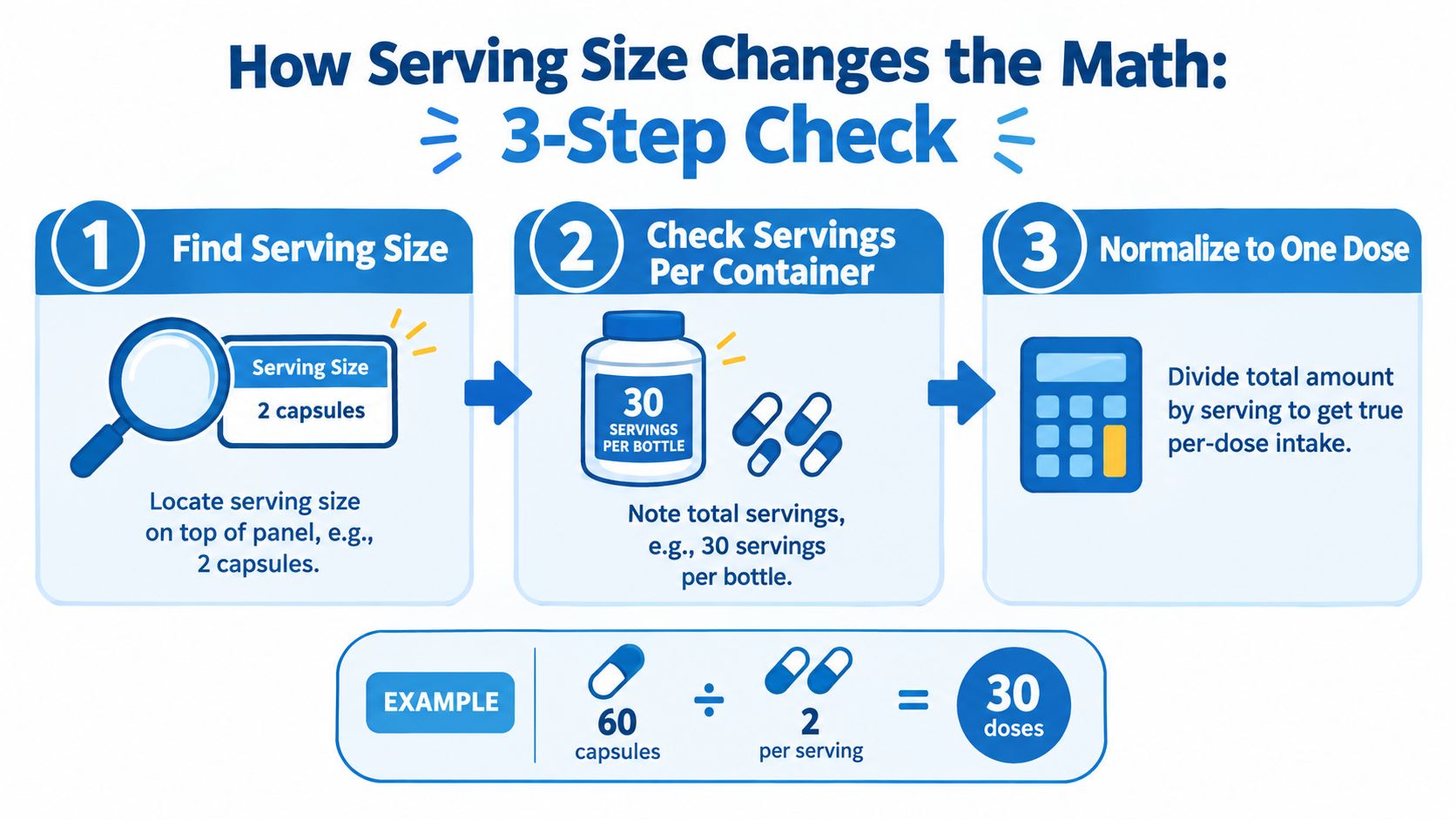
Use this formula:
Your planned units ÷ units per serving = servings you take.
If you plan to take two capsules and the serving is two capsules, you take one serving. If the serving is four capsules, you take half a serving. That changes the amount of every listed ingredient and any applicable % Daily Value.
A larger bottle count does not automatically mean better value. A product may contain more capsules because it requires more capsules per dose. The Horbaach Multi Collagen 2000mg product listing shows why servings per container deserve as much attention as total units.
Apply the same check to gummies, powders, shots, and liquids. A scoop, packet, or fluid measure counts as a serving only because the label defines it that way. Start with that definition before judging dose, duration, or price.
Decoding Active Ingredients Forms and Percent Daily Value
拿到一瓶補充品時,先不要只看熟悉的成分名稱。確認每份含有哪些形式、來源或化學結合物,尤其是礦物質,這些細節會影響產品之間的比較。
礦物質可能以鹽類或化合物列出,標籤也可能另外標示元素礦物質的含量。兩者不是同一個數字。比較產品時,找出真正對應你想評估的營養素含量。化合物重量較大,不代表其中的活性礦物質一定較多。這就像比較兩杯含糖飲料,不能只看整杯重量,還要看你真正關心的糖含量。
草本產品通常需要更仔細地讀完整行文字。植物名稱後面可能接著植物部位、萃取物說明或標準化資訊。根、葉、種子和整株萃取物不應直接當成同一種原料比較。若標籤把許多成分合併成一個總量,你便難以知道每種成分實際提供多少。透明的標示,才讓你有機會比較形式、含量和產品價值。
% Daily Value 能告訴你什麼,不能告訴你什麼
FDA說明,% Daily Value 是用每份含量除以既定的 Daily Value,再乘以100計算。每份 5% Daily Value 或以下通常可視為低含量,適合用來快速比較不同產品對某種營養素的貢獻,詳見FDA explanation of % Daily Value。
% Daily Value 並不會出現在每一種成分旁邊。維生素和礦物質可能有既定的 Daily Value,但許多草本、胺基酸和特殊化合物只會列出含量,並寫著 「Daily Value not established」。這句話只表示目前沒有可用的既定 Daily Value 作為比較基準,不能單獨用來判定成分有效或無效。對草本和運動表現產品來說,還要回頭看形式、實際含量、使用方向與產品宣稱。
標籤格式也可能因版本不同而有差異。FDA資料說明,維生素D、鉀和添加糖的標示有所更新,膽鹼與氟化物的排列也可能不同,可參考FDA supplement labeling guide。因此,拿舊產品圖片和眼前的新包裝比較時,應以實際拿到的標籤為準。
| What You See on Panel | What It Means | What to Do Next |
|---|---|---|
| Amount per serving | The quantity applies to the complete stated serving | Confirm how many capsules, tablets, or scoops make that serving |
| % Daily Value | The serving's amount compared with an established Daily Value | Use it for nutrient comparison, not as a universal quality score |
| “Daily Value not established” | No established Daily Value appears for that ingredient | Examine the form, dose, directions, and evidence separately |
| Proprietary blend | Ingredients are grouped, with the blend's total amount shown | Decide whether the hidden individual amounts are acceptable to you |
| Mineral compound or salt form | The ingredient may be listed by its chemical form | Look for the elemental mineral amount and compare like with like |
專利混合配方需要特別留意。標籤可能只顯示整個混合物的總重量,卻不列出每種成分各自的含量。這會讓你難以判斷實際攝取量,也不利於和標示清楚的產品比較。
NIH的 Dietary Supplement Label Database 收錄美國市場產品的標籤資訊,包括成分形式、每份含量、警語和宣稱,資料庫包含 over 200,000 products。當標籤過於模糊,或你想比較不同產品如何標示相似成分時,可以使用NIH Dietary Supplement Label Database作為查閱工具。 തീരുമാന
Spotting Claims Warnings and Marketing Language That Misleads
The most important label skill may not be nutrient arithmetic. It may be recognizing when marketing language sounds like proof.
Supplement claims can fall into different categories. Structure/function claims describe a role in the body, such as supporting normal immune function. Health claims connect a substance with disease risk reduction under authorized conditions. Qualified health claims communicate a relationship with a qualification about the evidence. These categories don't all carry the same meaning, and a benefit-oriented phrase on the front of a bottle isn't a substitute for reading the ingredients and directions.
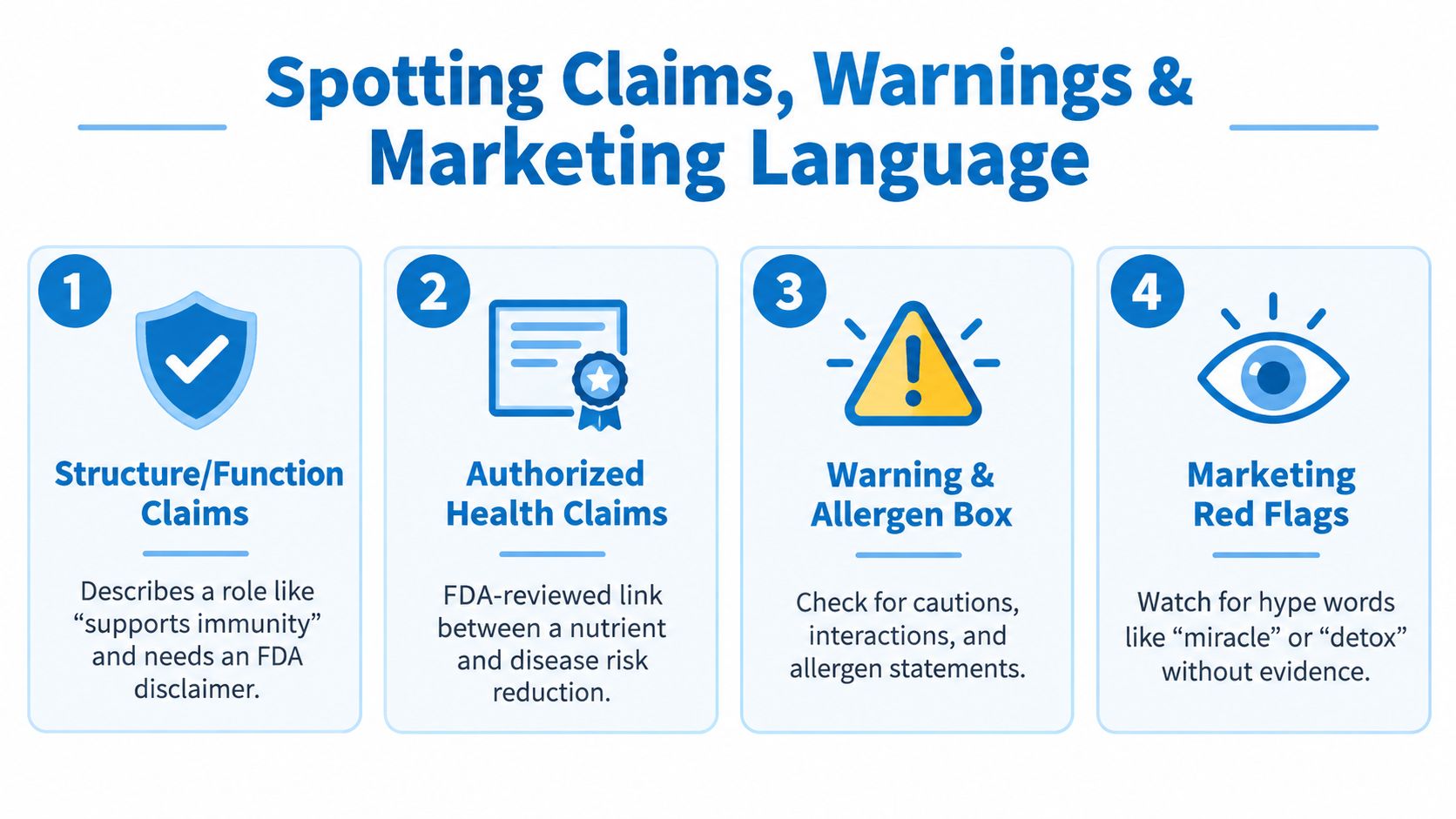
Ask what the wording actually promises
A phrase like “supports energy” is broad. It doesn't necessarily tell you which ingredient is intended to produce that effect, whether the product contains a meaningful amount, or whether the claim applies to everyone who takes it.
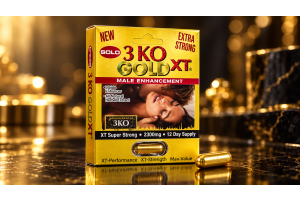
Herbal, sexual wellness, and performance products often rely heavily on attention-grabbing language. Treat words such as “miracle,” “instant,” “detox,” or “guaranteed” as prompts to investigate, not reasons to buy. A product that claims to diagnose, treat, cure, or prevent a disease deserves particular caution because that language goes beyond a simple description of normal body structure or function.
The FDA has noted that consumers may not understand the difference between structure/function claims, health claims, and qualified health claims. Its consumer health information comments provide useful context for why claim interpretation matters alongside the standardized Supplement Facts format (FDA consumer health information on nutrition claims).
Finish with the less visible information
Before buying, turn the bottle around and check:
- Directions: Confirm the recommended amount, timing, and whether the product is intended to be taken with food.
- Warnings: Look for cautions, restrictions, and interaction language.
- Other ingredients: Check capsule materials, flavorings, colors, sweeteners, and potential allergens.
- Manufacturer details: Make sure the responsible business is clearly identified.
- Testing marks: Treat third-party verification as useful quality information, but verify what the mark covers.
Practical filter: If the promise is specific and dramatic but the dose, form, and evidence context are vague, the label is asking you to trust the marketing.
A third-party mark can provide information about testing against a stated standard, but it doesn't replace your own review of dose, suitability, or warnings. The label should still make clear what you're taking and how the product is meant to be used.
Your Confident Choice Checklist Before You Buy
A good label-reading routine should work in a store aisle and on a product page. Use this sequence before adding a supplement to your cart:
- Identify the serving. Write down the number of capsules, tablets, gummies, scoops, or other units in one serving.
- Calculate the container's usable doses. Check servings per container rather than relying on the total unit count.
- Compare active amounts. Use the amount per serving, and compare similar ingredient forms.
- Interpret % Daily Value carefully. Use it for nutrients with established Daily Values. Treat “Daily Value not established” as a reason to examine the ingredient more closely, not as a quality verdict.
- Question blends. Decide whether you're comfortable with a product that doesn't disclose each ingredient's individual amount.
- Read claims skeptically. Separate structure/function wording from disease-related or highly dramatic promises.
- Check the back panel. Review directions, warnings, other ingredients, manufacturer information, and any relevant dietary attributes.
For capsules, gummies, powders, and shots, compare the actual labeled serving and the ingredients delivered by that serving. A larger package, lower shelf price, or attractive front label doesn't establish better value. You can browse broader vitamins, supplements, and nutrition products while applying the same checklist to each item.

The next time you shop, choose one product and perform the complete check before comparing it with another. You'll make a clearer buy-or-skip decision, and you won't have to rely on the loudest promise on the shelf.
CalVitamin brings together vitamins, minerals, proteins, probiotics, herbal formulas, performance products, and sexual wellness options with product details, reviews where available, and multiple dosage forms. Visit CalVitamin and use the label-reading checklist to compare serving sizes, ingredient forms, warnings, and value before you buy.