You're not looking for a miracle product. You're looking for an explanation. Desire feels lower than it used to, arousal takes longer, or sex has started to feel like one more thing you're too tired to think about. You search for something natural, you see maca everywhere, and then you're stuck between bold marketing claims and very little clear information. That's exactly where a careful look at maca root for women's libido helps.
Table of Contents
- Why Women Turn to Maca Root for Libido
- What Clinical Studies Say About Maca and Desire
- How Maca Might Work in the Body
- Recommended Dosages and How to Trial Maca
- Maca vs Other Libido Herbs
- Safety, Side Effects, and Who Should Be Cautious
- How to Choose a Quality Maca Supplement
- Frequently Asked Questions About Maca and Libido
Why Women Turn to Maca Root for Libido
Consider a familiar pattern. A woman in her forties notices that she rarely thinks about sex anymore. She still loves her partner, she isn't in pain, and nothing dramatic has changed. Desire just feels quieter. She doesn't want to start hormones for this alone, and she doesn't want a product that promises instant arousal. She wants to know whether a plant based option could help her feel more like herself again.
Another woman has a different starting point. Her antidepressant helps her mood, but desire and orgasm changed after she began treatment. A third is postmenopausal and notices that lower desire arrived alongside poorer sleep, anxiety, and less energy. These situations look similar from the outside, but they're not the same problem.
What maca actually is
Maca, also called Lepidium meyenii, is a root vegetable traditionally grown in the Andes and eaten as food. Supplements usually use dried root powder or an extract made from that root. That food history is part of its appeal, but it shouldn't be confused with proof that a capsule will restore libido.
Maca also attracts interest because it isn't presented as estrogen or testosterone. Women who feel cautious about hormone based approaches often look for something that might support desire, mood, or energy without directly replacing a hormone. That distinction matters, and the research section below explains why researchers paid attention to it.
A fair question isn't whether maca is powerful. It's whether your reason for low desire resembles the situations researchers actually studied.
What women usually hope will change
Most readers aren't asking for a dramatic overnight shift. They hope for more spontaneous interest, easier arousal, less mental resistance to intimacy, or a return of the desire they had before medication or menopause. Those are related outcomes, but studies don't measure them all in the same way.
That mismatch creates confusion. A product page may say libido support, while a study measured a sexual dysfunction score, anxiety, or one question about desire. Before buying, define your own target in plain words. For example, write down whether you're mainly tracking interest, arousal, orgasm, satisfaction, or comfort. You'll assess a trial much more clearly that way.
Maca is best approached as a gradual experiment, not a pre sex stimulant. If it helps, you're more likely to notice a pattern over weeks than a switch flipping after one capsule.
What Clinical Studies Say About Maca and Desire
The evidence trail is short, and that's the most important thing to understand. Researchers have ran small human trials, and some results look promising. They haven't produced the kind of large, repeated evidence that would let anyone promise results for women generally.
The postmenopausal trial
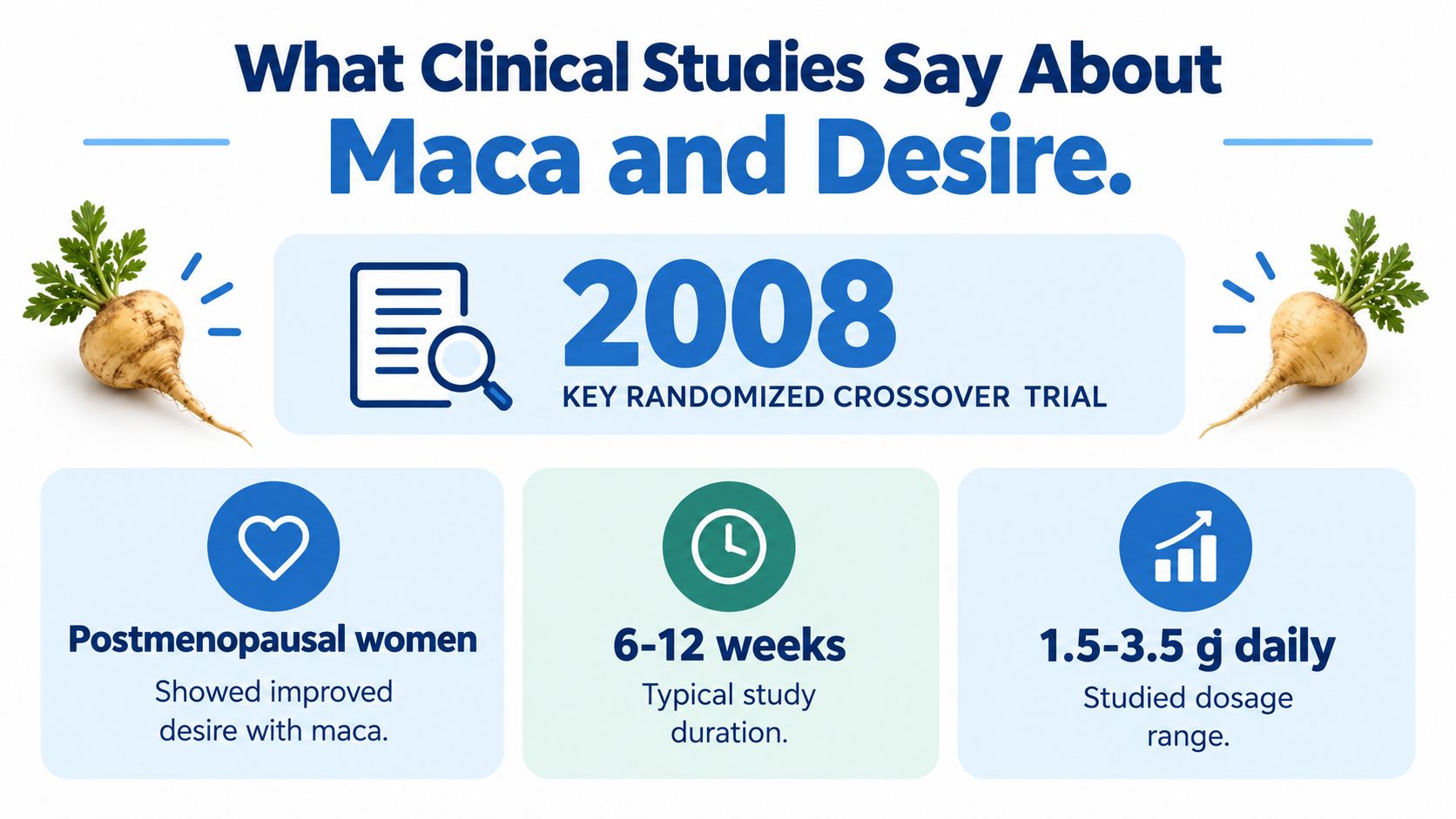
An early milestone was a randomized, double blind, placebo controlled crossover trial in postmenopausal women. In that trial, 14 women completed 3.5 grams of powdered maca daily for 6 weeks and a matching placebo for 6 weeks, and maca was linked to lower sexual dysfunction scores and improvements in anxiety and depression at P less than 0.05 on the Greene Climacteric Scale, as described in the 2008 postmenopausal maca trial record.
A crossover design means participants tried both maca and placebo at different times, so each woman partly served as her own comparison. That's useful, but it doesn't remove the main limitation. Fourteen people is a very small group, and short treatment periods can't tell us about long term benefit or who is most likely to respond.
Don't read that trial as proof that maca treats menopause related low libido. Read it as an early signal that justified better research.
The antidepressant related pilot study
A later pilot study asked a narrower and very practical question. Could maca help sexual problems that develop with antidepressant treatment, when desire, arousal, or orgasm may decline? Participants received 1.5 grams or 3.0 grams daily for 12 weeks, and the higher dose group improved on the Arizona Sexual Experience Scale from 22.8 to 16.8 and on the Massachusetts General Hospital questionnaire from 24.1 to 17.0, according to the NIH funded maca pilot study record.
Lower scores on those scales indicate fewer sexual problems, so the direction of change favored the higher dose. The lower dose didn't show the same significant improvement in that analysis. That pattern suggests dose may matter, but a small pilot can't establish an ideal dose.
How to interpret the whole trail
Think of the evidence as a trail of footprints, not a paved road.
- Postmenopausal women: One small crossover trial found improvements in sexual dysfunction scores and psychological symptoms.
- Antidepressant related problems: Pilot research suggests the higher studied amount may deserve further study.
- Women in general: The trials don't prove that maca works for every cause of low desire.
Populations, preparations, and outcome measures differed across studies. That heterogeneity makes neat conclusions tempting but unreliable. A responsible claim is narrow. Maca root for women's libido is suggestive enough to trial thoughtfully in some contexts, and not established enough to present as treatment.
How Maca Might Work in the Body
The mechanism question trips up many readers. If maca doesn't act like estrogen, how could it affect desire at all? The honest answer is that researchers haven't pinned down one clear pathway in women.
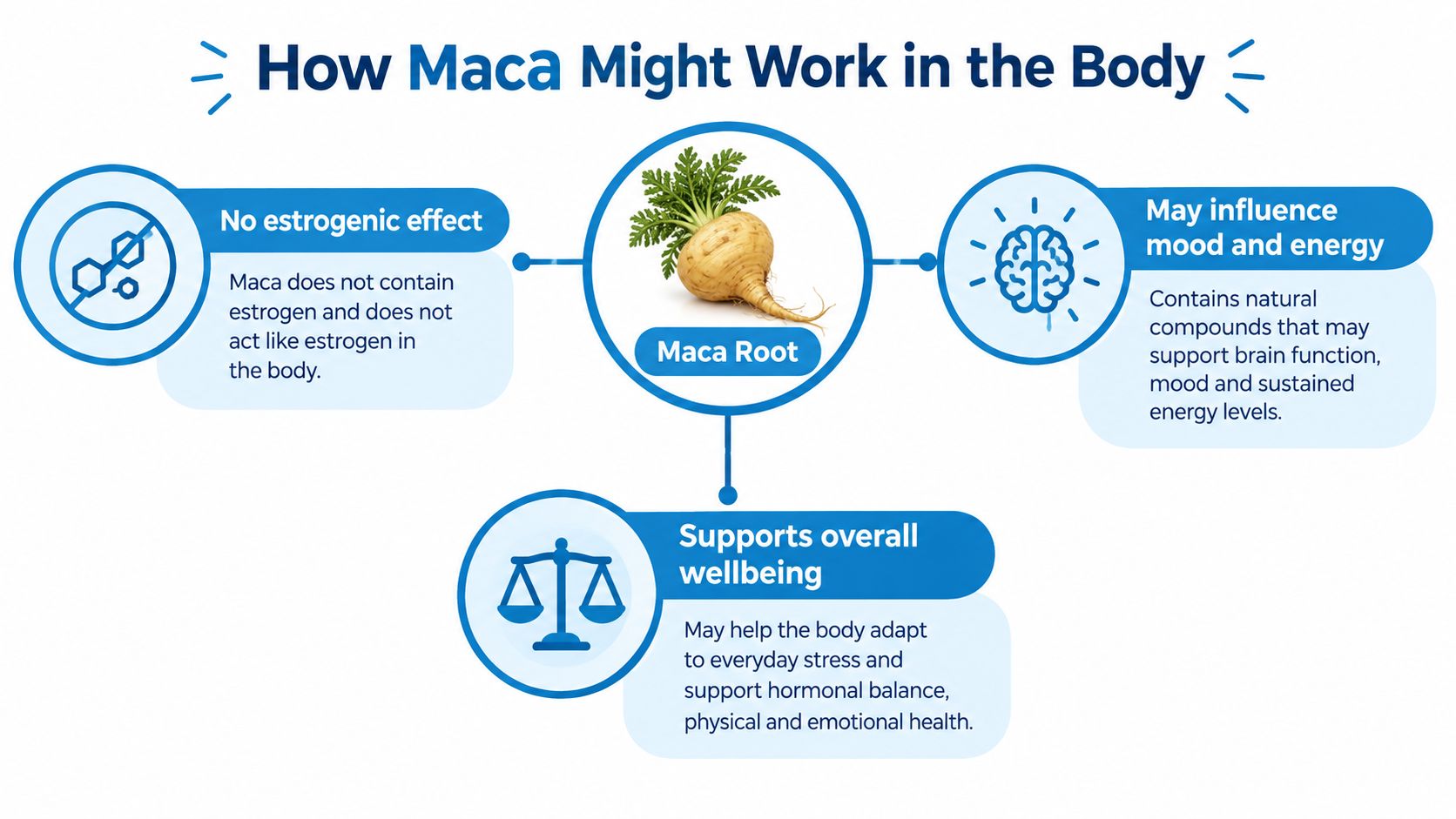
The image below maps the main ideas without turning them into certainties.
Not a hormone replacement
In the postmenopausal research discussed earlier, the observed benefits appeared without evidence that maca acted through estrogenic or androgenic mechanisms. In plain language, researchers didn't find that maca behaved like estrogen or testosterone. That doesn't prove every preparation is hormone neutral in every person. It means direct hormone replacement isn't the supported explanation.
Product language can mislead you. Hormonal balance sounds precise, but it often means very little. If a label implies maca corrects low estrogen or raises testosterone, it's going beyond what the human libido evidence shows.
A dimmer, not a light switch
A useful analogy is a dimmer connected to several rooms rather than a single light switch. Desire is influenced by mood, stress, sleep, relationship context, medication effects, physical comfort, and arousal. If maca influences one or more of those surrounding conditions, desire could feel easier without maca directly producing sexual arousal.
That model also explains uneven results.
- If stress dominates: Feeling calmer or less depleted might make interest more accessible.
- If medication blunts response: Any benefit would need to work around a drug related effect, which is a different challenge.
- If pain dominates: A desire focused supplement doesn't address the physical reason sex is being avoided.
Don't expect a supplement to solve a mismatch it wasn't designed to reach. Dryness, pelvic pain, relationship conflict, trauma, thyroid problems, and untreated depression can all suppress desire through routes maca hasn't been shown to fix.
Mental model: Maca may nudge conditions around desire. It hasn't been shown to override the cause of low desire.
Why effects would take time
A direct stimulant would be expected to act quickly. A gradual influence on mood, perceived energy, or sexual response would need repeated daily use and enough time to separate a real pattern from a good week. That's why judging maca after a few doses tells you almost nothing.
It also means you should track more than libido. Note sleep, mood, stress, and medication changes alongside desire. If several things change at once, you'll know maca may not deserve all the credit.
Recommended Dosages and How to Trial Maca
A good trial borrows its structure from research instead of from a product slogan. You're choosing a preparation, taking a consistent amount, and deciding in advance when you'll judge the result.
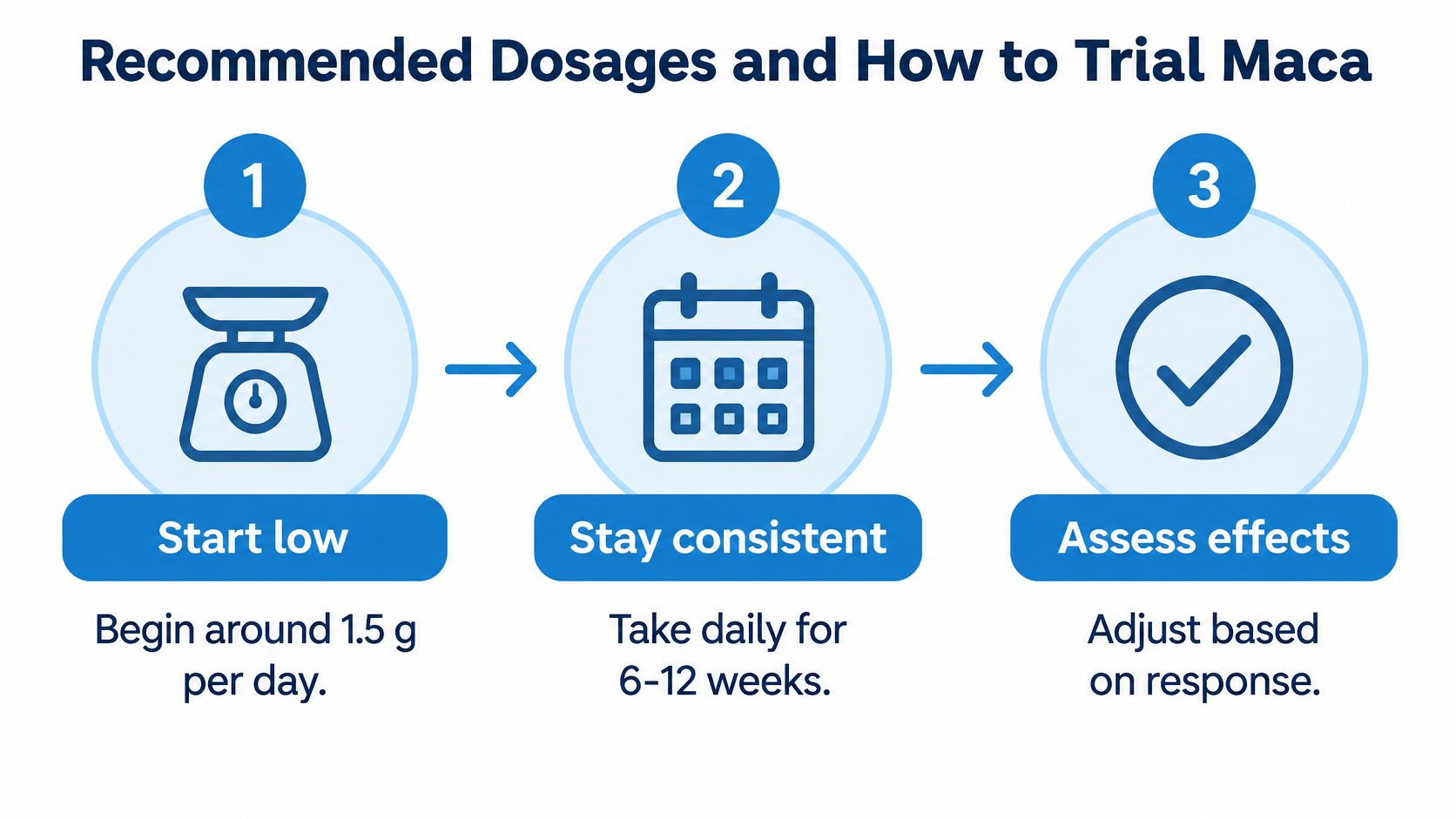
Start with the studied range
A systematic review found four eligible randomized controlled trials using oral maca at approximately 1.5 to 3.5 grams per day for 2 to 12 weeks, while also cautioning that samples were small and methods varied, as set out in the systematic review of maca for sexual function.
That range isn't a prescription. It's the territory researchers studied. Products containing far less maca inside a large proprietary blend aren't automatically comparable, and taking far more doesn't create evidence where none exists.
Run a fair personal trial
- Record a baseline: For a short period before starting, rate desire, arousal, orgasm ease, satisfaction, mood, and sleep in simple notes.
- Change one thing: Start maca without adding several other libido products at the same time.
- Stay consistent: Take the same preparation daily, ideally at a time you'll remember.
- Review the pattern: Compare your notes after at least 6 to 8 weeks, a practical checkpoint aligned with the durations used in the evidence summarized in the review linked above.
Consistency matters more than chasing the perfect hour. Some women prefer powder in a smoothie because the gram amount is visible. Others choose capsules because taste and measuring make powder unrealistic. Either form can fit a trial if the label tells you exactly what you're taking.
Powder and extract aren't interchangeable
Dried root powder is ground maca root. An extract concentrates selected components, and extraction methods differ. Trials didn't treat every commercial form as equivalent, so you shouldn't either. Record the product name, form, serving size, and daily amount in your notes. If you switch products halfway through, you've effectively started a new trial.
Set a stop rule before you begin. If there's no meaningful change by your review date, stop rather than escalating indefinitely. If side effects appear, stop sooner and reassess. A trial that produces a clear no is still useful information.
Maca vs Other Libido Herbs
Women often compare maca with ashwagandha, ginseng, and tribulus because they're sold side by side. The better comparison isn't which herb sounds strongest. It's which one matches the problem you're trying to influence, and how directly it has been studied for women's sexual function.
Libido Herbs at a Glance
| Herb | Evidence for Libido | Primary Action |
|---|---|---|
| Maca | Small human trials in specific groups, still inconclusive | Traditionally used for desire, energy, and sexual function |
| Ashwagandha | Emerging research, often tied to stress related outcomes | Adaptogen commonly used for stress and resilience |
| Ginseng | Mixed and indirect for women's desire | Traditionally used for vitality, fatigue, and circulation |
| Tribulus | Limited human evidence in women | Marketed for desire and androgen related support |
This table is a map, not a ranking. It doesn't mean the herb with the most direct libido research is right for you. It means you should know whether you're buying a product studied for sexual function or one whose libido claim rests on a stress or energy theory.
Choose by your main bottleneck
If low desire travels with constant tension and poor recovery, you may be drawn to a stress focused herb. A detailed comparison of goals and trade offs appears in this guide to maca root versus ashwagandha. If fatigue is central, ginseng may enter the conversation, but feeling more awake isn't the same outcome as wanting sex.
Be careful with blends. A formula containing maca, ashwagandha, ginseng, and tribulus sounds all-inclusive, yet it can make your trial impossible to interpret. You won't know which ingredient helped, which caused side effects, or whether any ingredient is present in a meaningful amount.
Combination products such as Zealous Passion Female Enhancement and Aphrodite Intense Pleasure Enhancer for Her illustrate this issue because maca appears alongside other herbal ingredients. They're examples of multi ingredient formulas, not equivalents of the single ingredient preparations used to study maca root for women's libido.
Try one primary approach at a time. A crowded formula gives you a result you can't explain.
No herb in this comparison is a guaranteed fix. If desire loss is sudden, distressing, linked to pain, or tied to a medication change, the next step isn't a stronger blend. It's a clinical review of the cause.
Safety, Side Effects, and Who Should Be Cautious
Maca is often described as gentle because it's also a food. That reputation shouldn't replace basic safety checks, especially when the reason for trying it involves prescription medicine.
The illustration below is a reminder to treat botanical products as active substances, not harmless flavoring.
What trial safety reporting shows
In one controlled trial, 45 women with remitted depression and SSRI or SNRI linked sexual dysfunction received 3 grams per day, given as 1,500 milligrams twice daily, or placebo for 12 weeks, and three participants discontinued because of adverse events including flu like symptoms and vomiting, as reported in the review of nutraceutical trials for sexual dysfunction.
That doesn't mean those reactions are common for every user. It means tolerability isn't automatic. Digestive upset or feeling unwell is a reason to pause, not a hurdle you're supposed to push through for libido.
Medication related low desire needs context
Don't self manage antidepressant side effects in silence. Tell the prescribing clinician when symptoms began, whether your depression is stable, and what sexual changes you're noticing. They may discuss timing, dose, switching treatment, or other medical options. Maca shouldn't become a reason to stop or alter an antidepressant on your own.
Use extra caution and seek individualized advice if you're pregnant, breastfeeding, managing a hormone sensitive condition, preparing for surgery, or taking medicines where added supplements need review. The absence of a proven hormonal mechanism isn't the same as proof of safety for every medical situation.
The video below offers additional context on approaching supplements cautiously.
For a wider view of benefits, limits, and interactions, read this overview of herbal supplements for sexual health before combining products. Seek prompt care for pain, bleeding, sudden loss of desire with other symptoms, severe mood changes, or any reaction that feels more than mild.
How to Choose a Quality Maca Supplement
Shopping gets easier when you shop for a testable product instead of an exciting promise. Your label should let you reproduce the trial conditions you chose and explain exactly what's in each serving.
Read the label like an investigator
- Exact amount: Look for the amount of maca per serving, not only the size of a blended formula.
- Preparation: Check whether it's dried root powder, gelatinized powder, or an extract.
- Serving math: Confirm how many capsules or scoops make up the daily serving.
- Other ingredients: Identify added herbs, stimulants, allergens, sweeteners, and capsule materials.
Avoid labels that hide maca inside a proprietary blend if your goal is to trial maca itself. You can't compare your intake with studied amounts when the manufacturer won't disclose the amount. You also can't repeat a helpful trial accurately if the formula changes.
This guide to choosing the best maca supplement for your needs can help you compare label details before purchase. Use it as a checklist, not as permission to ignore your own medical context.
Match the form to your routine
Powder works well if you already make smoothies or oatmeal and don't mind an earthy taste. It also makes gram amounts easy to see. Capsules are easier when you travel, dislike the flavor, or want a routine with no preparation. Gummies and shots may be convenient, but added ingredients and serving clarity matter even more with those formats.
Think about adherence. The theoretically ideal powder won't help your experiment if it stays unopened. A capsule you'll take daily gives you cleaner information.
Check values and manufacturing details
Some shoppers need gelatin free capsules, while others look for cruelty free or halal labeled options. Those attributes don't prove effectiveness, but they can determine whether a product fits your requirements. Look for a complete supplement facts panel, lot information, contact details, and clear storage and allergen statements.
Price should be judged across the full trial, not by the bottle headline. Ask how long one container lasts at your chosen serving. A cheaper bottle that runs out quickly may cost more over the trial than a larger container.
Finally, distrust cure language. A quality product can state its ingredients clearly without promising restored hormones, guaranteed desire, or results by tonight. Clear labeling is the feature you're buying first.
Frequently Asked Questions About Maca and Libido
How long should I give maca
Give a consistent trial enough time to show a pattern, then make a decision. Many readers use the checkpoint described in the dosage section because judging after a few days mostly captures normal fluctuation. If nothing meaningful changes by your planned review, continuing out of hope isn't a strategy.
Does maca work for everyone
No. A recent clinical review identified three studies totaling 85 participants and concluded that evidence remains insufficient for reliable conclusions about dose, duration, and long term effects, according to the clinical literature review on maca and sexual function. That small evidence base can't predict an individual response.
Can I combine maca with other supplements
You can discuss combinations with a clinician or pharmacist, but don't start several products together if you want useful information. Combining them clouds cause and effect and may add interaction or side effect risks. One change at a time is slower, and it's much clearer.
What if maca doesn't help
Treat that as information, not failure. Revisit likely drivers such as medication effects, sleep, stress, pain, vaginal dryness, mood, relationship strain, and menopause related changes. A clinician who takes sexual health seriously can help identify which driver deserves attention next.
Is maca an instant arousal product
No. The research model is repeated daily use, not taking a capsule shortly before sex and expecting a reliable response. If a seller frames maca root for women's libido as an immediate stimulant, that claim doesn't match the way the human studies were designed.
If you're ready to compare clearly labeled maca powders, capsules, and women's sexual wellness formulas, visit CalVitamin to review ingredients, serving amounts, and product attributes before choosing one for your trial. Start with one product, track your baseline, and give your review date the same importance as your start date.