
The most popular advice about herbal supplements for sexual health is also the least useful: “try this herb for libido” or “take that one for performance.” That sounds simple, but human sexuality usually isn't. Desire, arousal, erection quality, comfort, hormones, stress, medications, relationship factors, and circulation can all affect the outcome.
That's why a long list of “best herbs” often leaves people disappointed. A product may be marketed for everyone, even when the evidence only applies to a narrow group, such as people with erectile dysfunction, women after menopause, or women with medication-related sexual side effects. If you want a realistic answer, the better question isn't “What's the strongest herb?” It's “What problem am I trying to solve, and is there actual evidence for this ingredient in people like me?”
Table of Contents
- The Promise Versus The Proof in Sexual Wellness
- How Herbal Supplements May Influence Sexual Health
- A Sober Look at The Evidence for Popular Herbs
- Safety First Navigating Risks and Side Effects
- How to Become an Informed Supplement Shopper
- Finding Your Fit on CalVitamin
- Practical Answers to Common Questions
The Promise Versus The Proof in Sexual Wellness
Many people reach for herbs because they want something that feels gentler, more private, or more “natural” than prescription treatment. That instinct makes sense. The problem is that the supplement aisle often sells confidence first and evidence second.
A 2015 review in The Journal of Sexual Medicine found little or no scientific evidence to support claims from top-selling supplements for men's sexual health, and many products contained potentially dangerous impurities or hidden drugs like sildenafil, as summarized by Harvard Health. The same report notes that experts described these products as a “phenomenal waste of money” that mainly produce a placebo effect.
That finding changes how you should read supplement marketing. A bottle can promise stamina, libido, harder erections, and “hormone support” all at once. Biology doesn't usually work that way. A supplement that might help blood flow won't necessarily fix low desire caused by stress, menopause, antidepressants, pain during sex, or relationship strain.
Practical rule: Treat a sexual wellness supplement claim the way you'd treat a used-car ad. The headline is never enough. You need to know what's under the hood.
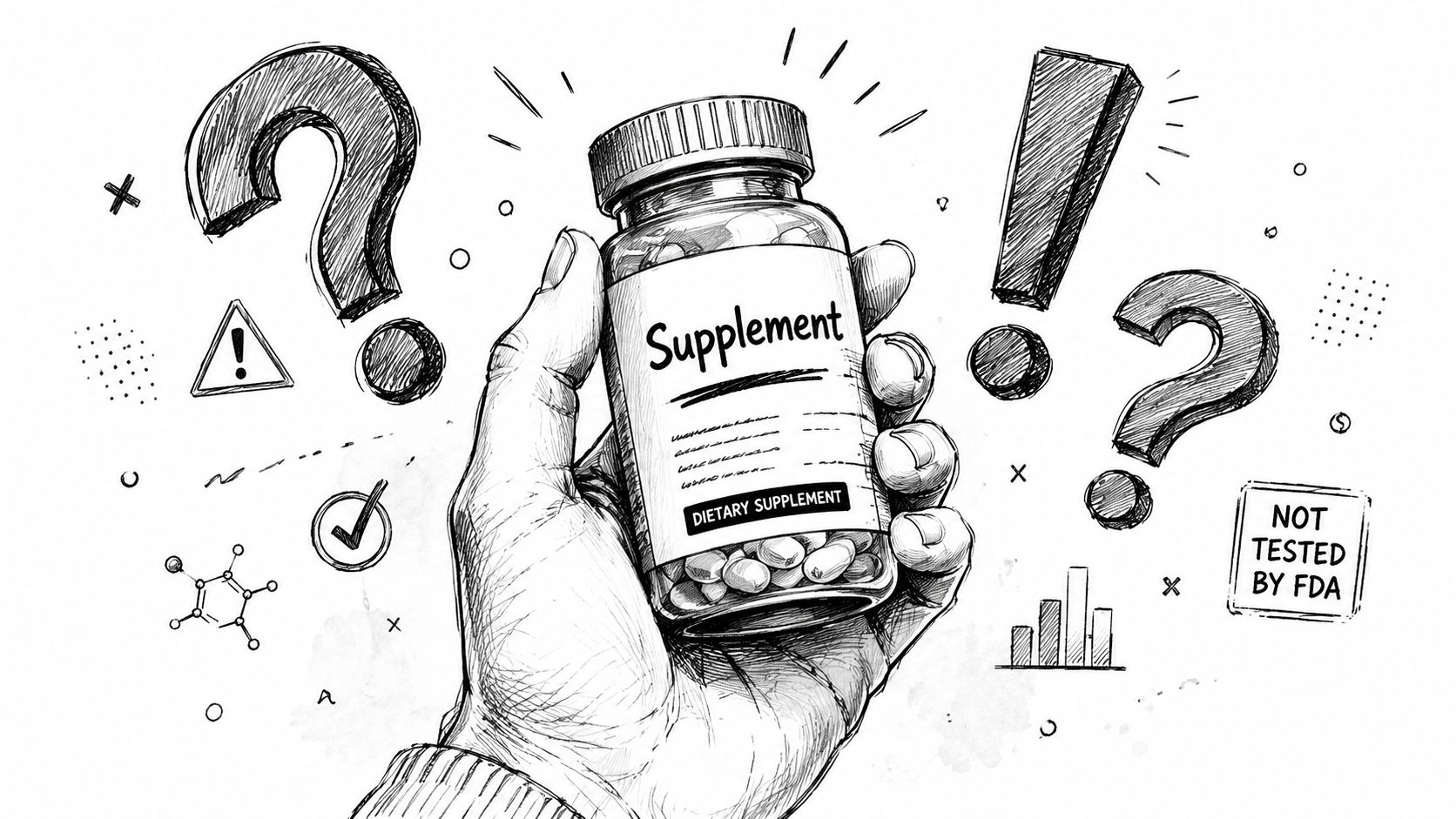
There's another reason to stay skeptical. Unlike prescription drugs, many supplements aren't tested in the same rigorous, product-by-product way before they reach consumers. So even if an ingredient has some promising research, the bottle in your hand may not match what was studied.
A smarter approach is calmer and less exciting. Start with the symptom. Ask what mechanism would plausibly help. Then ask whether the evidence applies to your age, sex, health status, and medication use. That process won't make flashy marketing more fun, but it can save you money, frustration, and avoidable risk.
How Herbal Supplements May Influence Sexual Health
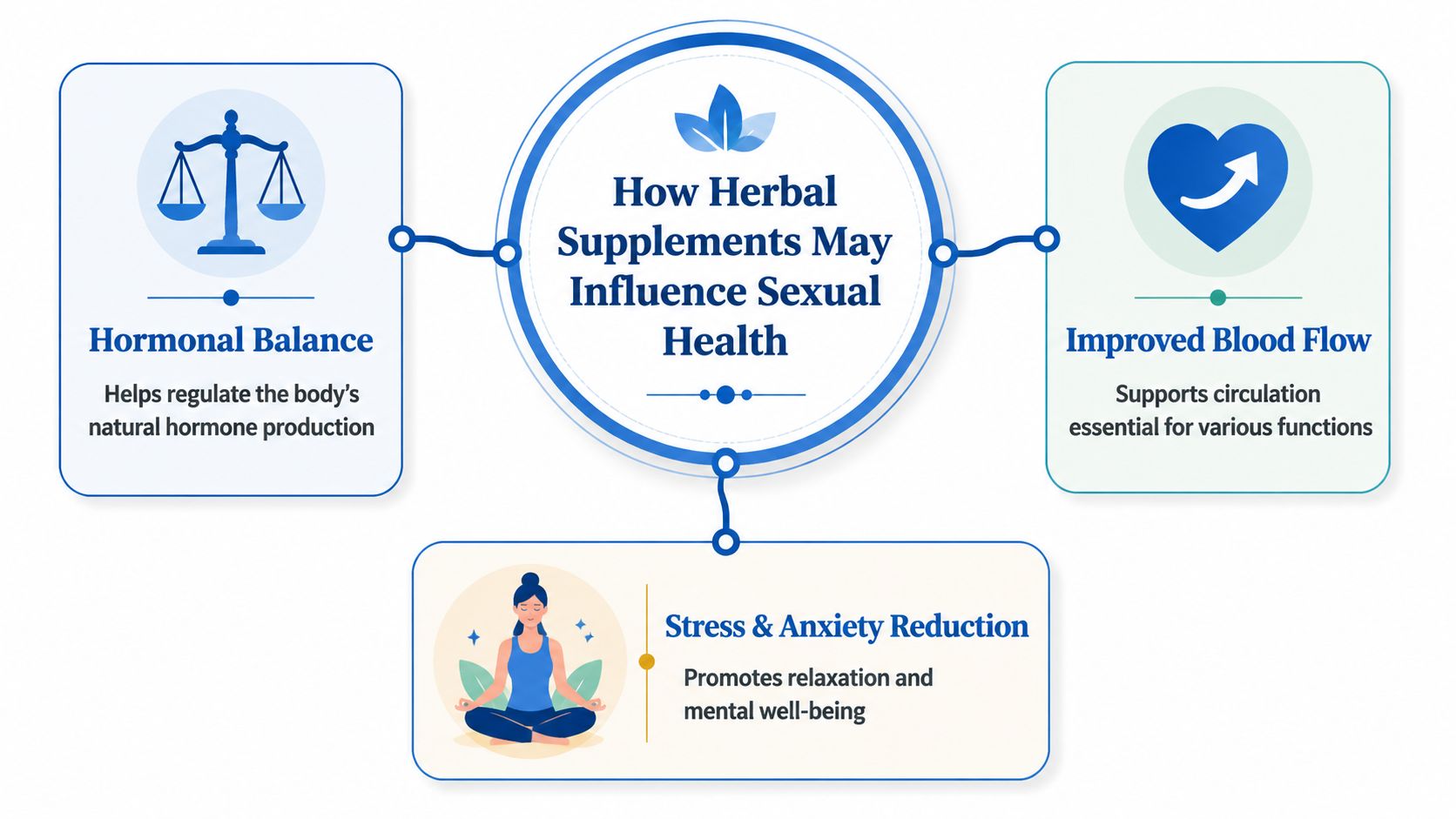
Some herbs are marketed as if they “boost sex drive” in a vague, all-purpose way. In reality, the few ingredients that show promise usually work through more specific pathways. Think of sexual function as a system with several moving parts. Blood has to reach the right tissues. Nerves and brain signals have to coordinate. Hormones can shape the background environment. Stress can either support desire or shut it down.
Blood flow as the delivery system
For erection quality in particular, blood flow matters a lot. A useful analogy is a garden hose. If the hose is narrow, kinked, or under low pressure, the water output won't be strong. If the pathway opens, flow improves.
Mechanistically, Panax ginseng and saffron are thought to improve erectile function and sexual satisfaction through nitric oxide mediated vasodilation and antioxidant pathways, with ginseng also potentially raising serum testosterone in some contexts, according to this review of herbal supplements and sexual function. Nitric oxide acts like a signal that tells blood vessels to relax and widen.
That's why some shoppers also notice overlap between sexual wellness marketing and circulation-support ingredients such as arginine or citrulline. Those products are often framed around nitric oxide support, such as this arginine and citrulline formula. The key point is that a circulation angle makes more sense for blood-flow problems than for every sexual concern.
Hormones and signaling
Hormones don't act like an on-off switch for libido. They're more like the lighting and temperature in a room. If the environment is off, desire and response can suffer. If the environment improves, the system may function better.
Some herbs are marketed as “testosterone boosters,” but that label often goes far beyond the evidence. Even when a mechanism is plausible, it doesn't mean the actual sexual effect will be noticeable for every person. It also doesn't mean the herb addresses the true cause of someone's symptoms.
Stress mood and the desire puzzle
Desire is not only physical. Stress, low mood, poor sleep, and mental overload can flatten interest in sex even when hormones and anatomy are otherwise normal. In those cases, a supplement sold as a libido enhancer may be trying to support the conditions around desire rather than desire itself.
A product can have a plausible mechanism and still fail in practice if it's aimed at the wrong problem.
A common point of confusion arises. If a person says, “I have low libido,” that could mean low interest, difficulty getting aroused, pain with sex, medication side effects, or unsatisfying erectile response. Those aren't interchangeable. The more specific you are, the easier it is to judge whether an herb's mechanism even fits your situation.
A Sober Look at The Evidence for Popular Herbs
The supplement market loves to lump very different herbs into one bucket. A product page may place maca, ginseng, tribulus, saffron, and red clover side by side, then imply they all support “sexual wellness” in the same way. That shortcut hides the part that matters most. Each herb has been studied for different symptoms, in different groups, with very different results.
A better way to read the evidence is to sort herbs by the problem they were tested for. A supplement can look promising for desire but do little for erections. Another may help a narrow group, such as women with menopause-related symptoms, but have little proof outside that setting. Herbs are more like tools in a drawer than a master key. The right tool may help. The wrong one only creates frustration.
Why the same herb gets very different headlines
Panax ginseng shows how easily marketing can outrun nuance. A systematic review found statistically significant improvements in female sexual dysfunction, including arousal, sexual desire, and orgasm quality compared with placebo, as reported in this ScienceDirect abstract on herbal interventions for female sexual dysfunction. That is a meaningful finding, but it applies to a specific condition and population.
The same herb is often promoted much more broadly than that. For men with erectile dysfunction, the evidence is less consistent, and earlier discussion in this article noted that reviews have not all reached the same conclusion. That difference matters. “Promising” in one setting should not be stretched into “works for everyone.”
Maca has a similar reputation gap. It is widely sold as a general libido booster, yet the evidence is much narrower than the label language suggests. The Mayo Clinic overview of erectile dysfunction herbs describes some encouraging findings for certain herbs and also makes clear that others lack good support. Maca may be worth a closer look for some people, especially around desire, but that is different from proven benefit for erections, orgasm, or every form of low libido.
That distinction is easy to miss because supplement marketing tends to flatten everything into one promise.
Evidence summary for common herbal supplements
| Herb | Primary Use Claim | Level of Evidence | Key Considerations |
|---|---|---|---|
| Panax ginseng | Female sexual dysfunction, erectile function | Mixed but meaningful in specific settings | Positive findings exist for female sexual dysfunction and some sexual function outcomes. Results are less consistent once claims broaden to general erectile dysfunction. |
| Saffron | Erectile function, orgasmic function, satisfaction | Promising for specific male sexual outcomes | More targeted evidence than broad “libido booster” marketing suggests. Best viewed as condition-specific, not universal. |
| Maca | Sexual desire | Limited and context dependent | Better known for desire-related claims than for erections. Marketing is broader than the evidence base. |
| Tribulus terrestris | Desire and arousal | Some clinical promise in selected settings | Early findings are encouraging in some groups, but they do not justify sweeping claims for every user or symptom. |
| Red clover | Menopausal sexual symptoms | Limited but relevant for a narrow group | Most relevant to women with menopause-related concerns such as dryness, discomfort, or reduced interest. |
| DHEA | Female libido and arousal | Some support in women | Often sold beside herbs, even though it is not an herb. Evidence and safety questions should be judged separately from plant supplements. |
| Yohimbe | Erectile dysfunction, libido | Poor evidence with major safety concerns | A poor choice for casual experimentation given its weak support and well-known risk profile. |
If you are comparing a maca product, narrow the question before you judge the label. Ask whether you are trying to address desire, erection quality, menopausal symptoms, medication-related changes, or something else entirely. A high-potency organic maca root supplement may be a reasonable product to examine, but the label alone cannot tell you whether it fits your specific issue.
Good evidence is specific. Weak marketing is broad.
The most useful takeaway is not “buy ginseng” or “buy saffron.” It is this. The same herb can look helpful in one group and disappointing in another because sexual symptoms are not one condition. If a product never tells you who it is for, what outcome it may support, and what the limits of the evidence are, skepticism is the right response.
Safety First Navigating Risks and Side Effects
A supplement doesn't have to be fake to be risky. It only has to be mismatched, contaminated, or combined badly with your health conditions or medications.
Natural does not mean low risk
One of the biggest consumer mistakes is translating “plant-based” into “safe enough to try casually.” That shortcut can backfire fast. Some ingredients may affect blood pressure, heart rhythm, sedation, bleeding risk, or drug metabolism.
Yohimbe deserves special caution. The Mayo Clinic warns that it lacks sufficient evidence for erectile dysfunction and has been linked to severe side effects including agitation, increased blood pressure, irregular heartbeat, heart attack, and seizures, as noted in the Mayo Clinic reference cited earlier. If you see aggressive marketing for a yohimbine libido booster product, treat that as a cue to slow down and review safety first, especially if you have cardiovascular concerns or take other medications.
There's also the product-quality problem. As covered earlier, some sexual wellness supplements have contained undeclared pharmaceutical ingredients or impurities. That means a person may think they're taking an herb when they're taking a hidden drug exposure of unknown dose.
The hidden risk of using the wrong evidence
Sometimes the danger isn't a dramatic side effect. It's false confidence and wasted time. A 2024 review noted that evidence for many libido-boosting herbs is mainly limited to postmenopausal women or women with antidepressant-induced dysfunction, and for healthy premenopausal women without specific hormonal deficits, evidence for herbs like maca and ashwagandha is insufficient to make firm recommendations, according to GoodRx's review of natural supplements and sex life claims.
That point matters because sexual symptoms often get flattened into one vague complaint. A woman with menopausal dryness and pain during sex is not dealing with the same issue as a healthy premenopausal woman with stress-related low desire. An herb studied in the first group may not help the second group at all.
If the evidence applies to someone else's biology, it may not apply to yours.
A safe mindset includes three checks before you buy anything:
- Check your medications: Blood pressure drugs, antidepressants, heart medicines, and blood thinners can all change the risk picture.
- Check the symptom: Low desire, erection trouble, vaginal dryness, pain, and poor orgasm quality aren't interchangeable.
- Check your health context: Menopause, hormone status, and medication side effects often matter more than the marketing headline.
How to Become an Informed Supplement Shopper
The easiest way to waste money on a sexual wellness supplement is to shop by promise. The better approach is slower and less exciting. Shop by fit, dose, and evidence.

Read the label like a skeptic
Start with the Supplement Facts panel. That panel is the ingredient map. The front of the bottle is the sales pitch.
A useful label should answer basic questions plainly. What herb is in it? How much is in each serving? How many servings do you take? If those answers are fuzzy, the product is asking for trust it has not earned.
Look for these signs:
- Named ingredients with amounts: A proprietary blend hides the dose, and dose is often the difference between a studied ingredient and a decorative sprinkle.
- A realistic claim: A formula that promises help with erections, libido, testosterone, stamina, mood, and fertility in one sweep is usually selling a fantasy, not a targeted use.
- Clear serving details: Capsule, gummy, powder, or liquid can affect whether you use it consistently and whether the serving size is practical.
- Third-party testing language: Independent testing can increase confidence that the bottle contains what it says and is less likely to contain unwanted contaminants. It does not prove the supplement will improve sexual function.
Dose matters for the same reason seasoning matters in cooking. A pinch and a tablespoon are both the same ingredient, but they do not produce the same result. Many supplements rely on the name of an herb doing the persuasive work while the actual amount stays hidden or unimpressive.
Match the claim to your actual problem
This step sounds simple, but it filters out a surprising number of bad buys.
Before you purchase anything, write one sentence: “I am considering this because I want help with ______.”
Be specific:
- “I want support for erection quality.”
- “I'm dealing with menopause-related dryness and pain.”
- “I'm noticing lower desire after starting an antidepressant.”
- “I feel mentally interested, but stress is making arousal harder.”
That sentence works like a prescription label. It keeps the product tied to a defined problem instead of a vague hope. Sexual health is not one single system. Blood flow, hormones, nerves, mood, sleep, medication side effects, and comfort all play different roles. If your concern is stress-related arousal, a product marketed for “male performance” may miss the problem entirely. If your issue is pain or dryness, a libido blend may be beside the point.
A short explainer can help sharpen that filter before you compare labels:
One more habit helps. Treat broad herbal formulas the way you would treat a key ring full of random keys. One key might fit your lock, but a crowded ring does not make that more likely. It often just makes it harder to tell what you are trying.
Shopping mindset: Ask whether the product matches your symptom, your body, and the amount that was actually studied. A strong-sounding label is not the same as a good match.
Finding Your Fit on CalVitamin
Once you know how to read claims more critically, shopping gets less overwhelming. You stop browsing for hype and start browsing for fit.

A simple shopping walkthrough
Say you're comparing products on a large wellness site. Start with the most relevant category rather than the homepage. If your concern is sexual wellness, look for the male or female enhancement category first, then narrow by ingredient, format, and any dietary preferences that matter to you.
That's where practical filters help. Some shoppers want capsules because they're simple to dose. Others prefer gummies or liquid shots. Some need attributes such as halal or gelatin-free. Narrowing by those features won't tell you whether a supplement works, but it does reduce decision fatigue and helps you compare similar products side by side.
Then open the product page and ignore the marketing headline for a moment. Look for the ingredient list, stated strength, serving details, and any customer reviews or ratings that may describe user experience. Reviews can tell you about taste, ease of use, or tolerability. They can't substitute for evidence, but they can help with day-to-day fit.
If pricing matters, compare “Special Price” and “As low as” offers carefully. Those can be useful for repeat purchases when you already know the product works for you and agrees with your body. They shouldn't pressure you into bulk buying a formula you haven't evaluated yet.
A good shopping sequence looks like this:
- Choose the right category: Male enhancer, female enhancer, herbal formula, or ingredient-focused option.
- Filter for your preferences: Capsules, gummies, shots, halal, gelatin-free, cruelty-free, or similar attributes.
- Read the facts panel: Confirm ingredient names and amounts.
- Check the claim against your goal: Desire, erection quality, menopausal symptoms, or general wellness support.
- Buy small first when possible: Test tolerability before committing to larger quantities.
Practical Answers to Common Questions
How long should you give a supplement
It depends on the ingredient and the goal. Some herbs in research were used over weeks or months, not overnight. If a product promises immediate transformation, that's usually marketing talking. Give enough time to judge a pattern, but don't keep taking something indefinitely if you notice no clear benefit or if side effects show up.
Is it smart to combine multiple sexual wellness supplements
Usually, that's where risk rises fastest. Combining products can stack stimulants, duplicate herbs, or increase the chance of interactions. It also makes it harder to know what helped or what caused a problem. If you're tempted to combine formulas, it's smarter to review the full ingredient lists with a pharmacist or clinician first.
How should you talk with your clinician
Bring the bottle or a photo of the label. Don't just say, “I'm taking an herbal sex supplement.” Say what symptom you're trying to address, how long it's been happening, what medications you take, and whether you have heart, blood pressure, hormone, or mood concerns. That turns a vague conversation into a useful one.
Can lifestyle changes matter more than supplements
Often, yes. Sexual function is tightly linked to sleep, stress, mood, medication effects, relationship dynamics, pain, and circulation. Herbs may have a role for some people, but they rarely replace the basics. If those basics are off, even a well-chosen supplement may disappoint.
If you want a place to compare sexual wellness products, ingredient-focused formulas, and different dosage forms without guessing from memory, browse CalVitamin with the same evidence-first mindset you've built here. Start with your actual symptom, read labels carefully, and choose products that match your needs instead of the loudest promise on the page.






