You're standing with your phone in one hand and two product pages open in the other. Both promise iron, both look clean and simple, and only one says halal on the front. That single word raises more questions than it answers, especially when the other bottle says gelatin-free and costs less. This guide slows that moment down, so you can check what matters before you buy halal iron supplements with confidence.
Table of Contents
- Two Iron Bottles, One Real Question
- What Halal Status Means for a Supplement
- Ingredients That Quietly Decide a Product's Status
- How to Verify a Halal Certification
- Iron Forms, Bioavailability, and What to Compare on the Label
- Dosage Math, Upper Limits, and Common Interactions
- A Shopping Workflow for Halal Iron Products
- The Three Checks That Matter Most
Two Iron Bottles, One Real Question
One bottle carries a halal seal. The other says gelatin-free, uses a plant capsule, and lists a higher milligram number. If you're a first-time shopper, it's reasonable to wonder whether those two claims mean the same thing.
They don't, and the difference isn't about the iron itself. Iron supports the body in the same way regardless of your faith. Halal status concerns ingredients and manufacturing controls, including capsules, coatings, excipients, and processing aids that must comply with Islamic dietary requirements.
The need behind the product is real and widespread. WHO reported anaemia affected 571 million women and 269 million young children worldwide in 2019, with iron deficiency identified as the most common focus of prevention and treatment. That scale explains why clear halal options matter, but it doesn't mean every case of anaemia comes from low iron or that a supplement suits everyone.
The questions worth answering first
Before you compare prices, work through four checks in order:
- Certification scope: Does the halal claim cover the finished product, or only one ingredient?
- Full ingredient list: What's in the capsule shell and the inactive ingredients, not just the iron line?
- Elemental iron amount: How much usable iron does each dose provide?
- Personal context: Is this a general purchase, or are you treating diagnosed deficiency, pregnancy, or symptoms that need testing?
The first three checks you can do at the shelf or on a product page. The fourth belongs in a conversation with a clinician, because anaemia can also result from infections, other nutrient deficiencies, inflammation, and genetic conditions. Keeping those lanes separate protects you from two common mistakes: assuming a gelatin-free label proves halal status, and assuming a halal label proves the dose is right for you.
A halal seal answers a sourcing and production question. It doesn't answer a medical one.
What Halal Status Means for a Supplement
Think of halal status as a documentation claim with a defined scope. It tells you that permitted sourcing, processing aids, and facility controls have been checked against Islamic dietary requirements. It doesn't change how iron works in your body.
The iron compound itself, such as ferrous sulfate or ferrous fumarate, is a mineral salt. The halal questions gather around everything that carries it into a finished product. A capsule shell, a tablet coating, a lubricant that helps powder flow through machinery, or a flavoring in a liquid can each introduce animal-derived or alcohol-based inputs.
The diagram below maps the three areas a credible halal claim should address.
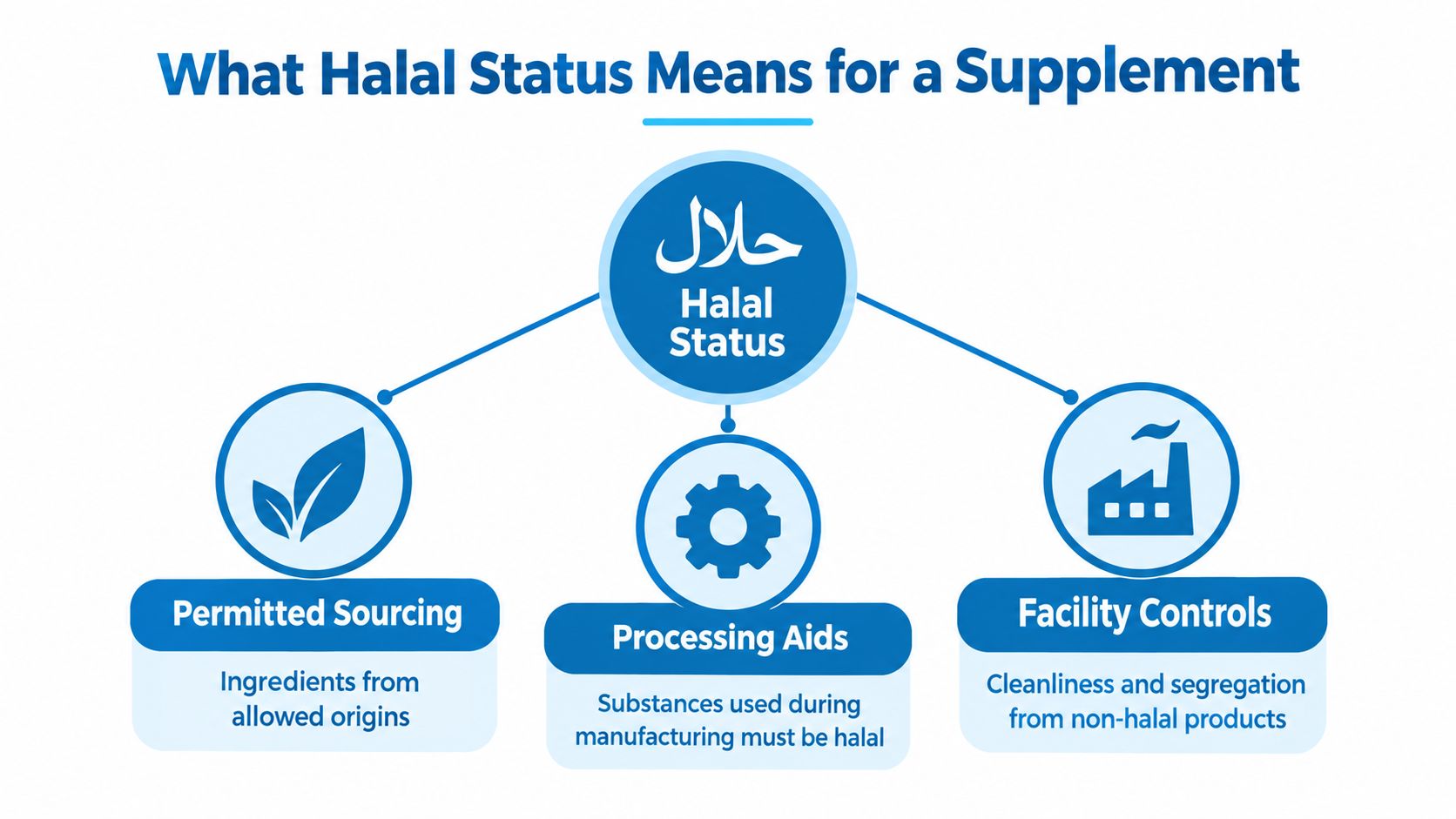
Three pillars behind the seal
Permitted sourcing covers where ingredients come from. Gelatin is the familiar example, because its acceptability depends on source and processing, but glycerin, stearates, and capsule polymers raise the same origin question.
Processing aids are substances used during manufacturing that may not appear prominently on a retail label. A shopper can't verify these from the front of a bottle, which is exactly why certification of the production process matters more than a marketing line.
Facility controls address the manufacturing line itself, including segregation from non-halal products and cleaning procedures. A finished iron tablet can use permissible ingredients and still fall short if the line it runs on isn't controlled.
Labels that sound similar but aren't
- Vegetarian or vegan: Describes animal content, not halal compliance across the supply chain.
- Gelatin-free: Rules out one ingredient only.
- Cruelty-free: Concerns testing practices, a separate ethical question.
- Halal certified: Indicates a third party checked sourcing, process, and facility within a stated scope.
None of the first three independently verifies the entire supply chain. Treat them as useful information, not substitutes.
Ingredients That Quietly Decide a Product's Status
Most shoppers read the iron line and stop. The halal status of a product is usually decided further down, in the inactive ingredients that rarely get a second look. Learning to scan that list with a halal lens is the skill that transfers to every supplement you buy afterward, and a step-by-step method for reading a supplement label can help you build the habit.
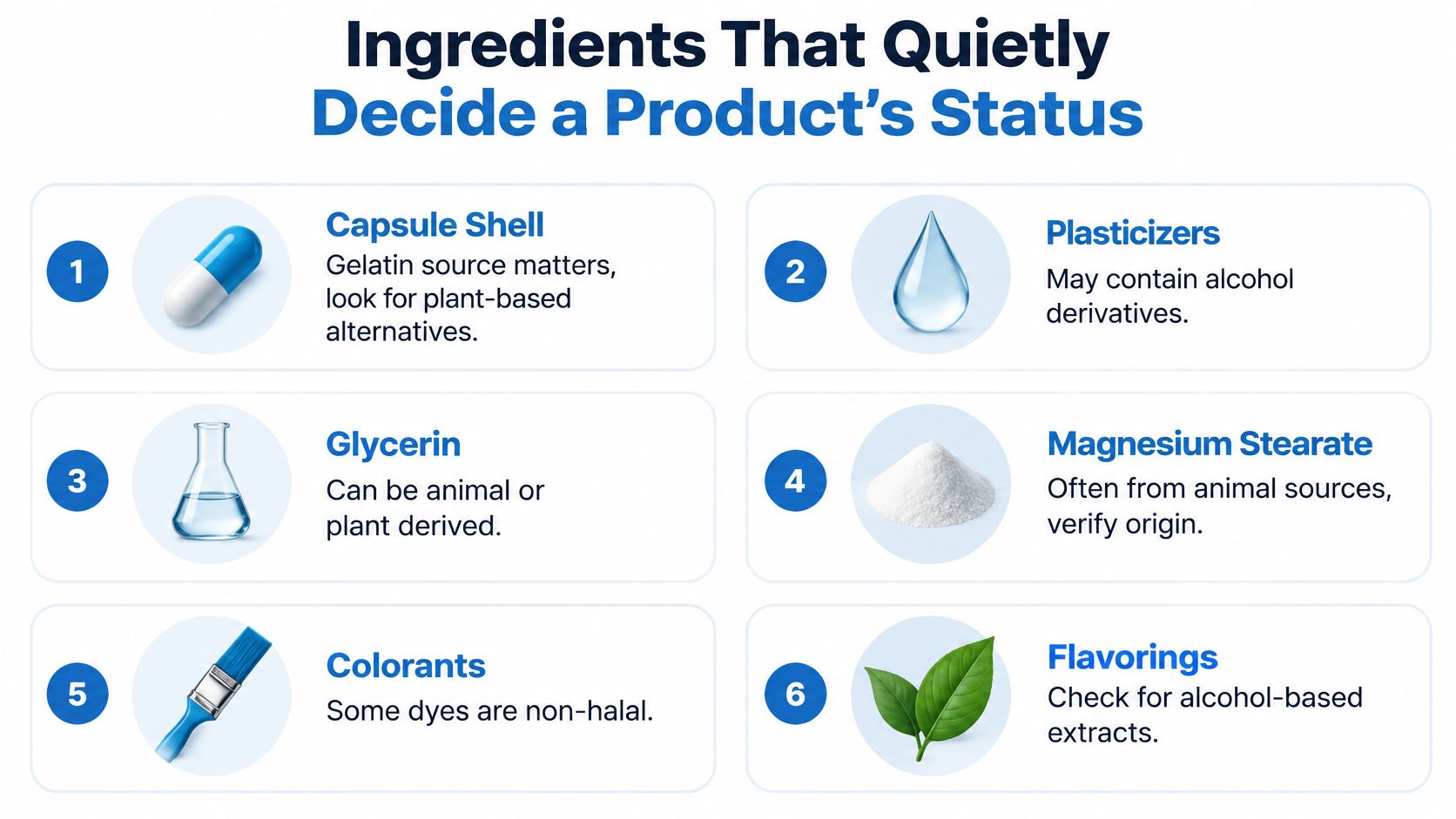
Start with the capsule shell. If it lists gelatin without a source, you can't determine acceptability from the label alone. Plant-based shells made from cellulose sidestep that specific question, but the rest of the formula still needs checking.
Six categories to scan
- Glycerin: Can be animal or plant derived, so origin needs confirming when certification is absent.
- Magnesium stearate: A common lubricant whose source varies by supplier, so ask for origin documentation.
- Plasticizers and coatings: These keep softgels flexible and tablets intact, and they may involve alcohol-based inputs.
- Colorants: Some dyes raise halal concerns, and labels rarely explain sourcing.
- Flavorings: Liquid and chewable iron products may use alcohol-based extracts, worth asking about directly.
- Processing aids: Used during manufacture, often invisible on the label, and covered only by facility-level certification.
Notice the pattern. For several of these, the honest answer is that the label can't tell you enough. Excipient disclosure on retail labels is often incomplete, so your next step is a question to the seller, not a guess. Ask for the capsule source, the full excipient list, and whether certification covers those components. A seller who can answer with documents gives you more security than one who repeats the word halal.
How to Verify a Halal Certification
A logo on a website is advertising. A certificate is evidence. Your job as a shopper is to move from the first to the second, and that takes about two minutes once you know what a credible document states.
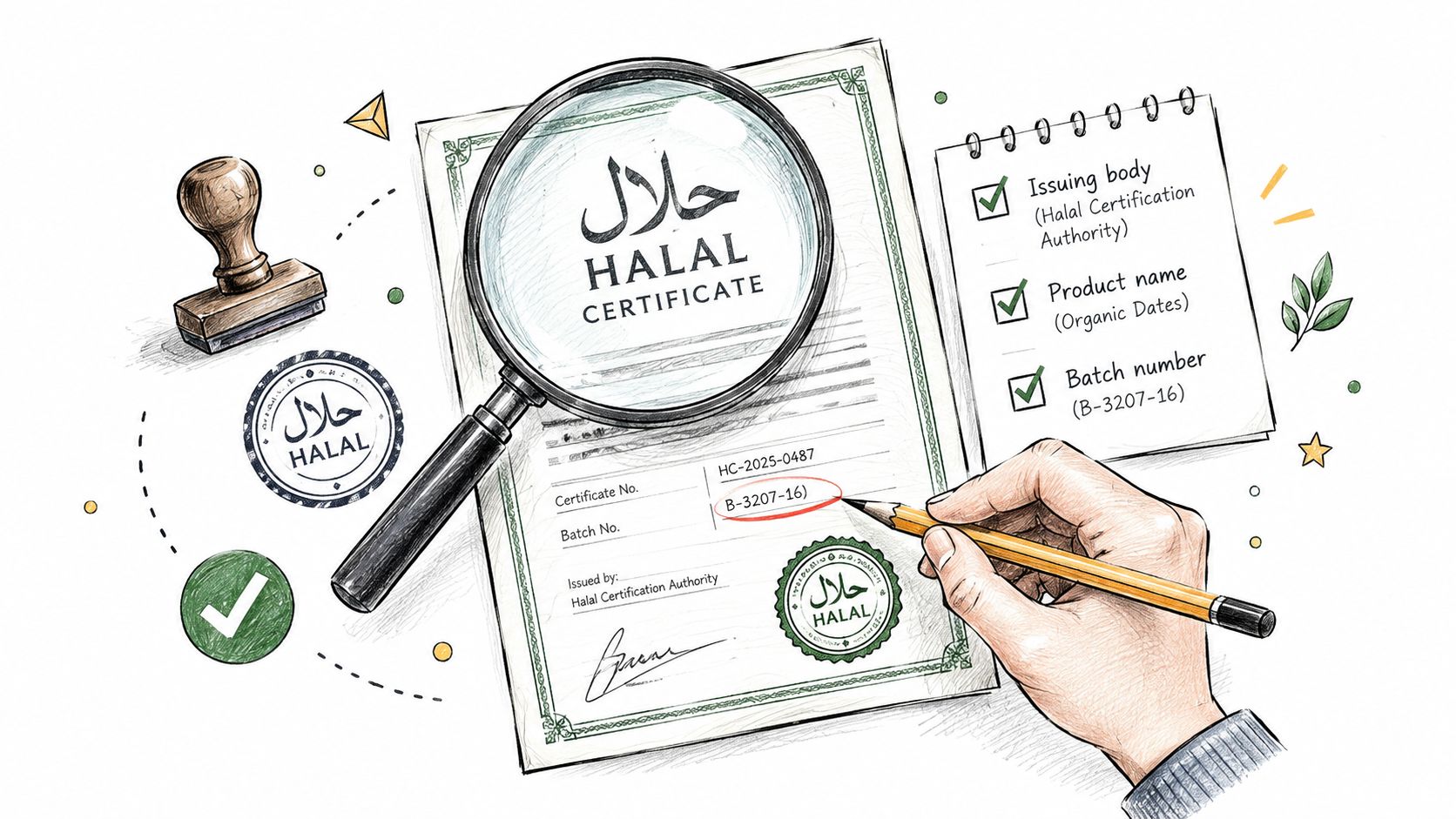
What to look for on the document
- Certifier name: A recognized issuing body you can identify and, if needed, contact.
- Product scope: The specific product name listed, not just the brand.
- Formulation coverage: Confirmation that excipients and the capsule shell fall inside the scope.
- Facility and country: Where the product is manufactured, since certification can be site specific.
- Expiry date: A certificate that has lapsed, or that predates a reformulation, is weaker evidence.
The distinction between product-level and facility-level certification matters here. A certified facility doesn't automatically certify every product made inside it, and a certified capsule shell doesn't certify the finished supplement. Guidance on what halal status must cover for a complete product reinforces why shoppers should confirm that documentation applies to the current formulation, the manufacturing facility, and relevant excipients rather than one component.
If you want broader background on how these claims appear across product categories, an overview of halal certified vitamins shows how the same scope questions apply beyond iron.
One more point of fairness. A product without certification isn't automatically prohibited, and you shouldn't treat absence of a seal as proof of a problem. Certification is just the clearest verification route available to a shopper. For disputed ingredients, a qualified religious authority is a better source than a seller's product description, and it's fine to pause a purchase until you've asked.
Iron Forms, Bioavailability, and What to Compare on the Label
Halal certification governs sourcing and production. It doesn't alter iron chemistry, so once status is verified, you're comparing the same forms any shopper compares. Two families dominate the shelf: ferrous salts and ferric preparations.
Ferrous iron is generally preferable when efficient absorption is the goal. Ferrous sulfate preparations typically provide approximately 10 to 15% bioavailability, while ferric preparations are roughly three to four times less bioavailable, because ferric iron dissolves poorly in alkaline gut conditions and must be reduced to the ferrous form before uptake.
The number that actually matters
Labels can mislead through arithmetic rather than intent. A capsule may contain a large weight of iron compound yet deliver modest elemental iron, which is the iron your body can use. WHO's antenatal equivalences show 60 mg of elemental iron equals 300 mg of ferrous sulfate heptahydrate, 180 mg of ferrous fumarate, or 500 mg of ferrous gluconate, which is why total compound weight is the wrong comparison.
Common Iron Compounds and Their Elemental Iron Share
| Compound | Typical elemental iron share | Practical note |
|---|---|---|
| Ferrous fumarate | About one third of compound weight | Compact dose, so smaller tablets can deliver more elemental iron |
| Ferrous sulfate heptahydrate | About one fifth of compound weight | Conventional reference form, widely used and well characterized |
| Ferrous gluconate | About one eighth or less of compound weight | Larger compound weight needed for the same elemental amount |
Read the Supplement Facts panel for elemental iron per serving, then confirm the chemical form in parentheses. Delivery format, whether capsule, tablet, liquid, or the gummy formats covered in this guide to iron gummies for adults, changes taste and excipients, not this underlying math.
Practical rule: Compare elemental iron and iron form first. Compare compound weight never.
Dosage Math, Upper Limits, and Common Interactions
The WHO antenatal benchmark referenced earlier, 30 to 60 mg of elemental iron daily during pregnancy alongside folic acid, with the higher amount preferred where anaemia in pregnancy is common, is clinical guidance for a specific situation. It isn't a shopping target for every adult, and pregnant consumers should supplement under qualified medical guidance.
The infographic below summarizes the dosage reference points and interaction checks that matter at the point of purchase.
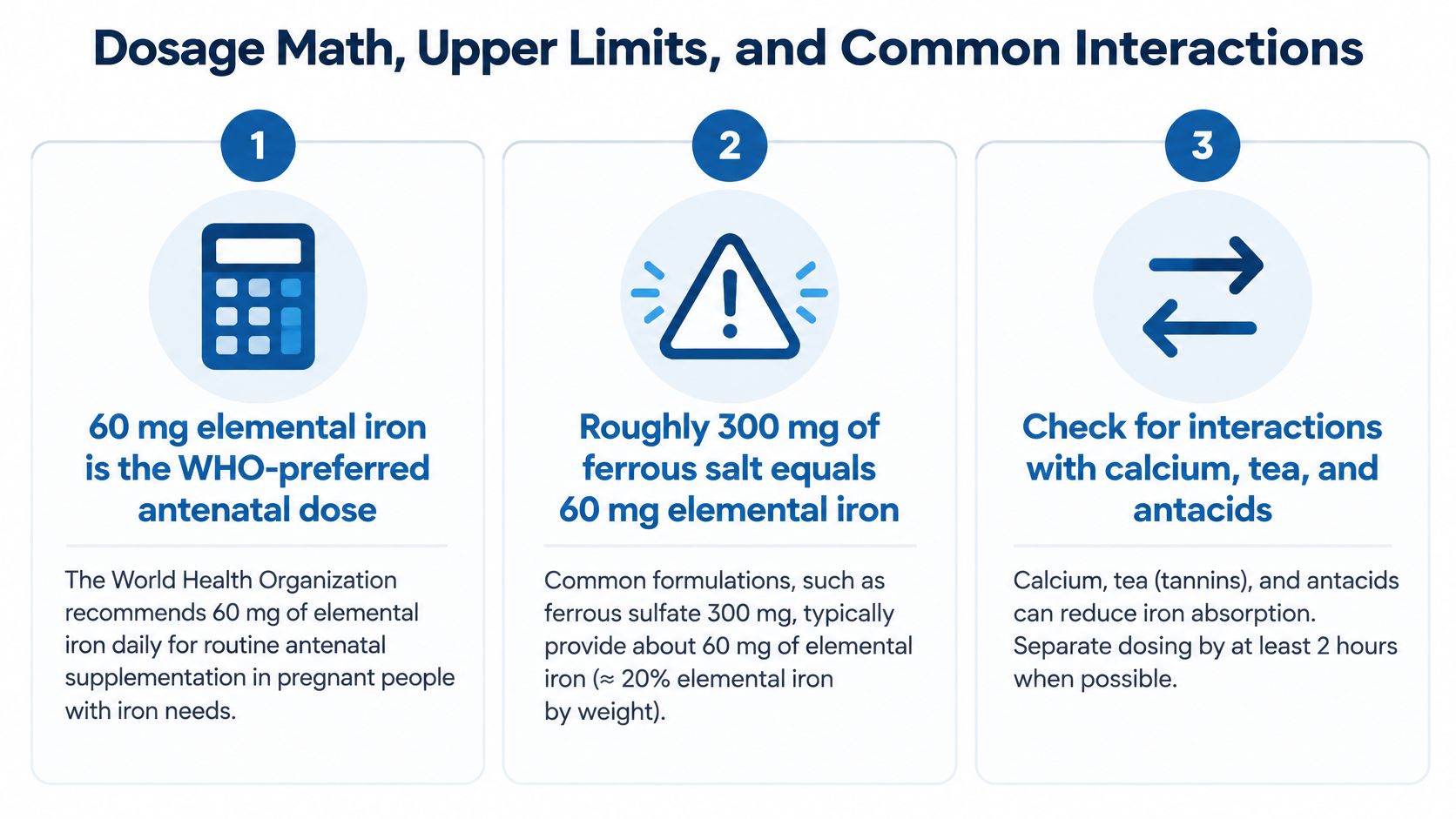
For self-directed adult use, the U.S. National Institutes of Health lists a tolerable upper intake level of 45 mg of elemental iron per day from food, beverages, and supplements combined. Clinicians may prescribe above that level temporarily for documented deficiency, but that's a supervised decision, not a retail one. The same source flags that iron can interact with levodopa and levothyroxine, and that U.S. regulators require strong warnings and single-dose packaging for many products above 30 mg per dose because high-dose iron is hazardous to children.
The short video below walks through how timing and dose spacing affect what you absorb.
Timing deserves respect because of hepcidin, a regulator of iron absorption. Doses of 60 mg of elemental iron or more can raise hepcidin for up to 24 hours and reduce absorption from a subsequent dose, and only about 10 to 20% of oral iron may be absorbed while the rest can drive constipation, nausea, and abdominal pain.
Practical implications follow. More doses per day doesn't guarantee more absorbed iron, and alternate-day or lower-dose schedules may improve fractional absorption for some people under clinical advice. Empty-stomach dosing may maximize absorption while food may improve tolerability, and calcium, tea, coffee, and milk can interfere, so separating iron from those items and from interacting medicines is a sensible default to confirm with your clinician.
A Shopping Workflow for Halal Iron Products
You can run this sequence on your phone in a store aisle or at your kitchen table. It takes the earlier checks and puts them in an order that prevents the most common error, which is comparing doses before confirming status.
Six steps in order
- Name your need: General dietary support is a shopping decision. Fatigue, pallor, or a suspected deficiency is a testing decision first.
- Verify certification scope: Find the certifier name and confirm the certificate names this product and its current formulation.
- Scan inactive ingredients: Check the capsule shell, glycerin, stearates, colorants, and flavorings for anything the certificate doesn't appear to cover.
- Compare elemental iron: Note the milligrams of elemental iron per dose and the iron form, ignoring total compound weight.
- Choose your format: Tablets minimize flavoring questions, liquids and chewables add them, and plant capsules simplify the shell question.
- Sanity check the total: Add dietary iron mentally against the adult upper limit discussed earlier, and store the product away from children.
If step two or three stalls because the product page doesn't say enough, ask the seller four specific things: certifier name, certificate scope, country of manufacture, and capsule source. Vague reassurance in reply is information too.
Price comparison comes last, and it only makes sense per dose of elemental iron, not per bottle. A cheaper bottle delivering half the elemental iron per capsule may cost more over a month. Quantity pricing can help once you've found a verified product you tolerate, but buying in bulk before you've confirmed tolerability and documentation puts the discount ahead of the decision.
The Three Checks That Matter Most
Everything in this guide compresses into three checks you can reuse on any iron product, in any store, for the rest of your shopping life.
First, certification scope. Ask whether the documentation covers the finished product, its excipients, and the manufacturing line. A halal capsule shell inside an uncertified product is a partial answer, and partial answers are where shoppers get caught.
Second, elemental iron per dose. The compound weight on the front of a bottle is marketing-friendly and clinically unhelpful. The elemental figure on the Supplement Facts panel, paired with the iron form, tells you what you are taking and lets you compare a fumarate tablet against a gluconate liquid.
Third, your medical context. Pregnancy, a diagnosed deficiency, thyroid or Parkinson's medication, and unexplained symptoms each move the decision from the shelf to a clinician's office. Halal compliance and clinical suitability are separate questions, and a product can pass the first completely while being wrong for you on the second.
Hold those three apart and the original two-bottle dilemma resolves itself. The gelatin-free bottle might be a fine product, but you now know it hasn't answered the halal question. The certified bottle has answered that question, but you still check its elemental iron and your own situation before it goes in the cart. Documentation beats description every time, and a seller who provides it has earned the comparison.
When you're ready to put these checks to work, browse the iron and mineral selection at CalVitamin, where product pages list formats, labeled attributes, and pricing tiers you can compare dose by dose. Bring your three checks with you, verify the certification scope and elemental iron on any product you shortlist, and reach out to the support team if a label leaves a question unanswered.