

An iron gummy can improve iron status in adults, but it can also make accidental overuse easier. In a randomized, double-blinded study of young Chinese women, daily iron-fortified gummies taken for 8 weeks improved iron status in 80% of participants, while mean hemoglobin increased by 14.5 g/L compared with control (clinical study of iron-fortified gummies). That's useful evidence, but it doesn't turn a gummy into harmless candy.
The vehicle changes the experience in both directions. A flavored chew can make daily use easier for someone who hates tablets, yet the same candy-like format can encourage careless dosing. The correct question isn't whether gummies are fashionable. It's whether the product delivers a clearly stated amount of elemental iron, in a tolerable form, for a reason you can defend.
Table of Contents
- Why Adults Are Reaching for Iron Gummies
- How Big the Need for Adult Iron Supplementation Really Is
- The Iron Forms Most Likely to Be in Your Gummy
- What the Best Iron Gummies Put on the Label
- Side Effects and the Overdose Risk of Candy-Like Iron
- Who Iron Gummies Actually Make Sense For
- Drug Interactions and When to Talk to a Clinician
- A Simple Buyer's Checklist Before You Click Add to Cart
Why Adults Are Reaching for Iron Gummies
Adults don't need an “energy gummy.” They need an iron supplement only when low iron is plausible or confirmed and the product's dose is clear. The gummy is the delivery system. Treat it like medicine that happens to taste better.
Traditional iron tablets can be difficult to swallow and may cause nausea, constipation, abdominal discomfort, or other gastrointestinal complaints. A chewable format removes the swallowing barrier and may fit more naturally into an existing morning routine. That matters because an iron supplement sitting untouched in a cabinet has no clinical value.
The trade-off is obvious once you stop thinking of gummies as sweets. They're flavored, portable, easy to take without water, and often stored in places where children can find them. A product that improves adherence for one adult can create an overdose hazard in the same household if the bottle is left on a nightstand or kitchen counter.

The seven label and safety decisions that matter
By the time you finish evaluating an iron gummy, you should be able to:
- Read elemental iron: Find the actual iron amount, not merely the weight of the iron compound.
- Identify the form: Distinguish a chelated form from a conventional iron salt or vague “iron complex.”
- Judge the dose: Compare the serving amount with your clinical goal and your total daily intake.
- Assess absorption support: Check whether vitamin C is included and whether calcium is likely to interfere with timing.
- Predict tolerability: Recognize that a gummy can still cause constipation, nausea, cramping, or diarrhea.
- Screen interactions: Review prescriptions, antacids, and mineral supplements before starting.
- Know when to stop self-treating: Unexplained anemia, iron-overload risk, or serious symptoms require medical evaluation.
Practical rule: If the front label sells “energy” but the Supplement Facts panel hides the iron form and elemental dose, put the bottle back.
The most important shift is psychological. You're not buying a wellness treat. You're choosing an oral iron product, and the gummy vehicle changes adherence, taste, storage, and overdose risk, not the underlying responsibility.
How Big the Need for Adult Iron Supplementation Really Is
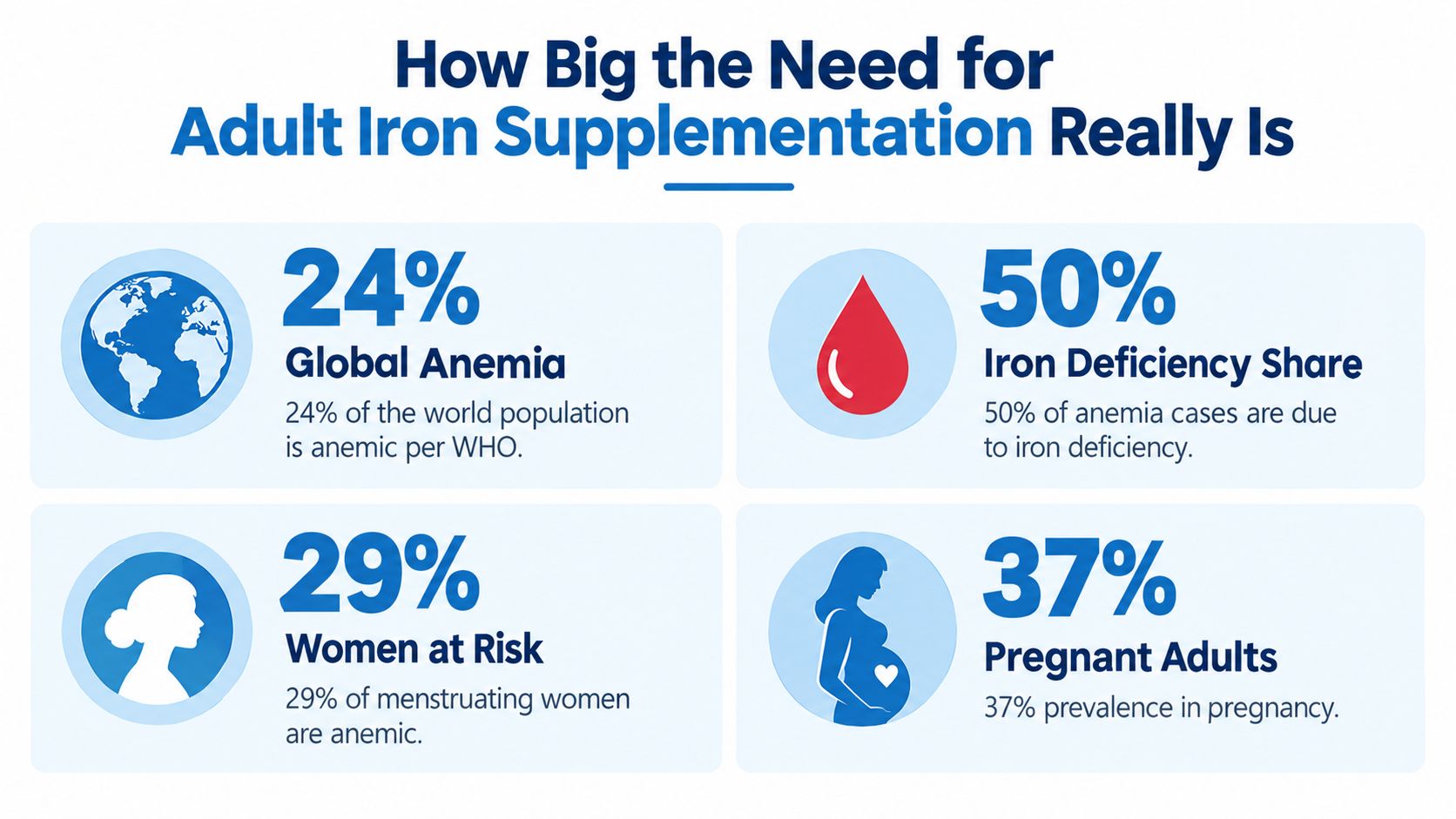
Iron deficiency is widespread, but fatigue alone does not justify an iron gummy. The World Health Organization describes iron deficiency as the most common and widespread nutritional disorder in the world and estimates that 30% to 40% of people in industrialized countries may be iron deficient when anemia is used as an indirect indicator (WHO iron deficiency assessment and control guidance).
The same WHO guidance estimates that about half of the 1.62 billion anemia cases worldwide are attributable to iron deficiency, or roughly 810 million cases linked to inadequate iron status. Separate burden estimates show an increase from 984.61 million cases in 1990 to 1,270.64 million in 2021. These figures establish a large public-health problem, not a reason for every tired adult to self-prescribe iron.
Risk varies by physiology and circumstance. Menstruating women can lose iron through regular bleeding, while pregnant people have increased nutritional demands. Endurance athletes, frequent blood donors, older adults with poor intake, and people with absorption problems may also develop depleted stores. The right response is to identify the likely cause and assess iron status, rather than treating vague symptoms with a sweetened chew.
The market response is physiological, not magical
A gummy earns consideration when it solves a practical adherence problem. Adults who abandon tablets because of taste, swallowing difficulty, or stomach upset may take a chewable product more consistently. That only helps if the product supplies a meaningful amount of elemental iron and matches the person's actual need.
The vehicle changes behavior and risk. A flavored gummy may make daily use easier, but its candy-like presentation can also encourage casual dosing or unsafe storage. Read the Supplement Facts panel before the marketing copy. The label should state the elemental iron per serving and identify the iron compound. “Iron blend” is not enough information for a responsible purchase.
Iron gummies therefore fit a specific situation: documented or likely iron deficiency combined with a barrier to conventional oral supplements. They do not establish that supplementation is appropriate for everyone, and they do not replace evaluation for unexplained anemia or possible iron overload.
Once the need is established, inspect the compound inside the gummy. The iron form affects elemental iron delivery, flavor, absorption, and tolerability.
The Iron Forms Most Likely to Be in Your Gummy
The iron compound determines how much elemental iron the product supplies, how difficult the flavor is to mask, and how likely the formula is to cause gastrointestinal trouble. Don't accept “iron blend” as an answer. A transparent label names the salt or chelate.
Ferrous bisglycinate is the premium-gummy favorite for a reason. It's a chelated form, often chosen for a cleaner taste and better tolerability than harsher iron salts. It can fit a flavored chew more easily, although the label still needs to state the elemental iron amount. “Chelated” describes the compound, not the complete dose.
Ferrous sulfate is a conventional salt that appears in lower-cost products because it's established, concentrated, and widely available. It can deliver meaningful iron, but its metallic taste and gastrointestinal effects make it harder to formulate pleasantly. A tablet example is high-potency ferrous sulfate iron supplementation, which illustrates why compound weight and elemental iron must be distinguished.
Ferric forms, including ferric saccharate and ferric pyrophosphate, are often marketed as gentle or taste-friendly. That marketing can be incomplete. Ferric chemistry may help the sensory profile, but absorption per milligram can be less favorable than ferrous forms, so the elemental amount and intended use matter more than the word “gentle.”
| Iron Form | Elemental Iron % | GI Tolerance | Taste / Gummy Fit | Typical Cost |
|---|---|---|---|---|
| Ferrous bisglycinate | Varies by formulation | Often selected for better tolerability | Generally well suited to flavored gummies | Premium |
| Ferrous sulfate | Varies by formulation | More likely to create gastrointestinal complaints | Metallic taste can be difficult to mask | Budget to moderate |
| Ferric forms | Varies by formulation | Often positioned as gentle, but product-specific | May fit flavor systems more easily | Moderate |
Scan for the chemistry, not the slogan
Look for ferrous bisglycinate, ferrous sulfate, or a named ferric compound in the Supplement Facts panel. A label that says only “iron” gives you too little information to compare products intelligently.
My preference for a gummy is a clearly labeled ferrous form, especially ferrous bisglycinate when tolerability is the deciding factor. But no form earns a pass if the bottle hides elemental iron or relies on a proprietary blend.
What the Best Iron Gummies Put on the Label
Start with the serving size, then read the iron line. Ignore the largest number on the front of the bottle until you know whether it refers to elemental iron or the total weight of an iron compound.
Consider a label that advertises 45 mg of iron but provides only 18 mg of elemental iron from ferrous bisglycinate, along with 60 mg of vitamin C and 3 g of added sugar per two-gummy serving. The meaningful dose is 18 mg of elemental iron. The vitamin C may support absorption, while the added sugar affects whether the product fits your diet. The serving is two gummies, so taking one delivers only part of the listed serving amount.
A worked label check
Read the panel in this order:
- Find the serving size.
- Locate the elemental iron amount per serving.
- Identify the named iron compound.
- Check vitamin C and other absorption-related ingredients.
- Review added sugar and total carbohydrate.
- Scan for testing marks, allergens, dyes, and unnecessary fillers.
The NIH Office of Dietary Supplements notes that taking iron away from calcium-containing foods or antacids can help avoid an absorption problem, while vitamin C or orange juice may support absorption. Taking iron with food can reduce side effects, but it may also reduce absorption (NIH iron fact sheet for consumers).
| Label Cue | What It Means | What to Look For |
|---|---|---|
| Serving size | Defines the dose you're actually taking | Clear number of gummies per serving |
| Elemental iron | Measures the iron supplied to the body | Milligrams stated separately from compound weight |
| Iron form | Identifies the chemistry used | Ferrous bisglycinate, ferrous sulfate, or named ferric form |
| Vitamin C | May support iron absorption | A stated amount or clearly identified source |
| Added sugar | Shows the sweetener burden | Grams per serving, not just “naturally flavored” |
| Testing mark | Signals an external quality program | USP, NSF, or ConsumerLab verification |
| Allergens | Helps prevent avoidable reactions | Full ingredient and allergen disclosure |
| Proprietary blend | Can conceal individual quantities | Avoid blends that don't disclose iron details |
A product such as an iron-free vegan gummy multivitamin also makes an important point: not every gummy multivitamin is intended to supply iron. Don't assume a product contains it because the bottle promises general wellness.
Label test: If you can't identify the elemental iron per serving in a few seconds, the product fails the transparency test.
Side Effects and the Overdose Risk of Candy-Like Iron
A gummy is still iron, not harmless candy. It can cause gastrointestinal upset, constipation, nausea, abdominal pain, vomiting, and diarrhea. The adult Tolerable Upper Intake Level is 45 mg of iron per day from supplements and food combined, per the NIH fact sheet cited earlier.
The format changes the risk. Small, pleasant pieces make it easier to chew several at once, while a candy-like appearance can hide how concentrated the product is. Judge the dose by elemental iron per serving, not by the number of gummies, the flavor, or claims such as “gentle.”
Manage symptoms without improvising the dose
Follow the label or clinician's instructions. Taking iron with a small snack may ease nausea, although food can reduce absorption. Splitting a medically appropriate daily amount may improve tolerability. Do not raise the total dose to make up for a missed serving.
Use these safeguards:
- Support bowel regularity: Drink enough water and maintain fiber intake if constipation develops.
- Track dark stools carefully: Iron can change stool color. Black or tarry stools with pain require medical attention.
- Secure the bottle: Store gummies locked, out of sight, and away from children.
If a multivitamin already contains iron, add its elemental iron to the gummy's amount before taking another product. The total matters more than any single label.
Storage rule: A child should never be able to mistake an iron bottle for candy.
Packaging and placement deserve the same scrutiny as the formula. A gummy may solve pill fatigue while making a concentrated mineral easier to access. Child-resistant storage is part of responsible use, not a decorative feature.
Who Iron Gummies Actually Make Sense For
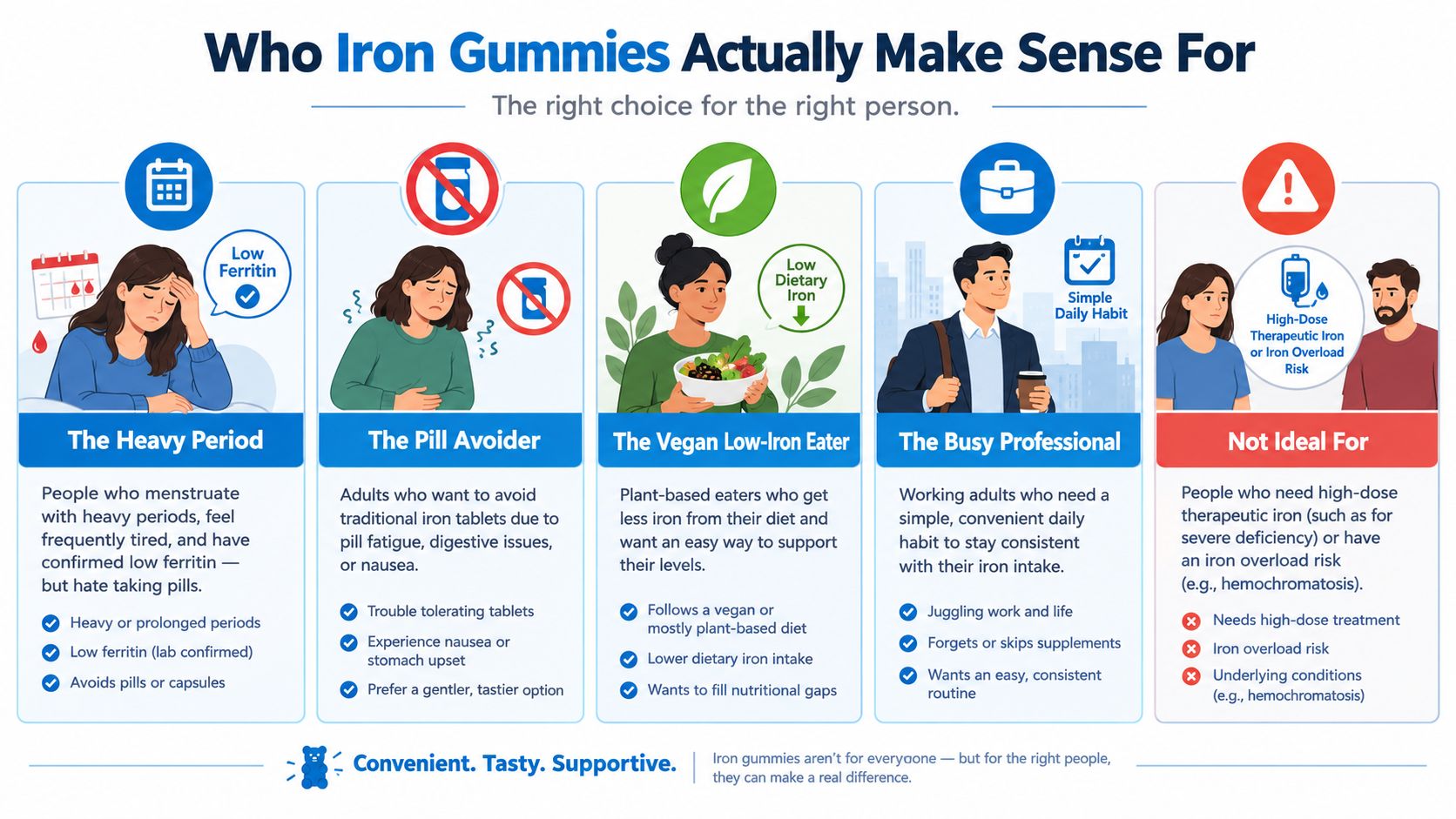
A gummy makes sense when it solves a real adherence or tolerability problem after the need for iron has been established.
Consider the menstruating adult with heavy periods and confirmed low ferritin who repeatedly stops ferrous sulfate tablets because they upset her stomach. A tolerable gummy may earn its place because she's more likely to follow a clinician-directed routine. The gummy doesn't diagnose the bleeding or replace evaluation of its cause.
An endurance runner with low ferritin and borderline hemoglobin may need a carefully selected maintenance approach. The useful feature here is convenience and consistency, not a vague promise of athletic energy. The dose should match the plan, and the runner shouldn't treat fatigue as proof that more iron is needed.
Four practical profiles
- Pregnancy planner: Iron needs and supplement choices should be handled with prenatal and clinical guidance. A gummy may help someone who can't swallow standard tablets, but self-prescribing high-dose iron isn't a sensible preconception strategy.
- Older adult with low intake: A person eating little iron-rich food may benefit from a format that fits a daily routine, but unexplained low iron after menopause deserves investigation rather than indefinite supplementation.
- Post-bariatric surgery patient: Reduced absorption and poor tablet tolerance can make a chewable format attractive. This group needs specialist oversight because a routine over-the-counter gummy may not meet the person's nutritional requirements.
- Pill-avoidant adult: If swallowing tablets is the main barrier, a clearly labeled gummy can improve convenience. The user still needs to count gummies as doses, not treats.
Who should skip self-directed use
Don't choose an iron gummy casually if you have hemochromatosis, a history of iron overload, repeated transfusions, active infection, or unexplained anemia. Adults with chronic kidney disease, inflammatory conditions, active malignancy, or planned surgery also need clinical direction.
The format is most defensible when the user has a reason for supplementation and a predictable way to take it. If the reason is only “I feel tired,” find the cause first.
Drug Interactions and When to Talk to a Clinician
Oral iron can interfere with the absorption or activity of other medicines, and several medicines can reduce iron absorption. The NIH specifically advises attention to calcium-containing products and antacids, while medication timing should be checked with a pharmacist or prescriber (NIH iron fact sheet for consumers).
| Substance | Effect on Iron | Recommended Separation |
|---|---|---|
| Antacids | Can reduce iron absorption | Ask a pharmacist about timing, often separated by several hours |
| Calcium supplements or calcium-rich products | Can interfere with absorption | Take at a separate time |
| Proton pump inhibitors | May reduce stomach acidity and affect absorption | Confirm a schedule with your clinician |
| H2 blockers | May alter conditions needed for absorption | Confirm a schedule with your clinician |
| Tetracyclines | Oral iron can reduce antibiotic absorption | Use clinician-directed separation |
| Fluoroquinolones | Oral iron can reduce antibiotic absorption | Use clinician-directed separation |
| Bisphosphonates | Iron can interfere with absorption | Use clinician-directed separation |
| Levothyroxine | Iron can interfere with absorption | Use clinician-directed separation |
A commonly used approach is to separate interacting medicines from oral iron by several hours, but the correct interval depends on the specific drug. Don't apply a rigid schedule without checking the medication label or asking a pharmacist.
Symptoms that change the advice
Talk with a clinician before starting or continuing an iron gummy if fatigue persists, you have shortness of breath at rest, palpitations, unexplained bruising, or abdominal pain with black or tarry stools. Those symptoms need evaluation, not a stronger supplement.
The same applies if you have a history of hemochromatosis, repeated transfusions, chronic kidney disease, inflammatory disease, active malignancy, or a planned operation. Iron can be useful, but it's a poor substitute for finding blood loss, malabsorption, or another medical cause.
A Simple Buyer's Checklist Before You Click Add to Cart
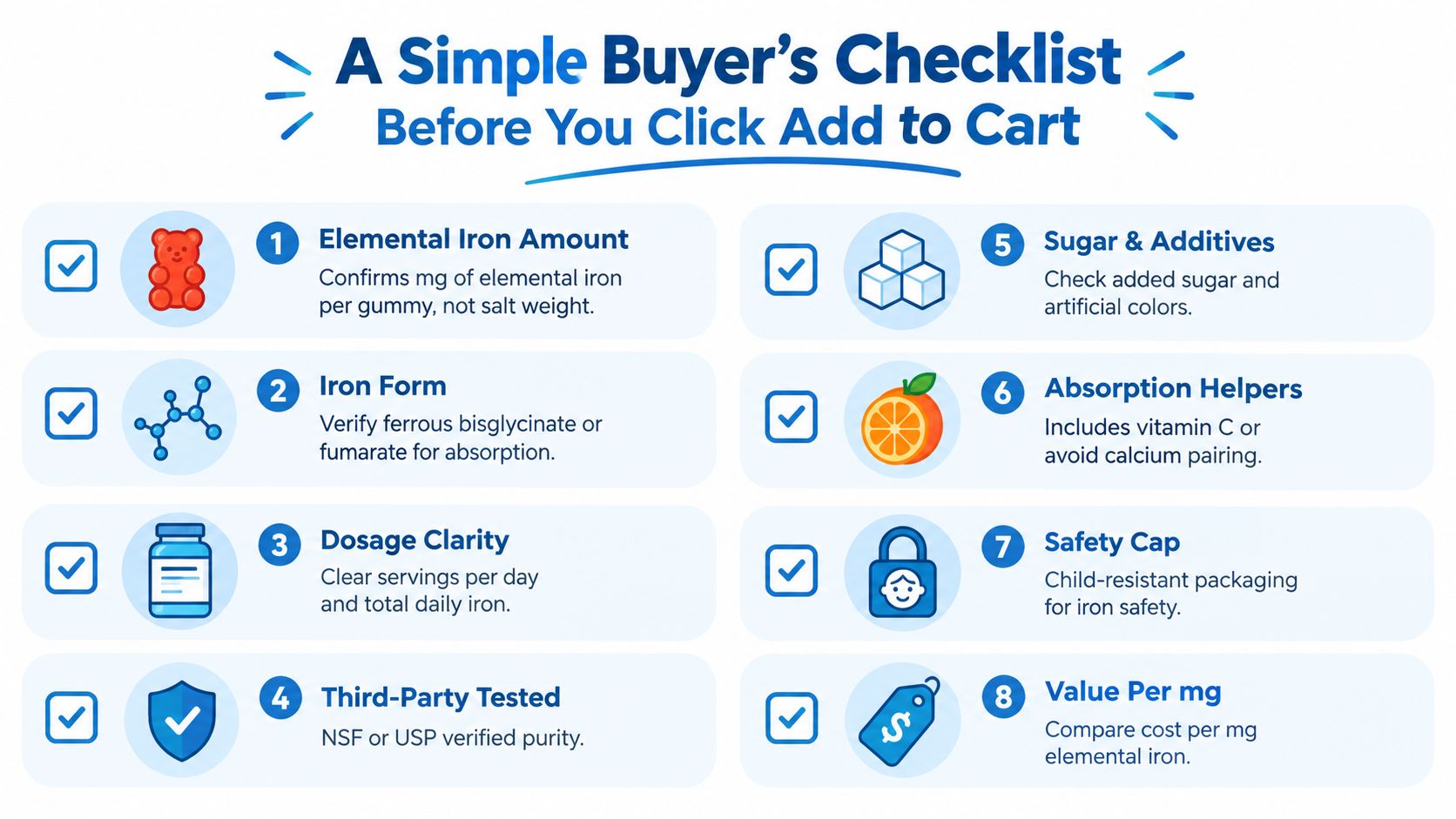
Use this checklist before buying iron gummies for adults. The gummy format can improve adherence, but its sweetness also makes accidental overuse easier. Judge the product by elemental iron, not by flavor, claims, or the number of gummies in the bottle.
- Confirm elemental iron: The Supplement Facts panel must state milligrams of elemental iron per gummy or serving.
- Verify the form: Prefer a named form, such as ferrous bisglycinate, especially when tolerability matters.
- Check the full daily dose: Confirm how many gummies provide the listed amount.
- Look for absorption support: Vitamin C may help, but it does not rescue an unclear formula.
- Scan sugar and carbohydrates: Review the actual grams per serving.
- Look for independent testing: Check for USP, NSF, or ConsumerLab verification.
- Read every ingredient: Screen fillers, dyes, sweeteners, gelatin, and major allergens.
- Compare value by elemental iron: Divide the price by the total milligrams of elemental iron in the bottle. A larger bottle may deliver less iron per serving, while a cheaper product may cost more for the dose you need.
Check the total daily dose against the 45 mg adult upper limit discussed earlier. That ceiling is not a treatment target. A clinician may recommend a different amount based on laboratory results, diet, medication use, pregnancy status, or the cause of deficiency.
For broader mineral shopping, CalVitamin's minerals collection lets you review available formats and labels. Apply the same checklist to every product, especially the elemental iron line.
Bring this sentence to your doctor or pharmacist: “I plan to take a gummy delivering X mg of elemental iron as ferrous bisglycinate or another named form, alongside my current medications, and I want to confirm it's appropriate.”
CalVitamin stocks gummy and tablet iron formats side by side, so you can apply this checklist to real Supplement Facts panels before choosing. Review the mineral options, then confirm your elemental iron dose with a clinician.






