

You're standing in the supplement aisle, comparing bottles that promise digestive comfort, immune support, and “advanced gut health.” One lists a huge CFU total, another highlights several familiar species, and a third names a strain you've never seen before. The loudest label is tempting, but it may be the least useful choice if it doesn't match your reason for taking a probiotic.
The practical answer to how to choose probiotics isn't to buy the highest-CFU product or the longest ingredient list. Start with your specific goal, identify the exact strain tested for that goal, confirm the studied dose and potency through the use-by date, then check the formulation, storage requirements, and safety information. This approach takes more judgment than grabbing a colorful bottle, but it sharply reduces guesswork.
Table of Contents
- Introduction Why Choosing Probiotics Feels Confusing
- Define Your Goal and Match It to the Right Strain
- Understand CFU Dose and What Potency Really Means
- Compare Formulations Delivery and Extra Ingredients
- Read Labels Verify Quality and Check Safety and Storage
- Smart Shopping Tips and Your Next Steps on CalVitamin
Introduction Why Choosing Probiotics Feels Confusing
Probiotics aren't interchangeable. A product containing Lactobacillus may differ meaningfully from another product containing a different species or strain in the same genus. Evidence is strongest when researchers test a specific strain, for a specific condition, at a specific dose and duration. A broad “probiotic” claim doesn't tell you whether the product fits your situation.
A 2024 evidence review found sufficient support for specific probiotics in some situations, including gut support during antibiotic use and reducing the risk of respiratory tract infections. It didn't find enough evidence to recommend probiotics broadly for every healthy person, as detailed in this 2024 evidence review on probiotic use. That distinction should shape your purchase. You may want general wellness, but a targeted product with a documented purpose is easier to evaluate than a vague all-purpose formula.
Practical rule: Buy for a defined use case, not for the biggest promise on the front of the package.
Suppose you're taking antibiotics and want to support your gut. A product tested for antibiotic-associated diarrhea deserves more attention than a general “daily microbiome” blend, even if the blend advertises a larger CFU count. If your concern is IBS-related bloating, you need evidence tied to IBS symptoms, not merely evidence that another probiotic helped a different digestive complaint.
I use a simple shopping sequence: define the goal, search for the full strain name, compare the label against human evidence, and then inspect delivery format and quality signals. CalVitamin's probiotics and prebiotics blog collection can provide useful category context, but the product label still has to pass your own audit. The right choice should make sense before it reaches your cart.
Define Your Goal and Match It to the Right Strain
Begin with one sentence: “I'm considering a probiotic because…” Keep the answer specific. “I want better health” is too broad to filter products. “I'm taking an antibiotic and want targeted gut support” or “I'm evaluating an option for IBS-related symptoms” gives you a usable buying brief.

Start with the use case
A 2017 review of meta-analyses found that the strongest evidence was concentrated in a narrow range of applications, particularly antibiotic-associated diarrhea in adults and children, Clostridium difficile-associated diarrhea in adults and older adults, and some respiratory tract infections. Many other proposed uses lacked strain-specific and dose-specific proof, according to the review of probiotic meta-analyses.
Use that evidence pattern as a filter:
- Targeted gut support: Look for products whose full strain and intended use relate to the digestive outcome you're trying to address. Antibiotic-related concerns and IBS are not the same shopping brief.
- Respiratory support: Search for evidence connected to respiratory tract infections rather than assuming any digestive probiotic has the same role.
- General wellness: Set realistic expectations. Broad wellness products may be convenient, but the evidence doesn't justify treating every probiotic as necessary for every healthy person.
- A diagnosed condition or persistent symptom: Ask a clinician or pharmacist for guidance before self-treating, particularly if symptoms are severe, new, or worsening.
Read beyond the genus
The label should identify the genus, species, and strain designation. “Lactobacillus” alone is incomplete. Even a species-level name may be insufficient because different strains can behave differently and may produce different clinical results.
The review of 228 trials concluded that only some specific strains or strain combinations worked, and that broad genus-level labeling wasn't enough to predict benefit. Expert guidance also favors recommendations supported by at least two randomized controlled trials for the same strain subgroup. That's why you shouldn't assume a result for one strain automatically applies to another strain in the same species.
Turn your goal into a search phrase. Instead of searching “best probiotic,” search for the condition, the full strain name, and the dose used in human trials. Then compare the product's actual formula with the evidence. If the product page names only a genus, gives no indication, and offers no way to verify the formulation, move on.
For digestive symptoms, CalVitamin's diarrhea relief guide may help you think through the problem before shopping. It shouldn't replace clinical care or strain verification. Your final brief should contain three items: the target outcome, the exact strain or strain combination, and the studied dose and duration.
Understand CFU Dose and What Potency Really Means
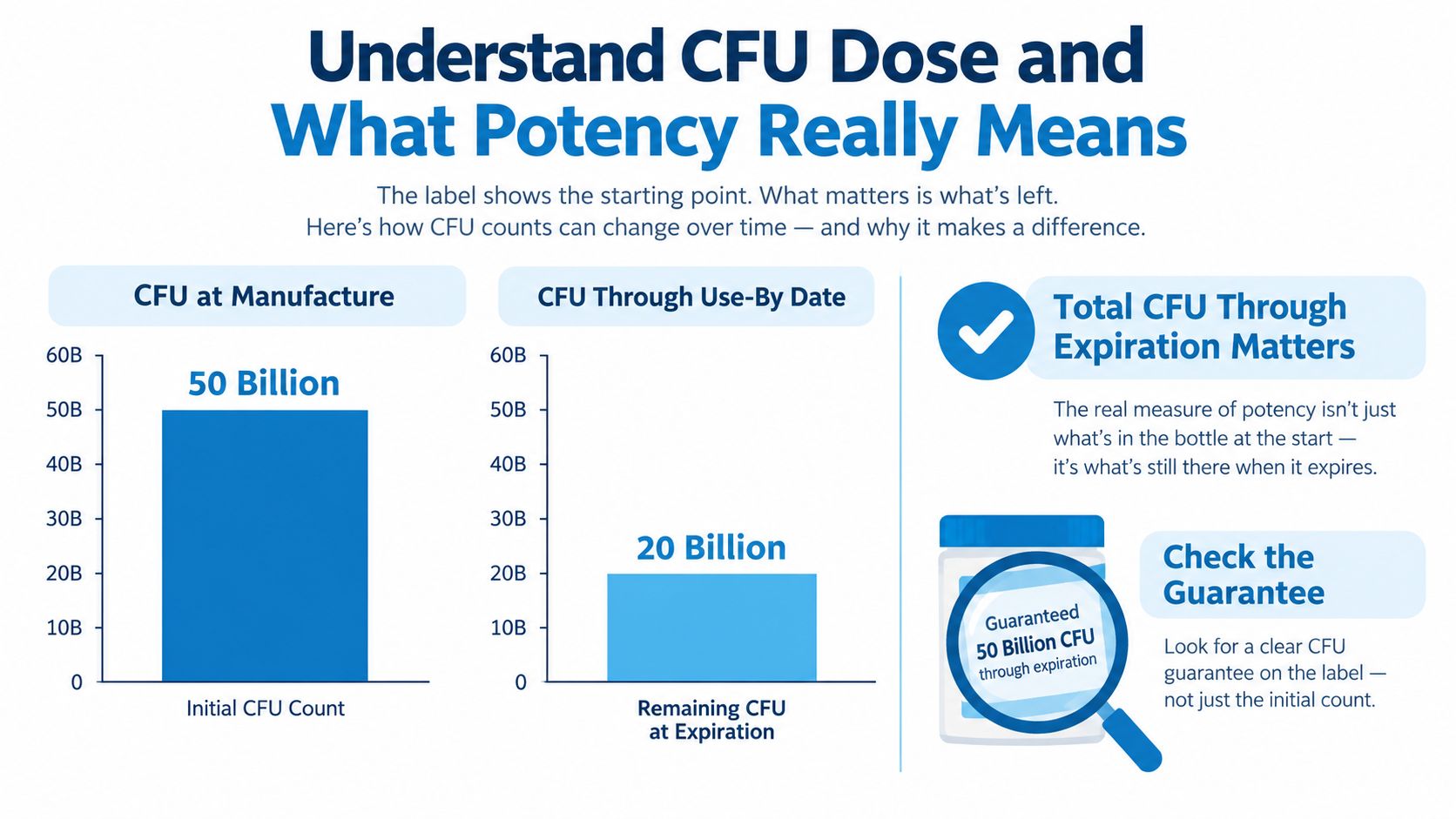
CFU means colony forming units, a count of viable microorganisms. It does not measure clinical effectiveness. A higher CFU number can still be the wrong choice if the strain does not match your goal, the dose differs from human research, or the organisms lose viability before use.
Compare the number that matters
Some products promote potency at manufacture. That number may not show how many viable organisms remain by the use-by date. The FDA draft guidance on live microbial supplements explains that companies may declare live microbial amounts in CFUs on the Supplement Facts label, giving shoppers a clearer basis for comparison.
Check five label details:
- Total CFU per serving: Confirm the amount promised for the stated serving.
- CFU by strain: Prefer a label that shows each strain's contribution instead of only a combined blend total.
- Guarantee through expiration: Look for a potency guarantee through the use-by date.
- Serving instructions: Verify whether the stated CFU applies to one capsule, several capsules, or a scoop.
- Storage conditions: Potency depends on following the package instructions after purchase.
The International Scientific Association for Probiotics and Prebiotics recommends listing total CFU, preferably for each strain, through the expiration or use-by date, together with storage instructions and strain identity. The NIH probiotics fact sheet for health professionals summarizes this labeling guidance.
A label that shows only a large total CFU count leaves out the information you need to verify whether the formula matches your target.
Match dose to evidence
The dose used in human research matters more than the bold number on the front of the bottle. Compare a product with the dose studied for the specific strain and outcome. A high total count does not compensate for a weak strain match or unclear shelf-life potency.
Research on IBS and diarrhea has found benefits in some probiotic groups, including associations with Bifidobacterium and Lactobacillus strains. The findings also include variation between studies and concerns about study quality. Use those results as context, not as permission to treat every product containing those genera as equivalent.
The same evidence overview reports that 12 of 29 probiotics, or 41%, showed no IBS symptom or quality-of-life benefit. That result makes the shopping filter straightforward: verify the exact strain, indication, studied dose, and potency through expiration.
CalVitamin search results can help you compare products, but the product page must show enough label detail to verify those points. Choose the clearest match, not the biggest CFU claim.
Compare Formulations Delivery and Extra Ingredients
Once the biological match looks credible, choose a format you'll use. A carefully selected probiotic is wasted if you dislike swallowing it, can't store it correctly, or react to an inactive ingredient.
Capsules suit shoppers who want a simple routine and a measured serving. Veggie capsules remove gelatin from the format, which may matter for dietary, religious, or ethical reasons. Powders can work for people who don't swallow capsules comfortably, but you'll need to mix them as directed and protect the package from moisture. Gummies may feel easier to take, although you should inspect the full ingredient panel rather than treating a pleasant format as proof of quality.
Spore-based options deserve separate attention. Their stability characteristics may differ from those of traditional bacterial products, so storage and indication claims still require scrutiny. Don't choose a spore-based product merely because it sounds more durable, and don't reject a conventional capsule just because it requires specific storage.
Use the format as a lifestyle decision
Your routine should determine the delivery form. Someone who travels often may prefer a product with clear room-temperature instructions. Someone with a refrigerator and a stable home routine may accept a refrigerated product. Neither storage approach automatically makes one product superior.
Prebiotic combinations, often called synbiotics, add another layer. A prebiotic ingredient is intended to support beneficial microorganisms, but it can also be an unwanted addition for someone who's sensitive to fermentable ingredients or who's trying to identify which product affects symptoms. A long formula isn't better. It gives you more ingredients to evaluate.
| Format or Blend | Best For | Watch For |
|---|---|---|
| Capsule | Simple, measured daily routine | Gelatin, capsule excipients, and storage instructions |
| Veggie capsule | Vegetarian, halal, or gelatin-free preferences | Confirm the complete dietary claims on the label |
| Powder | People who prefer mixing a product into food or liquid | Moisture exposure, mixing directions, and serving accuracy |
| Gummy | Shoppers who dislike capsules | Sweeteners, added ingredients, and whether the strain details are complete |
| Single-strain formula | A narrow goal with evidence for one strain | Don't expect it to cover unrelated outcomes |
| Multi-strain blend | A formula with a clearly documented combined purpose | Check every strain and whether the finished blend was studied |
| Synbiotic formula | Someone intentionally seeking probiotic and prebiotic ingredients together | Extra fermentable ingredients and symptom tolerance |
| Spore-based option | A shopper whose goal and label evidence fit that format | Don't confuse stability claims with proven clinical benefit |
Treat allergens and dietary attributes as hard filters, not afterthoughts. Check for gelatin, dairy-derived ingredients, wheat, and other components that matter to you. If the product page doesn't provide enough detail, the convenience of the format isn't worth the uncertainty.
Read Labels Verify Quality and Check Safety and Storage
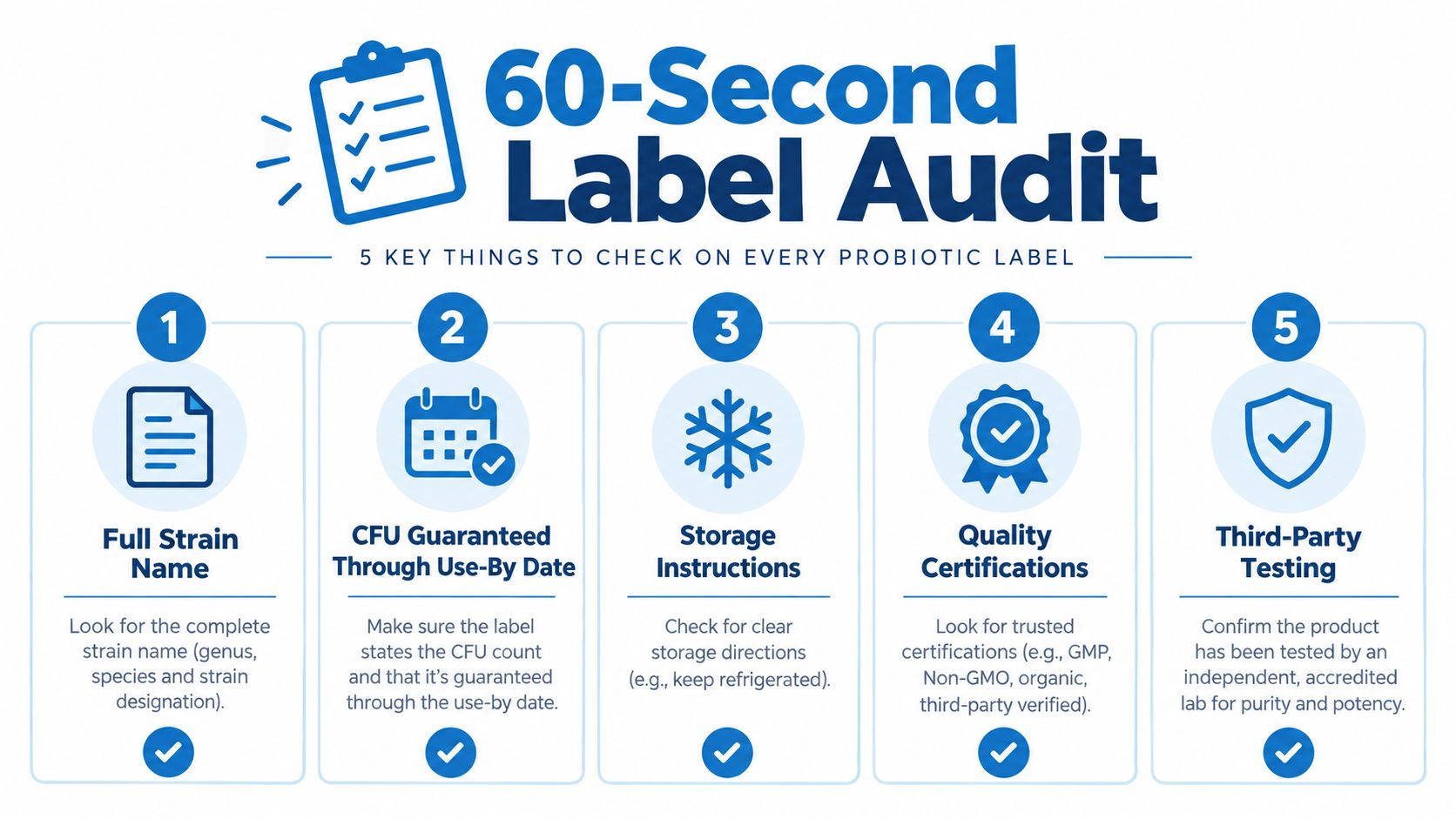
A good label audit takes about a minute. You're not looking for the most attractive bottle. You're checking whether the manufacturer gives you enough information to connect the product to your goal and use it safely.
Run the five-point check
First, find the full strain name. You want genus, species, and strain designation. A product that lists only “proprietary probiotic blend” makes it difficult to verify whether its formula has been studied for your intended use.
Second, find the potency guarantee. The label should state CFUs through the use-by date, ideally for each strain. A manufacturing-time count is less useful if the product doesn't tell you what remains at the end of shelf life.
Third, read storage instructions before buying. Some products require refrigeration, while others specify room-temperature storage. Follow the package directions, keep the container closed, and avoid heat and moisture. Don't leave a product in a hot car or beside a steamy sink.
Fourth, inspect quality and dietary information. Look for certifications or testing statements that are specific enough to understand. Review allergen information and claims such as gelatin-free or halal rather than assuming they apply to every product in a brand's range.
Fifth, look for independent verification. Third-party testing, batch information, and QR-style tools that connect a strain to its origin or evidence can provide useful transparency signals. These tools don't replace clinical evidence, but they can help you verify what's in the bottle. Industry coverage from MarketsandMarkets on probiotic transparency and product development describes the market's movement toward more specialized use cases and easier evidence verification.
Keep safety in view
Healthy adults often tolerate probiotics, but “natural” doesn't mean risk-free for everyone. People who are seriously ill, immunocompromised, have complex medical conditions, or are considering probiotics for a child, pregnancy, or a diagnosed gastrointestinal disorder should consult a qualified clinician before starting a product.
Ask a pharmacist about timing if you're taking antibiotics or other medicines. Seek medical care for severe or persistent diarrhea, blood in the stool, dehydration, fever, significant pain, or symptoms that don't fit a routine digestive complaint. A probiotic shouldn't delay evaluation of a potentially serious problem.
A product review can help you understand a label, but it can't confirm that a formula suits your health history. CalVitamin's Physician's Choice 60 Billion probiotic review may be useful for product-specific context, while your clinician remains the right person to address contraindications and treatment decisions.
Smart Shopping Tips and Your Next Steps on CalVitamin
Shopping becomes easier when you stop browsing by brand and start filtering by evidence. Write down your goal, strain requirements, dose, storage preference, and dietary restrictions before you open a product page. That short list prevents an attractive discount or oversized CFU claim from changing your criteria.

Use CalVitamin's Advanced Search to narrow the probiotic and prebiotic category by the features that matter to you. On each product detail page, inspect the strain list, serving directions, storage requirements, ratings, and customer reviews. Reviews can reveal practical issues such as capsule size or packaging, but they shouldn't substitute for strain-specific evidence.
Shortlist products before comparing price. Check Special Price and As low as tiers only after confirming that the product meets your strain, potency, and storage requirements. A lower price doesn't improve an unsuitable formula, and a bulk purchase doesn't make sense if you're still testing whether the product fits your goal.
Shopping filter: If you can't identify the strain, intended use, end-of-shelf-life potency, and storage instructions, don't add it to the cart.
Save plausible options to a wish list and compare them side by side. If two products meet your evidence requirements, choose the one with the clearer label and the format you're most likely to use consistently. You can also contact CalVitamin's support team by phone or email if a product page leaves an important question unanswered.
See the process in action before you shop:
The best probiotic isn't the loudest product on the shelf. It's the one whose strain, purpose, dose, potency guarantee, format, and storage instructions line up with your needs. Start narrow, verify everything, and change course if the label can't support the claim.
CalVitamin offers probiotics and prebiotics in multiple formats, with product pages that provide ingredient details, ratings, reviews, and shopping tools for comparison. Visit CalVitamin with your goal and label checklist ready, then choose the product that matches your intended use rather than chasing the biggest CFU number.






