
You're comparing B12 supplements online, and the labels seem to compete for attention. One bottle says 500 mcg, another says 1,000 mcg, and a brightly packaged lozenge lists an even larger number. The 500 mcg option looks like a sensible middle ground, but it raises a practical question: is that number meaningful, mostly marketing, or a little of both?
The answer becomes clearer when you stop treating the label as a direct prediction of what your body will absorb. Vitamin B12 uses an absorption system that fills quickly, so a large oral dose works partly through a high-capacity “spillover” route. Once you understand that mechanism, B12 500 mcg becomes less mysterious, and comparing tablets, lozenges, methylcobalamin, or cyanocobalamin becomes much easier.
Table of Contents
- Why a 500 mcg B12 Bottle Stands Out on the Shelf
- What 500 mcg of B12 Actually Means
- Methylcobalamin vs Cyanocobalamin at the Same 500 mcg Dose
- Who 500 mcg B12 Is Designed For
- Safety, Tolerability, and How Often to Take It
- Reading a B12 500 mcg Product Label Like a Pro
- Choosing the Right B12 500 mcg Product for Your Goals
Why a 500 mcg B12 Bottle Stands Out on the Shelf
A shopper scrolling through an online pharmacy might see three 1,000 mcg capsules, two 500 mcg tablets, and a 2,500 mcg sublingual product, all priced within a similar range. The 500 mcg bottle can feel reassuring. It isn't the smallest dose on the page, but it doesn't look as aggressive as the larger products either.
That instinct is understandable, but the dose alone doesn't tell you what the product will do. 500 mcg is a quantity, not a complete product description. The same amount can appear in methylcobalamin, cyanocobalamin, hydroxocobalamin, or adenosylcobalamin products. It can also come in a capsule, tablet, lozenge, gummy, liquid, or sublingual format.
The label number needs context
Two products can both list 500 mcg of vitamin B12 while differing in form, serving size, sweeteners, flavoring, allergens, and quality testing. One tablet may contain the full serving, while another product may require multiple gummies or lozenges to reach the listed amount.
That's why a buyer's ranking based only on “small,” “medium,” or “high” potency can mislead. The more useful questions are:
- What form is listed? Look for a specific name such as methylcobalamin or cyanocobalamin.
- What does one serving contain? The serving may be one tablet, more than one tablet, or a measured amount of liquid.
- What happens after swallowing it? B12 absorption is limited by the gut's transport system.
- Is the product intended for maintenance or treatment? Those aren't interchangeable goals.
Practical rule: Treat “500 mcg” as the starting point for label reading, not the final verdict on a B12 supplement.
Vitamin B12 has been clinically important for much longer than modern supplement labels have used standardized strengths. Harvard physicians George Minot and William Murphy reported in 1926 that eating large amounts of raw liver could treat pernicious anemia. Their work contributed to a 1934 Nobel Prize. Scientists isolated B12 as bright red crystals in 1947, Dorothy Hodgkin determined its molecular structure in 1956, and Robert Woodward announced the first successful total synthesis in 1971, after about a decade of work. These milestones are documented in this historical overview of vitamin B12 chemistry.
The modern 500 mcg bottle belongs to that longer story, but its usefulness depends on absorption mechanics, the person taking it, and the product label, not on the number's visual position in an online search result.
What 500 mcg of B12 Actually Means
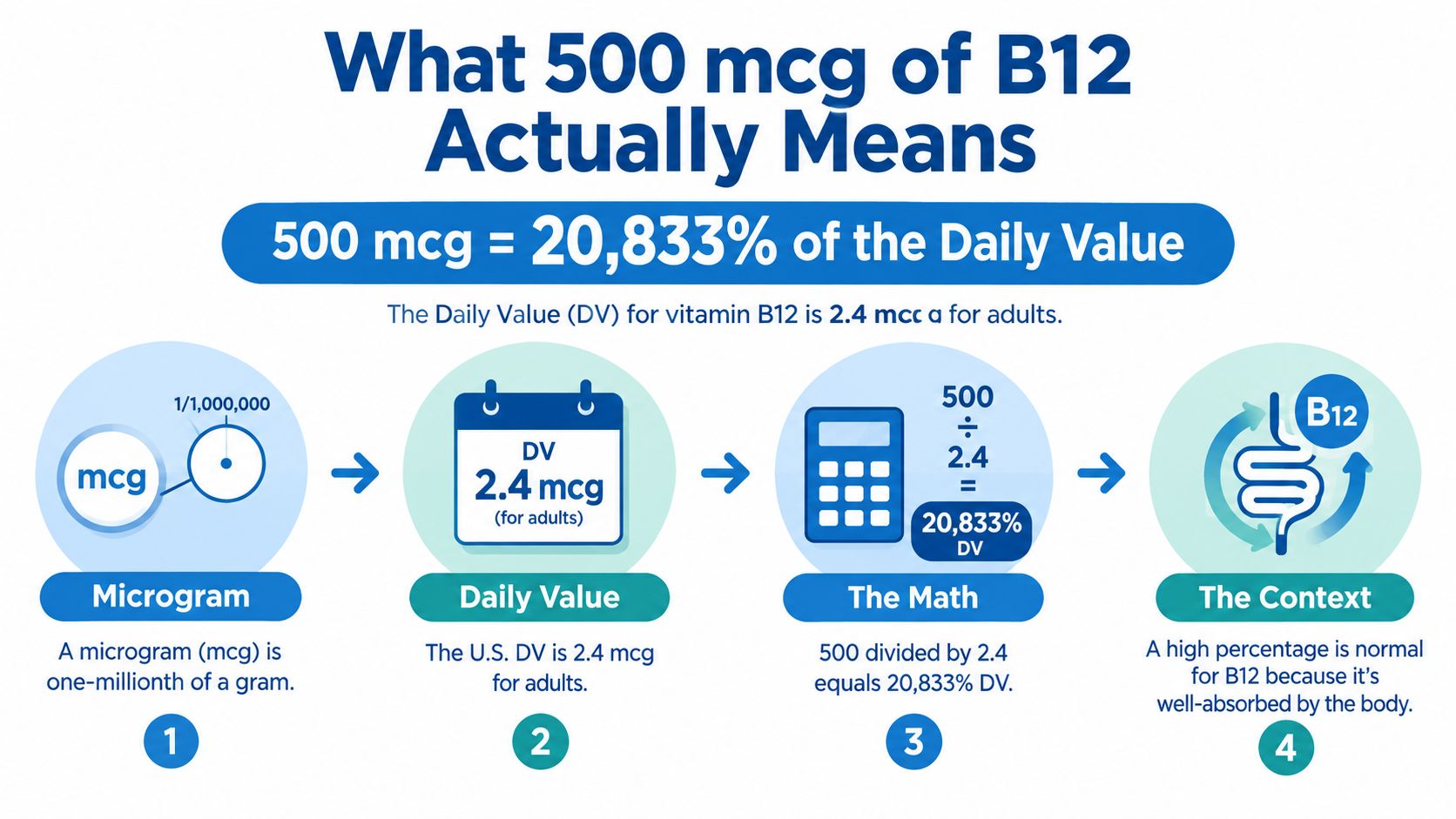
A microgram, or mcg, is one-millionth of a gram. That sounds tiny, yet vitamin B12 is required in tiny amounts. The U.S. adult Recommended Dietary Allowance is 2.4 mcg per day, according to the NIH Office of Dietary Supplements.
The arithmetic makes a 500 mcg label look startling:
500 mcg ÷ 2.4 mcg × 100 = approximately 20,833% of the Daily Value.
That percentage doesn't mean your body receives 20,833% of its daily need in a usable form. It describes the amount placed in the product before digestion and absorption. The body doesn't absorb every microgram that enters the intestine.
Think of absorption as a small sponge and a spillover route
Vitamin B12 normally binds with intrinsic factor, a stomach-produced protein that helps transport it through the intestine. That active pathway is efficient at low amounts, but it saturates. The NIH reports absorption of roughly 50% at lower doses near 1 to 2 mcg, compared with about 2% at 500 mcg and 1.3% at 1,000 mcg. Those figures are summarized in the NIH professional fact sheet on vitamin B12.
A useful analogy is a small sponge. At a modest dose, the sponge can soak up a substantial share. At 500 mcg, the sponge fills quickly, and much of the remaining liquid spills past it. A small amount can still cross the intestinal wall through passive diffusion, but that route absorbs only a limited fraction.
So 500 mcg is not 208 times more effective than 2.4 mcg. The number is high because the body's main absorption pathway has a ceiling, and the rest of the dose is offered as spillover. This is why a product can contain a dramatic percentage of the Daily Value without delivering that entire amount into circulation.
The most important distinction is between dose swallowed and dose absorbed. A 500 mcg tablet provides a large reserve, but the physiological result depends on intrinsic factor activity, digestive health, and whether passive absorption can compensate.
The 2025 expert framework on B12 supplementation adds an important qualification. It proposes that lower supplemental amounts may correct abnormal markers in some deficient patients, but states that 500 mcg per day isn't considered sufficient for manifested B12 deficiency under the latest recommendations. A 500 mcg product may suit maintenance or prevention for some adults, but it isn't a universal treatment dose.
Methylcobalamin vs Cyanocobalamin at the Same 500 mcg Dose
The two forms most shoppers encounter are methylcobalamin and cyanocobalamin. Their names describe different chemical forms of B12, but the amount printed on the front of the package remains the same if both products provide 500 mcg per serving.
Methylcobalamin is a coenzyme form of B12 that circulates naturally in the body and participates directly in reactions involving methionine synthase. Cyanocobalamin is a synthetic, crystalline form that the body converts into active B12 forms. That conversion releases a very small amount of cyanide, which healthy bodies normally clear without difficulty.
A 500 mcg methylcobalamin product supplies 500 mcg of that named form. A 500 mcg cyanocobalamin product supplies 500 mcg of the precursor form, which the body can convert. The label doesn't mean that one product automatically produces a larger absorbed dose. The absorption bottleneck described earlier still matters.
Side-by-side comparison
| Attribute | Methylcobalamin 500 mcg | Cyanocobalamin 500 mcg |
|---|---|---|
| Chemical role | Coenzyme form used directly in certain B12-dependent reactions | Synthetic form converted by the body into active forms |
| Label meaning | 500 mcg of methylcobalamin per serving | 500 mcg of cyanocobalamin per serving |
| Common formats | Often found in lozenges, gummies, and tablets | Common in tablets, capsules, and fortified products |
| Stability | Generally less shelf-stable than cyanocobalamin | Known for strong shelf stability |
| Cost positioning | May cost more depending on formula and format | Often used in economical formulations |
| General takeaway | A reasonable choice when the label specifically identifies this form | A well-established option for many healthy users |
Marketing often presents methylcobalamin as automatically superior, but the dose form and the user's health status matter more than a simple winner-and-loser claim. For a healthy person who can absorb oral B12 and takes an adequate amount, both forms can raise B12 status.
If you're evaluating a methylcobalamin lozenge, you can compare the product details on this Life Extension vitamin B12 methylcobalamin listing. The useful habit is to check the exact ingredient form rather than assuming that “active” or “natural” language tells you everything.
Cyanocobalamin deserves special caution for people with Leber's hereditary optic neuropathy, who should avoid that form unless a clinician advises otherwise. For everyone else, form selection can reasonably come down to tolerance, price, availability, and whether the product's serving information is clear.
Who 500 mcg B12 Is Designed For
A 500 mcg product makes the most sense when someone needs more than a food-level amount but doesn't necessarily need a clinician-directed repletion protocol. It's often positioned as a maintenance or preventive dose, not as a complete response to every kind of deficiency.
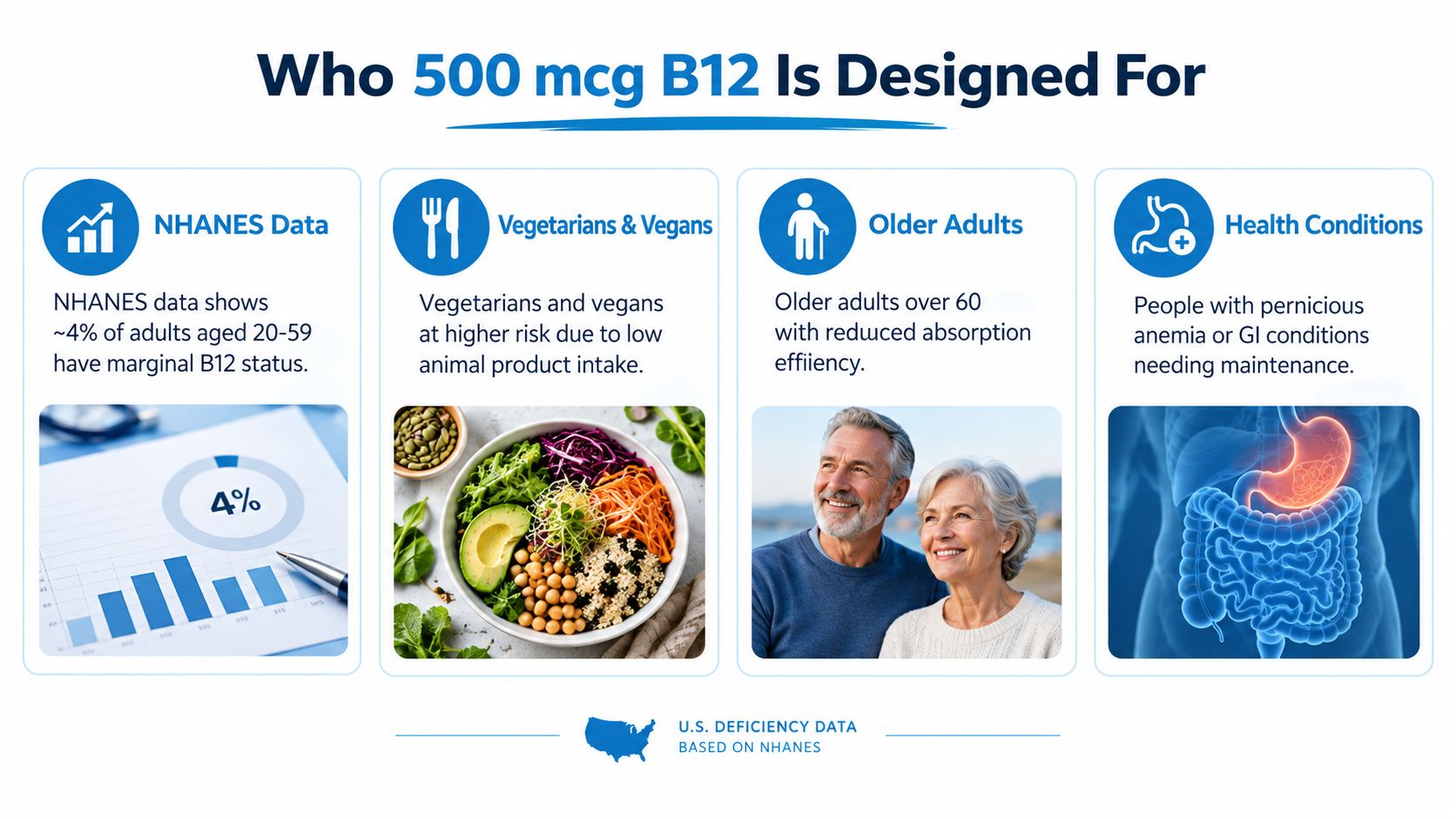
Population data help explain why high-potency products remain relevant. NHANES-based estimates summarized by the NIH vitamin B12 fact sheet indicate that about 3.6% of U.S. adults aged 19 and older have vitamin B12 deficiency, while about 12.5% have insufficiency. Deficiency reaches about 3.7% among adults aged 60 and older.
The people most likely to need a closer look
Older adults may absorb food-bound B12 less efficiently because the digestive process that releases B12 from food can change with age. A supplement offers B12 in a concentrated form, but a person with a diagnosed absorption disorder still needs individualized guidance.
Vegans and strict vegetarians may have limited dietary B12 intake because naturally occurring B12 is associated mainly with animal-derived foods. Fortified foods and supplements can help fill that gap, but a plant-based diet doesn't automatically determine the correct dose.
People taking certain medicines, including long-term metformin or acid-suppressing medicines, may need to discuss B12 monitoring with a healthcare professional. These medicines can affect B12 status through different effects on absorption.
People with gastrointestinal conditions or previous bariatric surgery may also require more careful assessment. The problem may not be a lack of intention or consistency. It may be that the gut can't use the usual pathway effectively.
Maintenance isn't the same as treatment
A 500 mcg tablet can be a sensible option for some adults who want regular nutritional coverage, especially when dietary intake or absorption may be unreliable. It shouldn't be used to self-manage significant symptoms such as persistent numbness, tingling, balance changes, or marked fatigue without testing and medical advice.
The 2025 B12 framework specifically warns that 500 mcg daily isn't considered sufficient for manifested deficiency under current recommendations. That distinction protects readers from a common mistake: assuming a high-looking percentage on the label equals a treatment plan.
Safety, Tolerability, and How Often to Take It
Vitamin B12 has a broad safety margin, and the NIH hasn't established a tolerable upper intake level for it. That doesn't mean every supplement is appropriate for every person, or that a larger dose is automatically more useful. It means available evidence hasn't established a daily ceiling at which B12 consistently causes toxicity in healthy people.
A 500 mcg product is typically tolerated well. Some may notice digestive symptoms, itching, flushing, or a skin reaction. If a new symptom appears after starting a supplement, stop treating the label as harmless by default and ask a healthcare professional whether the product or another ingredient could be responsible.
People with Leber's hereditary optic neuropathy should avoid cyanocobalamin specifically. Anyone with diagnosed deficiency, significant malabsorption, kidney disease, or complex medication use should choose a plan with clinical input rather than relying on a general supplement schedule.
Daily and weekly schedules
The spillover model also explains why people may use different schedules. Each larger oral dose has a limited absorbed fraction, so some users take a smaller amount regularly while others use a larger amount less often. Those schedules aren't automatically interchangeable for someone with severe deficiency or a clinician-prescribed regimen.
| Regimen | Typical schedule | Approximate weekly intake | Best for |
|---|---|---|---|
| 500 mcg daily | One serving each day | 3,500 mcg | People who prefer a steady routine |
| 1,000 mcg weekly | One serving once weekly | 1,000 mcg | Adults using an intermittent maintenance plan |
| 2,500 mcg weekly | One larger serving once weekly | 2,500 mcg | People who want fewer supplement days |
| 5,000 mcg weekly | One high-dose serving once weekly | 5,000 mcg | A schedule to discuss when maintenance needs differ |
The weekly intake figures in this comparison are arithmetic descriptions of the schedules, not treatment recommendations. A daily 500 mcg routine may be easier to remember and may feel more appropriate when absorption is uncertain. The right frequency depends on the reason for supplementation, laboratory findings, and professional advice.
A high label number doesn't remove the need to identify why B12 is low.
Reading a B12 500 mcg Product Label Like a Pro
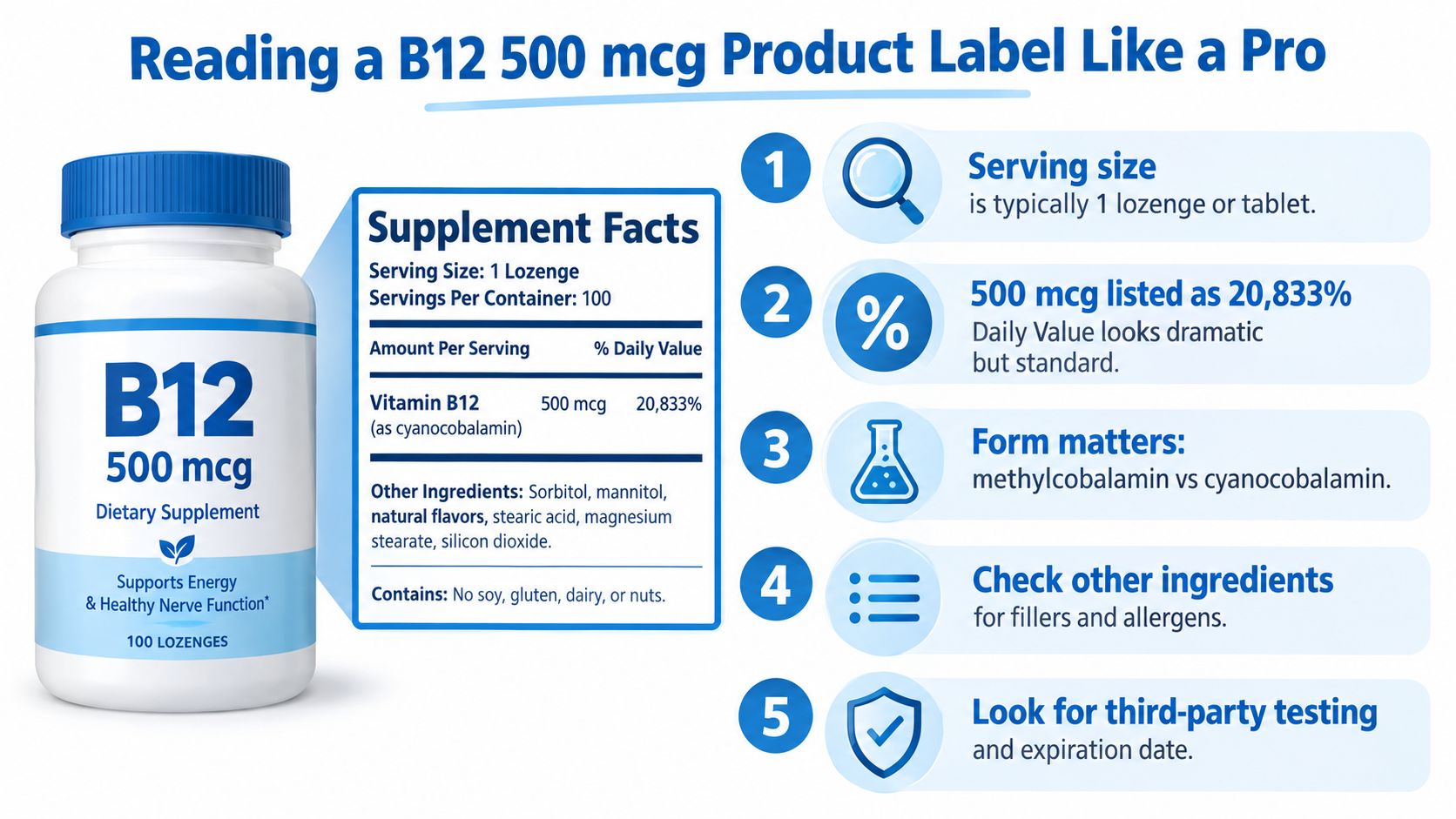
The Supplement Facts panel deserves more attention than the front of the bottle. Start with serving size, then read the B12 amount, the named form, and the other ingredients. A product that says 500 mcg per serving may contain that amount in one tablet, two tablets, several gummies, or a measured liquid portion.
The Daily Value percentage can look dramatic because the adult Daily Value is only 2.4 mcg. A 500 mcg serving therefore appears as approximately 20,833% of the Daily Value, as calculated from the value listed by the NIH Office of Dietary Supplements. That number reflects the size of the serving before absorption, not the amount your body will use directly.
Five label checks
Confirm the serving size. If the panel lists two lozenges as one serving, don't compare its per-serving amount with a tablet that provides the same amount in one piece.
Find the exact B12 form. Look for methylcobalamin, cyanocobalamin, hydroxocobalamin, or adenosylcobalamin. A vague “vitamin B12” statement gives you less information.
Read the other ingredients. Check for added sugars, colors, fillers, flavoring agents, soy, gluten, or other ingredients relevant to your diet and tolerance.
Look for quality information. USP, NSF, ConsumerLab verification, third-party testing, GMP certification, lot details, and an expiration date can make a product page easier to evaluate. These markers don't replace medical advice, but they provide useful purchasing information.
Watch for hidden formulas. A proprietary blend that doesn't disclose the B12 form or exact amount makes comparison difficult. A transparent panel is preferable when you're choosing between similar products.
For an example of how product information may be presented alongside educational content, see this B12 and nerve health product guide. Use it as a reference for the kind of details to inspect, not as a substitute for reading the specific product's current label.
Choosing the Right B12 500 mcg Product for Your Goals
The best choice depends on the problem you're trying to solve. A 500 mcg supplement can be reasonable for regular maintenance, but the same bottle may be inadequate for confirmed deficiency or inappropriate for someone who needs injections or another clinician-directed approach.
A methylcobalamin 500 mcg lozenge may suit someone who prefers that named form and finds a dissolving product easier to use. A cyanocobalamin 500 mcg tablet can be a straightforward option for general supplementation when price, stability, and a simple formula matter. Neither choice bypasses the need to consider the body's limited absorption pathways.
Someone who struggles with swallowing may prefer a liquid or sublingual format for convenience. That format can improve adherence, but you shouldn't assume that “sublingual” automatically means the body absorbs the entire serving directly through the mouth.
Use this checkout checklist
- Identify the reason: maintenance, dietary coverage, or a medically confirmed deficiency.
- Verify the form: choose a product that names the actual B12 compound.
- Check potency per serving: confirm how many tablets, gummies, or drops provide 500 mcg.
- Review the formula: inspect sugars, colors, fillers, allergens, and unnecessary added ingredients.
- Assess quality details: look for transparent testing and a clear expiration date.
- Match the format to your routine: the product you can take consistently is more practical than one you avoid because of taste or texture.
- Ask for medical guidance when needed: symptoms, malabsorption, or abnormal laboratory results can change the appropriate plan.
For shoppers comparing liquid formats, the Live Conscious vegan B12 liquid drops illustrate why serving size and concentration need careful attention. A product with a different strength isn't directly comparable with a 500 mcg tablet unless you check the amount delivered per serving.
CalVitamin offers vitamins and supplements in formats including capsules, liquid products, gummies, and other wellness categories, so you can compare delivery styles and label details in one place. Visit CalVitamin to review B12 options, confirm each serving's form and potency, and choose a product that fits your diet and routine.






