
The popular advice is simple: pick the “better” adaptogen. That advice is also the reason many maca root vs ashwagandha comparisons mislead shoppers. These herbs aren't interchangeable tools for one shared problem. Maca's human evidence is concentrated around sexual desire and selected menopausal outcomes, while ashwagandha has a much stronger modern trial record for stress-related outcomes, sleep, and some endocrine effects.
The useful question isn't whether maca or ashwagandha wins overall. It's whether your priority is sexual desire, stress physiology, sleep, or hormonal effects, and whether the evidence for the herb matches that priority. The comparison below weighs those outcomes separately, because a supplement that fits one goal may be a poor choice for another.
| Outcome | Maca root | Ashwagandha | Practical evidence leader |
|---|---|---|---|
| Sexual desire | Small randomized trials suggest a modest libido benefit, often without measurable sex-hormone changes. Evidence summary | Support is more relevant when stress, sleep disruption, or fertility concerns are part of the picture. Comparative evidence | Depends on the cause |
| Stress physiology | Little meaningful cortisol-specific evidence | Repeated randomized trials support reductions in perceived stress, anxiety, and cortisol. NIH overview | Ashwagandha |
| Sleep | Direct sleep evidence is limited | Human trials support sleep-related benefits, especially where stress is involved. NIH overview | Ashwagandha |
| Hormonal effects | Generally positioned as non-hormonal support, with little consistent change in estrogen or testosterone | May influence some thyroid and sex-hormone measures, which makes both potential benefits and cautions more important | Neither universally |
Table of Contents
- Why Maca and Ashwagandha Are Not the Same Adaptogen
- Origins, Traditional Uses, and How Each Herb Works
- Comparing Effects on Libido, Stress, Sleep, and Hormones
- Dosing, Forms, and How Fast Each One Works
- Safety, Side Effects, and Who Should Avoid Each Herb
- Which One to Choose for Your Specific Goal
- Practical Takeaways and Common Questions
Why Maca and Ashwagandha Are Not the Same Adaptogen
Calling both products “adaptogens” creates a false equivalence. The label is broad and says little about the outcome a plant has been tested for. Maca isn't well established as a cortisol-modulating herb, while ashwagandha has repeated randomized-trial support for stress-related outcomes.
That distinction should guide the purchase. Someone with stress-linked insomnia could reasonably prioritize ashwagandha. Someone seeking sexual-desire support without a clear stress complaint may find maca's evidence more directly relevant. The useful question is not which herb wins overall, but which one has been studied for the problem being addressed.
The evidence is distributed differently
A 2025 systematic review and meta-analysis pooled 15 randomized controlled trials involving 873 participants and found significant reductions in cortisol and perceived stress after 8 weeks of ashwagandha use. The extracts and doses varied across those trials, so the result supports a category-level signal rather than one universally established regimen. The NIH's professional fact sheet on ashwagandha also describes its longstanding use in Ayurvedic and Unani medicine as an adaptogen.
This evidence does not make ashwagandha suitable for every complaint. It gives the herb a more credible position for short-term stress support, with possible relevance to sleep, than maca currently has. A separate multicenter safety trial randomized 1,002 adults aged 18 to 65, after screening 1,286 individuals overall, adding useful safety information to the contemporary record.
Maca's clinical signal is narrower. One systematic review summarized only four qualifying randomized trials with roughly 131 participants total, generally testing 2 to 3.5 grams daily for 2 to 12 weeks. Maca and ashwagandha evidence review That does not establish ineffectiveness. It means confidence should remain more modest, and the target should be more specific.
Practical rule: Don't ask which herb is strongest in the abstract. Ask which herb has been tested against the symptom you're trying to change.
Use sexual desire, stress physiology, sleep, and hormonal effects as separate decision points, not as reasons to crown one universal winner. That approach better matches the supplement to the outcome.
Origins, Traditional Uses, and How Each Herb Works
Maca and ashwagandha are often grouped together as adaptogens, yet that label hides important differences. They come from different plant families and traditions, and their human evidence points toward different outcomes. Treating them as interchangeable makes it harder to match an herb to the goal, whether that goal is sexual desire, stress physiology, sleep, or hormonal effects.
Maca is a food-like Andean root
Maca, or Lepidium meyenii, is a cruciferous root associated with the Peruvian Andes. Traditional use has focused on stamina, fertility, reproductive health, and energy. Modern reviews generally position it as a non-hormonal libido and menopause-support option, because human trials have reported changes in sexual desire or selected symptoms without consistent changes in core sex hormones. Maca and ashwagandha evidence review
That pattern limits what maca can reasonably claim. The available evidence does not support treating it as a direct testosterone or estrogen enhancer. Researchers have discussed plant compounds such as macamides and other nutritional constituents, but human studies have not established a clear cortisol or hypothalamic-pituitary-adrenal axis mechanism.
Maca therefore fits best as a targeted reproductive and vitality supplement with a relatively small clinical record. Its traditional reputation provides context, not proof of a controlled human outcome.
Ashwagandha is a pharmacologically active medicinal herb
Ashwagandha, or Withania somnifera, is a nightshade-family shrub with a long history in Ayurvedic and Unani medicine. Traditional use has included rejuvenation, sleep, and resilience. Modern extracts are usually characterized by withanolides, the plant's distinctive bioactive compounds. NIH's ashwagandha professional fact sheet
Proposed mechanisms include effects on stress signaling, GABA-related activity, and thyroid physiology. These pathways remain more complicated than a supplement label implies, and a mechanism remains a hypothesis until clinical outcomes support it. Human trials nevertheless point more consistently toward stress reduction and sleep support, which aligns more closely with ashwagandha's traditional positioning than with maca's.
The practical distinction is:
- Maca's profile is more nutritional and reproductive, with its clearest human signal around desire and selected menopausal symptoms.
- Ashwagandha's profile is more pharmacological and stress-oriented, with human trials examining cortisol, anxiety, perceived stress, and sleep.
- Neither herb is a universal hormone balancer, because that phrase can conceal different effects on thyroid function, sex hormones, and symptoms.
Blended products may contain both herbs, but a shared formula does not show that they work better together. Judge each ingredient against the specific outcome being targeted.
Comparing Effects on Libido, Stress, Sleep, and Hormones
Maca and ashwagandha should not be ranked with one overall winner. The relevant question is which outcome a person wants to change, because libido, stress physiology, sleep, and endocrine measures do not represent the same clinical target. Evidence quality also varies by outcome, population, preparation, and study design.
Sexual desire is not the same as testosterone
Maca's clearest human signal concerns sexual desire. Small trials suggest that libido may improve, including in some sexual dysfunction contexts, without consistent changes in testosterone or estrogen. That pattern supports describing maca as a sexual-desire supplement rather than a hormone booster. The evidence is limited, but the outcome matches what many users are seeking.
Ashwagandha may support sexual function when chronic stress, anxiety, or poor sleep is suppressing desire. Its potential advantage is therefore conditional. Someone whose libido changed alongside prolonged stress may have a different rationale for choosing ashwagandha than someone seeking a direct libido intervention.
The stress findings are meaningful, but heterogeneous
A systematic review and dose-response meta-analysis found significant reductions in anxiety, with an SMD of -1.55, and stress, with an SMD of -1.75, compared with placebo. It also reported substantial heterogeneity, including I² values of 93.8% for anxiety and 83.1% for stress. These figures indicate that study results varied considerably, so they should not be treated as a guaranteed individual response. Systematic review
This gives ashwagandha the stronger evidence base for stress-related outcomes. The size of the reported effects is relevant, but heterogeneity limits how confidently they can be applied across different extracts, doses, and patient groups.
Maca may feel energizing to some users. That experience does not establish that it lowers cortisol or treats anxiety-related insomnia.
Sleep may improve as stress improves, but those are separate outcomes. Ashwagandha has the more relevant human evidence for sleep-related benefits, particularly when sleep disruption occurs with psychological stress. Maca's direct sleep evidence is comparatively limited, so choosing it specifically for insomnia has a weaker rationale.
Hormonal claims require precise language
Maca is frequently marketed as a hormone balancer, yet summarized human findings generally show little consistent change in central sex hormones. A change in sexual desire without a measurable testosterone or estrogen change is not a contradiction. It means the observed benefit, where present, may not depend on raising those hormones.
Ashwagandha has a more active endocrine profile. It may affect thyroid measures and some sex-hormone outcomes in particular populations, which makes context more important for people with thyroid disease or those using thyroid medication. Neither pattern justifies treating either herb as a universal hormone regulator.
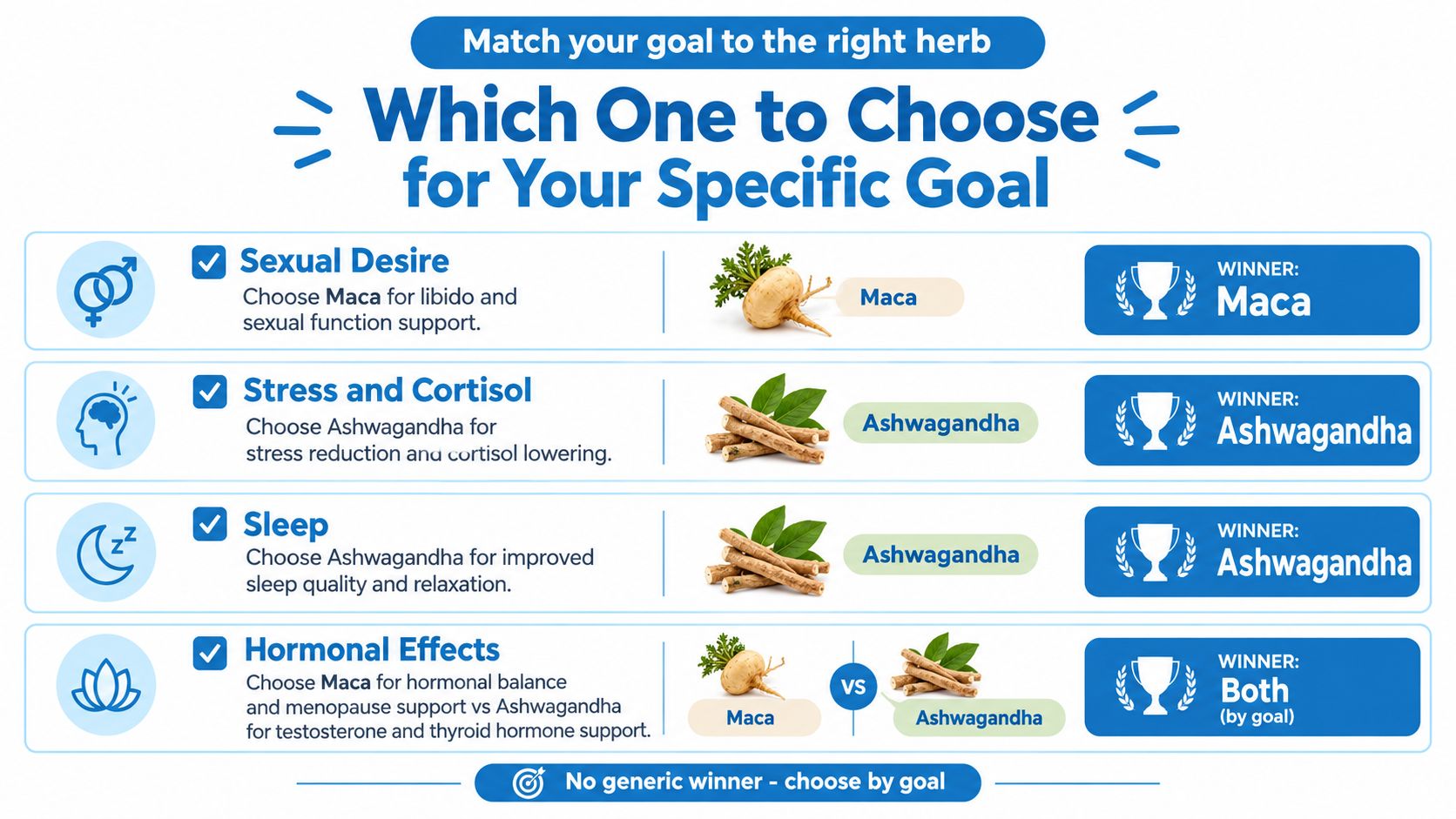
The practical conclusion is conditional: maca is the more direct libido choice, ashwagandha has better-supported stress and sleep findings, and neither should be purchased solely for a promise of “hormone balance.” Before buying, shoppers can review the ingredient and format details for BareOrganics Ashwagandha Root Powder, then check whether that product matches the outcome they want.
Dosing, Forms, and How Fast Each One Works
A label can suggest dosing precision that the research does not support. Maca trials generally use gram-level amounts of dried root, while ashwagandha studies more often use smaller quantities of concentrated root extract. These amounts cannot be compared by milligrams alone.
| Variable | Maca root | Ashwagandha |
|---|---|---|
| Common trial format | Dried root powder or extract | Root extract or root powder |
| Typical research scale | Often 1.5 to 3 grams daily in human libido trials. Maca evidence summary | Commonly studied as an extract, with potency depending on the preparation and its withanolide content |
| Practical forms | Raw powder, gelatinized powder, capsules, liquid products, gummies | Root powder, capsules, liquid products, gummies, standardized extracts |
| Expected evaluation window | Libido outcomes are generally assessed over several weeks rather than after one serving | Stress and cortisol outcomes showed significant changes at 8 weeks in the cited review |
| Main label question | Are the species, plant part, and amount clearly disclosed? | Is the extract standardized, and is its withanolide content identified? |
Form matters more than fashionable claims
Gelatinized maca is processed to reduce starch and may be easier for some people to digest. That processing does not, by itself, establish better absorption or stronger clinical effects. Raw powder works in smoothies or food, while capsules make the amount easier to track.
Ashwagandha requires closer inspection of extract identity. Root powder and concentrated extract can contain very different quantities of active constituents, so comparing milligrams without considering the preparation can mislead. KSM-66 and Sensoril appear often in research and commercial products, but a branded extract still needs a finished-product label showing the plant part and standardization details.
Capsules are usually the simplest format for a controlled personal trial. Powders can suit people who tolerate the taste and can mix them consistently. Liquid products and gummies may be convenient, but the label should show whether they provide a meaningful amount of the intended herb.
Onset is gradual, and stacking adds uncertainty
Ashwagandha's clearest stress findings emerged after sustained use, with significant changes at 8 weeks in the cited review. Maca studies summarized in expert reviews span 2 to 12 weeks, so an immediate response is not a reliable test of effectiveness. Maca evidence review
The practical timeline should match the target outcome. A person testing maca for libido should assess change across several weeks, whereas someone using ashwagandha for stress should not judge the product after only a few servings.
Some products combine both herbs, but the provided evidence contains no clinical trial testing the combination. Claims of synergy therefore remain theoretical. If you are comparing maca products, Extra Strength Super Maca Complex illustrates why the labeled amount and ingredient form should be checked before comparing it with an ashwagandha extract.
Safety, Side Effects, and Who Should Avoid Each Herb
Safety should be matched to the herb and the person using it. Ashwagandha has more modern human safety data, but that evidence also identifies more clinically relevant cautions. Maca appears simpler in short trials, though its safety record is less developed.
Maca has fewer established pharmacological cautions
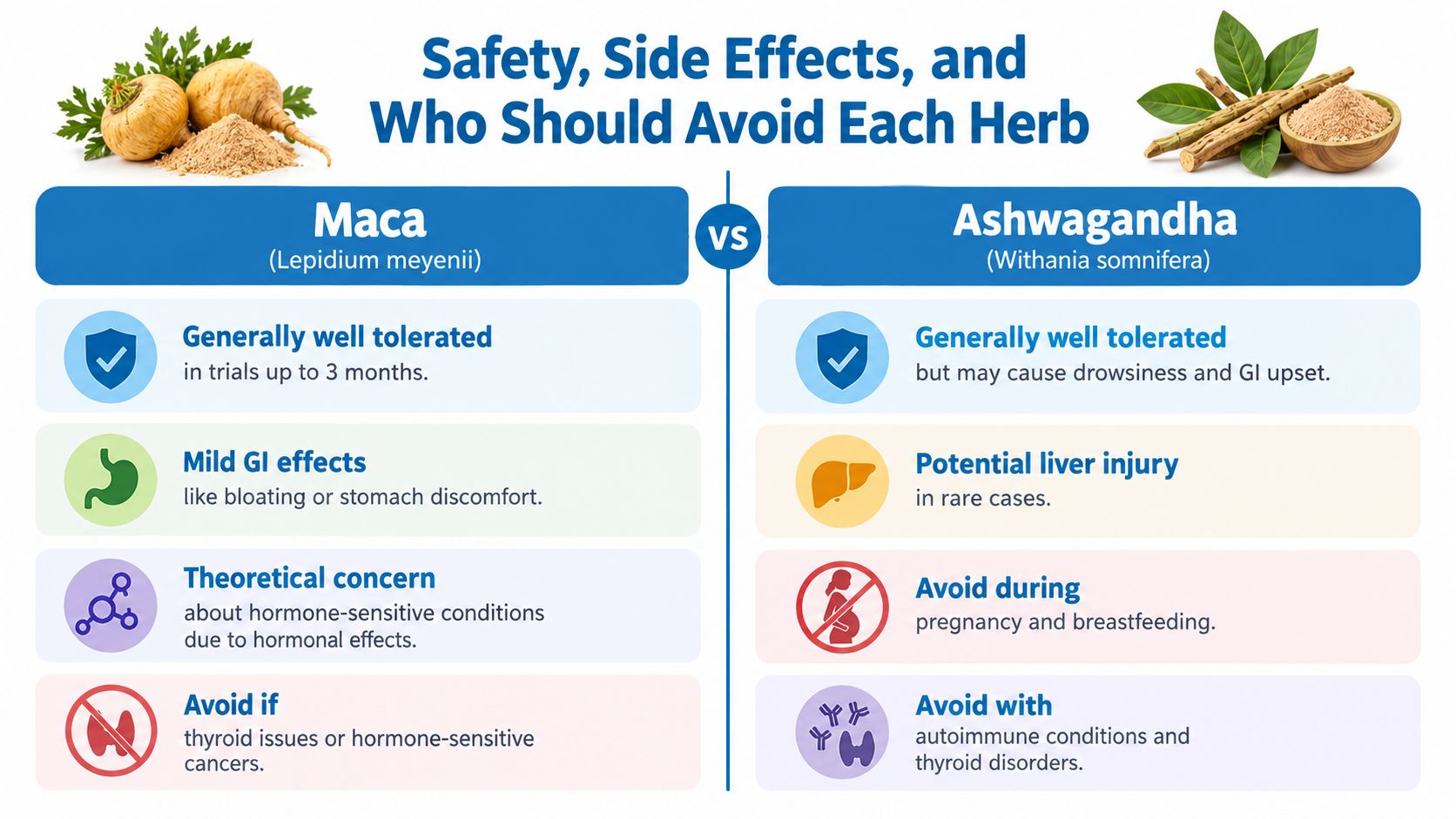
Maca was generally well tolerated in the short human trials summarized in reviews. Some users may experience digestive discomfort, bloating, or an unpleasant powder texture, particularly with larger servings. These complaints suggest tolerability problems rather than a clearly established drug interaction.
Available evidence does not establish maca as a direct hormone stimulant. People with hormone-sensitive conditions should still consult a clinician before taking it. Raw maca preparations also raise a theoretical concern for people with thyroid conditions when consumed in large amounts, although the supplied evidence does not establish a clinical thyroid effect.
Ashwagandha deserves more screening
Ashwagandha can cause gastrointestinal upset or drowsiness. Its possible effects on thyroid physiology make unsupervised use unsuitable for someone with hyperthyroidism or someone taking thyroid replacement. People with autoimmune disease should ask a clinician before using it because its immune-modulating activity may be relevant.
Sedation matters when ashwagandha is combined with alcohol, benzodiazepines, or other calming medicines. Rare liver-injury reports add another precaution. Stop the product and seek medical evaluation if unexplained jaundice, dark urine, severe itching, or unusual fatigue develops.
Neither herb should be used during pregnancy or breastfeeding without explicit medical direction. Ashwagandha is generally approached as a short-term supplement, not an indefinitely self-directed treatment. Longer use should be reviewed with a healthcare professional.
Safety checkpoint: “Natural” does not show whether a product affects thyroid function, immune activity, sedation, or liver health. Your medication list and medical history matter more than the marketing category.
If you take thyroid medication, immunosuppressants, sedatives, or treatment for a chronic condition, show the complete product label to your prescriber. Product quality varies, so the clinician may need to assess the plant part, extract type, serving amount, and standardization information.
Which One to Choose for Your Specific Goal
The better choice depends less on which herb is “stronger” and more on whether the product fits your symptoms, risks, and ability to track an outcome. Use a short screening process before choosing either supplement.
Start with the outcome you can measure
Choose one target rather than trying to improve everything at once. Examples include sexual desire, time needed to fall asleep, nighttime waking, perceived stress, or a specific menopausal symptom. A vague goal such as “hormone balance” makes it difficult to judge benefit and can encourage unnecessary stacking.
For sexual-wellness context beyond herbs, the CalVitamin guide to vitamins for sexual health places maca and ashwagandha alongside other supplement categories.
Run a simple personal trial
Record the target symptom for several days before starting. Each evening, note the symptom's intensity using the same scale, along with sleep duration, alcohol intake, unusually stressful events, and any new medication or supplement. Continue the same log during the trial.
Change only one variable. If you choose maca, keep the question focused on whether desire or related sexual function changes. If you choose ashwagandha, track stress-related symptoms, sleep quality, or another clearly defined outcome. Review the pattern after a sustained period rather than judging the first noticeable day. This approach cannot prove the herb caused an improvement, but it reduces reliance on memory and expectation.
Use a stop-and-review checklist
Pause the trial if new gastrointestinal symptoms, marked drowsiness, or another concerning reaction appears. Review the choice with a clinician before starting if you have thyroid disease, an autoimmune condition, liver concerns, are pregnant or breastfeeding, or take medicines that affect sedation, thyroid function, immunity, or a chronic condition.
A persistent symptom also changes the decision. Low desire, disrupted sleep, fatigue, or menstrual changes may reflect medication effects, mood disorders, endocrine disease, relationship factors, or another condition that an herb will not address. Seek assessment when the symptom is new, worsening, or difficult to explain.
Decide whether the experiment is worth continuing
Continue only if the intended outcome improves without troublesome effects and the benefit matters to your daily life. Stop if there is no meaningful change after a fair trial, if adverse effects outweigh the benefit, or if tracking exposes a different underlying problem.
If two goals compete, rank them. Someone primarily concerned with desire may select the option aligned with that outcome, while someone whose desire changed after prolonged stress may first address the stress and sleep pattern. The decision should follow the suspected driver, not the popular label of either herb.
Practical rule: Choose one outcome, one product, and one review point. Keep the result, change the plan, or seek medical evaluation based on what the record shows.
Practical Takeaways and Common Questions
A product label should let you judge whether the supplement matches the evidence and your intended outcome.
- Does the form match the evidence? For maca, look for clearly identified maca root, a disclosed serving amount, and a format you can use consistently. For ashwagandha, check whether the label specifies root extract or powder and provides meaningful standardization information.
- Can you verify quality? Look for credible third-party testing, including a USP, NSF, or ConsumerLab seal where available. These seals do not establish that an herb will improve your chosen outcome, but they can support checks of identity and manufacturing quality.
- Is the formula transparent? Avoid proprietary blends that conceal individual amounts. Without per-ingredient quantities, comparing products or matching a studied form becomes difficult.
Common questions
Can you cycle them together? The available evidence does not establish a maca and ashwagandha cycling protocol or prove combination synergy. If you use both, introduce one product first and record benefits, side effects, and other changes before adding the second. A clinician should review the plan when medications or chronic conditions are involved.
How should you judge a product before buying it? Read the Supplement Facts panel rather than relying on front-label claims. Confirm the plant part, extract or powder form, serving amount, and whether a proprietary blend obscures the dose. Check the lot or testing information when provided, and look for USP, NSF, or ConsumerLab verification where available. These checks address product quality, not whether maca or ashwagandha is the better choice for your goal.
Are they compatible with vegan or low-FODMAP diets? The herbs are plant-derived, but capsules, gummies, flavorings, and excipients vary. Check for gelatin, dairy-derived ingredients, sweeteners, and other additives instead of assuming a finished product suits your diet.
What should you ask your doctor? Bring the exact label. Ask about thyroid medication, SSRIs, sedatives, immunosuppressants, autoimmune disease, pregnancy or breastfeeding, and any history of liver problems. Those details can change the risk-benefit assessment.
Choose the herb according to the outcome you want to change, whether sexual desire, stress physiology, sleep, or hormonal symptoms. For a transparent way to compare maca, ashwagandha-containing formulas, and related products by ingredient and format, visit CalVitamin. Review the label before adding anything to your routine, and seek professional advice if you take medication or have a diagnosed condition.






