

The most popular shilajit advice focuses on timing. Take it at sunrise, take it on an empty stomach, take it before training, avoid coffee, and somehow the routine becomes more important than the product itself. That's backwards.
The best way to take shilajit starts with purity, verified testing, and a clinically sensible dose. A perfectly timed serving of contaminated material is still a poor choice. Human evidence most often centers on purified shilajit at 250–500 mg per day, used across periods ranging from 8 to 48 weeks, so the practical job is simple: remove avoidable quality risks, choose a form you'll use consistently, and follow a conservative dosing plan. (Your Healthier's dosage and safety summary)
Table of Contents
- Why the Best Way to Take Shilajit Starts With Purity, Not Timing
- Choosing the Right Form of Shilajit for Your Routine
- Dosing Shilajit the Way the Studies Actually Did
- When to Take Shilajit for Energy, Workouts, and Wellness
- Reading a Shilajit Label for Heavy Metals and Contamination
- Stacking Shilajit With Food, Drinks, and Other Supplements
- Storing Shilajit and Getting Started the Smart Way
Why the Best Way to Take Shilajit Starts With Purity, Not Timing
Morning rituals are easy to market because they sound precise. Empty-stomach instructions, pre-workout windows, and special drink pairings make shilajit seem like a supplement where the clock controls the outcome. The available human evidence doesn't establish one universally superior schedule, and public clinical summaries describe the evidence as limited and relatively short-term. (Cleveland Clinic's shilajit overview)
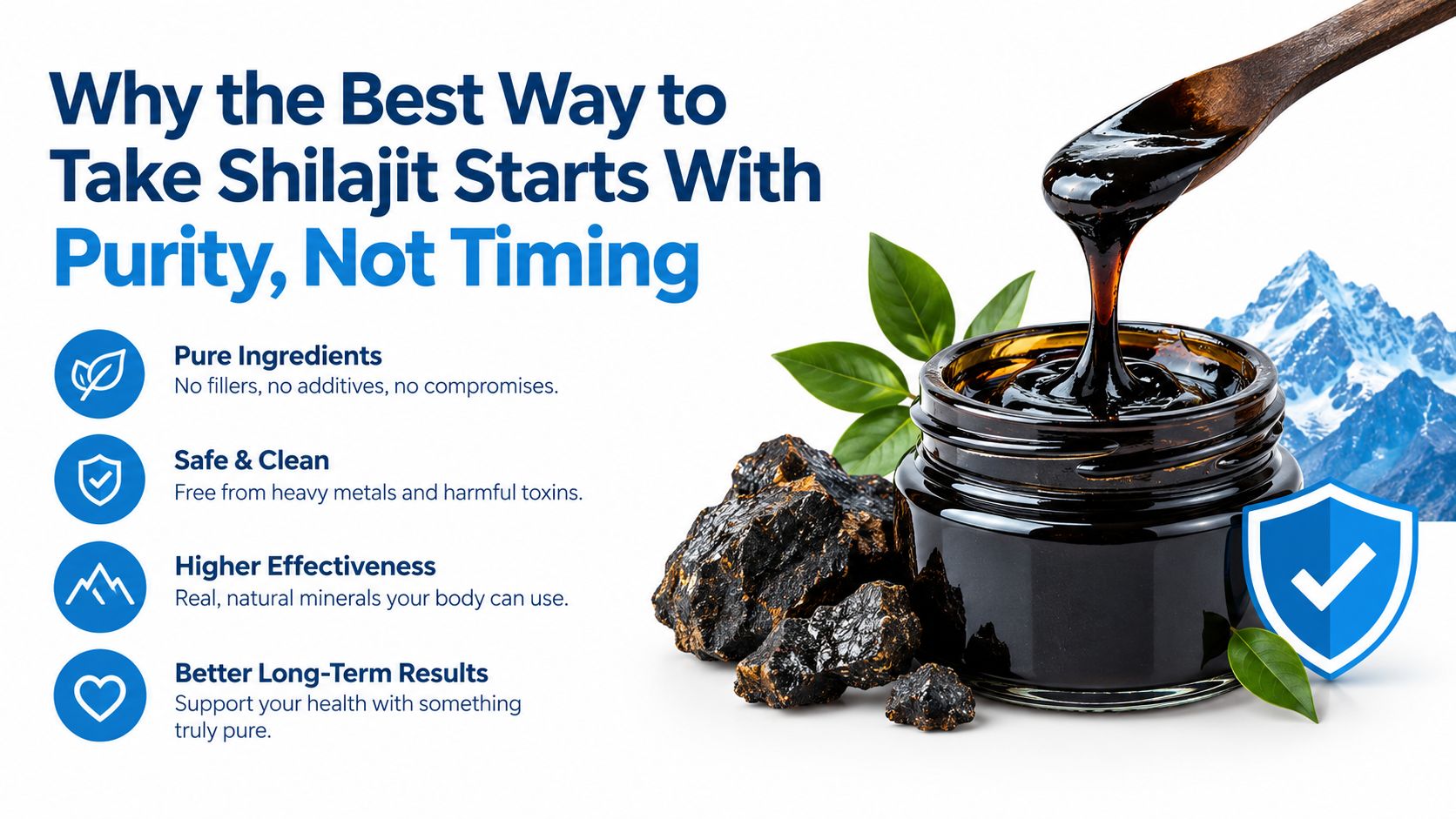
Purity is the first filter. Shilajit is a mineral-rich natural material, and unprocessed shilajit can carry contamination risks. Safety reviews warn about lead, arsenic, mercury, cadmium, and thallium, while one analytical review cited in the available guidance found that shilajit may contain about 65 different metals. (ShilajitDB's heavy-metal guidance)
Three filters that matter first
Use this buying sequence before worrying about breakfast or bedtime:
- Purification: Choose a product clearly described as processed or purified for consumption. “Natural,” “raw,” and “premium” aren't safety certifications.
- Batch testing: Look for a batch-specific certificate of analysis, ideally from an independent laboratory. The report should identify the batch and show a heavy-metal panel, not merely repeat general brand language.
- Standardization: The label should tell you how much shilajit you're receiving and, where available, its fulvic-acid standardization. A vague “Himalayan extract” statement leaves too much unknown.
Sourcing transparency helps, but an impressive origin story doesn't replace laboratory testing. Even high-altitude material needs processing and verification before routine use. If you're comparing raw ingredients, product details, or concentrated forms, review the raw supplement options with the same scrutiny you'd apply to any other shilajit listing.
Practical rule: Treat timing as a preference. Treat purification and batch testing as requirements.
Choosing the Right Form of Shilajit for Your Routine
The best form isn't automatically resin. It's the form that gives you a clearly stated amount of purified shilajit, provides credible testing, and fits your habits well enough that you'll use it correctly. A difficult product that sits unopened has no practical advantage over a convenient capsule with transparent quality documentation.
Resin is the traditional, concentrated format. It usually requires careful measuring and dissolving, and its earthy, bitter taste can be pronounced. Resin may appeal to experienced users who want direct control over preparation, but don't mistake stickiness or dark color for proof of purity.
Capsules solve the measurement and taste problems. They're easier to carry, simpler during travel, and useful when adherence is your main obstacle. The trade-off is less visibility into the actual material, fillers, flow agents, and standardization. Read the supplement facts panel rather than judging a capsule by its branding. A product such as purified shilajit capsules should still be evaluated for its batch documentation and stated shilajit content.
Powder can work in smoothies or other drinks, but the word “powder” doesn't tell you whether the ingredient is pure shilajit or a blend with carriers. Liquid drops can be convenient for small, adjustable servings, yet their quality depends heavily on the liquid carrier and the accuracy of the dropper.
| Form | Typical Fulvic Acid % | Ease of Use | Best For | Watch Out For |
|---|---|---|---|---|
| Resin | Varies by product | Moderate | Users who want a concentrated traditional format | Difficult measuring, strong taste, missing COA |
| Powder | Varies by product | Easy to mix | Smoothies and flexible preparation | Carriers, clumping, unclear actual shilajit content |
| Capsules | Varies by product | Very easy | Travel and routine adherence | Fillers, hidden standardization, less preparation control |
| Liquid drops | Varies by product | Easy to micro-dose | Users who prefer adjustable servings | Carrier ingredients, dropper accuracy, weak testing |
A simple decision rule
Choose resin if you're comfortable measuring and dissolving it. Choose capsules if convenience is the reason you'll stay consistent. Choose powder or liquid only when the label clearly identifies the active amount and the product supplies a batch-specific certificate of analysis.
Ignore any format that doesn't publish credible testing. A convenient unverified product is still an unverified product.
Dosing Shilajit the Way the Studies Actually Did
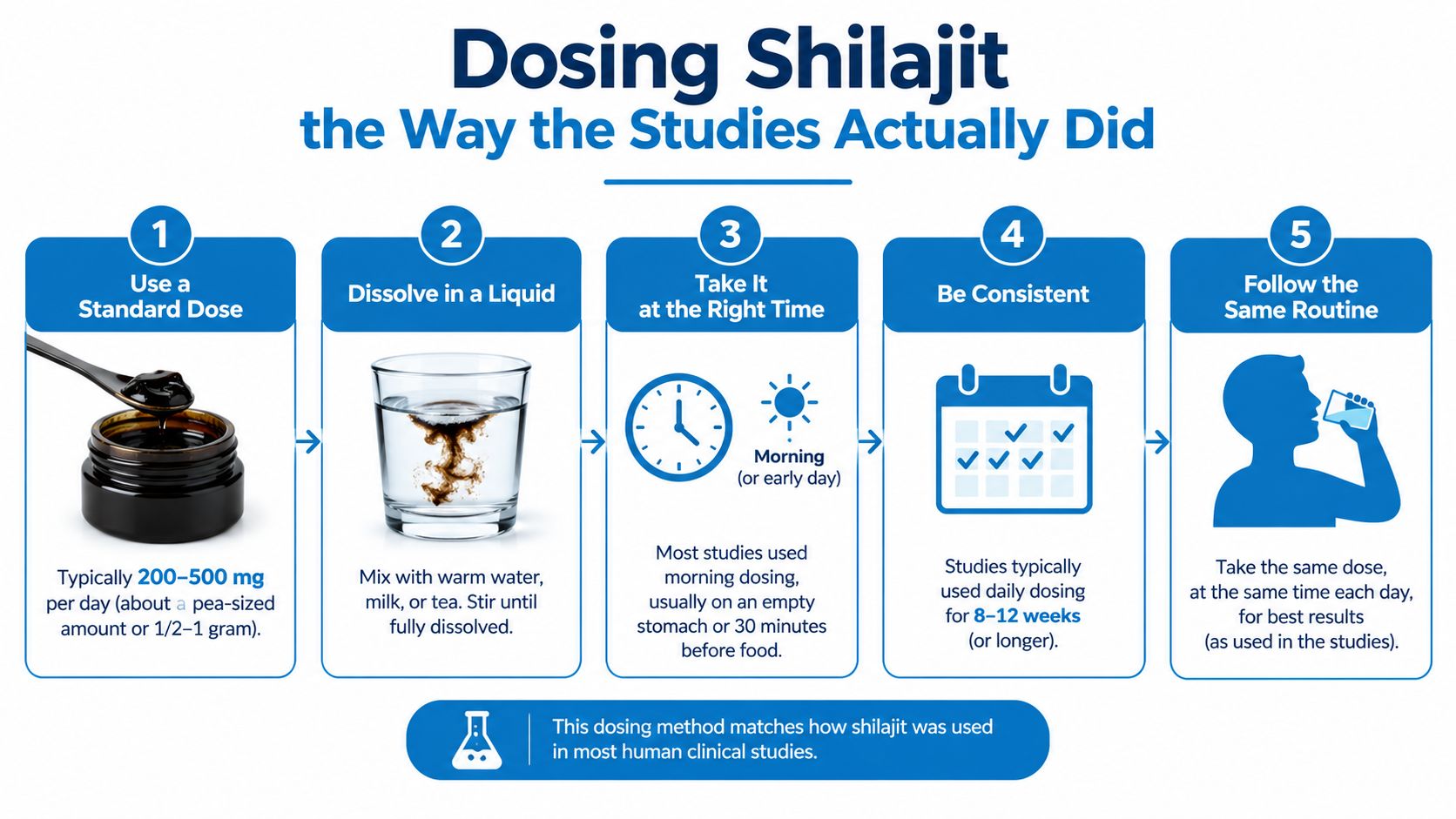
Forum advice often treats shilajit like a food where a larger scoop should produce a stronger result. That is weak guidance. Human trials generally use a conservative range of 250–500 mg per day, with treatment periods commonly lasting 45 to 90 days and some studies continuing for 48 weeks. (The Yeti Life's review of human trials)
Purity and verified testing matter more than the hour on the clock. A precisely timed dose cannot compensate for contaminated resin, unclear labeling, or a product that does not confirm its shilajit content.
Start at the lower end with 250 mg once daily. Increase toward 500 mg per day only if the product is purified, the label is clear, and you are a healthy adult using an amount reflected in human research. (Verified Supplement Data's dosing guidance)
A practical progression
- Begin at 250 mg once daily. Use the product's scoop or another reliable measurement method. Resin servings should not be estimated by appearance.
- Assess tolerance before increasing. Monitor digestion, unusual reactions, and whether the routine is easy to follow.
- Consider 250 mg twice daily. That provides 500 mg per day, a commonly studied adult regimen, provided the product has been properly purified and tested. Treat this as a research-based ceiling for routine use, not an invitation to increase further.
- Avoid self-directed high dosing. Amounts above 1,000 mg per day lack strong long-term safety support in the summarized evidence. They are not a sensible default for self-experimentation. (Your Healthier's evidence-based dosage summary)
For resin, dissolve the measured serving fully in warm water or another suitable warm liquid. Do not swallow sticky chunks, and do not use boiling liquid as a shortcut. Consistent measurement matters more than making the preparation elaborate.
The available evidence does not establish a separate proven protocol for every goal. General wellness, exercise support, and sexual wellness discussions often fall within the same studied range. Keep the dose conservative, and let verified purity and accurate content guide the routine rather than online bravado.
When to Take Shilajit for Energy, Workouts, and Wellness
The clock is not the main decision. Purity and verified testing matter far more than whether you take shilajit in the morning or before training. Once the product is properly tested and the serving is measured, choose a schedule you can repeat comfortably. A timing plan that disrupts sleep, irritates your stomach, or gets forgotten is a poor plan.
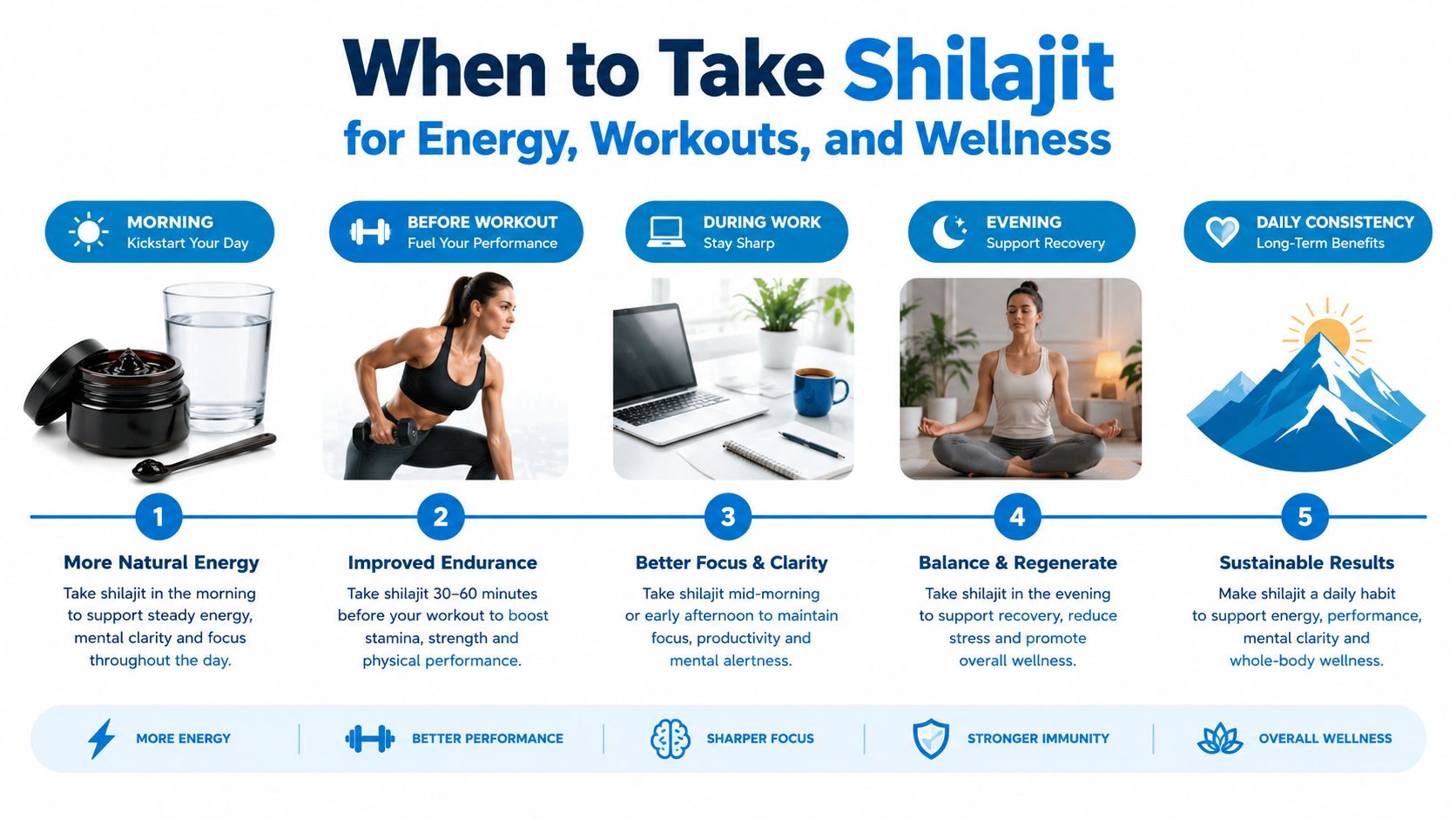
For daytime use, take a serving after waking, before breakfast, or with breakfast. Food can make the routine gentler for some people, while others prefer taking it separately. An empty stomach is not a proven requirement, so do not force that approach if it makes the supplement unpleasant.
Three realistic routines
- Morning wellness: Take the measured serving at the same point each morning, such as after waking or with breakfast. Keep preparation simple enough to repeat on workdays.
- Training days: Fit your normal daily dose into your existing pre-training routine if that is convenient. Shilajit does not replace sleep, food, hydration, creatine, or a well-planned training program.
- Evening use: Test a later serving only when you can observe your response. Some users report feeling stimulated, so avoid a late dose if it interferes with sleep.
Food or empty stomach?
Take shilajit with food if that improves comfort. Take it separately if that makes the routine easier to remember. The human trial summaries do not establish a universally superior morning, empty-stomach, or pre-workout schedule. Stronger timing claims go beyond the available evidence.
Use this order: product first, preparation second, timing third. Verify the material and batch testing, measure the serving accurately, then choose the part of your day you can maintain. Purity and consistency will do more for a sensible routine than chasing a supposedly perfect hour.
Reading a Shilajit Label for Heavy Metals and Contamination
Timing matters less than what is in the jar. A label can sound impressive while offering no evidence that the specific batch is safe. “Himalayan,” “ancient mineral,” and “standardized extract” describe marketing or product positioning, not laboratory verification. Before buying, ask for a batch-specific certificate of analysis that identifies the laboratory, test methods, and heavy-metal results.
Screening should cover lead, arsenic, mercury, and cadmium. Thallium testing provides another safeguard because contamination is not limited to the metals a brand chooses to mention. Example daily-use benchmarks are lead below 10 ppm, arsenic below 10 ppm, mercury below 1 ppm, and cadmium below 0.3 ppm. Stricter limits are preferable for a product intended for regular use. (Verified Supplement Data's purity and heavy-metal discussion)
What a usable COA should show
Check these points before ordering:
- Batch identity: The report must match the lot or batch number printed on your container.
- Named contaminants: Lead, arsenic, mercury, and cadmium should be listed individually. Thallium results strengthen the report.
- Laboratory information: The document should name the testing laboratory and method. A brand-written purity statement is not a substitute.
- Actual serving content: The label should state how much shilajit each serving contains.
- Standardization details: If fulvic acid is promoted, its percentage should be disclosed clearly.
| Contaminant | Daily-Use Limit (ppm) | Red-Flag Level (ppm) |
|---|---|---|
| Lead | Below 10 | At or above 10 |
| Arsenic | Below 10 | At or above 10 |
| Mercury | Below 1 | At or above 1 |
| Cadmium | Below 0.3 | At or above 0.3 |
Use these figures as screening benchmarks, not as permission to overlook missing data. A product that will not provide batch testing is difficult to evaluate, regardless of its source, price, or appearance.
A 2025 paper reported measurable thallium in commercial shilajit supplements, so “natural” on the front label is not enough. Choose a product with a current, batch-matched report that shows what was tested and the actual results.
Stacking Shilajit With Food, Drinks, and Other Supplements
Shilajit doesn't need a complicated stack. The safest approach is to introduce one variable at a time, keep the dose measured, and avoid assuming that every supplement with an “energy” label belongs in the same serving window. The available human evidence supports a conservative shilajit baseline, not a kitchen-sink protocol.
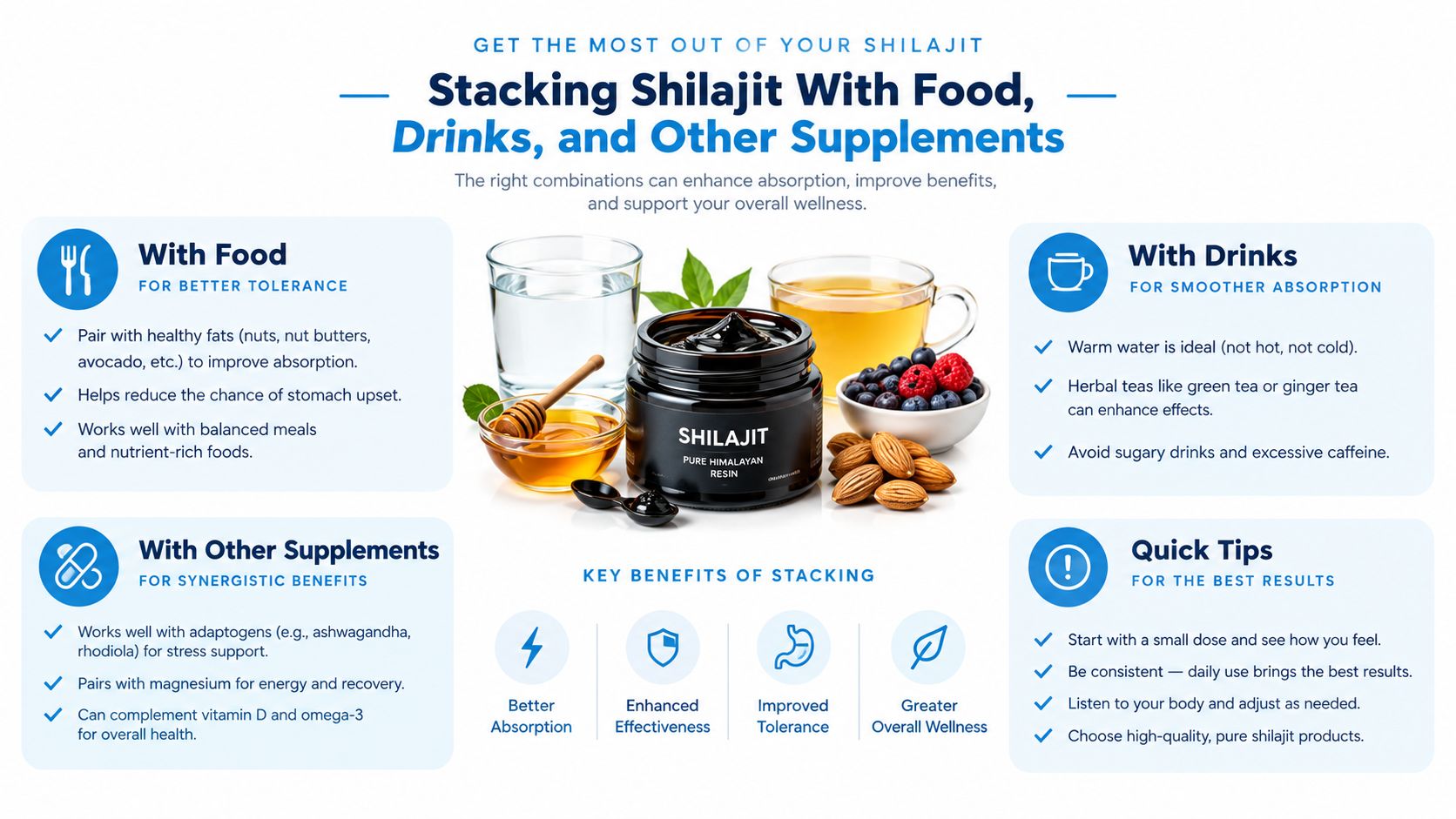
Food choice should prioritize comfort. Warm water is simple, while warm milk or another familiar drink may make resin easier to consume. If you notice digestive discomfort, taking the serving with food is a reasonable adjustment. Claims that specific fats dramatically transform absorption aren't established strongly enough to make them mandatory.
Keep the stack manageable
- Start alone: Use shilajit by itself while you evaluate tolerance. That makes it easier to identify the source of any unwanted reaction.
- Add only familiar products: If you already use creatine, electrolytes, or a basic nutrition routine, keep those habits stable rather than changing everything at once.
- Separate medication questions from supplement experimentation: Prescription drugs deserve individual review with a qualified clinician or pharmacist. Don't rely on a generic stack chart.
You may see shilajit paired with ashwagandha, CoQ10, B-complex formulas, zinc, or tongkat ali. These combinations may be appealing for stress, energy, or men's wellness, but the existence of a popular stack doesn't prove that the combination is necessary or superior. Product quality and personal suitability still come first. Ingredient-focused products such as liquid humic and fulvic acid minerals should be assessed for their own labels and testing, not treated as interchangeable with purified shilajit.
Who should pause before using it?
Avoid self-directed use during pregnancy or breastfeeding. Get medical guidance if you have active gout, take immunosuppressants, use blood-pressure medication, or manage another ongoing condition. People with iron overload disorders and anyone preparing for surgery should also speak with a clinician before adding shilajit.
Storing Shilajit and Getting Started the Smart Way
Storage protects a product you already bought, but it cannot repair weak manufacturing. Confirm that the shilajit is purified and that its batch documentation is available before opening it. Keep the container sealed in a cool, dark place. Store resin in a clean glass jar, while capsules and powders should remain dry in their original bottle.
Temperature naturally changes resin's texture. A dark, pliable resin is easier to measure, while a firmer texture does not automatically mean spoilage. Use the included scoop or a clean, dry utensil. Dissolve the serving in warm, not boiling, water or milk.
A simple 14-day start
- Days 1–7: Take 250 mg once daily to assess tolerance. Keep the serving measured and avoid increasing it just because you want faster results.
- Days 8–14: If the product is purified and you are tolerating it, consider moving toward 400–500 mg per day, while following the label.
- After day 14: Reassess digestion, energy, recovery, and how well the routine fits your day. A lack of dramatic effects is not a reason to keep raising the dose.
Check the product itself during regular use. Capsules should not crumble, powder should not develop unexplained clumps or unusual odors, and resin should not be repeatedly exposed to moisture. If the packaging, smell, texture, or documentation changes unexpectedly, stop using it and contact the manufacturer instead of guessing.
Quick questions
Who should avoid shilajit? People who are pregnant or breastfeeding, those with iron overload disorders, anyone scheduled for surgery, and people with relevant medical conditions or medication use should seek professional guidance first.
How long does a jar last? That depends on the container's total contents and your measured daily serving. Calculate it from the stated weight and serving size rather than estimating by sight.
Do you need to cycle daily use? The summarized evidence describes daily use across defined study periods, but it does not establish a universal cycling requirement. Follow the product directions and reassess whether continued use makes sense for you.
The priority order is clear: verify testing first, choose a conservative dose second, and worry about timing last. The best way to take shilajit is a measured routine built around a properly purified product. A morning ritual cannot compensate for poor quality control.
If you are comparing purified shilajit capsules, raw ingredients, or other wellness supplements, browse the selection at CalVitamin. Choose products with clear serving information and transparent ingredient details, then make testing and measured use the foundation of your routine.






