
You're standing in a supplement aisle with two tubs that both promise “high protein.” One offers a larger scoop, another claims fewer calories, and a third has a clean-looking front label covered with words such as organic, natural, and grass-fed. The useful information is on the back, but only if you know how to read it.
Protein powder nutrition facts become much easier to compare when you separate the label into four questions: how much powder counts as one serving, how much protein you get, how many calories come with it, and what the ingredient and testing information leaves out. The examples below use common label formats and the verified nutrition reference for whey protein from FitAudit's whey protein profile, alongside FDA labeling guidance and the product-comparison principles shoppers need in practice.
Table of Contents
- What a Protein Powder Nutrition Facts Label Actually Tells You
- How FDA Labeling Rules Shape the Numbers You See
- Serving Size, Scoop Size, and Why 30 g Is the Common Benchmark
- Whey and Casein Compared Side by Side
- Pea, Rice, and Soy Plant Proteins Compared Side by Side
- Quick Reference Macro Table for Six Powder Types
- Reading the Ingredient List Beyond the Macros
- Allergens, Certifications, and What Labels May Not Say
- Matching Serving Size to Your Fitness Goal
- Protein per Calorie Matters More Than Protein per Scoop
- When a Clean Label Still Hides Heavy Metal Risk
- Label Reading Checklist and Common Questions Answered
What a Protein Powder Nutrition Facts Label Actually Tells You
Start at the top of the panel, not with the large protein claim on the front. Serving size tells you how many grams the manufacturer used for every number below it. A scoop may look full, but the label's gram amount is the benchmark for comparing tubs. The next line gives calories, followed by total fat, saturated fat, and trans fat when present.
Carbohydrates appear next, usually with dietary fiber and total sugars beneath them. Added sugars may appear as a separate line, which helps distinguish naturally occurring sugars from sweeteners added during formulation. Protein follows, and the gram amount is usually the most useful first comparison between products. For food-form protein powders, the FDA explains that protein is declared in grams, while percent Daily Value is generally optional unless the package makes a protein claim such as “high in protein” through its interactive protein labeling guidance.
How to interpret the right-hand column
Percent Daily Values use a 2,000-calorie reference diet, so they're a comparison tool, not a personalized target. Protein's adult and child reference value for ages 4 and older is 50 grams, according to the FDA-based labeling information summarized in the whey nutrition reference. A 30-gram serving containing about 24 grams of protein therefore represents roughly 48% of that reference value, while a 100-gram portion containing 78.1 grams would exceed it by more than one and a half times.
The lower part of the label may list calcium, iron, sodium, and sometimes potassium or magnesium. The footnote can also show the familiar 4-4-4-9 calorie factors, meaning protein and carbohydrate provide four calories per gram, while fat provides nine. Finally, check “servings per container.” A tub advertised as containing 30 servings may not give you exactly 30 level scoops if your scoop size differs from the labeled gram weight. For broader protein product comparisons, you can also review CalVitamin's protein selection.
How FDA Labeling Rules Shape the Numbers You See
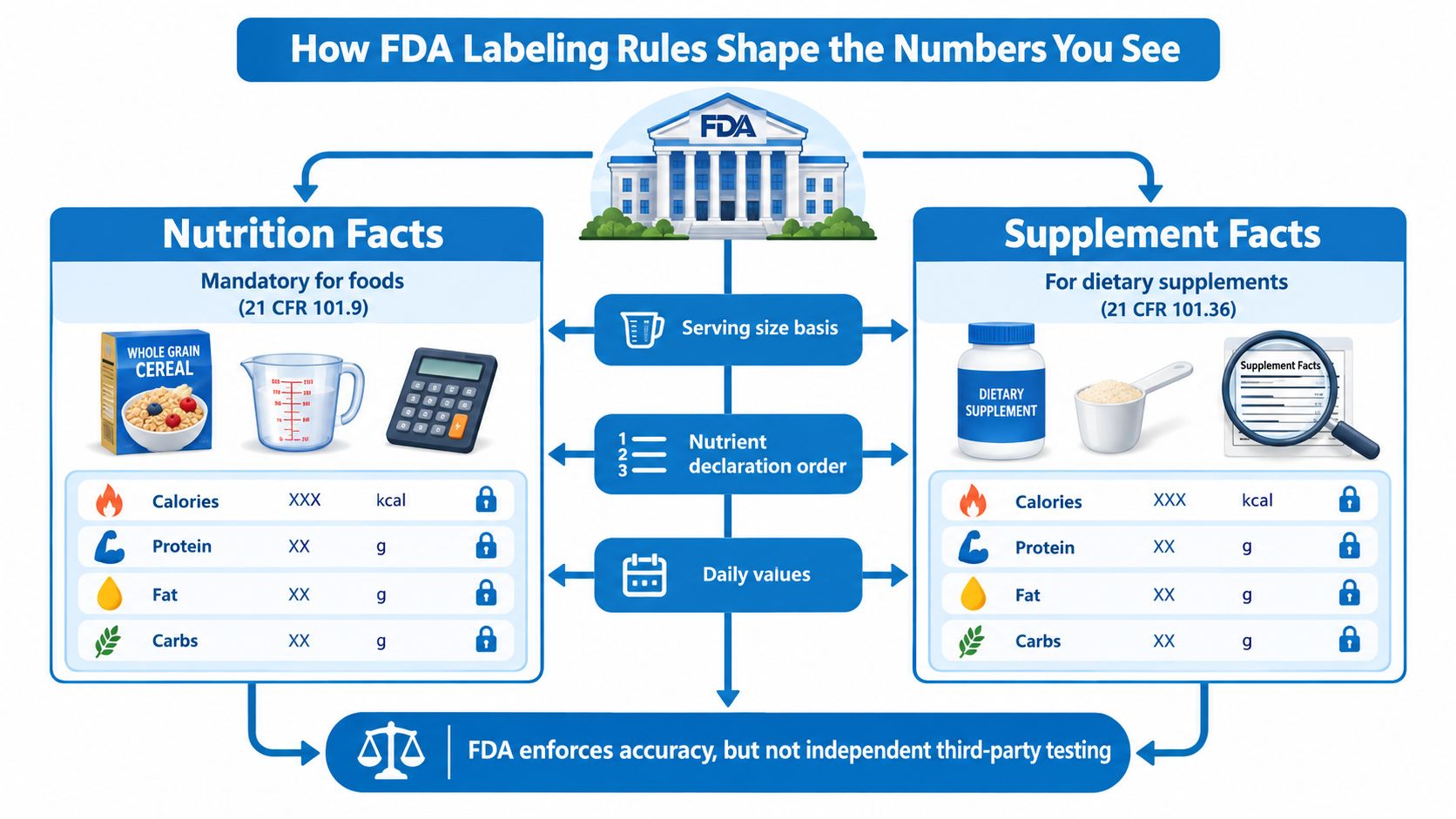
The format on the back depends partly on how the product is sold. Conventional foods generally use Nutrition Facts, governed by the FDA's food-labeling framework, while dietary supplements use Supplement Facts, governed by separate supplement-labeling rules. Protein powders marketed as supplements commonly use the latter format, which can include nutrients such as sodium, potassium, or other declared ingredients that aren't always displayed in the same way on a standard food panel.
Serving size is also a regulatory concept, not just the amount that fits in the included scoop. It represents the amount customarily consumed on one occasion. Manufacturers often set the serving around one scoop, even though some shoppers use more. If you double the scoop, you also double the listed calories, protein, carbohydrate, fat, and other nutrients unless the product's directions state otherwise.
Why labels can look cleaner than the formula
Rounding rules affect what you see. Small amounts of some nutrients may be displayed as zero, so “0 grams” doesn't always mean the ingredient is chemically absent. Read the ingredient list alongside the panel when a low-fat or low-sugar claim matters to you.
FDA guidance also distinguishes intact proteins, such as whey and plant blends, from products made only from individual amino acids. A powder made solely from amino acids shouldn't declare those amino acids as protein. Commercial panels commonly show servings near 30 grams, with around 22 to 25 grams of protein and about 110 to 120 calories, such as 22 grams in a 30-gram serving at 110 calories or 24 grams in a 29-gram serving at 110 calories, as described in the FDA dietary supplement labeling guide.
Manufacturers are responsible for label accuracy. FDA doesn't pre-approve every supplement label before the product reaches the market, so independent testing and transparent batch documentation can add information the package itself doesn't provide.
Serving Size, Scoop Size, and Why 30 g Is the Common Benchmark
A scoop size measures volume, while the Nutrition Facts panel uses weight. Powder density varies with the protein source, carbohydrates, thickeners, and how firmly the contents settle. As a result, two level scoops can hold different amounts, even when the scoops look similar.
Many commercial products set a serving near 30 grams, making that amount a practical comparison point. A 100-gram reference profile, such as the one in FitAudit's whey profile, can help you understand concentration, but it should not replace the serving information on your own package. A flavored powder may include sweeteners or other ingredients that change its calories and macros.
The label's serving weight is the anchor. If it says 25 grams of protein and 120 calories, divide 25 by 120. That gives about 0.21 grams of protein per calorie. Multiply the result by 100 to compare protein delivered per 100 calories, rather than judging products only by scoop size.
| Powder Type | Typical Scoop Weight | Protein per Scoop | Calories per Scoop | g Protein per Calorie |
|---|---|---|---|---|
| Example whey isolate | 30 g | 25 g | 120 | 0.21 |
| Common whey reference | 30 g portion | About 24 g | About 110 to 120 | Compare from label |
| General whey profile | 100 g | 78.1 g | 352 | About 0.22 |
Use a kitchen scale once when opening a new tub. A level scoop may not equal the declared serving weight, while a heaped scoop increases the amount of powder, calories, and protein you consume. For an honest comparison, record the actual grams first, then compare the panel values and ingredient list.
Whey and Casein Compared Side by Side
Whey and casein both come from milk, but their labels often reveal different formulation priorities. Whey isolate is usually the leaner option, with a high protein proportion and less lactose and fat than whey concentrate. A typical 30-gram isolate serving may show around 120 calories, 25 to 27 grams of protein, 1 to 2 grams of carbohydrate, and less than 1 gram of fat.
Whey concentrate can retain more milk components. Its label may reach 3 grams of fat and 4 grams of carbohydrate per scoop, which can matter to shoppers sensitive to lactose or trying to keep calories tightly controlled. Micellar casein often lands near 130 calories and may contain roughly 1.5 grams of fat, while calcium caseinate can vary according to the rest of its formula.
| Powder Type | Calories | Protein (g) | Carbs (g) | Fat (g) | Lactose/Sugars (g) | Sodium (mg) |
|---|---|---|---|---|---|---|
| Whey concentrate | About 120 | About 22 to 24 | Up to 4 | Up to 3 | Varies | Varies |
| Whey isolate | About 120 | About 25 to 27 | About 1 to 2 | Under 1 | Usually lower | Varies |
| Micellar casein | About 130 | About 23 to 24 | Varies | About 1.5 | Varies | Often lower |
| Calcium caseinate | Varies | About 23 to 25 | Varies | Varies | Varies | Varies |
The protein source changes the eating experience
Whey is associated with faster digestion than casein, while casein is commonly chosen for a slower, more sustained release. Whey also tends to provide more leucine per gram, an amino acid involved in muscle protein synthesis signaling. Those characteristics don't make one automatically superior. The more useful choice depends on tolerance, texture, calorie needs, and whether you prefer a lighter shake or a thicker one.
For a concrete product-page example, Life Extension Wellness Code Vanilla Whey Protein Isolate can be read using the same process: confirm serving grams, protein, calories, carbohydrates, fat, sweeteners, and allergen information before comparing it with another dairy powder.
Pea, Rice, and Soy Plant Proteins Compared Side by Side
Plant powders vary more than their front labels suggest. Soy isolate often provides about 24 to 26 grams of protein in a 30-gram serving at around 115 calories. Brown rice isolate may provide closer to 22 grams of protein at about 120 calories, with roughly 1 to 2 grams of fiber. Pea protein commonly falls between those patterns, with more noticeable fat than soy and a texture many people find thicker.
| Powder Type | Calories | Protein (g) | Carbs (g) | Fiber (g) | Fat (g) | Key Amino Acid Note |
|---|---|---|---|---|---|---|
| Soy isolate | About 115 | About 24 to 26 | Varies | Varies | About 0.5 | Complete essential amino acid profile |
| Pea isolate | Varies | About 20 to 24 | Varies | Varies | About 1.5 to 2 | Strong lysine and useful leucine |
| Brown rice isolate | About 120 | About 22 | Varies | About 1 to 2 | About 1 | Relatively richer in methionine |
| Pea-rice blend | Varies | Varies | Varies | Varies | Varies | Combines complementary amino acid patterns |
Pea protein tends to be relatively high in lysine and lower in methionine. Rice protein offers the opposite pattern, so manufacturers frequently combine them. The blend isn't automatically more nutritious because it says “plant blend,” but pairing sources can create a more balanced essential amino acid profile.
Soy is the plant option in this comparison that naturally supplies all essential amino acids in proportions comparable to whey. Pea can provide strong leucine, while rice is often leaner overall. For shoppers comparing a specific vegan product, KOS Organic Plant Protein Powder Vanilla should be assessed by its own serving weight and panel rather than by the category name alone.
Quick Reference Macro Table for Six Powder Types
A single comparison table can make store decisions faster, but treat these as typical label ranges, not guaranteed specifications. Formulas differ because manufacturers add flavors, sweeteners, oils, fibers, digestive ingredients, and minerals. Even powders within the same category can vary by a gram or two.
The “percent calories from protein” column is calculated from protein grams using four calories per gram, then compared with the listed calories. It gives you a quick preview of protein efficiency, but it isn't the same as percent protein by weight.
| Powder Type | Calories | Protein (g) | % Calories from Protein | Carbs (g) | Fat (g) | Fiber (g) | Sodium (mg) |
|---|---|---|---|---|---|---|---|
| Whey concentrate | About 110 to 130 | About 22 to 24 | About 68% to 87% | Up to 4 | Up to 3 | 0 to 2 | Varies |
| Whey isolate | About 110 to 120 | About 25 to 27 | About 83% to 98% | About 1 to 2 | Under 1 | 0 to 1 | Varies |
| Micellar casein | About 120 to 140 | About 23 to 24 | About 66% to 80% | Varies | About 1.5 | 0 to 2 | Often lower |
| Soy isolate | About 115 | About 24 to 26 | About 83% to 90% | Varies | About 0.5 | Varies | Varies |
| Pea isolate | About 110 to 140 | About 20 to 24 | About 57% to 87% | Varies | About 1.5 to 2 | Varies | Varies |
| Pea-rice blend | Varies | Varies | Calculate from label | Varies | Varies | Varies | Varies |
The verified commercial examples show why the calculation matters. A 30-gram serving with 22 grams of protein and 110 calories is not nutritionally identical to a 29-gram serving with 24 grams and the same calories, even though both may be marketed as high-protein powders. Compare the complete panel rather than shopping from the protein headline alone.
Reading the Ingredient List Beyond the Macros
The nutrition panel tells you the totals. The ingredient list tells you how the formula gets there. Ingredients generally appear in descending order by weight, so the first few items usually reveal whether you're buying a mostly single-source protein or a heavily modified blend.
Sweeteners may include sucralose, acesulfame potassium, monk fruit extract, or steviol glycosides. Flavor systems may be labeled as natural flavors, artificial flavors, or both. Emulsifiers such as soy lecithin and sunflower lecithin help powders disperse in liquid, while xanthan gum, guar gum, and carrageenan can change thickness and mouthfeel.
What deserves a closer look
- Sweeteners: A low-sugar label may still contain several high-intensity sweeteners. If you're sensitive to aftertaste or certain ingredients, identify them before buying.
- Thickeners: Xanthan gum, guar gum, and carrageenan can make a shake creamier, but some people find heavily thickened formulas harder to tolerate.
- Fillers and added carbohydrates: Maltodextrin, inulin, and dextrose can increase texture, sweetness, or calories. Their presence isn't automatically a problem, but they change the nutrition economics.
- Blends: A proprietary blend can group amino acids, creatine, or digestive enzymes without showing each ingredient's individual amount. That makes it harder to judge whether the added ingredients are present in meaningful quantities.
- “Natural flavors”: This label term can describe a complex flavor mixture. It doesn't tell you the full flavor recipe by itself.
A short ingredient list isn't always better, and a long one isn't automatically unsafe. The practical question is whether each added ingredient serves your goal and whether the label gives you enough information to evaluate it.
Allergens, Certifications, and What Labels May Not Say
Milk and soy are especially important on protein powders, because whey, casein, and soy isolate are common sources. U.S. allergen labeling rules require major allergens to be identified, including milk, soy, wheat, egg, fish, and tree nuts among the major categories. Look for a “Contains” statement, which identifies intentional allergens, and distinguish it from a “may contain” warning, which addresses possible cross-contact during manufacturing.
The certification logo adds another layer, but each mark answers a different question.
- NSF Certified for Sport and Informed Choice: These programs can address product identity and screening relevant to sport, but certification scope depends on the program and product.
- USP: A USP mark can indicate that a product meets specified standards for identity, strength, quality, and purity.
- USDA Organic: Organic certification concerns production and handling standards. It doesn't automatically mean the powder has been tested for heavy metals or banned athletic substances.
- Non-GMO Project Verified: This addresses genetically modified organism criteria, not protein efficiency or contaminant results.
- Vegan Society, Kosher, and Halal marks: These can help shoppers evaluate animal-derived ingredients and processing requirements, but the exact certification scope still matters.
- Gluten-Free Certification Organization: A gluten-free mark supports gluten-related purchasing decisions, but it doesn't tell you whether the powder is low in sugar or sodium.
Labels may not provide pesticide-residue results, country-of-origin detail for every ingredient, or glyphosate testing for plant proteins. If those factors matter, look for a current certificate of analysis or batch-specific testing rather than assuming a front-of-package claim answers the question.
Matching Serving Size to Your Fitness Goal
The serving printed on the tub is a measurement, not a command. Your useful amount depends on what the powder is replacing or adding, your broader diet, and whether the product is a concentrated isolate or a calorie-dense mass gainer.
| Goal | Scoops | Protein (g) | Calories | Best Powder Type |
|---|---|---|---|---|
| Add protein around resistance training | 1 to 2 | About 25 to 50 | Use the label total | Whey, casein, soy, or plant blend |
| Raise intake without a large calorie addition | Partial serving, such as half a scoop | About 12 to 20 | Use the label total for the portion | Isolate or lean plant powder |
| Replace a light meal when appropriate | Product serving | Depends on formula | About 200 to 400 | Meal-replacement blend |
| Support higher calorie intake | Product serving as directed | Depends on formula | Higher than an isolate | Mass gainer |
A full serving isn't always necessary. A half scoop can add protein to oatmeal, yogurt, or a smoothie while keeping the calorie contribution smaller. If you use two scoops to create a larger protein serving, check whether the resulting calories, sodium, sweeteners, and additives still fit the meal.
Meal-replacement formulas deserve separate attention. They may include more calories, fiber, vitamins, and minerals than a pure isolate, so comparing them only by protein grams misses their purpose. Likewise, a mass gainer isn't interchangeable with whey isolate. The former is designed to add energy, while the latter is usually chosen for concentrated protein.
Practical rule: Choose the smallest serving that solves the problem you actually have, then count the full nutrition of that serving.
Protein per Calorie Matters More Than Protein per Scoop
A large protein number can distract you from the calorie cost. ConsumerLab's 2026 testing found that some products delivered the same 20 grams of protein with as many as 200 calories, while others provided that amount with only 80 to 90 calories, according to its protein powder quality and nutrition testing report. The comparison shows why “protein per scoop” is incomplete.
Use this calculation:
Protein efficiency = protein grams ÷ calories × 100
| Product Type | Protein per Serving (g) | Calories per Serving | g Protein per 100 Cal |
|---|---|---|---|
| Whey isolate example | 25 | 110 | About 22.7 |
| Mass-gainer example | 20 | 200 | 10 |
| Leaner product example | 20 | 80 to 90 | About 22.2 to 25 |
A powder with 25 grams of protein and 110 calories gives about 22.7 grams per 100 calories. A 20-gram serving at 200 calories gives 10 grams per 100 calories. The difference usually comes from added carbohydrates, fats, and other ingredients that may be useful in a meal replacement or calorie-surplus plan, but unnecessary if you only want concentrated protein.
One caveat matters. ConsumerLab's 2026 review also found that some products provided as many as 200 calories for the same 20 grams of protein, so don't assume a lower calorie number guarantees superior quality. Check protein grams, calorie total, sugar, sodium, and the ingredient list together.
When a Clean Label Still Hides Heavy Metal Risk
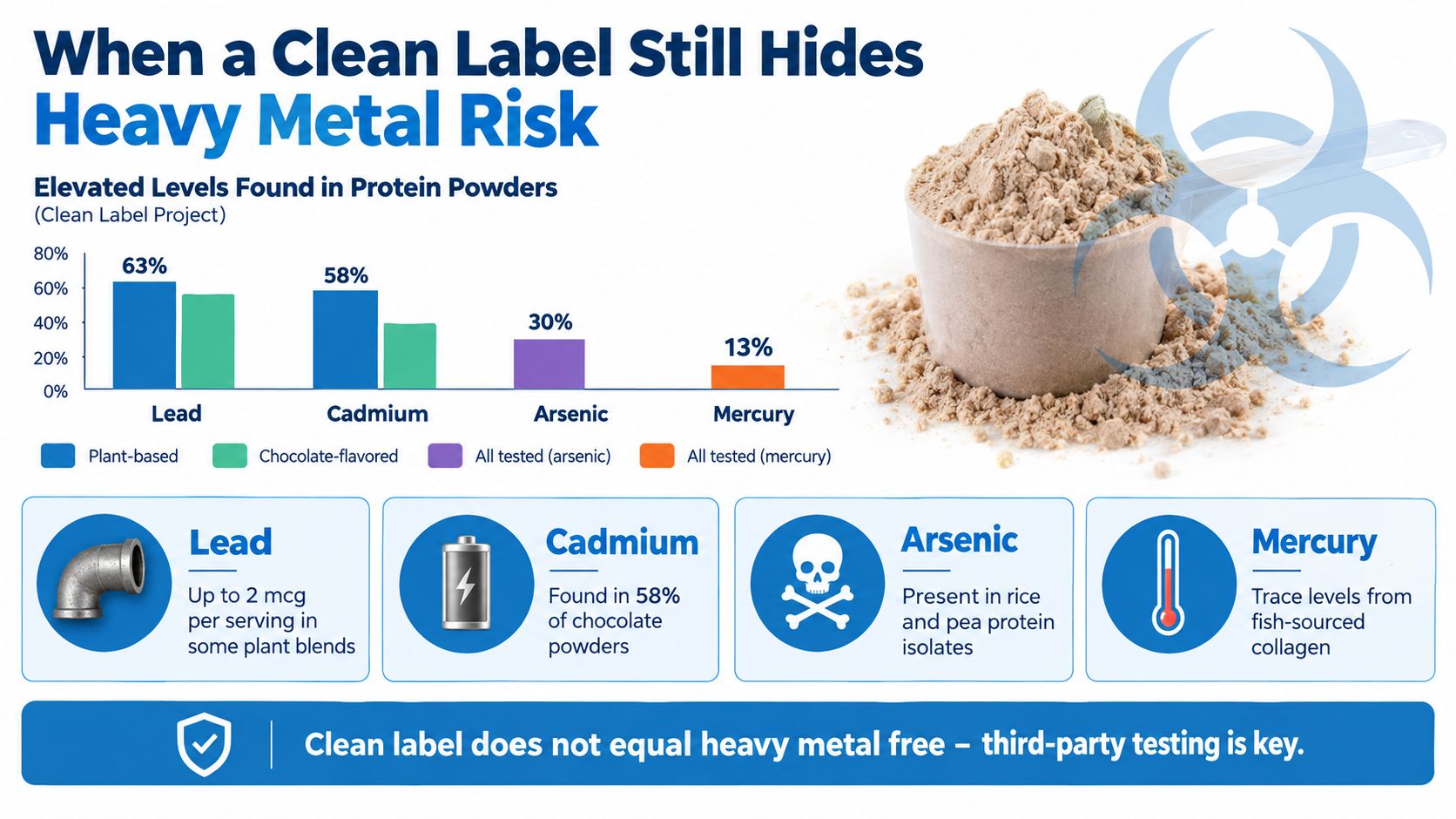
A spotless macro panel doesn't confirm that a powder is free from contaminants. A 2025 review of 160 products found that 47% exceeded at least one safety threshold for lead, and 21% were more than twice the Prop 65 limit. The review also found that plant-based powders had about three times more lead than whey, while organic powders had about three times more lead and twice as much cadmium as non-organic powders, according to the Powers Health summary of the protein powder safety report.
Plant ingredients grow in soil, and cocoa, rice, and pea ingredients can introduce different contaminant concerns than dairy-derived ingredients. Chocolate flavor can therefore matter even when the protein grams and calories match an unflavored formula. The risk isn't visible in the standard macro lines.
What a buyer can do
- Ask for batch testing: Look for a current certificate of analysis that identifies the tested product and batch.
- Avoid relying on “clean” language: Organic, natural, vegan, and minimal-ingredient claims don't by themselves establish heavy-metal safety.
- Vary sources when practical: Rotating between suitable protein sources can reduce dependence on one ingredient stream.
- Consider simpler formulas: An unflavored, single-ingredient powder may be easier to evaluate than a multi-ingredient flavored blend.
Lead, cadmium, arsenic, and mercury affect different biological systems, and exposure risk depends on dose, duration, and individual circumstances. People who are pregnant, caring for children, or managing a medical condition should discuss regular supplement use with a qualified clinician.
Label Reading Checklist and Common Questions Answered
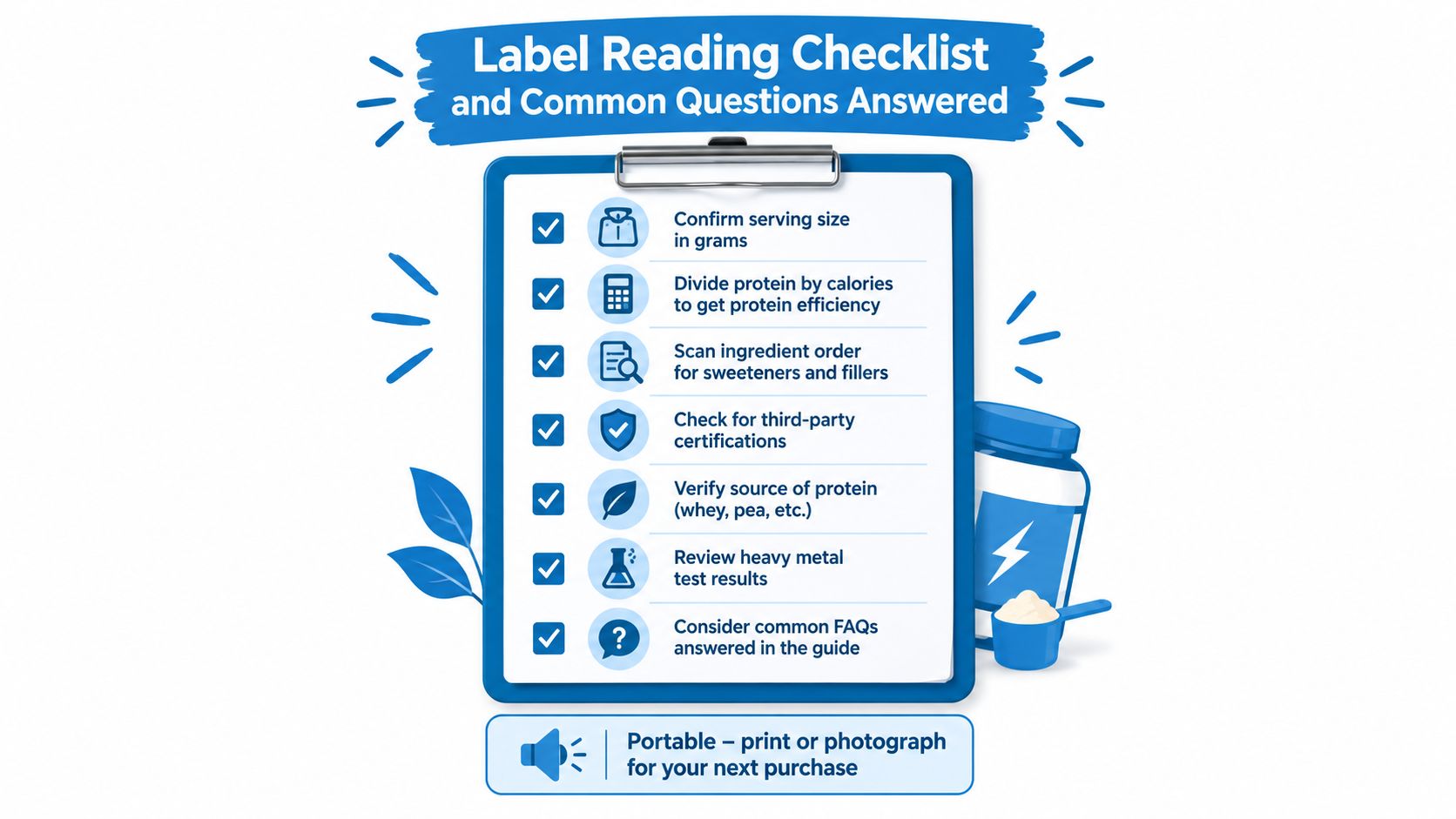
Save this seven-step routine before your next purchase:
- Confirm serving weight: Read grams, not just scoop size.
- Calculate efficiency: Divide protein grams by calories.
- Scan ingredient order: Notice sweeteners, thickeners, fillers, and blends near the beginning.
- Verify allergens: Check both “Contains” and cross-contact language.
- Look for testing: Prefer transparent third-party or batch-specific documentation.
- Review carbohydrate quality: Identify added sugars, fibers, and concentrated carbohydrate ingredients.
- Match the source to your diet: Whey and casein contain milk, soy is an allergen for some people, and plant blends may have different amino acid and contaminant considerations.
Common questions
Can plant protein support muscle building? Yes, a suitable plant powder can contribute protein to a muscle-focused diet. Soy provides a complete essential amino acid profile, while pea and rice can complement one another in a blend.
Why choose isolate over concentrate? Isolate generally contains less lactose and fat than concentrate, although the exact difference depends on the product formula.
Is using two scoops safe for a 50-gram serving? Two scoops can be a practical way to reach about 50 grams when the label provides about 25 grams per serving, but you should count the doubled calories and other nutrients.
What do BCAAs mean on the label? Branched-chain amino acids are leucine, isoleucine, and valine. Their presence doesn't replace checking total protein, calories, and source quality.
Does protein powder expire? Yes. Check the printed date, storage directions, seal condition, and changes in smell, texture, or taste. When in doubt, don't use it.
Read the panel first, the ingredient list second, and certifications or testing documentation third. That sequence keeps the marketing language from making the decision for you.
CalVitamin offers protein products alongside vitamins, minerals, probiotics, and other wellness supplements, with product pages that can help you review serving size and nutrition details before buying. Visit CalVitamin to compare labeled protein options and apply this checklist to your next selection.






