
A lot of people don't think about bone density until something jolts it into focus. It might be a parent's fall that led to a fracture that seemed out of proportion to the accident. It might be a routine visit where your clinician mentions osteopenia. Or it might be simpler than that. You're exercising, trying to eat well, and wondering whether what you're doing is enough to protect your bones.
That uncertainty is common because bone loss is quiet. You don't feel your skeleton getting weaker in the way you feel sore muscles or an increased heart rate. But bone is living tissue. It responds to load, nutrition, hormones, recovery, and daily habits. That means your bones aren't just passive structures you inherit and hope for the best with. They're adaptable.
The most useful way to think about how to improve bone density is as a Bone-Building Blueprint. Not a random list of supplements. Not vague advice to “walk more.” A real plan that combines targeted exercise, a bone-supportive diet, strategic supplementation, and lifestyle choices that stop undermining your progress.
Table of Contents
- Why Your Bone Density Matters Now More Than Ever
- Diagnosing Your Risk Understanding DEXA Scans and Key Factors
- Your Exercise Prescription for Stronger Bones
- The Foundational Diet for Bone Remodeling
- Strategic Supplementation for Bone Support
- Lifestyle Adjustments and When to See a Doctor
Why Your Bone Density Matters Now More Than Ever
Bone density is the structural strength of your skeleton. It reflects how much mineral is packed into bone tissue and, in practical terms, how well your bones can handle force. Stronger bones support movement, lifting, balance, and recovery from everyday stress. Lower density raises the chance that a simple misstep, awkward landing, or minor fall turns into a serious injury.
What makes this tricky is timing. Individuals start paying attention after a warning sign appears. A scan shows bone loss. A fracture happens earlier than expected. A woman reaches menopause and notices that her training, recovery, and body composition are changing all at once. Men often delay thinking about bone health even longer, which can be a mistake.
Bone health is easiest to protect when you act before you feel vulnerable.
The good news is that bone loss isn't completely fixed by age or family history. Some factors are outside your control, but many of the biggest levers are modifiable. The right kind of exercise can stimulate bone-building. Adequate nutrition gives your body the raw materials it needs. Better recovery, steadier eating, and smarter habits can stop you from cancelling out your own efforts.
This matters whether you're in your twenties trying to build a strong baseline, in midlife navigating hormonal changes, or older and focused on staying independent. Bone density isn't just about fracture prevention in the abstract. It affects how confidently you move through daily life.
A practical plan beats fear every time. If you know what to train, what to eat, what to supplement, and when to involve a clinician, you can improve your odds in a meaningful way.
Diagnosing Your Risk Understanding DEXA Scans and Key Factors
A lot of readers want to know one thing first. How do you tell whether your bone health is a problem, or just a vague concern? That's where medical assessment matters. You shouldn't guess if you have significant bone loss.
What a DEXA scan actually tells you
A DEXA scan is the standard imaging test clinicians use to measure bone mineral density. It's commonly used when someone has risk factors, a fracture history, or a clinical reason to check bone status more closely. If your doctor recommends one, the main goal is simple: establish a baseline and decide whether your current plan is enough.
The result people hear about most often is the T-score. In plain English, it compares your bone density with that of a healthy young adult reference group. A lower result suggests more bone loss. Your clinician uses that score alongside your medical history, medications, age, fracture history, and other risk factors. It's not a number to interpret in isolation.
If you're already paying attention to nutrients that support bone health, products discussed in the broader vitamin D space, such as Phytoral Vitamin D3 Gummies for immune and bone support, often come up in the conversation. But they don't replace proper testing when there's a real concern about low bone density.
Practical rule: If you've had a low-impact fracture, have major hormonal shifts, or know you carry multiple risk factors, talk with your doctor instead of trying to self-diagnose from symptoms.
Risk factors you can change and risk factors you can't
Bone health gets easier to understand when you split risk into two buckets.
| Risk factor type | Examples | What to do with that information |
|---|---|---|
| Less controllable | Age, family history, sex, hormonal changes | Treat these as your baseline risk, not your fate |
| More controllable | Exercise habits, calorie intake, smoking, alcohol use, nutrient intake | Build your plan around these immediately |
The less controllable category matters because it tells you how proactive you need to be. If osteoporosis runs in your family, if you've gone through early menopause, or if you've spent long periods inactive, your threshold for getting evaluated should be lower.
The more controllable category is where most day-to-day progress happens. If you want to know how to improve bone density, focus your energy here:
- Training quality matters: Walking has benefits, but it may not be enough on its own for bone building.
- Food intake matters: Chronic under-eating can work against bone remodeling.
- Lifestyle matters: Smoking and heavy drinking raise risk.
- Consistency matters: Bone responds to repeated signals over time, not occasional bursts of effort.
A scan gives you information. Your habits determine what happens next.
Your Exercise Prescription for Stronger Bones
A common scenario looks like this: someone gets told to do more “weight-bearing exercise,” starts walking more often, stays consistent for months, and still sees little change on follow-up testing. The missing piece is usually not effort. It is the training signal.
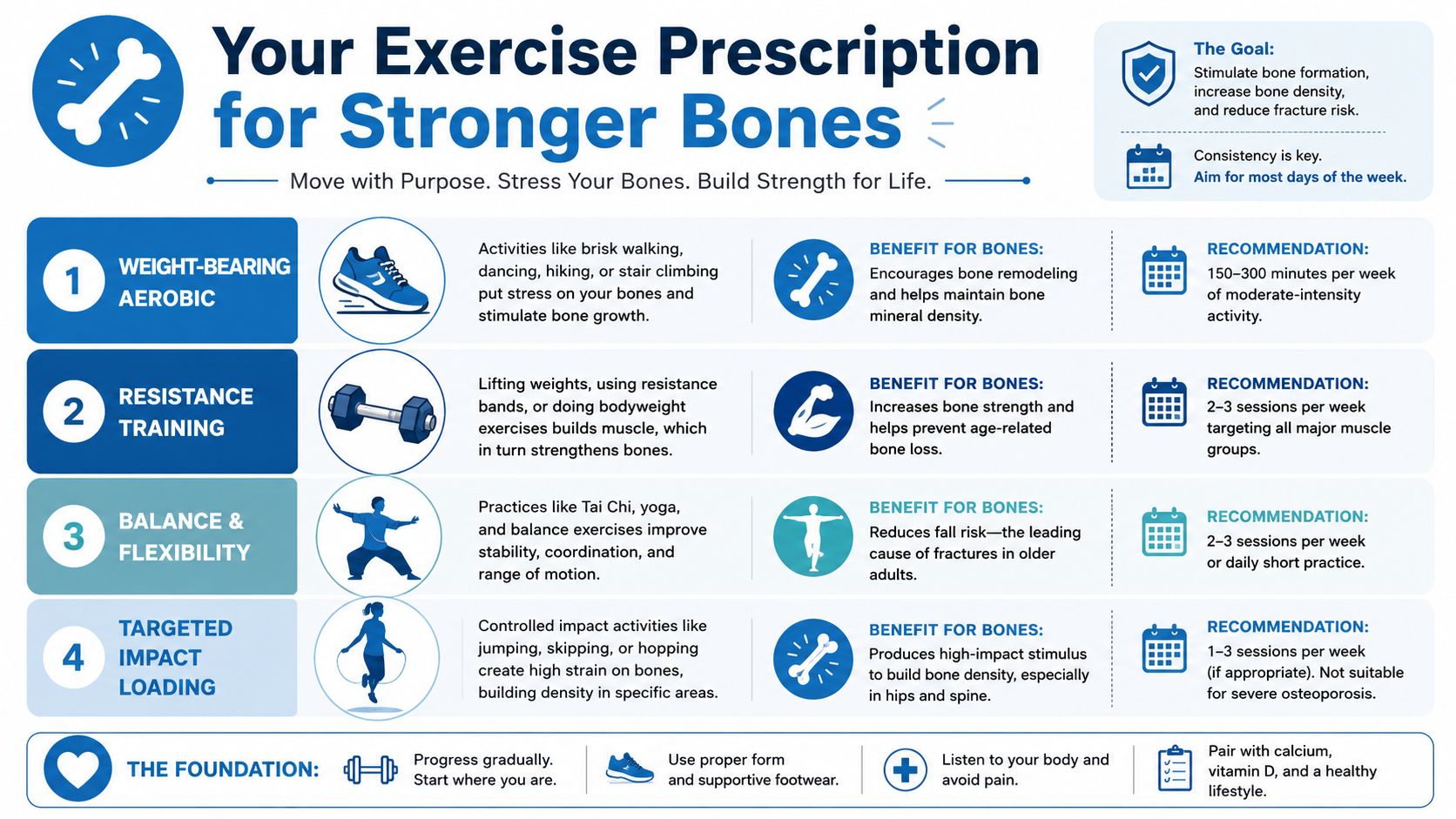
Bone responds to strain. To improve bone density, the plan needs enough load, enough repetition over time, and enough progression to give bone-forming cells a reason to keep building. In practice, the strongest results usually come from pairing resistance training with impact work when it is safe to do so. That is one part of the Bone-Building Blueprint. Exercise creates the signal, and the nutrition covered next supplies the raw materials.
What works better than walking alone
Walking has value. It supports cardiovascular health, helps with daily activity, and can be a sensible starting point after a long period of inactivity.
For bone density, though, it is often too gentle on its own.
A clinical overview of exercise for bone health supports regular weight-bearing and muscle-strengthening work, with sessions lasting about 30 to 40 minutes, 3 to 4 times per week, and examples such as Pilates, weightlifting, jogging, and running in this review of bone density interventions. The practical takeaway is straightforward. Bones tend to respond better to a mixed plan than to one steady, unchanging activity.
Resistance training matters because muscle pulls on bone. Impact matters because ground reaction forces add another signal. Put together, they create a stronger reason for the skeleton to adapt than easy walking at the same pace every week.
That does not mean everyone should start with jogging or jumping. It means your program should include the highest level of loading you can tolerate and repeat consistently.
Here's a useful video overview before we get into the weekly template:
A practical weekly training template
The goal is not variety for its own sake. The goal is repeated exposure to bone-building movement patterns.
Sample weekly framework
- Day 1. Lower-body resistance training: Squats, deadlifts, step-ups, and loaded carries. Use compound lifts as your base and increase load gradually as technique improves.
- Day 2. Impact plus balance work: Jogging, skipping, controlled hops, or racket sports if your joints and current bone status allow it. Finish with balance practice such as single-leg stands, Tai chi, or yoga.
- Day 3. Rest or light activity: Mobility work, easy walking, or gentle cycling.
- Day 4. Full-body resistance training: Repeat lower-body loading and add upper-body pushing, pulling, and core work.
- Day 5. Weight-bearing aerobic work: Brisk uphill walking, stair climbing, or short jogging intervals if tolerated.
- Day 6. Mixed session: A shorter strength session plus a brief impact block.
- Day 7. Recovery: Prioritize sleep, food intake, and soreness management.
For many adults, two to four strength sessions per week is a realistic target. If you are building your home setup, a simple tool such as calcium citrate chewables for bone and muscle support can fit the bigger plan, but supplements do not replace training progression or adequate food intake.
One more point matters here. General activity targets still count, but they are the floor, not the full prescription for stronger bones.
How to progress without overdoing it
The best program is the one you can repeat long enough for remodeling to occur. Bone changes slowly. Tendons, joints, and confidence also need time to catch up.
Use this progression logic:
- If you're deconditioned: Start with sit-to-stands, bodyweight squats, stair climbing, and light dumbbell or machine work.
- If your joints are sensitive: Use lower-impact loading such as weighted vest walks, step-ups, sled pushes, or strength machines.
- If balance is a concern: Put stability first. Tai chi, supported single-leg work, and leg strengthening often make impact training safer later.
- If you already train regularly: Increase resistance gradually, add another set, or add a short impact block rather than changing everything at once.
- If you have diagnosed osteoporosis, a prior spine fracture, or pain with loading: Get medical clearance and an individualized plan before adding higher-impact drills.
I tell patients to chase challenge, not punishment. A good session leaves you worked, not wrecked. If pain spikes, technique breaks down, or fear makes you avoid the next workout, the dose is too high.
Consistency wins here. A moderate program done for months beats a hard program done for ten days.
The Bone-Building Blueprint works best when exercise and nutrition reinforce each other. Loading tells your body where to build. Calcium, vitamin D3, K2, and magnesium help support the process that follows.
The Foundational Diet for Bone Remodeling
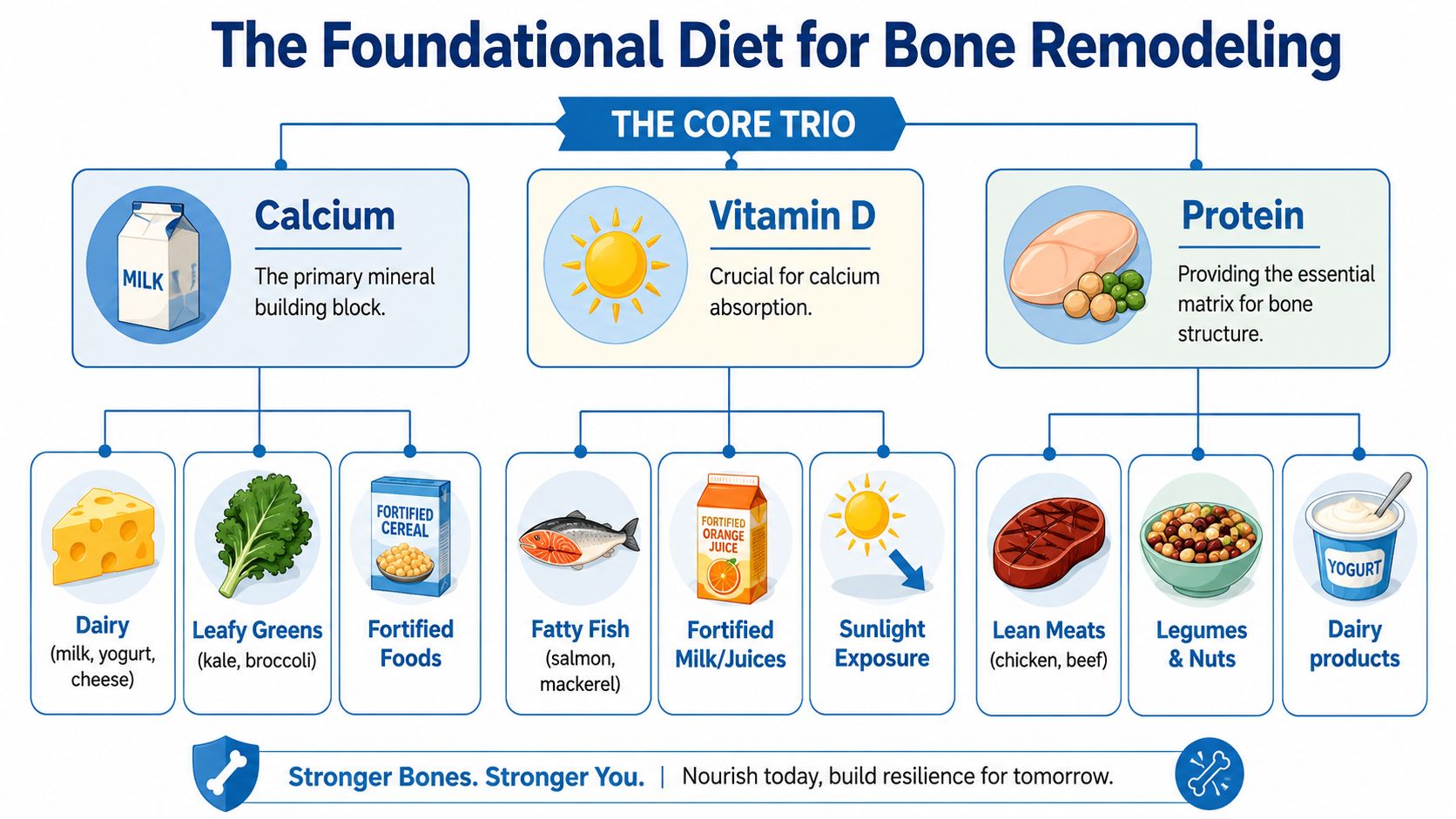
You can't out-train a poor intake pattern. Bone remodeling requires raw materials, and the basics matter more than trendy add-ons. For most adults, the nutritional foundation comes down to a simple trio: calcium, vitamin D3, and protein. If one of those is consistently low, your exercise plan has less to build with.
A visual summary makes the hierarchy easier to remember.
The core trio your bones need every day
The National Academy of Medicine recommendations summarized by Johns Hopkins are clear: women aged 50 and under need 1,000 mg of calcium daily, women aged 51 and older need 1,200 mg, adults under 70 need 600 IU of vitamin D3 per day, adults older than 70 need 800 IU, and protein intake of 0.8 to 1.2 g/kg daily is critical for the bone matrix according to the Johns Hopkins osteoporosis update.
That gives you a practical target range, but food still comes first whenever possible.
Consider the job each nutrient performs:
- Calcium: The main mineral building block. Dairy foods, fortified foods, and some leafy greens can contribute.
- Vitamin D3: Supports calcium absorption and bone metabolism. Sunlight helps, but intake often still needs attention.
- Protein: Provides structural support for the bone matrix and becomes even more important when you're doing resistance training.
This is also where many people go wrong by under-eating. If total calorie intake is too low, bone formation suffers. Trying to get lean while doing hard training and eating too little is one of the fastest ways to undermine a bone-building plan. If you use a chewable calcium product for convenience, something like KAL High Potency Calcium Citrate Chewables fits into the broader conversation, but it works best as support for a solid diet, not a substitute for one.
The strongest nutrition plan for bones is usually boring in the best way. Enough food. Enough protein. Reliable calcium. Consistent vitamin D.
A bone-building day of eating
You don't need a perfect menu. You need repeatable meals that make the targets realistic.
Here's what that can look like qualitatively:
| Meal | Bone-supportive focus |
|---|---|
| Breakfast | Yogurt or fortified non-dairy option, fruit, nuts or seeds, and a protein source |
| Lunch | Salmon, tofu, beans, or chicken with leafy greens and a calcium-containing side |
| Snack | Cottage cheese, kefir, fortified beverage, or a protein-rich snack |
| Dinner | Lean protein, vegetables, and a starch that keeps total energy intake adequate |
A few food-first principles help:
- Build meals around protein first: This makes it easier to reach daily protein intake without chasing it at night.
- Use calcium-rich foods across the day: Splitting intake across meals is often easier than trying to cram it into one sitting.
- Include fortified foods if needed: They can fill gaps for people who eat little dairy.
- Don't fear adequate calories: Bone is metabolically active tissue. It doesn't thrive under chronic restriction.
If you're plant-based, this still works. The main adjustment is intentionality. Use fortified beverages, calcium-set tofu, beans, lentils, nuts, seeds, and higher-protein meals instead of assuming the numbers will take care of themselves.
When people ask how to improve bone density through nutrition, my answer is usually the same: stop thinking in terms of isolated “superfoods” and start building complete days of eating. Bone responds to patterns.
Strategic Supplementation for Bone Support
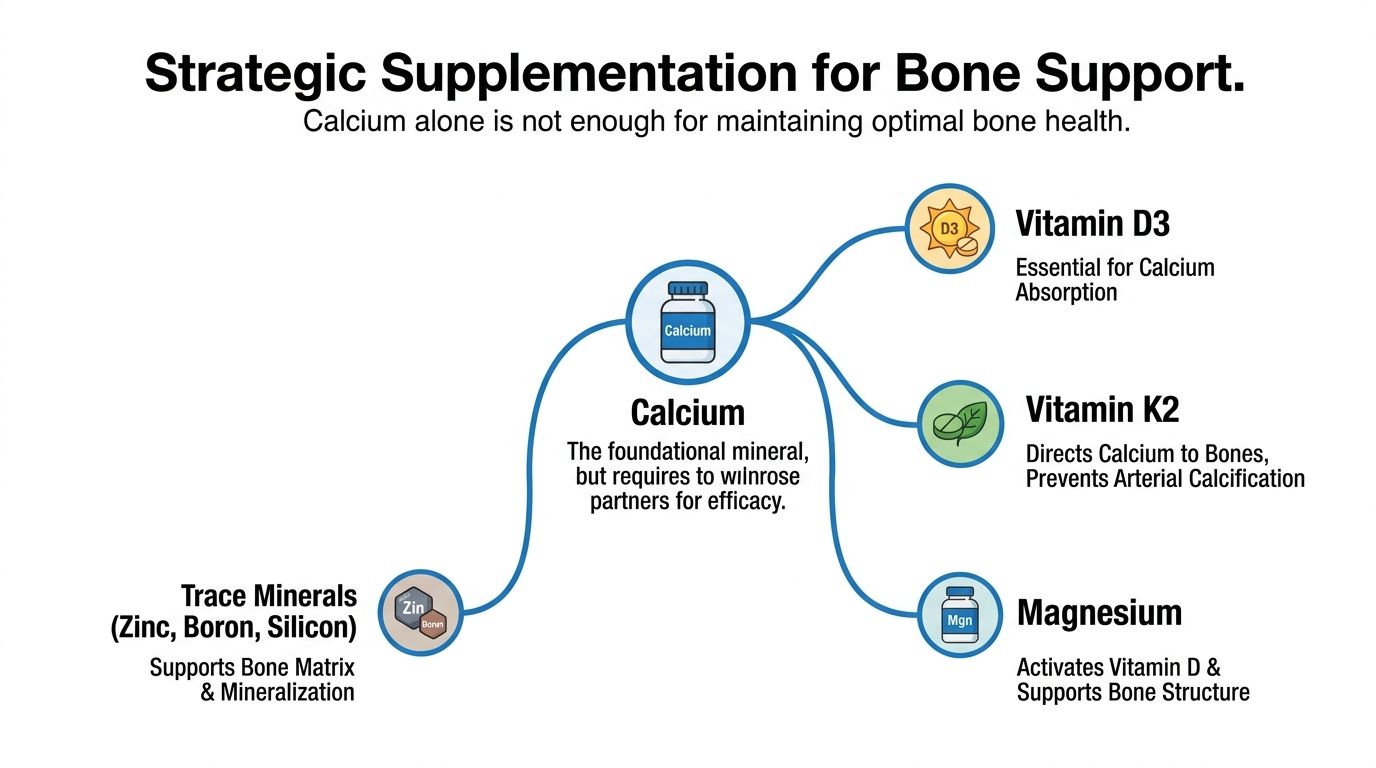
Supplement shelves can make bone health look simpler than it is. Buy calcium. Take calcium. Problem solved. In practice, that's often incomplete. A stronger approach is to think in terms of a bone nutrient network, where one nutrient helps another do its job.
This is the part many generic bone-health articles miss.
Why calcium alone is often an incomplete plan
A key point from the provided data is that without Vitamin K2, which activates osteocalcin, and Boron, which extends vitamin D half-life, up to 40% of supplemental calcium fails to reach bone tissue as stated in this source discussing K2 and boron in bone support.
Even if you treat that insight cautiously, the practical lesson is valuable. More calcium isn't automatically better if the broader nutrient environment is weak. Bone support works better when calcium intake is paired with the nutrients involved in absorption, transport, and utilization.
That's why a one-bottle strategy often disappoints people. They take calcium consistently, but they haven't checked whether vitamin D intake is adequate, whether their diet supplies enough magnesium-rich foods, or whether the rest of their routine is strong enough to signal bone growth in the first place.
How to build a smarter supplement stack
A good supplement plan starts by asking what food and training already cover, then fills gaps without becoming excessive or redundant.
Think in roles, not hype:
- Calcium supports the mineral side of bone structure. It makes sense when food intake falls short.
- Vitamin D3 helps your body absorb and use calcium effectively.
- Vitamin K2 is often discussed for helping direct calcium into bone-related pathways.
- Magnesium supports vitamin D metabolism and overall bone physiology.
- Protein powders can be practical if low appetite or busy schedules make protein targets hard to meet.
- Collagen may interest some people as a supportive protein source, but it shouldn't replace total protein adequacy.
A supplement formula such as Life Extension Bone Restore reflects this broader, multi-nutrient idea more closely than a calcium-only approach. That doesn't make every blend automatically right for every person. It does reinforce the bigger principle: strategic combinations usually make more sense than isolated megadoses.
Here's a simple decision guide:
| Situation | Smarter supplement move |
|---|---|
| Low dairy or low-calcium diet | Add calcium support to close the intake gap |
| Limited sun exposure or winter months | Pay closer attention to vitamin D3 intake |
| Poor overall diet quality | Use a broader bone-support formula instead of chasing one nutrient |
| Low protein intake | Add a protein supplement if whole-food intake stays low |
Supplements should support a good plan, not rescue a weak one.
If you're trying to improve bone density, the highest-return question isn't “What's the strongest bone pill?” It's “Where is my current plan incomplete?” That mindset usually leads to better decisions.
Lifestyle Adjustments and When to See a Doctor
A common real-world pattern looks like this. Someone improves calcium intake, starts strength training, adds a bone support supplement, then keeps under-eating, drinks heavily on weekends, or ignores repeated falls and dizzy spells. The plan looks good on paper, but the bone-building signal stays incomplete.
That is why I treat lifestyle as the final part of a Bone-Building Blueprint. Bones respond best when training, nutrition, recovery, and fall prevention all point in the same direction.
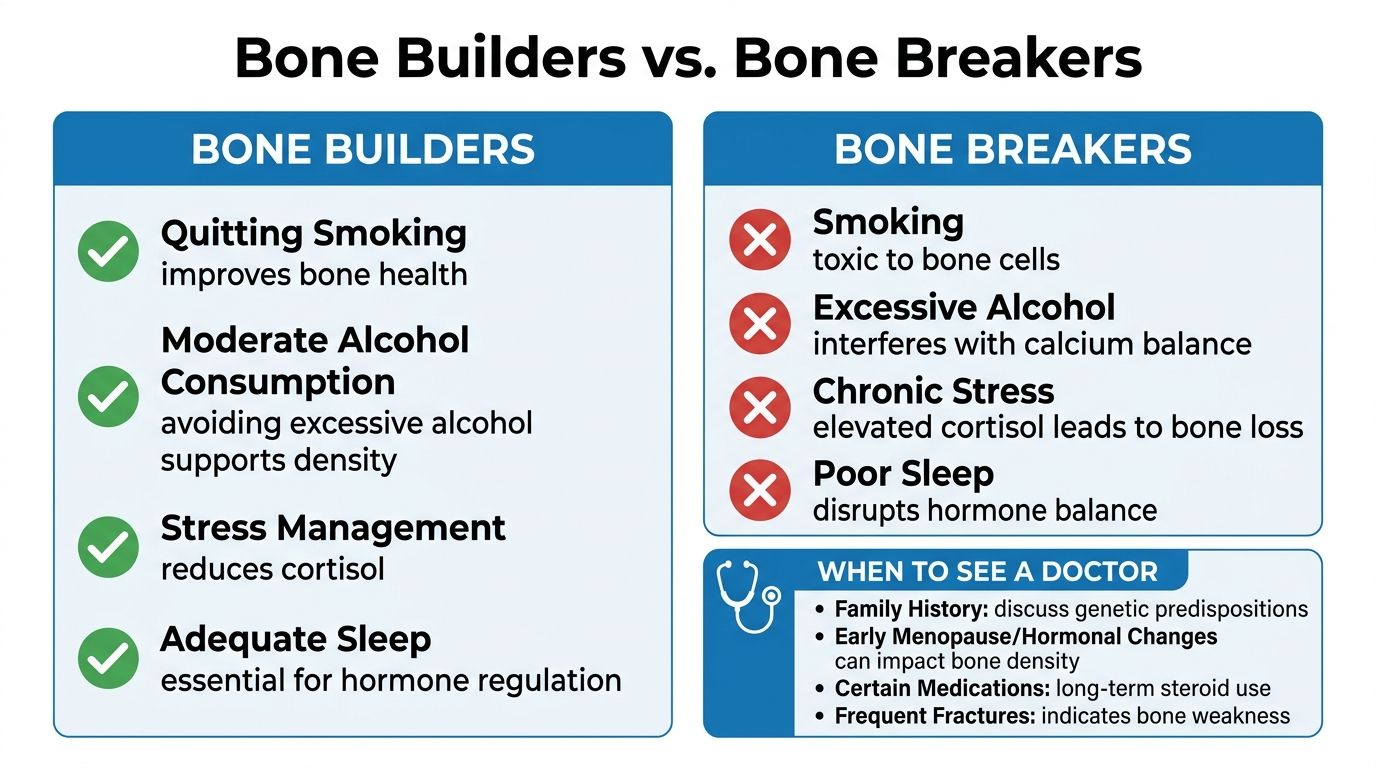
Bone builders and bone breakers
Daily habits can either support bone remodeling or interfere with it.
Bone builders
- Adequate calorie intake: Bone tissue does not rebuild well during chronic under-fueling. This matters most in people who train hard, diet often, or have low appetite.
- Seasonal vitamin D awareness: If sun exposure drops for part of the year, review your vitamin D plan instead of assuming summer habits still cover you.
- Balance training: Tai chi, yoga, and simple single-leg balance drills can lower fall risk by improving stability and body control.
- Home safety habits: Better lighting, secure rugs, handrails, and supportive shoes reduce the chance of a fracture caused by a preventable fall.
- Consistent recovery: Sleep, regular meals, and enough protein help your body use the training and nutrient inputs you are already giving it.
Bone breakers
- Smoking: Smoking is consistently linked with poorer bone health.
- Heavy alcohol use: High alcohol intake can work against bone maintenance and increase fall risk at the same time.
- Repeated crash dieting: Low-calorie cycles send the wrong message to the body and make bone rebuilding harder.
- Long stretches of inactivity: Bones need regular loading. Even a good exercise program loses impact if the rest of the week is mostly sedentary.
- Ignoring falls or near-falls: A close call in the bathroom or on the stairs is useful clinical information, not bad luck to shrug off.
This is the trade-off many people miss. Building stronger bones is only part of fracture prevention. The other part is reducing the odds that you hit the ground in the first place.
When medical care should move to the front of the line
Lifestyle changes help, but some situations need a medical plan early. Make an appointment if you have had a fragility fracture, known osteopenia or osteoporosis, prolonged loss of menstrual cycles, major hormonal shifts, a strong family history, digestive conditions that limit nutrient absorption, or long-term use of medicines that can affect bone health.
Medication review matters here. Steroids, some acid-reducing drugs, certain seizure medications, and other prescriptions can change bone risk. That does not mean you should stop them on your own. It means the full picture should be reviewed by a clinician.
Some people also need prescription treatment, not just better habits. Bisphosphonates and other osteoporosis medications may be appropriate when fracture risk is high or bone loss is already established.
Bring focused questions to the visit:
- What is my fracture risk right now?
- Should I get a DEXA scan or repeat one?
- Could any of my medications be affecting bone health?
- Do I need lab work for vitamin D, hormones, or other contributing factors?
- Would prescription treatment make sense for me?
- What kind of exercise is safe with my history?
The practical goal is simple. Build a plan that loads bone, supplies the full nutrient network that supports remodeling, and catches medical red flags early.
CalVitamin makes it easier to shop for bone-supportive nutrients, proteins, and wellness products in one place. If you're building a practical routine and want options across calcium, vitamin D, mineral support, and daily nutrition, explore CalVitamin for products that fit your preferences and supplement style.






