
You're probably here because CoQ10 has come up in a very real moment, not in an abstract wellness debate.
Maybe your doctor started you on a statin and a friend said, “Take CoQ10, it helps.” Maybe you've been reading about heart failure, blood pressure, or “cellular energy” and found a mix of confident claims that don't agree with each other. One site treats CoQ10 like a cure-all. Another dismisses it. If you're trying to protect your heart and avoid wasting money, that's frustrating.
CoQ10 is one of those supplements that sits right at the intersection of solid science, oversimplified marketing, and practical questions patients ask. Which form matters. Age matters. Your diagnosis matters. Your medications matter. And the answer for a healthy adult looking for general support isn't always the same as the answer for an older adult with heart failure or someone taking a statin.
This guide takes a careful, patient-style approach to CoQ10 heart health. I'm going to explain what CoQ10 does, why the heart depends on it, where the best evidence is strongest, and where the advice gets murky. I'll also show you the meaningful difference between ubiquinone and ubiquinol, especially for older adults, and give you a practical way to discuss CoQ10 with your clinician without getting lost in supplement hype.
Table of Contents
- Introduction Your Guide to CoQ10 and a Healthier Heart
- What Is CoQ10 The Spark Plug for Your Body
- How CoQ10 Specifically Powers Your Heart
- The Clinical Evidence on CoQ10 and Heart Conditions
- Choosing Your CoQ10 Supplement Form Dose and Quality
- Understanding Safety Side Effects and Statin Interactions
- Who Might Benefit Most from Taking CoQ10
Introduction Your Guide to CoQ10 and a Healthier Heart
A patient in the pharmacy once asked a question I hear often: “If CoQ10 is so good for the heart, why doesn't everyone tell you exactly which one to buy?”
That's the right question. Individuals don't need another vague promise about “supporting cardiovascular wellness.” They need help sorting out what matters. Is CoQ10 mainly about energy? Is it about statins? Is it worth considering for heart failure? And why do some articles talk about ubiquinone, while others insist on ubiquinol?
The confusion usually starts because CoQ10 sits in two worlds at once. In one world, it's a normal substance your body already makes and uses inside cells. In the other, it's sold as a supplement, which means the practical details matter a lot. Form, age, dose, absorption, and medication interactions can all change the conversation.
Practical rule: Don't ask only “Should I take CoQ10?” Ask “Why am I taking it, which form fits me, and what outcome am I actually hoping for?”
For heart-related use, that framing matters. The strongest discussion isn't about CoQ10 as a generic anti-aging tonic. It's about whether it can support the heart's energy demands, whether some people are more likely to have low levels, and whether certain groups, especially older adults and people with heart failure, may have more reason to consider it.
If you've felt pulled between supplement marketing and cautious medical advice, your hesitation makes sense. A balanced view is possible. CoQ10 has meaningful evidence in some areas, weaker evidence in others, and one especially important gray zone around statins that deserves a straight answer.
What Is CoQ10 The Spark Plug for Your Body
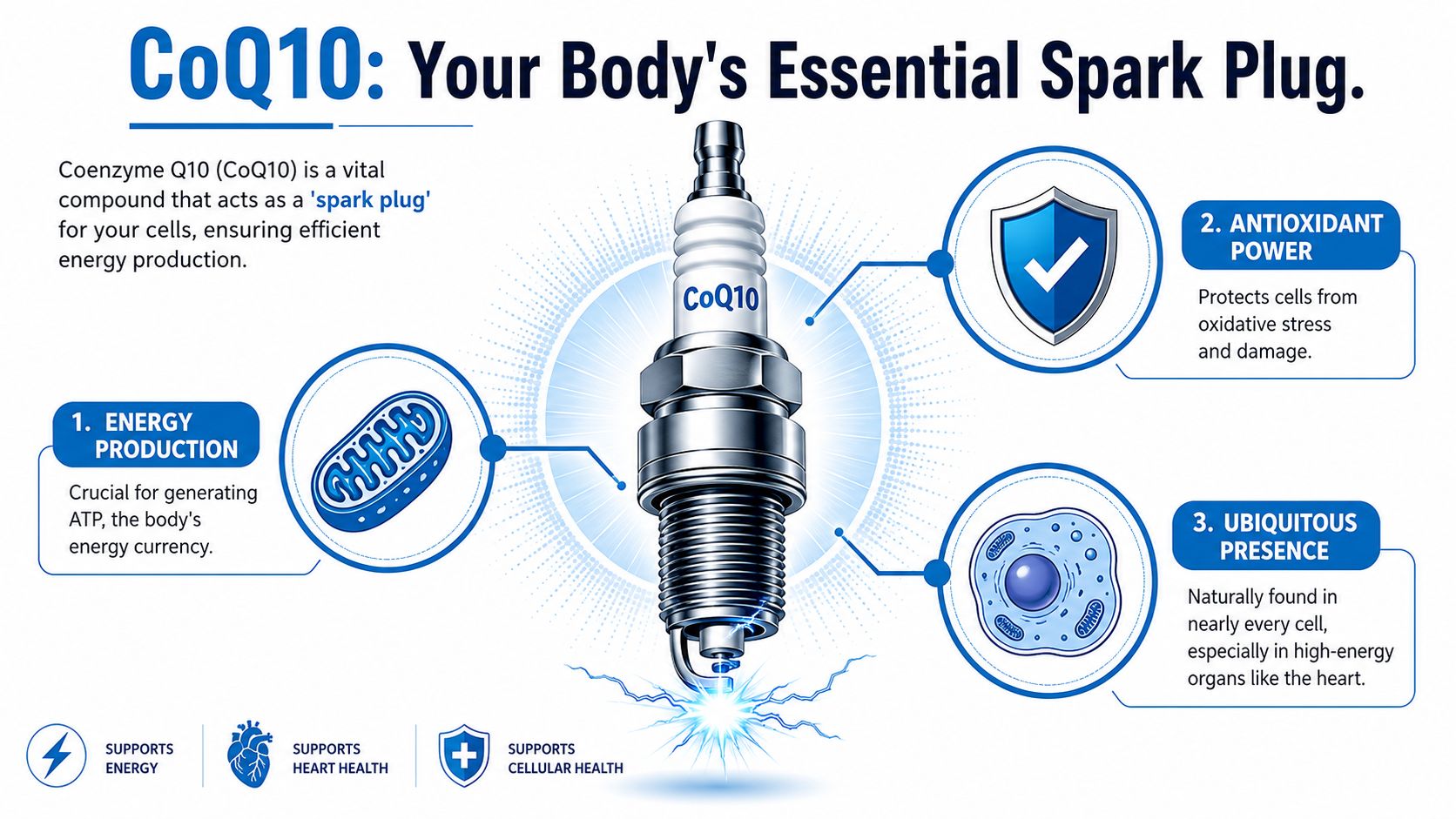
CoQ10, short for coenzyme Q10, is a natural compound your body makes and uses in nearly every cell. It helps cells turn food into usable energy, and it also helps protect those cells from oxidative stress. Those two jobs are the reason CoQ10 keeps coming up in heart health discussions.
A simple way to understand it is to start at the cellular level.
Your cells contain mitochondria, often described as the parts of the cell that produce energy. Inside those mitochondria, CoQ10 helps carry electrons through the steps that lead to ATP production. ATP is the cell's working fuel. It supports muscle contraction, nerve signaling, tissue repair, and the countless background tasks that keep the body running.
Why your cells need it
If the term “electron transport” feels abstract, here is the practical takeaway. CoQ10 acts like a shuttle in the cell's energy system. It helps pass along the chemical charges needed to build ATP efficiently. Without enough of that transfer, energy production can become less efficient.
CoQ10 has a second role too. It works as an antioxidant, helping limit some of the oxidative wear that comes from normal energy production. That matters most in tissues that are always active, especially muscle and nerve tissue.
This is also where the supplement conversation gets confusing.
Your body can make CoQ10 on its own, but production may decline with age, and levels may be affected by illness or medication use. That helps explain why a healthy 30-year-old, an older adult, and a person taking a statin may not be asking the same CoQ10 question. They are starting from different baseline situations.
Why form matters later in the discussion
CoQ10 is not just one supplement on a shelf. It appears mainly in two forms, ubiquinone and ubiquinol. Ubiquinone is the oxidized form. Ubiquinol is the reduced form that the body can use as an antioxidant. The body can convert between them, but that conversion may become less efficient with aging or chronic illness.
That does not mean one form is automatically best for everyone. It does mean the details matter more than marketing often suggests. For a younger person with no major health issues, standard ubiquinone may be a reasonable option. For some older adults, or for people trying to address low levels more effectively, ubiquinol is often part of the conversation because absorption and conversion may be more relevant.
So the big picture is straightforward. CoQ10 is a normal part of human biology, not a mystery ingredient. The useful question is whether your age, medications, and heart health history make extra CoQ10 worth discussing, and if so, which form makes the most sense for your situation.
How CoQ10 Specifically Powers Your Heart
Your heart is not a part-time muscle. It doesn't work in shifts. It contracts continuously, and that constant activity creates an enormous demand for energy.
That's why CoQ10 heart health discussions make sense in the first place. If CoQ10 helps cells make ATP, the heart is one of the organs where that role matters most.
Why the heart is different
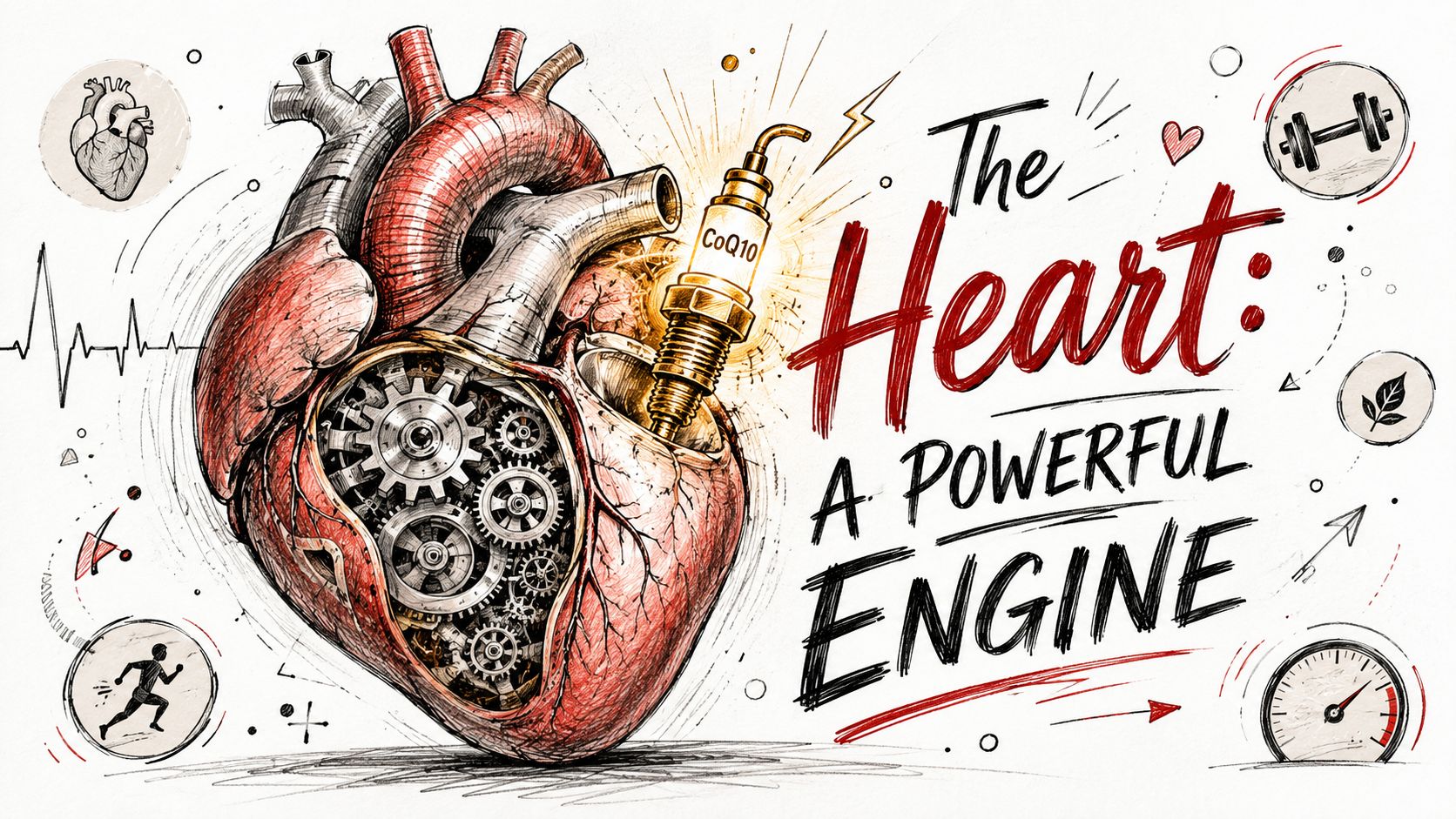
A useful analogy is to compare the heart to an engine that never gets turned off. Skeletal muscles get to rest. The heart doesn't. So even a modest drop in energy efficiency can matter more there than in tissues with lower demands.
CoQ10 helps the heart muscle produce ATP, which supports contraction. It also plays a role in reducing oxidative stress in the myocardium and blood vessels. That second job matters because the heart doesn't just need fuel. It needs protection from the stress created by ongoing high-output work.
A clinical review reported that in heart failure patients, CoQ10 supplementation was associated with a +9% increase in peak VO2 and a +38% increase in endothelium-dependent dilation of the brachial artery, with reasonable clinical benefit linked to serum CoQ10 levels above 2 mg/L, according to this review of CoQ10 in heart failure and endothelial function.
Energy and protection at the same time
People often get confused because CoQ10 seems to be described as both an energy nutrient and an antioxidant. It's both.
Think of a delivery truck that brings fuel to a factory while also helping keep the machinery from overheating. The two roles support each other. Better energy handling helps performance. Less oxidative stress may help preserve function.
That combination is part of why CoQ10 keeps showing up in discussions of heart failure and reduced exercise tolerance. In those settings, the issue isn't just “heart strength” in a broad sense. It's whether the heart muscle can produce and use energy efficiently enough to keep up with demand.
For a short visual explanation of the heart-energy connection, this video gives a helpful overview.
The easiest way to understand CoQ10 is this: it doesn't replace standard heart treatment. It's discussed as an adjunct because the heart needs energy every second, and CoQ10 is part of that machinery.
The Clinical Evidence on CoQ10 and Heart Conditions
A patient with heart failure often asks a fair question: if CoQ10 helps the heart make energy, has that idea held up in real clinical trials?
The best-known trial in this area is Q-SYMBIO, because it looked at meaningful outcomes, not just lab numbers. In that randomized study, patients with moderate-to-severe heart failure who took 100 mg of CoQ10 three times daily had fewer major cardiovascular events over two years than those taking placebo, along with lower all-cause and cardiovascular mortality, according to this American Heart Association report on Q-SYMBIO. The study enrolled 420 patients, and researchers also tracked blood levels to make sure participants reached a range associated with benefit.
What matters in plain language is simple. CoQ10 was studied as an add-on to standard treatment in a defined heart failure group, and the results suggested fewer serious complications. That is much more useful than a vague claim that it is “good for the heart.”
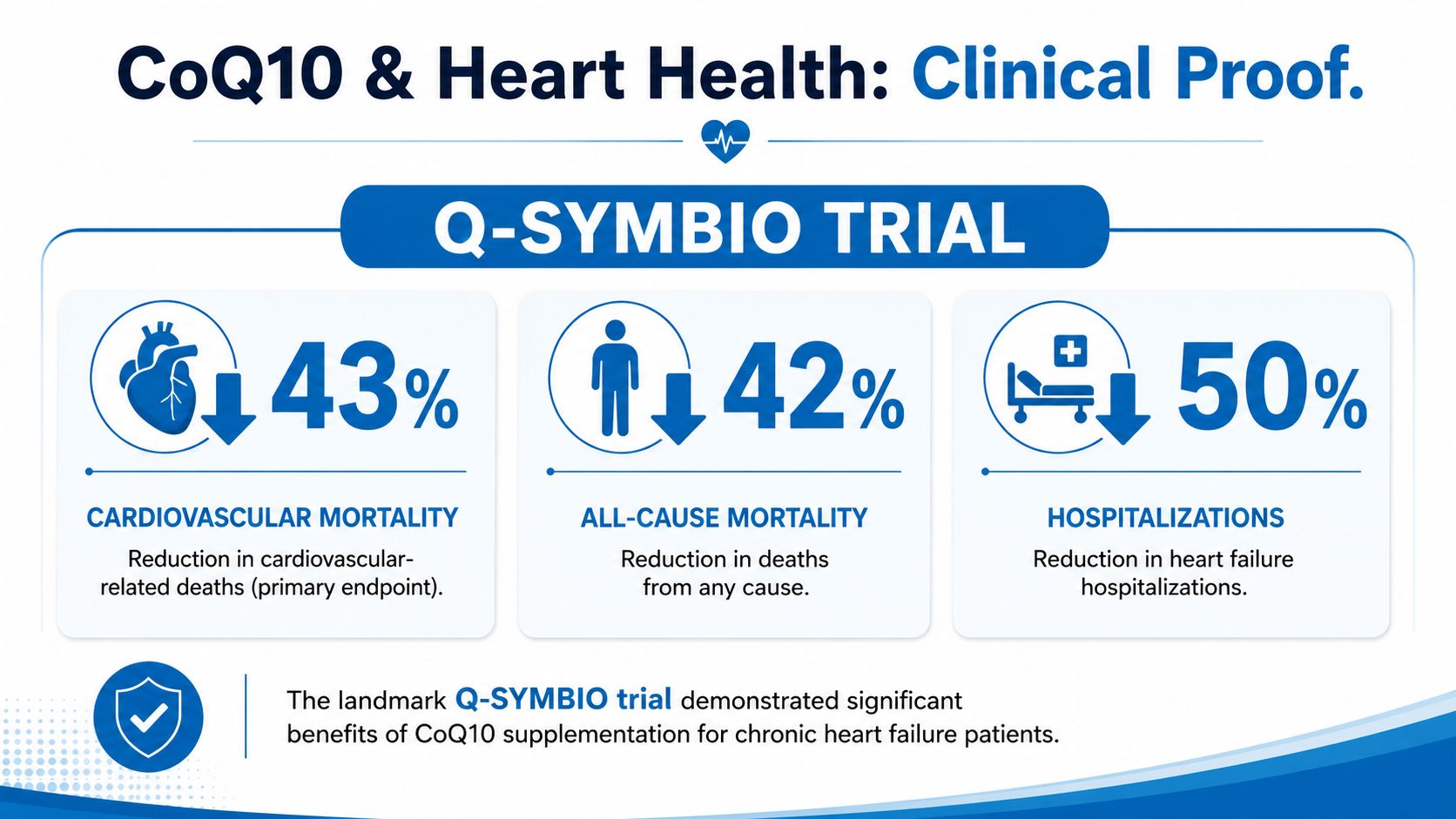
The infographic gives a quick visual summary, but for a medical discussion, the published trial report is the one to rely on.
Q-SYMBIO is not the only piece of evidence. Reviews and meta-analyses have reported improvements in measures such as left ventricular ejection fraction, exercise capacity, and symptom burden in some heart failure populations. A review that discusses this broader evidence also summarizes more recent pooled trial data suggesting lower mortality and fewer heart failure hospitalizations in selected patients, based on this Houston Methodist review of CoQ10 and heart failure evidence.
That does not mean every person with any heart concern should automatically start CoQ10. The clearest signal is still in heart failure, where the heart muscle is under constant energy strain. A practical way to picture it is a power plant that is still running but struggling to meet demand. If CoQ10 helps the cell's energy machinery work more efficiently, some patients may function better and have fewer setbacks, especially when it is used alongside prescribed therapy.
You will also see discussion of fewer hospitalizations and possible survival benefits in people with more advanced heart failure. Since that evidence overlaps with reviews mentioned earlier in the article, the safest takeaway is this: the research is promising enough to justify a clinician-guided conversation, but specific benefit depends on the person, the condition being treated, and the quality and form of the supplement chosen.
That last point matters more than many supplement articles admit. Two people can both say they are “taking CoQ10” and still be using different forms, doses, and absorption profiles. If you are comparing CoQ10 with other common heart-support supplements, this article on omega-3 support for heart and brain vitality shows how easily these decisions start to overlap in real life.
Bottom line: The strongest clinical case for CoQ10 is adjunctive use in heart failure, not broad use for everyone with a general interest in heart health.
Choosing Your CoQ10 Supplement Form Dose and Quality
Many shoppers get stuck here. They've decided CoQ10 is worth asking about, then they see ubiquinone and ubiquinol and assume it's mostly branding.
It isn't.
Ubiquinone and ubiquinol compared
Both are forms of CoQ10. Ubiquinone is the oxidized form. Ubiquinol is the reduced form, often described as the active antioxidant form. Your body can convert one to the other, but that conversion may become less efficient with age.
For older adults, that distinction matters. A consumer-facing review states that for adults over 60, the ubiquinol form is essential to bypass age-related metabolic decline, and that recent data shows adults over 65 may see better heart function metrics after switching to ubiquinol instead of standard ubiquinone, according to this discussion of ubiquinol for active adults and seniors.
| Feature | Ubiquinone (Oxidized Form) | Ubiquinol (Reduced/Active Form) |
|---|---|---|
| Basic role | Standard supplemental CoQ10 form | Reduced form used more directly in antioxidant activity |
| Conversion needed | Usually must be converted by the body | Less conversion burden |
| Best fit | Often reasonable for younger adults or general use | Often a better practical choice for older adults |
| Why age matters | Conversion may become less efficient with age | Helps bypass some age-related metabolic decline |
| Cost | Often less expensive | Often more expensive |
If you're over 60 and using CoQ10 for a heart-related reason, ubiquinol is the form I'd want on the shortlist first.
How to make a smart buying decision
Don't buy based on the front label alone. Look at the form, serving size, and how the product is meant to be taken.
A practical checklist:
- Match the form to your age: If you're younger and looking at general support, ubiquinone may be a reasonable starting point. If you're older, especially over 60, ubiquinol deserves stronger consideration.
- Take it with food containing fat: CoQ10 is fat-soluble, so absorption is generally better with a meal.
- Know the clinical context: Heart failure studies often used 300 mg daily, which is very different from a casual “energy support” product with a lower serving.
- Check quality signals: Look for a clear label, lot information, and reputable manufacturing practices.
- Bring the bottle to your appointment: That avoids the common problem where a clinician says “CoQ10 is fine,” but the patient is using a product with a very different form or serving.
If you're comparing labels and also thinking about broader heart muscle nutrition, some people look at companion products such as magnesium taurate plus heart muscle function support, but keep those decisions separate from your CoQ10 choice so you can tell what you're taking and why.
A final point on dose. For diagnosed heart failure, don't assume a generic wellness dose matches what clinical trials studied. That's one of the most common mistakes I see. The right question is not “How much CoQ10 do people take?” It's “What amount was studied for my situation, and is my clinician comfortable with it?”
Understanding Safety Side Effects and Statin Interactions
CoQ10 is generally considered well tolerated, which is one reason it stays in the conversation. But “generally safe” doesn't mean “automatically appropriate.”
What safety usually looks like
Individuals trying CoQ10 generally don't report dramatic problems. When side effects happen, they're often described as mild and digestive. The practical issue is usually not toxicity. It's fit. Does it make sense with your medications, diagnosis, and reason for taking it?
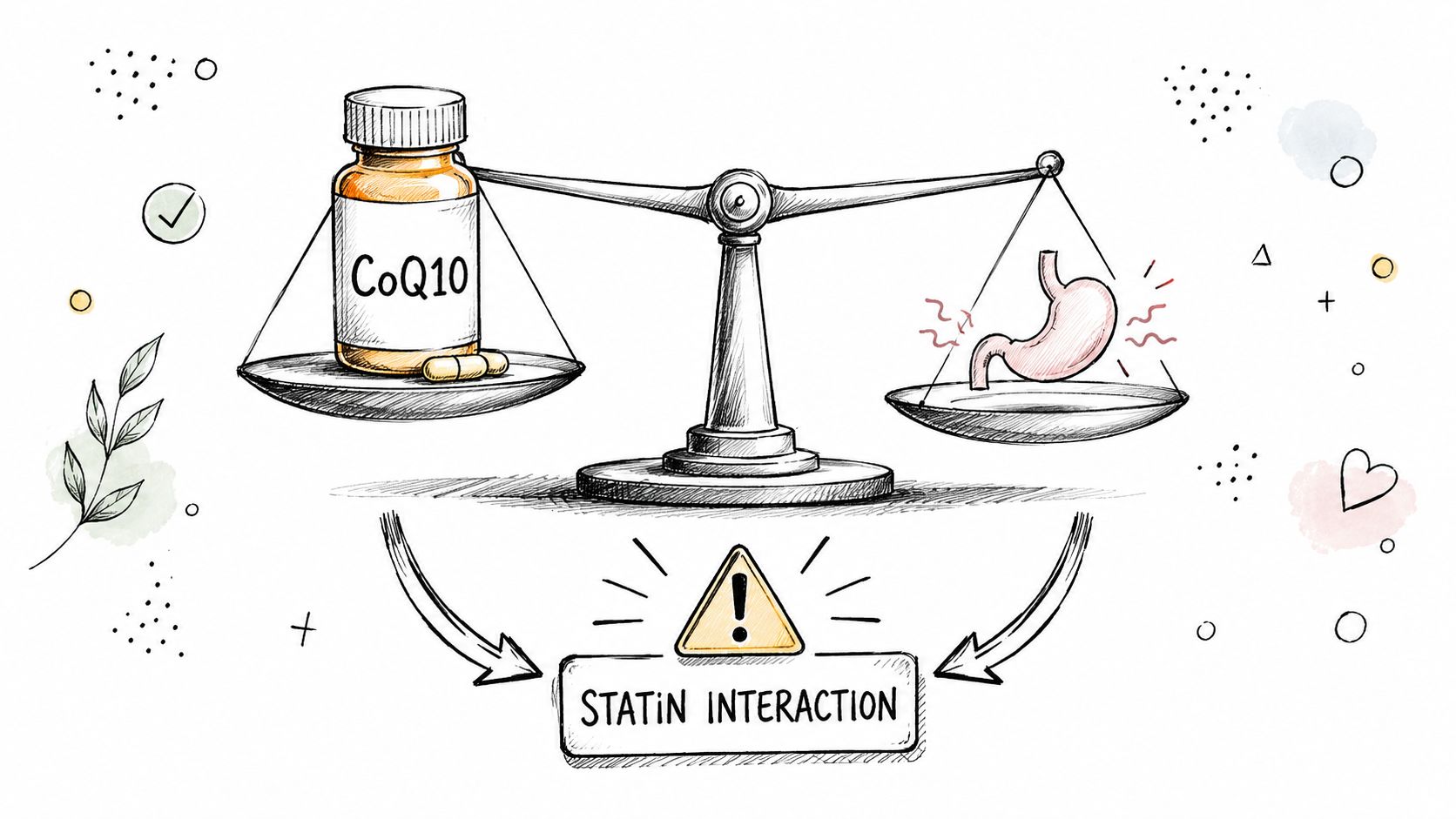
That matters even more if you take blood thinners, blood pressure medication, or several cardiovascular drugs at once. In that setting, a supplement should be treated like part of the medication conversation, not like a harmless add-on that doesn't need review.
Why statin advice sounds contradictory
This is the part people find most irritating, and understandably so.
The theory is straightforward. Statins affect the same biochemical pathway involved in cholesterol production and CoQ10 synthesis, so it makes sense that people would ask whether replacing CoQ10 might help with statin-related muscle symptoms. Some studies suggest it may help. But clinical guidance hasn't settled on a clear recommendation.
A summary from Cedars-Sinai notes that while some studies suggest CoQ10 may reduce statin-induced muscle pain, UK clinical guidance and the British Heart Foundation say current evidence does not support its use for this purpose, as discussed in this Cedars-Sinai review of fish oil, CoQ10, and common supplement questions.
That's not a trivial contradiction. It means both of these statements can be true at once:
- Some individuals may feel better on CoQ10 while taking statins.
- Guidelines may still say the evidence isn't strong enough to recommend it routinely.
“I'm taking a statin and I want to try CoQ10” is a reasonable question. “My doctor must be wrong if they hesitate” isn't.
There's another nuance from the same Cedars-Sinai discussion. CoQ10 doesn't have strong evidence for preventing atrial fibrillation, and high-dose omega-3 intake above 1 g/day was described there as being linked to a 49% increase in atrial fibrillation risk. That doesn't prove CoQ10 is unsafe in that context. It means people with arrhythmias or complex supplement stacks should avoid self-prescribing based on generic heart-health marketing.
The safest framework is simple. If you take a statin and want to try CoQ10, ask your clinician to help you define the goal first. Is it muscle symptom relief, concern about depletion, or broader heart support? Those are not the same question.
Who Might Benefit Most from Taking CoQ10
A better question than “Is CoQ10 good for the heart?” is “Who has a clear reason to consider it?”
CoQ10 is not a one-size-fits-all supplement. It makes more sense when there is a specific goal, a specific age-related concern, or a specific heart condition behind the decision.
People with heart failure are often the first group to discuss. Earlier sections covered why this is the setting with the strongest clinical support. The practical point here is simple. If your heart is already working harder than it should, a supplement involved in cellular energy production deserves a more serious conversation than it would for someone taking it only for general wellness.
Older adults, especially those over 60, are another group worth separating out. For them, the form of CoQ10 matters more. Ubiquinone is the standard form found in many supplements. Ubiquinol is the active form your body uses. Younger adults can often convert ubiquinone efficiently, but that conversion may become less consistent with age. A useful way to picture it is this: ubiquinone is the version your body still has to process, while ubiquinol is closer to the ready-to-use form. That does not mean every older adult needs ubiquinol. It means age makes the ubiquinone-versus-ubiquinol choice more relevant.
A third group includes people with established heart disease who may have lower CoQ10 status, especially if fatigue or reduced exercise tolerance is part of the picture. As noted earlier, lower CoQ10 levels have been observed in many heart patients. That does not prove every person in this category should supplement, but it does make the discussion more reasonable and more targeted.
A practical filter can help:
- You have diagnosed heart failure. This is the clearest reason to ask your clinician whether CoQ10 belongs in your plan.
- You are over 60 and shopping for a supplement. Ask whether ubiquinol may be the better fit for absorption and use.
- You take a statin and want a structured discussion. Focus on the goal first, such as muscle symptoms, concern about depletion, or broader heart support.
- You want a supplement with a defined purpose. “Help with exercise tolerance” is a better starting point than “something for my heart.”
If your reason is vague, your odds of buying the wrong product go up.
That is also why stacking several “heart health” supplements on your own can get messy fast. If you are comparing options, some people also look at broader formulas such as cardiovascular support capsules with vitamin C and garlic. Review the full ingredient list with your pharmacist or clinician before combining products, especially if you take heart medicines, blood pressure drugs, or a statin.
The right candidate for CoQ10 is usually not the person chasing a trend. It is the person with a clear clinical context, a realistic goal, and a plan to choose the right form with professional guidance.






