If a supplement raises arginine in your blood, does that automatically mean it improves blood flow, muscle pumps, or performance?
That assumption drives much of the marketing around L-Arginine AKG, also called AAKG. But biology doesn't always follow supplement-label logic. A nutrient can look promising on paper, make mechanistic sense in a lab diagram, and still produce mixed real-world results when people take it.
That's why AAKG is worth a closer look. It sits at the intersection of sports nutrition, circulation support, and sexual wellness. It's popular because it combines L-arginine, an amino acid involved in nitric oxide production, with alpha-ketoglutarate, a compound tied to cellular energy metabolism. The theory is appealing. The evidence is more uneven.
Some clinical findings are encouraging. In one controlled trial, trained lifters taking AAKG improved bench press performance. Other controlled studies found no meaningful boost in blood flow or exercise benefit beyond the effects of exercise itself. That gap matters, especially if you're trying to choose between AAKG, regular arginine, or citrulline.
This guide takes the practical route. It explains the chemistry in plain language, separates plausible mechanisms from proven outcomes, and helps you decide when AAKG may be worth considering and when marketing gets ahead of the data.
Table of Contents
- Your Guide to L-Arginine AKG
- What Is L-Arginine AKG and How Does It Work
- L-Arginine AKG for Athletic Performance The Evidence
- L-Arginine AKG for Sexual Wellness and Circulation
- L-Arginine AKG vs L-Citrulline and Other Arginine Forms
- How to Choose and Use L-Arginine AKG
- L-Arginine AKG Frequently Asked Questions
Your Guide to L-Arginine AKG
Can one nitric oxide supplement really improve workouts, circulation, and sexual wellness, or is that story more polished than proven?
That question matters with L-Arginine AKG, often shortened to AAKG. It is marketed with a clean, simple message: more nitric oxide means better blood flow, and better blood flow should help performance. That logic has some biological basis, but biology rarely works like a one-switch machine. The body regulates blood vessel tone, amino acid metabolism, training adaptation, and sexual function through several overlapping systems, not one shortcut.
AAKG sits right in that gap between plausible theory and uneven evidence. The ingredient combines L-arginine, a precursor your body can use to make nitric oxide, with alpha-ketoglutarate, a compound involved in cellular energy metabolism. On paper, that pairing sounds compelling. In practice, the key question is narrower: does putting those two pieces together lead to reliable benefits that people can notice?
The answer is more limited than many labels suggest.
Some people use AAKG for a stronger gym pump. Some use it because they hope better circulation will support erectile function or general vascular health. Those goals are related, but they are not interchangeable. A temporary increase in blood flow during exercise is not the same thing as a meaningful improvement in athletic performance, and neither is the same thing as fixing a circulation problem with an underlying medical cause.
That distinction is where supplement marketing often gets ahead of the science.
A useful way to view AAKG is as a targeted supplement with a reasonable mechanism and a mixed evidence base. There is research interest here, but the support is stronger for the general nitric oxide pathway than for every claim attached specifically to AAKG. That difference becomes even more important once you compare it with other options, especially L-citrulline, which often raises arginine levels more reliably in the body.
Bottom line: AAKG has a sensible rationale, but the strongest claims made for it go beyond what current evidence clearly supports.
If you approach AAKG with that filter, it becomes much easier to judge whether it fits your goal, your budget, and your expectations.
What Is L-Arginine AKG and How Does It Work
What are you getting when a label says L-Arginine AKG?
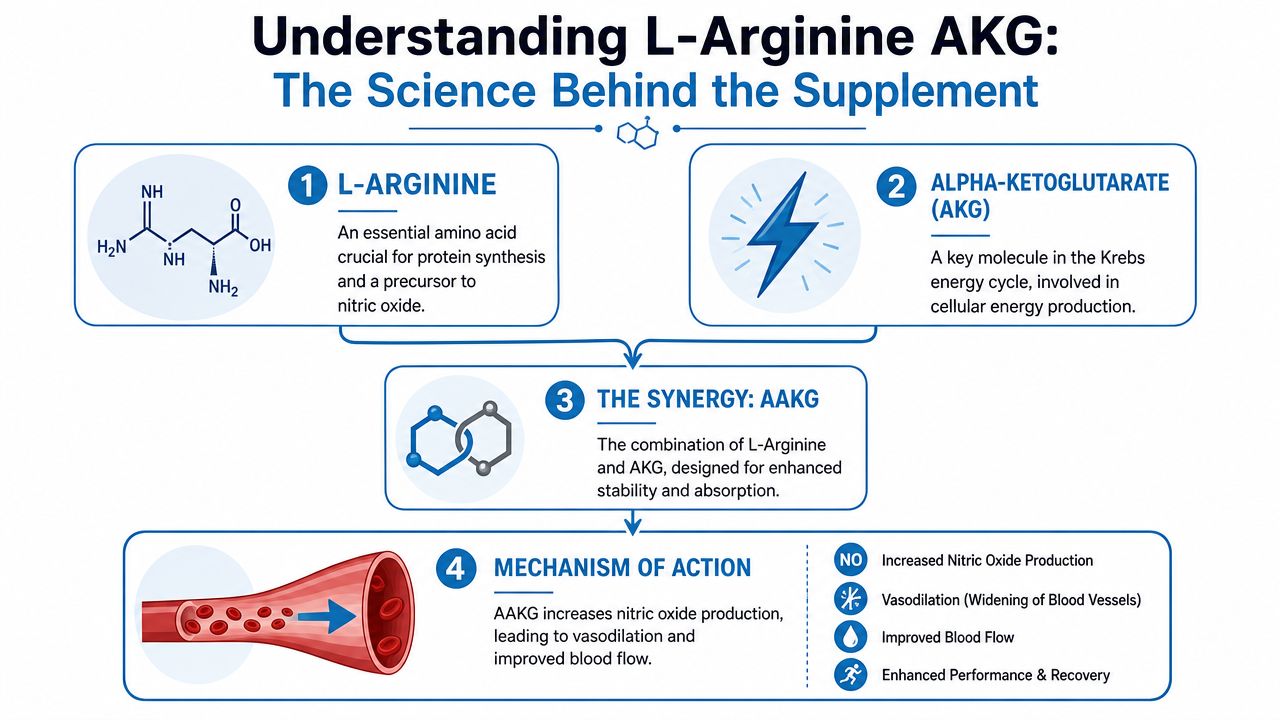
L-Arginine AKG, often shortened to AAKG, is a compound made from L-arginine and alpha-ketoglutarate (AKG). The pairing sounds technical, but the idea is fairly simple. One part is included because of its link to nitric oxide production. The other is a compound your cells already use in energy metabolism.
The two parts of AAKG
L-arginine is an amino acid. In supplement science, its main appeal is that the body can use it as a starting material to produce nitric oxide, a signaling molecule involved in blood vessel tone.
AKG, short for alpha-ketoglutarate, is part of the Krebs cycle. That is one of the core systems cells use to process fuel and support energy production. AKG is a compound that already belongs inside the engine of cellular metabolism.
Put together, AAKG is marketed as a form of arginine that may support nitric oxide production while also drawing appeal from AKG's metabolic role. That sounds promising, but this is also where marketing can blur an important distinction. A plausible formula is not the same thing as a proven advantage over plain L-arginine or other arginine-related supplements.
The most relevant comparison is between theory and measured outcomes in humans. Those are not always the same.
The nitric oxide idea in plain English
The nitric oxide pathway is the reason AAKG gets attention.
Here is the basic sequence. You take AAKG. The arginine portion enters circulation. Some of that arginine can be used by the enzyme nitric oxide synthase to make nitric oxide (NO). Nitric oxide then signals the smooth muscle in blood vessel walls to relax. When those vessel walls relax, blood vessels can widen, which may improve blood flow in some contexts.
A garden hose is a useful comparison. If the hose is slightly constricted, flow is harder. If it opens wider, water moves more easily. Blood vessels behave differently from hoses in many ways, but the general principle holds. Wider passageways tend to reduce resistance.
That mechanism helps explain why AAKG appears in many nitric oxide booster supplements for pre-workout support. It also explains why people connect it with muscle pumps, exercise performance, and circulation-related goals.
Still, the biology has a catch.
Raising arginine levels is only one step in the chain. The body still has to convert that arginine into nitric oxide, respond to that signal, and produce a change large enough to matter in real life. In nutrition research, that gap between a workable mechanism and a noticeable outcome shows up often.
Where the science is more uncertain than the label suggests
This is the part many supplement descriptions skip. AAKG may increase arginine availability, but that does not automatically mean better blood flow at rest, better exercise performance, or better sexual function in every user.
Why not? Because the body regulates blood vessel behavior through many inputs, not arginine alone. Enzyme activity, baseline health, exercise status, and the presence of compounds that interfere with nitric oxide signaling can all affect the end result.
That is also why AAKG should not be treated as a guaranteed upgrade over other forms. Some of the interest in AAKG comes from a sensible biochemical rationale. The evidence for clear superiority is less settled. Compared with forms such as L-citrulline, which often raises arginine levels more reliably because it bypasses some of arginine's early breakdown, AAKG has a harder case to make.
So the short version is this. AAKG combines an amino acid linked to nitric oxide with a metabolic intermediate your body already uses. The mechanism makes sense. The claims attached to that mechanism need a more careful reading than many labels give them.
L-Arginine AKG for Athletic Performance The Evidence
Can a supplement that promises better blood flow help you lift more weight or push harder in training, or is that mostly good marketing wrapped around a plausible mechanism?
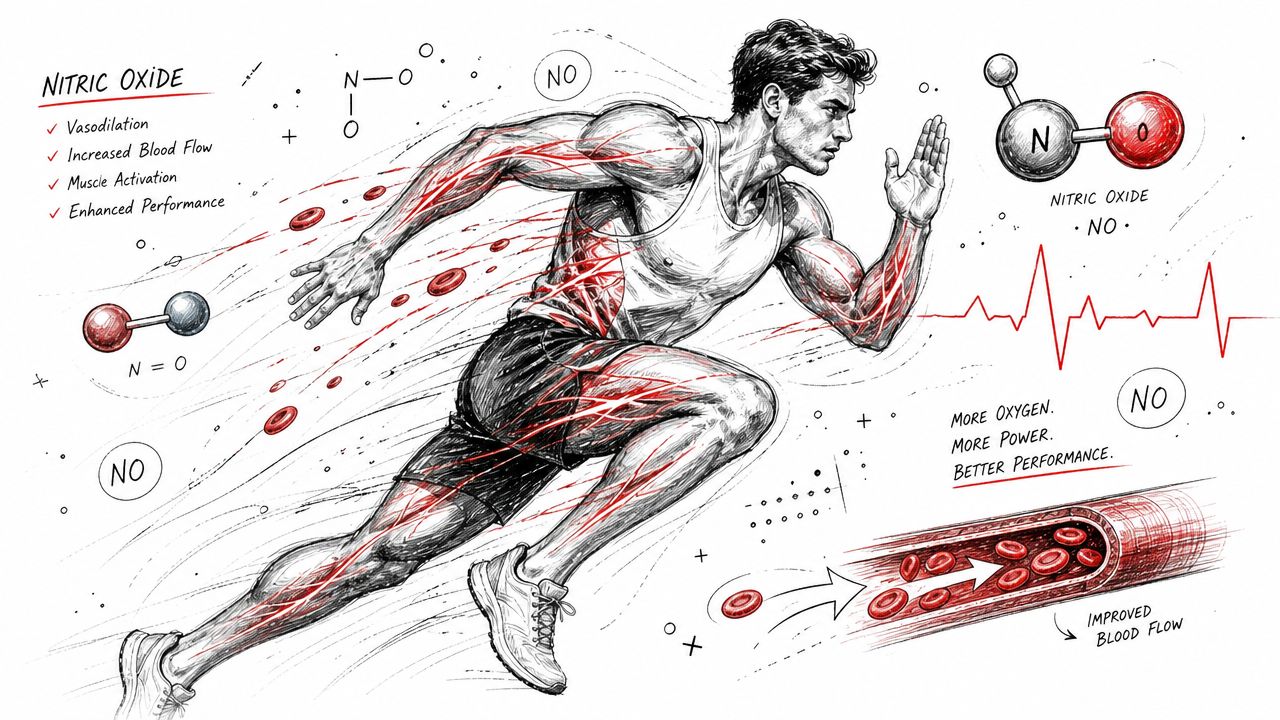
The athletic case for AAKG is easy to understand. If working muscle gets better circulation, it may receive fuel more efficiently and clear metabolic byproducts more effectively. On paper, that could support strength, repeated effort, or the “pump” many gym-goers notice during training.
Why athletes use it
Athletes usually buy AAKG for outcomes they can feel in a workout, not for abstract biochemistry.
Common goals include:
- Pre-workout pump: Fuller muscles during training are often interpreted as a sign of better blood flow.
- Strength support: Some lifters hope improved circulation will help them sustain output across hard sets.
- Workout endurance: Others use it before sessions where repeated efforts matter.
- Stacking with pump formulas: AAKG often shows up in products marketed for blood-flow support, including this nitric oxide booster supplement for pump-focused pre-workouts.
That logic is reasonable. The harder question is whether the clinical evidence supports the broad claims attached to it.
What the clinical evidence shows, and what it does not
The evidence for AAKG in sport is mixed.
One often-cited human trial in resistance-trained men reported improvements in measures such as bench press strength and peak power after several weeks of high-dose AAKG use during training. That finding matters because it shows AAKG is not supported by mechanism alone. At least one study found measurable performance benefits under a specific protocol.
But a single positive trial is not the same as a settled conclusion.
Reviews that examine the broader literature have pointed out an important problem. The marketing story usually centers on nitric oxide and blood flow, yet controlled studies have not consistently shown that AAKG improves those outcomes in a reliable, repeatable way. A review from Western Kentucky University also argued that claims made for AAKG often run ahead of the direct evidence for AAKG itself, especially when marketers borrow findings from plain L-arginine and apply them to the AKG form without proving they behave the same way.
That distinction matters. It is like seeing one car finish a race well and then assuming every car built on a similar frame will perform identically. Small formulation differences do not always translate into meaningful real-world advantages, and in supplements, they often fail to.
Why the results can look inconsistent
Exercise performance is shaped by far more than nitric oxide. Training status, workout type, dose, timing, diet, sleep, and baseline vascular function can all affect whether a supplement changes anything noticeable.
There is also a physiology issue. Raising arginine availability is only one step in the chain. The body still has to convert that arginine into nitric oxide, blood vessels still have to respond to the signal, and the change has to be large enough to improve performance in a measurable way. A smoother fuel line does not guarantee a faster car if the engine, tires, and driver stay the same.
That helps explain why users may report a good pump while controlled research does not always show a clear ergogenic effect. A subjective training sensation and a repeatable performance gain are not the same endpoint.
A short video can help frame how nitric oxide claims get discussed in sports supplements:
How to interpret AAKG for performance
AAKG fits best into the “possible but not proven enough to be a first choice” category.
A practical reading of the evidence looks like this:
| Question | Sensible takeaway |
|---|---|
| Is there some direct human research in lifters? | Yes. AAKG has at least some supportive performance data in trained populations. |
| Does that prove AAKG reliably boosts nitric oxide and performance for everyone? | No. The broader evidence is inconsistent. |
| Can a good workout pump be taken as proof of better athletic output? | No. Pump and performance are related ideas, but they are not interchangeable. |
| Should AAKG be treated as clearly superior to other arginine forms? | No. That claim has not been established. |
The strongest case for AAKG in athletic performance is narrow. It may help in some training contexts, especially for some lifters, but the science does not support the larger marketing promise that more AAKG automatically means more nitric oxide, more blood flow, and better performance every time.
L-Arginine AKG for Sexual Wellness and Circulation
The reason AAKG gets marketed for sexual wellness is straightforward. Erectile function depends heavily on blood vessel relaxation and blood flow. Since arginine is tied to nitric oxide production, and nitric oxide is part of that vascular process, arginine-based supplements naturally attract interest.
Why nitric oxide matters here
In plain terms, circulation has to respond appropriately for erectile function to work well. That response depends on signaling inside blood vessels and smooth muscle. Nitric oxide is one of the best-known signals in that pathway.
That creates a believable chain of reasoning:
- Arginine helps supply nitric oxide production.
- Nitric oxide helps blood vessels relax.
- Relaxed vessels support blood flow.
- Blood flow is central to erectile physiology.
So the biological rationale is real. The problem isn't the mechanism. The problem is assuming that AAKG specifically has been proven to outperform other forms, or even proven itself well enough for this purpose.
Where the evidence gets thin
Frequently, supplement discussions become muddled. Evidence for plain L-arginine often gets used to market L-arginine AKG, even though they are not interchangeable from an evidence standpoint.
Manufacturers often claim that arginine AKG is a more stable or absorbable form than regular arginine, but existing literature contains no comparative bioavailability studies to validate that claim, leaving its special value proposition speculative, according to this review discussing AAKG absorption claims.
That matters even more for sexual wellness because the selling point depends on reliable nitric oxide support. If the supposed absorption edge hasn't been clinically confirmed, then the case for choosing AAKG over standard arginine becomes weaker.
A more grounded way to think about it is this:
- The physiology supports interest in arginine-related compounds.
- The evidence specific to AAKG is limited.
- The claim that AAKG is the better arginine form for this purpose remains unproven.
If you're exploring broader nutrition and supplement approaches to intimacy and circulation, this guide to vitamins for sexual health gives a wider context beyond a single ingredient.
Don't confuse “the mechanism makes sense” with “this exact form has been shown to work better.”
For readers focused on sexual wellness, that distinction is one of the most important takeaways in the entire AAKG discussion.
L-Arginine AKG vs L-Citrulline and Other Arginine Forms
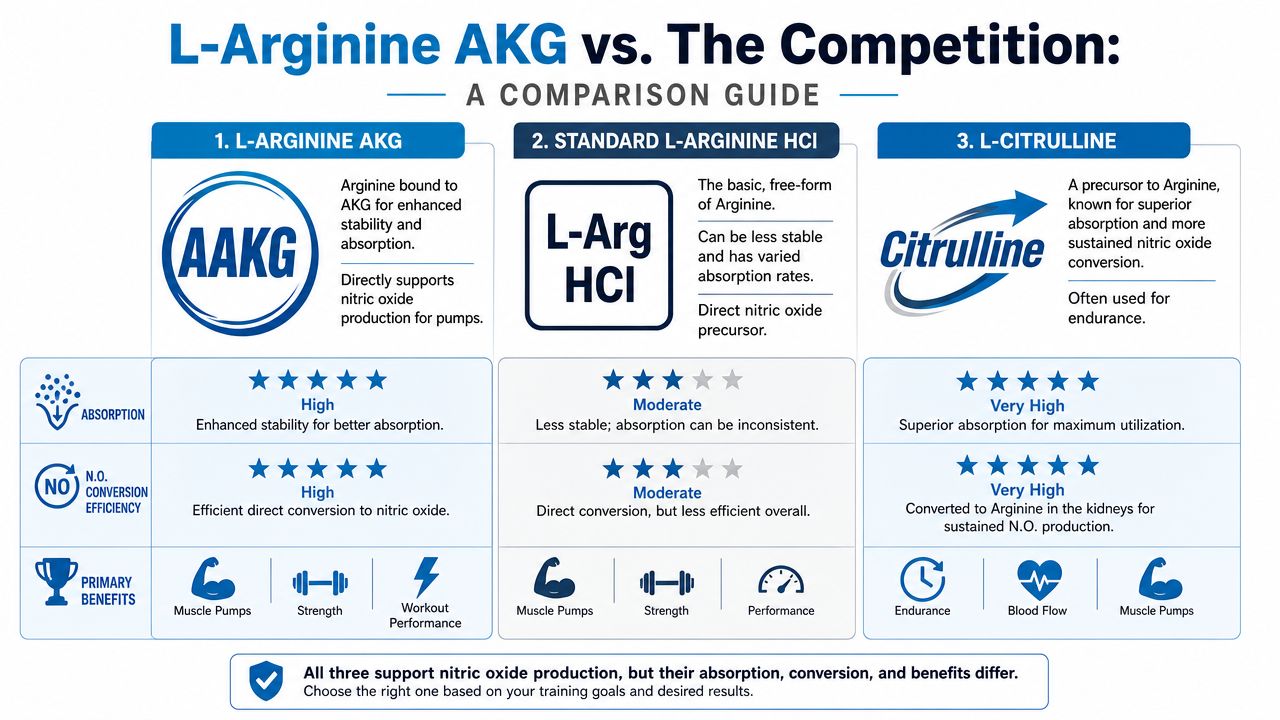
When shopping for a nitric oxide or circulation supplement, consumers aren't really deciding whether to use arginine chemistry in the abstract. They're choosing between forms. The most common comparison is AAKG vs L-citrulline, with plain L-arginine HCl as the basic reference point.
The real comparison point
AAKG and L-arginine HCl both give you arginine directly. L-citrulline works differently. It acts as a precursor that the body converts into arginine.
Why does that matter?
Because oral arginine doesn't always arrive in the bloodstream efficiently after digestion. Many sports nutrition practitioners prefer citrulline because it can be a steadier way to raise arginine availability indirectly. In real-world supplement conversations, that's the main reason citrulline often competes with AAKG more than plain arginine does.
AAKG tries to distinguish itself by adding AKG and by claiming better stability or absorption. But as noted earlier, the literature still lacks direct comparative bioavailability studies proving that advantage. So the AAKG pitch remains partly theoretical.
If you want a practical shopping example of how these categories get paired in the market, products such as this arginine and citrulline powder reflect how often users combine or compare them rather than treating them as interchangeable.
Supplement Comparison AAKG vs L-Citrulline vs L-Arginine HCl
| Attribute | L-Arginine AKG | L-Citrulline | L-Arginine HCl |
|---|---|---|---|
| Core identity | Arginine bound to alpha-ketoglutarate | Precursor converted to arginine in the body | Basic supplemental arginine form |
| Main marketing appeal | Pumps, performance, added AKG synergy | Sustained arginine support | Simple direct arginine delivery |
| Evidence for unique absorption advantage | Not confirmed clinically | Commonly favored in practice for arginine support | No special advantage claimed |
| Strength of AAKG-specific claims | Mixed and often overstated | Often chosen as the main alternative | Familiar but less differentiated |
| Best fit | People who want to test a pump-focused formula with some performance data | People prioritizing arginine support via a precursor route | People who want straightforward arginine without the AKG story |
A few plain-language takeaways help make the table usable.
- Choose AAKG if you specifically want the arginine-plus-AKG formula and you're comfortable with mixed evidence.
- Choose L-citrulline if your priority is usually practical nitric oxide support and you don't care about the AKG component.
- Choose L-arginine HCl if you want the simplest direct arginine option and don't need the extra formulation story.
For many buyers, AAKG is less a clearly superior form and more a specialized variant with one positive performance trial and several unresolved questions.
That doesn't make it bad. It just means your decision should match your goal. If you want experimental precision, AAKG has gaps. If you want a reasonable pre-workout ingredient to test personally, it may still fit.
How to Choose and Use L-Arginine AKG
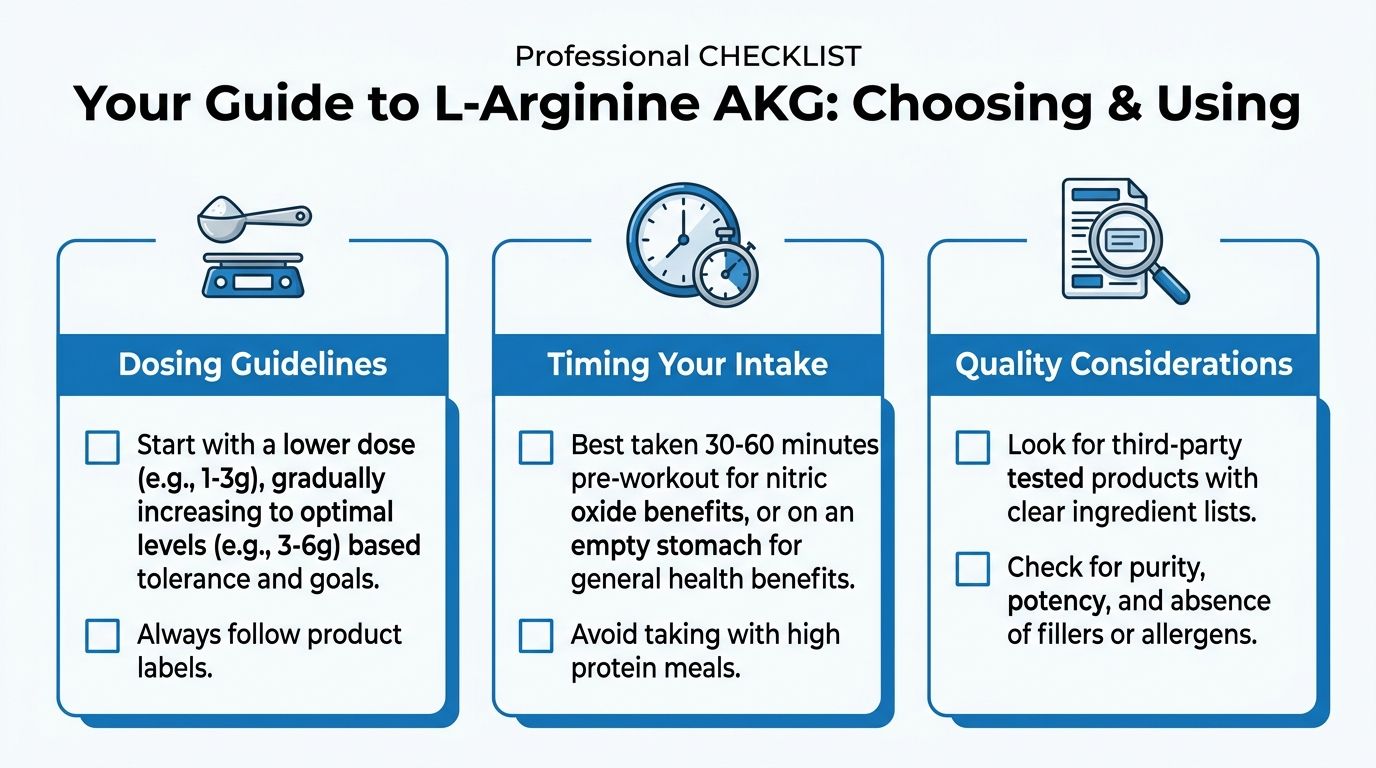
Buying AAKG makes more sense once you stop asking one product to cover every goal. The practical questions are simpler: how much are you taking, when are you taking it, and are you buying a formula that tells you what is inside it?
Dosing based on goal
AAKG is often marketed like a one-size-fits-all nitric oxide booster. The research does not support using it that way. Different studies have used very different amounts, which usually means you should match the dose to the reason you are trying it.
For workout-focused use, one positive study in resistance-trained men used a relatively aggressive protocol: 12 grams per day, divided into 4 grams three times daily. That is a lot more than the amount found in many pre-workout products, so label reading matters. If a supplement only gives a small serving hidden inside a proprietary blend, it may not resemble the products used in research at all.
For older adults and muscle-related support, the pattern looks different. The studied approach has been lower and more sustained, roughly 2 to 4 grams per day for several weeks, according to this review on AKG and muscle preservation in aging populations. That distinction matters because acute pre-workout use and long-term support are not the same experiment.
A simple way to frame it is this:
- Trying AAKG for training sessions: products often position it around pre-workout timing
- Trying AAKG for ongoing support: daily use usually makes more sense than occasional use
- Trying AAKG for aging-related muscle goals: lower-dose, longer-duration protocols fit the published research better
Safety and context
AAKG is not automatically risky, but “well tolerated in a study” does not mean “right for everyone at any dose.” Supplements that affect blood flow are a bit like turning a faucet handle. A small change may be unnoticed in one person and more noticeable in someone who already has blood pressure, circulation, or medication-related variables in the mix.
Start with the lowest practical dose on the label if you are testing tolerance.
Then pay attention to what you are noticing. Some users care about workout feel, such as pump or perceived endurance. Others care more about whether it causes stomach discomfort, headaches, or no meaningful effect at all. That kind of self-observation is useful because the evidence for AAKG is mixed enough that personal response often shapes the decision to keep using it.
Anyone using medication for blood pressure, circulation, erectile dysfunction, or metabolic conditions should check with a clinician first.
What to look for on a label
The label often tells you more than the marketing page.
Start with the actual amount of AAKG per serving. If the formula hides it inside a proprietary blend, you cannot compare it with the doses used in studies. That does not prove the product is poor, but it does make informed use harder.
Next, check whether the formula is built for testing one ingredient or for stacking many. A single-ingredient AAKG product lets you judge AAKG itself. A multi-ingredient pre-workout can be useful too, but once caffeine, beta-alanine, and other compounds are added, it becomes harder to know what is doing what.
Third-party testing is another helpful filter. It does not prove the supplement will work, but it does improve confidence that the label matches the contents.
A clean label can confirm dose and quality control. It cannot confirm that the product's blood-flow claims have been proven specifically for AAKG.
AAKG is usually best treated as a trial supplement, not an automatic upgrade. If the formula is transparent, the dose fits your goal, and your expectations match the mixed state of the evidence, you are using it in a way that is much closer to science than to marketing.
L-Arginine AKG Frequently Asked Questions
Does L-Arginine AKG really boost nitric oxide more than regular arginine
If AAKG were clearly better at raising nitric oxide, this would be one of the easiest selling points to prove. It has not been proved.
Here the biochemistry can sound more certain than the human research really is. L-arginine is the raw material your body can use to make nitric oxide. Alpha-ketoglutarate is a separate compound involved in energy metabolism. Joining them together in one ingredient does not automatically mean the body will produce more nitric oxide than it would from regular arginine alone. In practice, the evidence for a clear AAKG advantage is limited, and some controlled studies have not shown the kind of blood-flow or performance effects that supplement marketing often implies.
So the careful answer is simple. AAKG may help some users, but the claim that it is definitively superior to plain L-arginine for nitric oxide support is ahead of the evidence.
Can you take AAKG with caffeine
Yes, many people do.
The bigger question is whether that combination helps you learn anything useful. Caffeine has noticeable effects on energy, alertness, and training drive. AAKG is usually marketed for blood flow or pump. If you take them together in a pre-workout, the experience can feel stronger overall, but it becomes harder to tell which ingredient is responsible for what.
That matters if you are testing tolerance. If you feel jittery, get a headache, or notice no benefit at all, a multi-ingredient formula gives you a blurry answer. A single-ingredient trial gives a cleaner one.
How long does AAKG take to work
That depends on the outcome you care about.
For workout use, people often judge AAKG within a single session or over a few training days, usually based on subjective effects such as pump or exercise feel. Those are real experiences, but they are not the same as a proven improvement in strength, endurance, or muscle growth.
For longer-term goals, patience matters more. Research discussed earlier in the article suggests that muscle-related outcomes in older adults, when they appear, tend to require consistent use over weeks rather than days. AAKG is not like caffeine, where you usually notice the effect quickly. It works more like a slow test of whether your body and your goal are a good match for the ingredient.
AAKG makes the most sense when expectations stay tied to evidence instead of label copy. It has some plausible uses, but the science is still uneven, especially if the claim is that this form is clearly better than other arginine options.
If you're comparing supplement categories and want a retailer with a broad selection of vitamins, proteins, herbal formulas, sports blends, and sexual wellness products, browse CalVitamin for options that fit your goals and preferred dosage form.