Most advice about male enhancement pills starts with the wrong question. People ask whether they work, then jump straight to reviews, before-and-after claims, or ingredient lists. A safer starting point is simpler: what exactly is the product claiming to do, and what could it expose you to?
That shift matters because there is no clinical or scientific evidence that any male enhancement pills can permanently increase penis length, girth, or boost sexual performance, and reporting reviewed by Medical News Today on penis enlargement pills also notes that many products contain hidden ingredients like sildenafil, found in 81% of tested cases, that weren't listed on the label. If a pill may contain an undeclared drug, the question isn't just whether male enhancement pills work. It's whether the bottle is telling you the truth.
People look for these products for understandable reasons. Some want stronger erections. Some want more confidence. Some are trying to solve a problem they don't feel comfortable discussing with a clinician. There shouldn't be any shame in that. But there does need to be clarity.
Table of Contents
- The Real Question About Male Enhancement Pills
- How Common Enhancement Ingredients Are Supposed to Work
- The Science vs The Hype What Clinical Evidence Shows
- Unseen Dangers Safety Side Effects and Interactions
- Setting Realistic Expectations The Role of Placebo
- Making Smarter Choices Medical Alternatives and Reading Labels
- A Final Checklist for Safe Supplement Use
The Real Question About Male Enhancement Pills
Regarding whether male enhancement pills work, the honest answer is that the usual claims need to be broken apart first. A product might claim to increase size, improve erections, raise libido, boost stamina, or support testosterone. Those are very different promises. Marketers blur them together because it sounds more impressive.
The most important split is between permanent enlargement claims and temporary erectile support claims. Permanent enlargement is the easiest claim to dismiss because there isn't clinical or scientific evidence that pills can do it. Temporary erection support is more complicated, but that still doesn't mean an over-the-counter product has proven itself.
Practical rule: If a bottle promises bigger size, harder erections, more energy, and better performance all at once, treat that as a warning sign, not a convenience.
Another point confuses a lot of buyers. Some men do report feeling something after taking these products. That doesn't automatically prove the herbs on the label did what the company promised. In some cases, the effect may come from expectation, anxiety reduction, or hidden pharmaceuticals rather than the advertised blend.
What the question should really be
A better set of questions looks like this:
- What is the product claiming? Size increase, erection support, libido, or mood.
- What evidence supports that exact claim? Not theory. Not testimonials. Human evidence.
- What is in the pill? The label may not tell the full story.
- What could it interact with? Especially heart medications and other prescriptions.
That last point deserves more attention than it usually gets. People often treat "natural" as a safety badge. It isn't. A supplement can be herbal, mislabeled, contaminated, or adulterated at the same time.
Why safety comes first
A product that doesn't work wastes money. A product with hidden drugs can do much more than that. That's why the safety question comes before the effectiveness question. If the market were tightly controlled and labels were consistently reliable, "do they work" would be the natural first step. In this category, it often isn't.
How Common Enhancement Ingredients Are Supposed to Work
Most formulas rely on a simple sales idea: improve blood flow, raise desire, reduce stress, or make you feel more energized. Once you understand those buckets, labels become easier to read and less persuasive.
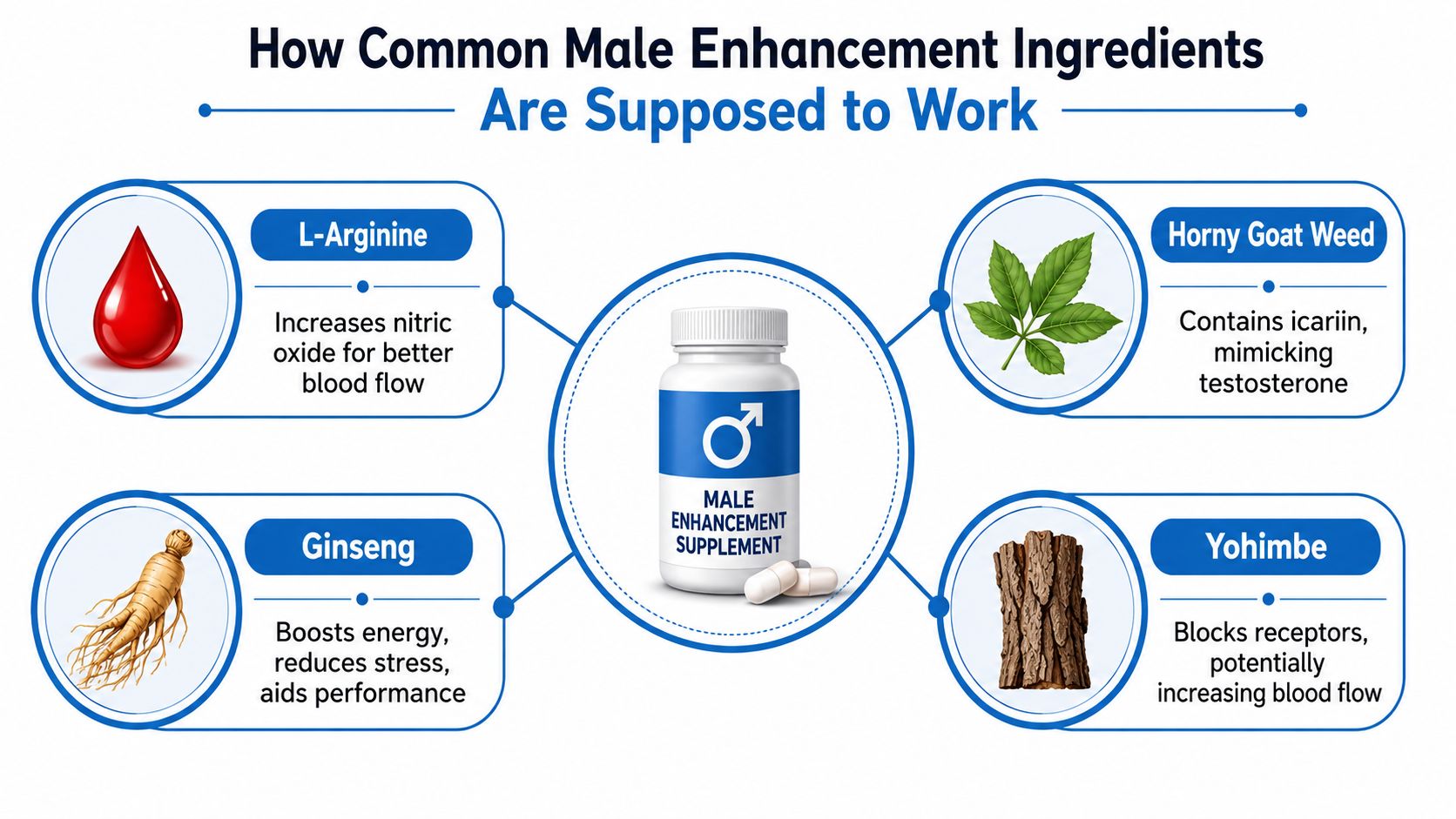
What supplement labels usually promise
One common route is blood flow support. Ingredients such as L-arginine are often marketed around nitric oxide, a signaling molecule involved in relaxing blood vessels. The pitch is easy to understand: if blood vessels relax more easily, blood flow may improve, and erections depend on blood flow.
Another route is plant compounds that are marketed as natural drug-like alternatives. Horny goat weed is a classic example. Sellers often imply it acts like a gentler herbal substitute for prescription erection drugs. If you've looked at product pages or educational posts about horny goat weed supplements, you've probably seen language about vitality, stamina, and performance.
A third route is energy, resilience, and stress support. Ingredients like maca, ginseng, and shilajit are often sold less as direct erection aids and more as products that may help you feel more ready, more motivated, or less worn down. That's important because many formulas shift from a sexual performance claim to a general wellness claim when they need to sound safer or broader.
Why theory is not the same as proof
The mechanism on a label is only a theory until it's tested well in humans. "Supports nitric oxide" is not the same as "improves erections in a reliable, clinically proven way." "Used traditionally for vitality" is not the same as "demonstrated to improve sexual performance."
A simple way to think about it helps. If a company says an ingredient is like opening a faucet for blood flow, that still doesn't tell you whether the faucet opens enough, whether it opens in the right situation, or whether it does so safely for the person taking it.
Here are the main categories many blends fall into:
- Blood flow ingredients: Often framed around circulation and vascular response.
- Libido ingredients: Usually marketed as desire boosters rather than direct erection aids.
- Stress and mood ingredients: Sold on the idea that better calm and confidence can improve intimacy.
- Hormone-themed ingredients: Often promoted with testosterone language, even when the support is vague.
The label usually explains what the manufacturer wants the ingredient to mean, not what high-quality clinical evidence proves it can do.
That's why ingredient familiarity can help you become a smarter shopper, but it shouldn't make you overconfident. A plausible mechanism is only the first step. Proof is a different standard.
The Science vs The Hype What Clinical Evidence Shows
The gap between marketing and evidence is where most confusion starts. A supplement can sound scientific without being supported by solid clinical results in humans.
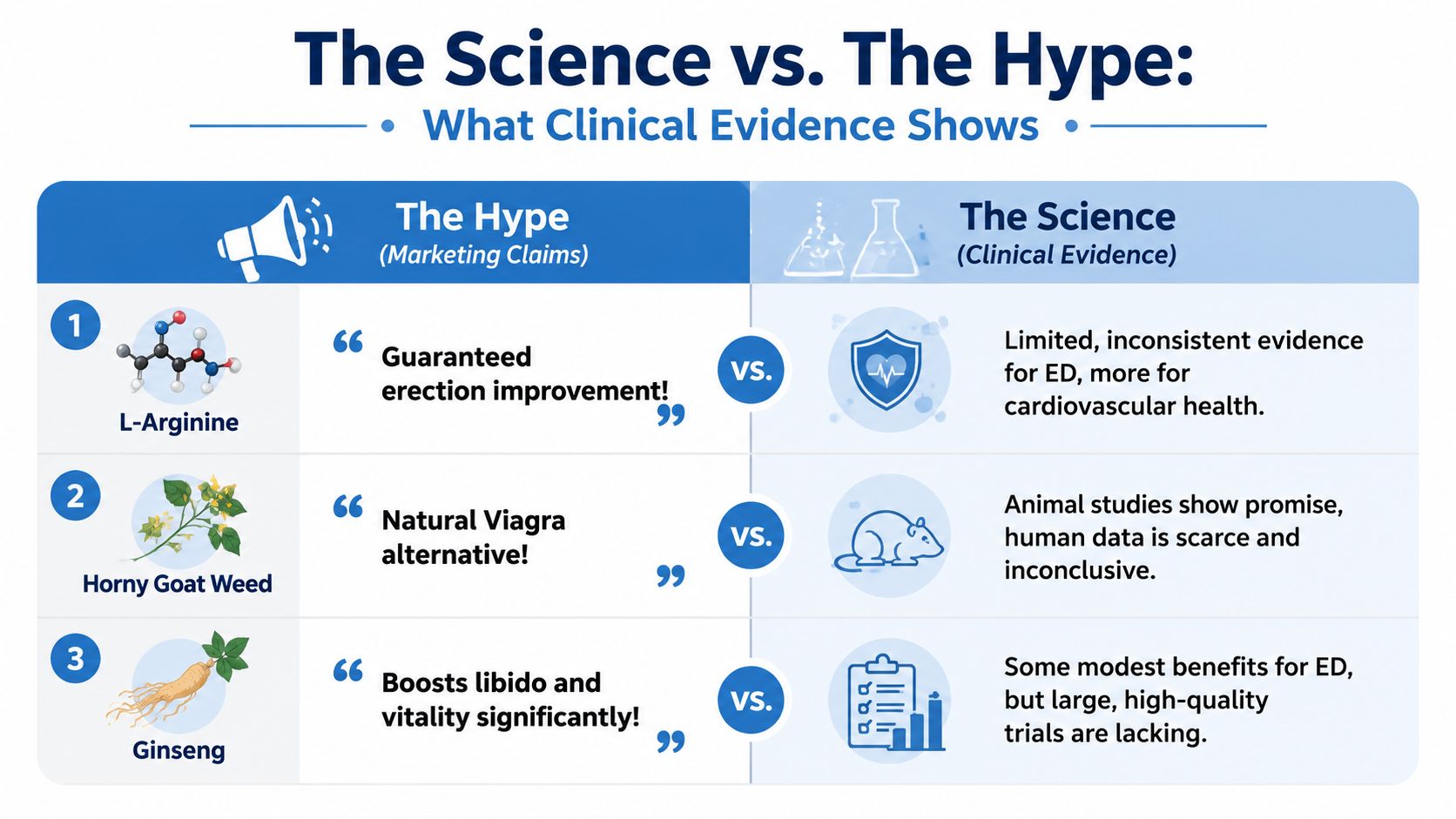
Marketing language versus human evidence
Companies often build a formula around herbs people already recognize. Ginseng, ginkgo, tribulus, horny goat weed, maca, and similar ingredients show up repeatedly because they sound familiar and traditional. That familiarity can make weak evidence feel stronger than it is.
The harder question is whether those ingredients have convincing support in controlled human research for erectile dysfunction or sexual performance. The answer is often no, mixed, or too limited to justify the confidence of the marketing.
A useful benchmark comes from FDA warnings. The agency has flagged that many "natural" male enhancement pills contain undisclosed PDE-5 inhibitors, and a 2015 study discussed in FDA sexual enhancement and energy product notifications found no evidence that common herbs like ginseng or ginkgo improve ED. That matters because it separates ingredient theory from real-world proof.
If you've been comparing products and articles about the best vitamins for sexual health, this is where caution matters most. A nutrient can support general health without being a proven treatment for erection problems.
Why adulteration changes the whole conversation
There is another reason anecdotal success stories can mislead people. If a product contains an undeclared prescription-type ingredient, a user may think the herbal blend worked when the effect came from something hidden.
That possibility changes how you should read hype-heavy claims like these:
| Marketing claim | Better question to ask |
|---|---|
| "Works like prescription ED medication" | Has that been shown in controlled human research? |
| "All natural and safe" | Has the product been independently tested for hidden drugs? |
| "Ancient herb for male power" | Is there convincing modern evidence for the exact claim? |
| "Fast acting performance support" | What ingredient is responsible, and is it even listed honestly? |
A testimonial can tell you how someone felt. It can't tell you what was actually in the capsule.
This is why the phrase male enhancement pills work can be misleading on its own. Some products may produce a noticeable effect in some users, but that doesn't confirm the label's story, the ingredient's science, or the product's safety.
Unseen Dangers Safety Side Effects and Interactions
The biggest problem with this category isn't just weak evidence. It's that some products create risks buyers don't see coming.
Early in the decision process, look at safety before ingredients, before reviews, and before price.
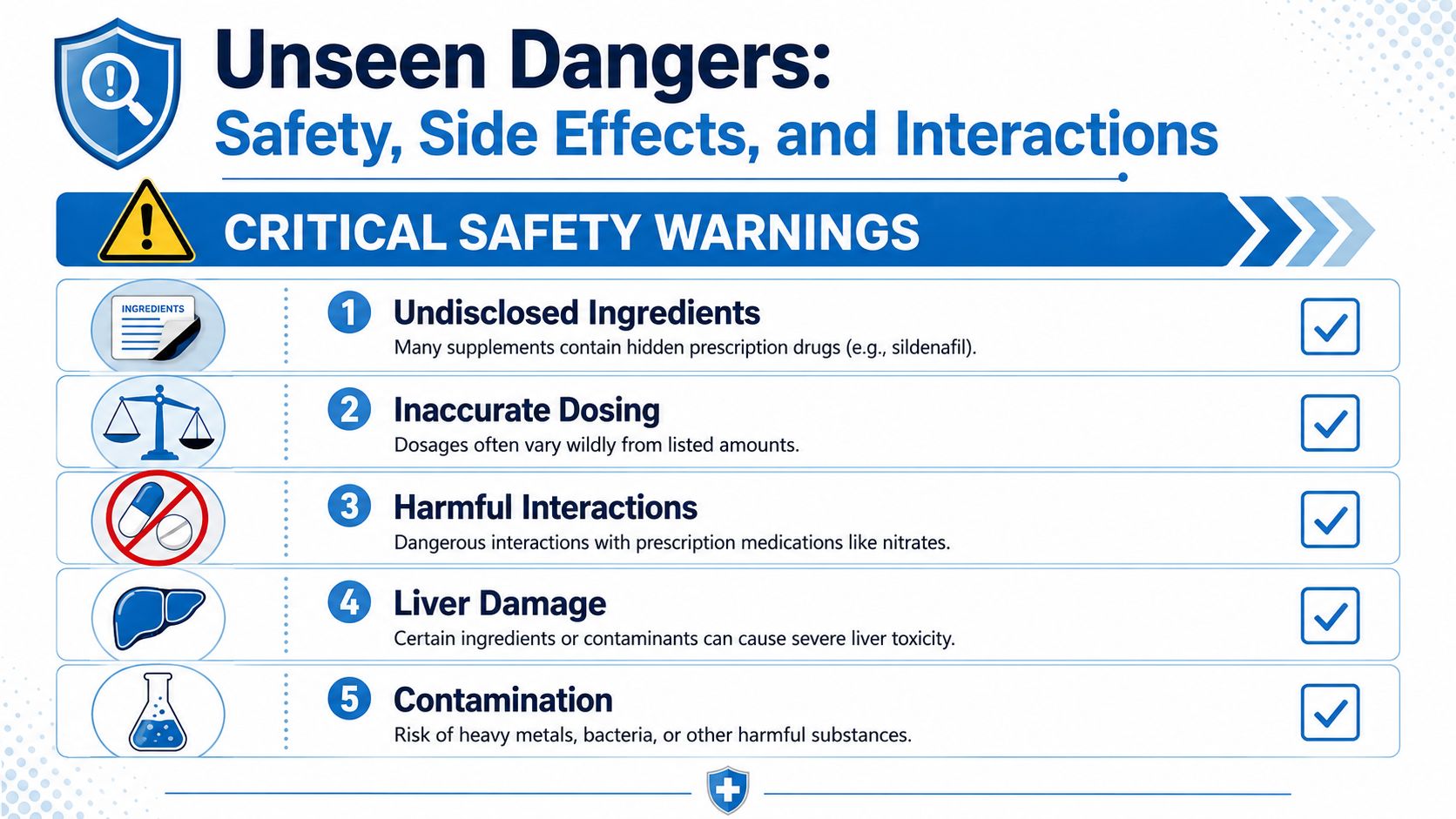
The risk you can see
Some listed ingredients can cause unwanted effects on their own. Depending on the formula, users may run into headaches, nausea, dizziness, agitation, insomnia, or mood-related effects. Stimulant-leaning products can be especially problematic for people who already deal with anxiety, heart concerns, or blood pressure issues.
The safety concerns become more serious when a product affects circulation. Male enhancement supplements have been linked to risks including priapism, severe drops in blood pressure, and dangerous interactions with nitrates. A review summarized by Atlantic Urology Clinics on the dangers of sex drive pills for men notes that these products are often adulterated with unlisted prescription drugs and contaminants, which can lead to hospitalization.
The risk you cannot see on the label
The hidden-pharmaceutical issue is what many buyers miss. A bottle may look like a simple herbal supplement while exposing the user to undeclared drug ingredients, unpredictable dosing, or contaminants.
If you want a practical example of why stimulant-style and blood-flow products deserve extra scrutiny, even at the product-review level, compare that mindset to how you'd examine a yohimbe bark extract supplement review. You'd want to ask what the ingredient does, who should avoid it, and what other medications it could clash with.
This overview helps illustrate the danger:
- Hidden drugs: The strongest effect may come from something absent from the label.
- Dose uncertainty: Even when a drug-like ingredient is present, the amount may not be predictable.
- Medication conflicts: Nitrates are the best-known example, but they aren't the only concern.
- Delay in proper care: A person may self-treat for months instead of addressing an underlying medical issue.
A short video can help reinforce why this category deserves caution before experimentation.
If you take heart medication, blood pressure medication, or multiple prescriptions, don't treat any sexual enhancement supplement as low stakes.
Setting Realistic Expectations The Role of Placebo
One reason this topic stays confusing is that some men say these products helped them. That doesn't always mean the active ingredients delivered a measurable biological effect.
Why some users still feel a benefit
Expectation changes experience. If a person believes a pill will help, that belief can lower anxiety, increase confidence, and make sexual situations feel less pressured. Those changes are real experiences, even if they don't come from the mechanism advertised on the bottle.
That's why the placebo effect matters here. According to Scripps on men's sexual health supplements and safety, most supplements haven't been scientifically studied, but they may produce a "placebo effect, which is not insignificant." That helps explain why someone can feel a benefit even when ingredients like ginseng and horny goat weed lack strong evidence for improving sexual function.
How to read testimonials more carefully
A review saying "this worked for me" may reflect many things at once:
- Reduced performance anxiety: Feeling calmer can improve the experience.
- Better timing and attention: Taking a product can make people prepare differently, rest more, or focus more.
- Expectation bias: Once someone spends money and hopes for a result, they're more likely to notice positives.
- An unlisted active drug: The user may credit the herbs when something else produced the effect.
Positive reviews don't separate biology from belief. They usually blend both.
This doesn't mean every user report is fake. It means anecdote is a poor tool for deciding whether male enhancement pills work in the scientific sense. Testimonials tell you about perception. They don't reliably tell you about proof.
Making Smarter Choices Medical Alternatives and Reading Labels
The safest way to judge any enhancement product is to compare it against a known standard. In erectile dysfunction care, that standard isn't a flashy label or a five-star review. It's a treatment tested in controlled research.
What proven treatment looks like
FDA-approved ED drugs give you a benchmark that supplements don't match. Harvard Health's review of ED drugs and sexual function states that sildenafil works in approximately 70% of men, with clear onset times and durations. It also notes that no over-the-counter male enhancement pill has demonstrated comparable results in controlled research, and some ingredient studies are limited to mice rather than humans.
That comparison doesn't mean everyone should use prescription medication. It means you shouldn't hold supplements and approved drugs to the same evidence standard if only one category has met it.
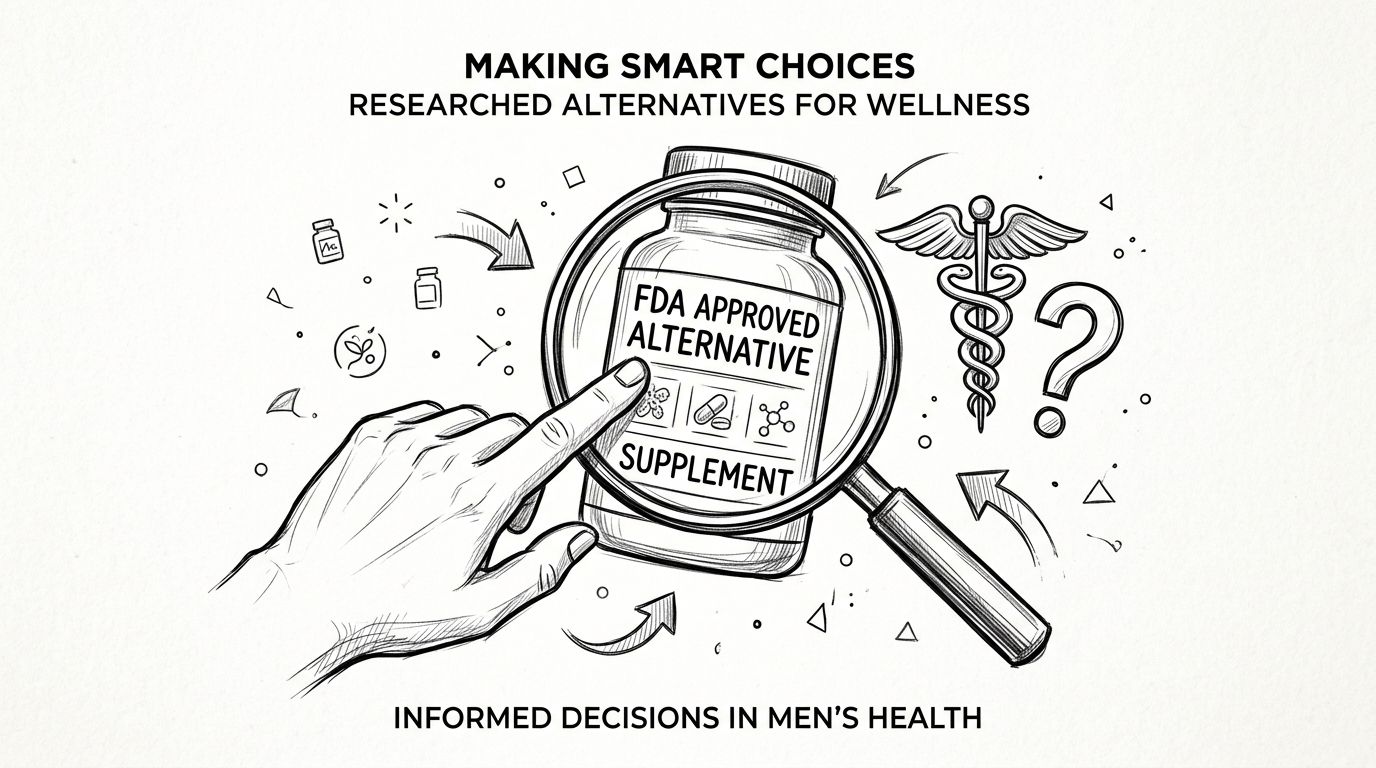
How to evaluate a supplement label
When you examine a product, slow down and look for red flags instead of benefits first.
- Claim check: If a bottle promises permanent enlargement, treat that claim as unsupported.
- Ingredient clarity: A long proprietary blend makes it harder to know what you're taking.
- Drug-like promises: "Works like Viagra" should raise concern, not confidence.
- All-natural language: This phrase says nothing meaningful about purity or safety.
- Third-party testing: Independent testing is worth looking for because label trust shouldn't be automatic.
A label also can't tell you whether your symptoms point to something else. Erection difficulties can overlap with circulation issues, stress, side effects from medication, sleep problems, or other health concerns. That's one reason a clinician visit is often more useful than another supplement trial.
Here is a practical decision frame:
| If the product says | Safer interpretation |
|---|---|
| "Immediate results" | Ask what ingredient creates that effect and whether it's honestly disclosed |
| "Doctor formulated" | Check evidence, not branding language |
| "Herbal male enhancement" | Herbal does not mean proven or safe |
| "No prescription needed" | Convenience is not a substitute for evaluation |
The smartest buyer isn't the one who knows the most marketing terms. It's the one who knows when to stop trusting the bottle.
A Final Checklist for Safe Supplement Use
A good rule for this category is simple: be harder to impress. These products are designed to trigger hope quickly. Safer decisions usually happen when you slow the process down.
Use this before you buy anything
Run through this checklist first:
- Talk with a clinician first: Especially if erections have changed recently, if you take prescription medication, or if you have heart or blood pressure concerns.
- Separate the claim from the goal: Are you looking for libido support, erection support, or permanent enlargement? Those are not the same thing.
- Distrust oversized promises: Permanent size increase claims deserve immediate skepticism.
- Read the full label: Look for proprietary blends, vague ingredient names, and language that sounds suspiciously drug-like.
- Look for independent verification: Third-party testing is a stronger signal than polished marketing.
- Treat testimonials cautiously: Reviews can reflect placebo, expectation, or hidden ingredients.
When to stop and get medical help
Don't keep experimenting if something feels off. Stop and get medical advice if you notice concerning symptoms, if you have a painful or prolonged erection, if you feel faint, or if you suspect a medication interaction.
A few final reminders make the whole topic easier to manage:
Buy with the assumption that the label may be incomplete, and protect yourself accordingly.
You don't need to be cynical. You do need to be careful. The central issue isn't just whether male enhancement pills work. It's that many products ask you to accept bold claims without reliable proof, while giving you too little information about what you're swallowing.
A smarter approach is grounded, not fearful. Know what outcome you're seeking. Compare claims against real evidence. Put safety ahead of urgency. If you do that, you'll make better decisions than the marketing wants you to make.
If you're comparing sexual wellness supplements and want a retailer with a broad range of wellness products, CalVitamin offers categories that make it easier to review options across herbs, sexual wellness, daily vitamins, proteins, and other supplement formats in one place. Use that convenience wisely. Read labels closely, question bold promises, and let your healthcare provider guide the final decision when safety or effectiveness is uncertain.