
You're standing in the supplement aisle, or scrolling through product pages, seeing Vitamin D2, Vitamin D3, gummies, sprays, softgels, chewables, and doses that range from modest to very high. One article says almost everyone needs vitamin D. Another says most healthy adults don't need extra supplementation at all. Then you notice labels like gelatin-free, halal, and D3 + K2, and the choice gets even harder.
That confusion makes sense. Recent guidance has made the conversation more nuanced. Most healthy adults under 75 may not need routine testing or automatic supplementation, yet people with limited sun exposure, darker skin, older age, or a documented deficiency still need practical guidance on choosing the right product and dose. Often, the key question usually isn't “Should everyone take vitamin D?” It's “If I'm going to take it, what should I buy?”
Table of Contents
- Feeling Lost in the Supplement Aisle
- The Critical Difference Between D2 and D3
- How to Determine Your Ideal Vitamin D Dosage
- Evaluating Supplement Quality Beyond the Label
- Choosing Your Best Form Capsules Gummies or Liquids
- Simple Tips to Maximize Vitamin D Absorption
- Your Checklist for Buying the Right Vitamin D
Feeling Lost in the Supplement Aisle
A lot of people start with a simple goal. They want better bone support, immune support, or help filling a nutrition gap. Then they run into conflicting advice online, high-dose products everywhere, and labels that seem written for professionals instead of regular shoppers.
That confusion has gotten worse because the guidance itself has changed. A recent summary of the Endocrine Society's 2024 to 2025 guidance notes that most healthy adults under 75 don't need routine vitamin D testing or extra supplementation, even though many consumers still assume higher-dose D3 is helpful for everyone. You can read that discussion in Utah Health's review of the new vitamin D guidelines.
What does that mean in practical terms? It means vitamin D isn't a one-size-fits-all purchase. If you spend little time in the sun, have darker skin, are older, or already know your level is low, your decision may look different from someone who gets moderate sun exposure and has no known risk factors.
Practical rule: Don't let a trendy dose decide for you. Start with your situation, then match the product to that need.
A better way to shop is to use a short decision framework:
- Start with form. Look for Vitamin D3 unless a clinician tells you otherwise.
- Choose dose based on need. Maintenance is different from treating a documented deficiency.
- Check the label carefully. Combo products can change your total daily intake.
- Pick a format you'll consistently take. A perfect supplement that sits unopened won't help.
If you're browsing a broad supplement catalog, it helps to narrow your options by category first. CalVitamin's vitamins, supplements, and nutrition collection is one example of how shoppers can sort by type before comparing details like dosage form, ingredient preferences, and specialty labels.
The Critical Difference Between D2 and D3
Some labels make D2 and D3 sound interchangeable. They're not.
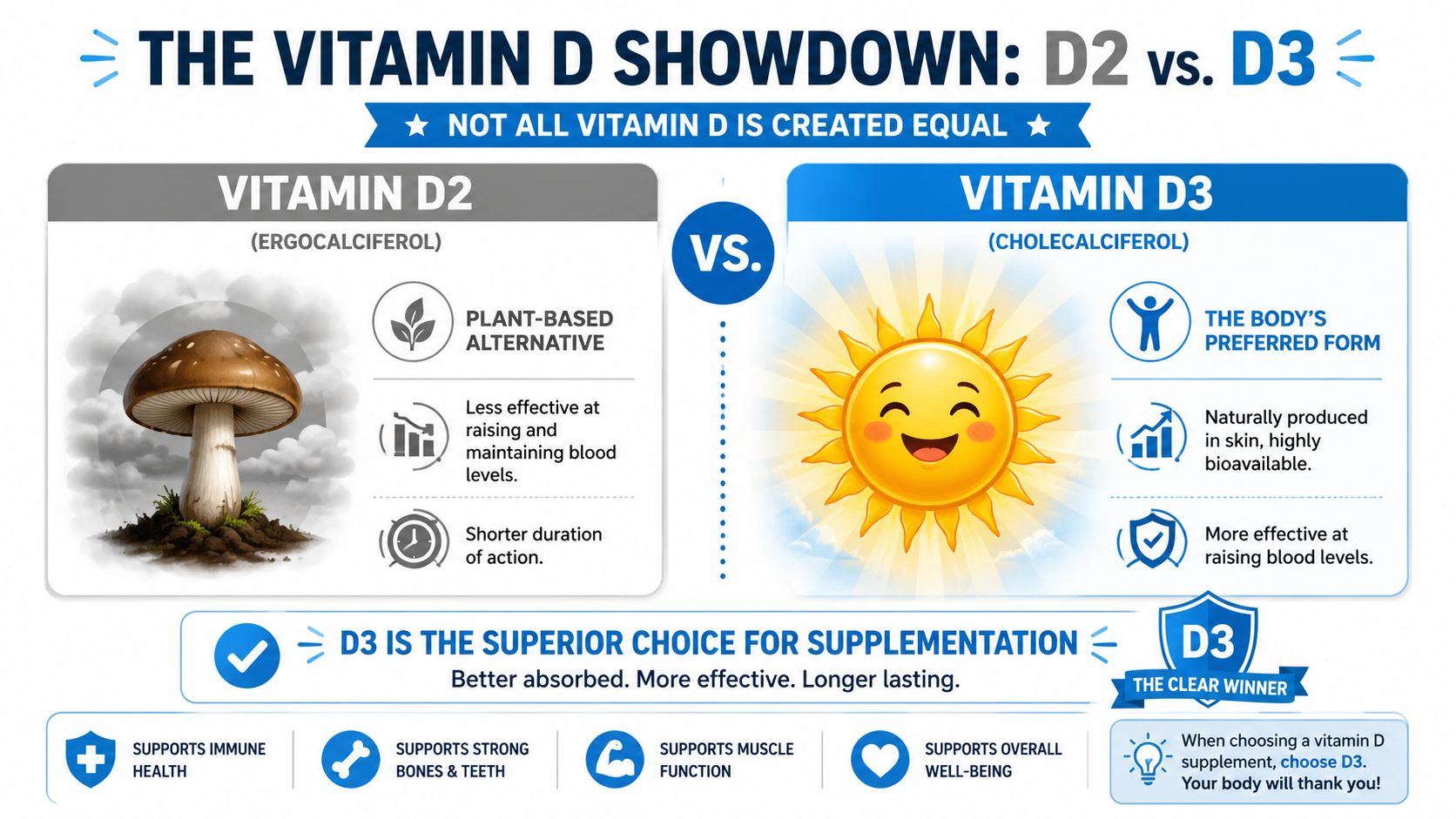
If you remember only one thing from this guide, let it be this. Vitamin D3 is usually the form to choose for supplementation. That single detail can make your shopping much easier.
Why the form matters
Think of D3 as the form your body handles more naturally. D2 can still raise total vitamin D measures, but it doesn't behave the same way over time. According to EatingWell's summary of the research on vitamin D supplements, Vitamin D3 is significantly more effective than Vitamin D2 at sustaining adequate serum levels, and research showed people taking D2 experienced an average decline in Vitamin D3 levels of about 18 nanomoles per liter.
That's the kind of detail many product roundups skip. On a shelf, D2 and D3 may look like minor variants. In the body, they aren't biologically equivalent.
The NIH Office of Dietary Supplements also supports the preference for D3. In its Vitamin D fact sheet for health professionals, D3 is described as technically superior for supplementation because it raises serum 25(OH)D more effectively and maintains levels longer.
A simple way to read the label
When you turn a bottle around, scan for the actual form name:
- Vitamin D3 means cholecalciferol
- Vitamin D2 means ergocalciferol
If you're choosing between two otherwise similar products, pick the one labeled Vitamin D3. For most adults looking for the best vitamin D supplements, that's the cleaner choice.
If the front of the bottle looks impressive but the supplement facts panel says D2, keep looking.
Readers often ask whether this means D2 is “bad.” Not exactly. It means D3 is generally the better fit when your goal is effective, sustained supplementation. If you're vegan or vegetarian, this is the point where you may want to look more closely at the source and formulation, but the first question is still the same. Is it D3?
How to Determine Your Ideal Vitamin D Dosage
Dose is where many shoppers get stuck. One bottle says daily support. Another says extra strength. A third looks almost identical but contains far more IU per serving. Without context, it's easy to assume more is better. It often isn't.
The best dose depends on why you're taking it. Maintenance, risk reduction, and deficiency correction are not the same situation.
General maintenance versus deficiency correction
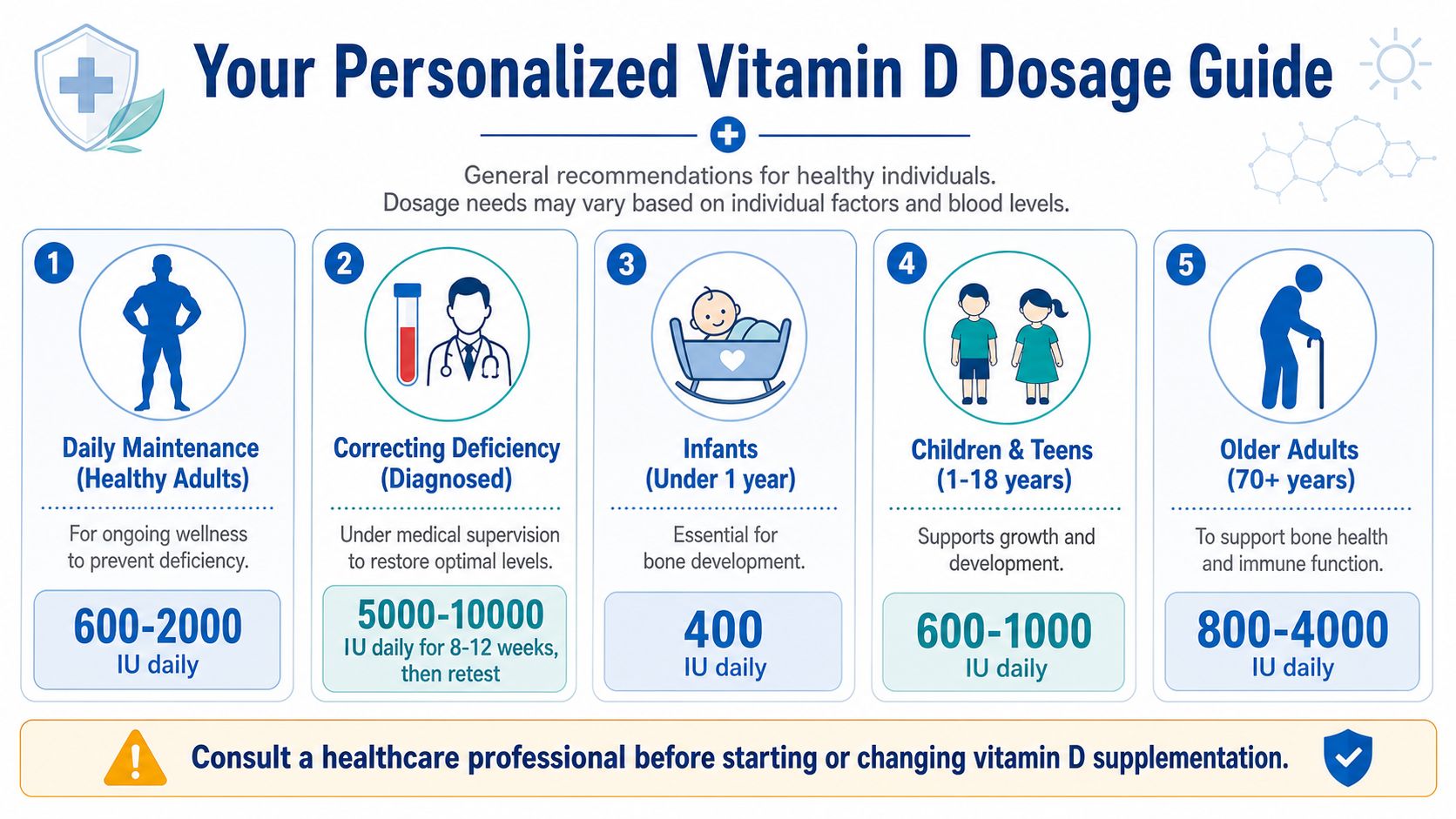
For adults with moderate sun exposure, the guidance summarized by EatingWell notes that 600 to 1,000 IU of D3 daily is typically enough to cover dietary and sunlight gaps. For people at risk of deficiency because of limited sun exposure, darker skin, or older age, the Endocrine Society recommendation cited there is 1,500 to 2,000 IU of D3 daily.
That's a helpful starting point because it separates regular support from more targeted supplementation.
If a deficiency has already been documented, the same source notes that medical guidance suggests 2,000 to 4,000 IU of D3 daily until target serum levels are reached. That's treatment territory, not casual self-experimenting.
Here's a simple way to view it:
- No known deficiency, moderate sun exposure: look at lower daily maintenance options.
- Higher risk for low vitamin D: consider a moderate daily D3 product.
- Documented deficiency: use the dose your clinician recommends and follow up.
A quick visual can make those categories easier to remember.
When higher doses need caution
The adult tolerable upper intake level is 4,000 IU daily, according to the NIH summary discussed in Medical News Today's review of vitamin D supplementation. That same article notes a meta-analysis finding that in prediabetic individuals, supplementation above 1,000 IU daily reduced the risk of developing Type 2 diabetes by 10%.
That doesn't mean everyone should jump to a higher dose. It means dose only makes sense in the context of the person taking it.
The same review also summarized a larger body of trial data showing that vitamin D supplementation in vitamin D-replete adults did not prevent cardiovascular events, cancer incidence, or falls in the overall population. That's a good reminder that buying the strongest bottle available isn't a shortcut to broad health benefits.
Higher-dose products can be appropriate. They're just not automatically appropriate.
A related point from the BEST-D trial summary is useful here. The Oxford CTSU page reports that daily dosing is superior to intermittent bolus dosing, because large intermittent doses create spikes and declines, while daily intake keeps levels steadier. You can read that in the BEST-D trial overview from Oxford CTSU.
So if you're choosing among the best vitamin D supplements, ask two dose questions:
- Is this for maintenance or correction?
- Is the product designed for daily use, rather than occasional very large doses?
If the label says 5,000 IU or more, pause and ask why that specific amount fits your situation. If you don't have a clear reason, a lower daily D3 product is often the more sensible choice.
Evaluating Supplement Quality Beyond the Label
A bottle can have the right dose and still be a poor choice. Quality depends on more than the front label.
Most shoppers look at IU first. That matters, but it shouldn't be the only filter. You also want to know whether the product is likely to stay potent, whether the ingredients fit your dietary needs, and whether you're accidentally stacking vitamin D from multiple products.
What quality really looks like
Start with the basics on the bottle and product page.
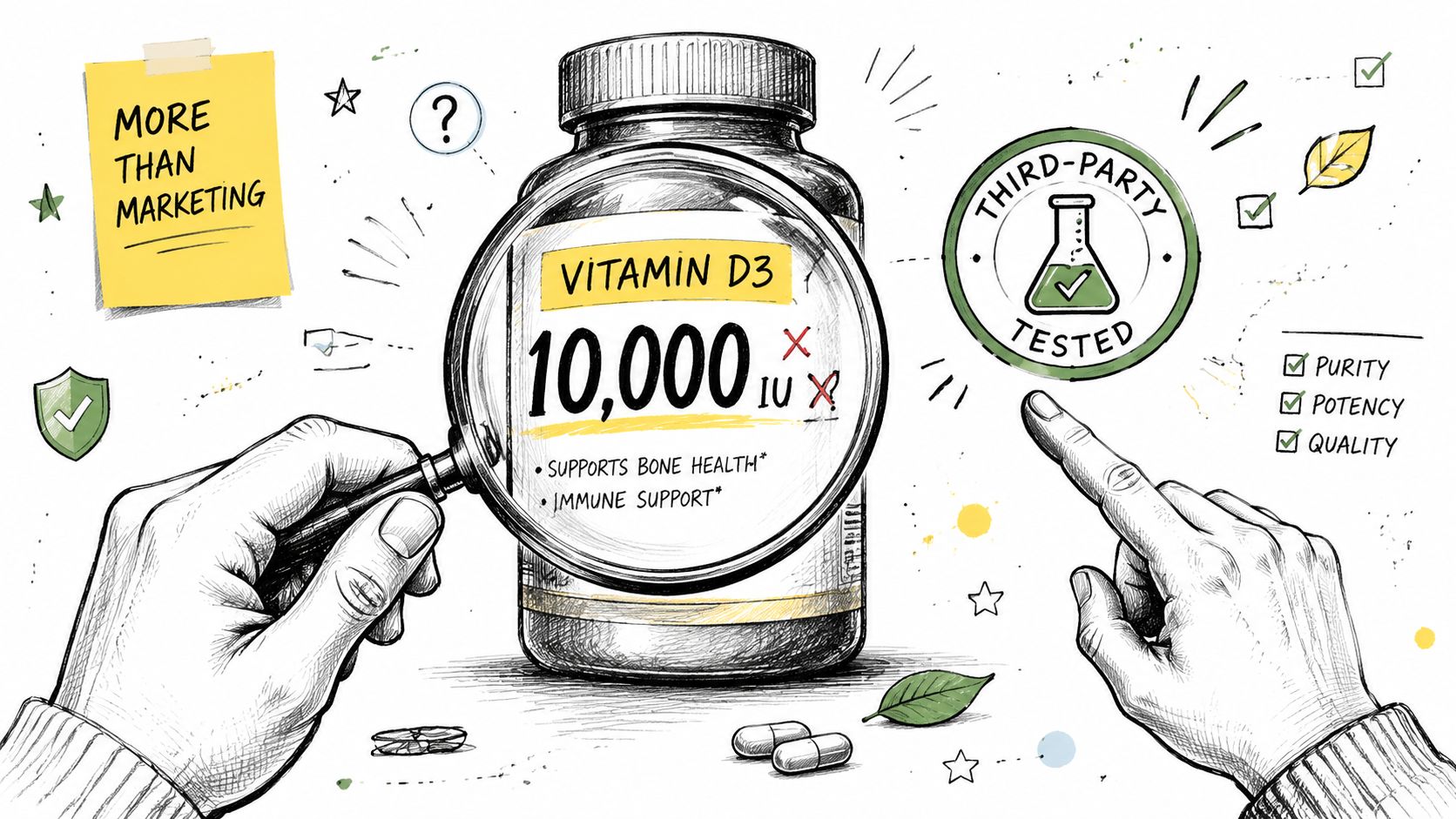
- Check the exact form. It should clearly say Vitamin D3 if that's what you intend to buy.
- Review the serving size. One drop, one gummy, and two capsules can all deliver very different amounts.
- Look at the inactive ingredients. These can include gelatin, sweeteners, dyes, and fillers.
- Match the formula to your needs. If you need gelatin-free or halal options, the label should make that easy to verify.
For many shoppers, convenience matters as much as chemistry. Someone who avoids animal-derived ingredients may prefer veggie capsules or a clearly labeled gelatin-free option. Someone else may care more about a chewable or gummy because they can't swallow pills comfortably.
A supplement only works if you can take it consistently and comfortably.
If you want a concrete example of how to assess a single product page rather than a generic category, CalVitamin's review of Life Extension Liquid Vitamin D3 2000 IU shows the kind of details worth checking, such as delivery format and practical use.
Storage and combination formulas
One overlooked issue is potency over time. According to Kelley-Ross's guide to choosing a vitamin D supplement, supplement guides often ignore the fact that vitamin D potency can degrade due to heat, humidity, and light.
That matters in real life. If you keep supplements in a steamy bathroom, leave them in a hot car, or buy a bulk bottle that will sit for a long time, you may not be getting the same reliability you expected.
Use this quick quality screen before you buy:
| Checkpoint | What to look for | Why it matters |
|---|---|---|
| Form | D3 on the label | Helps avoid buying the less effective form |
| Packaging | Intact seal, clear expiration date | Reduces avoidable product issues |
| Storage | Keep away from heat, humidity, and bright light | Supports potency over time |
| Extras | K2, calcium, or other add-ons | Prevents unintentional overlap |
Combination products need special attention. A D3 + K2 + calcium supplement may already contain enough D3 that adding a separate vitamin D product pushes your intake higher than you intended. This is one of the easiest ways to double-dose without realizing it.
If your routine includes a multivitamin, bone formula, immune blend, or D3 + K2 product, total your daily intake before adding anything else.
Choosing Your Best Form Capsules Gummies or Liquids
The best vitamin D supplements aren't always the “strongest” or the most popular. Often, they're the ones that fit your daily routine with the least friction.
Some people want a simple capsule they can take with breakfast. Others need gummies because they hate swallowing pills. Parents and adults who want flexible dosing often prefer liquid drops or sprays.
Vitamin D forms at a glance
| Form | Best For | Considerations |
|---|---|---|
| Capsules or softgels | Adults who want a simple, low-fuss routine | Check whether the capsule contains gelatin and review the dose per serving |
| Gummies or chewables | People with pill fatigue or swallowing difficulty | Look at serving size and added sweeteners |
| Liquids or sprays | Flexible dosing, households with different needs, people who prefer not to swallow pills | Measure carefully and read serving directions closely |
How to match the form to your routine
Capsules and softgels usually work well for people who already take other daily supplements. They're straightforward, easy to store, and simple to track. If you need specialty attributes, labels like gelatin-free or halal become especially useful.
Gummies and chewables can be a better match if swallowing pills feels like a chore. They often improve adherence as people tend to take them regularly. The tradeoff is that you need to read the serving size carefully. Two gummies may equal one serving, and that can affect how quickly a bottle runs out.
Liquids and sprays give you flexibility. That's useful if you want a product that can fit different household members or if you prefer more adjustable dosing. The tradeoff is precision. You need to measure or spray exactly as directed.
A real-world example helps. CalVitamin carries products in several delivery formats, including chewables, gummies, capsules, and sprays. Someone comparing options might look at a gummy such as Phytoral Vitamin D3 Gummies for immune and bone support if convenience is the main priority, while another shopper may prefer a capsule or liquid for different ingredient or dosing preferences.
Use these questions to narrow the form quickly:
- Do you dislike pills? Start with gummies, chewables, or liquids.
- Do you need ingredient restrictions? Read for gelatin-free, halal, or similar labels first.
- Do you want the simplest routine? A once-daily capsule is often easiest.
- Do multiple people in the home use it? Liquid or spray formats may offer more flexibility.
The right form is the one you'll take consistently without second-guessing it every day.
Simple Tips to Maximize Vitamin D Absorption
Choosing a smart product is only half the job. Your body still has to absorb and use it.
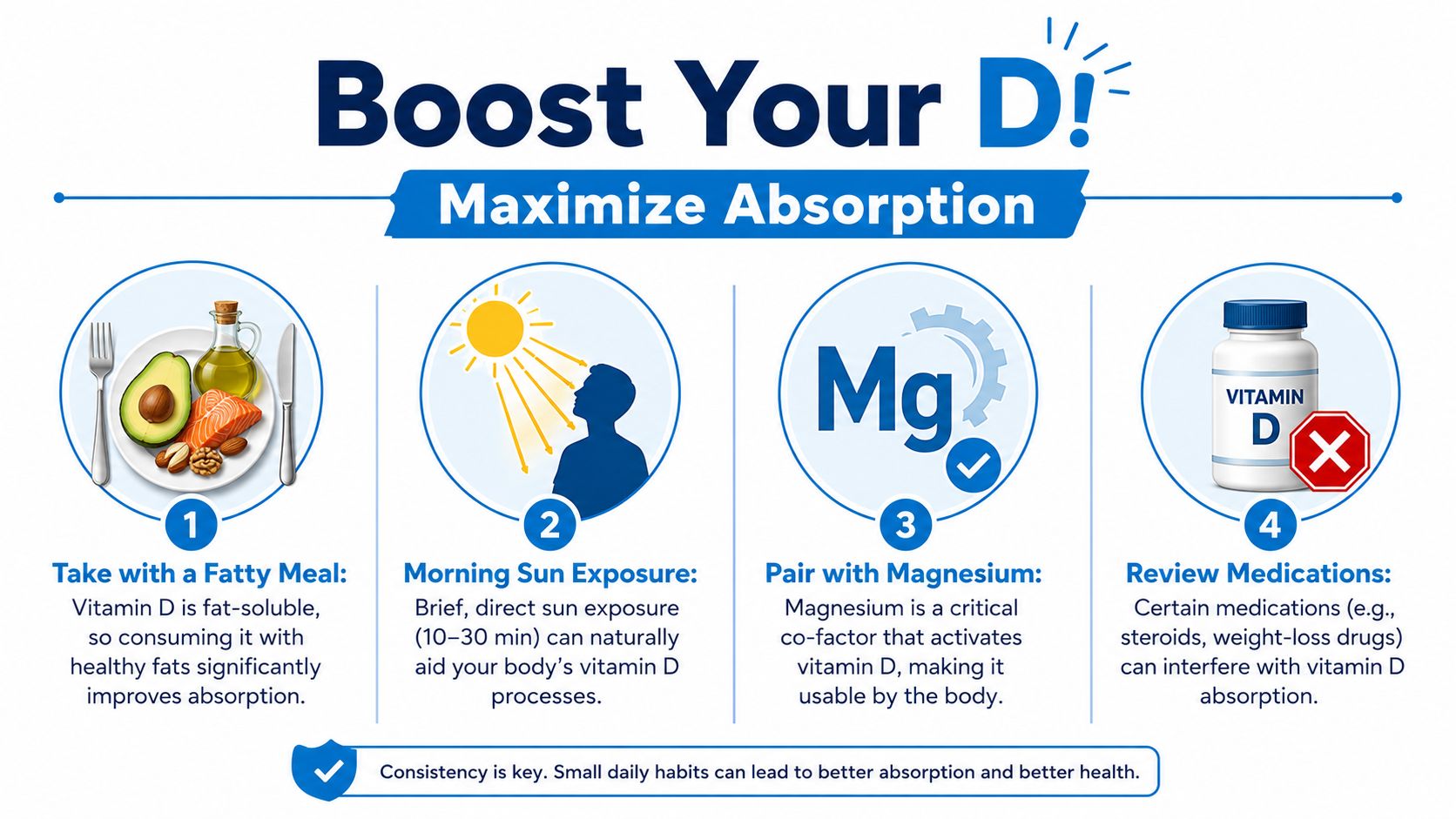
Vitamin D is fat-soluble, so small daily habits can make a practical difference. The goal isn't to make your routine complicated. It's to avoid doing the easy things poorly.
Small habits that make a real difference
Take your vitamin D with a meal that contains some fat. That can be as simple as eggs, yogurt, avocado, nuts, olive oil, or nut butter. You don't need a heavy meal. You just don't want to take it on a completely empty stomach if you can help it.
Consistency matters too. The BEST-D trial summary found that daily dosing is superior to intermittent bolus dosing for maintaining stable serum concentrations, as noted earlier from Oxford CTSU. In practice, that means a regular daily habit often works better than trying to “catch up” with occasional large doses.
A few useful habits:
- Pair it with breakfast or lunch. Attach it to a meal you rarely skip.
- Keep it visible. A supplement hidden in a cabinet is easy to forget.
- Use a reminder if needed. Phone alarms work better than good intentions.
Common mistakes to avoid
One common mistake is taking vitamin D randomly. A few days on, a few days off, then doubling up later creates an inconsistent routine.
Another is forgetting to review medications and the rest of your supplement stack. Some people also do better when they pay attention to related nutrition factors, such as magnesium intake, especially if their diet is limited.
Daily, moderate, repeatable habits usually beat heroic but inconsistent dosing.
If you're using one of the best vitamin D supplements but still making intake irregular, missing meals, or doubling up after missed days, the product may not be the main issue. The routine probably is.
Your Checklist for Buying the Right Vitamin D
When shoppers ask me how to simplify vitamin D choices, I tell them to ignore the marketing language first and run a short checklist.
Your buying checklist
- Choose D3. If the label says cholecalciferol, you're looking at the preferred form.
- Match the dose to the reason. Maintenance and deficiency correction are different decisions.
- Respect the upper limit. For adults, 4,000 IU daily is the tolerable upper intake level when not medically supervised, as noted earlier.
- Read the full label. Check serving size, extras like K2 or calcium, and inactive ingredients.
- Pick the format you'll consistently use. Capsules, gummies, chewables, and liquids all have a place.
- Store it well. Heat, humidity, and light can work against potency.
- Take it consistently with food. A steady daily habit is easier on the body than occasional large doses.
The best vitamin D supplements aren't mysterious. They're the products that meet a few clear standards: D3 form, appropriate dose, clean label, suitable format, and a routine you can maintain.
That's enough to make a much calmer, more informed choice the next time you shop.
If you want to compare vitamin D options in different formats and browse a wider supplement catalog, CalVitamin offers capsules, gummies, liquids, and products with attributes like gelatin-free and halal so you can filter by the features that matter to your routine.