

Yes, it's generally okay to take multivitamins at night. If you take them with food and water, absorption is only about 5 to 10% lower than morning use, and that difference is usually not clinically important.
Maybe this is you tonight: you remembered your multivitamin only after dinner, or while brushing your teeth, and now you're wondering if taking it before bed will help, hurt, or just go to waste. That question is more common than people think, because supplement timing sits at the intersection of three things that affect real life: absorption, sleep, and routine.
The tricky part is that “night” can mean very different situations. Taking a multivitamin with a full dinner is not the same as swallowing it on an empty stomach right before bed. A formula heavy in B vitamins may feel different from one that emphasizes minerals. And if you work nights, your “evening” may be the start of your active day.
That's why the best answer isn't a simple yes or no. It's more like, “Yes, usually. But the details matter.”
Table of Contents
- Introduction to Nighttime Multivitamin Use
- Understanding Vitamin Absorption Mechanisms
- How Multivitamins Affect Sleep Quality
- Comparing Meal Composition and Nutrient Uptake
- Special Populations and Timing Considerations
- Practical Timing Strategies and Product Selection
- Conclusion and When to Consult a Clinician
Introduction to Nighttime Multivitamin Use
If you skipped your morning dose, taking your multivitamin at night is usually a reasonable backup plan. Most healthy adults don't need to panic about the clock. They need to think about what they're taking it with, how close it is to sleep, and how their body tends to react.
Many people assume vitamins work like a light switch. Morning is “correct,” bedtime is “wrong.” The body doesn't work that way. A multivitamin is more like a mixed package of nutrients, and each nutrient behaves a little differently once it reaches your digestive system.
Some parts of a multivitamin absorb best with fat-containing food. Some are gentler when taken with a meal instead of on an empty stomach. Some ingredients, especially parts of the B-complex, may feel energizing in certain people.
Bottom line: Nighttime use is usually safe. The better question is whether your nighttime routine helps or hurts the supplement you're taking.
There are also two blind spots that deserve more attention than they usually get. First, night-shift workers often get advice built for a daytime schedule. Second, “take it with dinner” sounds simple, but dinners vary a lot. A steak, rice bowl, or salmon plate creates different absorption conditions than a plain salad or a piece of toast.
Those details explain why one person says, “I take mine at dinner and feel fine,” while another says, “I took mine before bed and it upset my stomach.”
Understanding Vitamin Absorption Mechanisms
Your body doesn't absorb every vitamin the same way. That's the key to understanding whether it's okay to take multivitamins at night.
Why food changes the outcome
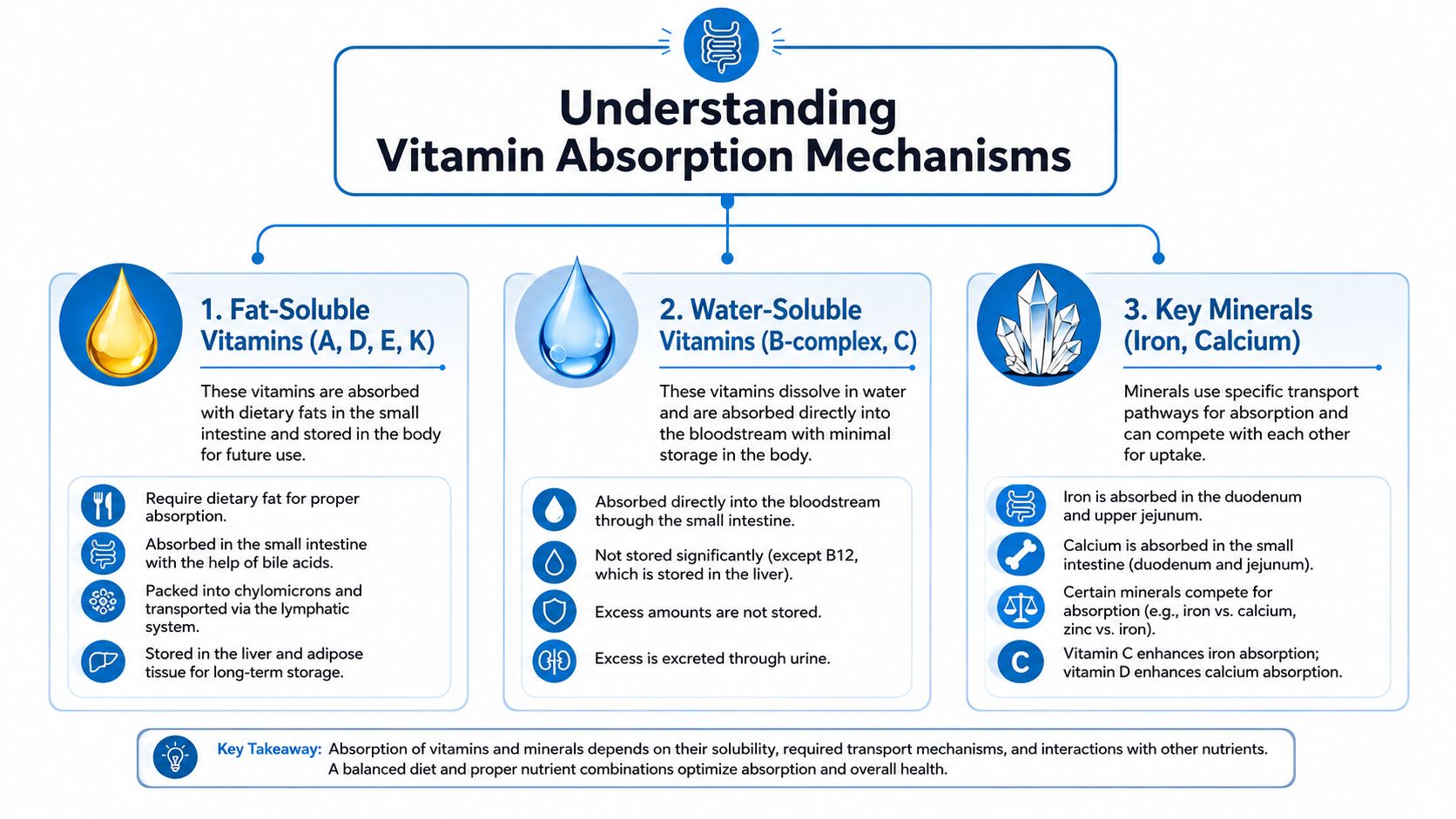
The most important divide is between fat-soluble vitamins and water-soluble vitamins.
Fat-soluble vitamins are A, D, E, and K. They need dietary fat to move efficiently through absorption pathways in the small intestine. According to Cleveland Clinic's guidance on the best time to take vitamins, these vitamins require 10 to 15 g of fat to form chylomicrons for absorption, which is one reason dinner often works well. The same source notes that taking a multivitamin without food leads to only about a 5 to 10% drop in absorption, but dinner is often ideal because it tends to include enough fat.
Water-soluble vitamins, such as B-complex vitamins and vitamin C, move differently. Think of them as nutrients that don't need the “fat vehicle” to travel in the same way. They still tend to be easier on the stomach with food, but they don't depend on fat the way vitamins A, D, E, and K do.
If you want a product example that highlights how minerals and fat-soluble nutrients often appear together, a calcium magnesium zinc D3 complex shows why timing with meals matters in practical shopping decisions, not just in theory.
A simple mail-delivery analogy
A good way to picture this is mail delivery.
- Fat-soluble vitamins need a truck. That truck is dietary fat.
- Water-soluble vitamins are more like smaller envelopes handled by a different courier route.
- Minerals can be picky passengers. Some are better tolerated with meals, and some can compete with each other depending on the full formula.
If you swallow a multivitamin right before bed on an empty stomach, the truck may never really show up. Your body can still absorb some nutrients, but the setup isn't as efficient for the fat-soluble ones.
A dinner with some healthy fat gives fat-soluble vitamins the transportation they need. An empty stomach makes the trip harder.
Here's the practical takeaway:
| Situation | What it usually means for absorption |
|---|---|
| With dinner that includes fat | Better setup for vitamins A, D, E, and K |
| With food and water late evening | Usually acceptable for most people |
| Right before bed on an empty stomach | More likely to cause stomach discomfort and less ideal absorption conditions |
This is why “take it at night” is too vague to be useful advice. The better version is, “Take it with an evening meal if that's when you'll be most consistent.”
How Multivitamins Affect Sleep Quality
People often hear two opposite claims. One says vitamins are neutral and won't affect sleep at all. The other says never take any vitamin after sunset. Neither extreme is very helpful.

Why some people feel more alert
The ingredient group most often behind bedtime complaints is the B-complex, especially formulas with a noticeable B12 presence. According to Solgar's discussion of multivitamin timing, B-complex vitamins can stimulate metabolism and brain function and may disrupt sleep onset for up to 30% of sensitive individuals when taken too close to bedtime.
That doesn't mean everyone will feel wired after taking a multivitamin at night. It means sensitivity varies. Some people notice nothing. Others feel mentally switched on when they'd rather be winding down.
Verywell Health's review of multivitamin timing explains the reasoning in plain physiological terms. B vitamins act as cofactors in ATP and neurotransmitter production, so late-evening dosing may feel less than ideal for people who already struggle with falling asleep.
If you've ever taken a multivitamin at night and then felt oddly alert, that reaction isn't “in your head.” It can be a sensitivity issue.
Some nighttime routines include separate sleep-support supplements rather than a general multivitamin. For readers comparing options, melatonin magnesium sleep support gummies are an example of a product category designed around evening use rather than daytime nutrient coverage.
How to test your own response
A smart approach is to watch your body, not the label alone.
- If you sleep well after dinner dosing, nighttime may work fine for you.
- If you feel restless, move the multivitamin earlier in the day.
- If your formula is high in B vitamins, try taking it with breakfast or lunch first.
This short video gives a simple consumer overview of timing considerations.
A second point matters here too. Nature Made notes that standard multivitamin formulas do not typically interfere with sleep quality for most healthy adults when taken as directed, and that consistency with meals matters more than strict clock time. Their guidance also notes that some experts suggest avoiding very late use of formulas high in vitamin D if you seem sensitive to nighttime stimulation. You can read that context in Nature Made's article on taking multivitamins at night.
Comparing Meal Composition and Nutrient Uptake
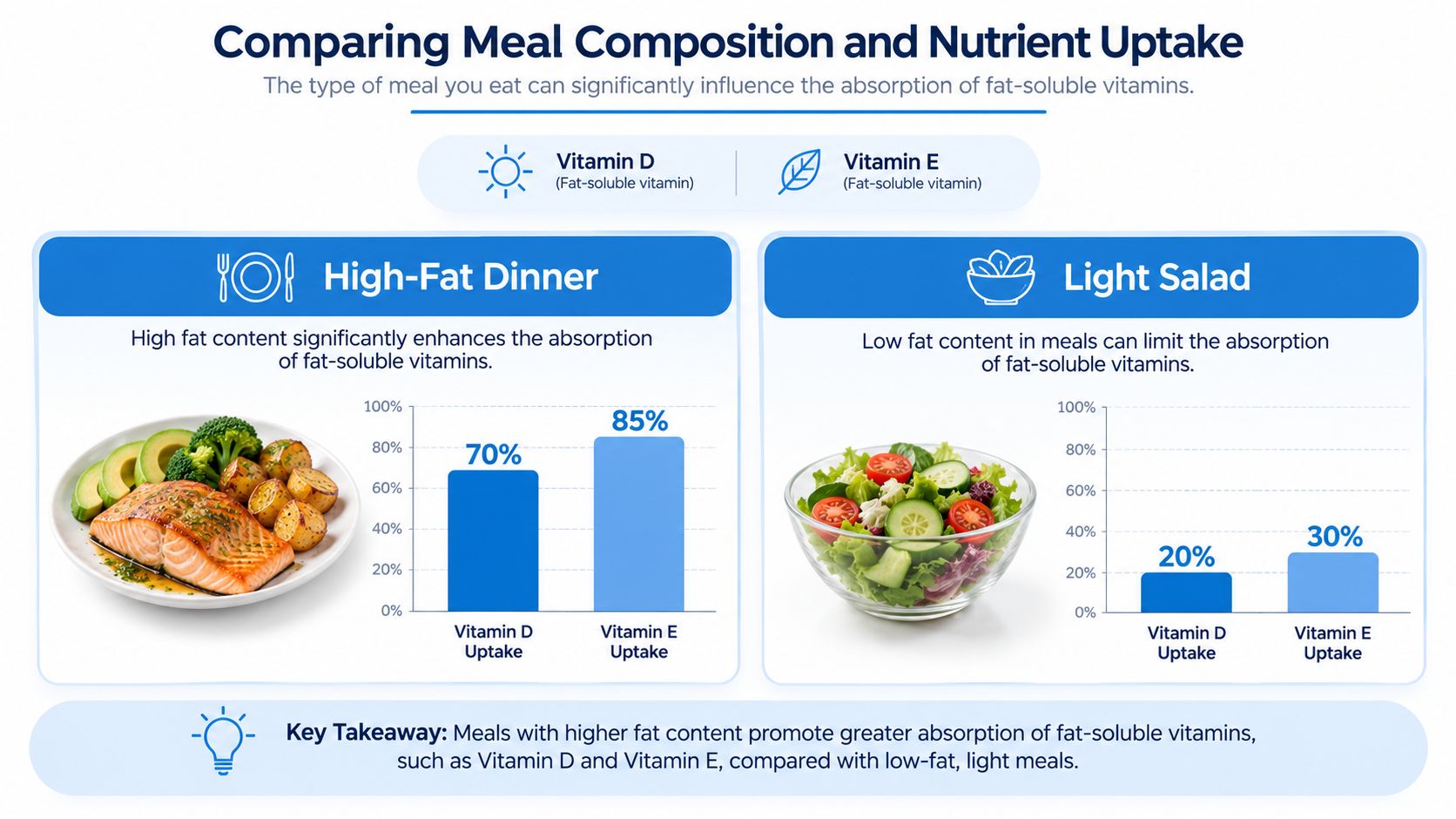
“Take it with dinner” sounds precise, but it isn't. Dinner can mean grilled salmon with olive oil, or it can mean lettuce, cucumber, and sparkling water.
Dinner types are not equal
Many people get tripped up here. They follow the advice technically, but not functionally.
The verified guidance shows that fat-soluble vitamins need dietary fat. Solgar notes that roughly 5 grams, about one teaspoon, can support bioavailability for vitamins A, D, E, and K when taken with a meal, and that this condition is often met more reliably at dinner than at bedtime on an empty stomach. But there's also a meaningful difference between a lower-fat evening meal and a higher-fat one.
According to Fully Healthy's discussion of nighttime multivitamin use, low-fat evening meals reduce vitamin D absorption by up to 30% compared to high-fat meals. That doesn't mean every dinner needs to be heavy. It means a very light meal can undercut the benefit of your timing choice.
Here's a simple side-by-side view:
| Evening meal pattern | Likely result |
|---|---|
| Salmon, eggs, yogurt, nuts, olive oil, or avocado included | Better support for fat-soluble vitamin uptake |
| Plain toast, fruit only, or a very low-fat salad | Less support for vitamins that depend on fat |
| No meal at all, just water before bed | More likely to cause discomfort and weaker absorption conditions |
Easy ways to improve a light evening meal
You don't have to overhaul your whole dinner. Often, small adjustments are enough.
- Add olive oil: A drizzle on vegetables or salad can make a light meal more supportive.
- Include nuts or seeds: They're an easy way to add some dietary fat.
- Pair with yogurt or eggs: If that fits your eating style, these can help create a better absorption environment.
A multivitamin taken with a light but balanced meal usually makes more sense than the same pill taken on an empty stomach five minutes before bed.
This is one reason people get mixed results from the same supplement. The pill may be identical. The meal isn't.
Special Populations and Timing Considerations
General advice works for many adults, but some groups need more focused thinking.
Pregnancy and sensitive stomachs
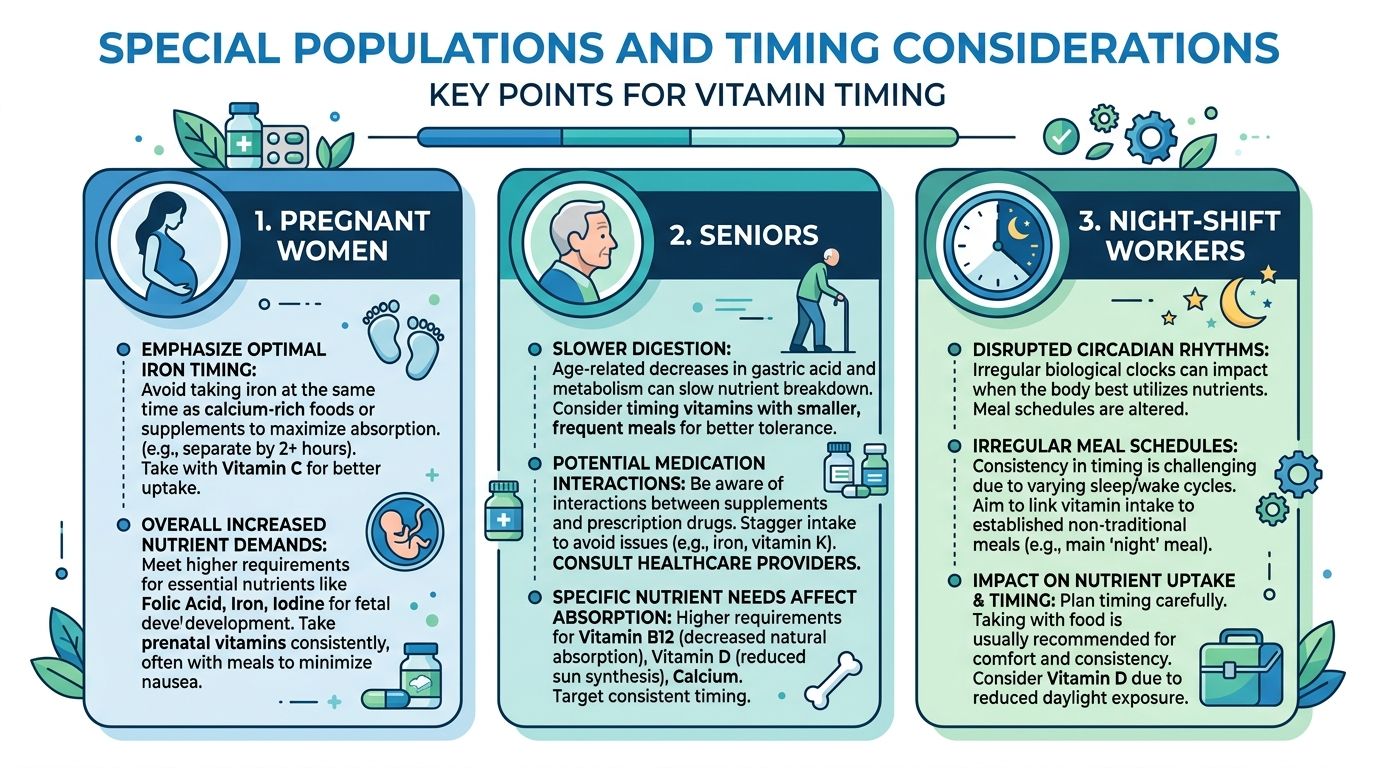
Pregnant readers often deal with nausea, iron sensitivity, and changing meal tolerance. A prenatal or multivitamin may be easier to tolerate later in the day if breakfast is difficult, but the exact timing should follow the clinician's guidance for that formula.
The practical issue isn't just “night or morning.” It's whether the supplement causes nausea, whether the meal helps, and whether other supplements or medications need spacing.
Older adults and medication timing
Older adults may find that taking supplements with a regular meal reduces stomach upset and makes adherence easier. They also tend to have more prescriptions in the mix, which makes timing conversations more important.
A simple written schedule often helps here. Not because nighttime is dangerous by default, but because consistency becomes harder when several pills are involved.
Night-shift workers and chronotype differences
This is the most overlooked group in the whole conversation. Advice about “don't take vitamins at night” usually assumes nighttime is your biological wind-down period.
But what if your workday starts in the evening?
According to Nutritionniste Paris on multivitamin timing and chronotypes, there's no universal consensus prohibiting nighttime dosing, and the major gap is that specific data for night-shift chronotypes is lacking. That means we don't have strong trial-based answers for workers whose active window happens at night.
So the most reasonable suggestion is practical, not dogmatic:
- If night is your active period, take your multivitamin with your main meal during that active period.
- If your sleep starts soon after your dose and you feel stimulated, shift earlier within your wake window.
- If your meals are irregular, anchor the supplement to the most reliable meal you typically eat.
For shift workers, the right question may not be “Is nighttime okay?” It may be “When does my body treat this as daytime?”
Practical Timing Strategies and Product Selection
The best supplement schedule is one you'll keep. Perfect timing that you forget every other day usually loses to good-enough timing that becomes automatic.
A simple decision guide
Use this decision path:
- Take it with your most reliable meal. That matters more than chasing an ideal hour.
- If you're sensitive to B vitamins, move it earlier in your waking day.
- If dinner is your biggest meal, evening may be the easiest and most absorbable slot.
- If you only remember right before sleep, ask whether you've eaten enough. If not, waiting until the next meal may be more comfortable.
A lot of people do well with one of these routines:
- Morning routine: Best for people who want to avoid possible bedtime alertness.
- Dinner routine: Best for people who eat their most substantial meal at night.
- Shift-work routine: Best tied to the meal that happens during the worker's active hours, not the wall clock.
Choosing a format you'll actually take
Delivery form matters less than consistency, but it still affects real-world adherence.
Capsules and tablets are familiar and convenient. Gummies may be easier for people who dislike swallowing pills. Liquids can work for people who prefer flexibility. The best format is usually the one you won't skip.
If you're comparing formulations and want a retailer-focused example of how product reviews discuss ingredient balance and daily use, this review of Thorne Advanced Nutrients Multivitamin shows the kind of details shoppers often evaluate.
A simple personal checklist helps:
- Track meals: Notice whether you usually eat enough fat at dinner.
- Track sleep: If nighttime dosing seems to make you alert, adjust.
- Track consistency: The schedule that survives busy weeks is usually the right one.
Conclusion and When to Consult a Clinician
So, is it okay to take multivitamins at night? For many people, yes. The better question is whether night is your best fit based on what you eat, how you sleep, and when your active hours happen.
Timing works a lot like choosing when to water a plant. The clock matters less than the conditions. A multivitamin often goes down more comfortably and absorbs more predictably when it is paired with a real meal, especially if that meal contains some fat. That detail gets missed often with evening dosing. One person's dinner is a full plate with protein and healthy fats. Another person's dinner is toast or a small snack right before bed. Those two situations can lead to very different experiences with the same supplement.
Chronotype matters too. A night-shift nurse taking a multivitamin at 8 p.m. before starting work is in a different situation than someone taking it at 10 p.m. and trying to fall asleep an hour later. For shift workers, the useful reference point is the start of your active period and the meal that supports it, not the number on the clock.
Get personalized advice if your multivitamin causes nausea, seems to make you feel wired, or may interact with prescription medicines. A clinician can also help if you are pregnant, have a digestive condition, have had bariatric surgery, or use a formula with higher doses of iron, vitamin D, or other nutrients that sometimes need more individualized guidance.
As you decide what timing fits your routine, the product format still matters because it affects whether you will keep taking it. CalVitamin offers multivitamins and related products in capsules, gummies, liquids, and other formats, which can be helpful if you want to match a supplement to your meal pattern, schedule, and preferences rather than forcing your routine to fit the product.






