You're probably looking at a prenatal label right now with a mix of hope and frustration. One bottle says “natural.” Another says “whole food.” A third says “organic,” but the supplement facts panel looks like a chemistry worksheet. If you're trying to make a careful choice for pregnancy, that confusion makes sense.
Most expecting parents don't need more marketing. They need a way to read the label and know what matters. The interest in this category is growing too. The global prenatal vitamin supplement market was valued at USD 542.8 million in 2023 and is projected to reach USD 957.7 million by 2030, growing at a CAGR of 8.4%, according to Grand View Research's prenatal vitamin supplement market analysis. That rise reflects stronger demand for supplements that avoid pesticides and synthetic chemicals.
Table of Contents
- Navigating Your Prenatal Vitamin Choices
- What Makes a Prenatal Vitamin Genuinely Organic
- The Non-Negotiable Nutrients in Your Organic Prenatal
- How to Decode Labels and Certifications
- Choosing the Right Organic Prenatal for You
- Frequently Asked Questions About Prenatal Vitamins
Navigating Your Prenatal Vitamin Choices
A lot of parents have the same experience. You walk into a store, head to the supplement aisle, and suddenly every bottle seems to promise the same thing. Better nutrition. Better ingredients. Better support for your baby. But when you turn the bottles around, differences hide in tiny print.
That's where many shoppers get stuck. The word organic sounds comforting, but it can mean very different things depending on the product. In prenatal care, that word matters because you're not just shopping for a generic multivitamin. You're looking for a formula that supports a narrow window of fetal development, while also being gentle enough for a body that may already be dealing with nausea, constipation, or food aversions.
One helpful starting point is to stop thinking in terms of “best brand” and start thinking in terms of best label. A strong prenatal should tell you, clearly, what nutrients it contains, how much of each nutrient is inside, and what form those nutrients take.
Organic prenatal vitamins aren't automatically better because the label says organic. They're better when organic sourcing is paired with the right nutrient forms and meaningful doses.
If you've been browsing broader supplement education resources, a vitamins, supplements, and nutrition blog archive can help you get familiar with common label terms before you compare prenatal formulas. That background makes the aisle feel much less overwhelming.
What Makes a Prenatal Vitamin Genuinely Organic
Think of it this way. A carrot grown in healthy soil and processed gently is different from a carrot-flavored substance made to imitate the original. Both may look similar on a package, but they don't come from the same place. The same basic idea applies to organic prenatal vitamins.
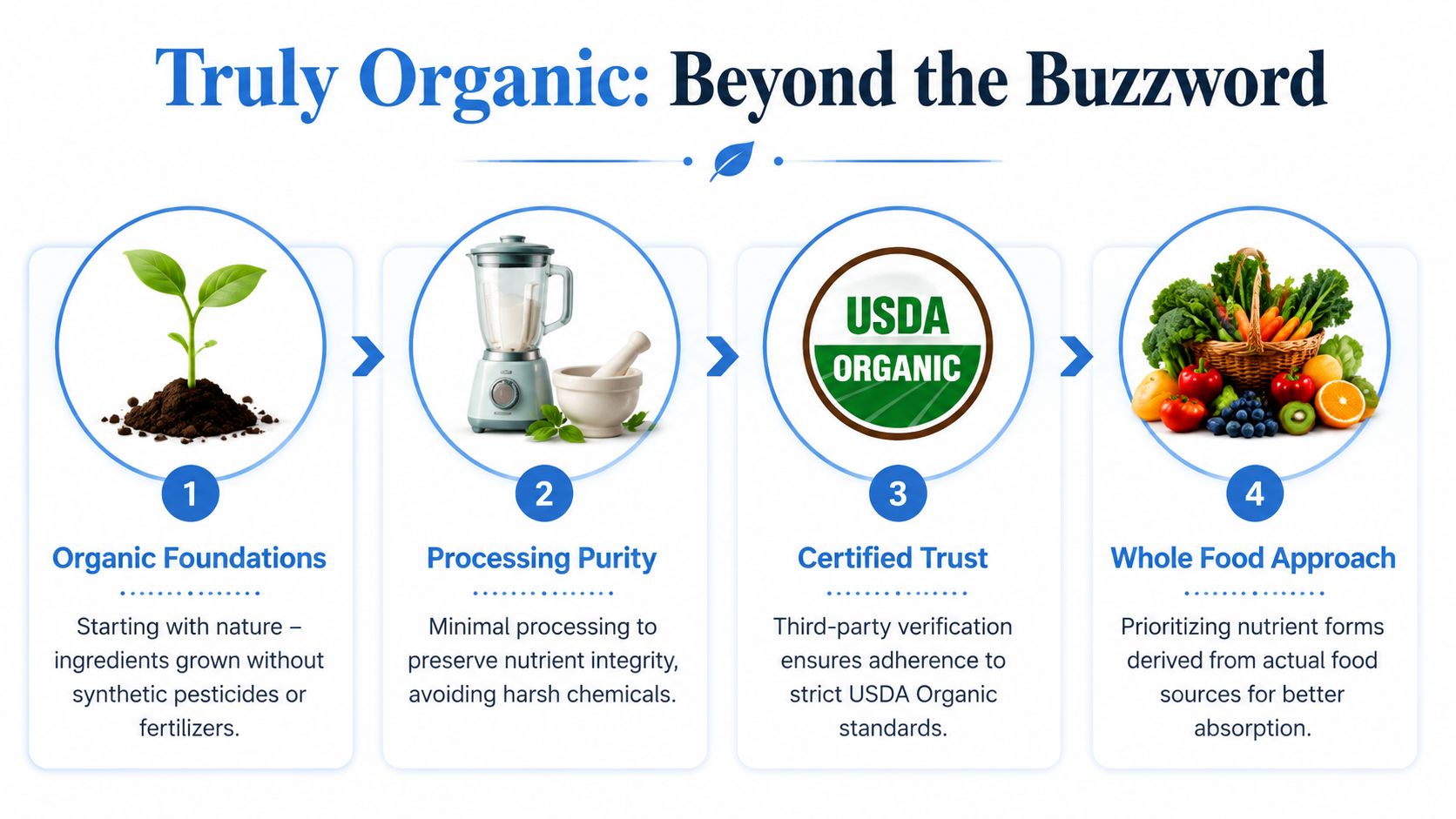
An organic prenatal starts with ingredients grown without synthetic pesticides, GMOs, and artificial preservatives. It usually emphasizes whole-food sourcing or food-derived ingredients, then pairs that with cleaner processing and clearer certification standards. The most useful shortcut for shoppers is the USDA Organic seal, because it signals that the product meets a defined standard instead of relying on vague language like “natural” or “clean.”
Whole-food sourcing is only one piece
Readers often find this confusing. “Organic” doesn't automatically tell you whether the formula is complete. It also doesn't tell you whether your body can easily use what's inside. That second issue is called bioavailability, which is a practical way of asking, “Can your body absorb and use this nutrient efficiently?”
During pregnancy, that question matters a lot. A label can look beautiful on the front and still fall short in the details. Some formulas use nutrient forms that require extra conversion steps in the body. Others use forms that are already active and easier to use.
Nutrient form matters as much as ingredient source
One of the clearest examples is folate. High-quality organic prenatals often use methylfolate (5-MTHF) instead of synthetic folic acid. According to Mama's Select's discussion of organic prenatal vitamins, 60-70% of the population has MTHFR gene variations that can impair conversion of synthetic folic acid, which is why the methylated form is highlighted for neural tube closure.
That doesn't mean every person needs to become a genetics expert before buying a bottle. It means the supplement facts panel should tell you the actual form used, not just the generic nutrient name.
A few label examples help:
- Better folate listing: “L-5-methyltetrahydrofolate” or “methylfolate”
- Better B12 listing: “methylcobalamin”
- More informative iron listing: a named form instead of just “iron”
Practical rule: If the front label sounds reassuring but the supplement facts panel stays vague, trust the panel less, not the marketing more.
Some shoppers also like to compare examples from established whole-food supplement lines, such as mykind Organics Women's Multivitamin tablets, because it trains your eye to spot how a more transparent label is written.
What organic does and doesn't promise
Organic sourcing can reduce exposure to ingredients many parents prefer to avoid. It can also align with a whole-food approach that feels more consistent with how they already eat. But no certification replaces the need to verify the nutrient list.
Use this short checklist when you pick up a bottle:
- Look for a formal seal. USDA Organic means more than a front-label adjective.
- Check the ingredient list. Fewer unnecessary fillers is usually a good sign.
- Read the nutrient forms. Methylfolate and methylcobalamin are worth spotting.
- Don't confuse organic with complete. A product can be organic and still miss key prenatal needs.
The Non-Negotiable Nutrients in Your Organic Prenatal
A prenatal can be organic, beautifully packaged, and easy to swallow, but if it misses the core nutrients, it's not doing the job you need it to do. This is the part of the label that deserves the most attention.
According to Remedy's summary of evidence-based prenatal vitamin ingredients, prenatal vitamins must contain at least 600 mcg DFE of folate and 27 mg of iron. The same source notes that ACOG also recommends 150 mcg of iodine, 450 mg of choline, and 600 IU of Vitamin D3. The same review also identifies 200–300 mg of DHA as an evidence-based target.
Folate and iron come first
Folate supports early fetal development and is central to neural tube formation. This is why the folate line on the label isn't a minor detail. It's one of the first things I'd check.
Iron supports oxygen transport and helps meet the increased demands of pregnancy. It's also one of the ingredients most likely to affect how a prenatal feels in real life. Some forms are gentler than others, so the amount matters, but the form matters too.
A useful mindset is this: if a prenatal underdelivers on folate or iron, the rest of the label becomes much less impressive.
The most trustworthy prenatal labels don't just mention folate and iron. They show the amount clearly and identify the form clearly.
The supporting nutrients that often get overlooked
After folate and iron, several nutrients deserve a deliberate look because many shoppers assume they're included at meaningful levels when they aren't.
Iodine supports thyroid function and healthy development. On a label, you want to see the amount listed, not hidden in a blend.
Choline is another one many formulas underemphasize. It plays an important role in development, yet it's often missing or included in a smaller amount than many parents expect when they first start comparing bottles.
Vitamin D3 helps support bone health and broader maternal nutrition. If the formula includes vitamin D but doesn't specify the form, it's worth slowing down and reading more carefully.
DHA often appears outside the prenatal itself, either as a companion softgel or a separate product. That's not automatically a problem, but it does mean you need to know whether the bottle in your hand is intended to be complete on its own.
Quick label reference table
| Nutrient | Crucial For | Recommended Daily Amount |
|---|---|---|
| Folate | Neural tube development and DNA synthesis | 600 mcg DFE |
| Iron | Oxygen transport and maternal blood support | 27 mg |
| Iodine | Thyroid support and fetal development | 150 mcg |
| Choline | Brain and nervous system development | 450 mg |
| DHA | Brain and eye development | 200–300 mg |
| Vitamin D3 | Bone health and maternal nutrient support | 600 IU |
A quick example of how this helps in practice: if you compare two products and one says “complete prenatal” but leaves out DHA, while the other includes DHA separately, neither is necessarily wrong. But the labels tell different stories. One requires a second purchase or a second capsule. The other may simplify the routine.
If you need another reference point while comparing mineral support products, some shoppers also browse calcium, magnesium, zinc, and D3 combinations to understand how bone-support nutrients are typically listed on supplement facts panels. That can make Vitamin D lines easier to interpret, even though a prenatal still needs its own pregnancy-specific balance.
Use these questions when reading a prenatal panel:
- Is folate listed in a meaningful amount? This is one of the first lines to verify.
- Does iron meet the expected target? Don't assume a pleasant-tasting formula includes enough.
- Are iodine and choline visible? If they're hard to find, the formula may not be as complete as it sounds.
- Is DHA included or separate? Either can work, but you need to know which routine you're signing up for.
How to Decode Labels and Certifications
You are standing in the supplement aisle, holding two bottles that both say “organic prenatal” on the front. One has leaves, clean-looking colors, and words like “whole food” and “gentle.” The other looks more clinical. At that point, the safest choice is rarely the prettiest label. It is the product that explains itself clearly.
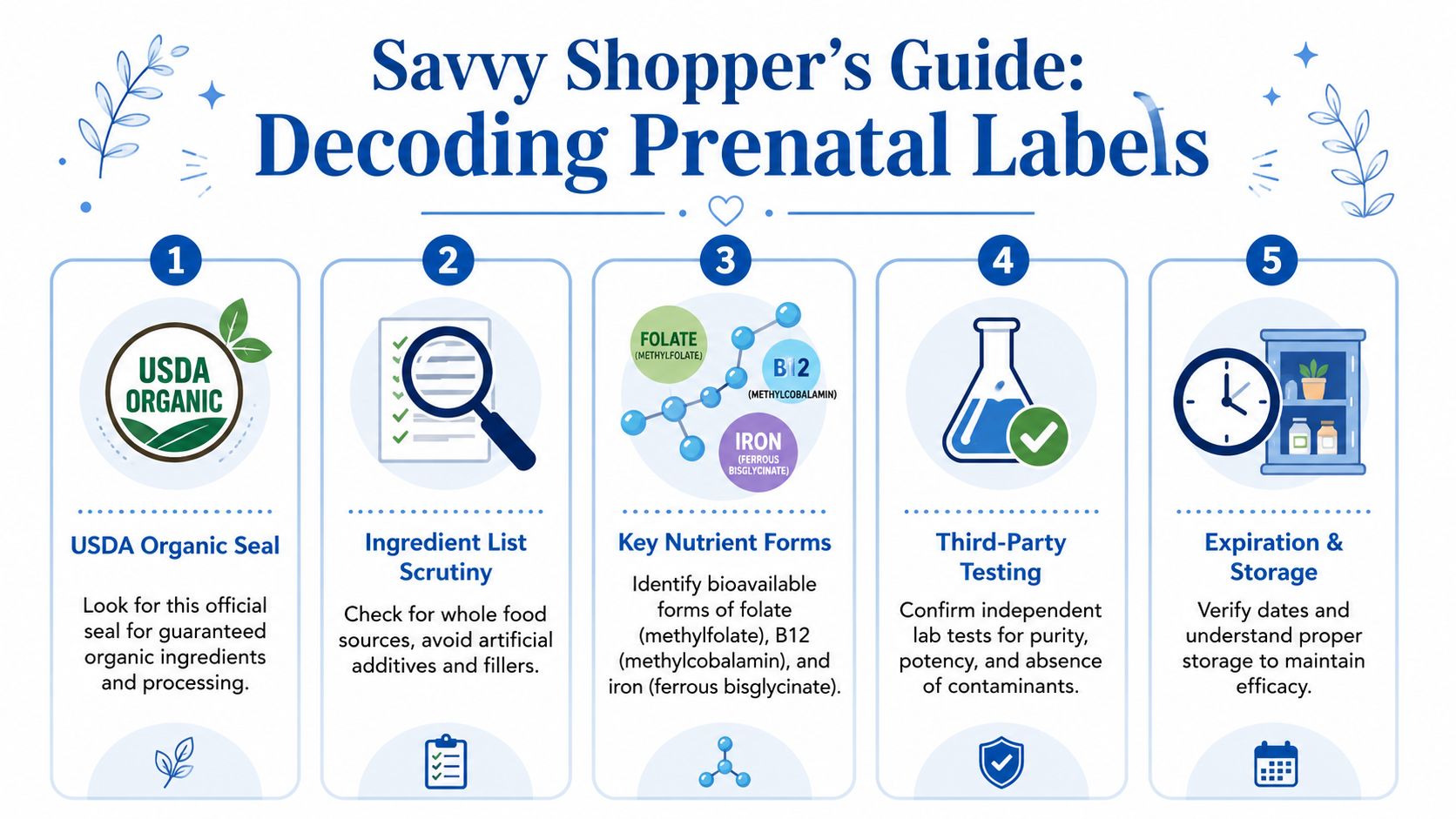
A prenatal label works a lot like a food ingredient list. The front attracts your attention. The supplement facts panel shows what you are getting. The “other ingredients” box fills in the fine print that can affect tolerability, texture, and ingredient quality.
Start with the front of the bottle
The front label is useful for screening products quickly. It is not enough to make the final decision.
Look for certifications tied to a real standard. The USDA Organic seal is the clearest example. It tells you the product meets organic handling and ingredient rules, though it does not guarantee that every nutrient is present in the form or amount you want. That distinction matters. “Organic” describes how ingredients were sourced or processed. It does not automatically mean “best formulated for pregnancy.”
You may also see claims such as Non-GMO Project Verified, vegan, gluten-free, or third-party tested. Those labels can help if they match your needs, but each one answers a different question. Vegan tells you about ingredient origin. Gluten-free addresses one dietary concern. Third-party testing speaks more to quality control than to nutrient completeness.
Then read the supplement facts panel like a checklist
Now, label literacy starts to protect you.
Read nutrient lines closely, because small wording changes can mean a real difference in form. For example, a label that lists methylfolate gives different information than one that lists folic acid. A label that names methylcobalamin tells you more than one that says vitamin B12. If you have heard terms like these and felt unsure what they mean, focus on this principle: the exact form listed on the bottle helps you judge how specific and transparent the formula is.
A few practical checks make this easier:
- Read the full nutrient name. “Folate” and “5-MTHF” are not the same wording as a broad B-vitamin claim.
- Check the amount per serving. A strong-sounding product name can distract from a weak formula.
- Look at serving size before comparing bottles. One product may appear stronger until you notice the listed dose requires two or three capsules.
- Scan the “other ingredients” section, which lists sweeteners, coatings, dyes, gums, and fillers.
This short video walks through label-reading basics in a practical way:
What certifications do, and what they do not do
Certifications are helpful, but each one has limits.
USDA Organic can support confidence in sourcing standards. It does not confirm that the prenatal includes enough choline, iron, iodine, or DHA. A third-party testing seal can suggest the product was checked for purity or label accuracy. It still does not tell you whether the formula fits your pregnancy needs. In other words, certifications help answer “Can I trust how this was made?” The supplement facts panel helps answer “Will this meet my needs?”
That difference is easy to miss, especially when marketing language is doing a lot of work.
Red flags to catch before you buy
One of the clearest warning signs is vague labeling. If a company makes broad claims about supporting pregnancy but avoids showing exact nutrient forms and amounts, pause there.
Another concern is a crowded “other ingredients” list. A prenatal does not need to read like candy or a flavored drink mix unless there is a clear reason for those extras. Sweeteners, artificial colors, shiny coatings, and multiple filler ingredients are not always harmful, but they should have a purpose you understand.
A final red flag is confusion by design. If the bottle highlights organic herbs, fruits, or greens more than the actual prenatal nutrients, the marketing may be louder than the formulation.
A trustworthy prenatal should be easy to verify, not just easy to sell.
A simple reading order helps: front label first, supplement facts second, other ingredients last. That habit turns a shelf full of claims into a set of clear, comparable facts.
Choosing the Right Organic Prenatal for You
You are standing in the supplement aisle, comparing two bottles that both say “organic prenatal.” One is a once-daily capsule with methylfolate and iron. The other is a berry-flavored gummy with beautiful packaging and a shorter nutrient list. If you do not know how to compare the forms and amounts, the choice can feel more confusing than helpful.
The best fit is the prenatal you can understand, tolerate, and take regularly. That starts with label literacy. A good label lets you connect what is in the bottle to what your body may need during pregnancy.

Match the formula to your real life
Start with your routine, not the marketing. A prenatal only works if it fits into your day without becoming a battle.
If you eat vegan, check the DHA source. Some prenatals include DHA from algae, while others use fish oil or leave DHA out entirely. If your clinician has discussed methylation or you have been told to look more closely at folate forms, a label that lists methylfolate may feel clearer and more reassuring than one that lists folic acid without explanation.
Tolerance matters too. A tablet that looks perfect on paper is not helpful if it triggers nausea every morning.
Ask practical questions:
- Can you swallow capsules more easily than large tablets?
- Would taking your prenatal with dinner work better than taking it early in the day?
- Would a split-dose option fit your routine better than one large serving?
Those are not small details. They often decide whether a prenatal becomes a steady habit or a bottle that sits half-used on the counter.
Use nutrient forms to guide your decision
Reading the label carefully makes a real difference. Two products can list the same nutrient category but use different forms.
For example, “folate” is not a single ingredient. One bottle may provide folic acid. Another may provide methylfolate. Magnesium can also appear in more than one form, and iron may be listed in forms that some people tolerate better than others. You do not need to memorize every ingredient chemistry term. You just want enough label fluency to recognize that the form listed under a nutrient can affect how comfortable, practical, or reassuring that product feels for you.
A simple way to compare bottles is to ask:
- What exact form is used for folate?
- Is iron included, and how much is there?
- Is choline present or missing?
- Does the product include DHA, and if so, from what source?
That turns a vague “organic prenatal” claim into a more useful question. Does this formula match my needs?
When gummies make sense and when they do not
Gummies can be a reasonable choice for some pregnant parents. They are often easier to take during nausea, and they can remove the stress of swallowing a large pill.
The tradeoff is that gummy formulas often leave out nutrients that are harder to include in meaningful amounts, especially iron, and sometimes DHA or calcium. As noted earlier in the article, analysts reviewing prenatal formulas also found that some products fell short on folate targets. That does not make gummies bad. It means they require closer label reading than many shoppers expect.
A gummy may be a workable option if:
- swallowing pills is a real barrier
- you have confirmed the folate form and amount
- you are willing to add a separate iron or DHA supplement if your clinician recommends it
A gummy may be incomplete for you if:
- the supplement facts panel does not list iron
- DHA is missing and there is no clear plan to get it elsewhere
- the front of the bottle focuses more on flavor than on nutrient details
Gummies work like a lighter toolkit. Sometimes that is enough. Sometimes you need the full set.
If your prenatal causes constipation, nausea, or a heavy stomach, talk with your prenatal care clinician before giving up completely. A different iron form, a different timing strategy, or a separate DHA supplement can make the routine much easier to stick with.
Frequently Asked Questions About Prenatal Vitamins
When should I start taking a prenatal vitamin
Start before pregnancy if you can. The evidence-based guidance in the earlier nutrition section noted that folic acid should be taken before and during pregnancy, and starting at least one month before conception is the recommended clinical milestone for protective benefit. If you're already pregnant and haven't started yet, begin now and discuss the next step with your clinician.
Can a healthy diet replace a prenatal
A nourishing diet matters a lot, but it doesn't make label literacy unnecessary. Pregnancy raises nutrient demands, and a prenatal helps cover the nutrients that are hardest to get consistently in the right amounts every day. Think of food as the foundation and the prenatal as targeted backup.
What's the difference between folic acid and folate
In practical terms, folate is the umbrella nutrient, while folic acid and methylfolate are different forms. Many shoppers choose a prenatal with methylfolate because the label identifies it as an already active form. That can be reassuring when you want fewer conversion steps between the capsule and what your body can use.
What if my prenatal makes me constipated or nauseated
Try taking it with food or later in the day. Some people do better with a split dose if the product allows it. If symptoms continue, ask your clinician whether a different form of iron, a different delivery format, or a separate DHA product would make the routine easier.
You're not failing if your first prenatal doesn't suit you. You're learning what your body tolerates.
Do I need to avoid every supplement that isn't labeled organic
Not necessarily. Organic is one helpful quality marker, especially for shoppers who want cleaner sourcing. But a safe, well-formulated prenatal still has to prove itself on the label. Nutrient form, dose, transparency, and tolerability still decide whether it's a strong choice.
If you're comparing prenatal options and want a broader place to browse wellness products from vitamins and minerals to specialty supplements, CalVitamin offers an easy way to explore categories, read product details, and build a routine that fits your preferences.