
A handful of nuts can carry a food's worth of fats, protein, and fiber, while a bowl of berries brings a very different kind of value, phytochemicals that act more like cellular defense than fuel. That contrast is exactly why these two foods keep showing up in wellness conversations. They don't do the same job, and that's the point.
Table of Contents
- Introduction to Nuts and Berries for Wellness
- Core Nutrient Concepts in Nuts and Berries
- Comparing Nutritional Profiles of Common Nuts and Berries
- Evidence Based Health Benefits of Nuts and Berries
- Portion Guidelines and Allergy Considerations
- Storage and Preparation for Freshness
- Creative Ways to Use Nuts and Berries Daily
- Conclusion Integrating Nuts and Berries into Your Routine
Introduction to Nuts and Berries for Wellness
It's 3 p.m., the meeting ran long, and someone at a desk starts hunting for a snack that won't leave them sluggish an hour later. That's where nuts and berries make sense together, because they answer different cravings. Nuts bring staying power. Berries bring freshness and a lighter, brighter finish.
The confusion is understandable. Wellness blogs often praise both foods, but they rarely explain how to choose, combine, or portion them in real life. A person may know almonds are “healthy” and blueberries are “good for you,” yet still wonder what that means for heart health, energy, or weight goals. For broader fruit context, this fruit benefits and vitamins overview is a useful companion read.
The practical question is not whether one is better than the other. It's how their strengths fit together. Nuts are more like a compact snack with a slow release. Berries are more like a quick burst of flavor and plant compounds, especially useful when you want volume without a heavy calorie load.
Simple rule: use nuts when you need satisfaction, use berries when you want freshness, and pair them when you want both.
That pairing is where many people get the most value. A snack that combines satiety and flavor is easier to repeat consistently, and consistency matters more than chasing perfect foods.
Core Nutrient Concepts in Nuts and Berries
Nuts as dense fuel, berries as phytochemical carriers
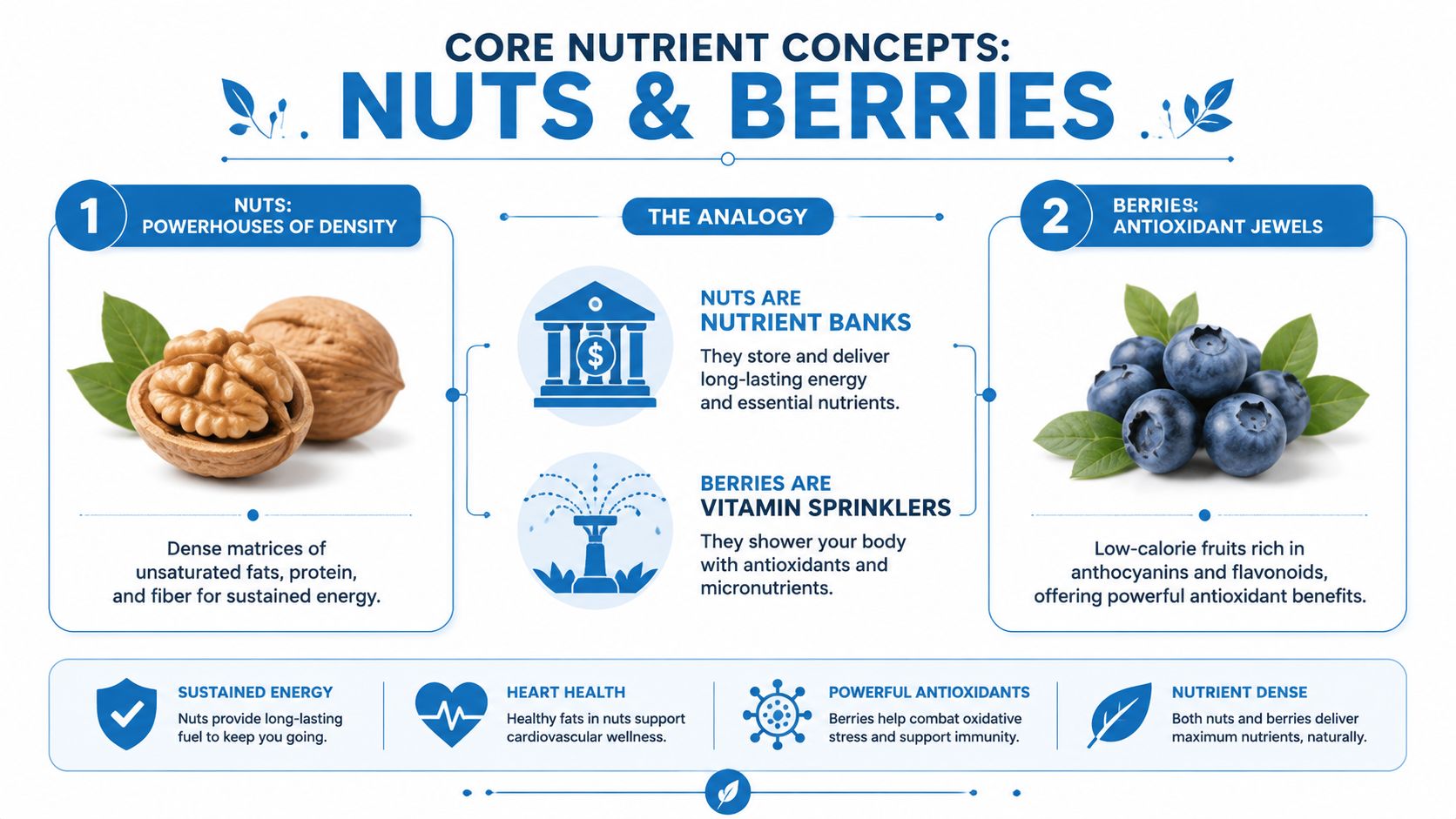
A useful way to compare nuts and berries is to place them side by side and ask what each one contributes first. Nuts are lipid-protein matrices, which means they are dense packages of fats, protein, and fiber. A broad review found that nut fat commonly ranges from 43.9% to 78.8% of weight, with unsaturated fats making up 31.6% to 62.4%, while carbohydrate stays relatively low at 11.7% to 30.2% and protein ranges from 7.9% to 25.8% PMC review on nut composition. That nutrient pattern explains why nuts behave like a compact fuel reserve.
Berries work differently. They are not known first for macronutrients. Their value comes from anthocyanins and other flavonoids, which help explain their antioxidant and anti-inflammatory reputation berry phytochemical review. If nuts act like a packed pantry shelf, berries act more like a basket of protective compounds, light in structure but rich in plant chemistry.
Why those differences matter in daily eating
Those structural differences change how each food feels at the table. Nuts tend to slow the pace of a snack because fat, fiber, and protein support fullness and a lower glycemic impact. Berries offer volume and flavor with a much lighter macronutrient load, so they are easy to add to meals without making them feel heavy.
The simplest way to remember it is this. Nuts steady the meal, berries brighten it. A snack that only uses nuts may feel satisfying but dense. A bowl of berries alone may feel fresh but not lasting. Together, they give two different kinds of support in one serving.
Practical pairing: combine a small portion of nuts with berries when you want both satisfaction and a food that still feels fresh.
For readers who want a broader mineral reference point, this minerals guide can help connect food choices to broader nutrient patterns.
Comparing Nutritional Profiles of Common Nuts and Berries
A side-by-side look makes the differences obvious. Almonds, walnuts, and pistachios are all energy-dense, but they don't contribute nutrients in the same way. Blueberries, strawberries, and raspberries are much lighter in calories and lean more on plant compounds and hydration support.
| Food | Typical strength | What stands out |
|---|---|---|
| Almonds | Satiety and crunch | Protein, fiber, unsaturated fats |
| Walnuts | Richer fat profile | Dense texture, strong flavor |
| Pistachios | Balanced snack feel | Protein, fiber, easy portioning |
| Blueberries | Fresh, versatile fruit | Polyphenol-rich profile |
| Strawberries | Light and bright | High perceived volume, easy mixing |
| Raspberries | Fiber-forward fruit | Strong tartness, strong texture |
The sharpest contrast is between a small handful of nuts and a berry portion. Nuts deliver more fat, protein, and staying power. Berries deliver more volume for fewer calories and a very different antioxidant profile. That's why they're used differently in practice, even when both are labeled “healthy.”
For example, almonds and pistachios often work better when you need a snack that bridges meals. Blueberries and strawberries fit well when you want to top yogurt, fold into oatmeal, or balance a richer breakfast. Raspberries are especially useful when you want fruit character without making the dish overly sweet.
How to choose by goal
If your goal is energy stability, nuts usually come first. If your goal is adding freshness, color, and plant compounds, berries do more of the heavy lifting. If your goal is a snack that feels complete without being complicated, combine them.
The comparison also helps with mindset. People often think they need to choose one “superfood.” In reality, these foods solve different problems. Nuts keep a snack from being too light. Berries keep a plate from feeling too dense.
This omega-3 fish oil category is a helpful reminder that nut and berry discussions usually sit inside a larger heart-health pattern, not a one-food rule.
Evidence Based Health Benefits of Nuts and Berries
The health evidence for nuts and berries points in different directions, and that difference is useful. Nuts are the denser food, built around fat and protein. Berries are the lighter food, packed with color, water, and plant compounds. Put side by side, they do different jobs in a diet, which is why the most useful articles explain them as complements rather than substitutes.
The strongest case for nuts comes from cardiovascular research. A review of cohort and meta-analytic evidence reported that 28 g/day of nuts versus no nuts was associated with a 21% relative risk reduction in cardiovascular disease, an 11% reduction in cancer deaths, and a 22% reduction in all-cause mortality PMC review on nuts. That same review also described a dose-response pattern, with the most efficient benefit range around 15 to 40 g/day and limited added protection beyond about 28 g/day PMC review on nuts.
Why nuts keep showing up in heart-health discussions
That pattern makes sense once you look at what nuts contain. Nuts are rich in unsaturated fats, and those fats help explain why nut intake consistently lowers LDL-C in intervention studies PMC composition review. They also tend to replace snacks that are lower in fiber and less filling, so the practical effect is not just about nutrients on paper. It is also about what people eat instead.
Berries bring a different kind of support. A 2017 systematic review found that eating 100 g of berries daily was linked to an 8% decrease in all-cause mortality berry review summary. Other reviews summarized improvements in glycemic and lipid profiles, along with reductions in total cholesterol, LDL cholesterol, triglycerides, and blood pressure berry phytochemical review.
What the body is actually responding to
Berries' effects are usually discussed through their polyphenols, not only through their sugar content. Their anthocyanins and flavonoids are tied to oxidative stress and vascular function, which is why berries are often described as supporting blood vessel health rather than just serving as “healthy fruit” berry phytochemical review. That helps explain why a handful of berries can change the nutritional character of a meal so quickly. They add plant compounds and freshness without making the plate feel heavy.
Nuts and berries also appear in cognition discussions, but the evidence is still more promising than conclusive PubMed review on cognition. For readers trying to use the evidence in real life, the simplest conclusion is straightforward. Nuts bring the stronger long-term cardiovascular signal. Berries bring a strong metabolic and vascular signal, plus a growing mortality association. Together, they support a diet pattern that is practical, varied, and easy to repeat.
Portion Guidelines and Allergy Considerations
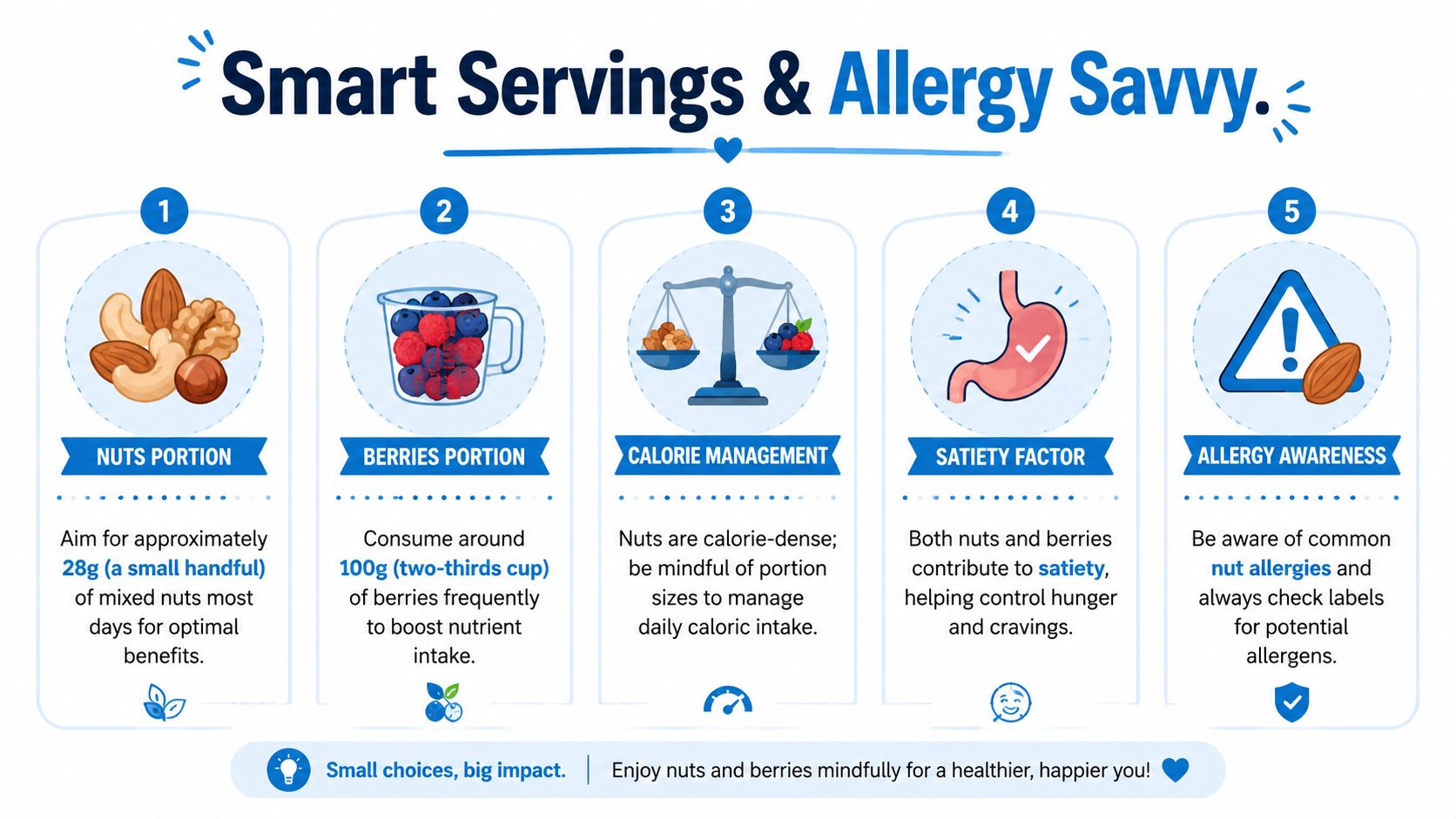
A practical starting point is about 28 g of nuts, which is a small handful, and about 100 g of berries, which is roughly two-thirds of a cup. Those amounts give people a useful serving without turning a snack into a meal. They also make it easier to keep the foods in the diet regularly instead of treating them like occasional add-ons.
The weight myth around nuts
People still assume nuts must cause weight gain because they're calorie-dense. The more accurate view is that nuts can fit into weight management when they replace less healthy snacks, and higher intake has been associated with lower body weight in guideline summaries Better Health guidance on nuts and seeds. The trap is not nuts themselves. It's eating them on top of everything else.
Practical rule: portion nuts first, then decide whether you still need something else.
Safety checks that matter
Nut allergies are real and sometimes severe, so label reading matters. People with a known allergy should treat mixed snack bags, granolas, and dessert toppings carefully because cross-contact is common. Seeds and seed butters can be useful alternatives for some households, but anyone with a history of food allergy should choose them with the same label discipline.
Berries are generally simpler from an allergy standpoint, but freshness matters. If fruit is soft, leaky, or visibly moldy, it's time to discard it. The goal is not to fear these foods. The goal is to use them with enough care that they stay helpful, not risky.
Storage and Preparation for Freshness
Nuts last better when they're treated like pantry staples that dislike heat, light, and air. An airtight container helps preserve flavor, and a cool, dark cabinet is better than leaving an opened bag near the stove. If you buy nuts in bulk, dividing them into smaller containers can reduce how often the whole batch is exposed to air.
Berries need the opposite kind of attention. They're delicate, moisture-sensitive, and easy to bruise. Keep them dry until use, refrigerate them promptly, and sort through the container before storage so one spoiled berry doesn't spread quickly to the rest.
Easy prep habits that save time
Roasting nuts lightly with spices can make them feel new again. Cinnamon, paprika, or rosemary works well when you want savory or sweet without added sugar. For berries, a short maceration, just letting them sit briefly with their own juice, can deepen flavor without complicated prep.
Frozen berries are especially useful when you want convenience. They blend well into smoothies and breakfast bowls, and they remove the pressure of using fruit before it spoils. Nuts can do the same in another way, because they're shelf-stable enough to keep in a jar for quick toppings.
Freshness check: if nuts smell bitter, paint-like, or stale, they've likely gone rancid. If berries look mushy or fuzzy, don't salvage them.
That simple habit keeps texture, flavor, and trust intact. Food tastes better when it's fresh, and people are more likely to keep eating it when it consistently tastes good.
Creative Ways to Use Nuts and Berries Daily
Start with breakfast if you want this to stick. A smoothie bowl with almond butter, frozen mixed berries, and a topping of chopped walnuts gives you creaminess, color, and crunch in one bowl. If you want a lighter version, use berries as the main fruit and let the nut butter act as the anchor.
Another easy move is yogurt parfaits. Layer plain yogurt, fresh berries, and a spoonful of chopped pistachios or granola. The berries cut the richness, and the nuts keep the texture interesting. A similar logic works in chia pudding with nut milk and a berry compote, which feels dessert-like without needing a separate treat.
Recipes that work in real kitchens
- Energy bites: mix walnuts, oats, chopped dates, and a little nut butter, then roll into small balls. They travel well and work best when chilled.
- Savory salad topping: add pistachios and raspberries to leafy greens with cucumbers and a simple vinaigrette. The fruit brings acidity, while the nuts add crunch.
- Trail mix: combine almonds, walnuts, pistachios, and a small amount of dried berries for a desk snack that's easy to portion.
- Spiced nut mix: toss mixed nuts with smoked paprika, cumin, or cinnamon, then toast briefly for stronger aroma.
- Berry coulis: simmer frozen berries until they break down, then spoon over oats, pancakes, or nut-based desserts.
One of the best pairings is nuts with fruit in a texture contrast. Creamy plus crisp. Tart plus rich. That contrast makes the food more satisfying, which is often what makes healthy habits repeatable.
The video below is useful if you want more visual recipe ideas after you've got the basic combinations down.
A final kitchen trick is to think in layers. Put nuts on top for crunch, berries in the middle for brightness, and a creamy base underneath. That structure works for breakfasts, snacks, and even simple desserts.
Conclusion Integrating Nuts and Berries into Your Routine
Nuts give you density, staying power, and a strong cardiovascular research signal. Berries give you phytochemical richness, color, and a lighter metabolic lift. The easiest routine is simple, use sensible portions, keep them fresh, and pair them when you want a snack that feels complete instead of random.
Track how you feel for a week after using them in different ways. Notice which combinations help with cravings, energy, and mood. Then keep the pairings that fit your real life, not the ones that only look good in a recipe photo.
If you're ready to turn these food ideas into a steady wellness habit, visit CalVitamin and build a routine that feels practical enough to repeat.






