
Vitamin D3 isn't the same as vitamin D overall. It's one of the two main forms of vitamin D, and D3 is generally the more effective choice for raising and maintaining blood levels.
That answer challenges the most popular shortcut in the supplement aisle: treating every bottle labeled “vitamin D” as interchangeable with every bottle labeled “vitamin D3.” The labels overlap, but they don't always identify the same form, source, or practical choice.
A bottle labeled vitamin D may contain D2 or D3. A bottle labeled vitamin D3 identifies cholecalciferol. Both forms can support the body, yet D3 may raise blood vitamin D higher and keep it high longer than D2. The difference matters when you're comparing products, following a dietary preference, or deciding whether a supplement is appropriate at all.
This isn't an argument for taking the largest dose available or ordering a blood test because a product page recommends one. More D3 and more testing aren't automatically better. The useful question is more specific: Which form is in the product, where did it come from, how much does it provide, and do you have a reason to take it?
Table of Contents
- Why the D3 and Vitamin D Question Matters
- What Vitamin D Means as a Family
- How D2 and D3 Differ in Origin and Chemistry
- The Conversion Pathway From D2 or D3 to Active Hormone
- Reading a Vitamin D Label Like a Pro
- The Case Against Mega-Doses and Routine Testing
- When D3 Is the Right Pick and When It Is Not
- Vitamin D Questions Shoppers Actually Ask
Why the D3 and Vitamin D Question Matters
“Vitamin D” and “vitamin D3” are related labels, not interchangeable names. Vitamin D is the family; D3 is one member, alongside D2. Both are recognized sources of vitamin D by the U.S. National Institutes of Health.
That distinction matters when two bottles look nearly identical. One may contain cholecalciferol, the chemical name for D3, while another contains ergocalciferol, the name for D2. Even products containing D3 can differ in origin. Some use lanolin, while others use lichen. The large dose printed on the front may distract from the form and source listed in smaller text.
The practical difference for shoppers
Read every label as four separate questions:
- Which form? Look for D2, ergocalciferol, D3, or cholecalciferol.
- How much? Check the amount in International Units and micrograms.
- What source? D3 may come from lanolin or lichen.
- Does the product fit your diet? Check for vegan, halal, gelatin-free, or other relevant certifications.
The NIH notes that D3 may raise blood concentrations more and keep them higher longer than D2. That difference can guide a product comparison, but it does not make D2 pointless or mean everyone needs D3. A bottle labeled only “vitamin D” leaves too much unanswered to judge whether two products are equivalent.
Practical rule: Treat “vitamin D” as a family name. Check the specific form and source before choosing between products.
This guidance concerns ordinary supplements and everyday label decisions, not medical treatment. People with symptoms, deficiency risks, calcium or phosphate disorders, malabsorption concerns, or a prescribed regimen should involve a healthcare professional. Avoid choosing a product solely because it offers a larger dose.
What Vitamin D Means as a Family
Vitamin D is an umbrella term for a family of fat-soluble secosteroid compounds. The technical name matters less than the category: “vitamin D” is the broad family, while D2 and D3 are the forms most often found in supplements and fortified foods.
A vehicle analogy helps. A sedan and a truck both belong to the vehicle family, but they are not interchangeable in every situation. D2 and D3 likewise share the vitamin D name while differing in chemical structure and common sources.
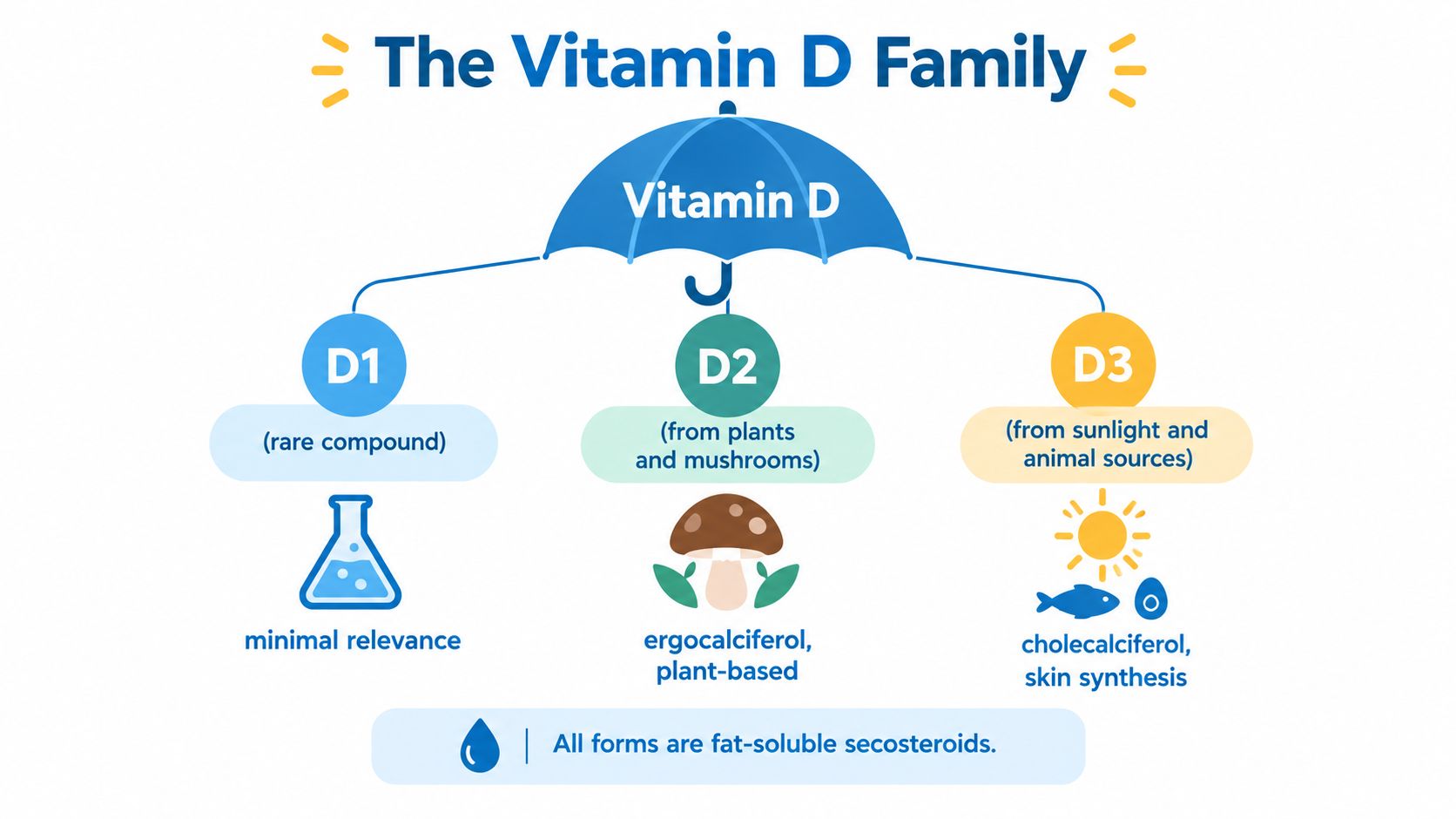
The two forms you'll see most often
Vitamin D2, also called ergocalciferol, is linked mainly with plant and fungal sources. Vitamin D3, or cholecalciferol, forms naturally in human skin after ultraviolet B exposure and also occurs in animal-derived foods. Both forms are absorbed in the small intestine, then converted inside the body into vitamin D metabolites.
Labels may show either the short form or the chemical name. “Vitamin D3” and “cholecalciferol” identify the same form. “Vitamin D2” and “ergocalciferol” identify the other principal form. This vocabulary is useful when comparing products, because a label that says only “vitamin D” does not identify which form it contains.
Understanding the units
Vitamin D labels commonly use International Units, written as IU, and micrograms, written as mcg or µg. The conversion is fixed: 1 microgram equals 40 IU. Check both units when comparing bottles, especially when one product highlights IU and another highlights micrograms.
For adults ages 19 through 70, the recommended daily intake is 600 IU, or 15 micrograms. For adults aged 71 and older, it is 800 IU, or 20 micrograms. These figures describe recommended intake, not an individual prescription. Food, sunlight, medications, and health history can all affect what is appropriate.
Once vitamin D is understood as a family, label reading becomes simpler. “Vitamin D” names the category, while “D2” or “D3” identifies the member in the capsule, drop, gummy, or fortified food.
How D2 and D3 Differ in Origin and Chemistry
D2 and D3 aren't just two names for the same molecule. They have different side-chain structures, which means they're chemically distinct even though the body uses both as vitamin D sources.
D3 is made in human skin when ultraviolet B radiation converts 7-dehydrocholesterol. It's also associated with animal-derived foods and with supplements made from animal or lichen sources. D2 is produced from ergosterol found in fungi and yeast, often through ultraviolet treatment. These origins explain why D2 has traditionally been attractive to people seeking a plant or fungal source.

Why the chemistry matters without becoming a chemistry lesson
The side-chain difference doesn't mean that one form is active and the other is inactive. Both D2 and D3 are absorbed, and both enter the body's vitamin D processing pathway. The more relevant consumer distinction is how each form behaves in the bloodstream after intake.
The NIH recognizes both forms as legitimate contributors to vitamin D status, while noting that D3 may raise blood concentrations higher and maintain them longer than D2. That's why D3 often becomes the default comparison point for an everyday over-the-counter supplement, while D2 can still be appropriate in particular products or clinical plans.
Sourcing is part of the decision
“D3” alone doesn't answer whether a product fits your ethics or dietary requirements. Many D3 supplements use lanolin, a wax-like substance obtained from sheep's wool. Other products use lichen-derived D3, which provides an animal-free option for people following a vegan diet.
Check the product details rather than assuming. A vegan label, source statement, or certification can tell you more than the D3 designation itself. Likewise, shoppers who avoid gelatin or need halal products should inspect the capsule ingredients and certification information separately from the vitamin form.
The result is a more useful way to compare products: D2 versus D3 describes the molecule, while lanolin versus lichen describes the source. Those are related questions, but they aren't the same question.
The Conversion Pathway From D2 or D3 to Active Hormone
Neither D2 nor D3 is the finished hormone used directly by the body. Both are prohormones, so the body processes them through chemical steps before they become biologically active.
The pathway works like a two-stage factory. First, the liver converts D2 or D3 into 25-hydroxyvitamin D, also called 25(OH)D or calcidiol. This is the main circulating form and the marker measured in a standard vitamin D blood test.
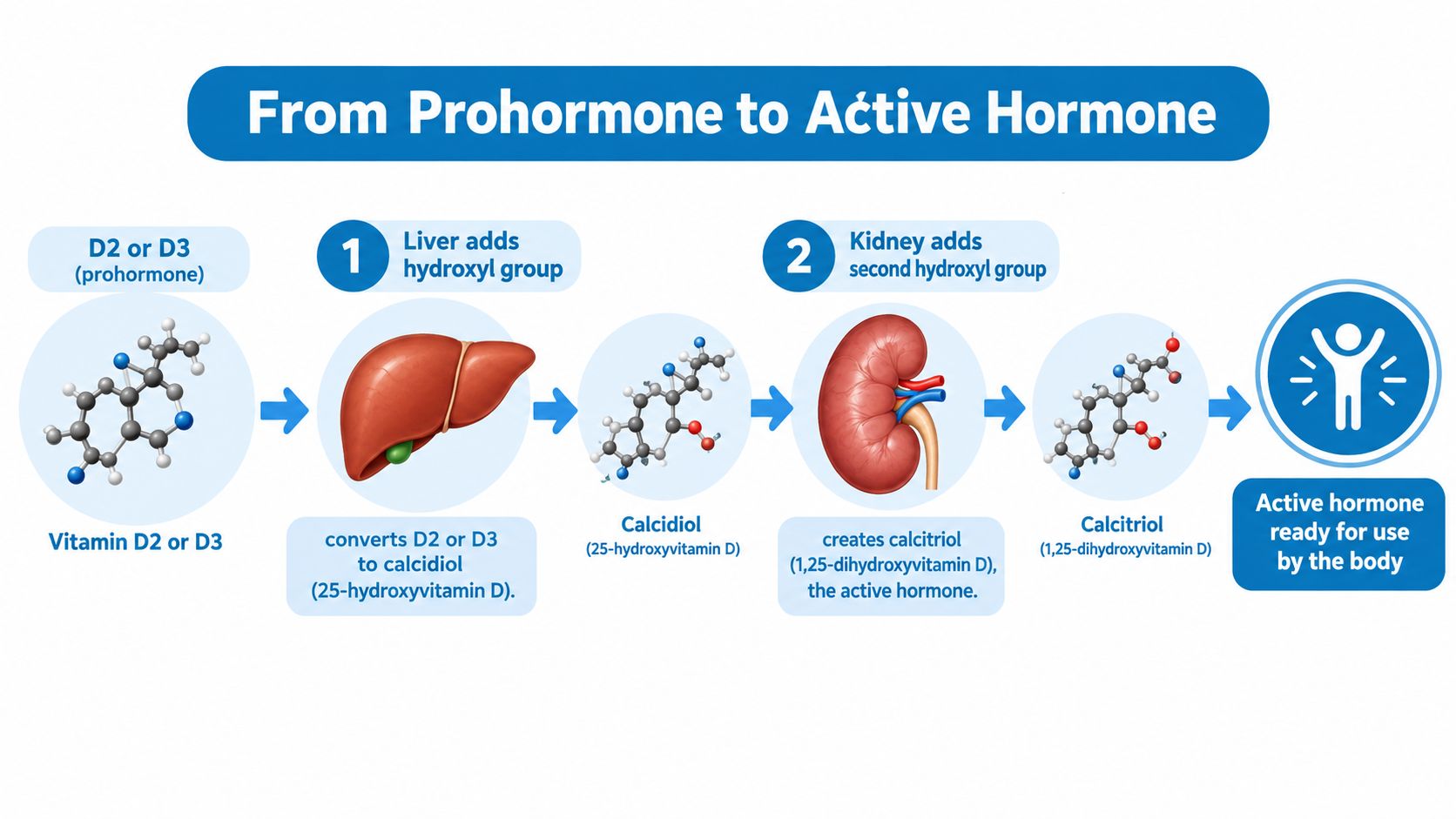
The kidneys, together with some other tissues, perform the second conversion. They turn 25(OH)D into 1,25-dihydroxyvitamin D, or calcitriol. Calcitriol is the active form that helps regulate calcium and phosphate.
Why the same blood marker applies to both forms
D2 and D3 enter the same broad conversion pathway, so clinicians assess vitamin D status by measuring serum 25(OH)D, regardless of which form someone consumed. The test measures the circulating metabolite produced after processing, not the label claim on the bottle.
That distinction keeps the D2 versus D3 question in proportion. The practical difference concerns blood concentration and persistence, rather than one form becoming an entirely different type of hormone. Used appropriately, both can support calcium regulation and help prevent or treat nutritional rickets.
The NIH explanation of vitamin D metabolism describes D2 and D3 as prohormones processed by the liver and kidneys into circulating and active metabolites. The label identifies the starting form, while the body's conversion pathway determines how it becomes active.
“Active vitamin D” can still cause confusion. Ordinary D2 and D3 supplements differ from prescription products containing an already active vitamin D compound. If a clinician prescribed one of those products, ask before substituting an over-the-counter D3 capsule.
Reading a Vitamin D Label Like a Pro
A vitamin D label should answer more than “how many IU?” Start with the form, then check the source, dose, serving format, and relevant certifications. This approach works whether you're looking at a capsule, a gummy, liquid drops, or a softgel.

Four questions to ask before buying
First, identify the form. “Vitamin D3” or “cholecalciferol” means the product contains D3. A label that says only “vitamin D” may contain D2 or D3, so look at the Supplement Facts panel or product description for the chemical name.
Second, translate the dose. Labels may show IU, micrograms, or both. Since 1 microgram equals 40 IU, you can compare products even when they use different units. Don't compare the front-panel number alone. Check the serving size and whether the listed amount applies to one capsule, several gummies, or a measured amount of liquid.
Third, find the source. D3 may be made from lanolin or lichen. If you're vegan, don't assume D3 is automatically unsuitable or automatically vegan. Look for a clear lichen source and an appropriate vegan statement.
Fourth, inspect the delivery format and certifications. Capsules, veggie capsules, liquid drops, gummies, and softgels suit different routines. Gelatin-free, halal, and vegan claims can matter as much as the vitamin form for some shoppers.
CalVitamin product pages can be one place to compare supplement formats and labeled attributes, while its guide to vitamin D supplements provides additional shopping context. The important habit is to compare the effective serving, not just the sticker price.
Price needs context
An “As low as” price may reflect quantity-based pricing or a promotion. That figure doesn't automatically tell you the cost per serving. Divide the actual purchase price by the number of servings, then compare products with the same form and a similar dose.
A cheaper bottle may use more capsules per serving, while a higher-priced bottle may contain a longer supply. Gummies may also include added ingredients that aren't relevant to your goal. The most useful comparison is form, source, dose, servings, and certifications in that order.
Label-reading shortcut: If you can't identify the form, source, serving size, and total servings within a minute, the product page hasn't answered the questions you need answered yet.
The Case Against Mega-Doses and Routine Testing
Vitamin D advice often swings between two extremes: test everyone, or take a very large dose just in case. Neither approach fits average-risk, asymptomatic adults well.
A 2025 review of 31 clinical guidelines found that none recommended routine vitamin D screening for the general adult population. The guideline review summary describes a more targeted approach, with testing considered for people who have relevant symptoms, deficiency risk factors, disorders involving calcium or phosphate, or suspected toxicity.
Why a bigger dose isn't automatically safer
The NIH identifies 4,000 IU, or 100 micrograms, per day as the adult tolerable upper intake level. That isn't a target. It's an upper boundary for daily intake from supplements and other sources, and a clinician may use a different short-term plan when treating a documented problem.
Excessive supplemental intake can lead to hypercalcemia and complications such as kidney stones, arrhythmias, and kidney failure. Very high blood levels can also cause nausea, weakness, confusion, dehydration, excessive thirst, and excessive urination. The NIH considers blood concentrations above 375 nanomoles per liter, or 150 nanograms per milliliter, capable of producing toxicity symptoms, while levels below 30 nanomoles per liter, or 12 nanograms per milliliter, are too low and may impair health. Typical bone and general health are considered adequately supported at or above 50 nanomoles per liter, or 20 nanograms per milliliter, according to clinical guidance from Mayo Clinic Proceedings00244-X/fulltext).
Use a risk-based decision rule
Testing deserves more attention when a person has symptoms, a known risk factor for deficiency, a condition affecting absorption, a disorder of calcium or phosphate metabolism, or a reason to suspect toxicity. A clinician may also want testing when a person is using a medically supervised high-dose regimen.
For an average-risk adult without symptoms, routine screening isn't automatically useful. Taking extra D3 “for insurance” can be counterproductive, particularly when the person also takes calcium supplements. Ask a clinician or pharmacist to review the complete regimen rather than treating each bottle as an isolated product.
The same caution applies when combining products. A multivitamin, calcium formula, prescription treatment, and standalone D3 product can all contribute to total intake. The discussion of zinc and vitamin D is a useful reminder to consider supplements as a complete routine, not as unrelated purchases.
When D3 Is the Right Pick and When It Is Not
For an adult who needs an over-the-counter vitamin D supplement and has no clinician-directed reason to choose another form, D3 is usually the practical default. The NIH notes that D3 may raise blood vitamin D higher and maintain it longer than D2.
That recommendation still has boundaries. A vegan shopper may choose lichen-derived D3. Someone following a clinician-prescribed D2 plan shouldn't switch forms independently. A healthcare professional may also prefer one form because of a specific condition, treatment plan, or follow-up testing.
| Attribute | Vitamin D2 | Vitamin D3 |
|---|---|---|
| Chemical name | Ergocalciferol | Cholecalciferol |
| Common association | Plants, fungi, and yeast | Human skin, animal sources, lanolin, or lichen |
| Body pathway | Converted to 25(OH)D and then active vitamin D metabolites | Converted to 25(OH)D and then active vitamin D metabolites |
| Blood-level pattern | Raises vitamin D levels | May raise levels higher and maintain them longer |
| Dietary choice | Often suitable for plant-focused shoppers | Vegan option exists when sourced from lichen |
Bottle size also needs realistic math. A 60-softgel bottle lasts 60 days at one softgel daily, whether the softgel provides 1,000 IU or 2,000 IU. The IU amount changes the dose, not the number of days in the bottle. Compare the cost per serving and the dose you need, rather than choosing the lowest front-panel price.
If you're considering a combination product, read the formula carefully. The discussion of D3 with K2 can help you identify why shoppers should evaluate every added ingredient instead of assuming that a larger formula is automatically more suitable.
Ask your clinician:
- Do I have a reason to test my vitamin D level?
- Should I count vitamin D from my multivitamin and calcium product?
- Is D3 appropriate for my health history and medications?
- Do I need follow-up testing if I use a high-dose regimen?
Vitamin D Questions Shoppers Actually Ask
Is D3 safe during pregnancy? Vitamin D needs during pregnancy should be discussed with an obstetric clinician, especially if you're considering a dose above the amount in a prenatal supplement. Don't add a high-dose product without reviewing the full regimen.
Can D3 interact with calcium or magnesium? Calcium deserves particular attention because excessive vitamin D can increase calcium absorption. Review combined products with a pharmacist or clinician, especially if you use a calcium supplement or have kidney concerns.
Do gummies work as well as capsules? The form of the delivery product doesn't answer that by itself. Compare the listed vitamin D form, serving size, dose, and added ingredients.
How long does a bottle last? Divide the number of servings by the number you take daily. A 60-serving bottle lasts 60 days when used once daily.
How is vegan D3 made? Vegan D3 can be sourced from lichen. Check the product's source statement and certification rather than assuming every D3 product uses the same raw material.
If you have symptoms, a diagnosed condition, a prescribed vitamin D regimen, or questions about combining supplements, get individualized advice before changing your dose.
CalVitamin offers vitamin, mineral, and wellness products in formats such as capsules, liquid products, and gummies, with labeled attributes available on select items. Visit CalVitamin to compare vitamin D options by form, serving details, source information, and dietary preferences.