

The best magnesium supplement for sleep is the one you tolerate at a labeled, moderate elemental dose. The evidence does not crown a single winner, and no head-to-head trial has proven one form beats the rest.
Most of the popular advice gets this backward. People chase glycinate, threonate, or citrate like the label alone decides the result, when the decisive factor comes down to elemental magnesium, digestive comfort, and whether your body needs supplementation in the first place.
Table of Contents
- Why the Best Form Question Is the Wrong Question
- How Magnesium Actually Supports Sleep
- Comparing Glycinate, Citrate, Threonate, Oxide and Malate
- What the Clinical Evidence Actually Shows
- Dosing, Timing and a Safety Self-Check
- How to Read a Magnesium Label Like a Clinician
- Choosing the Best Option for Your Situation
- Common Questions About Magnesium and Sleep
Why the Best Form Question Is the Wrong Question
The phrase best magnesium supplement for sleep sounds precise, but it hides the underlying issue. Most shoppers want a neat ranking of magnesium glycinate, citrate, threonate, oxide, and malate. The problem is simple, no eligible trial has directly compared the common forms in a way that lets anyone declare a universal winner.
That leaves a lot of marketing noise and not much clinical truth. A systematic review found inconsistent results across randomized trials, and the overall certainty was low or very low. Some trials reported benefit with different forms, others didn't, and the differences were tangled up with dose, study quality, participant characteristics, and treatment length (systematic review).
What Actually Matters More Than the Salt Name
The practical question is not, “Which chelate is magic?” It's, “Which form can you take consistently without stomach drama, at a dose that makes sense, without stacking three other magnesium products on top of it?”
Practical rule: pick the form you can stick with, then judge it by your sleep, your gut, and the label, not by the front-of-bottle hype.
That's especially important because the evidence is strongest for a modest effect on sleep onset, not for knocking everyone out or fixing chronic insomnia. If a brand spends more time bragging about a trendy form than explaining elemental magnesium per serving, that's a sales pitch, not a sleep strategy.
The rest of this article cuts through that noise. You'll get a clear framework for choosing a form, reading the label, screening for risk, and deciding when magnesium is a reasonable experiment versus when it's the wrong tool altogether.
How Magnesium Actually Supports Sleep
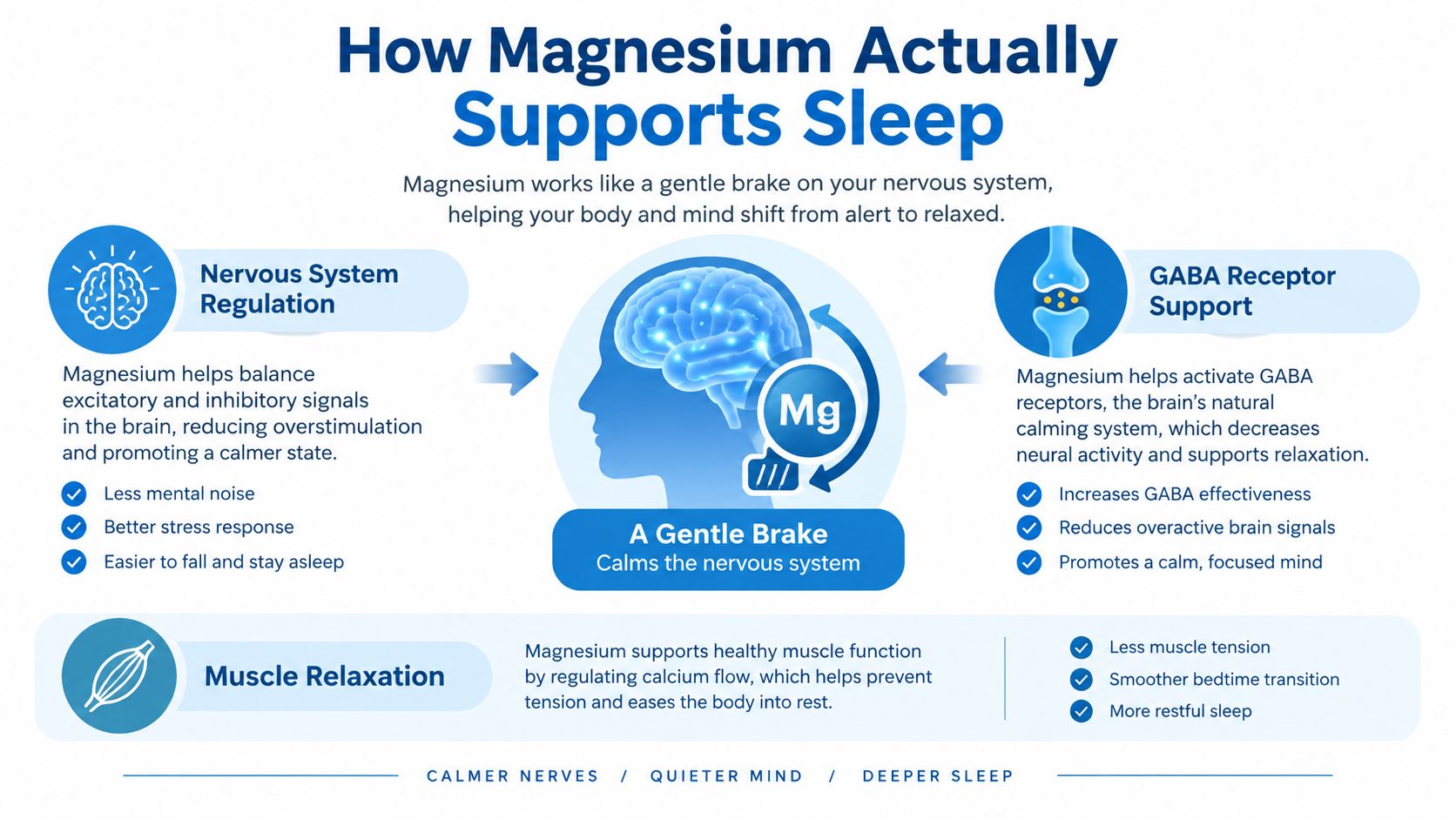
Magnesium acts more like a gentle brake than a sleeping pill. It helps steady the nervous system, which matters most when your brain feels “on” after the lights go out.
The nervous system piece
A simple way to think about it is this. Your brain has gas pedals and brakes. Magnesium helps reduce the pressure on the gas side by supporting the balance between excitatory signaling and calming pathways, including GABA and NMDA activity. That shift doesn't force sleep, it makes it easier for sleep to happen.
It also fits with the body's rest-and-digest mode. When magnesium supports parasympathetic activity, your system is less stuck in alert mode and more willing to downshift. That's why people usually care about magnesium at bedtime, not because it sedates them, but because it may help the body stop resisting rest.
Why form and timing still matter
Mechanism alone doesn't justify a premium price. Two products can both say “magnesium” and still behave differently in practice because one is easier on the stomach or delivers a different elemental amount per capsule. That's why some people do better with a gentler form at night, while others want a form that fits a digestive need as well.
Timing matters for the same reason. If the goal is sleep onset, a bedtime routine makes more sense than random daytime use. But the true value isn't the clock, it's whether the product gets absorbed, stays tolerable, and fits your situation without creating a new problem.
Comparing Glycinate, Citrate, Threonate, Oxide and Malate
The fastest way to choose is to stop asking which one is “best” in the abstract. Ask what each form is better suited for in practice.
| Form | Tolerability | Elemental Mg per dose | Sleep evidence signal | Typical price tier |
|---|---|---|---|---|
| Magnesium glycinate | Usually gentler on the gut | Varies by product | Reasonable, often chosen for sleep routines | Mid to higher |
| Magnesium citrate | More likely to loosen stools | Varies by product | Reasonable, especially if constipation is also a concern | Lower to mid |
| Magnesium threonate | Often marketed for cognition | Varies by product | No clear sleep-specific winner | Higher |
| Magnesium oxide | Often cheaper, more likely to bother digestion | Varies by product | Weak choice for sleep marketing claims | Lower |
| Magnesium malate | Usually a middle-ground option | Varies by product | Sleep-specific evidence is limited | Mid |
What each form is actually good for
Glycinate is the default pick when stomach sensitivity matters. It's the form people reach for when they want something calm, straightforward, and less likely to turn bedtime into a bathroom issue.
Citrate makes more sense if constipation is part of the picture. That's not a sleep-efficacy advantage, it's a tolerability and digestive-use case.
Threonate gets sold with brainy language, but the sleep claim is mostly marketing gloss unless your product search is really about cognitive positioning. If you're comparing it for sleep alone, don't pay for the halo effect.
Oxide usually belongs in budget conversations, not premium sleep conversations. It can make sense in some formulas, but it's not the form I'd buy because a label calls it “relaxing.”
Malate sits in the middle. It's a practical option when you want a form that isn't hyped as much as glycinate or threonate, and you care more about a tolerable routine than a fancy story.
If you're looking at a threonate product, this CalVitamin magnesium L-threonate listing is a useful example of how brands position that form around cognition rather than sleep.
Bottom line: choose the form that matches your gut, budget, and routine. Don't pay more for a sleep promise the evidence hasn't actually earned.
What the Clinical Evidence Actually Shows
The human evidence supports a modest sleep-onset benefit, not a dramatic insomnia treatment. A 2021 meta-analysis examined 3 randomized controlled trials involving 151 older adults across 3 countries. Compared with placebo, magnesium reduced the time needed to fall asleep by an average of 17.36 minutes, with a 95% confidence interval of 7.44 to 27.27 minutes and a p-value of 0.0006.
That finding gives magnesium a defensible role for people whose main problem is falling asleep. It does not establish that supplementation routinely treats insomnia or show that one form works better than all others.
What the evidence did not prove
The pooled analysis also found an increase of about 16.06 minutes in total sleep time, but the change was not statistically significant. A person may fall asleep faster yet still not see enough change to call the product a real solution.
A separate systematic review covering 7,582 participants across 9 observational, cohort, and randomized studies found that observational research connected magnesium status with several sleep measures, while randomized trials produced contradictory results. Magnesium status and poor sleep may occur together, but that association does not show that capsules will correct the sleep problem.

The practical conclusion is clear. Magnesium is a reasonable, evidence-aware option for some adults who mainly struggle to fall asleep, particularly when intake may be low and the chosen form is easy to tolerate. The trials do not justify claims that a premium chelate cures insomnia, and they do not settle the form question on their own.
Dosing, Timing and a Safety Self-Check
Start with your total daily intake, not a bedtime ritual. The NIH magnesium fact sheet lists adult recommended magnesium intakes from 310 to 420 mg, depending on age, sex, and life stage. Those totals include magnesium from food and supplements. For magnesium from supplements and medications, the tolerable upper intake level is 350 mg per day, excluding magnesium naturally present in food.
That distinction matters in practice. A bottle may seem modest alone, while a multivitamin, antacid, or laxative adds more magnesium to the same day.
A sensible bedtime protocol
For sleep, choose a moderate elemental dose in the evening, often 30 to 60 minutes before bed. A larger serving does not guarantee better sleep. It can make side effects more likely and complicate your overall intake.
Run this self-check before starting:
- Kidney disease: toxicity becomes more concerning when the kidneys cannot clear excess magnesium effectively.
- Medication stacking: check bisphosphonates, diuretics, magnesium-containing laxatives, and antacids.
- Pregnancy or complex medical care: ask a clinician before adding a nightly supplement.
- Persistent insomnia: do not keep increasing magnesium when sleep problems are chronic or unexplained.
What side effects should stop you
The same NIH fact sheet warns that excessive supplemental magnesium commonly causes diarrhea, nausea, and abdominal cramping. Extremely high intakes can produce serious cardiovascular effects, including irregular heartbeat and cardiac arrest. This is why dose discipline matters.
A historical trial in elderly participants used 500 mg daily for 8 weeks, and only 43 of the original 46 participants completed it. That study dose should not become a routine self-care target. Stop or reduce the supplement if gastrointestinal symptoms appear, and seek medical advice for severe symptoms or concerning heart-related effects.
How to Read a Magnesium Label Like a Clinician
Most shoppers buy the front label and ignore the part that really matters. That's a mistake.
The number you want first is elemental magnesium, not the full compound weight. A capsule can look generous because the salt name sounds substantial, while the actual magnesium content is much smaller. If you don't separate those two, you can't compare products fairly.
The 60-second label drill
Start with the Supplement Facts panel and answer these questions in order:
- How much elemental magnesium per serving? That's the dose that matters.
- What is the form? Glycinate, citrate, malate, oxide, or threonate tells you more about fit than hype.
- What else is inside? Scan for caffeine, stimulant-style botanicals, or unnecessary add-ons that clash with sleep.
- Is there third-party testing? Clean testing language matters more than glossy wellness language.
- Does the serving fit your total day? If you already use multivitamins or other minerals, don't stack blindly.
A clean label at a moderate dose beats a fancy chelate with a noisy formula.
That's especially true when products are marketed as “buffered” or “chelated” like that alone proves sleep benefit. It doesn't. Those words may describe chemistry, but they don't replace evidence or common sense.
Here's a useful example. NOW Magnesium Glycinate is the kind of product many people reach for when they want a nighttime-friendly routine without a complicated formula. That doesn't make it magically superior, it just makes it easier to judge on label clarity and tolerability.
Choosing the Best Option for Your Situation
The right magnesium form depends on your body and situation, not the most impressive chelate name. Start with three practical questions: How sensitive is your stomach? What can you afford consistently? Could a medication or health condition change the choice?
Four common buyer profiles
- Sensitive sleeper: Try glycinate first if digestive comfort is your priority. It suits a calmer bedtime routine and is often easier to tolerate.
- Value buyer: Compare citrate with a straightforward glycinate product that clearly states elemental magnesium. A higher price is justified only when the formula fits your needs.
- Cognitive-priority buyer: Threonate may suit a brain-support shopping list better than a sleep-focused one. Keep those goals separate.
- Chronic-insomnia shopper: Use magnesium as a time-limited experiment, not the entire sleep plan. Persistent insomnia calls for proper evaluation, especially when breathing problems, restless legs, circadian disruption, or medication effects may be involved.
Your baseline status matters too. A person with low magnesium intake may notice more from correcting that gap than someone already meeting needs. Tolerability also determines whether a product becomes a consistent routine, so digestive effects deserve as much attention as absorption claims.
What magnesium cannot do
Sleep apnea, restless legs syndrome, and shift-work disruption need their own treatments. Ongoing sleep trouble can signal a problem that a mineral alone will not resolve.
Some retail formulas combine magnesium with melatonin, which makes label reading even more important. Convenience does not justify stacking several sleep ingredients without checking the amounts and possible interactions.
Pick the form your body tolerates, keep the dose moderate, and treat magnesium as one option, not a substitute for diagnosing a sleep disorder.
Common Questions About Magnesium and Sleep
Can you take magnesium with melatonin or valerian? Yes, many people do, but the smarter move is to keep the overall routine simple. If a stack turns into a pile of sedating ingredients, you won't know what helped and what caused next-day grogginess.
Should you take it with food? If your stomach is sensitive, yes, that often makes sense. If the product is well tolerated without food, consistency matters more than perfection.
How long should you try it before deciding it doesn't work? Give it enough time to test a real routine, not one random night. If sleep hasn't changed and your label literacy is solid, stop assuming the next bottle will magically do more.
Why does magnesium glycinate get marketed as calming? Part of that reputation comes from glycine, which is often paired with the magnesium in the chelate. That doesn't make the product bad, it just means the label story is doing more work than the evidence.
What should you do if sleep still doesn't improve? Don't keep buying stronger-looking products. Review medications, caffeine timing, pain, breathing problems, restless legs symptoms, and stress patterns with a clinician if the problem is ongoing.
For shoppers who want a pre-made blend instead of building a stack from scratch, the CalVitamin strawberry melatonin magnesium sleep gummies page is a simple example of how those formulas are presented online.
CalVitamin carries magnesium products and other sleep-support options in forms that make label comparison easier, including capsules, veggie capsules, gummies, and other supplement formats. If you want to compare magnesium products side by side and choose based on elemental dose, tolerability, and routine fit, visit CalVitamin and read the labels like your sleep depends on it.






