Pure MCT oil is a concentrated source of medium-chain triglycerides, typically dominated by caprylic acid (C8) and capric acid (C10). In a 2019 clinical trial, the tested oil contained approximately 54% C8 and 41% C10, while shorter and longer fatty acids made up only small proportions.
You're standing in a supplement aisle, comparing bottles marked “C8,” “100% MCT,” and “fractionated.” Each label sounds precise, but the word pure doesn't automatically tell you the ratio of fatty acids, the source oil, or how your body will respond.
Pure MCT oil differs from coconut oil because manufacturers concentrate specific fatty acids through fractionation. Coconut oil contains MCT-related fats, but these fats coexist with a substantial amount of lauric acid and other fatty acids. The useful question is not just whether a bottle says “pure.” It's which MCT fractions it contains, in what proportions, and whether that profile suits your purpose.
Table of Contents
- What Pure MCT Oil Actually Means
- The Four MCT Fractions and Why They Behave Differently
- Evidence-Based Benefits and What MCT Oil Does Not Do
- How to Choose a Quality Pure MCT Oil
- Dosing, Timing, and Real-World Usage Tips
- Side Effects, Safety, and Who Should Be Cautious
- Pure MCT Oil vs Coconut Oil, MCT Powder, and Other Fats
What Pure MCT Oil Actually Means
Start with the chemistry. Medium-chain triglycerides, or MCTs, are fats built from fatty-acid chains ranging from C6 to C12. The letter C refers to the number of carbon atoms in the chain. A shorter chain generally changes how the fat is absorbed, transported, and metabolized.
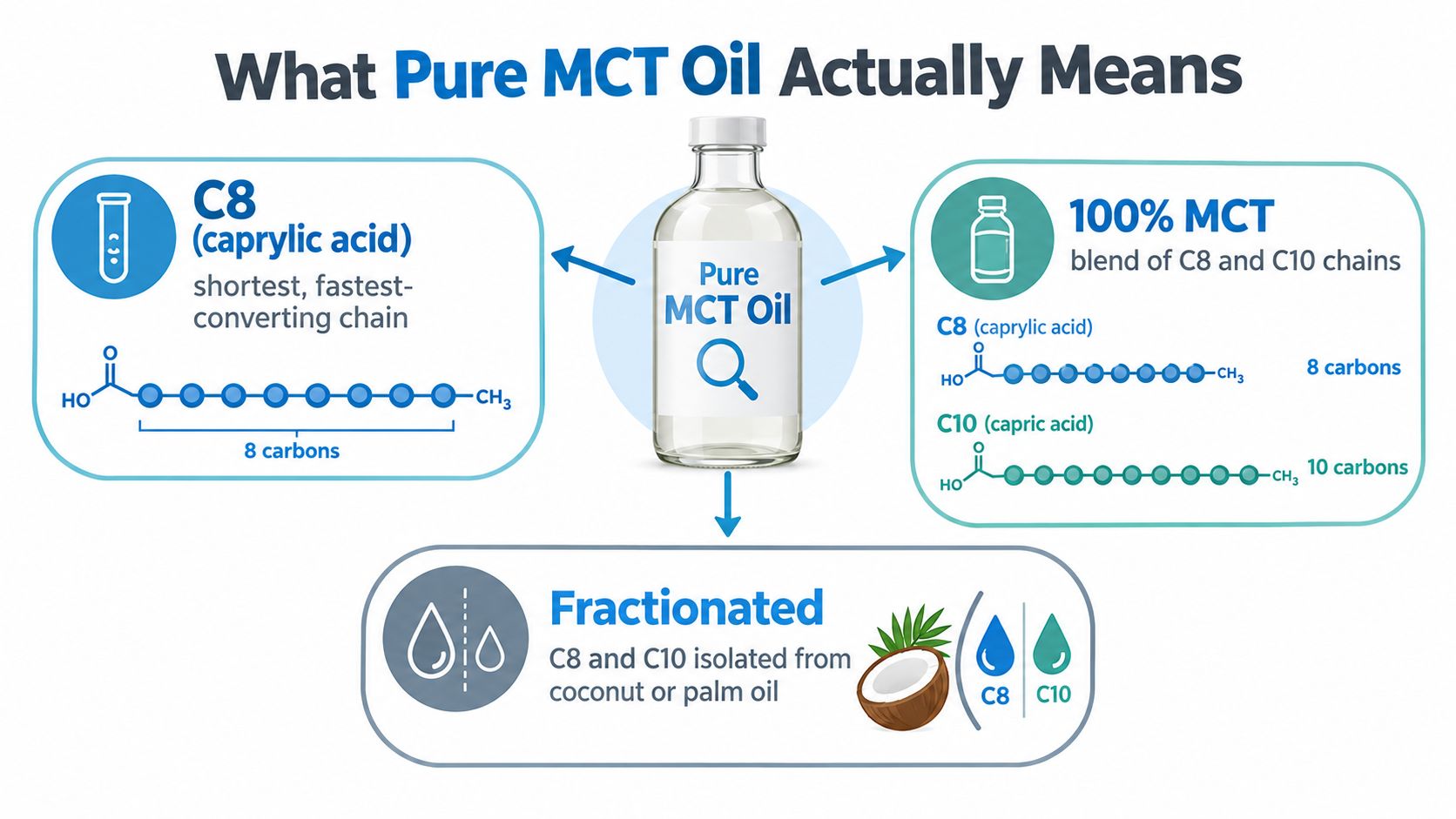
Commercial pure MCT oil is made by concentrating selected fractions from a source such as coconut or palm kernel oil. The finished product is usually centered on C8, caprylic acid, and C10, capric acid, rather than containing the full fatty-acid profile of the original oil. Research formulations commonly emphasize those two fractions, with C8 often treated as the more rapidly ketogenic component. The 2019 human trial on MCT oil composition and metabolic outcomes tested an oil containing approximately 54% C8 and 41% C10.
Purity describes composition
On a label, “100% MCT” usually means the oil contains MCTs rather than another carrier oil. It doesn't necessarily mean the product has a fixed C8-to-C10 ratio. One brand may offer a C8-dominant oil, while another may sell a balanced C8/C10 blend, and both can describe the product as pure MCT oil.
That distinction matters because the fractions behave differently. A C8 product is designed around caprylic acid, while a mixed product may provide more capric acid. Neither label is automatically superior. The better choice depends on whether you're prioritizing ketone production, general dietary use, cost, or digestive tolerance.
Label-reading rule: “100% MCT” tells you the category. The declared C8 and C10 amounts tell you what you're actually buying.
Coconut oil is the common source people confuse with MCT oil. It isn't the same product. Coconut oil contains several fatty acids, including lauric acid, while pure MCT oil is industrially concentrated to emphasize selected medium-chain fractions. The difference is therefore molecular composition, not whether one product is clean and the other is contaminated.
The Four MCT Fractions and Why They Behave Differently
The MCT family includes four commonly discussed fractions: C6, C8, C10, and C12. Chain length influences absorption, odor, ketogenic potential, and how comfortable the oil feels in the digestive system.
| Chain | Name | Ketogenic strength | Typical source | Tolerability |
|---|---|---|---|---|
| C6 | Caproic acid | Limited practical role in commercial oils | Coconut or palm kernel sources | Often less pleasant because of odor and taste |
| C8 | Caprylic acid | Generally considered the strongest ketogenic fraction | Concentrated MCT oil | Fast acting, but larger doses may upset digestion |
| C10 | Capric acid | Ketogenic, usually less rapid than C8 | Concentrated MCT oil | Often used in blends and may be more gradual |
| C12 | Lauric acid | Less characteristic of concentrated MCT behavior | Coconut oil | Behaves more like a longer-chain fat in metabolism |
Why C8 gets so much attention
C8, or caprylic acid, has a relatively short chain within the MCT category. The body can absorb and deliver MCTs to the liver efficiently, where they can be oxidized and contribute to ketone production. The review of MCT metabolism and ketone responses describes MCT oil as capable of producing a measurable rise in circulating beta-hydroxybutyrate, or BHB.
C10 also contributes to ketone production, but product labels often distinguish it from C8 because the response may be less rapid. A C8-dominant oil therefore appeals to shoppers who specifically want a concentrated ketogenic fraction, while a C8/C10 blend may be a more flexible option for general use.
C6 is usually not the reason someone buys MCT oil. It can contribute an unpleasant odor and is commonly minimized in commercial formulations. C12, lauric acid, deserves special attention because its longer chain changes its metabolic behavior. The review of MCT composition and classification notes that MCTs can range from C6 to C12, while commercial oils are commonly concentrated around C8 and C10.
The practical hierarchy is straightforward: C8 and C10 are the fractions shoppers usually want in a concentrated MCT product. A label that prominently lists C12 without clearly declaring its C8 and C10 content deserves closer inspection.
Evidence-Based Benefits and What MCT Oil Does Not Do
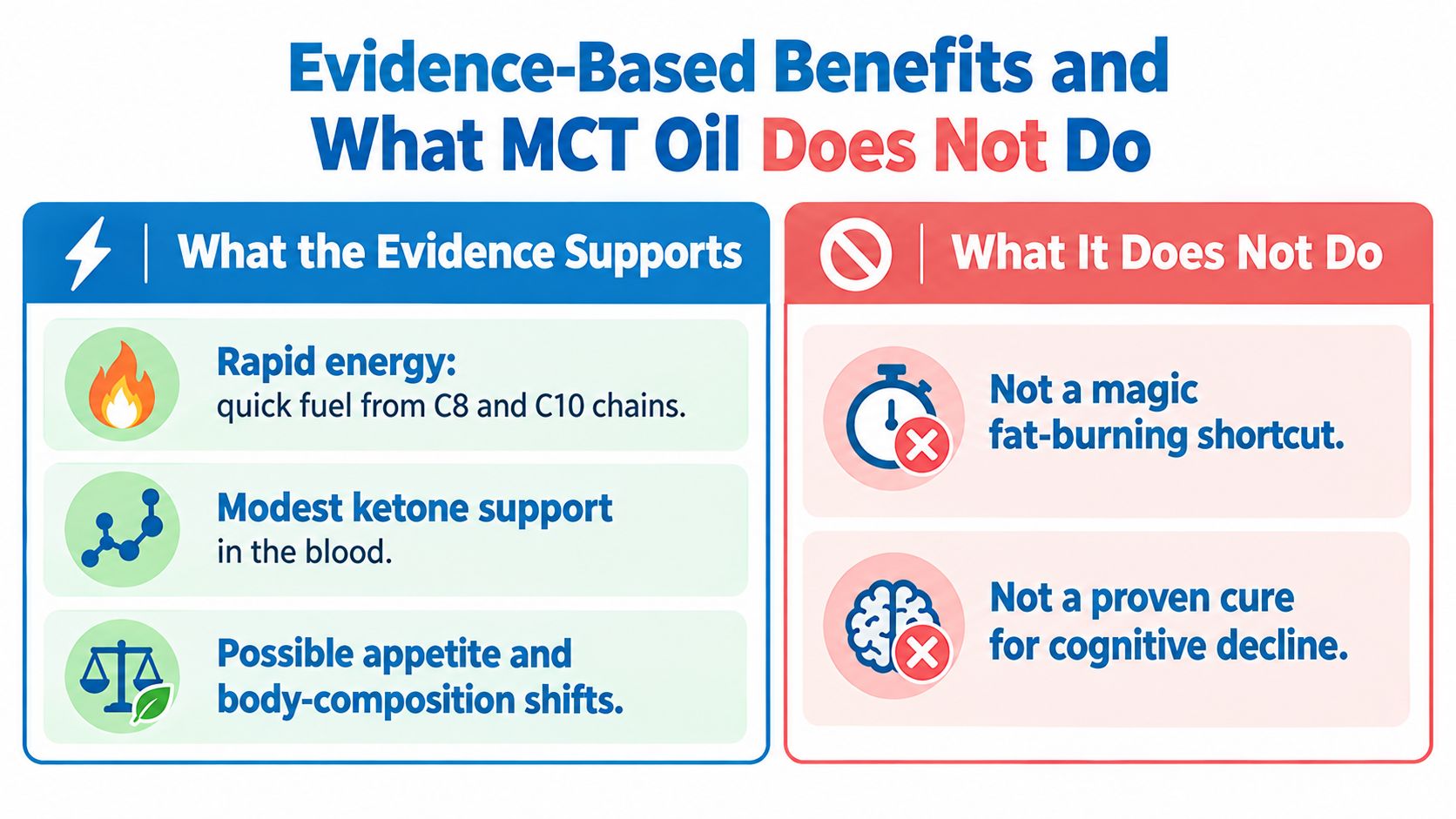
Suppose you want a fat that reaches the liver quickly, perhaps before exercise or alongside a lower-carbohydrate meal. Pure MCT oil can serve that purpose because C8 and C10 are processed differently from longer-chain fats. They can be converted into free fatty acids and ketones, making the oil a rapidly available fat source and a way to support circulating ketones. The label's fatty-acid profile explains this potential, but it does not guarantee a particular response.
In a study of 19 healthy adults, MCT oil alone raised BHB, with the average response peaking at about 60 minutes. Adding glucose delayed the peak slightly, produced a somewhat higher peak, and caused a large insulin increase. That distinction matters: a ketone rise after eating MCT oil is not the same metabolic state as fasting ketosis. The study of MCT oil, glucose, and ketone timing supports a measured interpretation rather than the idea that any increase in ketones represents a complete metabolic shift.
Where the evidence is useful
Pure MCT oil may help when someone wants:
- Fast dietary energy: It supplies concentrated fat that can be added to coffee, smoothies, or dressings.
- Modest ketone support: C8 and C10 can raise circulating ketones, although the response varies with dose, formulation, accompanying food, and individual metabolism.
- A convenient calorie source: Liquid MCT oil can make energy-dense nutrition easier, provided it does not displace needed dietary fats.
Research has examined appetite and body-composition outcomes, but those findings do not justify automatic weight-loss promises. MCT oil still provides energy. Adding it to an existing diet can therefore increase total intake rather than reduce it.
The 2019 six-week trial offers a useful reality check. Participants consumed MCT oil at 30 grams per 2,000 kilocalories per day, equivalent to about 249 kilocalories or 12.5% of estimated daily energy intake. Among 22 adults without diabetes, average body weight changed by only 0.3 kilograms, a result that was not statistically significant, with p = 0.39. The researchers also found no significant changes in fasting glucose, insulin, insulin resistance, ketones, resting energy expenditure, respiratory quotient, or body composition. Because the study was single-arm and non-randomized, it could not establish a strong causal effect. These findings are reported in the 2019 trial cited in the opening section.
Cholesterol claims require the same caution. A 2021 systematic review and meta-analysis of randomized trials found no significant change in total cholesterol, LDL cholesterol, or HDL cholesterol. Triglycerides showed a small average increase of 0.14 mmol/L, with a 95% confidence interval from 0.01 to 0.27.
Pure MCT oil can be a targeted nutrition tool. It is not a cholesterol-lowering treatment, a guaranteed fat-loss shortcut, or proof that a product delivers broad metabolic benefits.
How to Choose a Quality Pure MCT Oil
A good label should answer more than “Is this MCT?” It should tell you which fractions are present, where the oil came from, and how much actual MCT each serving supplies.
Start with the fatty-acid profile
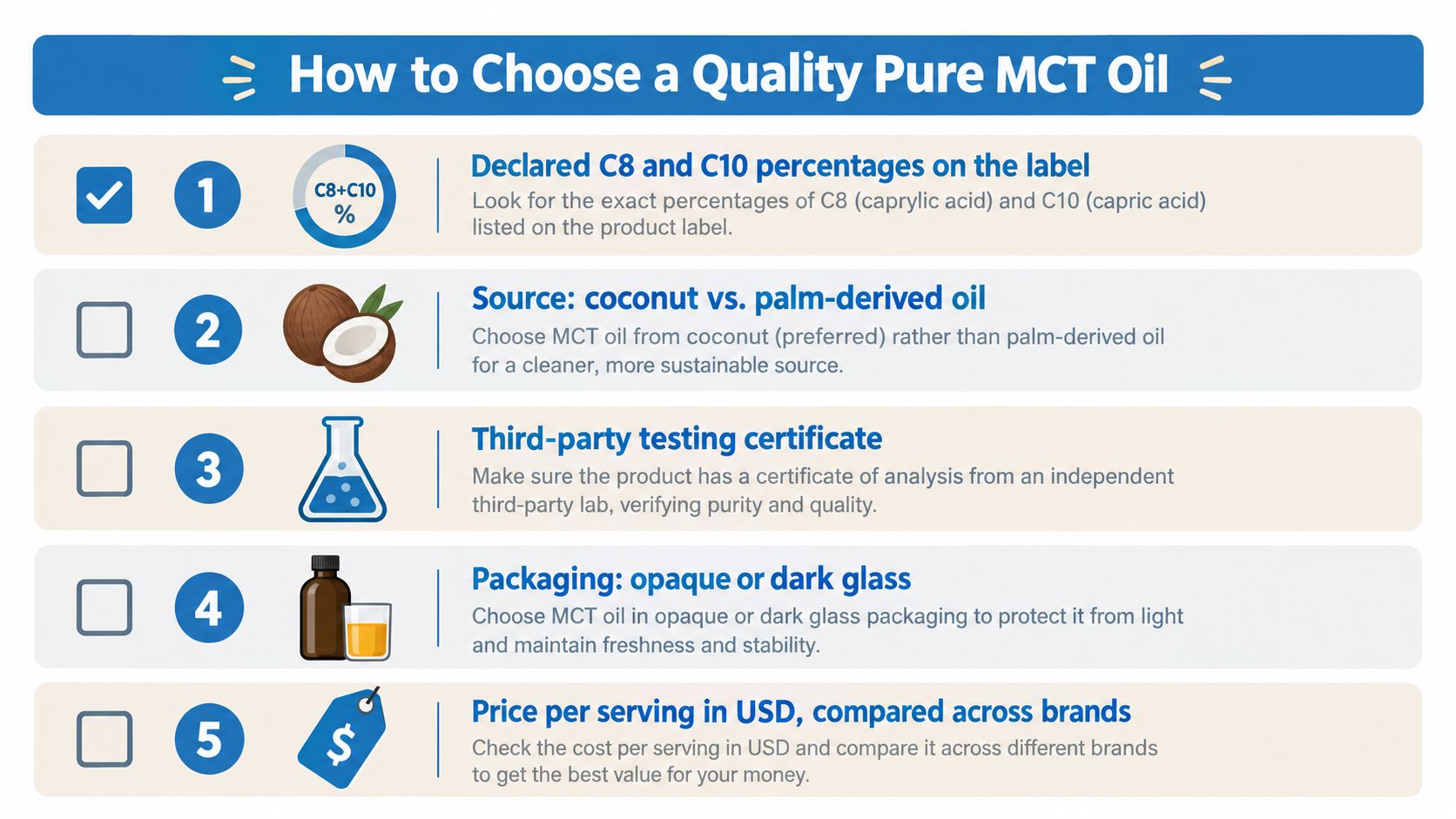
Look for a declared percentage or amount of C8 and C10. “100% MCT” without a breakdown leaves an important question unanswered. A C8 product, a C10 product, and a C8/C10 blend can all fit the broad category of pure MCT oil, but they won't have identical behavior.
A C8-dominant oil may suit someone focused on ketone support. A mixed C8/C10 product may be more appealing for everyday use, especially if the shopper wants a balance between concentration and tolerance. Don't assume that a higher C8 proportion is automatically better. A more rapidly absorbed product may also feel less forgiving when taken in a large amount.
Check the source and ingredient line
Coconut-derived and palm-derived MCT oils can both be fractionated into concentrated MCT products. Source matters to shoppers with environmental, dietary, or personal preferences, but the source alone doesn't establish the final fatty-acid ratio.
The ingredient line should be simple. Be cautious if a liquid oil includes unnecessary fillers, flavor systems, or a vague proprietary blend. MCT powder requires extra scrutiny because manufacturers may combine the oil with carriers such as maltodextrin or protein ingredients. That can improve handling and mixing, but it means the powder isn't equivalent to a spoonful of concentrated liquid oil.
Evaluate quality signals
Third-party testing, a current certificate of analysis, and good manufacturing practice certification can provide useful quality information. Packaging also deserves attention. Dark glass or opaque plastic can help limit light exposure, while a secure cap and sensible storage instructions support freshness.
A thirty-second scan can focus on five questions:
- Are C8 and C10 amounts declared?
- Is the coconut or palm source identified?
- Does the ingredient line match the product description?
- Is there evidence of independent quality testing?
- Can you compare the actual amount per serving rather than the marketing language?
For shoppers comparing products that combine MCT oil with other nutrition ingredients, the Bulletproof Keto Friendly Innerfuel product listing is an example of why the complete ingredient and serving information matters. A blended product serves a different purpose from a bottle of standalone pure MCT oil.
Dosing, Timing, and Real-World Usage Tips
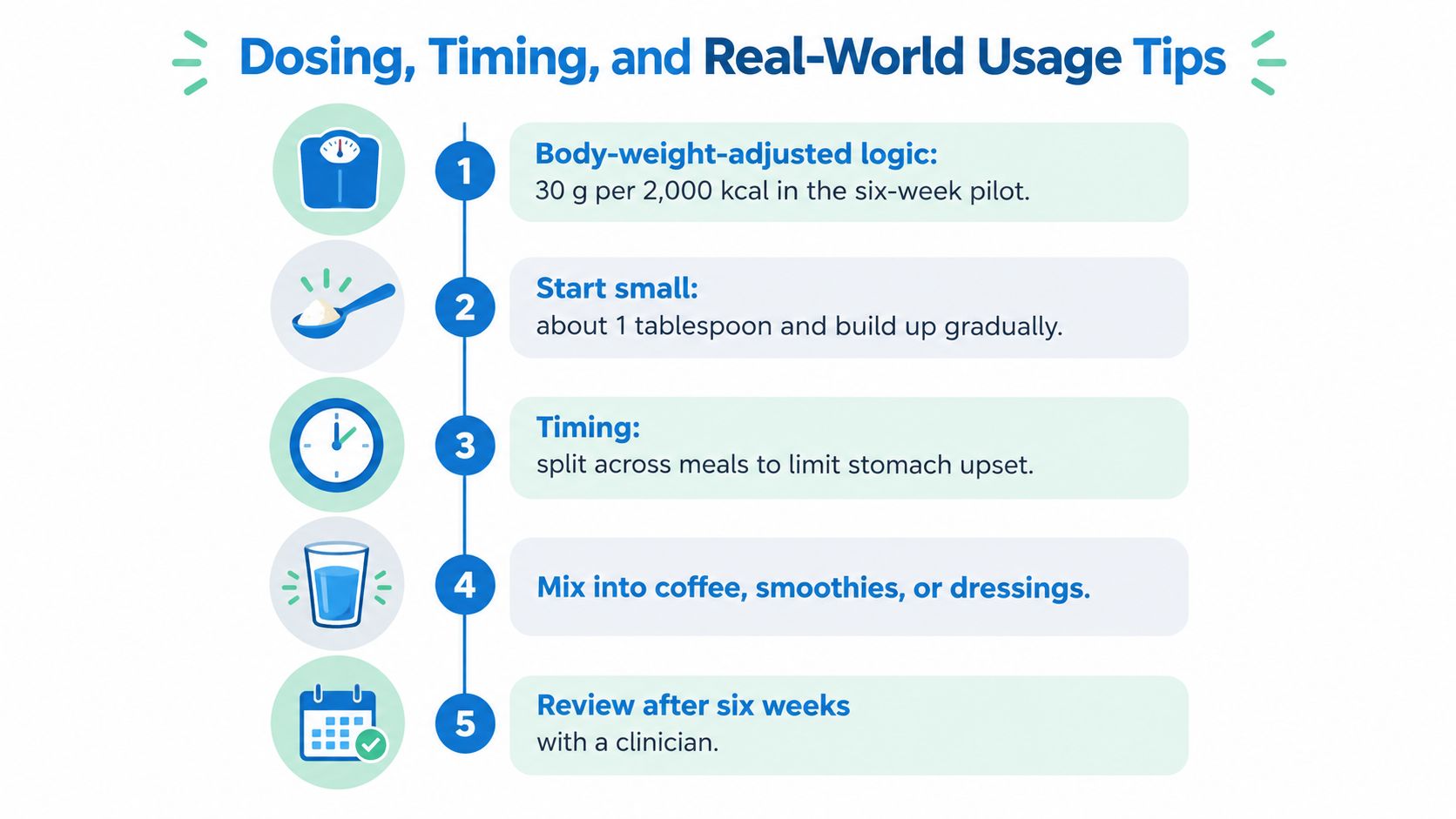
Suppose your bottle lists a generous serving, but your first spoonful leaves you queasy. The better starting point is the smallest amount that supports your goal without digestive symptoms. A six-week trial used 30 grams per 2,000 kilocalories per day, or approximately 249 kilocalories, but that research dose is not a universal starting point. Tolerance varies, and a large first serving can make a useful product unpleasant.
Build tolerance gradually
Start with about one teaspoon, roughly 5 grams, rather than the largest serving printed on the label. Keep that amount steady for several days. If digestion remains comfortable, increase gradually. A practical target may fall within 15 to 30 grams, although the suitable amount depends on your purpose, meals, and total fat intake.
The exercise-focused review cited in the safety section describes cramping, bloating, gas, abdominal discomfort, and diarrhea as possible gastrointestinal effects. It also reports little to no ergogenic effect in healthy populations. During or after exercise, keeping intake near 30 grams may help limit adverse reactions, but that figure should not be treated as a personal requirement.
Match timing to the purpose
For ketone support, some people take MCT oil in the morning or separate it from a carbohydrate-heavy meal. The food pairing can affect the response, so test one change at a time. That approach makes it easier to identify whether the amount, meal, or product composition is responsible for a noticeable effect.
Exercise is a different use case. MCT oil should not replace a proven fueling strategy. Ketones may rise without becoming the main fuel during endurance exercise, so a larger serving does not automatically mean a better workout.
Mix the oil into coffee or a smoothie, or use it in a cold dressing. Treat it as a supplement rather than a routine high-heat cooking oil. If your stomach reacts, reduce the amount or stop. Pushing through diarrhea or cramping isn't a sign that the oil is working.
The MCT and keto-focused product review on CalVitamin shows why shoppers should compare liquid MCT oil with powdered products carefully. Powdered products may have different serving instructions and added ingredients, so their scoop cannot be assumed to equal a spoonful of concentrated liquid oil.
Side Effects, Safety, and Who Should Be Cautious
A concentrated spoonful of pure MCT oil can turn an ordinary morning into an urgent search for a bathroom. The usual problem is digestive tolerance. Taking a large amount quickly may cause abdominal cramping, bloating, gas, nausea, abdominal discomfort, or diarrhea. One study reported abdominal discomfort and diarrhea in three of seven participants after about 25 milliliters. The finding is summarized in the exercise review cited in the dosing section.
Treat symptoms as information
Mild discomfort often means the serving exceeds your current tolerance, particularly if you take the oil rapidly or without food. Reduce the amount, divide it between meals, or stop if symptoms persist. A larger serving printed on the bottle is a product instruction, not a personal target.
Safety principle: Tolerance determines the dose. The maximum serving on a bottle doesn't determine what your body should take.
MCT oil also warrants care for people monitoring blood lipids. The randomized evidence reviewed in the lipid meta-analysis cited earlier found unchanged total, LDL, and HDL cholesterol, with a modest average triglyceride increase of 0.14 mmol/L. Individual responses can differ, so MCT oil should not be presented as a cholesterol-lowering fat.
People with high triglycerides or other lipid abnormalities should discuss regular use with a clinician. The same caution applies to liver disease, since the liver processes MCT-derived fatty acids and ketones. Anyone using MCT oil within a therapeutic ketogenic protocol, especially for a child, should follow the supervising clinical team's directions rather than adjust a consumer product label independently.
Carbohydrate intake can change the response. In a study of 19 healthy adults, combining MCT oil with glucose produced a delayed but slightly higher ketone peak and a large insulin increase. People with diabetes, or anyone concerned about medication effects, should ask a qualified clinician how MCT oil fits their meals and treatment plan.
Pure MCT Oil vs Coconut Oil, MCT Powder, and Other Fats
Pure MCT oil exists because whole coconut oil doesn't provide the same concentrated C8 and C10 profile. Coconut oil can still be useful in the kitchen, but it's a broader fat rather than a targeted MCT supplement.
| Product | MCT content | Best use | Trade-off |
|---|---|---|---|
| Pure MCT oil | Concentrated mainly around C8 and C10 | Measured supplementation, drinks, smoothies, and dressings | Easy to overconsume and may cause digestive symptoms |
| Coconut oil | Contains several fatty acids, including lauric acid | Cooking and general food preparation | Less concentrated in the C8 and C10 fractions |
| MCT powder | MCT oil combined with a carrier or other dry ingredients | Travel, premixed drinks, and portable servings | Often less concentrated than liquid oil and may include fillers |
Choosing the right format
Choose liquid pure MCT oil when you want to control the dose precisely and know the fatty-acid profile. A C8-dominant product may appeal to someone prioritizing ketone production, while a C8/C10 blend can provide a broader MCT profile for general use.
Choose coconut oil when you want a conventional cooking fat and appreciate its flavor and texture. It offers a whole-food ingredient profile, but it shouldn't be treated as interchangeable with a concentrated C8/C10 product. For a non-nutritional coconut oil use, such as personal care, the Deep Steep Coconut Oil High Shine Shampoo belongs to an entirely different category and shouldn't be confused with edible coconut oil.
MCT powder is mainly a convenience format. Check whether the label lists maltodextrin, protein, or another carrier, and compare the actual MCT amount rather than the scoop size. A simple rule works well: cook with a suitable cooking oil, use pure MCT oil when you want concentrated and measurable MCTs, and reserve powder for situations where portability matters most.
CalVitamin offers dietary supplements, protein products, probiotics, prebiotics, and wellness formulas that can help you compare formats and ingredients in one place. Review the label details, choose a product that matches your goal and tolerance, and visit CalVitamin to explore available options.