

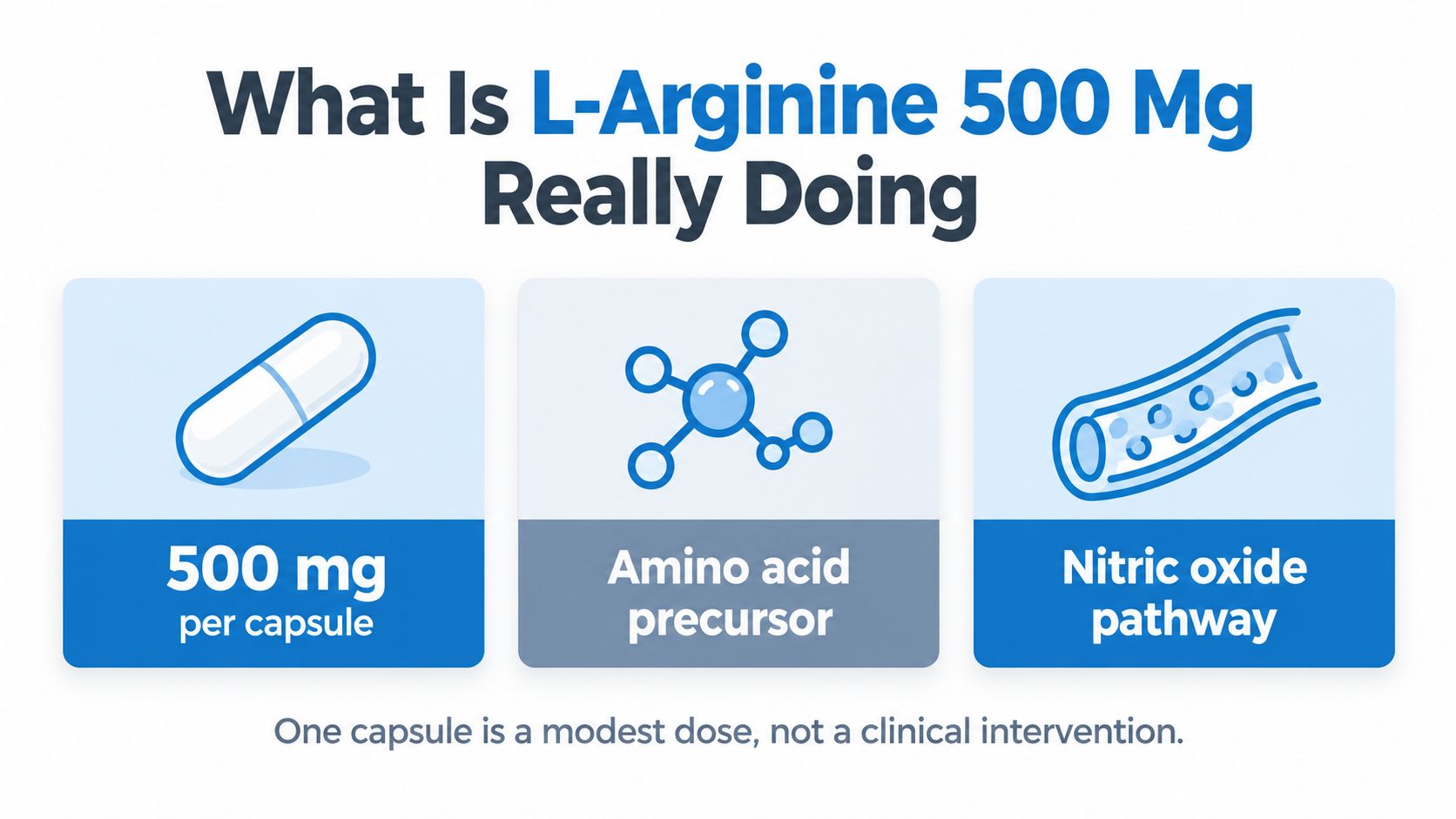
A 500 mg L-arginine capsule is substantially lower than the 2 to 10 grams per day most often evaluated in clinical research. One capsule may be a modest starting amount, but it shouldn't be treated as equivalent to the multi-gram protocols used in many studies.
Why does a supplement labeled L-arginine 500 mg often sound more powerful than the amount it delivers? The answer lies in a dose gap that's easy to miss. A capsule can contain a familiar, biologically active amino acid while still providing far less than the quantity used in research on exercise, blood pressure, or sexual wellness.
Table of Contents
- What Is L-Arginine 500 Mg Really Doing
- The Nitric Oxide Connection
- Common Uses and Realistic Expectations
- L-Arginine vs L-Citrulline
- Safety Considerations and Interactions
- Making the Right Choice for You
What Is L-Arginine 500 Mg Really Doing
Consider a shopper comparing two bottles. Both say “L-arginine,” but one provides 500 mg per capsule, while a research protocol may provide several grams across a day. The ingredient name is the same, yet the practical exposure can be very different. A 500 mg serving contains 0.5 grams, which equals 5% of a 10-gram dose, 8.3% of a 6-gram dose, or 25% of a 2-gram dose. These comparisons are calculated from the dose context summarized by the U.S. National Institutes of Health Office of Dietary Supplements.
That doesn't make 500 mg meaningless. It means you should describe it accurately: a relatively low, discrete serving, not a research-equivalent daily protocol. The body can use L-arginine as a building block in several biological processes, including the pathway that produces nitric oxide, but the amount consumed still affects how closely a supplement resembles the intervention studied.
Why the label can mislead
Across 18 studies of arginine alone versus placebo for exercise and athletic performance, the most common oral doses were 2 to 10 grams per day, with some studies using as much as 20 grams per day divided into three doses, according to the NIH review linked above. A single 500 mg capsule therefore sits well below most of those tested amounts.
That distinction matters for expectations. A person taking one capsule might notice no obvious acute change, and that result wouldn't contradict research performed with multi-gram dosing. It would instead show why you can't automatically transfer findings from a high-dose protocol to a low-dose serving.
For shoppers exploring amino-acid products, the Anabol Naturals amino acid powder illustrates a broader purchasing question: the form and labeled amount matter, but so do the total daily intake and intended use. More product isn't automatically better, especially when medications or health conditions are involved.
Practical rule: Treat 500 mg as a modest amount unless a clinician has advised a different plan. Don't assume the capsule matches the dose used in a clinical trial.
The Nitric Oxide Connection
L-arginine matters because it serves as the substrate used to produce nitric oxide, a signaling molecule involved in blood-vessel relaxation. In simple terms, endothelial cells can use L-arginine through nitric oxide synthase, an enzyme that helps convert the amino acid into nitric oxide. Nitric oxide then participates in signals that help regulate vascular tone.
This mechanism explains why L-arginine appears in discussions about circulation, exercise “pump,” blood pressure, and sexual function. It also explains why the mechanism alone doesn't prove that a particular capsule will create a noticeable result. The body already regulates nitric oxide production, and oral L-arginine must pass through digestion and metabolism before it becomes available to tissues.
A major discovery, with an important limit
The scientific foundation is substantial. Robert F. Furchgott, Louis J. Ignarro, and Ferid Murad received the 1998 Nobel Prize in Physiology or Medicine for discoveries concerning nitric oxide as a signaling molecule in the cardiovascular system. Historical research later connected L-arginine with nitric oxide production and identified nitric oxide synthase as the enzyme involved.
That history supports the biological rationale for studying L-arginine. It doesn't establish that every dose produces the same vascular response. A 2017 phase-IIA peripheral arterial disease study enrolled 22 participants who received L-arginine directly into an artery in cohorts of 50 mg, 100 mg, or 500 mg under clinical supervision. Limb blood flow increased in all groups, with reported increases of 130.9 ± 17.6, 136.9 ± 18.6, and 172.1 ± 24.8 mL/min, respectively.
Those doses were intra-arterial, not oral capsules. They show why route and delivery matter, and they can't be used to promise that routine oral L-arginine 500 mg supplementation creates the same effect.
For a practical discussion of this pathway, see this explanation of nitric oxide and the muscle pump. The useful takeaway is straightforward: a sound mechanism is a reason to investigate an ingredient, not proof of a guaranteed outcome at a specific serving size.
Common Uses and Realistic Expectations
What can a 500 mg capsule realistically do if many L-arginine studies tested much larger amounts? That question matters more than the ingredient name on the label.
People usually reach for L-arginine for three broad reasons: exercise support, blood-pressure management, or sexual wellness. The catch is that these are very different use cases. A serving that makes sense as a cautious starting point may be far below the amount studied for a specific outcome, much like using one rung of a ladder and expecting to reach the roof.
Exercise support
For exercise, the main expectation problem is scale. As covered earlier, oral research often used multi-gram daily amounts. Put in practical terms, 500 mg is about one quarter of 2 grams, the low end of that commonly studied range. That helps explain why one capsule is better viewed as a small serving, or one piece of a pre-workout formula, rather than a full research-style protocol.
That smaller serving can still have a place. Someone may prefer a gentle trial, may be sensitive to larger amounts, or may be using a product where L-arginine is only one ingredient among several. The useful mindset is simple: match the expectation to the dose. If a study tested grams per day, a single 500 mg capsule should be framed as an entry-level amount, not as a stand-alone performance strategy.
Training quality still matters more. So do food intake, hydration, sleep, and overall program design.
Blood pressure
Blood pressure is where the dose gap becomes especially easy to miss, because the language around the benefit sounds medical and precise. Yet the serving on the bottle may be much smaller than the serving in the trials.
A meta-analysis summarized by Mayo Clinic's L-arginine overview found average reductions of approximately 5.39 mmHg systolic and 2.66 mmHg diastolic in randomized, double-blind studies. The oral doses generally ranged from 4 to 24 g per day, with a median near 9 g per day.
Those numbers give the right frame for interpretation. A 500 mg capsule is a fraction of the amounts summarized there, so readers should be careful not to transfer study results directly onto a much smaller serving. The same Mayo summary also describes studies using less than 9 g per day for only 4 to 24 days, which limits how confidently those findings can be applied to long-term low-dose use.
Sexual wellness
Sexual-wellness marketing often reduces the discussion to "blood flow," but the picture is broader. Erectile dysfunction can involve vascular disease, diabetes, medication effects, hormone changes, psychological factors, and other medical conditions. L-arginine's nitric oxide role helps explain why it has been studied, but mechanism and outcome are not the same thing.
A Mayo Clinic review of erectile-dysfunction herbs links reported study benefits mainly with higher doses. A 2024 systematic review reported effective erectile-dysfunction study doses of 1,500 to 5,000 mg per day, not 500 mg per day. Five 500 mg capsules equal 2,500 mg, but capsule count by itself still does not confirm equivalence with a study. Timing, formulation, total daily intake, and a person's underlying health all shape the practical meaning of that comparison.
A 500 mg capsule works best as a starting serving or as one part of a broader formula. Set expectations according to the dose actually studied for the goal you care about.
Persistent erectile dysfunction deserves medical attention. It can be an early sign of an underlying condition, and merely increasing a supplement may add interaction risks without addressing the cause.
L-Arginine vs L-Citrulline
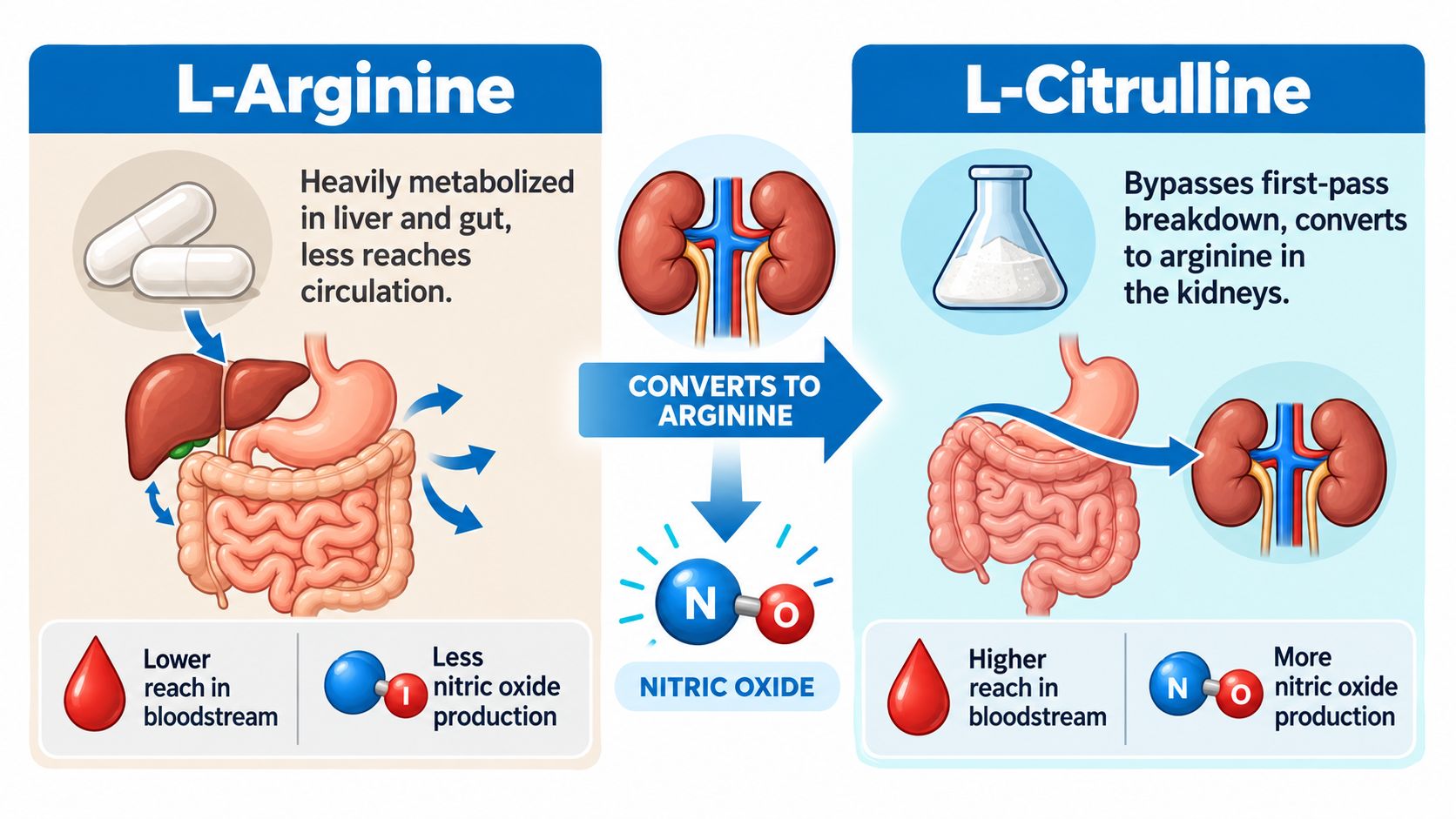
L-arginine and L-citrulline are related amino acids, but they take different routes through the body. L-arginine is the direct substrate for nitric oxide synthase, yet oral arginine is substantially affected by intestinal and hepatic metabolism. That means the amount swallowed isn't the same as the amount that reaches circulation intact.
L-citrulline follows another route. The body can convert it into L-arginine, particularly through metabolism involving the kidneys, which is why some people consider citrulline a different delivery strategy for raising available arginine. This doesn't make it automatically superior for every person or goal. It does mean the comparison shouldn't focus only on the number printed on the front label.
A simple decision framework
Choose based on the question you're trying to answer:
| Question | L-Arginine | L-Citrulline |
|---|---|---|
| What is it? | A direct precursor used in nitric oxide production | An amino acid that the body can convert into L-arginine |
| What can complicate oral use? | Intestinal and hepatic metabolism can limit availability | It uses a different metabolic route before contributing to arginine availability |
| What should you compare? | Serving size, total daily intake, and interactions | Serving size, formulation, goal, and interactions |
| What remains uncertain? | A low serving may not resemble research protocols | A different route doesn't guarantee a specific outcome |
A combination product can make the label harder to interpret because each ingredient may appear in a smaller amount. For example, NOW Sports Arginine & Citrulline provides 500 mg of free-form L-arginine per capsule, alongside L-citrulline. Read the Supplement Facts panel carefully instead of judging a blend by its total ingredient count.
The sensible comparison is not “which ingredient is stronger?” It's “which delivery approach fits my goal, health history, and professional guidance?”
Safety Considerations and Interactions
A low dose can reduce exposure, but it doesn't erase pharmacology. L-arginine may add to the blood-pressure-lowering effects of nitrates, antihypertensives, and sildenafil. That combination can lower blood pressure more than intended, which is why someone taking nitroglycerin, blood-pressure medicine, or Viagra shouldn't treat a 500 mg capsule as automatically harmless.
Mayo Clinic also identifies other situations that deserve medical review. L-arginine may increase bleeding concerns with anticoagulant or antiplatelet therapy, and potassium-sparing diuretics can raise concern about hyperkalemia. The organization cautions people with kidney disease, reports possible worsening of asthma or allergies, and advises against use after a recent heart attack. Review the Mayo Clinic medication and condition guidance for L-arginine before starting.
Use a medication screen first
Ask these questions before taking the product:
- Blood-pressure medicines: Could the supplement add to an existing blood-pressure effect?
- Nitrates or sildenafil: Could the combination create an unsafe drop in blood pressure?
- Anticoagulants or antiplatelets: Could combined use increase bleeding concerns?
- Potassium-sparing diuretics: Is there a risk of an electrolyte problem?
- Kidney, allergy, or asthma history: Has a clinician confirmed that L-arginine is appropriate?
- Recent heart attack: Has a healthcare professional specifically approved use?
The NIH review reports that doses up to 9 grams per day were generally safe and well tolerated over several days or weeks in the studies it evaluated. Doses of 9 to 30 grams per day were more commonly associated with diarrhea, nausea, gastrointestinal discomfort, and modest blood-pressure reductions, and safety beyond three months of high-dose use is unknown. These observations don't prove that 500 mg is risk-free, because interactions can matter even when the dose is relatively low.
Medication check: If you use sildenafil, nitrates, blood-pressure treatment, anticoagulants, antiplatelets, or potassium-sparing diuretics, ask a pharmacist or clinician before combining them with L-arginine.
Stop and seek medical guidance if you develop concerning symptoms. Don't respond to an absent benefit by repeatedly increasing the dose without professional input.
Making the Right Choice for You
L-arginine 500 mg can be a reasonable low-dose introduction, but it shouldn't be presented as equivalent to the multi-gram amounts used in many clinical studies. Start by defining the goal, then compare the labeled amount per capsule with the total daily amount studied for that goal.
Check the full ingredient panel, consider whether L-citrulline may suit your intended use, and review every prescription and over-the-counter product you take. If you're pursuing blood-pressure control or support for persistent erectile dysfunction, involve a healthcare professional rather than relying on supplement escalation.
CalVitamin offers dietary supplements in categories including amino-acid products, sports formulas, vitamins, minerals, and sexual-wellness products. Review the available options and product labels at CalVitamin, then discuss your choice with a pharmacist or clinician if you take medication or have an ongoing health condition.






