
You've probably seen D3 plus K2 sitting on a shelf next to vitamin D, magnesium, and calcium, and the label makes it look simple. One capsule, one routine, one tidy answer to bone support, heart support, and general wellness. Then the question hits, do you need the combo, or are you paying for a clever bundle?
That question is the right one. Vitamin D3 already has a clear job in the body, and vitamin K2 has a separate one, but the jump from “these nutrients work together” to “everyone should take both” is bigger than supplement marketing usually admits. The most useful way to look at D3 plus K2 is not as a universal must-have, but as a tool that makes more sense for some people, some goals, and some lab results than for others.
Table of Contents
- Why Everyone Seems to Be Taking D3 Plus K2
- What Vitamin D3 and Vitamin K2 Actually Do in the Body
- What the Evidence Says About Bone and Heart Health
- Who Actually Needs the Combo and Who Does Not
- How to Dose D3 Plus K2 Safely
- Forms, Labels, and Quality Markers That Matter
- Interactions, Side Effects, and When to Talk to a Doctor
- A Simple Decision Framework and Common Questions
Why Everyone Seems to Be Taking D3 Plus K2
A shopper standing in front of the supplement wall often sees the same pattern. One bottle says vitamin D3, another says D3 plus K2, and a third adds calcium for good measure. The label language sounds reassuring, especially if the goal is to “support bones” without having to think too hard about the details.
That's part of why this combo shows up everywhere. D3 has become the default vitamin D form for repletion and maintenance because it raises circulating 25-hydroxyvitamin D [25(OH)D] more effectively than D2, and K2 is commonly paired with it in bone-focused formulas. The marketing message is easy to understand, D3 helps bring calcium into the system, and K2 is presented as the nutrient that helps guide where that calcium goes.
The better question is not whether the pairing sounds logical. It's whether the pairing is worth it for your situation. Someone with a diagnosed bone issue, low vitamin D status, or a clinician who wants a bone-focused stack is in a different category from a healthy adult who just noticed the combo trending on social media.
Practical rule: if a supplement description promises broad benefits for everyone, pause and ask who was actually studied. Bone-focused formulas are not the same thing as universal wellness products.
For a product example, CalVitamin's NatureWise vitamin D3 plus K2 listing reflects the kind of bundled formula shoppers usually encounter, which is why it helps to understand the logic before you buy. The rest of the label matters just as much as the pairing itself.
What Vitamin D3 and Vitamin K2 Actually Do in the Body
D3 is the calcium gatekeeper
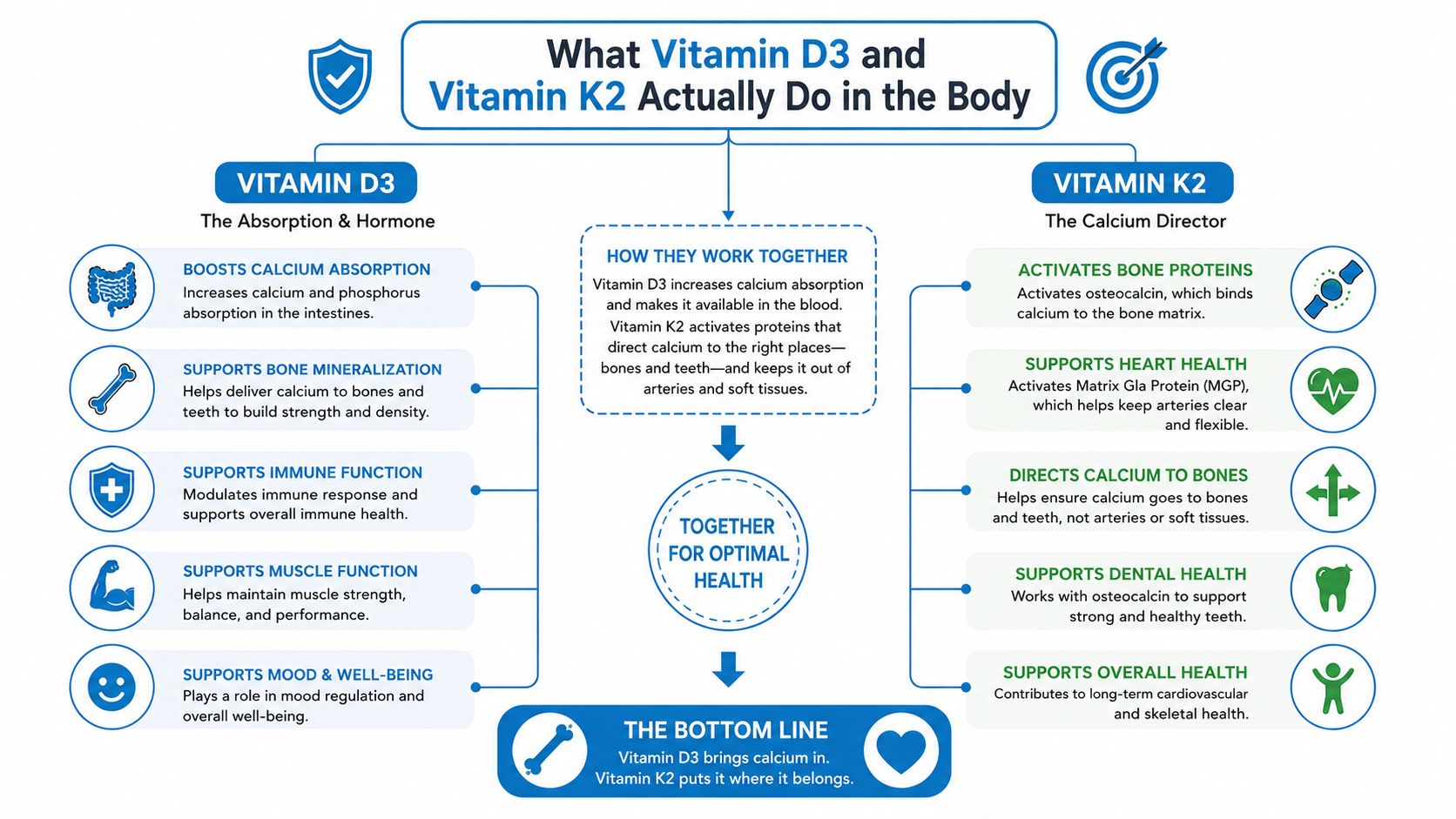
Think of vitamin D3, or cholecalciferol, as the nutrient that helps open the gate for calcium absorption. It raises the body's main vitamin D marker, 25(OH)D, more effectively than D2, and that's why it's commonly used when someone needs to improve vitamin D status. In plain English, D3 helps your gut absorb more of the calcium you eat.
That doesn't mean D3 “puts calcium in bones” by itself. It creates the conditions for calcium to be available. Without enough D3, you can eat a calcium-rich diet and still underperform on vitamin D status. That's the reason D3 is the first part of the combo many recognize.
K2 is the traffic director
Vitamin K2 is a separate nutrient family, and the two forms shoppers most often see are MK-4 and MK-7. K2 activates proteins that help move calcium toward bone-related pathways and away from soft-tissue deposition. The simplest way to explain it is that K2 helps direct traffic after D3 has increased calcium availability.
That's why the pairing is marketed as a bone-and-heart team. D3 helps calcium enter the system, K2 helps the system handle that calcium more deliberately. The logic is tidy, but the strength of the evidence depends on the outcome being measured, which matters a lot when you're deciding whether to add another capsule.
Why they're bundled together
The bundle exists because the nutrients perform different jobs in the same general mineral-handling pathway. A formula that combines them is usually trying to cover absorption and distribution at the same time. That's also why many shoppers look for a product that keeps both nutrients in one daily serving rather than buying them separately.
D3 is the “bring it in” nutrient. K2 is the “send it where it belongs” nutrient.
Some combined formulas also add a small amount of calcium, because the whole idea is to support mineral metabolism rather than just vitamin status. But the core concept stays the same. D3 increases the supply side, K2 helps with handling.
What the Evidence Says About Bone and Heart Health
The clearest evidence for D3 plus K2 comes from bone-health settings, where researchers can measure changes in bone density, bone repair, or related orthopedic outcomes. In a double-blind, placebo-controlled study of postmenopausal women with osteoporosis, combined vitamin D3 and vitamin K2 increased lumbar spine bone mineral density more than the control condition, and the trial record at PubMed reports that the combination also did better than either nutrient alone in repeated-measures analysis. That matters because it shows a real effect in a group with established bone concerns, even if it does not turn the combo into a universal answer.
A different line of evidence points in the same general direction. A prospective study in osteoporotic lumbar degenerative disease found higher fusion rates in the VK2 plus VD3 group, with 86.11% at 3 months and 91.67% at 6 months, compared with 65.71% and 74.29% in controls, and reported P = 0.012 and 0.044. These results are relevant because they reflect an orthopedic outcome rather than only a lab marker, which makes the signal easier to take seriously in a bone-repair context.
What that does, and doesn't, mean
The practical takeaway is narrow. These studies support the pairing in specific bone-related contexts, especially when bone density or bone healing is already part of the clinical picture. They do not establish that every healthy adult needs the combo for general prevention, and they do not provide strong support for broad cardiovascular claims.
A shopper can use a simple filter here. If the reason for considering D3 plus K2 is bone-focused, the evidence is more relevant. If the goal is general wellness without a bone issue, the case is much weaker, and a separate product such as NatureWise Vitamin K2 MK-7 is easier to think about as a targeted K2 option rather than proof that everyone should pair it with D3.
Bottom line: the evidence is real in bone-focused settings, but it is not broad enough to support universal claims.
Who Actually Needs the Combo and Who Does Not
A lot of supplement content treats D3 plus K2 as if it's automatically useful for everyone. That framing skips the most important question, who has a real reason to care? The best answer is more selective than the marketing language suggests.
A major review concluded there isn't enough evidence to recommend combined vitamin D and K supplementation for the prevention or treatment of osteoporosis, and a later review noted that no formal guidelines currently recommend combined supplementation even though some experts consider it in deficiency states (PMC review). That means the combo may be reasonable in some cases, but it's not a universal standard of care.
The people with the strongest case
Postmenopausal women with low bone density are the clearest fit, because the clinical evidence has concentrated there. Older adults with low dietary K2 intake may also have a more plausible reason to consider the pairing, especially if they're already using vitamin D long term. People using higher-dose D3 under supervision can also have a practical reason to think about whether K2 belongs in the routine.
Healthy younger adults with balanced diets and normal sun exposure are a different story. If vitamin D status is already fine and there's no bone-health issue on the table, the case for adding K2 gets much weaker. That doesn't mean it can't be taken. It means the benefit is much less certain.
A simple filter for shoppers
- Known bone issue: the combo makes more sense when bone health is already a concern.
- Low vitamin D status: D3 repletion is the clearer priority, and K2 becomes a secondary question.
- No clear risk factors: the combo may be more optional than necessary.
The most useful FAQ buried under all the hype is straightforward. If your vitamin D is low, you usually need D3 first. K2 may be a thoughtful add-on, but it's not a universally proven requirement for every person with low vitamin D.
How to Dose D3 Plus K2 Safely
Start with the label, not a ratio rule
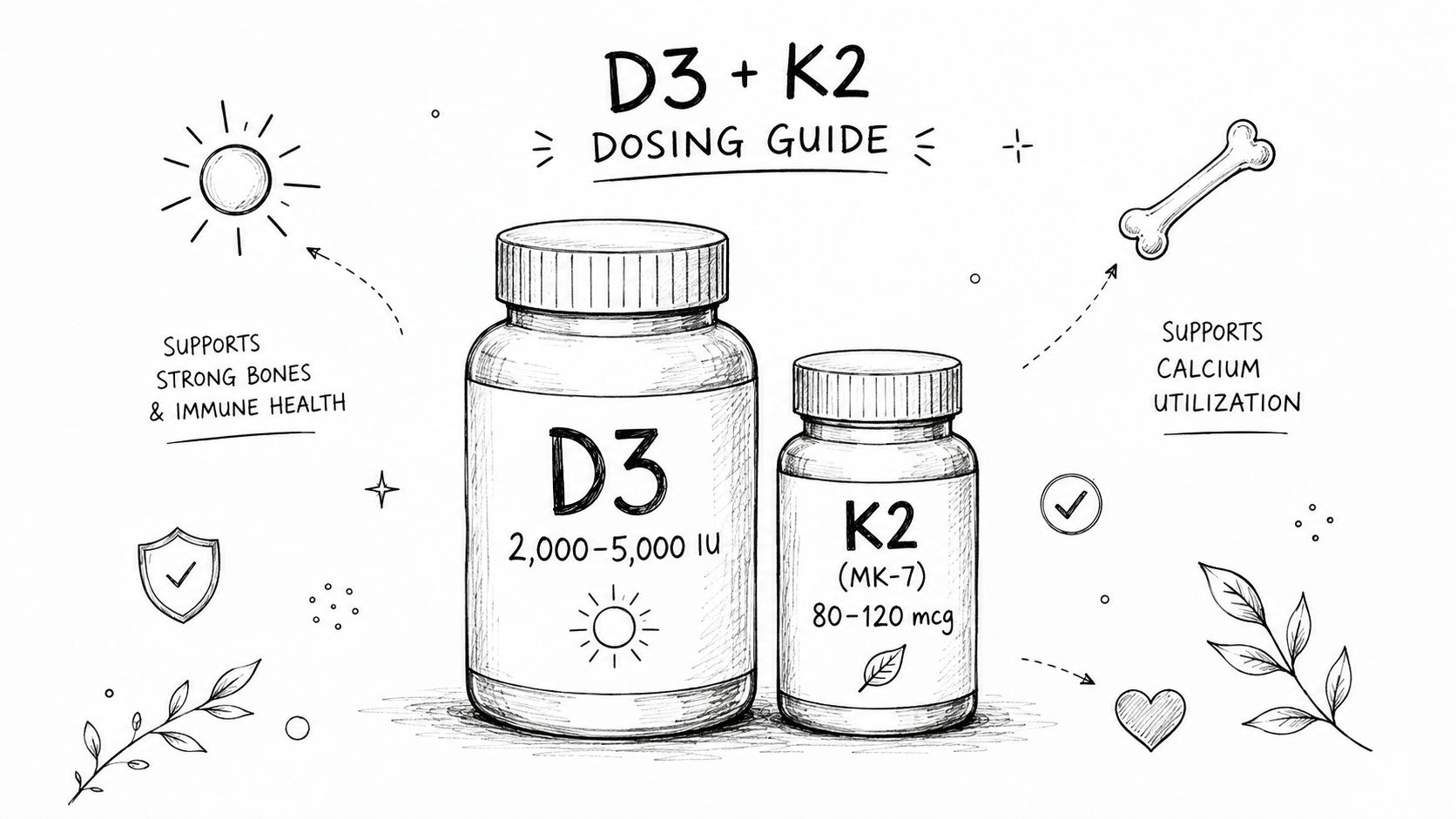
If you are standing in front of a supplement shelf, the first question is usually not whether D3 plus K2 exists. It is whether the bottle matches the reason you want it in the first place. Commercial formulas often cluster around 4,000 IU D3 plus 100 µg K2 or 5,000 IU D3 plus 120 µg K2 per serving, and some products add small amounts of calcium such as 55 mg (Wonderlabs reference). That gives you a sense of the market, but it does not establish a universal ratio you should copy.
The research does not support a one-size-fits-all D3-to-K2 formula. A tidy rule like “100 µg K2 for every 1,000 IU D3” can look reassuring on a label, but it is still a convenience rule, not a clinical one. If a formula fits your needs, good. If it only looks tidy, that is not the same thing.
Let your own context shape the dose
Age, diet, season, body weight, and baseline 25(OH)D level all matter. Someone who gets little sun and already tests low on vitamin D usually needs a different approach from someone who spends time outdoors and eats a varied diet. The growing trend in clinical discussion is to measure serum 25(OH)D and tailor D3 to the result rather than guessing.
A useful way to sort through the noise is to ask what problem the supplement is supposed to solve. If the answer is a low lab value, D3 is the first piece to address. If the answer is “I heard the combo is good,” that is a weaker reason.
Practical rule: test first when you can, then dose to the lab result instead of stacking capsules by habit.
Timing matters more than fussiness
D3 is fat-soluble, so it absorbs better with a meal that contains fat. Taking it with breakfast or dinner is fine if that meal includes some dietary fat. MK-7 can be taken at the same time or split across the day if that feels easier on your routine.
The simplest routine is usually the one you repeat. A supplement taken consistently with food is more useful than a theoretically ideal schedule that you forget after a few days. If dinner is the meal you never skip, that may be the easiest place to put it.
For a product style example, CalVitamin's Nature Made vitamin D3 plus K2 5,000 IU listing shows the kind of higher-dose bundle shoppers often compare when they are deciding whether a ready-made combo fits their routine.
Forms, Labels, and Quality Markers That Matter
The first label question is simple. Does the bottle clearly say MK-7 or MK-4, or does it hide K2 behind a vague “vitamin K complex” description? If the form isn't stated, you don't really know what you're buying. That matters because the two forms are used differently and behave differently in the body.
MK-4 vs MK-7 at a glance
| Attribute | MK-4 | MK-7 |
|---|---|---|
| Main commercial pattern | Often used in higher, repeated doses | Common in once-daily supplements |
| Dosing style | Typically less convenient for standard bundles | Fits microgram-range daily formulas |
| Label clarity | Needs exact form naming | Needs exact form naming |
| Common use in D3 formulas | Less common | More common |
MK-7 is the more common partner for D3 plus K2 products, because it fits the once-daily routine most shoppers want. MK-4 can still be used, but it's usually a different kind of supplement experience. That's why reading the form matters before you compare price or capsule count.
What a solid label should show
- Exact D3 amount: look for IU listed clearly.
- Exact K2 amount: look for micrograms, not a vague blend.
- Named K2 form: MK-7 or MK-4 should be written out.
- Testing disclosure: third-party verification or batch quality information is a plus.
- Additive transparency: check allergens, gelatin, colorants, and unnecessary fillers.
A softgel with oil is often a cleaner fit for fat-soluble vitamins than a dry tablet, but format alone doesn't guarantee quality. The question is whether the product tells you what's in it and backs up the label.
You can also see how format changes the buying experience in CalVitamin's NOW vitamin D3 plus K2 liposomal spray, which shows that shoppers have options beyond the standard capsule. That's helpful if you're comparing delivery methods, not just nutrient amounts.
Interactions, Side Effects, and When to Talk to a Doctor
Vitamin K2 is the biggest medication caution in this category because it can interact with blood-thinning medications such as warfarin. That's not a minor footnote. K2 supports clotting-factor activity, so anyone on anticoagulants needs medical supervision before adding it.
Watch the D3 side too
High-dose vitamin D3 can also create problems if it's not matched to your actual needs. Concerns include hypercalcemia, kidney strain, and special caution in conditions such as sarcoidosis or hyperparathyroidism. Mild digestive upset can happen with either nutrient, especially if the product doesn't agree with you or is taken on an empty stomach.
If you're buying a supplement because the label looks reassuring, that's not enough. The safest choice depends on your medications, your kidney history, and whether your clinician already has a reason to monitor your vitamin D status.
Talk to a clinician first if you're pregnant, have kidney disease, have a history of kidney stones, use anticoagulants, or have surgery coming up.
Those situations don't automatically rule out supplementation, but they do make self-directed dosing a bad idea. A little caution here is a better plan than fixing a preventable interaction later.
A Simple Decision Framework and Common Questions
Start with three questions. Do you have a known bone-health issue or documented low vitamin D status? Are you already taking D3 alone at a meaningful dose? Are you on any medication that interacts with vitamin K?
If the answer to the first question is yes, the combo deserves a closer look. If the answer to the second is yes, K2 may be a reasonable add-on only if your situation supports it. If the answer to the third is yes, the decision needs medical input before you buy anything.
Quick answers to the questions shoppers ask most
Do healthy adults with normal vitamin D levels need K2? Usually not. If bone health is fine, diet is balanced, and there's no deficiency concern, K2 becomes more optional than necessary.
Is D3 plus K2 safe long term? It can be, but long-term use should make sense for your actual nutrient status and health context. Safe doesn't mean automatic.
Does the combo help cardiovascular health specifically? That claim is much less secure than the bone-focused evidence. K2 is often marketed for heart support, but the strongest clinical support remains in narrower bone-related settings.
The cleanest takeaway is simple. D3 plus K2 is a useful tool when the context supports it, not a magic bullet for everyone who walks into the supplement aisle.
CalVitamin offers a broad supplement catalog, including vitamin and mineral formulas that fit different routines and preferences. If you're comparing D3 plus K2 products and want to look at formats like softgels, tablets, sprays, and gummies in one place, visit CalVitamin and check the label details before you choose.