

D Mannose is a naturally occurring sugar sold as a dietary supplement in capsules, most often promoted for urinary tract comfort. The best current evidence does not support routine preventive use in women with recurrent UTIs, even though the product remains popular with shoppers looking for a simple, pre-measured option.
Table of Contents
- What D-Mannose Is and Why It Comes in Capsules
- How D-Mannose Is Thought to Work in the Urinary Tract
- What the Evidence Shows
- Capsule vs Powder vs Tablet
- Recommended Dosage and Timing
- Safety, Side Effects, and Who Should Be Cautious
- How to Choose a Quality D-Mannose Capsule
- Practical Takeaways for Shoppers
What D-Mannose Is and Why It Comes in Capsules
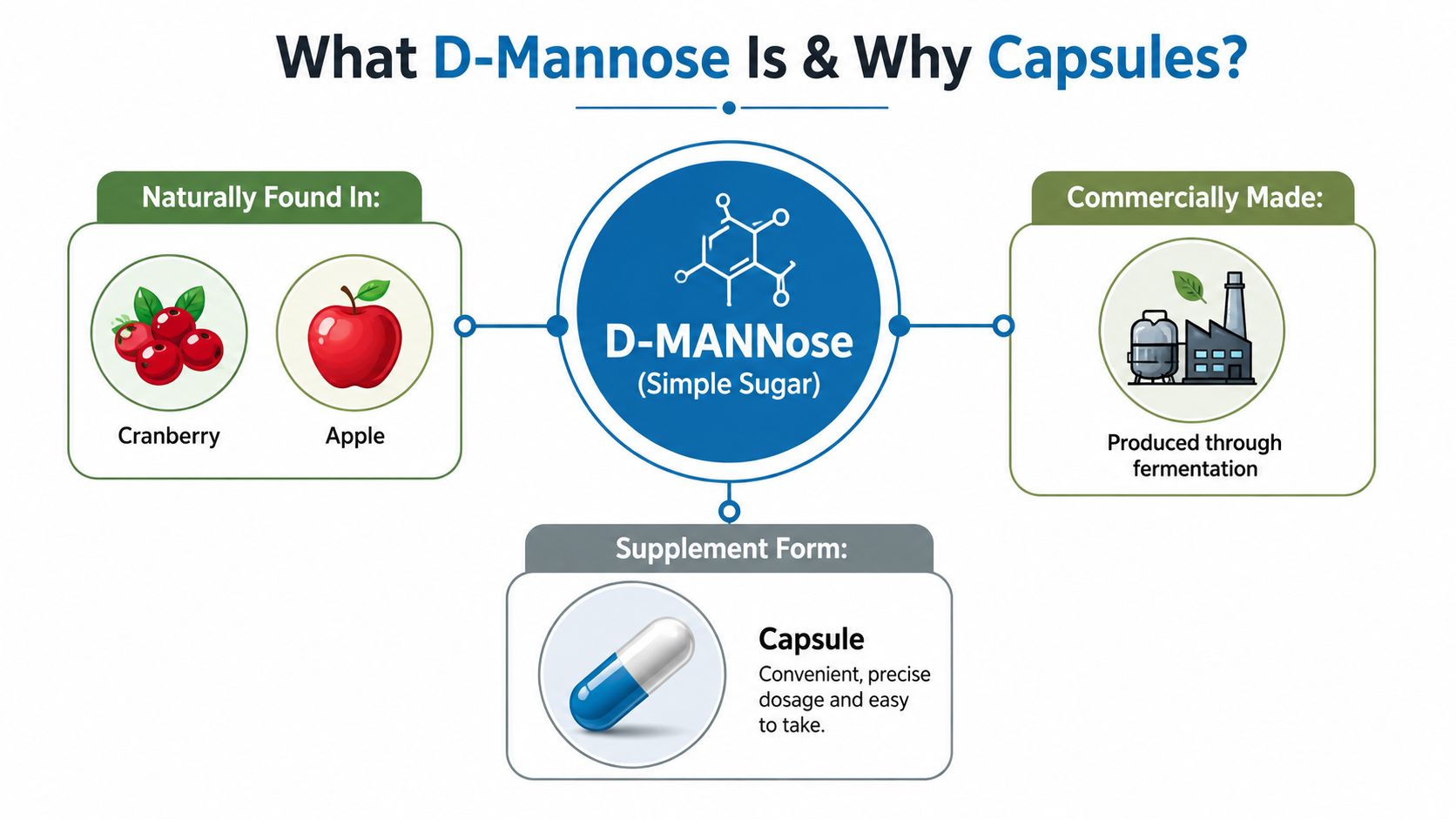
D-Mannose is a simple sugar related to glucose, and supplement brands sell it in capsule form for convenience, not because the active ingredient changes. For a shopper, that matters. A d mannose capsule is basically a pre-measured way to take the same ingredient without scooping powder or dealing with the taste.
Why capsule format became common
Capsules solve three practical problems at once. They make the dose easier to count, they travel well, and they let users move toward the commonly studied 2 g daily target without measuring tools. That's why a 500 mg capsule is such a common unit in the market, because four of them land at 2,000 mg, and two of them land at 1,000 mg.
The capsule is a delivery choice, not a different supplement. In other words, the question isn't whether the active ingredient is “better” in capsule form. The question is whether the label gives you a dose you can use consistently, in a shell you can tolerate, at a price you're willing to repeat.
Practical rule: if a label hides the dose behind a proprietary blend, it's harder to know whether you're actually getting a useful amount.
What to expect on a supplement label
Shoppers usually see D-Mannose paired with a short ingredient panel. The active ingredient is often listed with a clean number per capsule, then the shell and filler ingredients underneath it. That structure makes it easier to compare products across brands.
A well-labeled capsule should tell you the amount per capsule clearly, so you can do the math against your own routine. Later sections cover how to compare shells, excipients, and dosing patterns without getting lost in marketing language. The simple takeaway is that a D-Mannose capsule is a dose format, not a new category of ingredient.
How D-Mannose Is Thought to Work in the Urinary Tract
A capsule has to dissolve before any active ingredient can do its job. Once that happens, D-Mannose is absorbed in the small intestine, shows up in the blood within 1 to 2 hours, and is then handled in a way that leaves much of the dose available for urinary excretion rather than long-term storage or heavy metabolism.
The decoy idea in plain language
The proposed urinary mechanism is straightforward once the jargon is stripped away. Some bacteria, especially E. coli, use tiny hairlike structures called fimbriae to grip the bladder lining. D-Mannose is thought to work like a decoy parking space, giving those bacteria something else to latch onto so they are less able to stick where they cause trouble.
That theory helps explain why supplement pages often present D-Mannose as a urinary-support ingredient. A plausible mechanism does not prove a clinical effect, and that difference matters if you plan to buy it for repeated use. A mechanism can make the idea sound tidy, while the outcome in practice still depends on human trials and the population being studied.
Why the capsule shell does not change the active story much
The shell mainly affects how you swallow the dose and how quickly it opens. Product monographs describe HPMC or vegetable capsule shells with inert excipients such as rice flour, magnesium stearate, silica, or stearic acid, and one monograph says the capsule disintegrates in water within 60 minutes Protocol for Life monograph.
That is why capsule form is usually a question of convenience and label clarity, not a different biological mechanism. Once the shell breaks down, the key question is how much D-Mannose you swallowed. If you want a plain comparison to another capsule-based urinary-support product, see this cranberry and vitamin C capsule example.
What the Evidence Shows
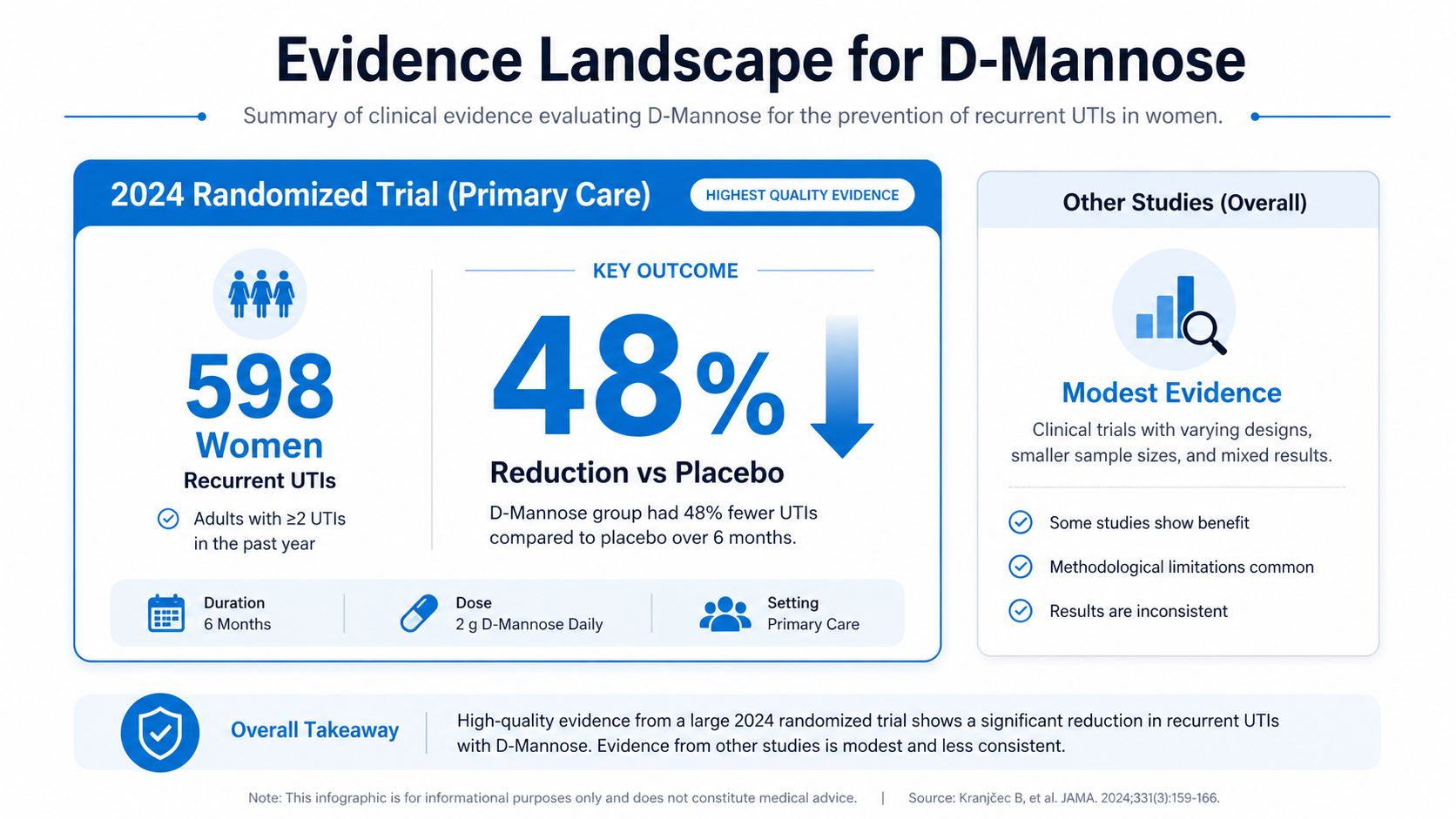
The most important point for shoppers is straightforward. The strongest recent trial evidence does not support routine D-Mannose use to prevent future UTIs in women with recurrent infection. A 2024 randomized clinical trial in primary care enrolled 598 women with recurrent UTI, used daily D-Mannose for 6 months, and found medically attended UTI in 51.0% of the D-Mannose group versus 55.7% on placebo. The authors concluded it should not be recommended for prevention in that population 2024 trial.
Why that trial matters more than older optimism
Earlier smaller studies had suggested benefit, and that helps explain why D-Mannose still has a strong reputation online. A larger, placebo-controlled randomized trial carries more weight than smaller or less rigorous reports. When a supplement is widely marketed for prevention, a negative result from that kind of study changes the discussion.
The practical reading is careful, not dismissive. It means the capsule may still be sold for urinary comfort, but shoppers should not confuse marketing history with strong proof. In evidence terms, “natural” does not equal “effective,” and the 2024 trial is the clearest modern reference point for that reality.
Ongoing research does not equal confirmed benefit
A separate 2025 registered trial is still testing D-Mannose capsules, using 2 g daily as 4 x 500 mg capsules for 12 months in 90 women with recurrent uncomplicated UTI 2025 clinical trial registration. That shows researchers are still asking the question, not that the answer has changed.
Ongoing trials show interest, not proof.
For a shopper, that distinction matters. A product can stay popular while the best available evidence remains mixed or negative. If you are deciding whether a d mannose capsule belongs in your routine, the clearest conclusion is that prevention claims remain debated, and the strongest current data lean against routine prophylactic use in women with recurrent UTI 2024 trial.
Capsule vs Powder vs Tablet
D-Mannose comes in several forms, but the form changes the shopping experience more than the ingredient itself. Capsules favor convenience. Powder favors flexible measuring. Tablets favor a familiar pill shape, but they often depend on more binders and coatings to hold everything together.
How the three forms differ
| Feature | Capsule | Powder | Tablet |
|---|---|---|---|
| Dose control | Easy to count in 500 mg units | Easy to scale precisely with a scoop | Fixed per tablet, less flexible |
| Portability | Strong | Weak unless repackaged | Strong |
| Taste | No taste while swallowing | Taste is noticeable | No taste while swallowing |
| Shell or carriers | HPMC or gelatin shells, plus inert excipients | Usually fewer shell materials, but may need flavoring or anti-caking help | More binders and coatings are common |
| Practical use | Good for daily routines | Good for exact gram-level mixing | Good for people who want a familiar pill |
Capsules make the math easier when the target is 2 g daily. That's why they're popular with shoppers who want a routine they can repeat without measuring tools. Powder can be cheaper per gram, but not everyone wants to taste it or manage clumping every day.
Why shell type still matters
Some shoppers need vegetarian HPMC shells, while others are fine with gelatin. That difference isn't cosmetic. It affects dietary compatibility, religious suitability, and how the product fits a cruelty-free preference.
Tablets can be perfectly fine for some users, but they tend to rely on more excipients to maintain shape and stability. If your goal is a straightforward supplement with clear dose math, capsules are usually the easiest middle ground. If your goal is the lowest cost per gram, powder often gets attention. If your goal is a swallowed pill that resembles a conventional vitamin, tablets may feel familiar.
Recommended Dosage and Timing
A practical dose starts with the strength on the label, then works backward to the daily target. In many consumer products and in research conventions, that target is 2 g daily. Once you know whether each capsule contains 500 mg or 1,000 mg, the count becomes straightforward. A 500 mg capsule means 4 capsules daily. A 1,000 mg capsule means 2 capsules daily. Canadian licensed-product information also shows a 500 mg per capsule design with an adult dose of 2 capsules daily for that specific product form Canadian product monograph.
How labels split the same daily amount
Manufacturers do not all package the daily amount the same way. Some labels treat the full daily amount as one serving, while others divide it into two servings. That difference usually reflects capsule count, brand style, and how the bottle is meant to be used.
The simplest routine is the one you can repeat without confusion. Many labels suggest taking the capsules with water, and some split the dose so swallowing feels easier or the serving instructions look simpler. Those directions are label instructions, not proof that one timing pattern changes outcomes.
If you are also comparing related products, a companion supplement like a women's care probiotic capsule may look similar on the shelf, but the label logic is different. D-Mannose dosing still comes back to the capsule strength, the daily target, and how many capsules you are willing to take each day.
What timing can and can't do
Take the capsules with a full glass of water. That makes swallowing easier and helps keep the routine consistent from day to day. If the label asks you to space doses apart, follow that instruction unless a clinician tells you otherwise.
Useful habit: match the capsule count to the daily target before you start worrying about timing tricks.
Timing advice can sound more precise than it really is. With D-Mannose, the bigger issue is usually whether the shopper can translate the label into an exact daily count without guessing. A product that looks convenient on the front can still be awkward if the capsule strength forces too many pills, or if the serving size is written in a way that is hard to track over time.
Safety, Side Effects, and Who Should Be Cautious
D-Mannose is a supplement, so the safety discussion should stay tied to what it can and cannot do. The common complaints are loose stools or diarrhea, especially at higher doses, and consumer references also list vaginal burning as a possible side effect. For many shoppers, the bigger question is not severe toxicity. It is whether the product fits their health situation well enough to use with care.
Who should slow down and ask a clinician first
People with diabetes or insulin resistance should be cautious, because review literature notes possible concerns around insulin secretion. Pregnant or breastfeeding people should also pause and talk to a clinician, since the evidence base is limited. That matters even more if the supplement is being considered for repeated use rather than a short trial.
Symptoms that feel more serious need medical evaluation. Fever, flank pain, or active UTI symptoms point to a possible infection, and a sugar supplement should not be used as a stand-in for treatment when antibiotics are indicated.
Side effects and real-world use
GI upset usually appears early if it is going to appear at all. If someone starts with a high capsule count, loose stools are the most likely annoyance, not a mysterious reaction. A lower starting dose can help people check tolerance before they commit to a full daily routine.
The capsule form matters here too. A bottle can look convenient on the front and still be awkward in practice if the serving size is hard to follow or the dose per capsule forces too many pills. That is the same kind of label reading you would use for a women's probiotic capsule, because the form is similar even when the purpose is different.
If symptoms feel like a real infection, do not self-manage for long.
That is the clearest safety line. A supplement can sit alongside a wellness routine, but it should not delay care when infection signs are present. The first week is the best time to watch for loose stools, stomach upset, or any burning sensation that makes the product feel poorly tolerated.
How to Choose a Quality D-Mannose Capsule
The label is the fastest way to separate a useful bottle from a polished one. Read it in the same order every time, dose per capsule first, then shell material, then inactive ingredients. That habit matters because a capsule can look similar on the shelf and still be very different once you start comparing what is inside it.
What to check first
- Dose per capsule: 500 mg is the easiest unit for simple math toward 2 g daily.
- Shell type: look for HPMC or vegetable capsules if you want gelatin-free options.
- Excipients: common inert carriers include rice flour, magnesium stearate, silica, or stearic acid.
- Unnecessary extras: skip products that hide the ingredient inside proprietary blends.
- Quality signals: third-party testing, clear manufacturer details, and a readable supplement facts panel all help.
A clean capsule label tells you how many milligrams you are getting before you open the bottle. If the front of the package is crowded with urinary-support claims but the back panel stays vague, that is a warning sign. You want dose clarity, not decorative language. The same careful reading helps when you compare broader supplement categories on a vitamins, supplements, and nutrition page, because the format on the label often tells you more than the marketing copy does.
How to read shopper-friendly product pages
Retail pages can save time if they show the right filters. Labels such as gelatin-free, halal, or cruelty-free matter when the shell material matters to you. Product pages that include ratings and customer reviews can also give a quick sense of whether buyers found the bottle easy to use.
Price matters too, but only after the label checks out. Bottle size often changes the final cost, and tiered offers can help people who plan to take a supplement regularly. That does not make the capsule more effective, but it can make ongoing use easier to fit into a budget. If you are comparing brands, line up the serving size, shell type, and excipients before you compare the sticker price.
Practical Takeaways for Shoppers
A D-Mannose capsule can look straightforward on the shelf, but the label still does most of the work. The strongest recent trial did not show preventive benefit for women with recurrent UTI, so the smart shopper treats the bottle as a product to inspect, not a promise to trust. The mechanism may still make sense on paper, yet the capsule itself deserves the closer look.
Three actions that make the choice clearer
Start with the dose per capsule. If a bottle uses a small amount per softgel or capsule, you may need several servings to reach the amount commonly discussed in studies, and the label should make that easy to see.
Next, check the shell type and excipients. Gelatin, vegetarian shells, and added fillers all matter for different reasons, whether you avoid animal ingredients, want a simpler formula, or need to watch for ingredients that do not fit your preferences.
Then read the use guidance with a clinician's advice in mind. That matters most if you have diabetes, get urinary symptoms often, or are dealing with signs of an active UTI, because the supplement choice should fit the person taking it, not just the marketing on the front panel.
Bottom line: the best capsule is the one whose label you can understand in under two minutes.
That habit helps separate convenience from evidence. It also helps you avoid a bottle that looks useful but does not match your routine, your health status, or your budget. For a careful supplement search with clear product details and category browsing, visit CalVitamin and compare options with the capsule format, shell type, and serving size that make sense for you.






