

You're standing in the supplement aisle, phone in one hand, trying to remember whether you wanted a prebiotic, a probiotic, or just something that won't taste like chalk. The shelf is full of pastel gummies promising gut health, and they all look similar until you flip the bottle over and realize the label is doing a lot more than the front panel suggests.
That's the part most shoppers miss. Prebiotic and probiotic gummies aren't just a cute format for adults who hate swallowing capsules, they're a category with different ingredients, different jobs, and different limits. Once you stop thinking “gummy versus capsule” and start thinking “what is inside this gummy,” the whole aisle gets easier to read.
Table of Contents
- Why a Gummy Is Not Just a Gummy
- The Three Biotics and How They Work
- What the Evidence Supports
- Prebiotic, Probiotic, or Synbiotic Gummy
- Reading a Gummy Label Like a Pro
- Who Should and Shouldn't Take Them
- Dosing, Timing, Storage, and Shelf Life
- Shopping the CalVitamin Catalog for Gut Health
Why a Gummy Is Not Just a Gummy
A shopper reaches for a bottle because the gummies look approachable, the flavor sounds harmless, and the promise on the front says something vague about digestive support. Then the label reveals the key question. Is this a prebiotic, a probiotic, or a synbiotic blend that combines both?
That difference matters more than the shape. A gummy is just the delivery vehicle, and the ingredient category tells you what problem it's trying to solve. Prebiotics feed the microbes you already have, probiotics add live organisms, and synbiotics try to pair the two so the microbes have both a passenger and a snack.
Practical rule: If you're choosing by flavor alone, you're shopping blind. If you're choosing by ingredient type, you can match the product to the job.
That's why the rest of the buying process gets simpler once you zoom out from format. One person wants something gentle for daily routine support. Another wants a product that fits after antibiotics or travel. Someone else just wants a gummy that doesn't require a pill-swallowing battle every morning.
The four jobs are straightforward. Understand the category first. Evaluate the label second. Choose the right type for your goal. Time it well enough that the product has a fair shot at doing what it says. Once you make that shift, the shelf stops feeling like a guessing game and starts looking like a set of specific tools.
The Three Biotics and How They Work

A label can look simple while doing two jobs at once. That is why the biotics category gets confusing fast. Prebiotics feed the microbes already living in the gut, probiotics add live organisms, and synbiotics combine the two in one product. Once you separate those roles, the front of the bottle makes more sense.
Prebiotics first
Prebiotics are non-digestible fibers that the body does not break down the way it breaks down sugar or starch. Gut microbes ferment them instead, which is why they are often described as fuel for beneficial bacteria. In gummy products, the prebiotic part is often inulin or polydextrose, and the fiber dose can matter as much as the live organisms.
A useful way to read this category is to ask what the fiber is doing. If the product includes fermentable fiber, it is helping create the environment that supports microbial activity, even before you think about the added live cultures. That is why the ingredient panel matters more than the marketing phrase on the front.
Probiotics next
Probiotics are the live microbes themselves. In gummy format, many commercially sold products use a spore-forming strain such as Bacillus coagulans, because that type is easier to keep alive through manufacturing and storage than many fragile strains. Real-world gummy formulations commonly land around 2 to 3 billion CFU per serving, paired with about 1.2 to 3.0 grams of prebiotic fiber. One formulation may provide 3 billion CFU plus 1,200 mg polydextrose and 100 mg inulin per 2 gummies, while another provides 2 billion CFU plus 3 g fiber per 2 gummies. Those numbers make the category feel less mysterious and more concrete, especially when you are comparing bottles side by side.
The strain matters as much as the count. A gummy that lists live cultures without telling you what strain is inside gives you less to work with than a product that names the organism and shows the supporting ingredients. If you want a broader look at how these products are grouped, the pro and prebiotic category page is a practical place to start.
Synbiotics are the quiet majority
A lot of products marketed like “probiotic gummies” are really synbiotics in disguise. The live strain gets the headline, but the fiber is doing important work in the background. That is not a problem. It just means the label should be read as a package, not as a single ingredient claim.
A gummy can be chewy, fruity, and easy to take, yet still function as a mix of live microbes plus fermentable fiber. If you only scan for the word probiotic, you can miss the prebiotic part that changes how the product should be understood.
Practical rule: If the bottle lists live cultures and fermentable fiber, you are looking at a synbiotic approach, even if the front only says probiotic.
What the Evidence Supports
The strongest case for these products is modest, and that makes it easier to judge them fairly. Certain probiotic products can be relevant after gut disruption, while prebiotic fiber is often the steadier option for regularity and feeding existing microbes. The promise should match the ingredient, not the advertising copy.

What's reasonable to expect
A gummy with a live strain and fiber can make sense for people dealing with antibiotic-associated disruption, occasional digestive discomfort, or a routine that works better with a gentle daily format. The evidence is more convincing when the product names a specific strain and gives a realistic dose, rather than hiding behind a generic “gut health blend.” A 2 to 3 billion CFU serving for a spore-forming strain can be a useful benchmark because it gives you a concrete starting point instead of a marketing slogan.
CFU count still does not tell the whole story. Strain identity and the ability to survive processing, storage, and the digestive tract matter just as much as the number on the label. A live strain that does not survive the product's own shelf life cannot do much work for you.
What gets oversold
Claims about weight loss, mood, skin, or broad wellness overhauls are where shoppers should slow down. Those promises often move faster than the underlying science, especially in a candy-like format that feels easy to trust. I would be cautious anytime a label sounds bigger than the ingredient is.
Bottom line: The best-supported claims are the boring ones, support during disruption, occasional digestive comfort, and fiber-driven regularity. The loudest claims are often the weakest ones.
The evidence does not say gummies are useless. It says they work best as a practical tool, not a cure-all. That gives you a clear way to judge whether the product fits your actual goal.
Prebiotic, Probiotic, or Synbiotic Gummy
A lot of shoppers ask for “the best gut gummy,” but the better question is, which type fits the situation. That answer changes depending on whether the product is trying to feed microbes, add microbes, or do both at once. Gummies also gained real traction in the market, with U.S. probiotic products accounting for 9% of all vitamin sales in a Circana-based industry report, household penetration reaching 16.5% in 2022 from 15.6% in 2019, and gummies holding 19% share with the highest growth rate among major forms at 17.3%; prebiotics were also identified as the fastest-growing segment in dollar sales in the broader biotics category. Those are market signals, not proof of benefit, but they explain why the shelf looks the way it does. Probiotic sales now represent 9% of U.S. vitamin sales
| Type | Primary Ingredient | Best For | Key Label Cue | Main Trade-off |
|---|---|---|---|---|
| Prebiotic gummy | Fermentable fiber | People focused on feeding existing microbes and supporting regularity | Fiber source like inulin or polydextrose | Can be gentler than some other formats, but it won't add live organisms |
| Probiotic gummy | Live microbial strain | Shoppers who want a live-culture product in an easy chewable format | CFU count, strain name, expiration detail | Live cells can be harder to keep stable in a gummy |
| Synbiotic gummy | Live strain plus fiber | Buyers who want a combined approach in one product | CFU plus a clear fiber listing | More moving parts means label reading matters more |
Why synbiotics dominate the gummy shelf
The gummy format has one stubborn technical problem, live cells don't always love heat, moisture, and time. Pairing a spore-forming probiotic with prebiotic fiber helps solve part of that problem and creates a more coherent product story. That's why so many bottles that look like simple probiotics are really combined formulas once you read the supplement facts panel.
How to choose without overthinking it
If your goal is basic dietary support and you already eat plenty of fermented foods and fiber-rich meals, a prebiotic-only gummy may be enough. If you want live cultures in an easier format, a probiotic gummy can make sense. If you want both pieces together, a synbiotic is the cleanest match.
The point isn't to buy the most complicated label. It's to buy the type that matches the role you want the product to play.
Reading a Gummy Label Like a Pro
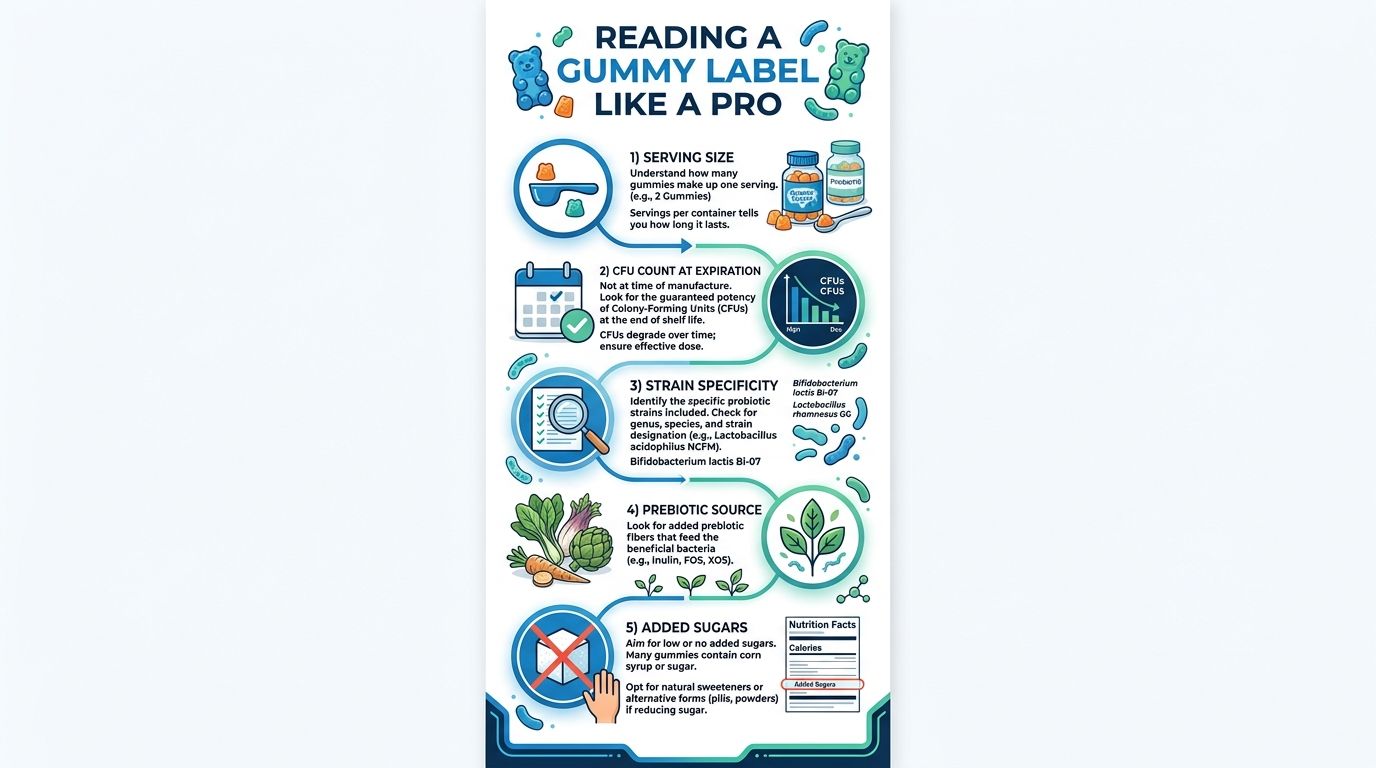
A shelf full of bright chewables can make every bottle look similar, but the label tells a different story. Start with the line that says what is still present at expiration. That detail matters more than a large number printed at manufacture, because live cultures can lose potency over time. If the label does not make that clear, you are guessing more than you are buying.
What to scan first
Start with the serving size, because two gummies may count as the full serving even if the bottle looks like it will last a long time. Then look for the CFU count at expiration, not just the starting number. After that, check whether the label names the strain, not just “probiotic blend,” because genus, species, and strain designation are what make the product interpretable.
What the gummy itself is telling you
The base matters too. Many gummies use pectin instead of gelatin, which matters if you are vegetarian, vegan, or avoiding animal-derived ingredients. That is not a side note, it is part of whether the product fits your routine.
The formulation underneath that friendly texture is where the tradeoffs show up. Peer-reviewed gummy-development research has shown carbohydrate loads of 75.1% to 82.76% w/w and total sugar of 65.4% to 79.91% w/w, which helps explain why texture, moisture, and microbial survival are such a balancing act. In plain terms, a gummy can be chewy and shelf-friendly, but that same structure can stress live cells if the formula is not built carefully.
Practical rule: A gummy that tastes like candy still counts as a supplement, not a dessert. Check the sugar, then check the strain.
A simple two-minute checklist
- Serving size: Confirm how many gummies make one dose.
- CFU at expiration: Look for the count that matters most for shelf life.
- Strain specificity: Do not settle for a vague blend if the label can be more exact.
- Prebiotic source: Identify whether the fiber is inulin, polydextrose, or something else.
- Added sugars: Make sure the flavor does not hide the sugar load.
If you are comparing a prebiotic product with a strawberry chewable, this product page is a good example of why form and ingredients need to be read together, not separately.
Who Should and Shouldn't Take Them
These gummies make the most sense for people who want a simple daily routine, can't swallow capsules comfortably, or want a lower-intensity product for maintenance rather than a more aggressive supplement stack. They're also a practical fit for someone who notices digestive changes during travel or after a disrupted routine and wants a chewable option that's easier to remember.
They're less automatic for people with more complicated gut situations. If someone has SIBO, active gastrointestinal disease, is immunocompromised, or takes immunosuppressants, I'd want them to check with a clinician first. The issue isn't fear, it's matching the tool to the medical context.
A quick fit check
- Good candidate: You want a gummy because pills are a nonstarter, and you're looking for everyday digestive support.
- Good candidate: You want a synbiotic with fiber in the same product and you're comfortable reading labels carefully.
- Needs caution: You have an active GI condition, complex medical history, or a clinician has already told you to be careful with live-culture products.
People also sometimes assume “natural” means harmless. That's not a safe shortcut here. The product still contains live organisms or fermentable fibers, and those can be useful for one person and a poor fit for another.
If you're unsure, the most useful question is simple. Does this product match your goal, your digestion, and your comfort with the format? If the answer is fuzzy, a different category may be a better move.
Dosing, Timing, Storage, and Shelf Life
For most maintenance products, the daily routine is usually straightforward, one to two gummies depending on the serving panel. The question is less about taking them in a dramatic window and more about taking them consistently enough that the product has a chance to matter. If the label suggests taking it with food, that can be worth following, especially when the gummy includes both live cultures and a sugary matrix.
Storage is where a lot of value gets lost. Keep gummies cool, dry, and away from direct sunlight unless the label says refrigeration is required. Heat and humidity are rough on both texture and viability, which is why a product that looks fine on day one can age badly on a warm shelf.
CFU counts can decline over time, and that's why at expiration labeling matters so much. A bottle can look impressive at the start and still underdeliver later if the strain doesn't hold up. That's also why the gummy formula itself matters, because the same sugar-heavy matrix that makes the product pleasant to chew can challenge live organisms during processing and storage.
The market context helps set expectations too. The global probiotics and prebiotic gummies market is estimated at USD 2.5 billion in 2025 with a projected 7% CAGR from 2025 to 2033, reaching USD 4.2 billion by 2033; the same source also estimates roughly 200 million units sold annually at about USD 10 per bottle with 60 gummies per bottle. A separate estimate in that source puts the category at about USD 1.8 billion in 2022 and potentially over USD 2.7 billion by 2027. That's a useful price-and-scale reality check, not a cue to overpay for packaging. Probiotics and prebiotic gummies market report
Buyer checklist: match the type to your goal, verify the strain, confirm the CFU at expiration, check the fiber source, review added sugars, and store the bottle the way the label says.
If a product passes that checklist, it's worth considering. If it fails two or three of those points, the shiny front panel probably isn't telling you much.
Shopping the CalVitamin Catalog for Gut Health
CalVitamin's catalog gives you a few ways to shop for this category without forcing one format on everyone. If you want a capsule, veggie capsule, or gummy, the site's product pages let you compare dosage forms, and select listings also show attributes like halal, gelatin-free, and cruelty-free for shoppers with dietary or ethical requirements. The site also surfaces ratings and reviews, plus pricing cues like Special Price and As low as tiers, which helps when you're comparing value across similar products. Digestive Advantage probiotic gummies 80ct

If you want a human answer before buying, CalVitamin also lists a toll-free support line, 1-888-510-9080, and a Jacksonville-based team for U.S. shoppers who prefer to ask questions first. That can be especially useful if you're deciding between a prebiotic, probiotic, or synbiotic option and want to match the format to your routine instead of guessing from the front label alone.
The cleanest way to shop this topic is simple. Decide which type you want, which attributes matter to you, and which format you'll take consistently. If those three pieces line up, the rest of the aisle gets a lot less confusing.
CalVitamin carries digestive-support options in multiple formats, so you can compare prebiotic, probiotic, and synbiotic choices without treating every gummy like the same product. If you want to keep shopping with a clearer label-reading lens, visit CalVitamin and use the product details, attributes, and support options to narrow down the right fit for your routine.






