

You're standing in the supplement aisle with two bottles in hand, one promising probiotics, the other prebiotics, and both sounding like they belong in the same routine. They're related, but they don't follow the same rules, and that's where most shoppers get tripped up. Probiotics are live microorganisms, prebiotics are fermentable substrates, and that difference changes how you choose them, when you take them, how you store them, and what to do if your stomach pushes back.
Table of Contents
- Why Probiotics and Prebiotics Follow Different Rules
- Reading the Label Before You Buy
- Dosing by Strain and Goal, Not by Hype
- Building Your Daily Routine Step by Step
- Storage and Shelf Life Done Right
- Troubleshooting Bloating, Gas, and Other Side Effects
- A Quick Checklist for Confident Daily Use
Why Probiotics and Prebiotics Follow Different Rules
One is alive, the other is fuel
A probiotic bottle is a live-culture product. A prebiotic bottle is food for the microbes already living in your gut. That sounds like a small distinction until you get to the practical stuff, because a living product has survival issues, while a fiber-based product has fermentation issues.
That's why advice that works for one can miss the mark for the other. Probiotics have to survive manufacturing, storage, stomach acid, and timing. Prebiotics don't need refrigeration, but they can cause gas or bloating if you start too fast or take too much too soon. The label, not the marketing, should tell you what kind of product you're holding.
Practical rule: If the product is alive, think survival. If the product is fiber, think tolerance.
Why the category itself matters
The prebiotic concept wasn't just invented as a buzzword and left vague. It was first defined in 1995, revised in 2004, and broadened again in 2017 to reflect a more precise scientific definition of substrates used by host microorganisms when a health benefit is shown. That history matters because it tells you the category has real boundaries, not just shelf appeal. The concept is documented in the review on prebiotic definitions and practical use from this paper.
For shoppers, the takeaway is simple. A probiotic is not “better fiber,” and a prebiotic is not “dead probiotic.” They work together, but they don't behave the same way in your cabinet or your gut. If you want a quick compare-and-contrast primer, this overview on the difference between prebiotic and probiotic is useful as a starting point.

Reading the Label Before You Buy
What a probiotic label has to tell you
A serious probiotic label should identify the genus, species, and strain. That detail matters because different strains of the same species can behave differently. A label that says only “Lactobacillus” is too vague to guide a purchase. A label that names the full strain gives you something you can compare against human research and product directions.
You also want the CFU count stated in a way that's meaningful at the time you'll use the product, not just when it left the factory. ISAPP advises manufacturers to list total CFUs through the expiration or use-by date, ideally for each strain, rather than only at manufacture. That's the number that matters when you open the bottle later, not the number printed for a fresh run off the line.
Practical rule: If a probiotic won't tell you the strain and the CFU through expiration, it's asking for blind trust.
What else to scan before you buy
Compare the inactive ingredients, capsule type, and storage directions. Fillers, gelatin, added fibers, and allergens can matter if you're sensitive or trying to keep the product simple. Storage symbols matter too, because a shelf-stable probiotic and a refrigerated one are not interchangeable if the label says otherwise.
For a practical label walk-through, the guide on how to choose probiotics is a useful companion. When you're comparing bottles, the right question isn't “Which one sounds strongest?” It's “Which one names the exact strain, the right dose, and the storage conditions I can follow?”
A quick side-by-side filter
| Label detail | What to look for | Why it matters |
|---|---|---|
| Strain name | Full genus, species, and strain | Lets you match the product to evidence |
| CFU statement | Guaranteed through expiration or use-by date | Tells you what you're actually taking |
| Storage direction | Refrigerate or store cool and dry | Protects live cultures from damage |
| Extra ingredients | Allergens, gelatin, fillers, added fibers | Affects tolerance and compatibility |
Dosing by Strain and Goal, Not by Hype
Why higher CFU isn't automatically better
A bigger CFU number doesn't guarantee a better result. The World Gastroenterology Organisation says there isn't a single general probiotic dosage that can be recommended, because benefits depend on evidence from human studies involving specific strains, amounts, and treatment durations. The NIH Office of Dietary Supplements gives the same practical message, recommend only strains, doses, and durations shown to help in human research, not whatever looks largest on the shelf.
That means the dose has to fit the goal. If a product was studied for a specific digestive concern at a certain serving, the evidence belongs to that exact setup, not to a bigger bottle with a louder front label. A 50 billion product for general digestive support can still be a weaker choice than a 10 billion product that matches the strain and serving studied.
How to compare products like a practitioner
Start with the strain name, then look for the dose used in human studies or in the manufacturer's directions that cite evidence. If a product page doesn't connect the strain to a studied use, treat the marketing copy as just that, marketing. The same applies to “more is better” claims. Often more is just more expensive.
| Strain | Common use case | Evidence-supported range |
|---|---|---|
| Specific strain named on label | Match the product to the use studied in humans | Follow the dose used in the relevant evidence |
| Different strain of same species | May have a different effect | Do not assume equivalence |
| High-CFU blend | Broad digestive positioning | Not automatically superior to a lower-dose strain with direct evidence |
For a broader category discussion, the article on probiotics, prebiotics, and postbiotics gives useful context, but the shopping rule stays the same. Match the strain and the serving to the evidence, then ignore the urge to chase the biggest CFU number.
Building Your Daily Routine Step by Step
Start with one product, not three
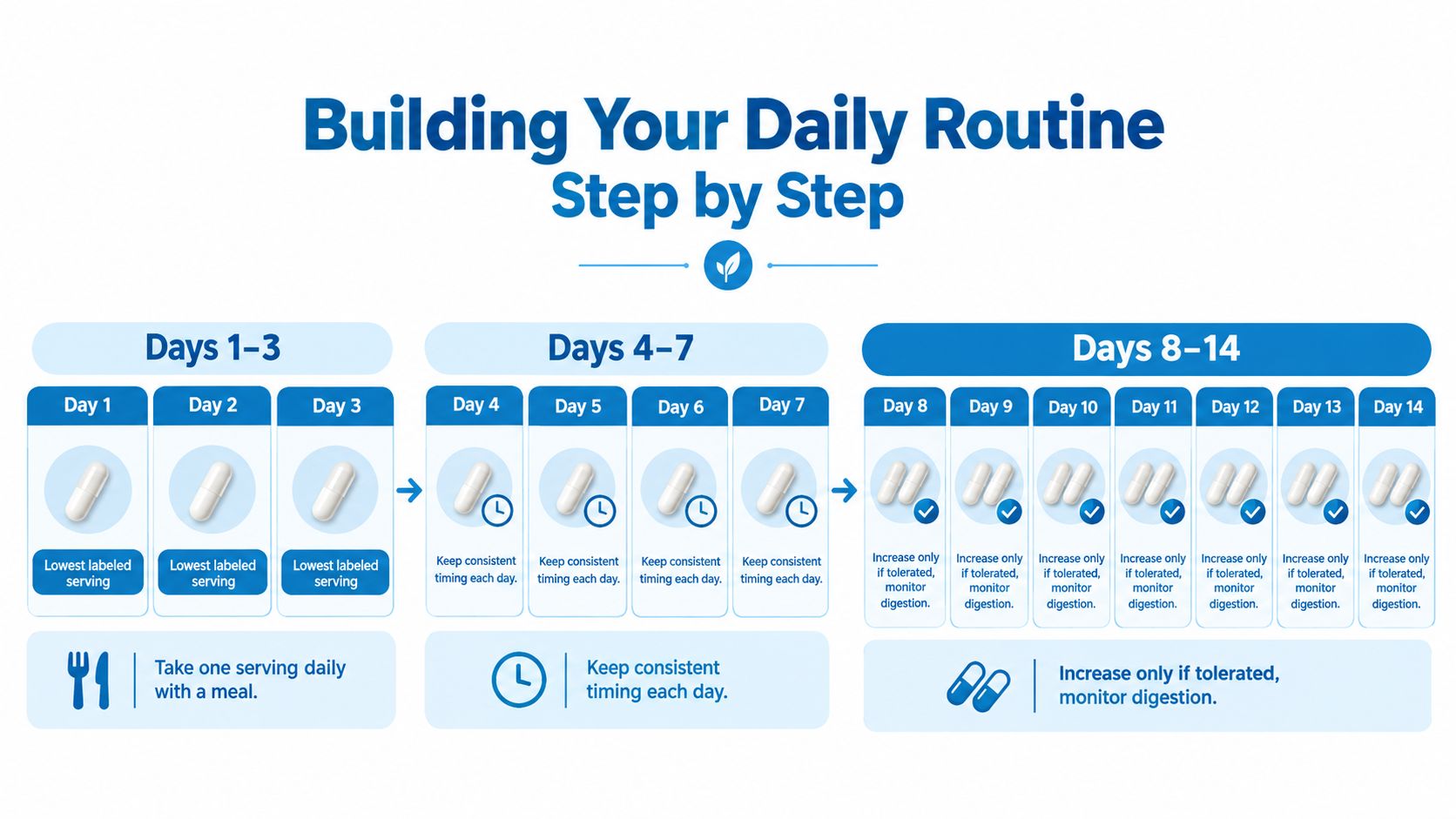
If you're introducing a probiotic and a prebiotic at the same time, you're making it harder to tell what helps and what bothers you. Begin with one product at the lowest labeled serving for several days. Once that feels stable, keep the dose steady before you consider adding the other.
Taking a probiotic with or shortly after a meal, especially one that contains some fat, may help bacterial survival better than taking it on an empty stomach. Human evidence still doesn't support one universal clock time, so consistency and label directions matter more than the idea of a perfect morning ritual. A probiotic that fits your breakfast routine is more useful than a “best” capsule you keep forgetting.
Practical rule: The best time is the time you'll actually repeat.
Use a simple two-week log
Write down the dose, the time, stool consistency, gas, bloating, urgency, and how your abdomen feels after meals. That gives you real feedback instead of trying to remember whether “it seemed fine.” If a product helps, the pattern usually shows up in routine, not in one dramatic day.
A simple onboarding rhythm looks like this:
- Days 1 to 3: Take the lowest labeled serving of the probiotic with a meal.
- Days 4 to 7: Keep the same product and the same timing.
- Day 7 checkpoint: Review stool comfort, gas, and bloating before changing anything.
- Days 8 to 14: Add a prebiotic only after the probiotic feels tolerated, then introduce it gradually.
For a daily-use example, a supplement like the CalVitamin probiotic listed with one capsule daily and consistent use shows the kind of label clarity you want to see, but the label still wins over habit.
Before you take your next capsule, place the product where your routine already lives, next to breakfast, inside your travel kit, or by the coffee maker. Consistency beats improvisation.
Storage and Shelf Life Done Right
Live cultures need protection, not guesswork
Probiotics are vulnerable to moisture, heat, oxygen, and light, though some formulations are built to tolerate room temperature better than others. That's why a bottle can say refrigerate, store in a cool dry place, or remain shelf-stable. Those directions aren't decorative. They're part of keeping the organisms viable long enough to do anything useful.
If the label says refrigeration required, follow it. If it says cool and dry, don't leave it in a hot car, a steamy bathroom, or a sunny windowsill. An overnight stint on the counter usually isn't the same as a product being ruined, but repeated exposure is a different story. When in doubt, prioritize the storage direction printed on the bottle over what somebody online swears by.
Prebiotics are easier to store, but not careless-proof
Prebiotics are non-viable fibers, so they don't need cold storage. That said, they can still clump, absorb odors, or degrade in a badly sealed container. You're protecting convenience and consistency here, not microbial survival.
The simplest way to think about it is this:
- Refrigerated probiotics need colder storage because they contain live organisms.
- Shelf-stable probiotics are formulated to survive room conditions, but still need protection from heat and moisture.
- Prebiotics are easier to store, but still belong in a dry, sealed container.
Timing advice is less universal than people think
The old “take it first thing in the morning on an empty stomach” rule is too neat for the evidence. Practical guidance now points out that fasting-associated gastric acidity can reduce survival, while taking probiotics with or shortly after a meal, especially one containing fat, may improve viability. Human evidence still isn't strong enough to name one best time of day for every strain and formulation.
Coffee or hot tea won't solve or ruin the whole picture by themselves, but they're not the point. Neither is before-versus-after-workout timing. The practical win is to match the label, keep the dose consistent, and store the bottle the way the manufacturer says. That beats chasing a universal clock-time myth.
Troubleshooting Bloating, Gas, and Other Side Effects
When discomfort is part of the adjustment
Prebiotics can ferment quickly, and that's why gas, bloating, and abdominal discomfort show up when people start too big, too fast. Probiotics can also briefly aggravate symptoms in some users, especially when the dose is high or the gut is already sensitive. In both cases, the first assumption should be “tolerance issue,” not “this category never works for me.”
A useful mental model is that the gut is reacting to a change in substrate, not just to the word probiotic or prebiotic on the label. Rapid fermentation and abrupt dose jumps are common reasons people quit too early. That's unfortunate, because a smaller, steadier dose often tells you more than a dramatic first day.
What to do when symptoms show up
Use a tiered response instead of abandoning the product at the first sign of gas.
- Drop back to the last tolerated dose: If symptoms increased after a dose jump, return to the earlier amount.
- Slow the titration: Hold the same serving for several more days before increasing again.
- Separate new products: Don't add a prebiotic, a probiotic, and another fiber at the same time.
- Keep fluids up: Especially with prebiotics, adequate fluid helps tolerance.
- Stop if symptoms persist or intensify: A reaction that doesn't settle deserves attention.
The goal isn't to “push through” gut discomfort. It's to find the dose your body can actually live with.
Know when to stop self-treatment
Persistent diarrhea, fever, blood in the stool, or worsening abdominal pain shouldn't be managed as a routine adjustment. People who are severely ill, immunocompromised, or on complex medical regimens should get clinician guidance before starting. Rare serious infections have been reported mainly in those higher-risk groups, so safety triage matters as much as label reading.
A Quick Checklist for Confident Daily Use
Choose by strain, not by slogan. If the label doesn't identify the exact microorganism, the product is too vague for careful use.
Match the serving to the evidence. Bigger CFU counts don't automatically mean better results, and the studied strain matters more than the front-of-package claim.
Use one change at a time. Start with the probiotic, then layer in the prebiotic only after the first product is tolerated.
Store it the way the label says. Probiotics may need refrigeration or at least a cool dry place, while prebiotics need dryness and a sealed container.
Track your response for two weeks. Comfort, gas, stool form, and consistency tell you more than hype ever will.
If you're immunocompromised, severely ill, or dealing with persistent diarrhea, pause the experiment and speak with a clinician. Otherwise, keep the routine steady, make one change at a time, and give the product a real trial instead of a guessing game. Good gut support is a long game, not a one-bottle verdict.
CalVitamin carries probiotic and prebiotic options alongside other supplement categories, which makes it a practical place to compare labels, forms, and usage directions in one spot. If you want to shop with the strain, storage, and dosing details in mind, visit CalVitamin and use the checklist above as you compare products.






