

Probiotics are live beneficial microorganisms, prebiotics are the compounds that selectively feed helpful gut microbes, and postbiotics are inactivated microorganisms or their components that can provide health benefits. The clearest way to understand probiotics, prebiotics, and postbiotics is as one ecosystem, not three competing supplement trends.
You may have stood in a store aisle holding a probiotic capsule, a fiber powder, and a newer postbiotic product, wondering which one matches your goal. The labels can sound interchangeable, but they describe different jobs. One supplies living organisms, another supplies their preferred fuel, and the third provides microbial preparations or compounds without requiring live organisms to remain active.
That distinction matters when you're choosing support for digestion or discussing a persistent symptom with a healthcare professional. A garden offers a useful mental model: probiotics are the plants, prebiotics are the nourishment in the soil, and postbiotics are part of the useful harvest created by the living system.
Table of Contents
- Understanding the Gut Ecosystem
- Defining Probiotics, Prebiotics, and Postbiotics
- Mechanisms of Action and Health Benefits
- Food Sources and Supplement Forms
- How to Choose the Right Formulation
- Safety, Interactions, and Best Practices
- Putting It All Together for Lasting Gut Health
Understanding the Gut Ecosystem
Think about a garden after heavy rain. Planting new seeds may help, but the seeds still need suitable soil and nourishment. Your gut ecosystem works in a comparable way. Adding a probiotic introduces selected living microorganisms, while prebiotic material gives resident microbes something to ferment. Postbiotics represent a different kind of support, because they consist of inactivated microorganisms, their components, or microbial products that can interact with the body without needing to stay alive.
This is why probiotics, prebiotics, and postbiotics aren't rivals. They occupy different positions in the same biological system. A probiotic may contribute a live organism, a prebiotic may help selected host microorganisms grow or function, and the microbial activity can generate compounds that affect the surrounding gut environment.
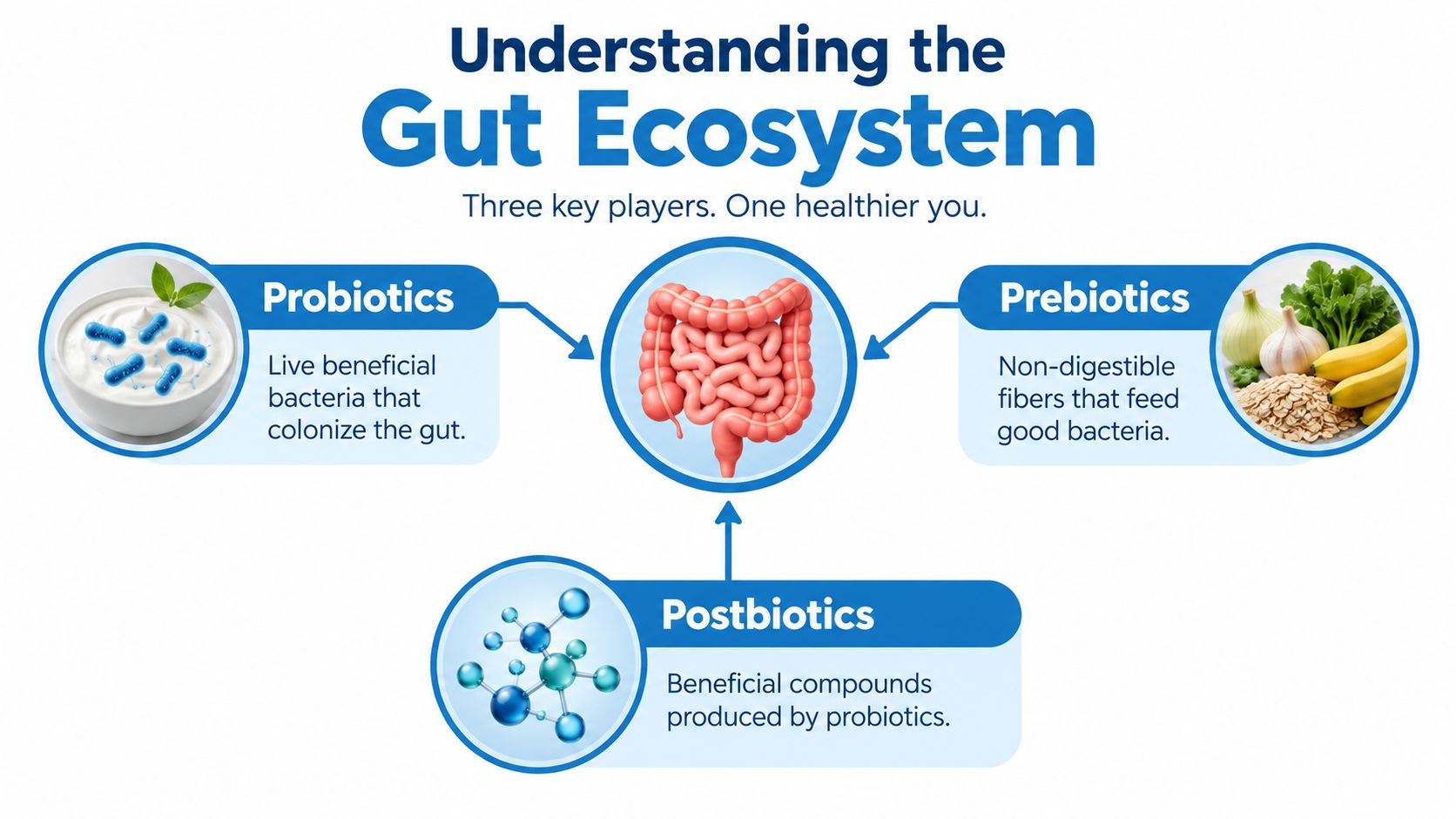
The garden analogy in practice
- Probiotics are the living plants. They're microorganisms selected for a potential health benefit when consumed in adequate amounts.
- Prebiotics are soil nourishment. They're substrates that host microorganisms can selectively use, rather than being generic fiber.
- Postbiotics are useful outputs. They're preparations of inanimate microorganisms or their components, and they may also include microbial substances with biological activity.
The analogy has limits. A probiotic doesn't necessarily permanently colonize the gut, and a postbiotic isn't merely any substance produced by bacteria. Still, the model helps prevent a common mistake: assuming that every product carrying a “biotic” label performs the same function.
If your immediate concern is loose stool or digestive discomfort, start by identifying the symptom and its context rather than buying several products at once. A practical resource such as this guide to diarrhea relief and gut health can help you think through when self-care may be reasonable and when medical assessment deserves priority.
Defining Probiotics, Prebiotics, and Postbiotics
The words became more precise through international scientific consensus. The ISAPP consensus paper records a sequence of milestones that shaped modern terminology: 2014 for the standardized probiotic definition, 2017 for the updated prebiotic definition, and 2021 for the postbiotic definition.
Probiotics are living microorganisms
ISAPP defines probiotics as “live microorganisms that, when administered in adequate amounts, confer a health benefit on the host.” Three parts matter:
- The microorganism must be alive when administered.
- The product must provide an adequate amount.
- The specific organism must be connected to a demonstrated health benefit.
That last point prevents a broad claim from being applied to every bacterium in a category. A product should identify its microorganism clearly, ideally down to the strain, and connect its intended use to relevant evidence.
Prebiotics are selective microbial fuel
ISAPP defines a prebiotic as “a substrate that is selectively utilized by host microorganisms conferring a health benefit.” In plain language, it's a material that particular microorganisms can use in a way associated with a health benefit.
This definition is narrower than “anything that contains fiber.” Some fibers may support digestion or bowel regularity without meeting the scientific definition of a prebiotic. Prebiotic ingredients can appear in plant foods and supplements, but the key question is whether the substrate is selectively used by host microorganisms.
Postbiotics don't need to be alive
ISAPP defines a postbiotic as “a preparation of inanimate microorganisms and/or their components that confers a health benefit on the host,” as described in the ISAPP postbiotic consensus. Viability is therefore not required.
That difference can matter during manufacturing and storage. Inactivation can make formulation and process control more predictable, while microbial structures or components may remain biologically relevant. However, “inactive” doesn't automatically mean “effective.” The preparation still needs evidence for a defined benefit.
Practical rule: Read the label as a description of function, not as a promise that every product in a category works the same way.
Mechanisms of Action and Health Benefits
The three categories can influence the gut through different routes. Probiotics introduce selected live microorganisms, prebiotics provide substrates that host microbes can selectively use, and postbiotics deliver inanimate microbial preparations or components. These mechanisms overlap in the gut, but the evidence isn't interchangeable across products.
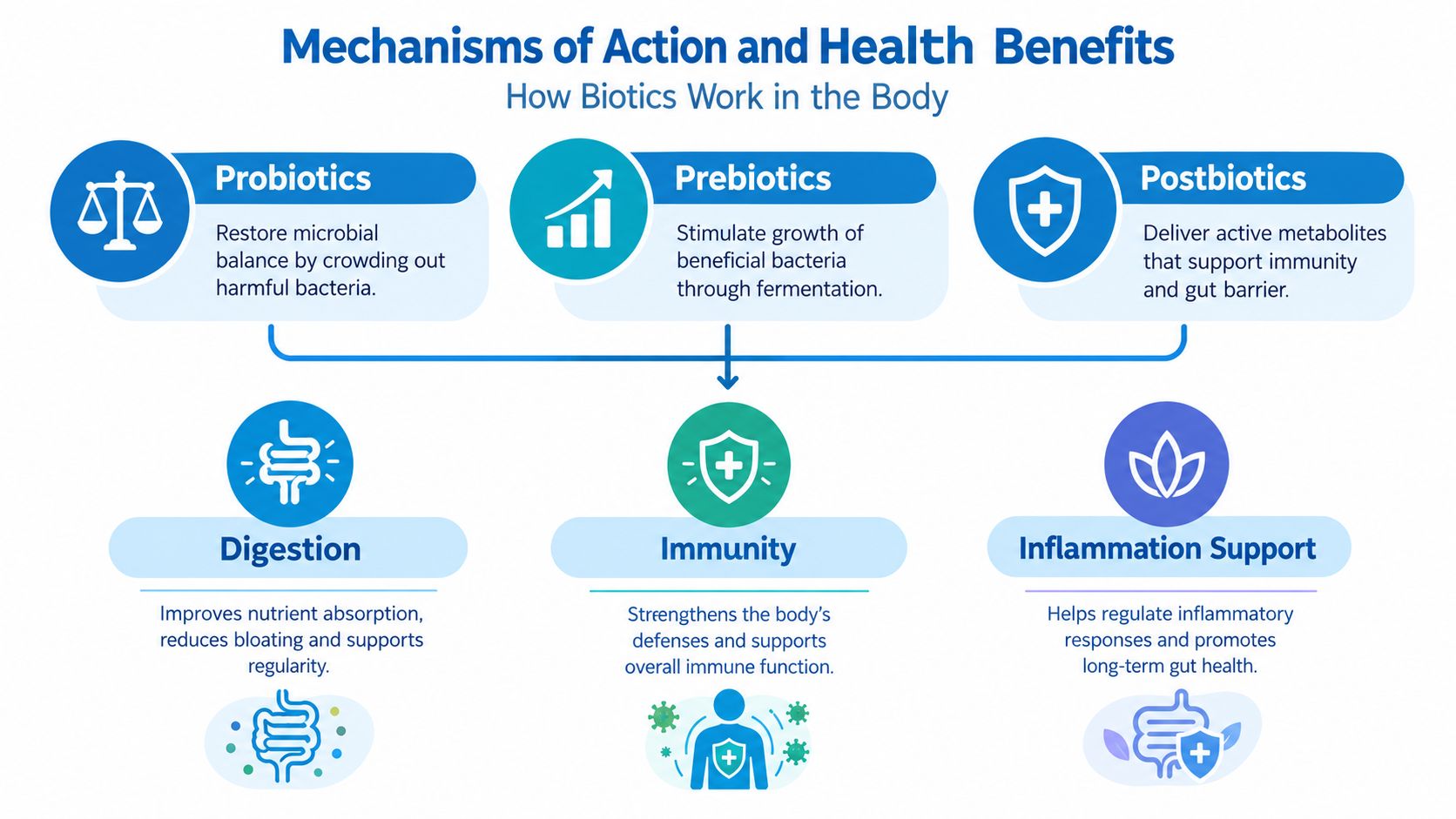
What each category can do
Probiotics may interact with resident microbes, the gut lining, and immune signaling. Their effects are often strain-specific, so “probiotic” describes a category rather than a single treatment. In IBS, a 2024 network meta-analysis found that probiotics improved global symptoms versus placebo, with OR 0.53 and a 95% confidence interval from 0.48 to 0.59. The same analysis didn't find significant improvement for prebiotics and synbiotics, underscoring why the broad product label isn't enough.
Prebiotics can be fermented by selected host microorganisms. Fermentation changes the local environment and can produce microbial metabolites, but tolerance varies. Someone with a sensitive gut may experience gas or bloating when increasing fermentable material quickly, even when the longer-term dietary direction is sensible.
Postbiotics can act through microbial components and metabolites that interact with the gut barrier or immune system. Their practical appeal comes partly from the fact that they don't require viable organisms in the finished preparation. Still, a postbiotic preparation should be evaluated according to its specific composition, dose, target symptom, and clinical evidence.
What the clinical evidence actually supports
IBS illustrates the difference between promising evidence and universal claims. A 2026 systematic review and meta-analysis reported that postbiotics significantly reduced IBS symptom severity versus placebo, with SMD -1.36, a 95% confidence interval from -1.75 to -0.97, and p < 0.00001 in the published analysis. A separate 2025 meta-analysis included 4 randomized controlled trials and 1,062 participants, reporting lower IBS symptom severity with postbiotics, SMD -1.36, and pain response, RR 2.46, while safety was similar to placebo. The review also described low certainty and moderate to substantial heterogeneity in the PubMed record.
Those findings support a targeted IBS discussion, not a blanket promise for immunity, mood, metabolism, or general wellness. The recent review on practical clinical use emphasizes fragmented evidence, incomplete mechanisms, and the need for larger standardized trials. Choose according to the outcome you care about, not the novelty of the ingredient.
Food Sources and Supplement Forms
Food and supplements solve different problems. Foods provide a broader eating pattern, while supplements can offer a defined microorganism, fiber, or postbiotic preparation in a controlled format. Neither option automatically wins, because the appropriate choice depends on your diet, tolerance, target outcome, and ability to use the product consistently.
Fermented foods such as yogurt, kefir, sauerkraut, kimchi, miso, and kombucha may contain living microorganisms, although processing and labeling determine what remains in the final product. Prebiotic substrates occur in foods such as fruits, vegetables, legumes, and whole grains. Postbiotic materials may be present in fermented foods, but their identity and amount aren't necessarily clear from a food label.
| Category | Food examples | Supplement forms | Main advantage | Main limitation |
|---|---|---|---|---|
| Probiotics | Yogurt, kefir, kimchi, sauerkraut | Capsules, powders, gummies | Adds a defined live microorganism when the label identifies it | Viability and strain-specific effects matter |
| Prebiotics | Fruits, vegetables, legumes, whole grains | Powders, chewables, combination capsules | Provides a measurable substrate | Fermentation may cause discomfort if increased too quickly |
| Postbiotics | Selected fermented foods and microbial preparations | Capsules or other labeled preparations | Doesn't require live organisms in the finished product | Evidence remains specific to the preparation and outcome |
Matching the format to your routine
A food-first pattern is often the simplest foundation. Add plant variety gradually, include fermented foods that you tolerate, and observe changes rather than assuming that more is better. A supplement may make more sense when your diet has a clear gap or when a clinician has identified a targeted use.
For a capsule that combines these categories, inspect the exact strain and prebiotic ingredient rather than relying on the front label. You can review an example such as Culturelle Digestive Daily Probiotic and Prebiotic, then compare its label with the evidence relevant to your goal.
How to Choose the Right Formulation
Start with the symptom or outcome, not the product category. “Gut health” is too broad to guide a purchase. Ask whether you're trying to support regularity, digestive comfort, a clinician-diagnosed condition, or a dietary gap. The answer determines which evidence deserves attention.
Use a label-reading sequence
First, identify the organism or preparation. For a probiotic, look for genus, species, and strain. A broad name such as “multiple beneficial cultures” makes comparison difficult. For a postbiotic, look for the inactivated organism or defined components, along with the intended benefit.
Next, check the evidence match. A strain studied for one digestive endpoint shouldn't automatically be assumed to help another. The IBS findings described earlier show why this matters. Clinical outcomes belong to specific products and populations, not to the word “probiotic” or “postbiotic alone.”
Then, assess the prebiotic material. Different substrates can produce different tolerance patterns. If your gut reacts easily to fermentable fibers, choose a modest introduction and monitor how you respond instead of combining several new fiber products.
Dose and timing require restraint
Follow the product label unless your healthcare professional gives different instructions. There isn't one universal dose for all probiotics, prebiotics, or postbiotics, and the evidence may use a formulation that differs from the one in your cabinet.
Timing should support consistency and comfort. If the label doesn't specify a time, choose a routine you can maintain, such as taking a capsule with a regular meal. Introduce one new product at a time when possible, because changing several variables together makes it hard to tell what helped or caused discomfort.
The useful question isn't “Which biotic is strongest?” It's “Which defined preparation has evidence for the outcome I want, and can I tolerate and use it consistently?”
Quality signals include clear ingredient identification, storage directions, expiration information, and transparent manufacturing details. Third-party testing can add reassurance, but it doesn't replace checking whether the formulation fits your needs.
Safety, Interactions, and Best Practices
Natural doesn't mean universally suitable. Probiotics, prebiotics, and postbiotics can affect digestion, and an individual response may differ from the experience described on a product label. People with chronic illness, significant immune suppression, complex medical conditions, or persistent unexplained symptoms should ask a qualified healthcare professional before starting a supplement.
A practical safety checklist
- Introduce changes gradually. A sudden increase in fermentable fiber may cause gas, bloating, or altered bowel habits. Reduce the pace if symptoms become disruptive.
- Check your medications. Ask a pharmacist or clinician to review potential interactions, especially when you take prescription medicines or manage a condition requiring close monitoring.
- Protect vulnerable users. Children, older adults with complex health needs, pregnant people, and immunocompromised individuals may need individualized advice.
- Separate supplement effects from warning signs. Blood in stool, severe pain, dehydration, unexplained weight change, persistent fever, or ongoing diarrhea needs medical attention rather than repeated product trials.
- Follow storage instructions. Live organisms can be sensitive to heat and moisture, while inactivated preparations may have different handling requirements.
A clinician can also help distinguish a tolerable adjustment from a sign that a product isn't appropriate. If you're comparing a combined probiotic, prebiotic, and fiber formula, review the specific label and discuss it with your provider. For example, Physician's Choice 60B Probiotic Prebiotic Fiber should be considered as a defined product, not as a stand-in for every formulation in the category.
Putting It All Together for Lasting Gut Health
The garden model leads to a practical conclusion. You don't improve a garden by adding the same thing repeatedly. You create suitable conditions, provide nourishment, select plants for the environment, and use the harvest according to the need. Gut support works similarly.
Begin with the basics you can sustain. Build meals around varied plant foods, add fermented foods if you tolerate them, and increase fiber at a pace your digestion accepts. If you choose a supplement, select one with a clearly identified probiotic strain, a named prebiotic substrate, or a defined postbiotic preparation that matches your target outcome.
A simple decision path
- Name the goal. Digestive comfort, bowel regularity, or a diagnosed condition calls for different questions.
- Choose one focused intervention. Avoid starting several new products together.
- Read the complete label. Check the strain or preparation, serving directions, storage, and warnings.
- Track your response. Note symptoms, comfort, and consistency without treating every change as proof of long-term benefit.
- Reassess with professional help. Persistent or serious symptoms deserve clinical evaluation.
The evidence supports a careful, targeted approach rather than a race toward “more microbiome support.” Probiotics have strain-specific findings, prebiotic results depend on the substrate and host context, and postbiotics have encouraging but still condition-specific evidence. The future of this field will depend on better standardized trials and clearer links between a defined preparation and a verifiable endpoint.
You don't need to master every microbiome term before making a sensible choice. Start with your goal, respect your tolerance, and treat a supplement as one tool within a broader eating and healthcare plan.
CalVitamin offers an online selection of probiotic and prebiotic supplements in formats such as capsules, veggie capsules, gummies, and other wellness products. Visit CalVitamin to compare labeled formulations and choose a product that fits your digestive health routine.






