

You're in bed, tired enough to sleep, but your mind hasn't received the message. You check the clock, change positions, and wonder whether a capsule, gummy, powder, or herbal blend might finally help. Then the label makes things harder: one product contains a long list of ingredients, another promises “deep sleep,” and a third offers only three familiar names.
The sleep 3 ingredients trend responds to that confusion with a simpler idea. A formula doesn't need the longest label to be useful. It needs ingredients chosen for the actual problem, whether that's difficulty falling asleep, a shifted body clock, or wakefulness driven by stress.
This guide uses that matching approach. You'll learn how three common ingredients work, when melatonin makes sense, when a melatonin-free formula may be more appropriate, how to read a label, and which safety questions deserve a clinician's input.
Table of Contents
- Why Three Ingredients Are Enough for Better Sleep
- How Sleep Works and Where Supplements Fit In
- The Three Sleep Ingredients Explained and How They Work
- Melatonin Blends Versus Melatonin Free Options Compared
- How to Choose a Quality Sleep Supplement on CalVitamin
- Common Misconceptions About Sleep Ingredients and Safety
- Your Next Steps to Better Sleep With the Right Blend
Why Three Ingredients Are Enough for Better Sleep
Consider two people buying the same sleep supplement. One lies awake because their bedtime changes from night to night. The other falls asleep easily but wakes with a racing mind after a stressful day. A three-ingredient formula could be relevant to both, but not necessarily the same formula.
That distinction matters because “sleep support” describes several different experiences. Sleep onset latency, the time it takes to fall asleep, is not the same as difficulty staying asleep. Stress-related alertness creates another challenge. Treating all three with the same large proprietary blend is like using one key for every lock.
A focused formula can make the label easier to understand. You can identify the active ingredients, check their individual amounts, and notice whether the combination fits your routine. You can also remove an ingredient that doesn't suit you, such as melatonin if you're concerned about next-day grogginess or don't need circadian support.
The commercial market helps explain why melatonin appears so often. In the U.S. mainstream sleep supplement market, ingredient sales reached $762 million in the year ending October 31, 2021, compared with $584 million the prior year, while melatonin accounted for $698 million, compared with $531 million previously, according to Nutritional Outlook's sleep ingredient coverage. Those figures show melatonin's role as a foundational ingredient, not proof that every sleeper needs it.
The useful question isn't “What's the strongest sleep supplement?” It's “What kind of sleep problem am I trying to support?”
The rest of this guide follows a practical path:
- Learn the job: Understand the difference between sleep timing, relaxation, and mental arousal.
- Compare the ingredients: See what melatonin, magnesium, and L-theanine can and can't reasonably do.
- Match the blend: Choose between melatonin-centered and melatonin-free options according to your sleep pattern.
- Check the label: Look for transparent amounts, sensible directions, and quality information.
- Start carefully: Use one consistent routine, observe your response, and seek professional advice when medications or health conditions are involved.
CalVitamin is one online retailer where shoppers can compare supplement formats and product information, but the same reasoning applies wherever you shop. A clear match beats an impressive-sounding ingredient list.
How Sleep Works and Where Supplements Fit In
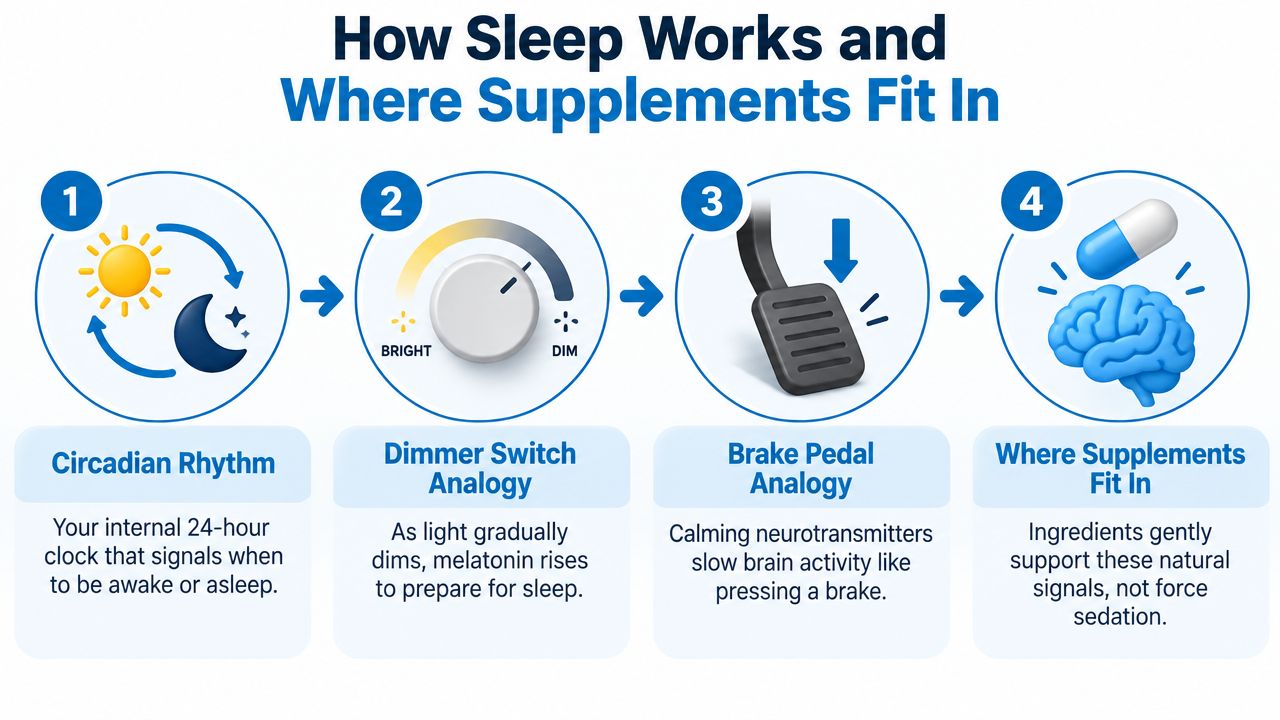
Your sleep system has two connected controls. The first is your circadian rhythm, an internal timing system that helps coordinate periods of wakefulness and sleep. The second is your level of brain and body arousal, which determines whether you can settle when the timing is right.
Think of circadian rhythm as a dimmer switch rather than an on-off button. Morning light turns the setting upward for daytime alertness. As evening becomes darker, the setting gradually lowers and the body produces more of its own melatonin signal. Bright light, late-night screens, travel, or irregular schedules can make the switch stay brighter when you want it dim.
A supplement containing melatonin doesn't replace the entire sleep system. It supplies a signal associated with nighttime, which is why it may be more relevant to circadian misalignment or trouble initiating sleep than to every kind of nighttime waking.
Three different sleep jobs
A second analogy helps with calming ingredients. Imagine your nervous system as a car approaching a quiet residential street. L-theanine, magnesium, and some botanical ingredients are often used to support the equivalent of easing off the accelerator and applying the brake. They aren't meant to force the engine to stop. They may help create conditions in which rest feels easier.
That leads to three practical sleep phenotypes:
- Falling asleep: You're physically tired but remain awake for a long time after going to bed. Timing, mental activation, and bedtime habits may all matter.
- Staying asleep: You fall asleep without much trouble but wake during the night or sleep feels fragmented. A supplement may not address the underlying reason, such as discomfort, an irregular schedule, or an untreated sleep issue.
- Stress-related wakefulness: Your body is in bed, but your attention keeps returning to unfinished tasks, worries, or plans for the next day. A calming ingredient may fit better than a stronger nighttime signal.
The fit improves when supplements accompany basic signals your body already understands. Keep your sleep and wake times consistent, reduce stimulating light before bed, and create a repeatable wind-down routine. A capsule can support that pattern, but it can't compensate for a schedule that constantly changes.
Supplements should gently support sleep timing or relaxation. They shouldn't be treated as a substitute for investigating persistent sleep problems.
The Three Sleep Ingredients Explained and How They Work
A three-ingredient sleep formula usually mixes a nighttime signal, a mineral tied to normal nervous-system function, and a helper for mental quiet. The label matters more than the count. Two products can both say “three ingredients” and still be built for very different sleep problems.
That difference becomes clearer if you match the blend to the sleep phenotype in front of you. Trouble falling asleep often calls for a timing cue. Stress-related wakefulness usually calls for calming the mind. Staying asleep can be a different issue altogether, and a supplement may or may not fit depending on what is disturbing the night.
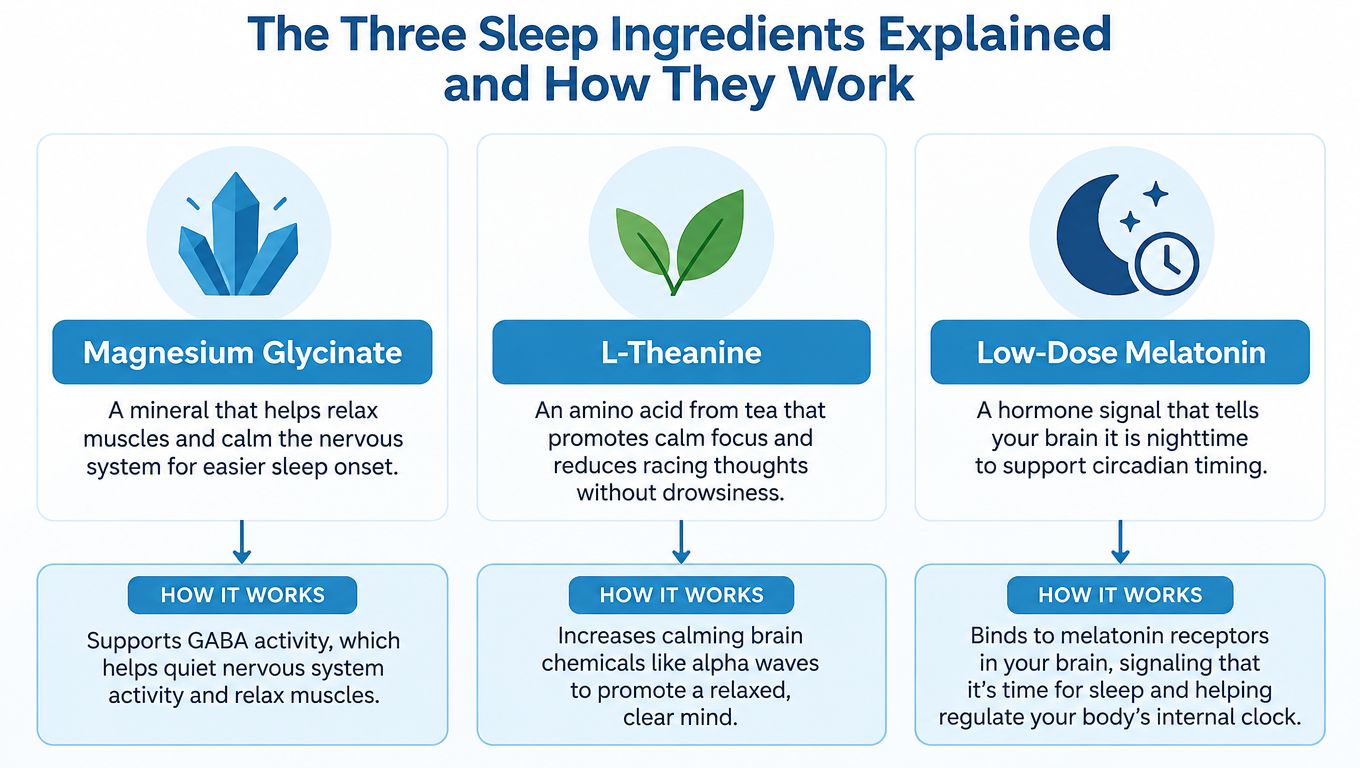
Low-dose melatonin
Melatonin is a hormone the body produces in response to darkness. In a supplement, it works like a nighttime message to the brain rather than a sedative that knocks you out.
It has the strongest clinical evidence among common sleep ingredients for helping with sleep onset. A meta-analysis of 19 randomized, placebo-controlled trials involving 1,683 participants found that melatonin reduced the time needed to fall asleep, increased total sleep time, and improved overall sleep quality, with effects that did not appear to fade with continued use, as summarized by All4Nutra's evidence review.
The effect is usually modest, not dramatic. That makes it a better fit for someone whose body clock is out of step with bedtime, such as after travel or a schedule change. If the main problem is wakefulness caused by shifting sleep timing, melatonin is often the ingredient to look for first.
More is not automatically better. Many commercial products contain higher amounts than the low-dose range discussed in evidence summaries, so the front label should not be read as a promise of stronger results.
Timing matters as much as the ingredient itself. Follow the product directions, and think about how you respond before taking it on a night when you need to be sharp the next morning.
Melatonin is mainly a timing tool. It is not a universal answer for every type of insomnia.
Magnesium, often as glycinate
Magnesium is a mineral involved in many body processes. In sleep formulas, it is often used for muscle relaxation and nervous-system support. Magnesium glycinate combines magnesium with glycine, an amino acid, and is commonly chosen because it is easy to take in capsule form.
The evidence is more conditional than the marketing language suggests. Industry coverage of current sleep formulations describes magnesium as part of growing melatonin-free combinations, while noting that benefits may be larger among people with low magnesium intake. That makes diet part of the picture. A magnesium-centered formula may make more sense when intake is limited, but it should not be treated as a guaranteed sleep fix.
Check the Supplement Facts panel for the amount of elemental magnesium, not just the name of the compound. Follow the serving instructions on the label. If you have a medical condition or take medication, ask a clinician or pharmacist whether it is suitable for you.
L-theanine
L-theanine is an amino acid found in tea leaves. In bedtime products, it is used to support a calmer mental state without making sleep feel like heavy sedation.
Its clearest role is for the mind that will not settle. You may feel physically tired, yet your attention keeps jumping from one task to the next. A formula with L-theanine may be aimed at that kind of mental transition, though individual responses vary and the evidence for ingredients other than melatonin is more limited.
One product example is NOW L-Theanine 200 mg with Inositol, which shows why shoppers should read the full panel instead of relying on an ingredient headline. The presence of L-theanine alone does not automatically make a product a sleep formula.
Timing should follow the product directions and your own response. Avoid stacking multiple calming products casually, especially if you use medicines that affect alertness.
A short video can add another way to visualize how these ingredients are commonly positioned in sleep-support formulas.
Melatonin Blends Versus Melatonin Free Options Compared
A sleep formula should match the job your night needs done.
If falling asleep is the main problem, a melatonin-centered blend can make sense, especially when your schedule has shifted or evening light has pushed your body clock later. If your sleep timing is already fairly steady but your mind keeps running, a melatonin-free blend may fit better. Some people also choose melatonin-free products because they want to avoid next-day grogginess, avoid a hormone-like ingredient, or keep the formula focused on relaxation rather than timing.
That difference matters more than the front label. A formula with several ingredients is not automatically better, just as a longer tool kit is not always the right one for a single repair.
Sleep product coverage has described growing interest in lower-dose melatonin, extended-release formats, and melatonin-free combinations that use ingredients such as magnesium, L-theanine, glycine, saffron, ashwagandha, valerian, and chamomile. The practical lesson is simple. Match the blend to the sleep phenotype, whether the issue is falling asleep, staying asleep, or stress-related wakefulness, instead of choosing by ingredient count.
| Blend Type | Best For | Evidence Level | Considerations |
|---|---|---|---|
| Melatonin-centered blend | Trouble falling asleep when sleep timing feels delayed or shifted | Strongest among common sleep ingredients, with generally modest effects | May not address stress-driven wakefulness and may cause next-day drowsiness for some people |
| Melatonin-free calming blend | Racing thoughts, stress-related wakefulness, or a preference to avoid melatonin | Evidence varies by ingredient and is generally more limited | Magnesium may be more relevant with low intake, while botanical support remains ingredient-specific |
| Three-ingredient blend with magnesium and L-theanine | A simple relaxation-focused bedtime routine | Mixed, depending on the exact ingredients and amounts | Confirm that each ingredient is listed clearly and that the formula fits your needs |
| Botanical-focused blend | People seeking ingredients such as chamomile, lemon balm, or valerian | More modest and variable than melatonin evidence | Check for allergies, interactions, and realistic expectations |
Product reviews of melatonin supplements show how often formulas center on melatonin alone or combine it with other ingredients, but that variety does not prove every added ingredient improves sleep. A simple label can still be useful if it matches the problem you are trying to solve.
For a melatonin-containing format, you might compare a product such as strawberry melatonin magnesium sleep support gummies. Use it as a starting point for label review, not as a one-size-fits-all answer.
How to Choose a Quality Sleep Supplement on CalVitamin
A clear label gives you control. Start with the Supplement Facts panel, not the front-of-bottle promise.
Look for the exact amount of every active ingredient per serving. If a product says “sleep complex” or “proprietary blend” without showing individual quantities, you can't meaningfully compare it with another three-ingredient formula. A short list is only useful when the list is transparent.
A practical label check
Use this sequence before adding a product to your cart:
- Identify the three actives: Write down each ingredient and its amount. Separate active ingredients from flavorings, capsule materials, and other inactive components.
- Check the serving instruction: Confirm whether the serving is one tablet, several capsules, or a gummy serving. Don't compare ingredient amounts until you know you're comparing equivalent serving information.
- Inspect the melatonin position: If melatonin appears, ask whether the formula's purpose is circadian timing or general relaxation. Avoid assuming a larger amount will create a stronger or safer effect.
- Look for quality information: Prefer manufacturers that explain testing, identity, purity, and manufacturing standards. A retailer page may help you compare details, but it can't replace the manufacturer's own documentation.
- Match the format: Capsules, tablets, powders, and gummies suit different preferences. A product you can use consistently is more practical than one you dislike taking.
Use retailer tools to narrow the field rather than browsing every product manually. On CalVitamin's blends category, shoppers can compare product pages, available formats, ratings, reviews, and labeled attributes such as halal or gelatin-free where provided. Advanced Search and filters can help you focus on a manageable group, while Special Price or As low as tiers may help compare value when purchasing options are otherwise similar.
Give the experiment a fair shape
Change one major variable at a time. If you begin a three-ingredient product while also adding several teas, changing your bedtime, and using a new sleep tracker, you won't know what affected your experience.
Follow the label, use the product at a consistent time, and record simple observations: how long falling asleep seemed to take, whether you woke during the night, how alert you felt the next morning, and whether anything unpleasant occurred. If sleep difficulty continues, worsens, or affects daytime functioning, discuss it with a healthcare professional instead of continually adding supplements.
Common Misconceptions About Sleep Ingredients and Safety
Sleep marketing often turns a simple idea into an absolute promise. Three ingredients can be easier to understand than a long blend, but simple doesn't mean universally safe or automatically effective.
Myth versus practical fact
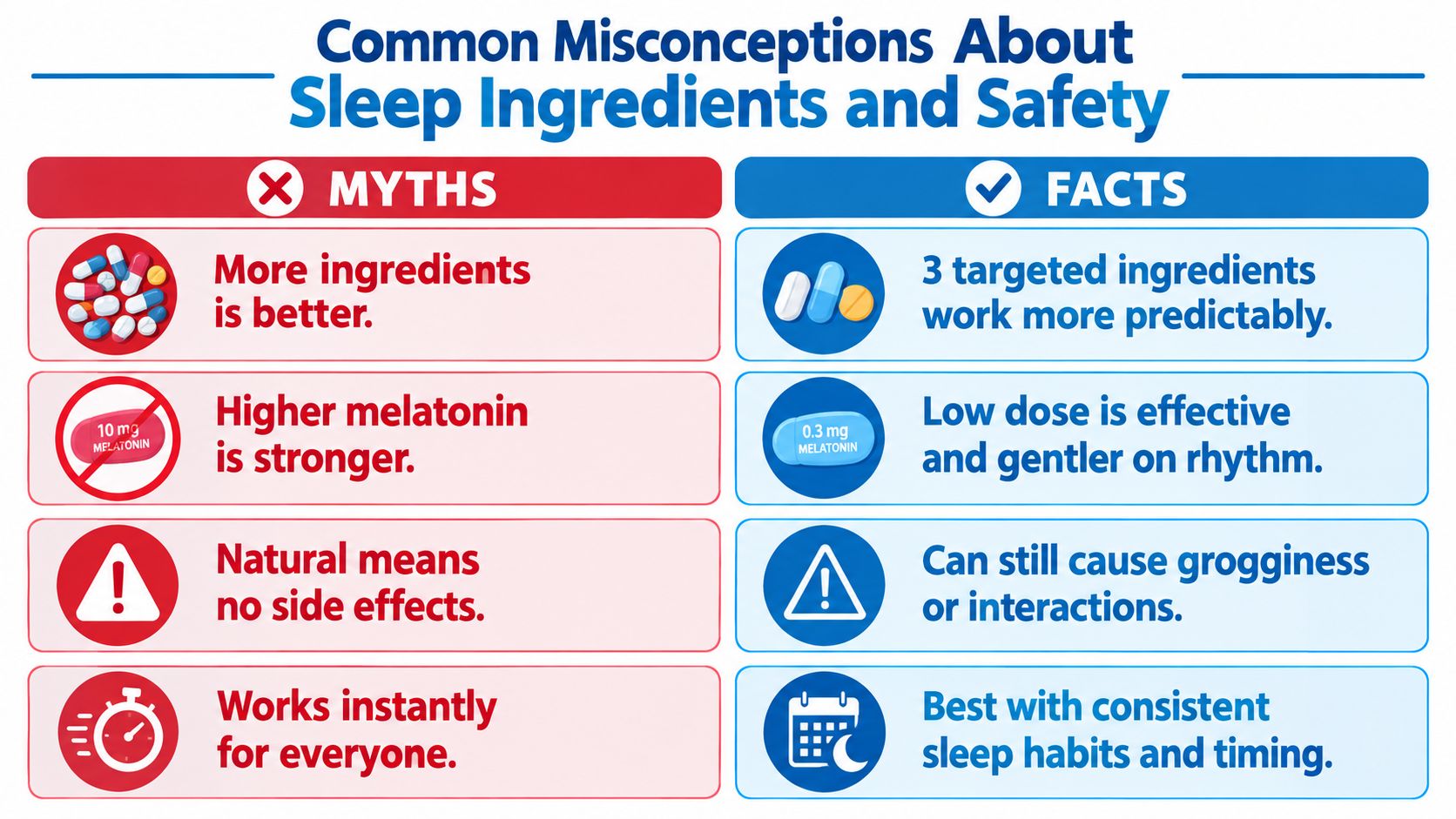
- Myth, more ingredients must work better: A longer label can make it harder to see which ingredient is helping or causing an unwanted response. A focused formula makes comparison easier.
- Myth, higher melatonin must be stronger: Melatonin's effects are generally modest, and commercial products often use amounts above the low-dose range discussed in evidence summaries. More is not a reliable shortcut to better sleep.
- Myth, natural ingredients can't cause side effects: Melatonin and calming ingredients may contribute to next-day drowsiness for some people. Botanicals can also be unsuitable for people with allergies or sensitivities.
- Myth, a supplement should work instantly for everyone: Sleep support depends on timing, individual response, and the habits around bedtime. A product cannot correct every schedule or environmental problem.
Interest in melatonin-free products partly reflects concerns about grogginess, hormone-like positioning, and uneven supplement quality. That interest is reasonable, but it should not turn into a new kind of hype. Evidence for melatonin is stronger than evidence for most botanicals, while magnesium may matter more for people whose intake is low, as noted in the review of product formulas and sleep literature.
A better way to choose is to match the formula to the sleep problem. Trouble falling asleep can call for a different ingredient pattern than waking often, and stress-related alertness at night may point to a melatonin-free blend instead of a melatonin-centered one.
Speak with a clinician before using a sleep supplement if you're pregnant, taking medication, managing a health condition, or caring for an older adult who uses multiple medicines. Ask specifically about possible interactions and whether ongoing sleep trouble could signal an underlying disorder.
A clean label reduces uncertainty, but it doesn't remove the need for personal safety checks.
Your Next Steps to Better Sleep With the Right Blend
Start with your sleep problem, not the label on the bottle.
If falling asleep is the hard part, a carefully labeled, low-dose melatonin formula may fit better. If your mind stays busy because of stress, a melatonin-free blend with calming support, such as magnesium or L-theanine, may be a better match. If your diet may be low in magnesium, review your intake with a qualified professional before adding anything. If you wake often or still feel unrefreshed, avoid stacking on more supplements until you have looked at schedule, light exposure, medication, and possible medical causes.
Choose a product with three clearly named ingredients, visible amounts, understandable directions, and realistic claims. Use it consistently with a steady sleep routine, dimmer evening light, and a calm wind-down period. Track how you respond over several nights, since one rough night can say more about the evening than about the formula.
CalVitamin offers online access to supplements in capsules, tablets, and gummies, with product details, ratings, reviews, and selected dietary filters on product pages. If you want to compare a sleep 3 ingredients formula with another option, review the label carefully before you buy, then contact the listed support team if you need product information.
Visit CalVitamin to compare transparent sleep-support formulas, ingredient combinations, and available formats. Choose the blend that matches your specific sleep challenge, not the one making the biggest promise.






