
Most advice about B12 energy gummies starts with the same promise: take one and feel more energized. That's the part shoppers need to question.
B12 isn't caffeine. It doesn't work like a stimulant, and it doesn't reliably create a noticeable lift in people who already have adequate B12 status. What it can do is help correct a real B12 shortfall, and that matters because deficiency and insufficiency are documented in U.S. adults. The NIH reports that about 3.6% of adults age 19+ and 3.7% of adults age 60+ had vitamin B12 deficiency, while 12.5% of adults 19+ and 12.3% of adults 60+ had insufficiency using a higher cutoff, based on NHANES 2007 to 2018 data in the NIH Vitamin B12 fact sheet.
That distinction changes how you should shop. If your tiredness is from poor sleep, stress, under-eating, low iron, illness, or a medication issue, a gummy won't fix the root problem. If your tiredness is tied to low B12, a supplement may help because it addresses the missing nutrient.
Table of Contents
- Why B12 Gummies Aren't the Energy Fix Most People Expect
- How B12 Connects to Energy in the Body
- The Absorption Curve Most Buyers Never See
- Choosing Between Methylcobalamin and Other B12 Forms
- Matching the Dose to Your Situation
- Gummies Versus Capsules, Sublinguals, and Sprays
- Reading the Label Before You Buy
- Smart Questions to Ask Before You Click Add to Cart
Why B12 Gummies Aren't the Energy Fix Most People Expect
“Energy gummy” is smart marketing because it borrows the language of coffee, pre-workout, and quick pick-me-ups. B12 does not work that way. If your B12 status is already adequate, taking extra usually does not create a sudden burst of energy you can feel that afternoon.
What often gets missed is the bottleneck. A gummy can contain a large number on the label, but your body does not absorb B12 in a simple 1-to-1 way. The amount swallowed and the amount that gets into circulation are different numbers. That is why shopping for B12 based on the biggest dose or the word “energy” can lead to the wrong expectation.
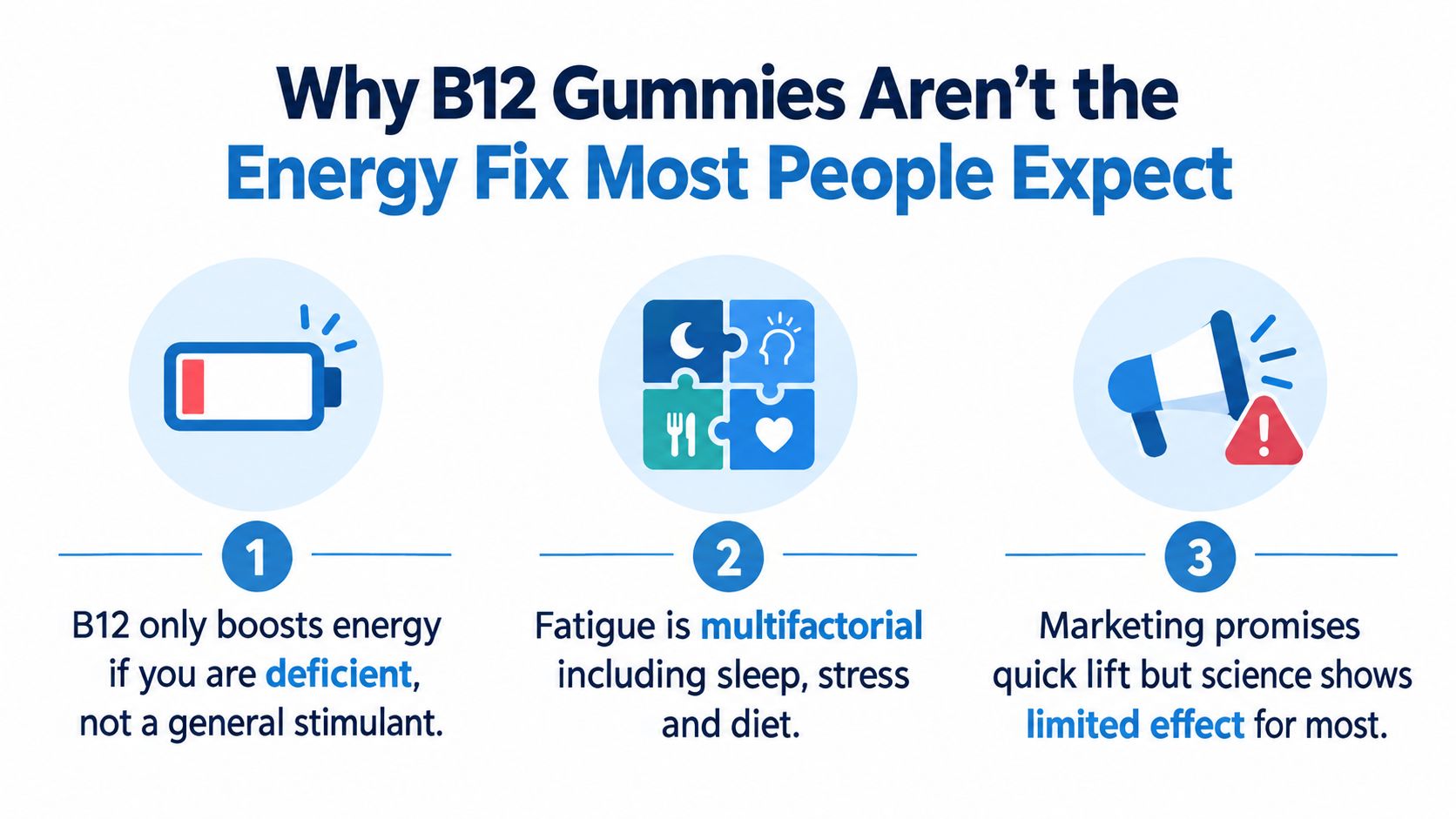
Fatigue has many causes
Fatigue is a broad symptom, not a diagnosis.
A low-B12 problem is one possible explanation, but it sits in a long line with poor sleep, under-eating, inconsistent meals, high stress, iron deficiency, thyroid problems, illness, depression, and medication side effects. A gummy cannot sort those out for you. It can only supply B12.
That distinction matters because shoppers often ask the wrong first question. Instead of “Will I feel more energy from this gummy?” a better starting point is “Do I have a reason to suspect low B12 in the first place?”
- Sleep-related fatigue: short sleep, broken sleep, or poor sleep quality
- Food-related fatigue: too little total food, long gaps between meals, or too little protein
- Stress-related fatigue: sustained mental strain, caregiving, burnout, or anxiety
- Medical fatigue: anemia, thyroid issues, infections, depression, or medication effects
Where gummies can still be useful
Gummies can still be a reasonable format. They may suit someone who dislikes swallowing pills, wants a chewable option, or needs a supplement they will remember to take.
They can also make practical sense for people with a higher chance of low intake or impaired absorption, including those who eat little or no animal food, some older adults, and some people using medications linked with lower B12 status. In that case, the gummy is less like a spark plug for instant energy and more like refilling a nutrient gap over time.
The question that leads to a better purchase
Do not judge a B12 gummy the way you would judge a stimulant.
Judge it by whether the dose, form, and format fit your situation, and whether there is a plausible reason you would benefit from extra B12 at all. That is the part many buyer guides skip, and it matters more than the “energy” claim on the front of the bottle.
How B12 Connects to Energy in the Body
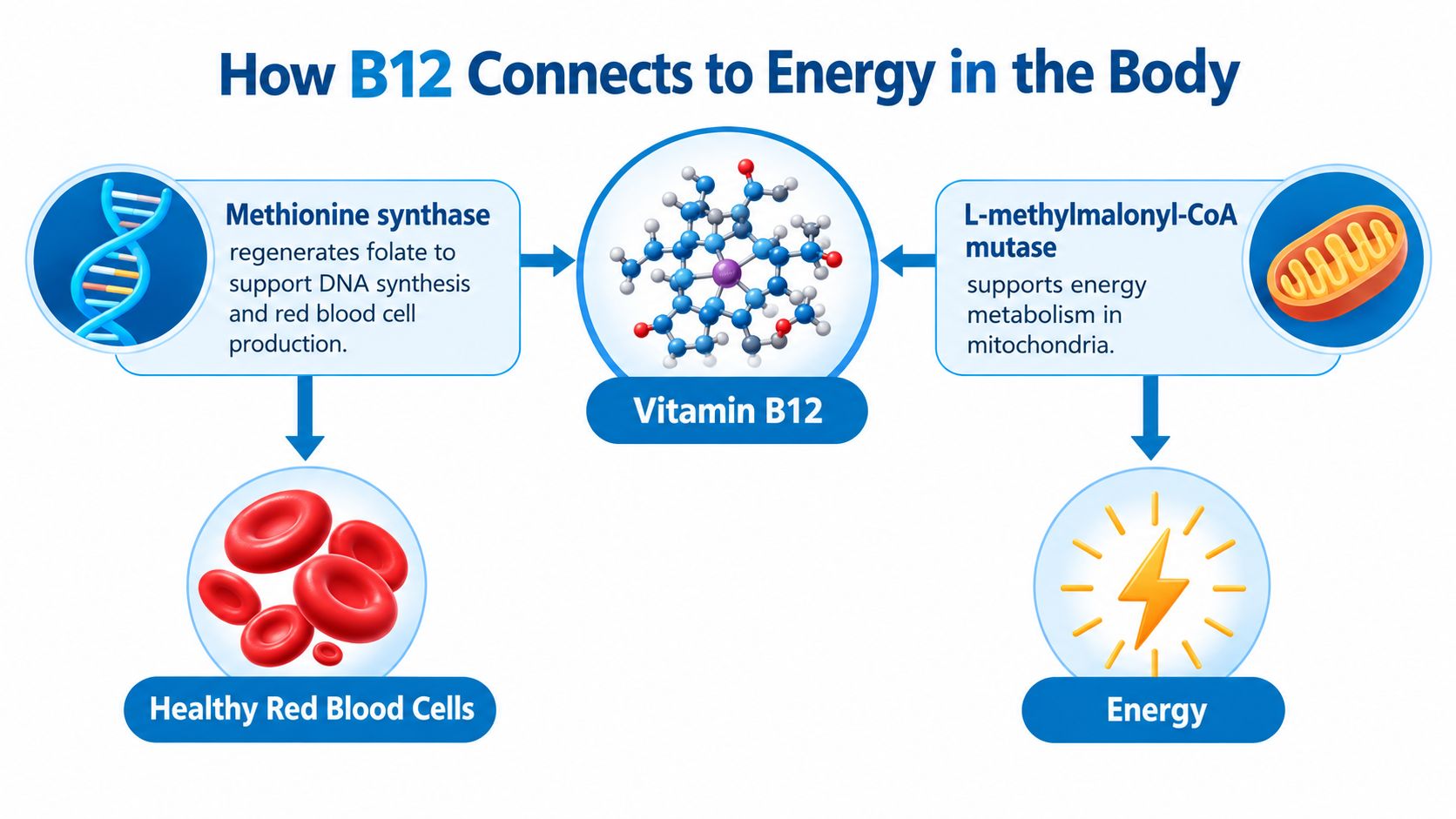
B12 earns its “energy” reputation because it helps run two core processes in the body. That's real physiology, not hype.
Think of B12 as part of the power system
A simple analogy helps. B12 is like a part inside your body's power system. It helps your cells process what you eat and supports healthy red blood cell production. But if the system already has what it needs, adding more of that one part doesn't make the machine run faster.
One B12-dependent enzyme is methionine synthase. It helps regenerate folate and supports DNA synthesis, which matters for making healthy red blood cells. Another is L-methylmalonyl-CoA mutase, which helps route certain compounds into energy metabolism. If B12 is low, these systems don't run smoothly.
Low B12 can contribute to fatigue partly because red blood cells help carry oxygen through the body. If red blood cell production is impaired, people may feel weak, foggy, or tired.
After learning the basics, some readers like a short visual summary before getting into shopping details.
Who is more likely to need extra B12
The key point isn't that everyone needs more B12. It's that some groups are more likely to benefit from paying attention to it.
The NIH reports a wide swing in prevalence depending on the cutoff used. In earlier NHANES data from 1999 to 2004, low serum B12 rates were 3% at a cutoff below 200 pg/mL and 26% at a cutoff below 350 pg/mL, as described in the NIH Office of Dietary Supplements overview. That tells you something important: “low” B12 depends partly on how clinicians define the threshold, and mild insufficiency is more common than many shoppers realize.
People who often deserve a closer look include:
- Vegans and some vegetarians: B12 is concentrated in animal-derived foods.
- Older adults: absorption can become less efficient over time.
- People taking certain medications: metformin and acid-suppressing drugs often come up in clinical practice.
- People with malabsorption conditions: some digestive disorders make oral intake less straightforward.
B12 helps your body make energy from food. It doesn't act like plugging your phone into a fast charger when your battery is already full.
The Absorption Curve Most Buyers Never See
The number on the front of the bottle can be misleading. A label may list a large amount of B12, but absorbed B12 is only a fraction of swallowed B12.
Why the body doesn't absorb B12 in a straight line
B12 absorption happens in two main ways. The first uses intrinsic factor, a protein that helps escort B12 through the digestive system so it can be absorbed efficiently. That route is limited. The second route is passive diffusion, where a small share crosses the gut without that transport system.
The practical result is that bigger doses don't scale neatly. According to the NIH material summarized in the NCBI Bookshelf review of vitamin B12, absorption is about 50% at very low doses, around 2% at 500 mcg, and about 1.3% at 1,000 mcg. The same source notes that a 2025 review similarly reported that 0.1% to 2.0% of orally administered B12 may reach circulation depending on dose and use pattern.
That's the math many buying guides skip.
What that means on an actual label
A bottle might make 1,000 mcg look dramatically stronger than 500 mcg. In absorbed terms, the difference is often less dramatic than shoppers expect.
| Dose on Label | Intrinsic Factor Uptake | Passive Uptake (~1%) | Approx. Total Absorbed |
|---|---|---|---|
| Low dose | Higher relative efficiency | Minimal | Proportionally strong for size |
| 500 mcg | Limited by saturation | Small additional amount | Much less than label suggests |
| 1,000 mcg | Still limited by saturation | Slightly more passive entry | More absorbed than 500 mcg, but not double |
A useful way to think about it is this: once the efficient pathway is saturated, dose inflation mostly increases what passes through you, not what gets used.
For shoppers comparing forms, a product such as NOW Ultra B12 liquid represents one non-gummy option when someone wants a different delivery style, but the bigger issue is still whether oral B12 fits the person's needs at all.
The real takeaway from absorption math
If you're healthy and not deficient, a very high-dose gummy usually won't feel like a bigger energy product. If you're trying to correct a deficiency, a clinician may still use higher oral doses because even a small absorbed fraction can matter over time.
That's why “more micrograms” isn't the smartest shortcut. Purpose matters more than bottle size.
Choosing Between Methylcobalamin and Other B12 Forms
Form matters, but not in the way many gummy labels suggest. For a shopper trying to correct low B12, the useful question is usually not, “Which form sounds the most advanced?” It is, “Which form is appropriate for my situation, and will I absorb enough of it to fix the problem?”
That framing helps calm a common worry. A different B12 form does not automatically turn a gummy into a stronger energy product.
Four forms you'll see most often
| Form | What it is | Practical strengths | Limits to keep in mind | Best-fit shopper |
|---|---|---|---|---|
| Methylcobalamin | One of the active forms used in the body | Popular with shoppers who want an active-form label | Often marketed as if it guarantees better results, which evidence does not clearly show for every healthy user | People who prefer a ready-to-use form |
| Cyanocobalamin | A common synthetic form | Stable, widely used, often lower cost | Some shoppers dislike the synthetic label, even though it works well for many people | People who want a straightforward, common option |
| Adenosylcobalamin | Another active form used in the body | Shows up in specialty products tied to cellular energy discussions | Less common in gummies and not automatically better for routine use | People comparing specialty formulas |
| Hydroxocobalamin | A form often used in medical settings | Useful in some supervised deficiency situations | Less relevant for casual self-supplementing | People under clinician guidance |
How to compare them without getting lost
Methylcobalamin gets attention because it is already in an active form. That sounds appealing, and for some shoppers it becomes an easy tie-breaker. But “active” does not mean “works better for everyone” or “creates a noticeable energy lift if you were not low in B12 to begin with.”
Cyanocobalamin is less glamorous, but it has a long track record in supplements. A plain analogy helps here. If B12 forms are different package designs for the same nutrient, the body still needs to receive and use the contents. For many people, cyanocobalamin does that job just fine.
Adenosylcobalamin often appears in products built around an “energy” theme because it participates in cellular pathways linked to energy production. That point is biologically interesting, but shoppers should be careful not to overread it. A pathway connection is not the same thing as proof that a gummy will make a person feel more energized.
Hydroxocobalamin is the form you are more likely to hear about in clinical care than in a candy-style supplement aisle. That alone tells you something useful. Some B12 decisions belong in a treatment plan, not in a flavor comparison.
The practical takeaway from absorption math
Once you account for the absorption bottleneck discussed earlier, form becomes a secondary decision for many buyers. If oral B12 is appropriate, the bigger question is often whether the product helps maintain status or correct a deficiency over time.
That is why the “best form” debate can mislead cautious shoppers. A methylcobalamin gummy may fit your preferences, but it is not a shortcut around poor absorption, an incorrect dose, or an undiagnosed cause of low B12.
A simple label rule
Use a simple screen instead of chasing form hype:
- General supplement use: methylcobalamin or cyanocobalamin can both be reasonable choices.
- Preference for an active-form label: methylcobalamin is the cleaner fit.
- Known deficiency, neurological symptoms, or suspected absorption problems: the delivery plan and medical guidance matter more than a form ranking chart.
If you want to compare formats, Life Extension Vitamin B12 methylcobalamin lozenges are one example of an active-form option outside the gummy category.
Matching the Dose to Your Situation
A bigger number on the front of the bottle does not automatically mean a stronger energy effect. For B12, dose only makes sense once you match it to the reason you are buying it.
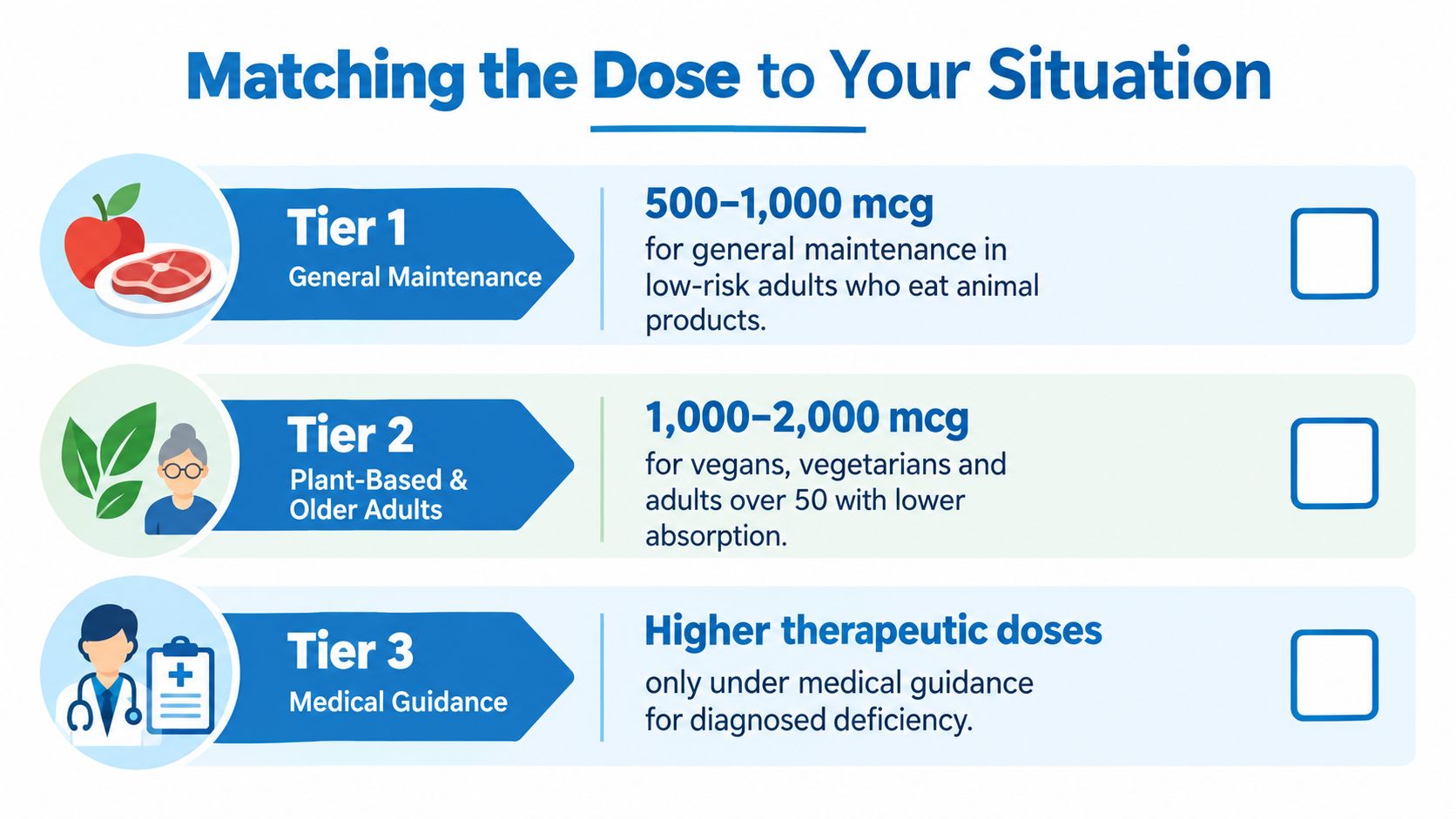
Someone trying to cover routine intake has a different goal from someone correcting a confirmed deficiency. That difference matters more than whether the gummy is berry-flavored, methylated, or labeled as an “energy” product.
Practical dose matching
Use the label like a measuring cup. First ask, “Am I maintaining normal status, or trying to correct a low level?” Then check how many micrograms you get per serving and per gummy.
- General maintenance: Labels in the 500 to 1,000 mcg per serving range are common for adults who want routine coverage.
- Higher-risk maintenance: Labels in the 1,000 to 2,000 mcg per serving range are often chosen by vegans, vegetarians, adults over 50, or people taking metformin or acid-reducing medicines.
- Documented deficiency: 5,000 mcg or more for a period of time may appear in correction plans, but that is a medical decision, not a casual shopping upgrade.
One reminder from earlier. The amount printed on the bottle is not the same as the amount your body ultimately uses.
How to read the serving size without getting fooled
The biggest B12 number on the label is sometimes for a full serving, not for one gummy. That is an easy place to misread a product.
A concrete example helps:
- Front label: 1,000 mcg B12
- Serving size: 2 gummies
- Actual amount per gummy: 500 mcg
That matters if you plan to take one gummy instead of two, or if you are comparing products side by side. A bottle can look “stronger” because the serving size is larger.
A simple way to sanity-check the bottle
For healthy adults, the recommended dietary allowance for B12 is 2.4 mcg, as summarized by the Office of Dietary Supplements at NIH. That tiny requirement is one reason gummy labels can look dramatically oversized.
The National Academies also did not set a tolerable upper intake level for vitamin B12 in the Dietary Reference Intakes report. That does not mean higher doses create more energy. It means B12 has a low risk of harm at typical supplement doses for the general population.
A cautious shopper should read a high-dose gummy as a tool for covering intake gaps or supporting deficiency correction, not as proof of a stronger everyday energy boost.
Gummies Versus Capsules, Sublinguals, and Sprays
Format matters, but not for the reason ads usually suggest. The best form isn't the tastiest one. It's the one that matches your absorption needs, consistency, and dose goal.
Where gummies fit well
Gummies shine when adherence is the main issue. If you hate swallowing tablets, forget capsules, or want a gentler entry point, a gummy can make daily use more realistic. For routine maintenance, that counts.
The limitation is that gummies often come with tradeoffs. They may contain added sweeteners, use a lower-precision serving format, or top out at doses that aren't ideal for someone with a more serious deficiency picture.
Comparing the main formats
| Format | Absorption Route | Typical Dose Range | Convenience | Best Fit |
|---|---|---|---|---|
| Gummies | Oral, swallowed after chewing | Low to moderate or high depending on product | Very easy | People who prioritize consistency and dislike pills |
| Capsules or tablets | Oral, swallowed | Broad range, including high-dose products | Familiar and precise | People who want dose accuracy |
| Sublinguals | Held in the mouth before swallowing | Broad range | Easy for many users | People who prefer non-pill formats and want flexibility |
| Sprays | Oral or buccal exposure depending on use | Moderate range | Portable and quick | People who want convenience without gummies |
| Liquids | Oral, measured by serving | Flexible | Useful for dose adjustments | People who want titration or dislike solid forms |
Choose by use case, not by trend
A vegan adult with normal digestion may do fine with a gummy, capsule, or sublingual. A person with a history that raises absorption concerns may need a more careful plan. A person with documented deficiency may need precision first and convenience second.
That's the useful frame: pick the format that solves the actual problem.
Reading the Label Before You Buy
A smart B12 purchase often comes down to two minutes with the Supplement Facts panel. Most mistakes happen because shoppers read the front of the bottle and stop there.
Start with the serving size
Many gummies list B12 per serving, not per gummy. If the serving is two gummies, the front label may look stronger than what you get from one piece.
Check these items in order:
- Serving size: one gummy or two
- B12 form: methylcobalamin, cyanocobalamin, or another form
- Dose per serving: the amount attached to the full serving, not just one gummy
- Percent Daily Value: useful for context, but less useful than understanding your actual goal
Then read the ingredients like a food label
A gummy can drift close to candy territory depending on the sweetener system. Look for glucose syrup, sugar alcohols, fruit juice concentrates, and flavoring choices. None of those automatically make a product bad, but they should match your preferences and tolerance.
Also check:
- Pectin versus gelatin: pectin often suits vegan and vegetarian shoppers better
- Allergen statements: especially if you avoid gluten, dairy, or other common triggers
- Third-party verification: seals such as USP or NSF can add confidence about what's in the bottle
- Flavor language: “natural flavors” and “no artificial flavors” aren't the same claim, even if both sound reassuring
A quick pre-purchase scan should answer five things: form, dose, serving size, sweetener profile, and dietary fit.
Smart Questions to Ask Before You Click Add to Cart
A good B12 gummy choice doesn't start with flavor. It starts with a short self-check.
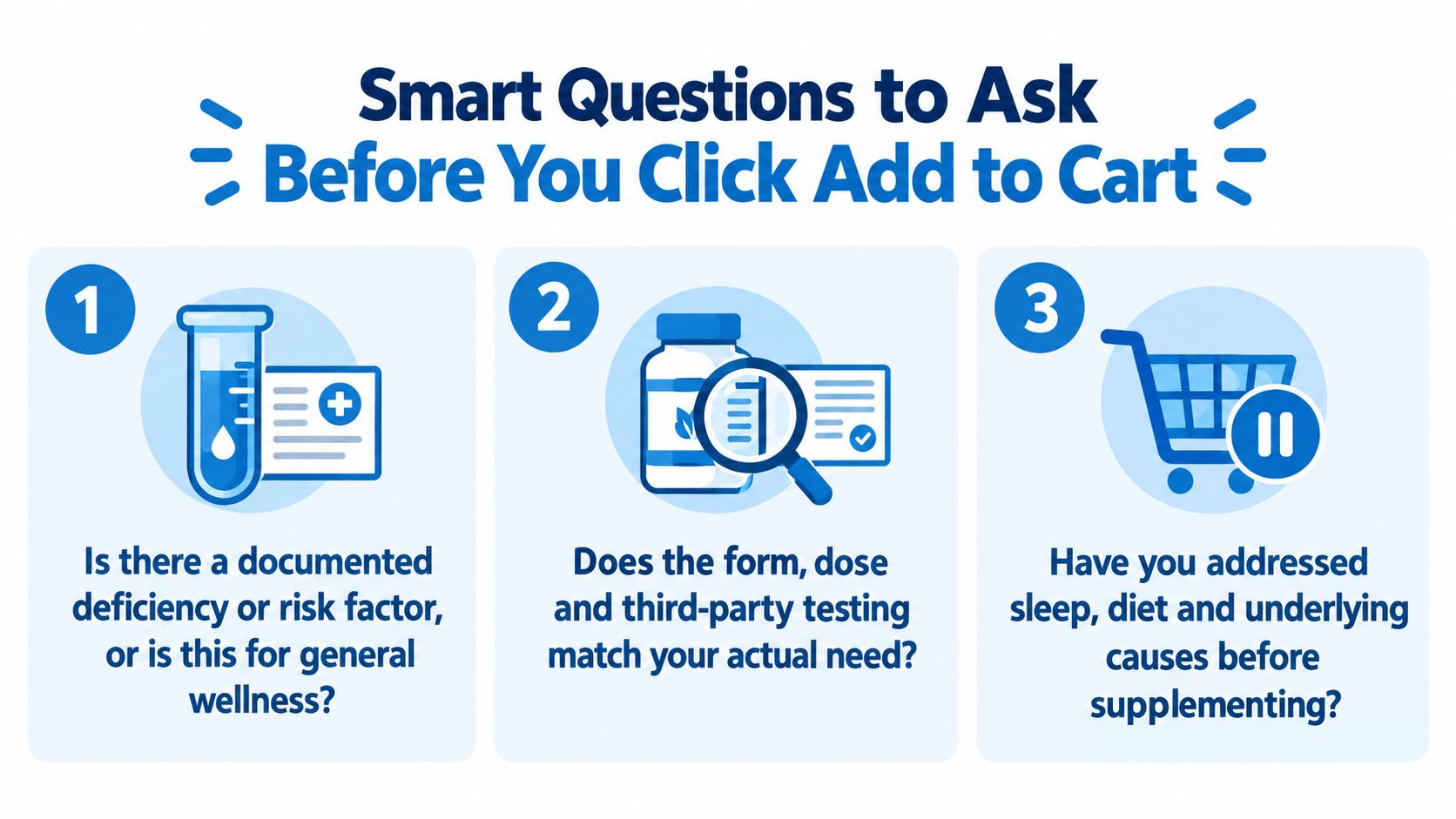
Three questions that prevent most buying mistakes
Am I trying to correct a likely B12 issue, or am I treating “low energy” as one vague problem?
If it's the second, pause. A gummy won't replace sleep, food, hydration, or medical evaluation.Does the dose match the reason I'm buying it?
A flashy megadose may be appropriate in some contexts, but it can also be label theater if your goal is basic maintenance.Does the format match my body and my diet?
If you need vegan, halal, gelatin-free, or low-sugar options, the ingredient panel matters as much as the B12 number.
Two more checks that save regret
Before you order, also ask:
- How much sugar or sweetener am I getting in a daily serving?
- Will I finish this bottle before it sits in the cabinet and gets ignored?
That second question sounds small, but consistency is often the whole point of choosing a gummy.
A B12 supplement is most useful when it matches a real need. It's least useful when it's standing in for unanswered questions about fatigue.
Red flags worth walking away from
Two label patterns should make you skeptical:
- Proprietary blends that don't clearly state the B12 amount
- Products sold as daily energy fixes with no meaningful context about deficiency, diet, or absorption
If a brand only talks about “boost” and never helps you decide whether B12 is relevant to your fatigue, that's weak education and weak labeling.
CalVitamin offers a broad selection of supplement formats, including gummies, capsules, liquids, and specialty wellness products, which is useful when you want to compare B12 options by form and dose instead of buying the first “energy” label you see. If you're trying to choose a product that fits your diet, swallowing preference, and label priorities, visit CalVitamin to review available options side by side.






