

You're standing in the supplement aisle, staring at jars that all seem to promise the same thing. One label says prebiotic, another says probiotic, and both sound like they belong in a gut-health routine. The difference matters, because these products work in different ways, and choosing the wrong one can leave you confused, underwhelmed, or dealing with extra bloating.
Table of Contents
- Your Gut Health Journey Starts Here
- Understanding Probiotics The Live Beneficial Bacteria
- Understanding Prebiotics Fuel for Your Good Microbes
- Prebiotics vs Probiotics A Detailed Comparison
- Synbiotics When to Use Prebiotics and Probiotics Together
- How to Choose the Right Supplement for Your Goals
- FAQ Common Questions About Prebiotics and Probiotics
Your Gut Health Journey Starts Here
The difference of prebiotic and probiotic is simple once you slow it down. Probiotics are live microorganisms, while prebiotics are non-digestible substrates that selectively feed beneficial gut microbes, and that distinction shapes how they're used in real life. Historically, scientific interest in probiotics traces back to early 20th-century work associated with Eli Metchnikoff, while prebiotics were formalized much later and refined by ISAPP in 2017 to emphasize selective use by host microorganisms (Nutrition Reviews).
That history matters because it explains why the two products are often marketed side by side even though they're not interchangeable. A probiotic product has to contain viable organisms at the time of use, while a prebiotic product does not. One adds living microbes, the other feeds the microbes already in your gut.
Practical rule: if you're trying to understand a label fast, ask one question first, “Is this product adding microbes, or feeding them?”
You'll also see why people get mixed up. In search results and store aisles, both categories sit under “gut health,” but their jobs are different enough that your goal should drive the choice. If you want a broader overview of products and formats, you can also browse the CalVitamin pro and prebiotic category for a quick sense of how these supplements are grouped.
Understanding Probiotics The Live Beneficial Bacteria
A probiotic is a live microorganism that must be given in adequate amounts to confer a health benefit. That definition is more than technical wording. It tells you that a probiotic's results depend on strain identity, viability, and dose at the time you take it, not just the words on the front of the bottle.
What Probiotics Do
Probiotics add live cultures to the gut ecosystem. Once there, they may help shift the microbial environment in a favorable direction, but only if the organisms survive processing, storage, and digestion. Heat, shelf life, and handling matter because these products contain living organisms, not inert ingredients.
Common probiotic families include Lactobacillus and Bifidobacterium, and they also appear in fermented foods such as yogurt, kefir, kimchi, and sauerkraut. These foods naturally contain live cultures, though the exact organisms and amounts vary from product to product. In practice, that means “probiotic” is not one single thing. It is a category of living microbes that differ by strain and function.

A useful way to picture probiotics is as a living ingredient added to a complex ecosystem. That is why they can fit some goals well and be a poor match for others.
A careful label read helps here. If the product does not identify the strain clearly, or if storage instructions are vague, you do not really know what you are getting. The word probiotic only tells you the product contains live microbes, not that it is the right one for your body or your goal. If you are comparing options at a retailer like CalVitamin, look for clear strain names, handling directions, and a format that fits how you plan to use it. People sometimes notice temporary bloating or gas when they start a probiotic, especially if they begin with a stronger formula, so a lower starting amount and a gradual approach can make the first week easier to handle.
Understanding Prebiotics Fuel for Your Good Microbes
You open a label at the store and see fiber blends, plant extracts, and a promise of better digestion. Prebiotics are the part of that story that feeds the microbes already living in your gut. They are non-digestible substrates that selectively support beneficial gut microbes, so they do not add new organisms, they help the ones already there do their job.
How prebiotics work in the body
Prebiotics usually act like specialized fibers. They resist digestion in the upper GI tract, move through to the colon, and are then fermented by resident microbes. That is why they are often described as microbial fuel, and why good prebiotic formulations are designed to reach the colon intact for fermentation (PMC).
Common prebiotic ingredients include inulin, fructo-oligosaccharides (FOS), and galacto-oligosaccharides (GOS). You also get them from everyday foods such as garlic, onions, bananas, asparagus, oats, and other fiber-rich plant foods. Because prebiotics are usually fibers or other non-digestible ingredients, they tend to have a more predictable stability profile than live-culture supplements.
Simple test: if it passes through your stomach and feeds gut microbes later, it is behaving like a prebiotic.
That is the practical reason many people start here first. If your diet is light on fiber, or if you want a more food-like way to support regularity, prebiotics are often easier to fit into daily habits than a live microbe product. If you are comparing a combined option at a retailer like CalVitamin, a product such as Culturelle Digestive Daily Probiotic + Prebiotic Capsules may make sense when you want both support and convenience in one routine, as long as the ingredient list matches your goals.
People also worry about side effects. Prebiotics can cause temporary gas, bloating, or a sense of fullness, especially when someone starts with a large amount of fermentable fiber. A gradual approach usually feels easier, because it gives your gut microbes time to adapt to the extra fuel.
Clinical trial reviews support that distinction. Pooled findings have shown better stool frequency and a shift in stool pH with prebiotics, which fits their role as fermentable material that changes the gut environment rather than adding live cells (PMC). If a client asks me whether to start with a prebiotic or a probiotic, the first question is usually simple, do you need to feed your current microbes, or are you trying to add new ones?
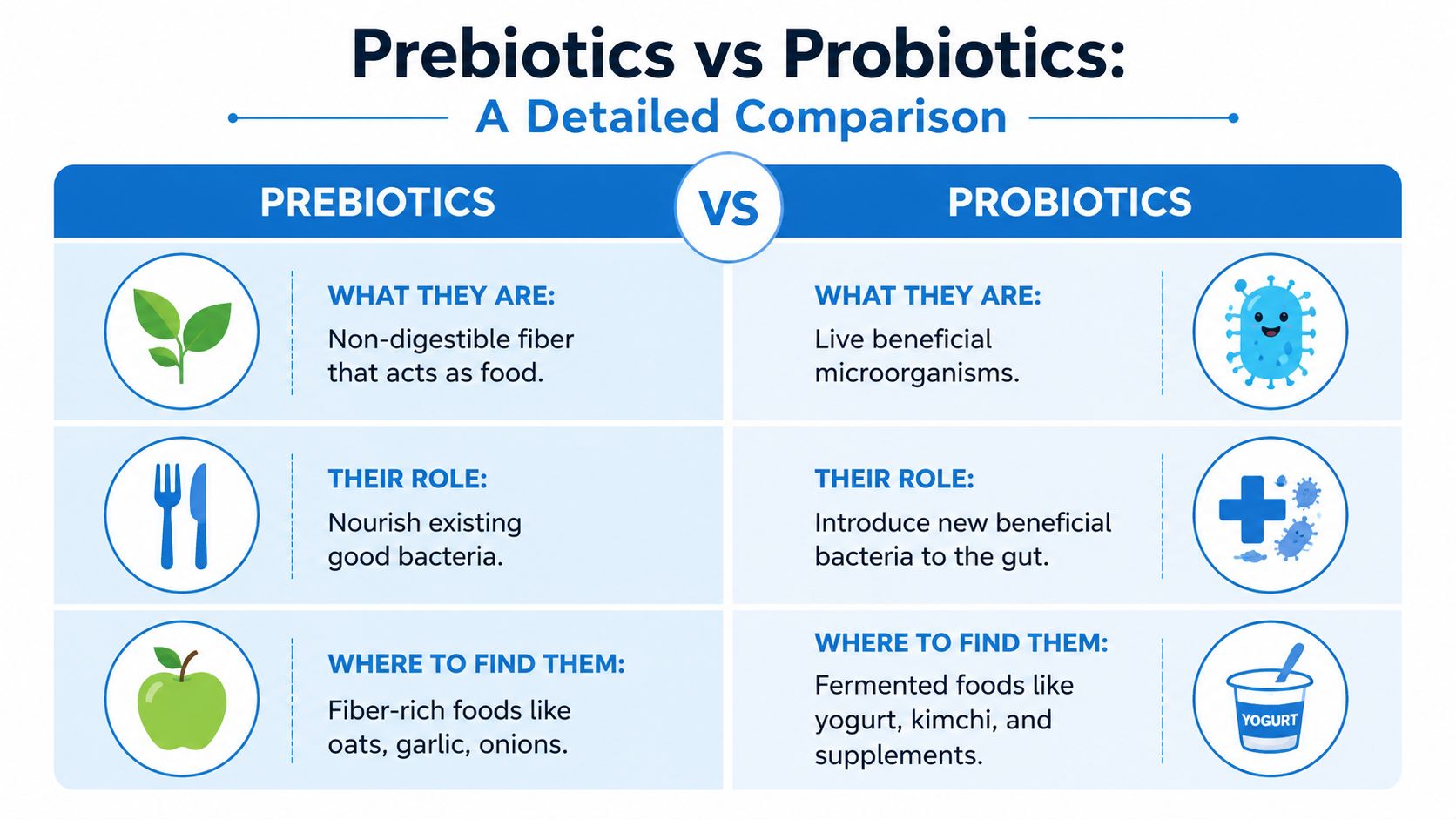
Prebiotics vs Probiotics A Detailed Comparison
A simple grocery-store test helps separate the two. If the product contains live cultures, you are looking at a probiotic. If it contains a fiber-like ingredient meant to reach the colon and feed resident microbes, you are looking at a prebiotic. Once you place them side by side, the difference becomes easier to use in real life.
| Attribute | Probiotics | Prebiotics |
|---|---|---|
| Core definition | Live microorganisms that confer a health benefit when given in adequate amounts | Non-digestible substrates selectively utilized by host microorganisms |
| What they do | Add beneficial microbes to the gut ecosystem | Feed the beneficial microbes already present |
| Product requirement | Must remain viable through processing and use | Do not need to stay alive, because they are not living organisms |
| Stability | Heat- and storage-sensitive | Typically more stable, often fiber-based |
| Main formulation concern | Strain identity, dose, shelf life, gastric survival | Chemical composition and selective fermentation |
| Common sources | Fermented foods and live-culture supplements | Fiber-rich foods and prebiotic supplements |
The distinction matters because the body handles each one differently. A probiotic product has to protect living organisms until consumed, so storage and handling affect whether it still delivers what the label suggests. A prebiotic product does not have that survival problem, so the main question is whether the ingredient is the right fuel for the microbes you already have.
The clinical pattern fits that biology. Reviews of trial data have found that prebiotics were associated with better stool frequency and a change in stool pH, which lines up with their role as fermentable material that changes the gut environment. Probiotics also showed benefits on stool frequency, though the pattern was smaller and depends more on the strain and product used. A separate review of probiotic and prebiotic effects in adults also supports the idea that the two categories work through different mechanisms (PMC, PMC).
Why the product label matters
A probiotic only matters if the organisms are still alive when you use it. That is why strain identity, storage instructions, and shelf life deserve attention. If a capsule sits in the wrong conditions, the label can promise more than the product can deliver.
Prebiotics are easier to keep stable, but label reading still matters. The ingredient has to be the right kind of substrate for gut microbes, not just any added fiber. If you are looking at a retailer like CalVitamin, a product such as Life Extension Florassist Prebiotic, PreticX Chewables is the kind of option people compare when they want a prebiotic that is simple to fit into a routine.
Why the consumer choice is different
The better question is not which one sounds more advanced. The critical question is what problem you are trying to address. A probiotic is usually chosen when you want to add live microbes, while a prebiotic is the better fit when you want to support the microbes already in place.
That is the core of the difference of prebiotic and probiotic. It is also why side effects can differ. Probiotics may sometimes cause temporary digestive changes as your gut adjusts, while prebiotics can cause gas, bloating, or fullness if you start with too much fermentable fiber too quickly. If you want a practical rule, start with the goal, then match the category, then check the product label to make sure it fits your routine.
Synbiotics When to Use Prebiotics and Probiotics Together
A combined product can make sense when you want one routine that supports both sides of gut health. A synbiotic brings a probiotic and a prebiotic together, so the live microbes have the fuel they need to do their work. That pairing also fits a broader shift in gut-health products toward combination formulas and metabolite-based options, including postbiotics, rather than treating every supplement as if it serves the same purpose (British Dietetic Association).
This approach is often practical if your diet is light on fermentable fiber and you want to support a live-culture supplement at the same time. It can also help if you prefer one formula instead of managing two separate products. In that setup, the prebiotic is not extra fluff, it is the substrate that supports microbial activity.
A synbiotic may be a good fit for someone who wants a combined gut-health strategy rather than a single-purpose supplement.
You can see that idea in product pages too. A combined option such as Culturelle Digestive Daily Probiotic + Prebiotic shows how some routines pair live microbes with their preferred fuel in one capsule-based format. That does not mean every person needs a synbiotic, but it explains why this category is appealing for people who want a simpler daily routine.
The clearest way to judge a synbiotic is by compatibility. A probiotic should still be strain-specific, and a prebiotic should still be the right substrate, so the question becomes whether the two parts work well together for your goal. If they do, the formula can support both the microbes and the environment they live in.
How to Choose the Right Supplement for Your Goals
Start with your goal, not the label claim. If your goal is live-culture support, look for a probiotic that names the strain clearly and explains how many CFU the product provides, since probiotic effects depend on the specific organism and whether it is still viable. If your goal is a prebiotic, focus on the fiber type and whether the amount fits your routine and digestion.
What to check on the label
A good probiotic label should tell you exactly which organism you are buying, not just that it is a “gut health” formula. A good prebiotic label should name the substrate, because different fibers behave differently in the gut and do not all feed the same microbes in the same way. A product designed for regularity may therefore look quite different from one aimed at general digestive support.
Match the form to your routine
Capsules, veggie caps, chewables, and powders each solve a different practical problem. Capsules are easy to carry, powders can be mixed into food or drinks, and chewables may feel easier if you do not like swallowing pills. A practical example is Life Extension Florassist Prebiotic PreticX chewables, which shows how a prebiotic can be offered in a format that is simple to use consistently.
Use the goal to narrow the choice
- For regularity support: start with a prebiotic fiber or a fiber-forward routine.
- For live-culture support: choose clearly identified probiotic strains and check the handling instructions.
- For a combined approach: a synbiotic makes sense if you want both the microbes and their fuel in one plan.
- For sensitive digestion: begin with a smaller amount, because a formula that feels too strong can be harder to tolerate.
Side effects are part of the decision too. A product that looks right on paper can still feel too aggressive at first, especially if your digestion is already reactive. If you are unsure, build slowly and watch how your body responds instead of changing everything at once.
The bigger point is that these products are not interchangeable. Probiotics are strain-specific, and prebiotics are substrate-specific, so the best choice is the one that matches your goal, your tolerance, and your routine. If you are shopping at a retailer like CalVitamin, that approach also makes the catalog easier to sort through because you can compare format, ingredient type, and the kind of support you want to build.
FAQ Common Questions About Prebiotics and Probiotics
Can either one cause gas or bloating
Yes, both can. Prebiotics are fermented in the colon, and that fermentation can produce gas, while probiotics can alter the gut environment in ways that some people feel as temporary bloating or discomfort (Mayo Clinic). Most side effects are usually mild, but sensitive users should still treat them as real.
Who should be cautious
Anyone with a complicated digestive history should talk to a clinician before starting either one, especially if symptoms are already active. That's because the same product that feels fine for one person can feel irritating for another. If you're already dealing with bloating, changing the microbiome too quickly can make the first few days feel worse before they feel better.
When should you take them
There isn't one universal timing rule for every product, because the label and formulation matter. The safer habit is to follow the package directions and introduce one product at a time so you can tell how your body responds. If a formula is particularly intense for you, taking it with food may feel easier, but the most important step is consistency.
Should you stop if you feel off
If symptoms are mild and brief, some people reduce the amount and build up more slowly. If symptoms are strong, persistent, or confusing, stop and get professional advice. Gut-health supplements are supposed to support your routine, not make your day harder.
Which one is simpler to start with
For many people, prebiotic-rich foods are the most practical first step because they fit into ordinary meals. Probiotics make more sense when you want live cultures, but they're also the category that depends more on strain, storage, and individual response. If you're unsure, a careful, one-change-at-a-time approach is usually the least frustrating path.
If you want help comparing prebiotics, probiotics, and synbiotics without guessing, explore the gut-health selection at CalVitamin. You can look at product type, format, and ingredient details in one place, then choose the option that fits your goals and your tolerance.






