
No single vitamin is best for muscle recovery: adequate protein and correcting a real nutrient gap matter more than routine high-dose vitamin C or E. Vitamin D is a targeted option when levels are low, while one small trial found improved muscle force with 4,000 IU of vitamin D3 daily.
The popular advice to take an antioxidant after every hard workout sounds straightforward, but recovery isn't a single process with one nutritional switch. Soreness, restored strength, and muscle growth are different outcomes, and a supplement that changes one doesn't necessarily improve the others.
Think of muscle repair as a construction site. Training creates the work, amino acids provide building materials, and enough food and sleep keep the job moving. A vitamin can help address a missing supply, but adding more of a nutrient that's already adequate doesn't automatically speed construction.
Table of Contents
- The Recovery Nutrient Shortlist
- Why No Vitamin Wins and When Vitamin D Matters
- Vitamin C and E Can Miss the Mark
- Protein Magnesium and Everyday Nutrients
- Dosing, Timing and Safety Limits
- Match Your Situation and Buy This Week
The Recovery Nutrient Shortlist
A useful shortlist starts with the gap, not the supplement label. Protein helps supply the materials for repair; vitamins and minerals are more relevant when your diet, sun exposure, or health circumstances suggest a shortfall.
| Nutrient | Use it when | Evidence in brief | Practical amount | Hold back when |
|---|---|---|---|---|
| Protein and amino acids | Daily intake is short of training needs | Protein supplies building materials for repair; vitamins cannot replace it | Meet needs through meals, adding a protein food or supplement only to fill a shortfall | Your meals already cover your needs |
| Vitamin D | You get little sun, train through winter, or have documented low 25(OH)D | A small trial found improved force after exercise with 4,000 IU of D3 daily for six weeks in young men with low or borderline vitamin D status. Results from older-adult trials have often been less promising. The NIH vitamin D fact sheet explains intake and safety limits | A clinician can help set a dose. Study doses varied; 4,000 IU is the adult upper limit | Your blood level is already adequate |
| Magnesium | Your diet is low in magnesium-rich foods or you lose a lot of sweat | A review found mixed findings across a small body of exercise-recovery research | Add magnesium-rich foods first; use supplements to fill a shortfall | You have kidney disease or plan unsupervised high doses |
| Vitamin C | You rarely eat fruit or vegetables | Findings on soreness are mixed across studies | Get it from fruit and vegetables; supplement only for a specific need | You're taking routine high doses to chase training gains |
| Vitamin E | You have a specific, clinician-identified need | High doses have not shown consistent recovery benefits; one example linked 1,200 IU daily for 12 days with increased muscle damage | Choose food sources such as nuts, seeds, and oils; no supplement dose is supported for soreness | You're considering a daily high-dose antioxidant stack |
| Omega-3 fats | You eat little fish and want to improve the balance of your diet | They may support inflammation balance, but they are not a stand-alone recovery vitamin | Prioritize food, such as fish about twice a week | You take blood-thinning medicine and haven't consulted a clinician |
| B vitamins | Your calories or food variety are low | They support energy metabolism, but there is little proof they speed repair when intake is adequate | Eat a varied diet; consider a standard multivitamin if your diet is narrow | You're considering megadoses just for soreness |
Use the table as a filter, not a shopping list. A nutrient that addresses a real gap has a clearer role than one added just because training was hard.
Protein supplies amino acids for repair. A supplement can help when meals fall short, but extra powder adds little if your regular food already covers your needs.
Vitamin D is a conditional option, especially when status is low. A dose used in a study is not a personal prescription, and 4,000 IU per day is the adult upper limit, not a target.
Magnesium is better treated as a dietary shortfall to address than as a dependable soreness remedy. The available exercise-recovery findings are mixed, so food-first guidance is more defensible than promising a supplement will speed recovery.
Vitamins C and E matter as nutrients, but high doses are not a proven shortcut to less soreness. For context on how food choices fit into training, see CalVitamin's sports performance nutrition guide.
Why No Vitamin Wins and When Vitamin D Matters
Training and recovery work together like a construction site. Exercise creates a repair job and an inflammatory signal; amino acids are the bricks, while sleep and energy help set the work schedule. Vitamins and minerals are part of the supply chain, but a shortage of one tool doesn't mean that buying a bigger tool solves every problem.
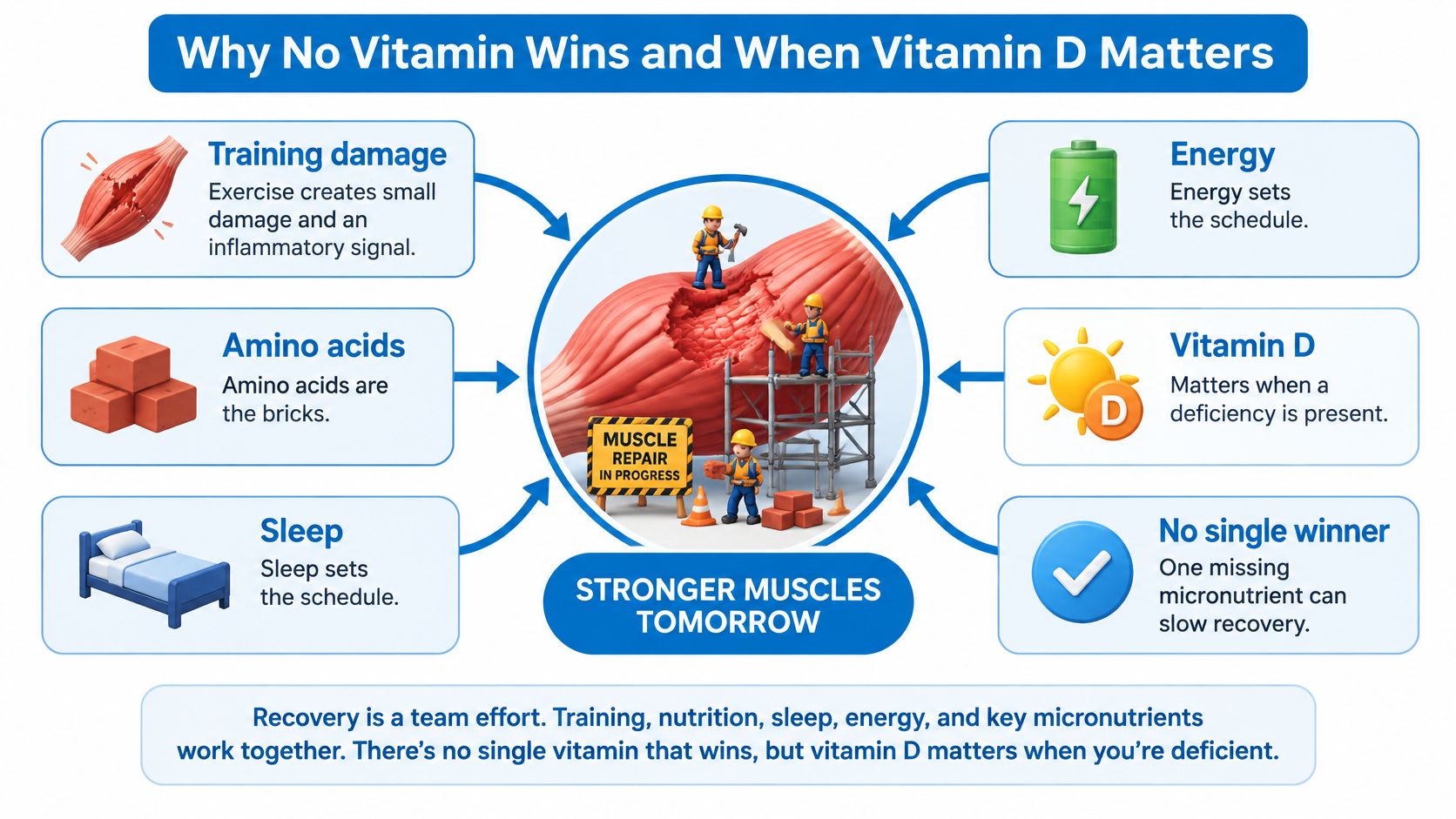
It also helps to separate three outcomes. Soreness describes how a muscle feels, strength recovery describes whether it can produce force again, and muscle growth reflects changes built over time. A change in blood vitamin D doesn't automatically show that any of these outcomes improved.
Why vitamin D is a conditional candidate
Skeletal muscle has vitamin D receptors, and deficiency can interfere with muscle function. In a randomized trial, 20 healthy men aged 18 to 30 with borderline or insufficient vitamin D status took 4,000 IU of vitamin D3 daily for six weeks or a placebo after eccentric exercise. The vitamin D group improved maximal voluntary contraction, a measure of muscle force, at 48 hours and seven days after the exercise. The result suggests that correcting low status may help some people; it doesn't establish a universal recovery dose.
Other groups haven't shown the same benefit. A trial of 78 frail or near-frail adults aged 65 and older found no significant strength or physical-performance differences after six months of supplementation with vitamin D3, 25-hydroxyvitamin D, or placebo. In another study, supplementation raised average vitamin D levels in 100 adults aged 60 and older from at or below 50 nmol/L to above 80 nmol/L, but didn't improve lower-extremity power, strength, or lean mass. These findings are described in the NIH Office of Dietary Supplements' vitamin D fact sheet for health professionals.
A 2025 systematic review of vitamin D studies in athletes found that supplementation reliably raised blood 25(OH)D, while muscle and blood-marker recovery results remained mixed. Raising a blood marker confirms that a supplement changed vitamin D status. It doesn't, by itself, prove that strength returned faster or that soreness improved.
When testing makes more sense
Consider discussing a 25-hydroxyvitamin D test with a clinician if deficiency is plausible. Relevant factors include little sun exposure, darker skin at a high latitude, clothing that covers most of the skin, malabsorption, or a diet that provides little vitamin D.
Practical rule: Correct a documented shortfall with medical guidance. If your level is already adequate, taking another capsule for soreness isn't a reliable recovery strategy.
If you're comparing products after a clinician has recommended vitamin D, read the dose per serving and follow that advice rather than choosing a high-strength option by default. CalVitamin's D3 product is suspended in medium-chain triglyceride (MCT) oil and formulated with MCT oil for better absorption. For additional background, see CalVitamin's vitamin D supplement guide.
Vitamin C and E Can Miss the Mark
Antioxidants sound like an obvious answer to exercise stress: reduce oxidative damage, and muscles should recover faster. The catch is that exercise-generated reactive oxygen species do more than damage. On the construction site of recovery, they work like the signals that tell repair crews where to reinforce the structure. A large dose that silences those signals may remove the instructions along with the noise.
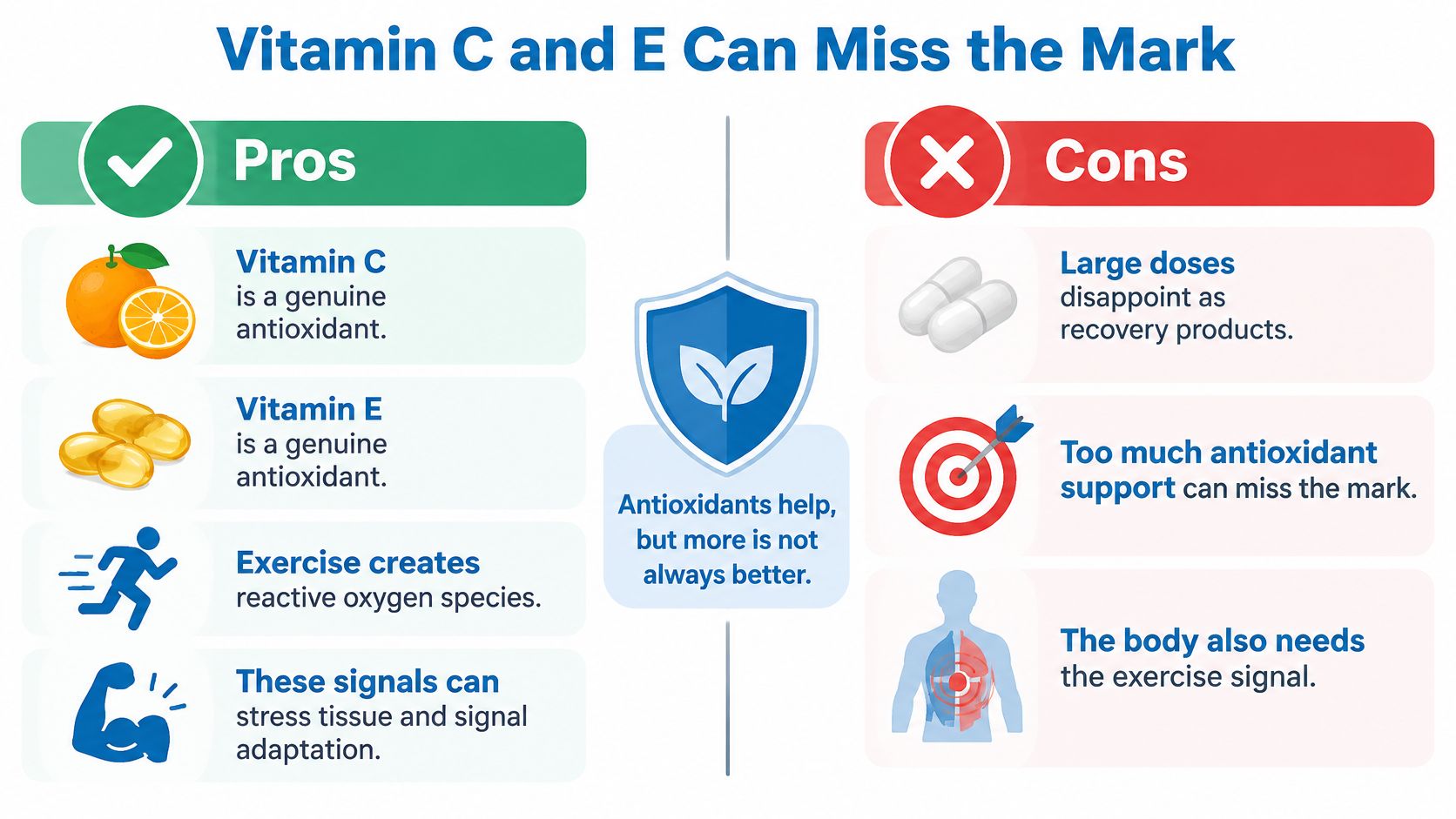
The trial evidence reflects that complication. A controlled trial in healthy young adults assigned participants to a high-dose combination of vitamin C and vitamin E or a placebo while following an endurance program built mainly on running. It found no consistent improvement in soreness or recovery markers with the combined supplementation.
Broader analyses point the same way. As summarized in the NIH Office of Dietary Supplements' exercise and athletic performance fact sheet, a review of 14 studies found significantly less soreness at every measured time point in only 3 studies, and a separate meta-analysis of 18 randomized trials involving 322 participants found insufficient evidence for a consistent recovery advantage from combined vitamin C and E.
Food antioxidants aren't the same as megadoses
The concern is routine, high-dose supplementation, not ordinary food. Fruit, vegetables, nuts, seeds, and oils provide vitamins and other nutrients as part of a varied diet. There's no reason to avoid these foods because they contain antioxidants.
Concentrated supplements raise a different question. Repeated high antioxidant doses may interfere with the cellular signals involved in training adaptation, and one short-term trial associated a high daily dose of vitamin E with increased muscle damage. That doesn't prove vitamin E is harmful for everyone; it does make routine high-dose use hard to justify as a recovery habit.
Across studies in young adults, vitamins C, D, and E have shown limited or no effect on exercise-related oxidative stress, with wide variation in how the research was designed. NIH guidance also cautions that antioxidant supplements may reduce some exercise benefits, including muscle growth and power output, when dietary intake is already adequate.
Antioxidants can belong in a healthy diet without needing to become a high-dose training ritual.
More of a vitamin is not automatically more recovery. If you want less soreness tomorrow and stronger training over time, a large antioxidant dose may not deliver both, so eat a varied diet and reserve supplements for inadequate intake or a specific clinical need.
Protein Magnesium and Everyday Nutrients
The nutrients that close common recovery gaps are often ordinary foods. Protein provides the amino acids used to repair muscle tissue, while magnesium supports processes involved in muscle function and energy use. Neither requires buying a large supplement stack before checking what you eat.
Start with three days of meals and snacks. Note whether each meal contains a protein source, whether magnesium-rich foods show up regularly, and whether fruit and vegetables are part of the day. This simple record can reveal whether you're missing a basic food habit or considering a supplement without a clear reason.
A short food-first check
- Build meals around protein. Include foods such as eggs, dairy, fish, meat, tofu, beans, or another protein source that suits your diet. Protein supplements are useful when it's hard to meet needs with meals, not because a shake has a special recovery clock.
- Add a magnesium-rich food. Nuts, beans, whole grains, and leafy greens are practical choices. If your diet already includes them regularly, a supplement may not solve a problem you have.
- Plan omega-3 foods. Fish can be part of a varied diet; an oil supplement isn't a replacement for meals, protein, or sleep.
- Use B vitamins to support adequacy, not to erase soreness. A varied diet usually gives more useful context than a megadose chosen for a specific workout.
Magnesium research remains limited. A 2025 review of magnesium and exercise recovery identified 108 records and included 10 studies, six randomized controlled trials and four observational studies. That small and mixed evidence base doesn't establish one magnesium form or dose as a dependable muscle-recovery treatment.
If you're considering a magnesium supplement, first decide what dietary shortfall you're trying to fill. People with kidney disease should get medical guidance before using supplements, since health conditions can change what's safe. For a closer look at one form, read CalVitamin's magnesium glycinate guide.
A practical food check isn't a test of perfection. It's a way to spot the easiest improvement before spending money. If your meals are inconsistent, fix that pattern first; if a specific gap remains, choose a product that addresses only that gap.
Dosing, Timing and Safety Limits
Use supplements to meet a defined need, not to chase the biggest number on a label. These rules help keep the decision focused on food, health, and the evidence relevant to each nutrient.
- Protein: Spread protein foods across meals rather than relying on one post-workout serving. Use a supplement only when meals leave a shortfall, and choose a product that fits your dietary preferences.
- Vitamin D: One exercise study used 4,000 IU daily for six weeks, but that was a study dose for a particular group, not a universal prescription. The adult upper limit is 4,000 IU daily; don't exceed it without a clinician's direction. If you're using a supplement, take it consistently with a meal that contains fat.
- Vitamin C: Favor fruit and vegetables as your everyday source. The adult upper limit for supplemental vitamin C is 2,000 mg, but an upper limit is a safety ceiling, not a recovery target.
- Vitamin E: No supplement dose is established for reducing soreness. Avoid routine high-dose use unless a clinician has identified a reason for it.
- Magnesium: Use foods to improve intake first. If you're considering a supplement, ask a clinician or pharmacist to review your health conditions and medications, especially if you have kidney disease.
- Omega-3: Put food first. Ask a clinician before taking concentrated fish oil if you use blood-thinning medicine.
Pregnancy, kidney disease, and blood-thinning medication are reasons to get professional advice before buying a supplement. Keep the product label available when you ask, so the clinician can review the form and amount per serving.
Match Your Situation and Buy This Week
Two people can stand in front of the same supplement shelf and need different things. A well-fed lifter with regular sun exposure has a different gap from someone training indoors through a dark winter, and an older adult who feels slow to recover should not assume one vitamin will rebuild strength on its own.
| Situation | Priority | Change this week | Do not buy |
|---|---|---|---|
| Well-fed lifter, regular sun | Protein distribution and sleep | Spread protein across meals and keep sleep consistent | A daily vitamin C and vitamin E megadose |
| Indoor or winter training, little sun | Vitamin D status | Ask a clinician whether a 25(OH)D test is appropriate | A recovery blend that assumes more vitamin D builds strength |
| Adult 60 or older, slow recovery | Protein plus strength work | Include protein at meals and keep lifting as appropriate | Vitamin D as the entire recovery plan |
| Heavy sweating and few vegetables | Magnesium and food vitamin C | Add a magnesium-rich food and fruit before buying a pill | A stack of every antioxidant on the shelf |
Start with the row that sounds most like you. The well-fed lifter who already eats fruit, vegetables, dairy, and protein foods gains little from a daily vitamin C and E stack. Steadier meals and consistent sleep will do more for that recovery than another bottle.
The indoor trainee's useful move is a conversation about vitamin D status, not a recovery blend built on the idea that more vitamin D automatically means more strength.
For an adult aged 60 or older, slow recovery is a reason to review the whole routine: protein at each meal, strength work suited to their ability, and sleep. In trials, vitamin D supplementation did not consistently improve muscle strength or physical performance in older adults, so one capsule should not carry the entire plan. The heavy sweater who rarely eats vegetables can add a piece of fruit and a magnesium-rich food such as beans or nuts, a direct diet fix that comes before any pill with overlapping ingredients.
Buy by the gap
First, estimate whether yesterday's meals included protein at breakfast, lunch, and dinner. Then note your sun exposure and whether a vitamin D test is worth discussing with a clinician. Add a magnesium-rich food before shopping for a mineral supplement, and drop any plan to take high-dose vitamin C and E every day just for soreness.
If a product still makes sense, buy the one item that matches the gap. CalVitamin's store organizes products into categories that include Proteins, Vitamins, Minerals, and Sports, so compare the amount per serving against the guidance you have received and choose a format you will use. The store lists Thorne EnteroMend Amino Acid Formula Orange Vanilla Flavored 5.9 Oz at $55.09; a price tag or a category label does not make a product necessary for your situation.
Customer reviews describe one person's experience and cannot prove the same product will work for you. CalVitamin customer Jessica wrote, "Lowkey impressed, moving easier and not sore like before at all" in a review titled "Actually works." Treat feedback as context, then base your choice on your needs, the label, and clinical advice.
Research reviews and NIH guidance indicate that antioxidant supplements may have limited effects when dietary intake is adequate, and that high-dose use could interfere with some exercise adaptations. Keep the goal in view: reduce a genuine shortfall rather than chasing every normal signal that follows a workout.
Choose a product only after identifying the gap it is meant to fill, then give your meals, training, and sleep time to work together before adding another supplement. If you have questions about a CalVitamin product, contact our team at info@calvitamin.com or 1-888-510-9080.
CalVitamin offers proteins, vitamins, and minerals for shoppers looking to address a specific nutrition gap, rather than treating every supplement as something recovery requires. Review the serving information and choose the product that fits your needs at CalVitamin.


