

The most important sports performance nutrition decision often happens before you choose a supplement. An athlete can consume a carefully selected protein powder and still train poorly if the day's total energy and carbohydrate intake don't match the work being done. The U.S. National Institutes of Health guidance on exercise and athletic performance places athletes' protein needs around 1.2 to 2.0 g/kg of body weight per day, while also describing substantial carbohydrate needs and a meaningful role for dietary fat.
That changes the question. Instead of asking, “Which powder should I buy?” ask, “Have I supplied enough energy, carbohydrate, protein, fluid, and recovery time for this session?” Supplements can be useful, but they work best as small, targeted additions to a daily fueling system.
Table of Contents
- Why Sports Performance Nutrition Starts With Daily Fueling
- Setting Your Macronutrient Targets
- Nutrient Timing Around Training Sessions
- Hydration and Electrolyte Replacement
- Recovery Nutrition for the Next Session
- Supplements That Actually Move the Needle
- Putting It All Together in a Sample Day
- Personalizing Your Plan and Common Pitfalls
Why Sports Performance Nutrition Starts With Daily Fueling
No powder, gel, or capsule can compensate for being under-fueled across the day. A supplement might fill a narrow gap, but it can't replace the energy required to support training, muscle repair, hormonal function, immune health, and ordinary daily activity.
A useful way to think about energy availability is the energy left after exercise expenditure is subtracted from food intake. When that remainder stays too low, the body has fewer resources for recovery and normal physiological functions. The consequences can appear as persistent fatigue, stalled adaptation, disrupted hormonal health, poorer bone health, and a greater struggle to recover. These problems don't always arrive dramatically. An athlete may first notice that easy sessions feel hard, sleep worsens, motivation falls, or small injuries keep returning.
The daily plate comes before the supplement shelf
Carbohydrates are the most direct training fuel because they help maintain muscle glycogen, the stored form of carbohydrate used during demanding exercise. Protein supplies amino acids for tissue repair and adaptation. Fats support the overall diet, including hormone production and absorption of fat-soluble vitamins.
The balance matters more than any isolated macro. An athlete who meets a protein target but chronically avoids carbohydrate may have enough building material but not enough usable training fuel. An athlete who eats plenty of carbohydrate but neglects protein distribution may make recovery harder than it needs to be.
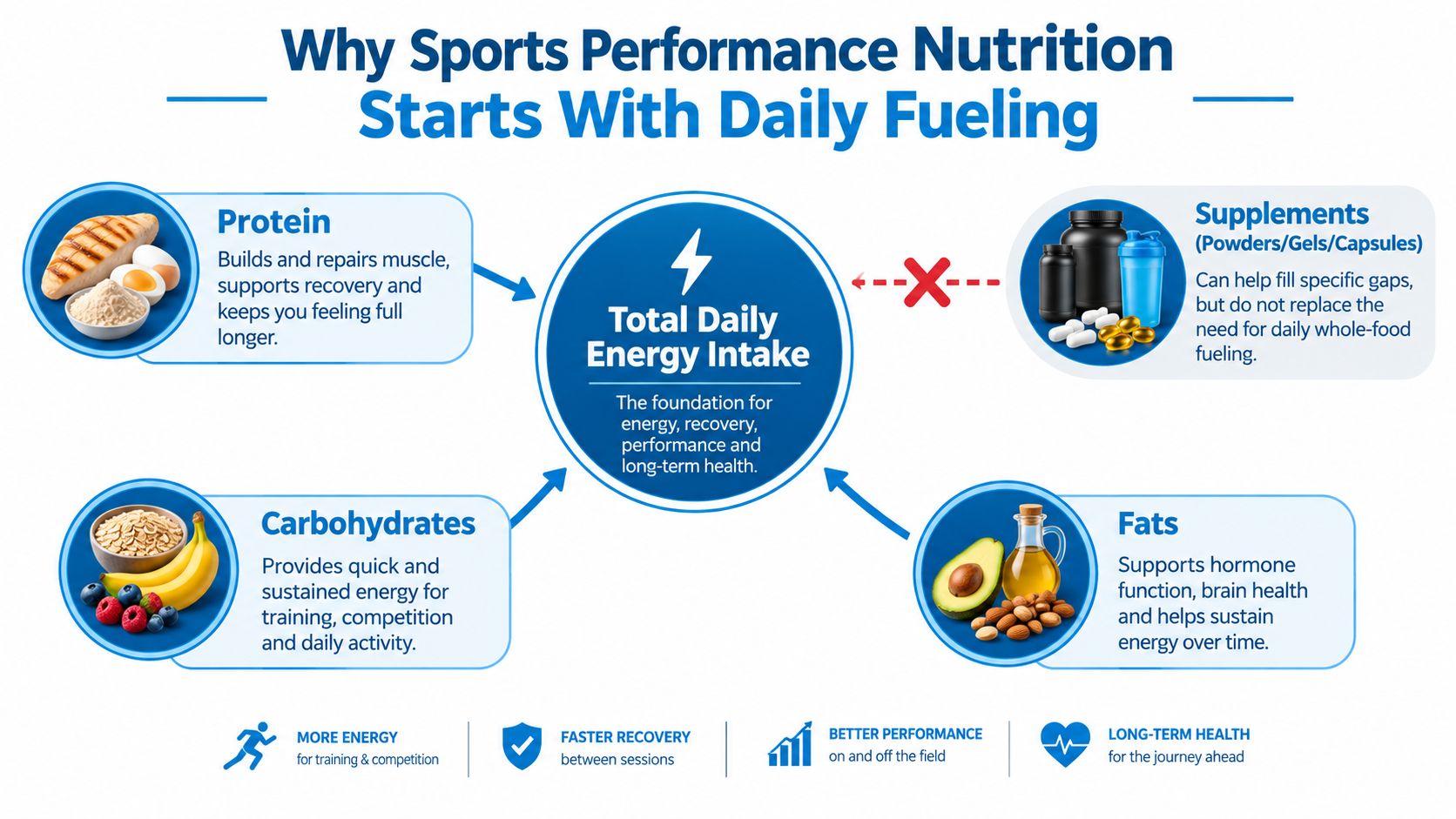
Practical rule: Build the day around food first, then use supplements to solve a specific problem that food, schedule, or tolerance doesn't solve conveniently.
The rest of a sound plan follows from this foundation. Macronutrient targets establish the raw materials, timing places fuel where it can help most, hydration supports fluid balance, and recovery nutrition prepares you for the next session. Personalization then adjusts the system for sport, climate, schedule, gut tolerance, and training demand.
Setting Your Macronutrient Targets
Set daily fuel targets before choosing supplements. Start with body weight, then adjust for sport demands and the purpose of the training block. NIH guidance for exercise and athletic performance gives broad ranges of 1.2 to 2.0 g/kg/day for protein, 3 to 10 g/kg/day for carbohydrate, and 20% to 35% of total calories from fat.
| Training Demand | Protein (g/kg/day) | Carbohydrate (g/kg/day) | Fat (% of kcal) |
|---|---|---|---|
| General training | 1.2–1.6 | 3–5 | 20–35% |
| High-volume mixed training | 1.6–2.0 | 5–7 | 20–35% |
| Endurance or demanding competition preparation | 1.6–2.0 | 7–10 | 20–35% |
These ranges are a starting map, not a fixed prescription. Training volume, body size, recovery needs, and food intake all affect where you fit.
Protein supports repair, but more isn't automatically better
Protein supplies the amino acids used to repair and remodel muscle after training. Spread it across meals so your intake supports the whole day instead of placing nearly everything at dinner. Start near the middle of the athlete range, then move toward the higher end during demanding training blocks or intentional food restriction.
Choose from dairy, eggs, fish, meat, tofu, tempeh, beans, lentils, nuts, seeds, and protein powders. A protein product collection can help when a full meal is impractical. A shake still works best as a convenient part of the plan, not as a replacement for carbohydrate-rich foods that supply training energy.
Carbohydrate fills the performance tank
Carbohydrate is often the macro athletes reduce first while trying to eat clean or control body weight. That can leave the tank partly empty. Muscle glycogen, the stored form of carbohydrate, supports repeated high-intensity efforts, long sessions, and sports with frequent accelerations.
A review of sporting performance and food describes how research in 1962, 1966, and 1967 connected diet-driven changes in muscle glycogen with endurance performance. The practical lesson is straightforward: carbohydrate is stored training fuel, not merely a side dish.
Dietary fat keeps the diet functional
Fat has a smaller immediate role in high-intensity exercise than carbohydrate, yet it helps keep the overall diet nutritionally complete. It supports hormone production and absorption of fat-soluble vitamins. Include sustainable sources such as olive oil, avocado, nuts, seeds, eggs, and oily fish.
Nutrient Timing Around Training Sessions
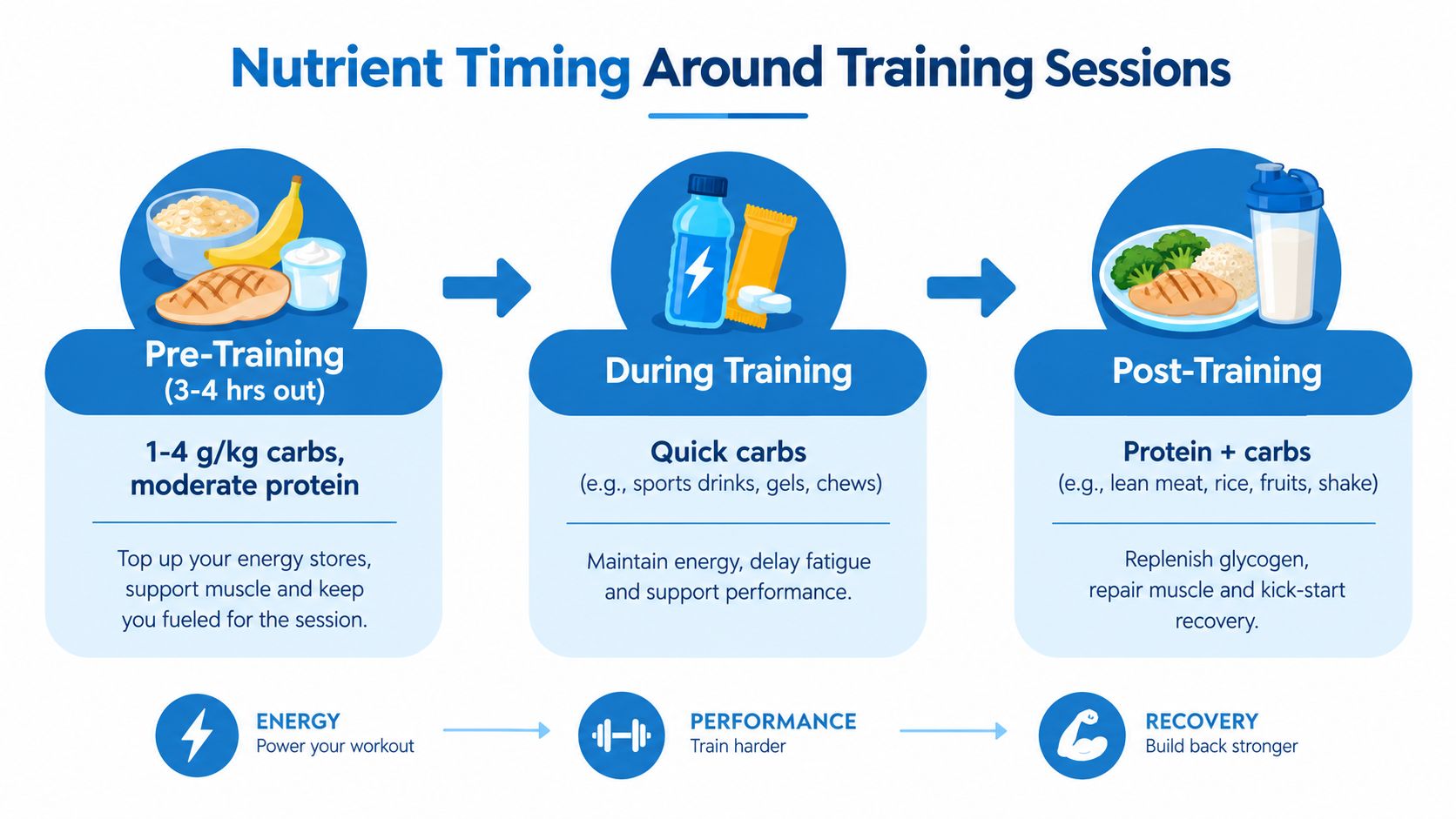
Timing works best as a refinement of adequate daily intake, not as a way to rescue an under-fueled day. The aim is simple: arrive with usable fuel, maintain output when the session demands it, and begin repair soon after finishing.
Before training
A substantial meal around 3 to 4 hours before training can combine carbohydrate with moderate protein. Rice with chicken, oats with yogurt and fruit, or potatoes with eggs can all work. The carbohydrate amount depends on body size, session intensity, and individual tolerance, but a broad pre-session range is 1 to 4 g/kg.
If hunger returns or the meal was small, a 30 to 60 minute top-up can provide fast-digesting carbohydrate. A banana, toast with jam, sports drink, or low-fiber cereal may be easier to tolerate than a heavy meal. Keep fat and fiber modest close to intense exercise if they tend to cause stomach discomfort.
During training
Intra-session carbohydrate matters most when the workout is prolonged, intense, or followed by another demanding effort. For sessions lasting roughly over an hour, athletes commonly use carbohydrate drinks, gels, chews, or easily digested food. Start with a tolerable amount and practice it in training, because the gut also needs preparation.
The source matters. Glucose-based carbohydrate, often combined with fructose, is especially relevant when rapid delivery and glycogen restoration are priorities. Don't introduce a new gel or drink on race day.
This short video can help athletes visualize how fueling fits into training:
After training
You don't need to panic about a rigid 30-minute deadline. Total daily protein and carbohydrate intake matter more than a magic clock, but eating a complete meal within roughly 2 hours is a sensible habit, especially after a hard session or when another session is coming soon. Combine carbohydrate, a high-quality protein source, fluids, and enough total food to replace what the workout used.
Hydration and Electrolyte Replacement
Hydration isn't a contest to see how much water you can drink. The right plan matches fluid intake to sweat loss, exercise duration, temperature, humidity, access to drinks, and your ability to tolerate fluid while moving.
Begin training normally hydrated. For a short, comfortable session, water and ordinary meals may be enough. As duration and sweat loss increase, carbohydrate and sodium become more useful, particularly when the next opportunity to eat or drink is limited.
Match the drink to the session
The fluid replacement position statement describes rehydration fluids with approximately 0.5 to 0.7 g/L of sodium and practical sports-drink benchmarks of 4% to 8% carbohydrate with about 10 to 30 mmol/L sodium. In hot or humid conditions, sodium needs can rise toward 300 to 600 mg per hour because sweat losses increase.
| Session Length | Fluid (mL/hr) | Sodium (g/L) | Carbohydrate in Fluid |
|---|---|---|---|
| Under 60 minutes | Drink to thirst | Usually unnecessary in the drink | Usually unnecessary |
| 60–120 minutes | Individualize to sweat rate | 0.5–0.7 | Useful when intensity or duration demands it |
| Over 2 hours or hot conditions | Individualize and practice | 0.5–0.7, adjusted to context | Useful for sustained fueling |
These are planning anchors, not universal prescriptions. Drinking too little can contribute to declining output, headache, unusual fatigue, and poor recovery. Drinking far beyond thirst can also create problems, so avoid treating a large bottle as proof of a better hydration plan.
Use a simple field check
Weigh yourself before and after a long training session under similar conditions, accounting for fluid consumed and urine produced. The change gives you a practical estimate of sweat loss, although it won't be perfect.
If you need rapid rehydration, the position statement supports replacing approximately 150% of lost fluid over the next 1 to 2 hours. Sodium helps the body retain that fluid, especially when the drink is consumed without a substantial meal. An electrolyte option such as Liquid I.V. Hydration Multiplier Tangerine can fit that use case, but check the label and test tolerance before relying on it in competition.
Recovery Nutrition for the Next Session
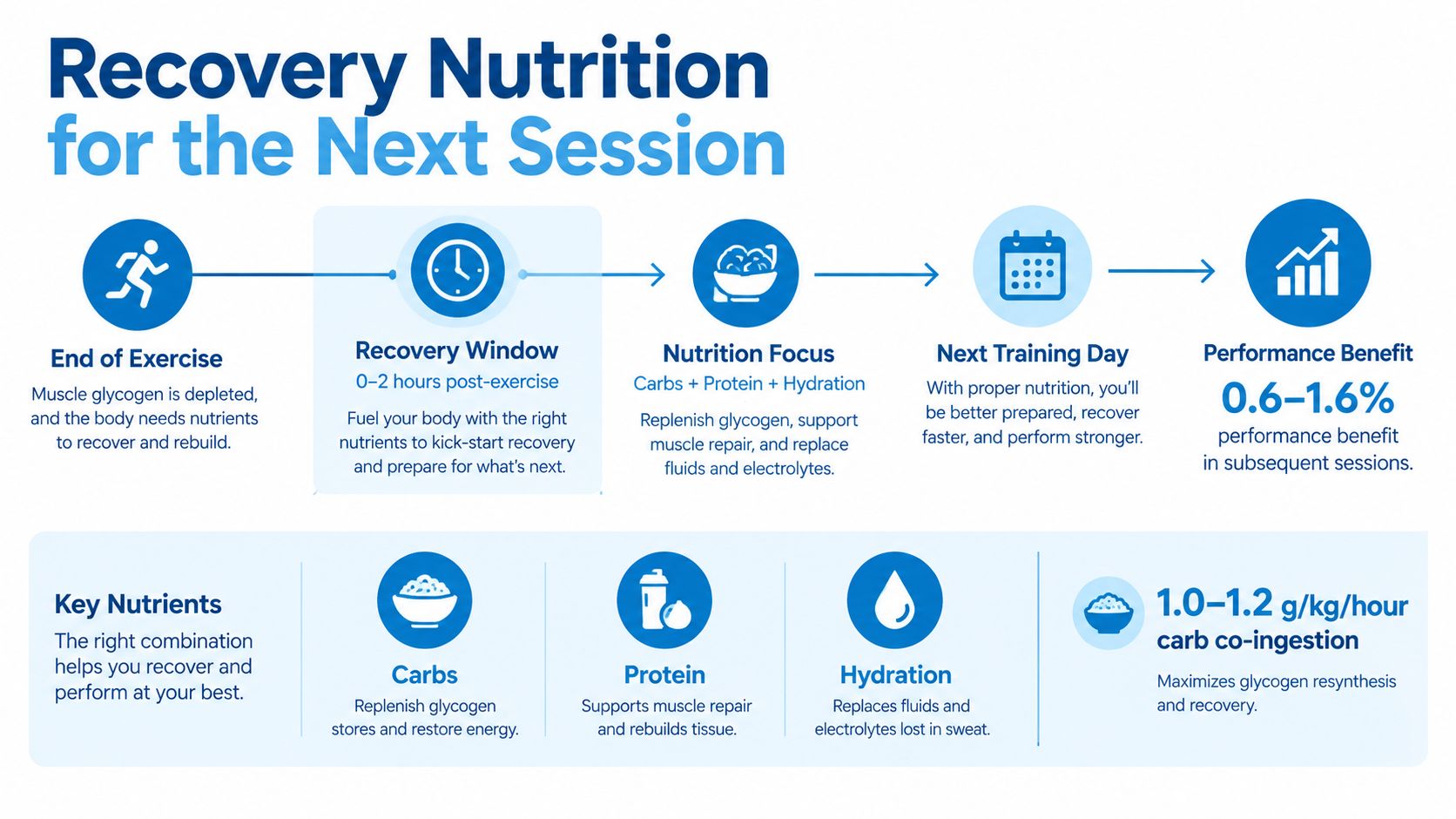
Recovery is a whole-day fueling task, not a protein-shake decision. Training ends the session, but carbohydrate restoration, tissue repair, hydration, sleep, and total energy intake continue working through the evening and overnight. An athlete with a full day before the next workout may recover well with a balanced meal. When another hard session arrives the next morning, the early recovery window matters more because there is less time to rebuild glycogen and replace what training used.
A recent review of post-exercise carbohydrate and protein found that, with less than 24 hours for recovery, combining carbohydrate and protein can provide a small subsequent-session performance benefit of approximately 0.6% to 1.6%. The review also identifies glucose-based carbohydrate, often paired with fructose, at roughly 1.0 to 1.2 g/kg/hour during the first 4 hours as the best-supported rapid glycogen approach.
Follow the athlete through a compressed recovery day
An athlete finishing a demanding morning session before another hard workout the next morning needs more than amino acids. A meal of rice, fruit, yogurt, and another protein source starts recovery by supplying carbohydrate for glycogen, protein for repair, and fluid, sodium, and other nutrients. A protein-only shake can contribute amino acids, but it leaves a major part of the recovery job unfinished.
Protein still has a clear role. Guidance recommends approximately 0.3 g/kg of high-quality protein within 0 to 2 hours after exercise, followed by similar opportunities every 3 to 5 hours. For a 150 lb athlete, that post-exercise serving is about 20 g of protein. Spread protein across the day rather than letting one large serving carry the entire plan.
Three priorities make recovery practical
- Refill glycogen: Eat carbohydrate soon after demanding training, then include it at regular intervals while the next session is close.
- Repair tissue: Add a complete protein source to the first recovery meal and distribute later servings across the day.
- Restore fluid: Replace training losses, using sodium when faster fluid retention matters.
A late snack cannot compensate for repeated under-fueling or poor sleep. Tart cherries, oily fish, nuts, seeds, and other minimally processed foods can support a varied recovery pattern, but they sit around the main priorities rather than replacing them.
Athletes wanting a convenient amino-acid option may consider Anabol Naturals Amino Balance. Use it as an optional tool, not a substitute for carbohydrate, protein-containing meals, sufficient total energy, or sleep.
Supplements That Actually Move the Needle
Supplements deserve a narrower role than marketing often gives them. The strongest decision rule is to ask what problem a product solves, whether the athlete can solve it with food, and whether the expected benefit justifies the cost and potential side effects.
Evidence reviews in the GSSI sports nutrition resource emphasize that many supplements have mixed or limited benefits, especially when applied broadly rather than to a defined situation. That makes context more useful than a universal “must-have” list.
| Supplement | Best For | Evidence Strength | Realistic Effect |
|---|---|---|---|
| Creatine monohydrate | Repeated high-intensity efforts and strength-focused training | Strong | Supports training capacity and adaptation when used consistently |
| Whey or plant protein | Meeting daily protein needs | Practical, not magical | Convenient protein, especially when meals are difficult |
| Caffeine | Focus and selected high-intensity or endurance sessions | Strong but individual | May improve alertness and perceived effort |
| Beta-alanine | High-repetition muscular endurance | Context-specific | May help some athletes during efforts that create substantial acid buildup |
| Nitrate-rich products | Endurance economy in selected athletes | Mixed | Potentially useful in specific endurance contexts |
| Electrolytes | Longer sessions and hot conditions | Context-specific | Supports a practical fluid strategy when sweat and fluid losses are high |
| BCAAs | Athletes already meeting protein needs | Weak for broad use | Usually add little beyond adequate complete protein |
| Glutamine | General performance enhancement | Limited | Not a universal recovery solution |
| Fat burners | Weight-loss marketing claims | Poor for dependable performance | Don't replace energy control, training, or dietary structure |
Creatine monohydrate is a useful example of targeted supplementation. Its purpose isn't to replace lunch or make an under-fueled session productive. It can support repeated high-intensity work when the athlete already eats enough and follows a consistent training plan.
Protein powder serves a different function. It helps close a protein gap when travel, appetite, or schedule gets in the way. A caffeine product may fit before a key session, but individual tolerance, sleep, anxiety, and timing matter. A product that improves one workout but disrupts sleep can undermine the next several days.
Decision filter: If you can't name the exact training problem a supplement addresses, don't make it the first change.
Putting It All Together in a Sample Day
A 75 kg endurance-strength athlete has a mixed training day. The following schedule isn't a prescription, but it shows how a whole-day system can fit together without turning every meal into a laboratory calculation.
At 7:00 AM, breakfast includes 60 g carbohydrate, 30 g protein, and 12 g fat. Oats with milk, berries, and eggs could supply a similar structure. At 10:00 AM, Greek yogurt, granola, and a banana provide another practical combination of carbohydrate and protein, while keeping the athlete from arriving at the pre-training meal excessively hungry.
The training window
At 11:30 AM, the athlete eats a pre-session meal containing 60 to 90 g carbohydrate and 20 g protein before a 12:30 PM workout. The meal could be rice with lean protein and fruit, or a bagel with yogurt and a banana. The right choice depends on taste, access, and gut tolerance.
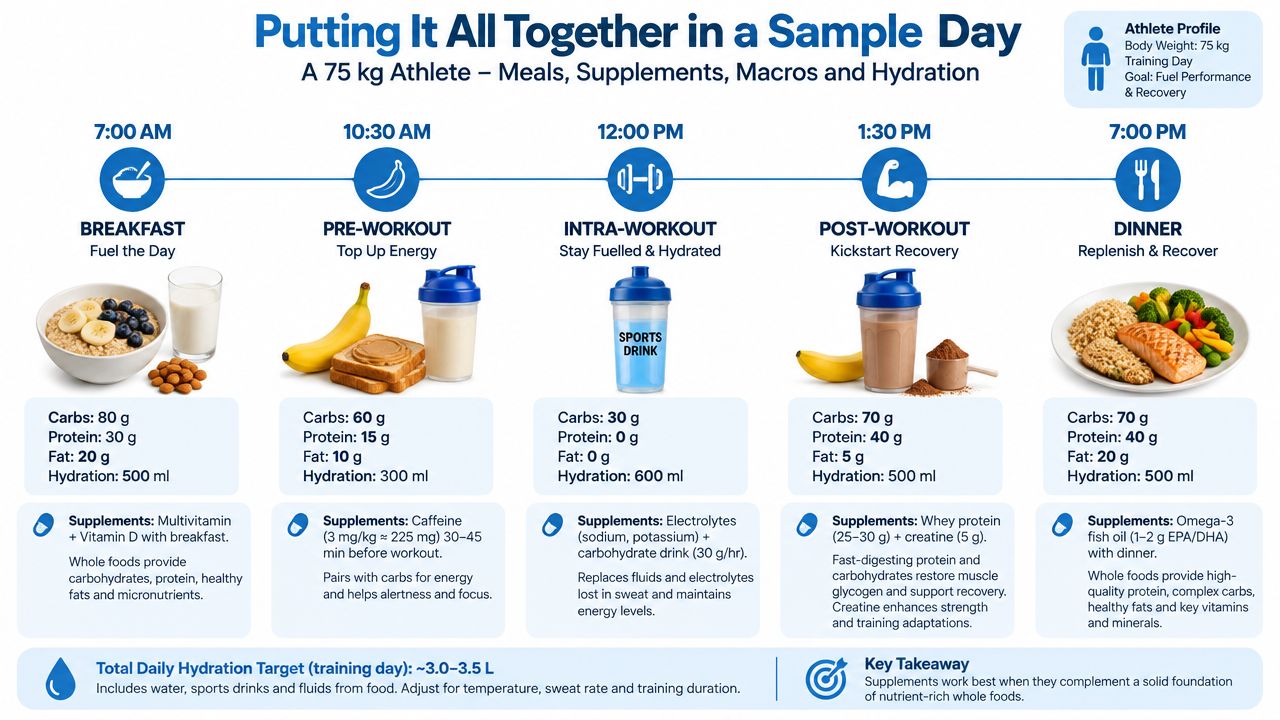
If the session lasts more than an hour and remains demanding, the athlete uses carbohydrate during training. A practical target in this example is 60 to 90 g per hour, with fluid containing approximately 600 to 900 mg sodium per liter when conditions and sweat losses justify it. Those targets need rehearsal. A drink that looks perfect on paper can fail if it causes bloating or nausea.
Within 60 minutes after training, the athlete aims for 1.0 to 1.2 g/kg carbohydrate and 0.3 g/kg protein. For this 75 kg athlete, that works out to 75 to 90 g carbohydrate and 22.5 g protein. A recovery bowl with cereal, milk, fruit, and yogurt could work, followed by a proper lunch later.
The rest of the day completes the plan
Lunch, an afternoon snack, and dinner supply the remaining energy, carbohydrate, protein, and fat. The athlete doesn't need every meal to look identical. The useful pattern is repeated opportunities to eat enough, with more carbohydrate placed around demanding work.
Creatine monohydrate at 3 to 5 g daily and optional caffeine at 60 to 200 mg before the session can form the supplement layer in this example, but those amounts are not included in the verified guidance provided for this article. Treat any supplement dosing as a product-specific and individual decision, and consider professional advice when medication, pregnancy, medical conditions, or unusual sensitivity is involved.
Personalizing Your Plan and Common Pitfalls
A good plan changes when the athlete changes. A cyclist preparing for long rides, a field-sport player completing repeated sprints, and a strength athlete in a lower-volume block shouldn't eat from the same template just because they all train hard.
Use this checklist to make the plan fit:
- Training demand: Increase attention to carbohydrate when sessions become longer, harder, or more frequent.
- Body-composition goal: Create changes gradually rather than cutting fuel around every workout.
- Sport format: Account for continuous endurance work, repeated sprints, strength sets, travel, and competition rules.
- Schedule: Use portable meals and drinks when work, school, or commuting limits normal eating.
- Climate: Reassess fluid and sodium strategy in heat, humidity, or unusually long sessions.
- Gut tolerance: Practice gels, drinks, high-fiber foods, and larger meals before competition.
- Food access: Build reliable options from foods you can buy, prepare, and carry.
The mistakes that keep showing up
The biggest trap is often too little carbohydrate and total energy, not too little protein. Athletes may fear carbohydrates, delay eating until after training, or build meals around lean protein while leaving the plate short on rice, oats, potatoes, bread, fruit, or other carbohydrate foods.
Another mistake is drinking plain water aggressively during long, hot sessions while ignoring sweat losses and fluid retention. Sodium can be useful in the right context, but it isn't a reason to consume electrolyte products automatically every day. Match the drink to the session rather than to the label's promises.
Finally, don't copy an elite athlete's supplement stack without copying their training load, support staff, food access, sleep routine, and medical oversight. The stack may create expense and digestive problems while doing nothing meaningful for your own objective.
Start with a food log covering several ordinary training days. Mark where energy, carbohydrate, protein, fluid, and recovery opportunities fall short, then change one variable at a time. Once the daily foundation works, add only the supplement that solves a clearly defined need.
CalVitamin offers an online range of proteins, sports blends, vitamins, minerals, and other dietary supplements that can support specific gaps in a sports performance nutrition routine. Review the available options at CalVitamin, compare product labels carefully, and choose additions only after your daily fueling foundation is in place.






