

You're standing in front of three maca products and none of the labels speaks the same language. One bottle lists 500 mg per capsule, a powder pouch gives a scoop size, and a liquid product uses a dropper measurement. You want support for energy, libido, or fertility, but you can't tell whether one serving is meaningful or merely convenient.
The shortcut is to stop comparing capsules and start comparing dried-root equivalents in grams. Human maca research has generally clustered around 1.5 to 3.5 grams per day, with many studies using the product for only 2 to 12 weeks. That gives you a practical starting framework, but it also reveals the question most labels avoid: how long should you continue, and when should you stop? Health Canada's maca monograph summarizes the most commonly studied adult dosing range and the limits of longer-term use.
Table of Contents
- Why the Right Maca Dose Is Hard to Find on the Label
- What Maca Root Actually Is and Why Dose Is Measured in Grams
- Maca Root Dosage by Goal and What the Trials Show
- Powder, Capsules, Extract, and Gelatinized Forms Compared
- How to Start Low and Titrate Up Safely
- How Long to Take Maca and Whether You Should Cycle It
- Safety, Side Effects, and Who Should Avoid Maca
- Quick Maca Dosage Checklist Before You Buy
Why the Right Maca Dose Is Hard to Find on the Label
A capsule label might say 500 mg of maca, while a powder label might describe a serving in grams. Those amounts can be compared only if both products refer to the same preparation. A plain dried-root capsule and a concentrated extract may carry identical milligram numbers while delivering very different amounts of original maca material.
Clinical research usually reports maca as a daily amount of dried root, dried hypocotyl, gelatinized root, or extract. Retail packaging does something else. It emphasizes capsules, scoops, servings, and droppers, often without making the dried-root equivalent obvious. That's why a shopper can follow every instruction on the bottle and still have no idea whether the product resembles the doses used in human trials.
The practical translation
Treat the serving size as a conversion problem. First identify whether the product contains plain root, gelatinized root, or an extract. Then check whether the label states an extraction ratio or gives a dried-root equivalent. If it doesn't, you can't confidently compare that product with a trial dose.
The most useful reference point is the clinically familiar band of 1.5 to 3.5 g per day, not the number printed in large type on the front of the package. A bottle providing 500 mg of plain root per capsule would require multiple capsules to reach that range, while a concentrated preparation may require much less material on the scale. The label must tell you which situation applies.
Shopping rule: If a product doesn't identify the maca preparation and the amount per serving, skip it. A low milligram number isn't automatically weak, and a high one isn't automatically better.
This approach also prevents a common mistake: assuming that more maca must produce more benefit. In one controlled trial, 1.5 g and 3 g per day did not produce a clear dose-response difference, so the higher amount wasn't automatically superior. Use the lowest dose that matches your goal and that you can tolerate consistently.
What Maca Root Actually Is and Why Dose Is Measured in Grams
Maca, or Lepidium meyenii, is a cruciferous root traditionally used as a whole food and supplement. The research dose refers to the dried root or hypocotyl, not to one isolated chemical. Maca contains several classes of compounds, including macamides, glucosinolates, and polysaccharides, and researchers haven't established one single compound as the universal active ingredient.
That matters because milligrams alone don't describe the preparation. A 500 mg capsule of plain dried root is a measured amount of the whole plant material. A 500 mg extract may represent a different quantity of original root, depending on how it was produced and standardized.
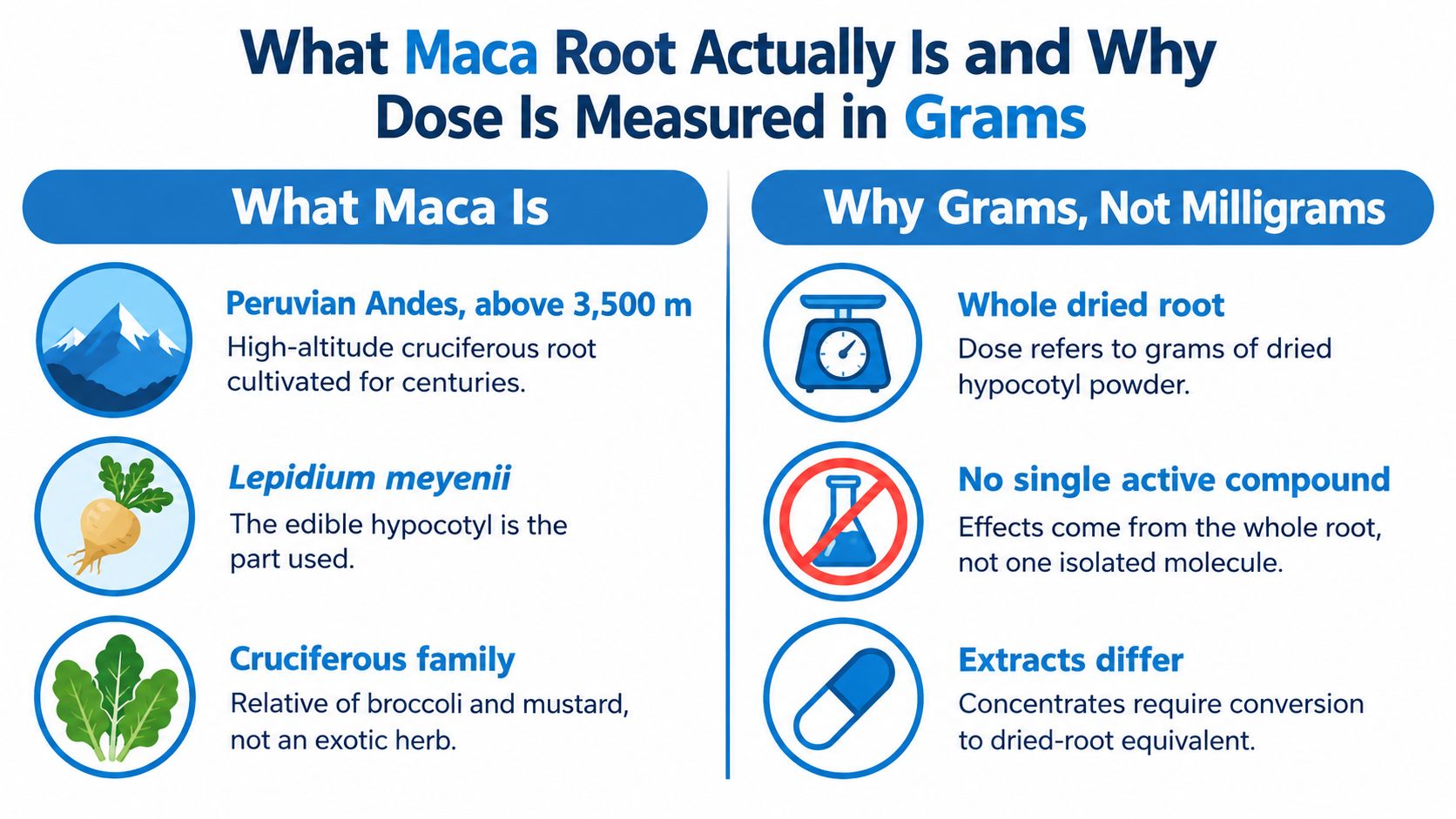
Read the label in three steps
- Find the plant material. Look for “maca root,” “maca hypocotyl,” “gelatinized maca,” or an extract description. Don't treat all of these as interchangeable.
- Find the actual serving. Record the amount per capsule, scoop, tablet, or milliliter. Then check whether that amount is plain root or concentrated material.
- Convert before increasing. If the label provides no ratio or dried-root equivalent, stay with the manufacturer's serving rather than guessing how much concentrated extract equals a study dose.
The evidence base is clearest for preparations that can be related directly to dried-root amounts. A review of maca studies found doses ranging from 1.5 g to 3.5 g per day, with study periods commonly lasting 2 to 12 weeks. That's why a grams-based approach is more useful than telling every shopper to take a fixed number of capsules. The clinical review in PMC provides the relevant dose and duration range.
Use the product's stated serving as your starting measurement. Don't rely on an ordinary kitchen spoon to estimate a precise dose, because powder density and serving size vary. For extracts, follow the stated equivalent on the label or ask the manufacturer for clarification.
Maca Root Dosage by Goal and What the Trials Show
The right maca root dosage depends partly on what you're trying to change. The strongest human evidence concerns sexual desire and some semen parameters. Evidence for general energy, athletic performance, mood, and menopausal symptoms is less consistent, so those goals don't justify automatically choosing the highest amount.
Libido
For libido, a sensible evidence-aligned target is 1.5 to 3 g per day of a preparation that clearly states its dried-root basis. A 12-week randomized, placebo-controlled trial in healthy men used 1.5 to 3 g per day of gelatinized maca and reported improved sexual desire. The study didn't show a clear difference between the two doses, which supports starting at the lower end rather than rushing to 3 g.
A separate dose-finding study used 1.5 g or 3 g per day, with the higher group showing the greatest improvement in sexual function. Taken together, the results support a practical range, not a single magic number. Give the lower dose a fair trial before increasing.
Fertility
Fertility deserves more discipline than a general vitality routine. Human studies have examined maca in relation to semen measures, and the commonly studied range remains 1.5 to 3.5 g per day. Don't interpret this as proof that maca treats infertility. A semen result can be affected by many medical and lifestyle factors, and supplement use shouldn't replace an evaluation when conception is delayed.
For a fertility-focused trial, choose a clearly labeled preparation and stay within the studied range. If you're already working with a fertility clinician, show them the product label, including the form and extraction details.
Energy and mood
Energy is the goal with the weakest basis for aggressive dosing. A lower starting target, such as 1.5 to 2.5 g per day, is more sensible than assuming that 3 g or more will produce extra stamina. Human research has used several preparations and small short-term studies, but the evidence doesn't establish a dependable dose-response pattern for everyday energy.
| Goal | Dose range | Form used in trials | Common trial duration | Evidence strength |
|---|---|---|---|---|
| Libido | 1.5 to 3 g/day | Gelatinized maca and dried-root preparations | 2 to 12 weeks | Strongest among the common consumer goals |
| Fertility support | 1.5 to 3.5 g/day | Dried root and maca preparations | Short-term studies | Promising for some semen parameters, not a substitute for care |
| Energy and mood | Start around 1.5 g/day, adjust only if tolerated | Preparations vary | Short-term studies | More limited and less consistent |
The dosing and safety summary in this clinical overview of maca describes the human trial range, the libido findings, and the absence of a consistent advantage for the higher dose in at least one study. My recommendation is straightforward: choose the lowest study-aligned dose that matches your goal, then judge the result by function, not by expectation.
Powder, Capsules, Extract, and Gelatinized Forms Compared
The form changes how easy it is to measure maca, how much material you swallow, and how confidently you can compare the label with research. It doesn't make a product clinically effective by itself.
Raw powder is the simplest form to understand because the label usually refers to dried root. It can be mixed into food, but some people find the taste or digestion difficult. Gelatinized powder has been processed to remove much of the starch, and it appears frequently in clinical dosing. It may be easier to tolerate, but you still need the package's serving measurement rather than guessing by volume.
Capsules and tablets win on consistency and portability. Their drawback is arithmetic. If each capsule contains 500 mg of plain maca, reaching 1.5 g requires three capsules per day. That calculation changes if the capsule contains an extract.
Liquid products are the most difficult to compare without a clear ratio. A dropper measurement tells you volume, not the amount of original dried root. If the label doesn't state the extract strength or dried-root equivalent, don't attempt an improvised conversion.
| Form | Typical concentration | What the label usually shows | Equivalent to study dose | Best for |
|---|---|---|---|---|
| Raw powder | Dried-root material | Grams per serving | Usually direct if the serving is clear | Flexible dosing and food use |
| Gelatinized powder | Processed root preparation | Grams per serving | Compare with the stated root equivalent | Shoppers concerned about digestion |
| Capsules or tablets | Plain root or extract | Milligrams per unit | Multiply units only when the form is clear | Precise, portable dosing |
| Liquid extract | Concentration varies | Milliliters and extract strength | Use the stated dried-root equivalent | People who can't swallow capsules |
For a product example, review the preparation and serving details of Gaia Herbs Gelatinized Peruvian Maca Powder, then compare its stated serving with your target in grams. Don't assume that “gelatinized” means concentrated by a fixed amount. The package must provide the information needed for a valid comparison.
Best choice: Pick the form whose label lets you calculate a daily dried-root amount without guesswork. Convenience matters, but transparent dosing matters more.
How to Start Low and Titrate Up Safely
You don't need to begin at the top of the maca dosage range. Starting low gives you information about digestion, sleep, mood, and whether the product fits your routine before you commit to a larger daily amount.
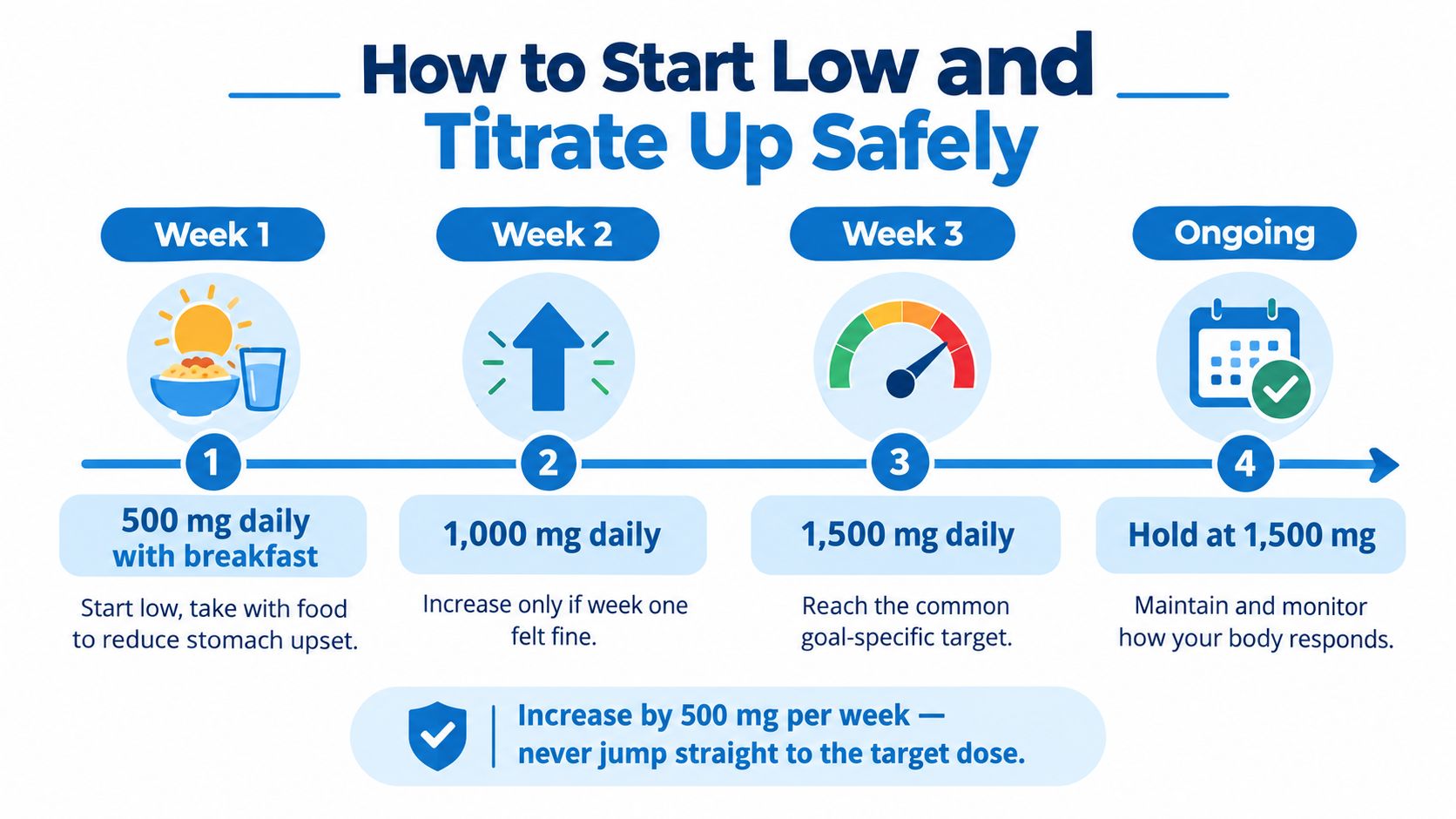
Use a simple weekly progression with a clearly labeled plain-root or dried-root-equivalent product:
- Week one: Take 500 mg once daily with breakfast. The purpose is tolerance, not an immediate verdict on effectiveness.
- Week two: If the first week felt normal, increase to 1,000 mg daily.
- Week three: If you're still tolerating it, increase to 1,500 mg daily. This is a common lower target for libido and a reasonable checkpoint for energy.
- Week four: Hold at 1,500 mg if you're responding. For a fertility-focused plan, discuss whether a higher amount is appropriate rather than increasing automatically.
The cited starting amounts and weekly increments are practical dosing instructions, not evidence that everyone must follow the same schedule. If your goal requires a higher studied range, increase only in small steps and remain within the product's stated equivalent.
What to do when your body objects
Mild stomach upset, restlessness, headache, or irritability means the current amount isn't working for you. Take the product with food, return to the last well-tolerated dose, or stop if the symptom continues. Don't increase while you're having a reaction, and don't double the next serving after a missed day.
If you're comparing a capsule routine, this Organic Maca Root 1900 mg capsule option illustrates why the serving instruction matters more than the front-label number. Confirm whether the stated amount refers to each capsule or to the full daily serving before you decide how many units to take.
How Long to Take Maca and Whether You Should Cycle It
Maca isn't caffeine, and the evidence doesn't establish a pharmacological need to cycle it in the way some people cycle stimulants. The stronger point is practical: human research is concentrated in short courses, so indefinite daily use goes beyond what has been studied well.
Most maca trials used doses in the 1.5 to 3.5 g per day range for 2 to 12 weeks, while safety summaries also describe some studies lasting 12 to 16 weeks. That supports a defined evaluation period, not an open-ended promise. The safety review from the National Library of Medicine specifically highlights the limited long-term human data and the recommendation to consult a clinician for use beyond 3 months.
A useful stopping rule
Assess your response at 8 weeks. Ask whether libido, sexual function, energy, or another clearly defined outcome has changed in a meaningful way. If nothing has changed, raising the dose above the commonly studied range is a poor next move. Reconsider the goal, product transparency, sleep, nutrition, medications, and possible medical causes instead.
A planned break can also help you separate a genuine benefit from routine, expectation, or changing circumstances. A 6-weeks-on, 2-weeks-off pattern is a reasonable self-monitoring strategy, but it isn't a clinically proven requirement. If you feel worse during the break or the original symptom returns sharply, that's a reason to investigate the symptom, not proof that maca must be taken indefinitely.
For fertility, don't judge the product by a few days of use. Semen-related goals require a clinician's guidance and a defined assessment plan. For energy, stop if the product makes you wired, disrupts sleep, or shifts your mood. More product won't correct an unidentified cause of fatigue.
Safety, Side Effects, and Who Should Avoid Maca
Maca is generally described as well tolerated in short human studies, but “well tolerated” doesn't mean symptom-free. A 12-week study using 3 g per day reported transient gastrointestinal upset, headache, and irritability. Those effects are a practical reason to start below the target and to avoid pushing higher when the current amount already causes problems. The NIH LiverTox entry on maca reviews the available safety information and reports that minor, transient adverse effects have occurred in small trials.
Medication and condition checks
Maca contains glucosinolates because it's a cruciferous root. That makes thyroid conditions and thyroid medication an important conversation, especially if you're considering regular use or a higher dose. People taking levothyroxine shouldn't add maca without asking their prescriber how to monitor and separate supplement use from their existing treatment plan.
Hormone-sensitive conditions also deserve professional review. If you have a history of a hormone-sensitive cancer, are pregnant or breastfeeding, or use hormone therapy, don't self-prescribe maca based on a wellness label. Human safety evidence for these situations isn't strong enough to justify casual use.
| Condition or medication | Potential concern with maca | Recommended action |
|---|---|---|
| Thyroid disease or levothyroxine | Glucosinolates and uncertain effects on thyroid management | Ask a clinician before starting |
| Hormone-sensitive cancer or hormone therapy | Possible interaction with a hormone-sensitive condition or treatment | Get individualized medical advice |
| Pregnancy or breastfeeding | Insufficient safety information | Avoid self-use and consult a clinician |
| Antidepressants or psychiatric medication | Possible changes in mood, sleep, or sexual symptoms | Discuss the product before using a higher dose |
| Blood-pressure medication | Blood-pressure effects are not sufficiently predictable | Ask a clinician and monitor as advised |
Stop maca and seek medical advice if you develop rapid heartbeat, a persistent digestive problem, a skin rash, or a mood change that doesn't settle. A new symptom may come from the supplement, another product in the stack, or an underlying condition. Don't keep increasing the dose while trying to identify the cause.
Quick Maca Dosage Checklist Before You Buy
Use this checklist at the shelf or on a product page. The aim isn't to find the most concentrated bottle. It's to find a preparation that gives you a clear daily amount and a routine you can follow without ignoring symptoms.
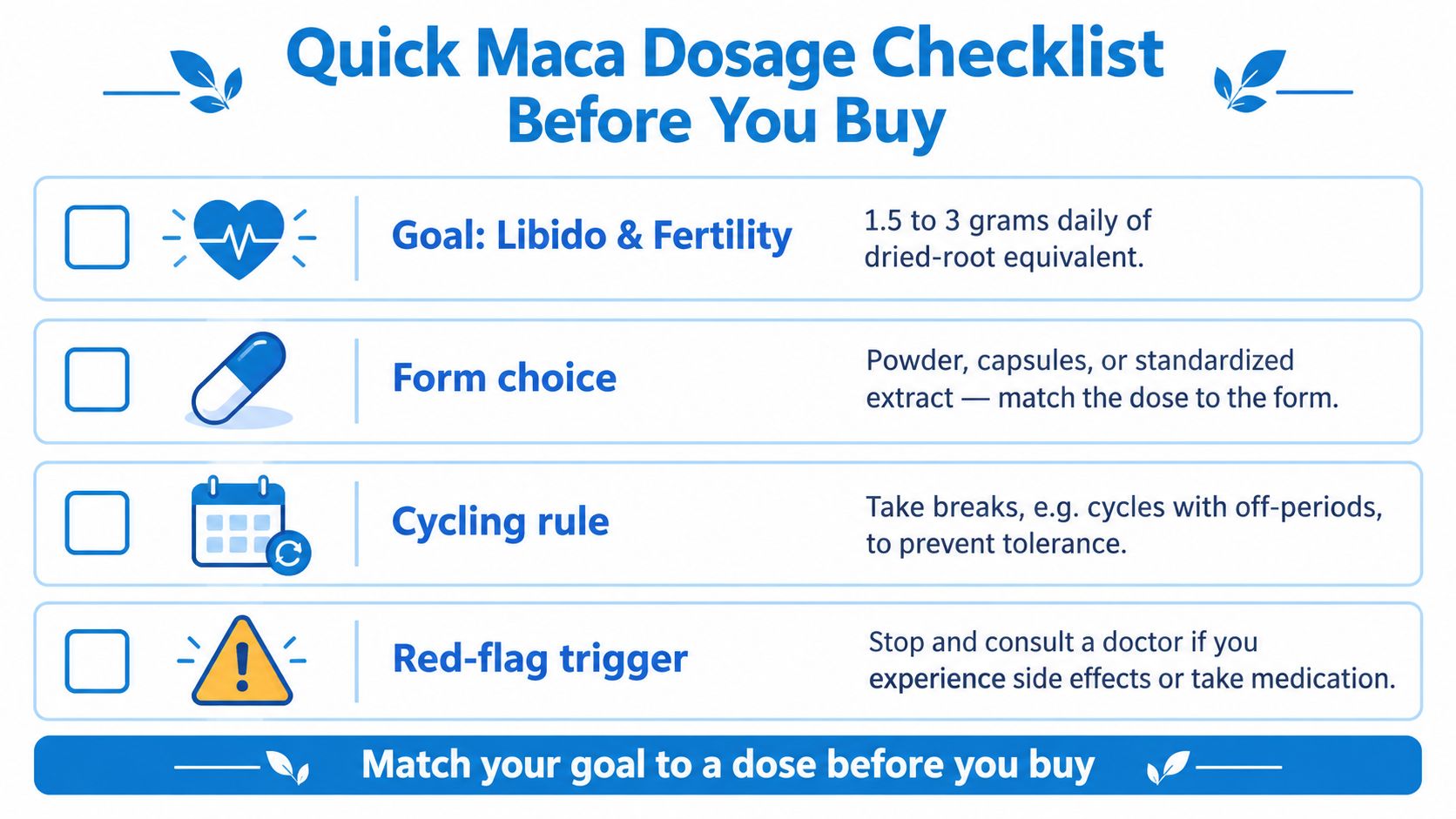
- Match the goal: For libido, begin within the 1.5 to 3 g per day study range. For fertility, stay within the commonly studied range and involve a clinician if conception or semen quality is a concern. For energy, start lower rather than assuming the upper end will work better.
- Choose a transparent form: Raw powder and gelatinized powder are easier to compare when the label states grams per serving. Capsules are practical when the amount per unit is clear. Treat liquid extracts as unsuitable for comparison if the label omits concentration or dried-root equivalent.
- Start with 500 mg: Use 500 mg daily with breakfast during the first week, then increase by 500 mg only when the previous amount was comfortable. Resume your last tolerated amount after a missed day, and never compensate with a double serving.
- Set a review date: Evaluate the result at 8 weeks. Consider a break rather than indefinite use, and ask a clinician before continuing beyond 3 months.
- Check your risk factors: Get advice before use if you take thyroid, blood-pressure, hormone, antidepressant, or psychiatric medication, or if you're pregnant, breastfeeding, or managing a hormone-sensitive condition.
- Know the stop signs: Stop and ask for medical guidance if you experience rapid heartbeat, persistent gastrointestinal symptoms, a rash, or lasting mood changes.
The most important buying question is simple: does the listed serving match a study-aligned dose you can take consistently and safely? If you can't answer that from the label, choose a more transparent product instead. For another practical look at serving instructions and product labeling, see this Organic Maca Root 1900 mg review.
CalVitamin offers maca products alongside vitamins, minerals, proteins, probiotics, and other wellness supplements, so you can compare labeled forms and serving sizes in one place. Visit CalVitamin to review maca options, check product directions, and choose a preparation that fits your goal and dosing plan.






