
Most buying guides treat an unflavored tub as the cleaner, smarter buy, as if skipping vanilla also skips the problems. That shortcut fails. Unflavored protein powder only tells you the formula has no flavor system. It does not raise protein quality, lower contaminants, or set your daily target.
A plain powder can still miss a limiting amino acid, clump in hot coffee, or come from a lot that was never tested for lead. Taste is the last decision. Source, dose, label, and how you cook with it come first.
Table of Contents
- Unflavored Protein Powder by Source
- How Much Protein You Need Each Day
- Choosing Unflavored Protein for Your Goals and Diet
- Mixing Unflavored Protein Into Coffee, Oatmeal and Soups
- Recipes Using Unflavored Protein Without Ruining Food
- Reading Labels and Verifying Purity Before You Buy
- Storing Unflavored Protein So It Stays Fresh
- Pick Your Unflavored Protein and Start Using It
Unflavored Protein Powder by Source
Unflavored protein powder is a concentrated protein ingredient, not its own nutrition category. The word on the front changes how the scoop tastes. It does not change how much protein you need or how well that protein is digested.
DIAAS (Digestible Indispensable Amino Acid Score) measures how well each indispensable amino acid is digested at the end of the small intestine. It is more informative than the older PDCAAS, which applied one overall digestibility number to the whole protein.
| Source | Protein per 30 g scoop | Digestibility and amino acid profile | Lactose and allergen notes |
|---|---|---|---|
| Whey protein isolate | about 25 g | High; fast-digesting with strong leucine content | Very low lactose; milk allergen |
| Whey protein concentrate | about 22 g | High; slightly lower purity than isolate | Some lactose; milk allergen |
| Casein (micellar) | about 24 g | High; slow-digesting | Low to moderate lactose; milk allergen |
| Pea protein | about 22 g | Moderate; lower in methionine, pairs well with rice | Dairy-free; check for cross-contact with other allergens |
| Soy protein isolate | about 22-25 g | Moderate to high; complete amino acid profile | Dairy-free; soy allergen |
| Rice protein | about 20-22 g | Moderate; low in lysine | Dairy-free; often blended with pea |
A comparison in the British Journal of Nutrition found that whey protein isolate, whey concentrate, and milk-protein concentrate generally provide higher digestibility for most indispensable amino acids than pea, soy, soy flour, and wheat proteins. The same datasets put whey-based DIAAS values from 78 to above 100. Processing, purity, and how much protein the factory recovers can move the score as much as the source name on the tub.
Why grams on the scoop are not the whole story
Two tubs can both say 25 grams and still feed you differently. Whey isolate and whey concentrate are strong picks when you want essential amino acids that show up quickly. Pea is often lower in methionine. Rice is often low in lysine. A pea and rice blend is the usual fix, because each source covers what the other lacks. Soy isolate is closer to a complete pattern on its own, but it is still a soy allergen.
Practical rule: Compare declared protein per serving and any amino-acid disclosure. Ignore the word unflavored until those two match the job you want the powder to do.
Third-party amino-acid testing beats a marketing line. If the brand will not show the pattern, you are guessing.
How Much Protein You Need Each Day
Judge the scoop against your day, not against the tub next to it on the shelf. For healthy adults, the Dietary Reference Intake is 0.8 grams of protein per kilogram of body weight per day, about 56 grams for a 70-kilogram adult and 64 grams for an 80-kilogram adult, per FDA nutrition-labeling guidance. That same guidance adds 10 grams per day in pregnancy and 15 grams per day in lactation.
| Case | Protein basis | Daily protein target |
|---|---|---|
| Healthy adult, 70 kg | 0.8 g/kg per day | about 56 g |
| Healthy adult, 80 kg | 0.8 g/kg per day | about 64 g |
| Pregnancy, 70 kg | Adult figure plus 10 g | about 66 g |
| Lactation, 70 kg | Adult figure plus 15 g | about 71 g |
| Older adult, 70 kg | 1.2-1.6 g/kg per day | about 84-112 g |
| FDA labeling benchmark | Daily Reference Value | 50 g |
AARP places many older adults' protein targets around 1.2 to 1.6 g/kg per day. For a 70-kilogram person, that lands near 84 to 112 grams. Age, activity, and health still move the number. The table is a starting map, not a prescription.
What one scoop actually covers
A serving of 20 to 25 grams is roughly 36 to 45 percent of the 56-gram reference for a 70-kilogram adult. Say you eat eggs at breakfast and fish at dinner and you are still short by about 25 grams. One scoop closes that gap. It does not replace the meals.
You can calculate your protein target from body weight before you decide how many scoops belong in the week.
One serving a day, or one after training, is a reasonable start. Spreading protein across meals beats dumping it all into a single shake. More powder is not automatically better, because the calories still count.
A product made only of amino acids may not declare those amino acids as protein on the label. If a tub markets "protein equivalents" without grams of protein, read it as a different product.
Choosing Unflavored Protein for Your Goals and Diet
Match the source to the constraint that would make you return the tub. Work through these five checks in order.
- Dairy tolerance: Lactose intolerance points to whey isolate, a clear whey, or a plant powder, because concentrate still carries some lactose. A true milk allergy rules out whey and casein. Both are milk proteins.
- Diet pattern: If you need a vegan or certified plant-based product, choose pea, soy, rice, or a blend, and read the certification. "Plant" on the front is not the certificate.
- Training goal: Post-workout use and muscle gain favor whey isolate or concentrate for fast amino-acid delivery. Micellar casein fits a slow overnight serving. Everyday meals can use any source that tests well and that you digest.
- Stomach and appetite: A sensitive stomach or a small appetite usually does better with isolate or a half serving. A thick pea blend in a huge shake is a hard sell when you are not hungry.
- Price per protein, not per tub: Divide the tub price by total grams of protein, then see what 25 grams costs. A cheaper 2-pound container with more filler can cost more per useful scoop than a smaller isolate.
Say a 2-pound tub holds about 900 grams of powder and each 30-gram scoop delivers 22 grams of protein. You get about 30 scoops and about 660 grams of protein. Divide the shelf price by 660, then multiply by 25. That is the price of one useful serving.
Once the source fits the allergy, the diet, and the goal, taste and texture get easier to manage. You are no longer forcing a sweet shake into a savory lunch.
Mixing Unflavored Protein Into Coffee, Oatmeal and Soups
Reviews stop at the shaker bottle. Everyday food is where an unflavored powder earns its place, and where it most often fails. Powders differ in solubility, particle size, and heat behavior. A whey isolate that vanishes in cold milk can seize in boiling coffee. Some plant proteins turn gritty, earthy, or bitter once the liquid is hot and acidic.
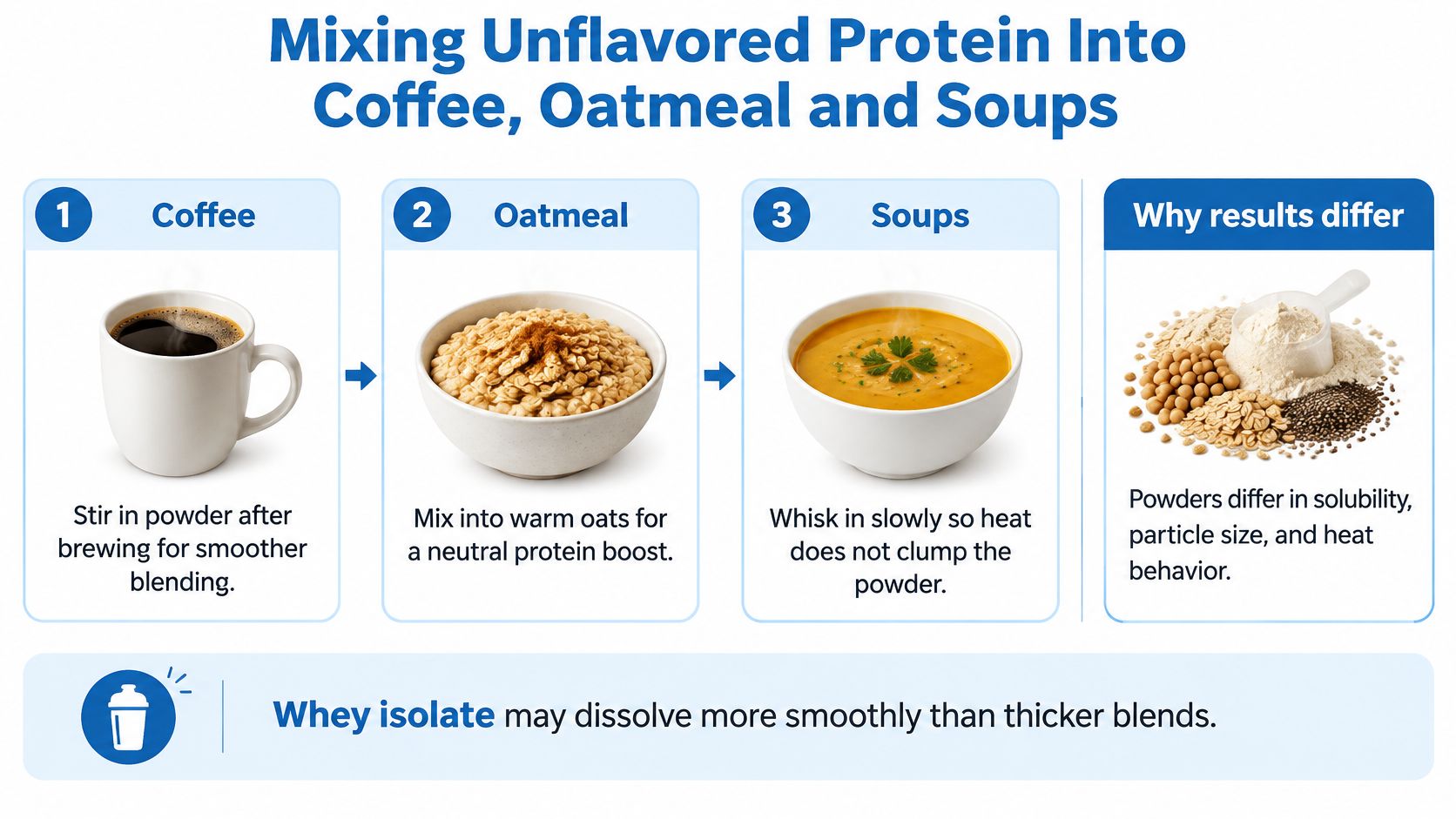
| Application | Temperature | Best protein type | Clump or texture fix |
|---|---|---|---|
| Cold shake or smoothie | Chilled | Whey isolate or pea | Blend 15-20 seconds; add liquid to powder gradually |
| Hot coffee | Hot but not boiling, about 60-70 degrees C | Whey isolate or hydrolyzed blend | Make a paste with a splash of cool milk first |
| Oatmeal | Cooked, then below simmer | Whey or soy | Stir in after removing from heat |
| Soups and sauces | Below simmer, off heat | Pea or soy; whey can curdle in acidic bases | Stir in last, never boil after adding |
| Yogurt or batter | Room temperature | Whey or casein | Mix into the base before other ingredients |
A clump-free sequence
- Whisk the powder into a splash of cool liquid, or into oats that have cooled, until you have a smooth paste. Dry powder needs water before it meets heat, or the outside gels and traps dry lumps.
- Add the rest of the liquid a little at a time while you stir. A sudden flood leaves dry pockets the spoon never reaches.
- Keep hot liquids below a simmer, around 60 to 70 degrees C. Higher heat unfolds the protein and makes whey curdle, especially in acidic coffee or tomato soup.
- Blend shakes for 15 to 20 seconds. The blades finish what a spoon starts, and longer blending just whips in foam.
- Stir the powder into finished food off the heat. Boiling after you add it is what turns a smooth soup grainy.
For a fuller walk-through of shaker technique, see how to mix protein powder without turning the drink into paste.
Unflavored is not the same as unsweetened. A tub can skip "natural flavors" and still contain stevia, sugar, gums, or salt. Those extras change sweetness and thickness even when nobody added vanilla. Read the ingredient list before you assume the oatmeal will taste like oats.
Cinnamon, unsweetened cocoa, and a spoon of fruit purée add flavor without a second sweetener. In soup, black pepper, lemon, and herbs do the same job.
Recipes Using Unflavored Protein Without Ruining Food
Use one scoop as an ingredient, not as the whole dish. These four formats stay mild because the powder never hits a hard boil.
- Cinnamon oat bowl. Stir one 25-gram scoop with 2 tablespoons of cool milk into a paste. Fold that paste into 1/2 cup of cooked oats off the heat. Finish with cinnamon and sliced banana. The cool paste stops the whey from seizing in the hot cereal.
- Cocoa protein coffee. Mix one scoop with a splash of cool milk until smooth, then whisk in hot coffee that has dropped below a simmer. Add 1 teaspoon of unsweetened cocoa. The cocoa covers the faint dairy note without a flavored powder.
- Savory soup boost. Whisk one scoop with a ladle of warm broth until smooth, then stir it into finished soup off the heat. Add herbs. Do not return the pot to a boil. Pea or soy holds up better here than whey, which can curdle in tomato or lemon.
- Pancake batter. Whisk one scoop into the dry flour before any wet ingredient goes in. Cook over medium heat. Hydrating the powder with the flour keeps it from forming rubbery pockets in the batter.
Whey isolate suits the oat bowl and the coffee. Pea or soy suits the soup. Each recipe treats the plain powder as the base, so you control salt, spice, and sweetness.
Reading Labels and Verifying Purity Before You Buy
Unflavored does not mean pure. Flavor oils are not the main contamination path. Soil, processing equipment, and the lot you happen to buy matter more than a blank flavor line.
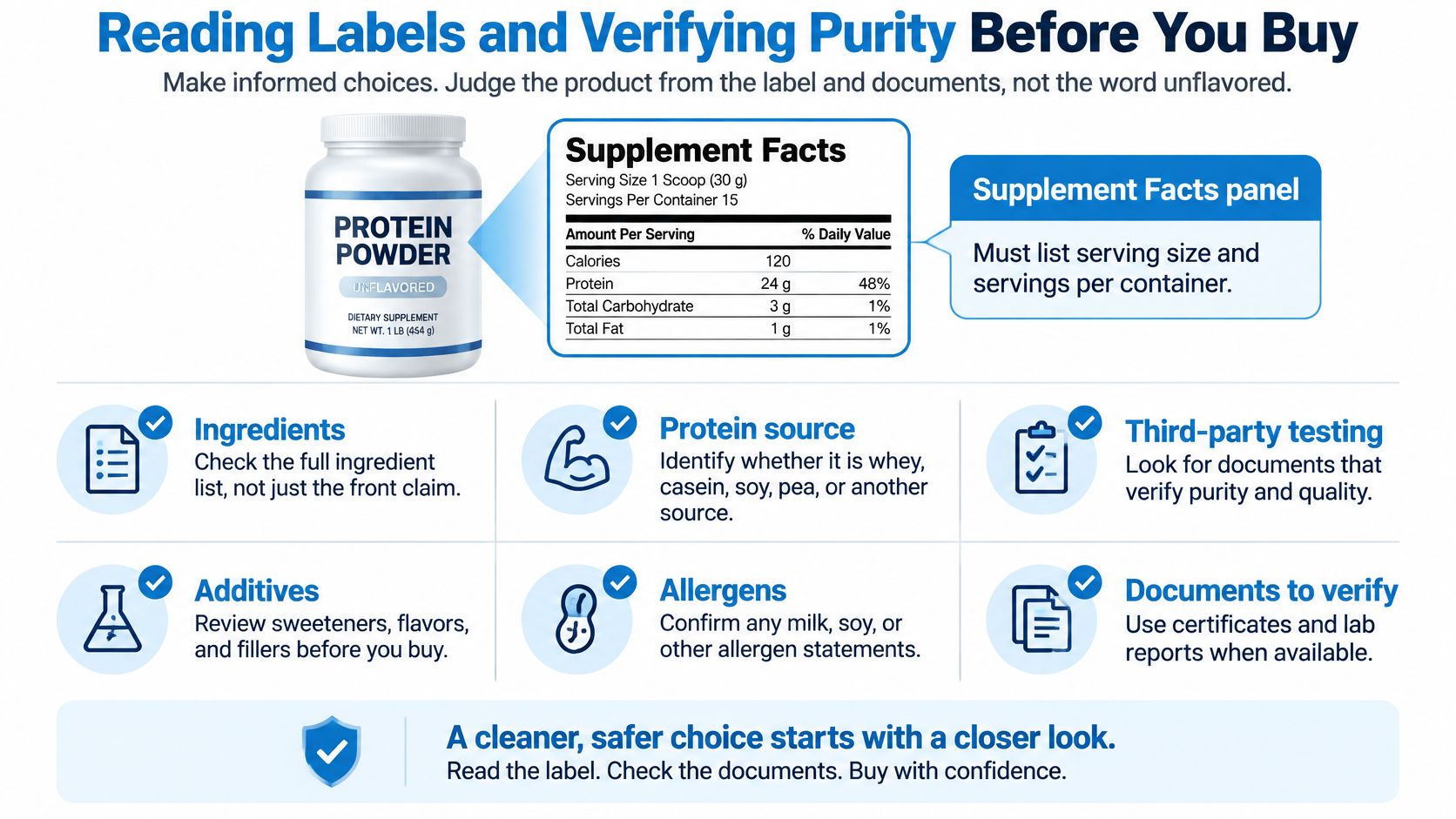
In the United States, a dietary-supplement label must show the product identity, net quantity, nutrition labeling, an ingredient list, and the manufacturer's or distributor's name and place of business. The FDA's questions and answers on dietary supplements also require the Supplement Facts panel to state serving size, servings per container, each dietary ingredient, and the amount per serving unless that ingredient sits inside a proprietary blend. Protein must be listed when it is present in a measurable amount. Other ingredients, including sweeteners, colors, flavors, fillers, and binders, go in descending order by weight.
For general nutrition labeling, FDA identifies a Daily Reference Value of 50 grams of protein for adults and children aged four and older. That figure is a packaging benchmark, not your personal target.
What to check on the panel
- Protein grams and serving weight: If the scoop weighs 30 grams and protein is 15 grams, half the scoop is something else.
- Calories: A "pure" isolate should sit close to the protein grams times four. A big calorie gap means added fat or carbohydrate.
- Ingredient order: The first name should be the protein source, not a gum or a sweetener.
- Sweeteners, gums, and flavors: Their presence means the tub is not the single-ingredient product the front implies.
- Front versus panel: If the front says unflavored and the panel lists natural flavor, trust the panel.
Consumer Reports' 2025 testing of 23 protein powders and ready-to-drink shakes found average lead levels in plant-based products were nine times higher than in dairy-based products, a gap cited in the Texas Attorney General's industry-wide investigation announcement. Separate testing by the Clean Label Project found 47% of 160 products exceeded California Proposition 65 limits for at least one toxic heavy metal. Lead, arsenic, cadmium, and mercury can show up in both plant and dairy powders. FDA does not verify most supplements before they are sold.
FDA interim reference levels cited in safety reporting are 2.2 micrograms of lead per day for children and 8.8 micrograms per day for women of childbearing age. Risk depends on dose and who is eating the powder, not on whether a lab can detect a trace. If you use a scoop daily, combine several supplements, are pregnant, are trying to conceive, or serve children, favor a brand that posts lot-specific heavy-metal results, ideally by ICP-MS, plus identity and microbial limits.
Our protein powder nutrition facts walk through how those panel numbers fit a real day.
| Document or claim | What it shows | What it does not prove |
|---|---|---|
| Certificate of analysis | Test results for a specific lot | That other batches meet the same results |
| Third-party certification | An outside lab checked the product against stated standards | Safety for every heavy metal unless the test covered it |
| Proposition 65 warning | A listed chemical is present above a state threshold | How much of a daily dose a person would get |
| Clean-label claim | The brand's own standard | Independent verification of purity |
| Unflavored label | No added flavor system | Lower contaminant levels or better protein quality |
A batch document beats a marketing word. "Clean" without a lot number is a slogan.
Storing Unflavored Protein So It Stays Fresh
Moisture, heat, and a wet scoop ruin a good powder faster than time alone. Clumps are often water. Sour or musty smells are a reason to stop using the tub.
- Keep the powder in its original sealed bag or an airtight container. A loose lid lets kitchen humidity in, and humidity is what turns a fine powder into bricks.
- Store it in a cool, dry cupboard away from the stove, dishwasher, and sunlight. Heat and light dull flavor and can wear down sensitive nutrients over months.
- Use a dry scoop every time and close the lid right after. A damp spoon is the usual way water gets into an otherwise fine tub.
- Write the opening date on the tub and check the best-by date before you use it. An opened container ages faster than a sealed one, even when the cupboard is cool.
- Discard powder that smells rancid, sour, or musty, or that shows mold. Texture you can fix. Spoilage you should not taste-test.
Plant blends that include added fats can go off sooner than a plain isolate, so finish those tubs earlier. If the powder clumps but still smells clean, break it up, keep it dry, and use it in hot food where a slight grain matters less than it would in a cold shake.
Pick Your Unflavored Protein and Start Using It
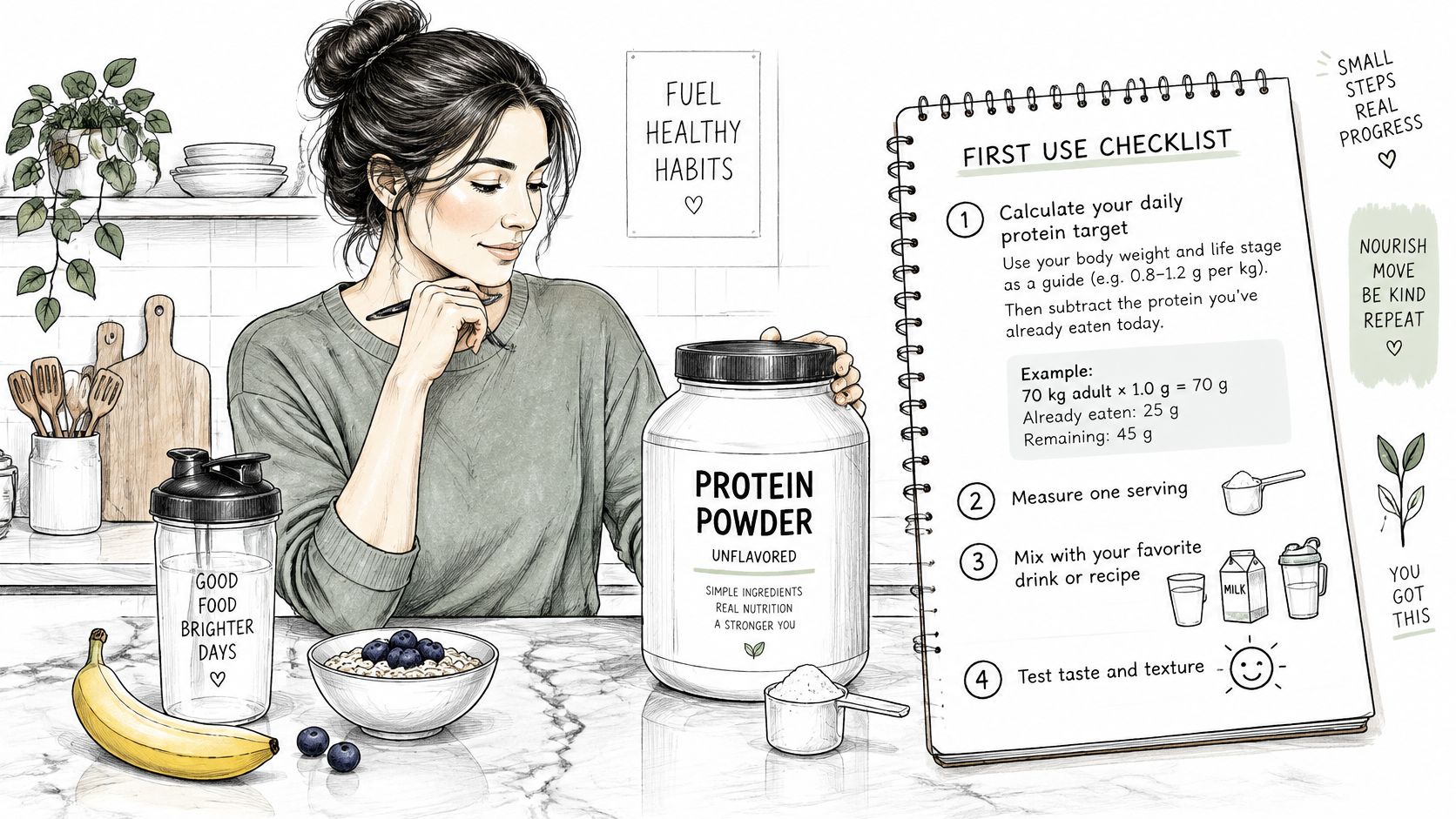
Unflavored is a format, not a purity grade. A tub with no flavor added can still vary in source, processing, and the testing the maker documents. Choose one product that fits a limit you already know, then test it for a week. Do not collect tubs you will not cook with.
- Calculate your daily protein target from body weight and life stage.
- Subtract protein you already eat from eggs, dairy, fish, legumes, or meat.
- Pick the source that fits your allergies, diet, and goal.
- Check the label or product page for grams of protein per serving, serving weight, and the ingredient source before you pay.
- Use one serving a day for a week. Note how it mixes, how it tastes in the food you eat, and whether the gap closes.
CalVitamin's Proteins category sits alongside Minerals, Pro/Pre-biotics, Vitamins, Raws, Blends, Sports, Beauty and Personal Care, Enhancers, Herbs, Sexual enhancement, and Life style, so you can compare protein listings in the same catalog as the rest of a routine. Treat that category as a place to compare protein products, not a guarantee that every listing is unflavored. Check each one against the five steps before checkout. The point is not a promise of faster results. The point is to see whether one tub matches your target and your kitchen. You can browse the category at CalVitamin.


