
To calculate your daily protein needs, multiply your body weight in kilograms by 0.8 g for a healthy sedentary adult, or use 1.2 to 1.6 g as a starting estimate for an active adult. Use the Daily protein multipliers by goal, age and kidney status table below to check whether a general estimate fits your situation.
The important question isn't just how much you weigh. It's whether your training, eating pattern, age or medical status makes that multiplier appropriate. A calculator can do accurate arithmetic and still give you the wrong dietary target if it doesn't ask those questions.
Table of Contents
- Protein Targets by Goal and Age at a Glance
- How to Calculate Your Daily Protein Number Step by Step
- Worked Examples for Common Body Weights
- Special Groups Who Need a Different Calculation
- Adjusting Your Target for Training, Dieting and Meal Timing
- Confirm Your Number Before You Change Your Diet
Protein Targets by Goal and Age at a Glance
Your daily estimate follows a simple formula: body weight in kilograms × an appropriate protein multiplier = grams of protein per day. Choosing the multiplier requires more judgment than doing the multiplication.
Cleveland Clinic's guidance on protein intake describes the 2025 Dietary Guidelines for Americans as recommending 1.2 to 1.6 grams per kilogram of body weight per day, adjusted for individual calorie needs. That's a general recommendation, not a separate prescription established specifically for every active adult.
Daily protein multipliers by goal, age and kidney status
| Goal or group | g per kg per day | Notes |
|---|---|---|
| Sedentary healthy adults | 0.8 as a basic starting estimate | Don't treat a reference intake as an individualized optimum |
| Active adults | 1.2 to 1.6 as a general starting range | Account for calorie needs and the demands of your routine |
| Muscle gain with resistance training | Set an individualized training target | Don't assume that heavier training automatically requires the highest multiplier you can find |
| Weight loss in a calorie deficit | Set alongside the calorie plan | Consider muscle preservation, food intake and training together |
| Healthy older adults | Use an age-appropriate assessment | Check appetite, muscle function and kidney health |
| Non-dialysis chronic kidney disease | Clinician-prescribed target | Don't self-calculate a restriction or increase |
| Dialysis | Renal dietitian or nephrologist sets the target | Treatment changes the calculation |
The training and weight-loss rows deliberately avoid a universal high-protein prescription. A goal such as building muscle doesn't tell you how much you already eat, how demanding your training is or whether a medical restriction applies.
Choose the row before choosing the number
Start with the description that best matches your usual week, not your hardest workout or most ambitious goal. Someone returning to occasional exercise needs a different assessment from someone following a demanding, structured program.
If several rows fit, don't automatically choose the highest target. Medical considerations take priority over a fitness goal, and an older adult with kidney disease needs more than an age-based formula.
Practical rule: Choose the appropriate category first. Only then use your body weight to calculate a daily amount.
The table is a screening tool, not a menu of increasingly effective diets. More protein isn't automatically a better answer.
How to Calculate Your Daily Protein Number Step by Step
Learning how to calculate the amount of protein needed starts with keeping your units straight. Your body weight is measured in kilograms; your answer is measured in grams of protein, not grams of food.
Use this visual to follow the calculation process.
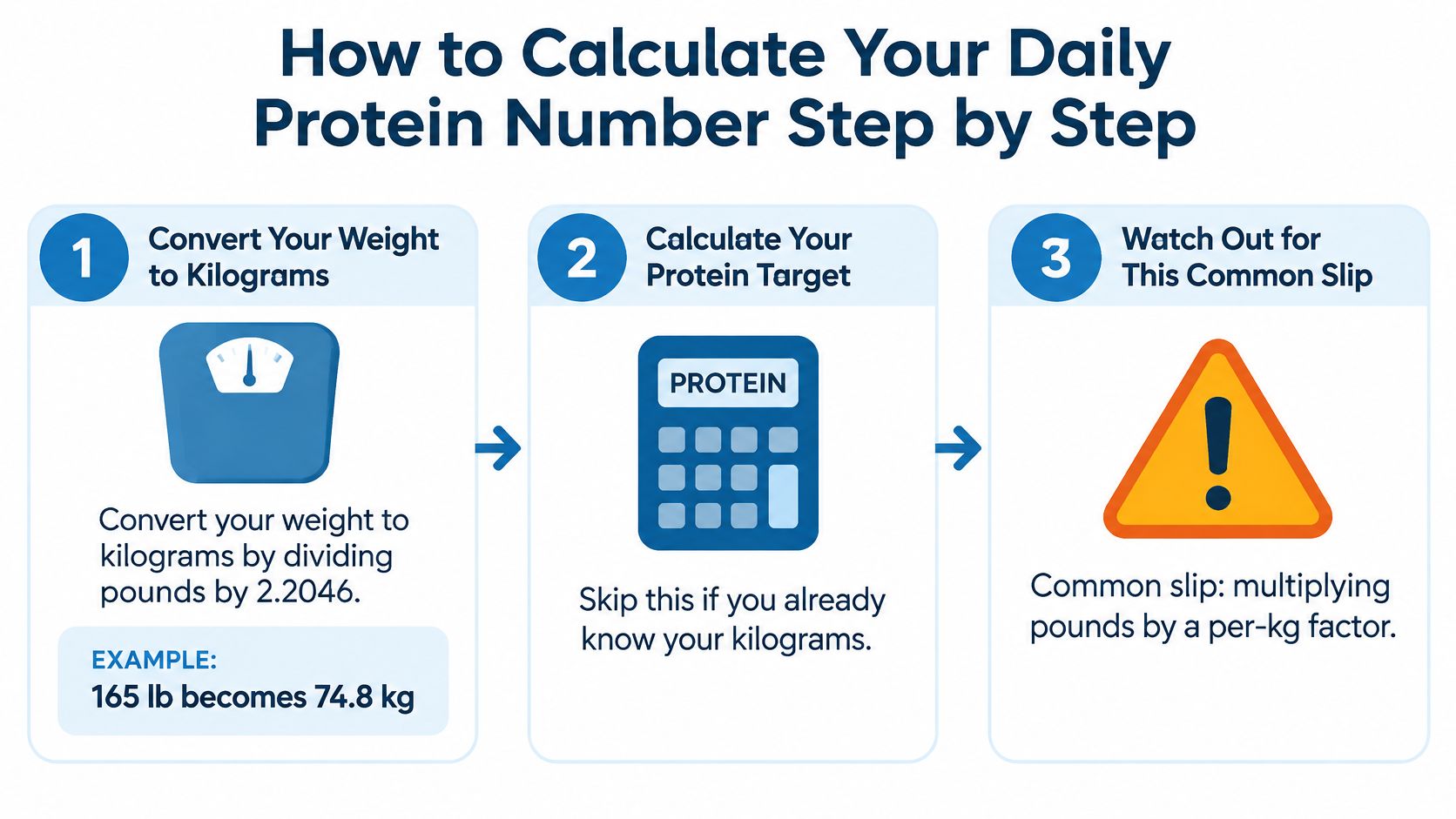
Work through the calculation
Put your weight in kilograms.
If your scale already displays kilograms, use that reading. Otherwise, switch its unit setting or use a pounds-to-kilograms converter. Don't multiply a weight in pounds by a factor expressed per kilogram.Choose an appropriate multiplier or range.
Use your health status and usual activity to guide the choice. If you're managing a medical condition, use the target your clinician has given you rather than substituting a fitness calculator's recommendation.Multiply your weight by each end of the range.
For a hypothetical person weighing 75 kg, using the general range gives 75 × 1.2 = 90 g and 75 × 1.6 = 120 g. Their calculated planning range is therefore 90 to 120 g per day. These are worked-example results, not a personal prescription.Select a practical working target.
For that example, 105 g is the mathematical midpoint. A midpoint can make meal planning easier, but it isn't a biological threshold. Choose a manageable amount within the appropriate range rather than trying to hit an exact decimal every day.Compare the result with your usual meals.
Write down what you eat and use package labels or a food-composition database to estimate the protein. Include meals, snacks, drinks and supplements. Calculate the difference before deciding whether you need to add anything.
Count protein, not food weight
A serving's total weight isn't its protein content. Meat, yogurt, beans and protein powders contain other components, including water, carbohydrate or fat.
For packaged foods, start with protein per serving, then check how much you ate. If you ate more or less than the labeled serving, adjust the protein amount proportionally.
Use these checks when your total looks unexpectedly high or low:
- Check the unit. Make sure you haven't entered pounds into a kilogram-based calculation.
- Check the serving. A scoop, container and labeled serving aren't necessarily interchangeable.
- Check the food entry. Match cooked foods with cooked entries and dry ingredients with dry entries.
- Check the total. A shake belongs inside your daily protein tally, not outside it.
A useful estimate is consistent enough to guide meals. It doesn't need to look precise to several decimal places.
Keep your assumptions beside the calculation. Recording your weight, selected multiplier and reason for choosing it makes the target easier to review when your circumstances change.
Worked Examples for Common Body Weights
Consider a hypothetical 70 kg adult who lifts weights and wants to build muscle. Using the general planning range gives 70 × 1.2 = 84 g at the lower end and 70 × 1.6 = 112 g at the upper end.
That calculation establishes a starting estimate, not proof that a particular amount will maximize muscle growth. A sports dietitian can assess whether the person's training and overall diet justify a different target.
For another hypothetical example, a 60 kg active adult calculates 60 × 1.2 = 72 g and 60 × 1.6 = 96 g. The arithmetic stays the same even though the daily total changes with body size.
Daily protein range for common body weights
The figures below are illustrative calculations using the general multiplier range, not separate recommendations for each body weight.
| Body weight | General active-adult planning example | Muscle-gain decision |
|---|---|---|
| 60 kg | 72 to 96 g per day | Assess training, energy intake and current diet before increasing |
| 70 kg | 84 to 112 g per day | Choose a target within an individualized training plan |
| 80 kg | 96 to 128 g per day | Don't treat body weight alone as a sports-nutrition assessment |
| 90 kg | 108 to 144 g per day | Review body composition and health before choosing a high target |
A lookup table saves arithmetic, but it can't decide which weight should be used in a clinical assessment. If your current weight is substantially outside a healthy range, ask a dietitian which weight basis is appropriate rather than independently substituting a goal weight or guessing your lean mass.
Turn the example into a food decision
Suppose the hypothetical 70 kg adult chooses 100 g as a working target and their food record totals 85 g. The planning gap is 15 g, not an automatic full serving of protein powder.
They could change a meal, add a snack or use a measured portion of a supplement. The useful choice is the one that fits their appetite, budget, dietary restrictions and overall nutrition.
When comparing powders, use the guide to protein powder nutrition facts to distinguish protein per serving from serving weight and other label information.
Don't use another person's shopping list as your calculation. Someone with the same body weight may have a different training routine, medical history or usual diet. The formula supplies a starting number; your food record shows what action, if any, you need to take.
Special Groups Who Need a Different Calculation
Before changing your protein intake, ask yourself these screening questions:
- Older age: Are you an older adult, particularly if your appetite or strength has declined?
- Kidney status: Do you have kidney disease or receive dialysis?
- Pregnancy or breastfeeding: Are you pregnant or breastfeeding?
- Unintended weight loss: Are you losing weight without trying?
Use this checklist to identify when a general calculator may not be suitable.
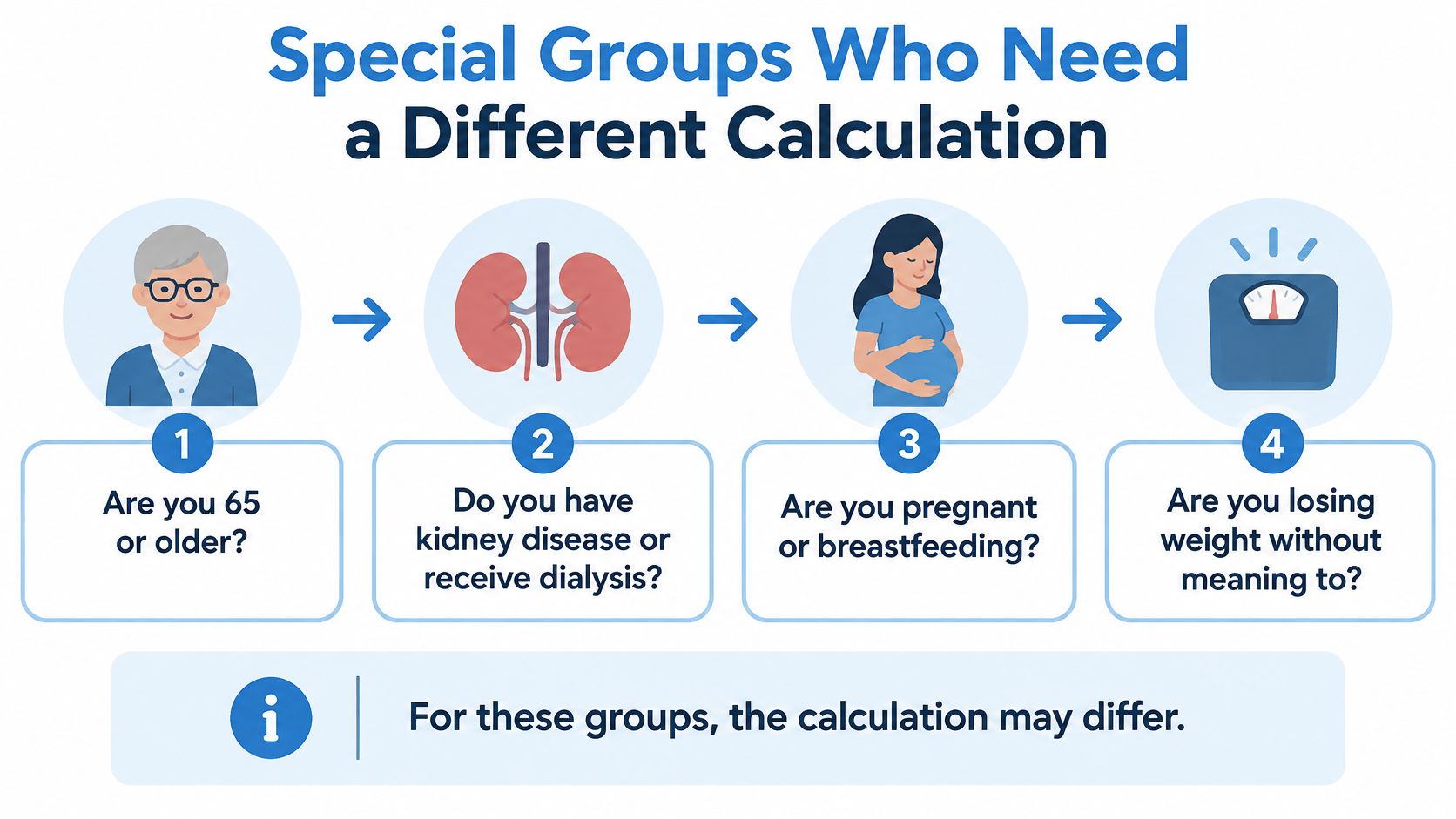
A yes doesn't always mean you need more protein. It means your circumstances deserve a closer assessment before you change your diet.
Older adults and kidney disease can need different answers
A clinical review available through PubMed Central describes approximately 1.0 to 1.2 g/kg/day for healthy older adults, roughly 0.6 to 0.8 g/kg/day for adults with non-dialysis chronic kidney disease, and about 1.0 to 1.2 g/kg/day for people receiving dialysis. Dialysis can cause protein losses, while a restricted prescription in a vulnerable older adult can raise concerns about malnutrition and protein-energy wasting.
These distinctions explain why a calculator should ask about kidney treatment rather than asking whether you want to maintain or build muscle.
For a healthy older adult, the discussion may focus on maintaining adequate intake when appetite is limited. A dietitian can examine eating patterns, food preferences and practical barriers such as chewing difficulties or trouble preparing meals.
For someone with non-dialysis kidney disease, a clinician may prescribe a lower intake. That prescription needs to fit the person's nutritional status and broader treatment plan, not just the result of multiplying body weight.
For a person receiving dialysis, copying a relative's low-protein kidney diet could be inappropriate. Kidney disease and dialysis aren't interchangeable nutrition categories.
When aging and kidney disease apply to the same person, neither “eat more for muscle” nor “eat less for kidneys” is enough to set a safe target.
Bring your current food record to the appointment. Your renal team needs to know what you're eating before recommending a change or deciding whether a supplement is suitable.
Pregnancy, breastfeeding and unintended weight loss
Pregnancy and breastfeeding call for a life-stage assessment rather than a generic adult fitness target. Ask your prenatal clinician or dietitian to set an appropriate plan, especially if nausea, food aversions or a restricted diet make eating difficult.
Unintended weight loss also changes the question. Instead of asking only how to increase protein, you need an assessment of why you're losing weight and whether you're getting enough food overall.
A protein drink shouldn't become a reason to delay that assessment. Tell your clinician about appetite changes, difficulty swallowing, digestive symptoms or meals you're no longer managing to eat.
When to stop self-calculating
Seek individualized guidance if you have diabetes alongside kidney concerns, have been told to follow a therapeutic diet, or are recovering from a condition that has affected your nutritional status. Do not begin a high-protein supplement or a low-protein restriction based only on an online tool's recommendation.
Useful appointment questions include:
- Weight basis: Which body weight should my calculation use?
- Daily target: Should I follow a range or a prescribed amount?
- Diet restrictions: Are there ingredients or nutrients I need to limit?
- Follow-up: What changes should prompt another review?
Your calculated number is a starting question for your doctor or dietitian, not a final prescription.
Adjusting Your Target for Training, Dieting and Meal Timing
Once you've chosen an appropriate daily target, make it work within your actual eating and training routine. Don't add protein without considering what it replaces.
Use meal planning to connect the target with the rest of your nutrition.
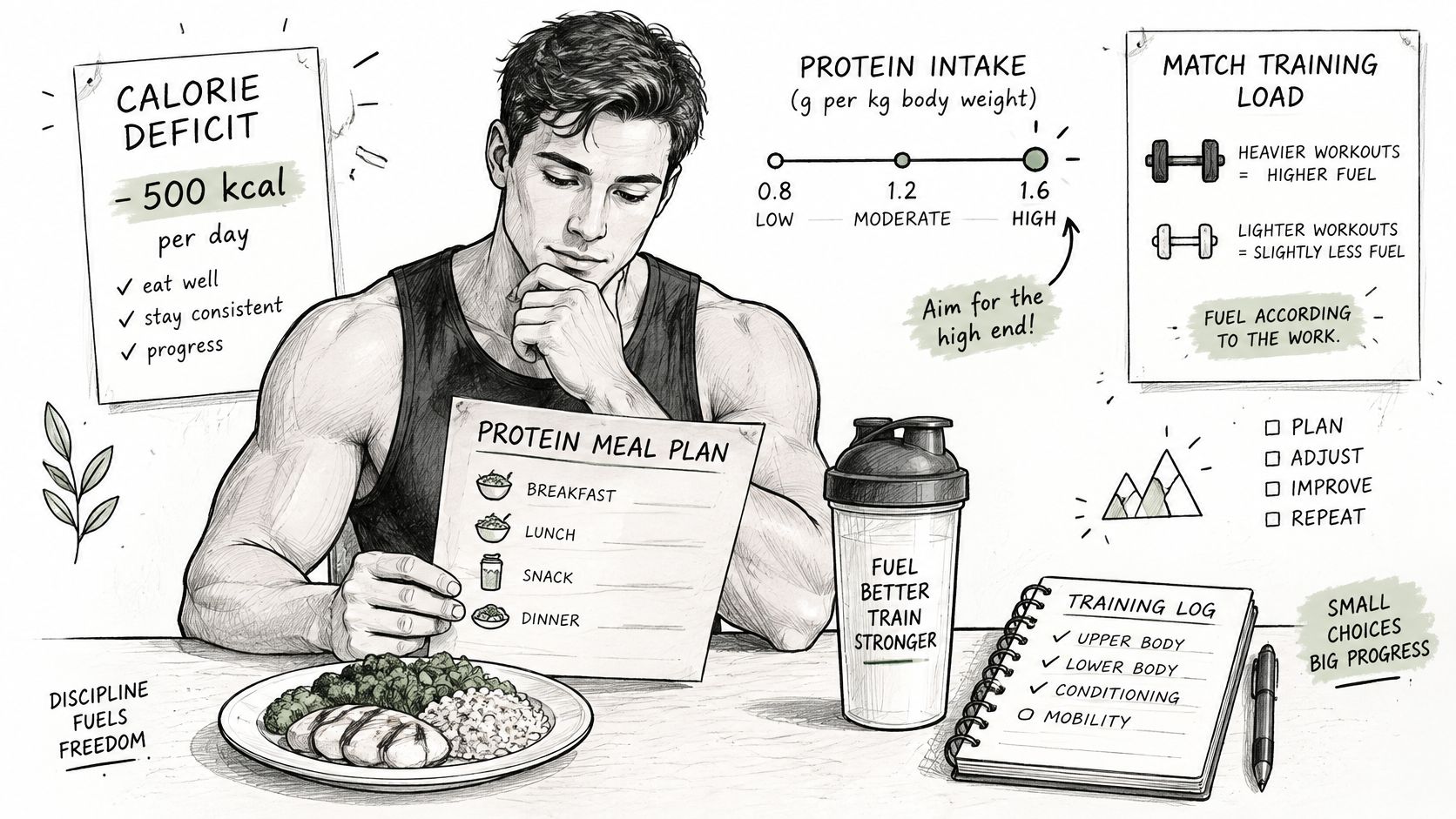
Adjust the plan rather than chasing a higher number
Review your calorie deficit.
If you're intentionally losing weight, plan protein alongside the amount and variety of food you can realistically eat. Don't let a protein target crowd out the rest of your meals. A dietitian can help balance a weight-loss goal with an appropriate muscle-preservation plan.Describe your training accurately.
Record what you do, how demanding it feels and how well you're recovering. “Active” can describe very different routines. Use the broader sports performance nutrition guide to consider fueling rather than treating protein as your entire training diet.Check protein quality.
The British Journal of Nutrition review of protein-quality assessment explains how amino-acid composition and digestibility contribute to protein quality, including assessment methods such as PDCAAS and DIAAS. Equal protein grams don't necessarily provide equal amounts of usable indispensable amino acids.
For a plant-forward diet, examine variety rather than automatically adding more powder. Include foods such as beans, lentils, tofu, tempeh, grains, nuts and seeds across your eating pattern. A daily total alone doesn't describe the quality of that combination.
The video below accompanies the discussion of protein planning.
Make the daily amount practical
Distribute the target across meals.
For a hypothetical 90 g daily target, dividing it across three meals gives 30 g per meal. Dividing it across four eating occasions gives 22.5 g each. These are arithmetic planning options, not required meal doses or absorption limits.Recognize when protein isn't the fix.
If you're persistently tired, under-fueled or struggling with training, don't assume another shake is the answer. Review total food intake, meal timing, recovery and any symptoms that need medical attention.
Meal-planning check: Look for a protein source at the meals you regularly eat, rather than leaving an uncomfortable catch-up amount for the end of the day.
Supplements and fortified foods can fill a measured gap. Count them within the whole diet, and choose them for a clear purpose rather than because the front label promises performance.
Confirm Your Number Before You Change Your Diet
A protein target should lead to a manageable food plan, not a daily test you can fail. Before buying anything or removing foods, check whether the calculation describes your needs and whether your usual diet already comes close.
A plan you can use this week
Write down the range and its assumptions.
Record the weight and multiplier you used, along with your goal. Keep any medical instructions beside the calculation so a general fitness target doesn't accidentally replace them.Keep an honest food record.
Use food labels, a kitchen scale where helpful and a nutrition app or notebook. Include snacks, drinks, cooking ingredients and supplements. Choose entries that match the food and preparation method.Review more than your protein total.
Note appetite, energy, sleep, training performance and whether eating this way feels sustainable. Don't respond to a difficult workout or a short-term weight fluctuation by immediately raising your target.Choose food changes before supplement changes.
Identify the meals that are hardest to manage and decide what would make them more complete. If a supplement would solve a specific convenience or appetite problem, use the guide to choosing protein powder to compare labels against that need.Get medical guidance when a screening flag applies.
Book an appointment before making substantial changes if you have kidney disease, receive dialysis, are pregnant or breastfeeding, or have unexplained weight loss. Older adults with poor appetite, declining strength or competing medical concerns should also seek an individualized assessment.
Decide what needs changing
You may discover that your normal meals already meet your working range. In that case, you don't need to add a supplement just to make the plan feel more deliberate.
If you're falling short, make a practical change you can repeat. If meeting the target feels difficult despite those changes, bring the food record and calculation to a registered dietitian rather than repeatedly increasing the number.
Write down your range and track it for two weeks.
CalVitamin offers protein products alongside vitamins, minerals and other wellness supplements. Visit CalVitamin to compare options against your food record and daily target, and choose a protein supplement only if it fills a gap in an appropriate nutrition plan.


