
The most popular advice treats inositol and magnesium as a ready-made pair. Add magnesium to inositol, the label says, and you get a stronger formula for polycystic ovary syndrome (PCOS), insulin resistance, acne, or mood. That advice skips the hard part. Each ingredient has its own job, its own dose range, and its own limits. Putting them in one capsule doesn't create a new clinical result.
A bottle that says "with magnesium" tells you almost nothing. It doesn't say how many milligrams of elemental magnesium you get, which salt that magnesium is, or whether the inositol is myo-inositol, D-chiro-inositol, or a mix. Those details decide whether a product even resembles what trials tested.
Table of Contents
- Direct Answer and How Each Ingredient Works
- What the Research Says About Using Them Together
- Doses Used in Studies and How to Read a Label
- Daily Magnesium Needs and Why Many Fall Short
- Safety, Interactions and Who Should Ask a Clinician First
- Deciding Whether the Combination Is Right for You
Direct Answer and How Each Ingredient Works
Inositol and magnesium are not interchangeable, and the claim that combining them adds benefit is unproven. They sit in different parts of how a cell handles insulin. Overlap in biology is a hypothesis, not a trial result.
Say someone buys a PCOS blend because both names appear on the front. The inositol half is about the message the cell writes after insulin arrives. The magnesium half is about whether the cell's machinery can run at all. Those are different problems, and fixing one doesn't automatically fix the other.
Think of insulin as a letter delivered to the cell's door. Inositol phosphates are the note the cell writes afterward. The analogy stops there. The chain is pathway-dependent. Sharing a pathway is not the same as a proven extra benefit from taking both supplements.
Myo-inositol is the form most common in food and supplements, and it acts as a precursor for those insulin-signaling messengers. D-chiro-inositol is a second isomer the body makes in smaller amounts. After the insulin receptor is activated, that activation can stimulate phospholipase C and phospholipase D, generating soluble inositol phosphoglycans that may act as secondary messengers. A review of this signaling describes how those intermediates can influence glycogen synthesis, Akt and ERK signaling, and glucose transporter regulation, as summarized in the Wiley review of inositol phosphoglycans. Effects in people have been reported in selected insulin-resistant groups, including some with PCOS, and they vary by phenotype, isomer, dose, and study design. Supplementation doesn't replace diabetes treatment.
Elemental magnesium is a cofactor, not a messenger. ATP must bind magnesium before most kinases and many enzymes can act, so magnesium sits underneath insulin signaling rather than inside the message. Low intake is a nutrition problem. It isn't proof that magnesium plus inositol outperforms inositol alone.
| Ingredient | Role in the body | Main research area | Key caveat |
|---|---|---|---|
| Myo-inositol | Insulin signaling messenger precursor | PCOS, insulin resistance, pregnancy | Most studied form; results vary by population |
| D-chiro-inositol | Second isomer in insulin signaling | PCOS metabolic markers | Trial doses vary widely; effects differ by phenotype |
| Elemental magnesium | Cofactor for ATP and many enzymes | Correcting low intake and deficiency | Combined PCOS use is not proven |
A shopper comparing formulas can start with an ingredient-level product such as AmpliCell inositol capsules and still ask the same three questions this article answers: what trials measured, what doses were used, and where the risks sit.
What the Research Says About Using Them Together
Adding magnesium to inositol has not been shown to create extra benefits for PCOS. The two ingredients have each been studied, but evidence about either one alone cannot establish that taking them together works better. The distinction matters: a formula's label describes what is in the product, not what the combination has been proven to do.
A 2024 systematic review and meta-analysis included 30 randomized trials involving 2,230 women with PCOS: 1,093 received inositol and 1,137 were controls. A 2023 systematic review and meta-analysis covered 26 randomized trials and 1,691 patients. Together, these reviews describe a substantial body of research on inositol, though a large evidence base does not mean results are settled.
Body weight and glucose, then the guideline view
An earlier pooled analysis associated inositol with a mean BMI reduction of 0.41 kg/m² (95% confidence interval -0.78 to -0.04, P = 0.028). Results varied considerably across trials (I² = 73.9%).
Separately, a 2025 meta-analysis of 18 trials and about 889 participants estimated a 0.57 kg/m² BMI reduction across 10 trials (P = 0.037) and a 7.25 mg/dL glucose reduction (P < 0.001). These are average changes across studies, not a prediction for an individual. A systematic review written to inform the 2023 international PCOS guideline judged the evidence limited and inconclusive.
A statistically significant average can conceal different results from one trial to another. Here, high heterogeneity means the pooled estimate may not reflect what any one person experiences.
What a bundled formula can't prove
A 2025 retrospective study of 200 women with PCOS reported improvements after six months taking myo-inositol, microlipodispersed magnesium, and folic acid. Because every participant took all three, the study cannot show whether magnesium added benefit to inositol. The authors called for double-blind, long-term randomized trials.
Evidence on magnesium alone is also limited: a review found only three randomized trials with 156 participants, and results for insulin resistance were inconsistent. That leaves an important gap between evidence about individual ingredients and claims that combining them provides extra benefit.
| Claim | Study evidence | Verdict |
|---|---|---|
| Inositol lowers BMI in PCOS | 2025 meta-analysis, 10 trials, 0.57 kg/m² reduction | Modest and preliminary |
| Inositol lowers glucose in PCOS | 2025 meta-analysis, 7.25 mg/dL reduction, P < 0.001 | Promising, not definitive |
| Inositol is an established PCOS therapy | Guideline-linked review found evidence limited and inconclusive | Not established |
| Magnesium improves insulin resistance | Three trials, 156 participants, inconsistent results | Unclear |
| Inositol plus magnesium adds extra benefit | 2025 retrospective study of 200 women, all received all three ingredients | Unproven |
Changes in acne, hirsutism, or HOMA-IR reported with a bundled formula remain preliminary. They do not establish that the inositol-magnesium pairing treats PCOS.
Doses Used in Studies and How to Read a Label
No single dose is "the" inositol dose or "the" magnesium dose. Trials used wide ranges, and outcomes didn't line up neatly with the highest number on the label.
| Ingredient or formula | Dose in studies | Duration | Caveat |
|---|---|---|---|
| Myo-inositol | 1.1–4 g daily | 2–24 weeks | Most studied form; outcomes vary |
| D-chiro-inositol | 27.6–2,400 mg daily | 2–24 weeks | Doses differ widely across trials |
| Oral magnesium | 200, 400 or 800 mg daily | 12 weeks | Outcomes inconsistent |
| 2025 PCOS formula | 2 g myo-inositol plus 56.25 mg microlipodispersed magnesium, each twice daily | 6 months | Retrospective; all received all three ingredients |
Those ranges come from clinical summaries of inositol regimens of about 1.1–4 g of myo-inositol, with some studies adding D-chiro-inositol from 27.6–2,400 mg daily over two to 24 weeks, and magnesium studies at 200, 400, or 800 mg daily for 12 weeks, as described in a review of inositol dosing in PCOS. The 2025 formula's 56.25 mg of microlipodispersed magnesium twice daily, next to 2 g of myo-inositol twice daily, doesn't set an optimal dose. Its design can't.
A five-point label check
Use the rows above as a checklist, not a prescription. The same habit is laid out in this guide on how to read a supplement label.
- Elemental magnesium, not compound weight. A 500 mg magnesium citrate tablet isn't 500 mg of magnesium. The Supplement Facts panel's elemental amount is the number to compare with 200, 400, or 800 mg.
- The salt or chelate name. Citrate, glycinate, oxide, and a "microlipodispersed" form are different products. "With magnesium" names none of them.
- Serving size versus daily total. If the studied pattern was 2 g twice daily, one 2 g capsule is half of that pattern, not the whole pattern.
- Inositol subtype and ratio. Myo-inositol and D-chiro-inositol aren't interchangeable. A tiny D-chiro dose and a gram-scale dose have both appeared in trials.
- Total daily dose across products. Two blends can stack myo-inositol past what you meant to take, or leave magnesium at a token amount.
Why the chemical form changes absorption
A systematic review of magnesium formulations reports that inorganic forms generally appear less bioavailable than organic ones. Magnesium citrate, lactate, gluconate, aspartate, pidolate, and chelated forms are commonly grouped as higher bioavailability. Chloride, sulfate, and bicarbonate are often moderate. Absorption is dose-dependent. Fermentable fiber, protein, and medium-chain triglycerides may support it. Phytate, oxalate, and some polyphenols can bind magnesium into less-soluble complexes.
Practical rule: If the front of the bottle says "with magnesium" and the back doesn't list elemental milligrams plus the salt, you don't yet know what you're buying.
Daily Magnesium Needs and Why Many Fall Short
Magnesium targets depend on age, sex, and life stage. Adult men need 400–420 mg per day and adult women 310–320 mg, according to the NIH Office of Dietary Supplements magnesium fact sheet. These recommendations refer to total dietary intake, not a specific magnesium–inositol combination.
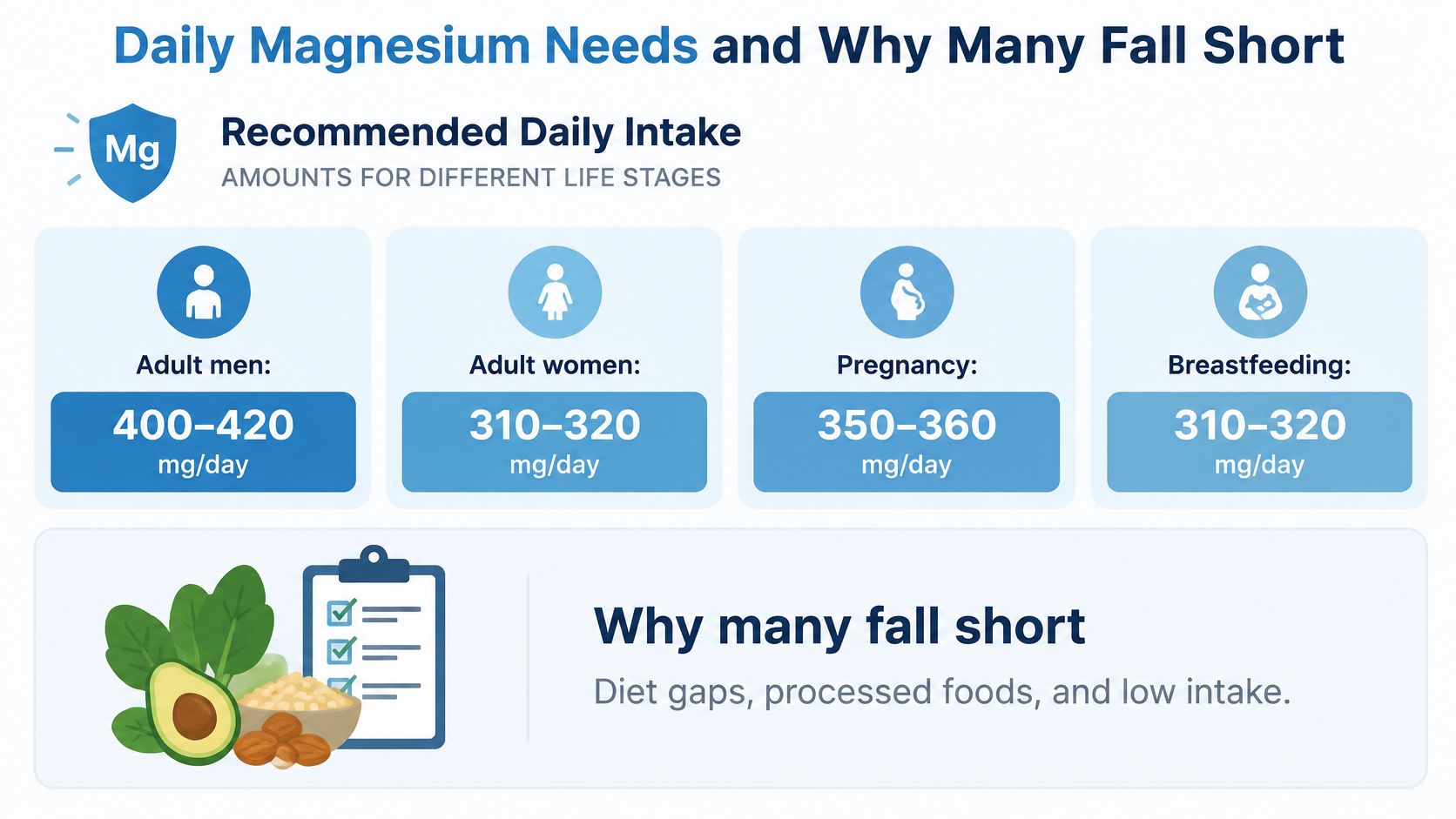
| Group | Recommended intake (mg per day) |
|---|---|
| Adult men | 400–420 |
| Adult women | 310–320 |
| Pregnancy | 350–360 |
| Breastfeeding | 310–320 |
| Adolescent boys | 410 |
| Adolescent girls | 360 |
| Label Daily Value, adults and children aged 4 and older | 420 |
Pregnancy raises the recommendation to 350–360 mg per day; during breastfeeding, it is 310–320 mg. The recommendations are 410 mg for adolescent boys and 360 mg for adolescent girls. The 420 mg Daily Value printed on labels is a reference amount, not an individual target for everyone.
How often intake misses the mark
An analysis of National Health and Nutrition Examination Survey data from 2013–2016 found that 48% of Americans across all age groups consumed less magnesium from food and beverages than their age- and sex-specific Estimated Average Requirement. Teenagers and men aged 71 and older were among the groups most likely to fall short.
Low intake does not always cause noticeable symptoms. In otherwise healthy people, the kidneys help conserve magnesium, while prolonged low intake, certain illnesses, alcoholism, and some medicines can raise deficiency risk. A 2024 analysis in Epidemiology and Health reported that oral magnesium supplementation reduced deficiency prevalence from 26.0% to 2.1%, using a serum magnesium level below 0.70 mmol/L to define deficiency.
For a closer look at one magnesium form, read this guide to magnesium glycinate and its benefits. Dietary gaps may be more likely for adolescents, people who are pregnant or breastfeeding, and adults whose meals include few magnesium-rich foods. Leafy greens, beans, nuts, and whole grains are among the foods that contribute magnesium; a suspected deficiency or medicine-related risk is a reason to ask a clinician rather than self-diagnose.
Magnesium recommendations are based on dietary needs. Whether adding inositol changes those needs remains a separate question. Review your usual meals first, then discuss a possible gap with a clinician.
Safety, Interactions and Who Should Ask a Clinician First
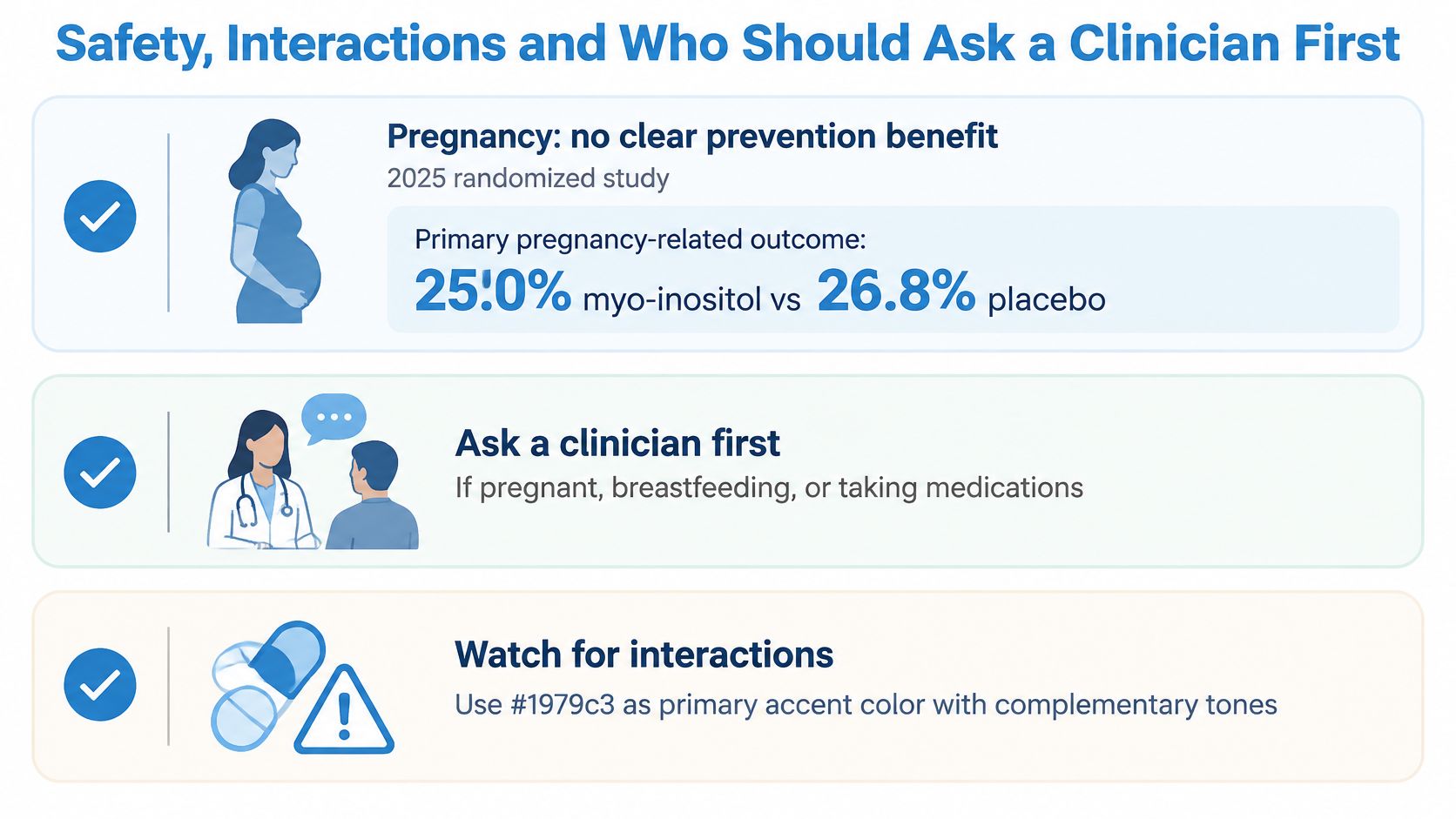
Pregnancy is the clearest place to slow down. A 2025 randomized study from University Medical Center Utrecht found a primary pregnancy-related outcome in 25.0% of participants receiving myo-inositol (180 people) versus 26.8% receiving placebo (193 people). That is not a clear prevention benefit. Anyone pregnant, or trying to prevent a pregnancy complication with a supplement, should talk with their clinician before starting.
What "no interaction listed" doesn't mean
Clinical summaries state that inositol–medicine interactions aren't fully understood, and evidence on mineral binding and absorption is incomplete. No documented interaction isn't the same as proven safety. Kidneys that don't filter well excrete less magnesium, so supplemental magnesium can accumulate. High supplemental doses commonly cause diarrhea and other stomach upset. Poorly absorbed forms can do that without delivering much magnesium.
People managing diabetes, or taking insulin or metformin, shouldn't swap a prescribed plan for a blend. The same applies to prescribed PCOS care. Magnesium can also cut absorption of some antibiotics and other drugs, so a pharmacist should set the timing, often separating the mineral from the medicine by a few hours.
Bring this checklist to the appointment:
- Pregnancy or breastfeeding: "Given a trial that didn't show a clear prevention benefit, is myo-inositol appropriate for me, and at what dose?"
- Kidney disease: "Can I excrete extra magnesium, or should I avoid supplements entirely?"
- Diabetes or metformin: "Will this change my glucose readings, and what should I track?"
- Antibiotics or other daily medicines: "Which doses need to be separated, and by how long?"
- Stomach tolerance: "If diarrhea starts, do I cut the dose, switch the salt, or stop?"
Ask the pharmacist to look at the whole label, including folic acid and any second mineral, not only the two names on the front.
Deciding Whether the Combination Is Right for You
Start with the reason you are considering a supplement. Addressing a magnesium intake gap is a nutrition decision; using inositol for a PCOS or insulin-resistance goal depends on research that remains mixed. The claim that combining them works better has not been tested separately in a proper trial.
Before buying, consider whether a diet review or test would help. Serum magnesium offers an imperfect snapshot, and outright deficiency is uncommon when the kidneys are healthy. A food log may clarify your intake.
If you choose a product, compare the ingredients with the amounts used in studies: elemental magnesium, its salt, the inositol subtype, and the daily total all matter. A small magnesium dose alongside a studied inositol dose does not make the combination a studied formula. Set a review point, such as three months, and track digestive symptoms, cycle changes, or the blood markers your clinician selected. Keep prescribed PCOS, diabetes, or fertility treatment in place, and bring the label and review plan to your appointment.
Magnesium for an intake gap, inositol for a metabolic or reproductive goal, and the combination as a proven upgrade are three different decisions. Evidence for the first two does not establish the third.
CalVitamin carries mineral and inositol products. Check each product's Supplement Facts panel for the elemental magnesium amount, the magnesium salt, and the inositol subtype before comparing it with doses used in trials. Start with the panel, not the phrase “with magnesium” on the front label. Visit CalVitamin to review current options, then take any short list to your clinician or pharmacist before starting.


