

Taking a B complex for more energy sounds sensible. Your body needs B vitamins to use food as fuel, so extra vitamins should help you feel more energetic, right? That advice skips the most important question: are you missing a particular nutrient, or are you already getting enough?
Vitamin B complex health benefits depend on the vitamin, your nutritional status, and the problem you're trying to address. Preventing a folate-sensitive birth defect, treating B12 deficiency, and taking a supplement for an afternoon slump are very different situations. Understanding those differences helps you choose between food changes, a targeted supplement, medical assessment, or no supplement at all.
Table of Contents
- The Eight B Vitamins at a Glance
- How the B Vitamins Work Together
- Benefits Backed by Evidence and Claims That Overreach
- Folate in Pregnancy and the Timing That Matters
- Deficiency Signs and Who Is at Risk
- Recommended Intakes and Upper Limits
- Drug and Nutrient Interactions and Lab Test Effects
- Deciding Whether a B Complex Supplement Makes Sense
The Eight B Vitamins at a Glance
A B complex contains eight separate nutrients, not eight versions of the same ingredient. They're grouped together because many help enzymes carry out essential chemical reactions, but each has distinct responsibilities.
Thiamine helps process carbohydrates. Riboflavin and niacin become parts of coenzymes used in energy metabolism. Pantothenic acid helps make coenzyme A, while biotin supports enzymes involved in processing fats and glucose. B6 helps process amino acids and produce neurotransmitters, the chemicals nerve cells use to communicate. Folate and B12 are especially important for DNA production and healthy blood formation.
Main role and food sources of each B vitamin
| Vitamin | Main role | Rich food sources |
|---|---|---|
| B1 thiamine | Turns carbohydrates into usable energy; supports nerve and heart function | Whole grains, pork, legumes, fortified cereals |
| B2 riboflavin | Participates in energy metabolism; helps activate B6 and folate | Milk, eggs, almonds, fortified cereals |
| B3 niacin | Forms NAD coenzymes used in energy production and DNA repair | Chicken, tuna, peanuts, fortified cereals |
| B5 pantothenic acid | Helps make coenzyme A for fat and carbohydrate breakdown | Mushrooms, avocado, chicken, eggs |
| B6 pyridoxine | Supports amino acid metabolism and neurotransmitter synthesis | Chickpeas, salmon, potatoes, bananas |
| B7 biotin | Helps carboxylase enzymes process fatty acids and glucose | Cooked eggs, nuts, seeds, sweet potato |
| B9 folate | Supports DNA synthesis, cell division, and neural tube development | Leafy greens, legumes, fortified grain products |
| B12 cobalamin | Supports nerve myelin, red blood cell formation, and DNA synthesis | Fish, meat, dairy, eggs, fortified foods |
What this means for your plate
A varied diet can supply these nutrients through overlapping food groups. Lentils provide several B vitamins, but they aren't a dependable natural source of B12. Fish supplies B12 and other B vitamins, but it doesn't replace folate-rich vegetables and legumes.
Build meals around variety rather than searching for a single food that covers every requirement. For example, oatmeal with milk or a fortified plant beverage, a chickpea lunch, and a dinner containing fish or another suitable protein provide different contributions. Check fortified-food labels because manufacturers don't all add the same nutrients.
Popularity isn't proof of need
In its 2024 release, the Centers for Medicare & Medicaid Services reported that more than 60% of Medicare beneficiaries said they used vitamin B supplements. That describes supplement use in that population, not evidence that everyone benefits from taking one.
The useful starting point is your diet and absorption, not how common a product is. A label can tell you what's inside a capsule, but it can't tell you whether your body needs it.
How the B Vitamins Work Together
Think of cellular metabolism as an assembly line. Food supplies the raw material, enzymes perform the work, and B vitamins help particular stations operate. If a necessary worker is missing, adding more workers at another station won't necessarily solve the problem.
This explains both why B vitamins are grouped together and why they aren't interchangeable. B12 can't take over thiamine's job, and extra biotin won't correct a folate shortage.
The energy-processing stations
B1, B2, B3, and B5 help enzymes carry out reactions that release usable energy from carbohydrates, fats, and proteins. B7 supports carboxylase enzymes, which participate in making or processing metabolic building blocks. These reactions allow cells to use what you eat.
The vitamins themselves aren't fuel. They don't supply the calories found in carbohydrate, fat, or protein, and adding more doesn't automatically make the assembly line run faster when every station already has what it needs.
A person eating a very limited diet may have several nutritional gaps at once. Someone relying on unfortified refined grains with little protein, dairy, legumes, or vegetables needs a broader dietary assessment, not an assumption that fatigue means low B12. A combined supplement may sometimes be appropriate, but the choice should follow the likely gaps.
The one-carbon pathway
A different part of the assembly line handles one-carbon metabolism, a network of reactions that transfers small carbon-containing units. Folate carries these units for processes such as DNA synthesis. B12 helps recycle folate into a usable form, while B6 participates in a related pathway that processes homocysteine.
The overlap creates a clinically important trap. According to the National Academies' discussion of vitamin B12, folate can correct the anemia associated with B12 deficiency while neurological injury continues. A better-looking blood count therefore doesn't necessarily mean that the underlying problem has been treated.
Practical rule: Treating a visible sign of deficiency isn't the same as identifying and correcting its cause.
The concept map below groups the shared pathways without making the vitamins substitutes for one another.
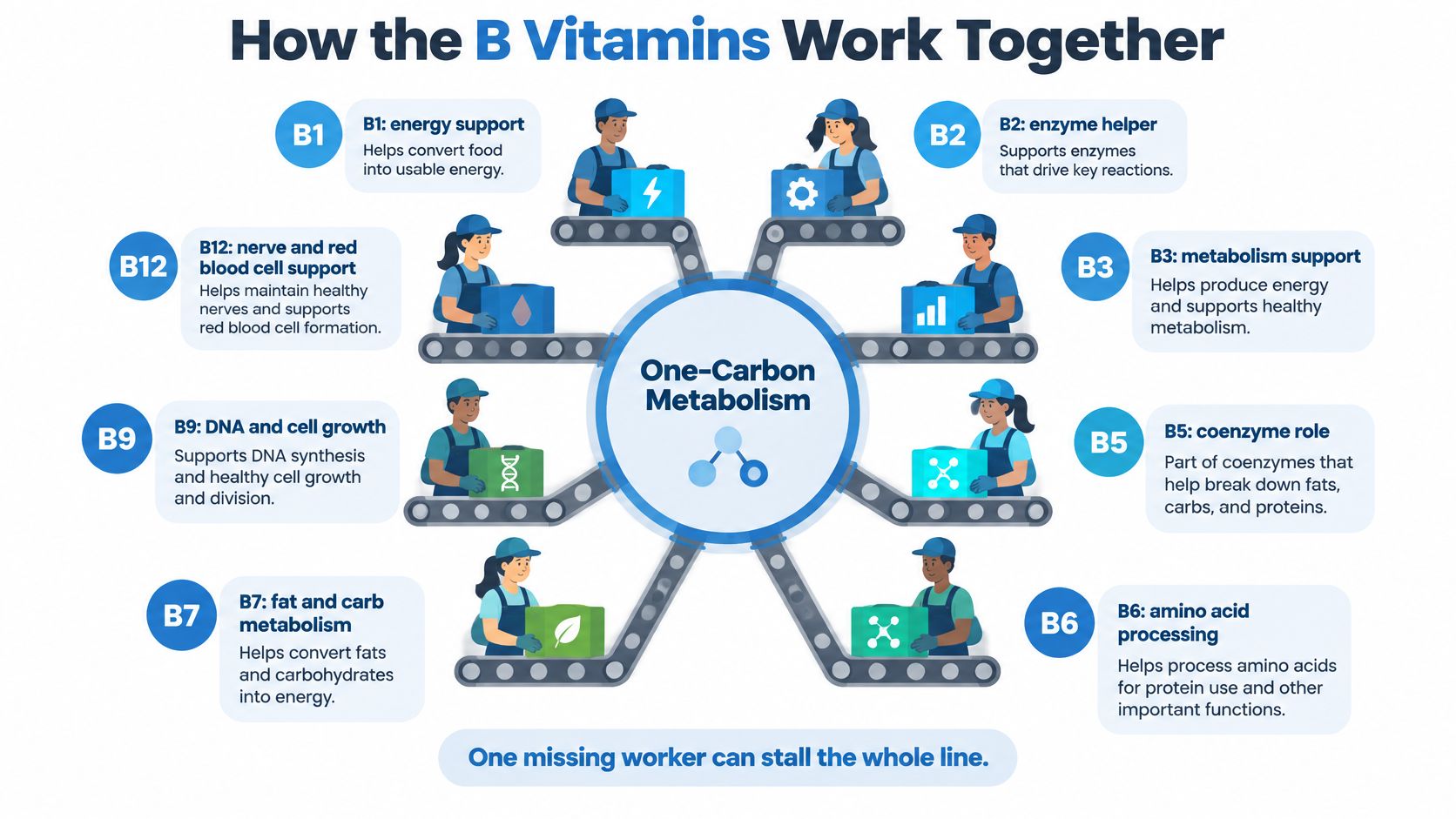
Read the map as connected workstations: energy-processing reactions help cells function, while one-carbon reactions support DNA production and related metabolic tasks. Their connections explain why nutritional assessment sometimes needs to consider several vitamins, even when a symptom initially points toward just one.
Benefits Backed by Evidence and Claims That Overreach
The strongest benefits have a clearly defined target. Folate has an established preventive role around conception and early pregnancy. B12 treatment addresses a specific deficiency affecting blood formation or nerves, although longstanding nerve injury may not fully reverse.
Those are different claims from saying that any B-complex product improves energy, mood, circulation, and brain performance in everyone. A nutrient's biological importance doesn't prove that extra intake improves an already adequate supply.
A better laboratory result isn't always better health
Homocysteine illustrates the distinction. B-vitamin supplementation can lower this blood marker, but researchers must still ask whether people experience fewer strokes, heart attacks, or deaths.
The NIH Office of Dietary Supplements folate fact sheet describes a Cochrane analysis of 10 trials involving 44,224 participants, in which stroke occurred in 4.26% of participants receiving homocysteine-lowering B vitamins versus 5.06% receiving placebo or control treatment; it also describes an approximately 25% reduction in stroke risk in HOPE-2, without consistent evidence of fewer overall cardiovascular events across large trials.
That isn't a reason to dismiss the stroke findings. It's a reason to keep the conclusion narrow: results for one outcome in selected trial populations don't establish a general heart-protection benefit for every supplement buyer.
Common B complex claims checked against the evidence
| Claim | Evidence | Verdict |
|---|---|---|
| Prevents neural tube defects in pregnancy | Strong evidence for adequate folic acid before and during early pregnancy | Supported for folic acid in the relevant window |
| Corrects B12 deficiency symptoms | Clinically established when deficiency is present; recovery can be incomplete | Supported with appropriate treatment |
| Lowers homocysteine | Consistent biochemical effect in trials | Supported as a laboratory effect, not a guarantee of clinical benefit |
| Reduces stroke risk | A modest benefit in pooled evidence, with differences between populations and trials | Limited, not a blanket prevention recommendation |
| Reduces heart attacks or overall cardiovascular events | Not demonstrated consistently in large trials | Not supported as a general claim |
| Boosts energy or athletic performance in people with adequate B12 | No demonstrated performance benefit from additional B12 in sufficient people | Not supported |
What about energy and exercise?
The NIH vitamin B12 consumer fact sheet states that B12 supplements don't improve athletic performance or endurance in people who already get enough. A person whose deficiency contributes to anemia may feel better after appropriate treatment, but that doesn't make B12 a stimulant.
The same reasoning helps you evaluate an energy-focused label. Ask whether it describes a normal nutrient function, such as supporting metabolism, or promises a noticeable outcome, such as eliminating tiredness. Those statements aren't equivalent.
For a closer look at that distinction, the guide to energy and metabolism vitamins can help you separate nutritional roles from expectations about how a product will feel.
Keep the benefit tied to the person
Someone with low folate intake, diagnosed B12 deficiency, or a medically identified absorption problem has a different reason to supplement than a well-nourished adult seeking general optimization. The relevant evidence should match the person, the nutrient, and the intended outcome.
B vitamins also don't replace prescribed treatment for high blood pressure, abnormal cholesterol, diabetes, or clotting risk. A supplement that changes a biomarker isn't a substitute for care shown to address the underlying condition.
Folate in Pregnancy and the Timing That Matters
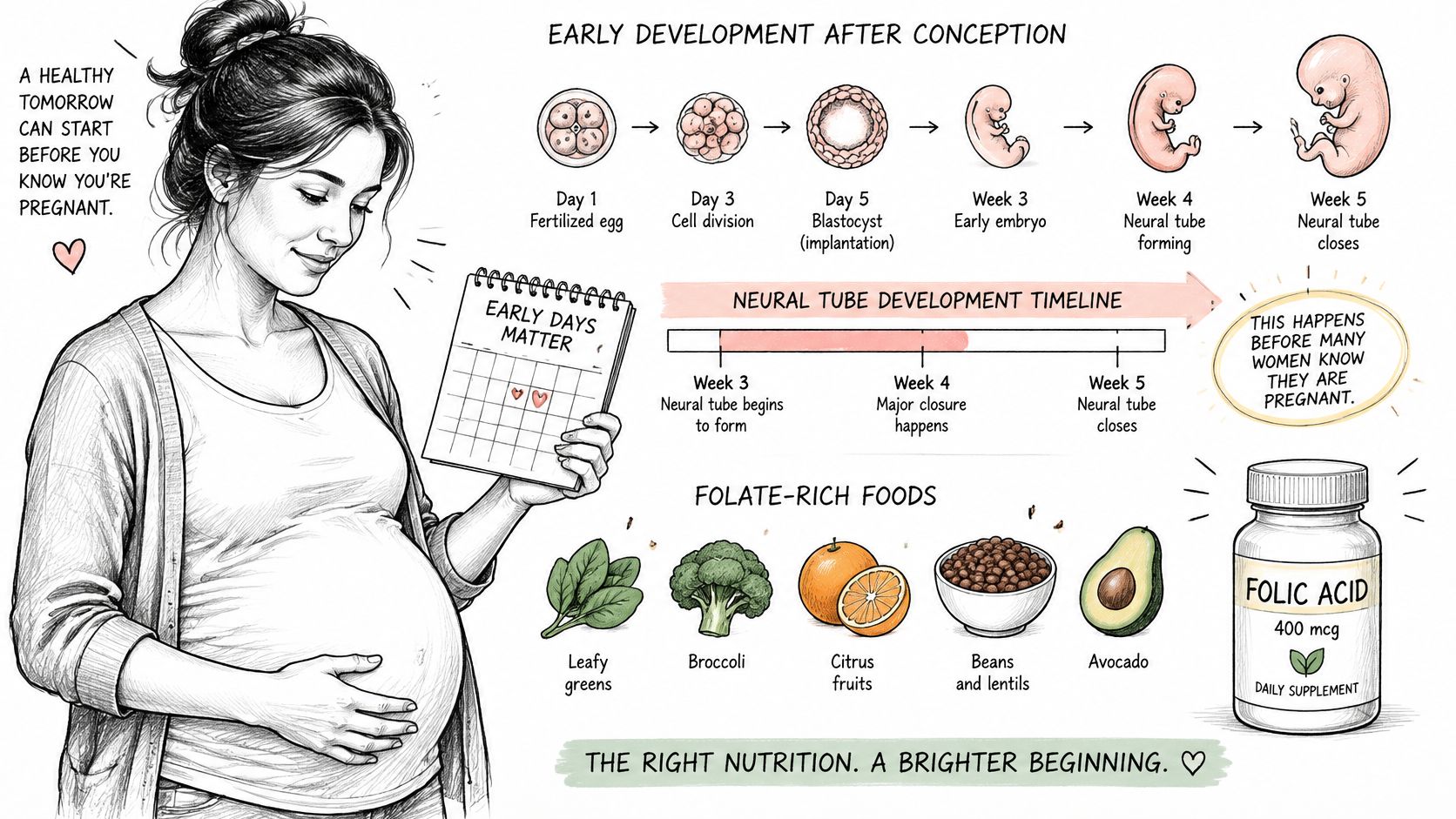
Folate adequacy matters before pregnancy is recognized. The neural tube, which develops into the brain and spinal cord, forms very early after conception. Waiting until a later prenatal visit can miss part of the preventive window.
This illustration shows why early preparation matters.
What fortification demonstrates
The CDC's account of folic-acid fortification describes approximately 4,000 NTD-affected pregnancies annually in 1995–1996, compared with approximately 3,000 in 1999–2000, following mandatory fortification of enriched cereal-grain products.
That population-level change supports a specific benefit: improving folic-acid availability helps prevent neural tube defects, including spina bifida and anencephaly. It doesn't mean every birth defect is preventable with folate, or that taking a high-potency B complex offers more protection than an appropriately selected prenatal plan.
Fortification also helps explain why nutritional advice isn't limited to people actively trying to conceive. Food-based public-health measures can improve folic-acid availability before someone knows they're pregnant.
Check the plan, not just the product name
Folate is the broader nutrient name; folic acid is a form used in supplements and fortified foods. A label may express folate using dietary folate equivalents and separately identify the amount of folic acid, so the numbers shouldn't be treated as interchangeable.
Before conception or at the start of prenatal care:
- Discuss your circumstances. Tell your clinician about previous pregnancy complications, medical conditions, dietary restrictions, and medications.
- Bring every relevant label. Include a prenatal, multivitamin, B complex, and any separate folate product.
- Avoid unnecessary overlap. Don't assume combining prenatal and B-complex products improves protection.
- Keep food in the plan. Leafy vegetables, beans, and fortified grains can contribute alongside clinician-directed supplementation.
A prenatal product is designed for a different purpose from a general B complex. The guide to organic prenatal vitamins offers another starting point for comparing product labels, but an organic designation alone doesn't establish nutritional suitability.
The accompanying video provides another way to review the pregnancy context.
If you've already become pregnant without taking a supplement, don't interpret the timing advice as a reason for panic. Contact your prenatal clinician promptly, review what you're currently taking, and establish an appropriate plan rather than trying to compensate with an unusually high dose.
Deficiency Signs and Who Is at Risk
B12 is a useful starting point because population surveys measure its status, and missed deficiency can have serious consequences. The NIH vitamin B12 professional fact sheet reports that an analysis of U.S. NHANES data from 2007–2018 found deficiency in approximately 3.6% of adults aged 19 and older, using serum B12 below 200 picograms per milliliter, while approximately 12.5% fell below the broader insufficiency threshold of 300 picograms per milliliter.
Those categories aren't interchangeable. A borderline result requires interpretation alongside symptoms, medical history, and sometimes additional testing. It isn't automatically a prescription for a high-potency B complex.
Intake and absorption are different problems
A vegan diet needs a dependable B12 strategy because unfortified plant foods aren't reliable sources. An older adult with atrophic gastritis may consume B12-containing foods but have trouble releasing and absorbing the vitamin.
Long-term metformin or acid-suppressing medication use can also make B12 assessment relevant. Don't stop a prescribed medication because of that possibility; ask whether your clinician recommends monitoring or supplementation.
Early deficiency signs and higher-risk groups by vitamin
| Vitamin | Early signs | Higher-risk groups |
|---|---|---|
| B12 cobalamin | Fatigue, numbness, tingling, gait problems, anemia, or memory changes | Older adults, people with atrophic gastritis, vegans, long-term metformin or acid-suppressing drug users |
| B9 folate | Megaloblastic anemia, fatigue, mouth sores | Pregnant people, people with restricted diets, people with alcohol use disorder |
| B6 pyridoxine | Low mood, cracked lips, rash, or neurological symptoms | People with alcohol use disorder, kidney disease, or certain medication exposures |
| B1 thiamine | Fatigue, irritability, numbness | People with alcohol use disorder or a history of bariatric surgery |
| B3 niacin | Rash, diarrhea, and confusion in severe deficiency | People with severe malnutrition or alcohol use disorder |
These are possible clues, not a diagnostic checklist. Some are features of established or severe deficiency rather than reliable early warnings. Tingling, for example, can arise from several medical problems and can also occur with excessive B6 intake.
Pregnancy findings need their proper scope
A study published in PMC in 2024 found that among 102 pregnant women, 7.8% had total folate below reference values and 2% had levels above them. Those findings describe that study group, not all pregnant people, and a result above a reference range doesn't by itself establish toxicity.
The practical lesson is that an assumption of either universal deficiency or universal adequacy can be wrong. Diet, current supplements, and the clinical meaning of a test result all matter.
Symptoms should guide assessment, not self-treatment
B12-related neurological symptoms can occur without obvious anemia. Persistent numbness, difficulty walking, balance changes, or unexplained cognitive changes deserve prompt medical evaluation rather than a trial of increasingly strong supplements.
Fatigue alone doesn't identify a B-vitamin deficiency. A symptom can justify investigation without identifying the treatment.
A clinician may review your diet, medications, digestive history, and blood count before choosing nutrient tests. When possible, discuss testing before starting supplements because supplementation can change the results; urgent treatment shouldn't be delayed when a clinician suspects a serious deficiency.
Recommended Intakes and Upper Limits
A daily requirement and an upper limit measure different things. The requirement is the amount that supports nutritional adequacy; the upper limit is the highest usual daily intake considered unlikely to cause harm. Neither number is a treatment dose.
Adult targets vary by sex and life stage. The table gives typical U.S. adult intake recommendations and upper limits where established. EFSA sets a lower adult upper limit for B6 than the U.S. does.
The NIH vitamin B6 professional fact sheet describes the U.S. adult upper limit of 100 mg per day and the EFSA limit of 12 mg per day. Chronic high-dose pyridoxine can cause severe, progressive sensory neuropathy. The difference between limits reflects differing safety assessments, not a reason to choose the higher ceiling for routine use.
Adult daily intakes and upper limits for each B vitamin
| Vitamin | Adult daily intake | Upper limit | Safety note |
|---|---|---|---|
| B1 thiamine | 1.1 mg for women; 1.2 mg for men | Not established | Lack of an established limit doesn't mean unrestricted dosing is useful |
| B2 riboflavin | 1.1 mg for women; 1.3 mg for men | Not established | Can turn urine bright yellow |
| B3 niacin | 14 mg NE for women; 16 mg NE for men | 35 mg per day from supplements and fortified foods | High doses can cause flushing, rash, headache, and dizziness |
| B5 pantothenic acid | AI: 5 mg | Not established | High potency isn't inherently beneficial |
| B6 pyridoxine | 1.3 mg | 100 mg per day in the U.S.; 12 mg per day under EFSA guidance | Chronic excessive intake can damage sensory nerves |
| B7 biotin | AI: 30 mcg | Not established | Can interfere with some laboratory tests |
| B9 folate | 400 mcg DFE | 1,000 mcg per day of folic acid from supplements and fortified foods | Excess folic acid can obscure blood signs of B12 deficiency |
| B12 cobalamin | 2.4 mcg | Not established | High doses are generally considered safe, but extra intake may be unnecessary |
These are reference values for healthy adults, not personalized prescriptions. Pregnancy, breastfeeding, age, or a diagnosed deficiency can change the appropriate plan. “Not established” means no formal upper limit has been set; it does not show that every dose is harmless. A product's percentage Daily Value is also not a personal target.
Add up what you actually take
The same vitamin may appear in a B complex, multivitamin, workout product, fortified drink, or separate supplement. Check the amount in the full daily serving, not just the amount in one capsule.
- Record the serving size. Note how many capsules or scoops make up a daily serving.
- List every source. Include supplements, fortified foods, energy drinks, and powders.
- Match the units. Milligrams and micrograms are different units; convert before adding amounts.
- Total B6 and niacin separately. A combined B-vitamin total cannot show how much of either nutrient you take.
- Review duration. A short clinician-directed course differs from indefinite use.
Keep the amounts in a written list or phone note so you can compare products accurately. If a proprietary blend does not disclose the relevant vitamin amounts, its contribution cannot be totaled.
New tingling, numbness, or balance trouble while taking supplements warrants prompt assessment. Those symptoms do not establish that more B vitamins are needed.
Drug and Nutrient Interactions and Lab Test Effects
A supplement can change medication handling or interfere with a laboratory measurement. Those are different problems: one can alter treatment, while the other can make a test result misleading.
Bring the actual product label to a pharmacist or prescriber. A description such as “just a vitamin” doesn't provide enough information to assess the interaction.
Medication combinations that need review
- Levodopa. Supplemental B6 can increase levodopa breakdown outside the brain when levodopa is used without a peripheral decarboxylase inhibitor. The formulation matters, so ask the prescriber rather than assuming all Parkinson medications interact the same way.
- Antiseizure medicines. Folate supplementation can affect medications such as phenytoin or phenobarbital and may complicate seizure control. Don't add high-dose folate without the treating clinician's advice.
- Methotrexate. Folate management depends on why methotrexate is prescribed. Clinicians commonly prescribe folic acid alongside some low-dose regimens, while other treatment settings require different precautions; follow the treating team's schedule.
- Niacin with statins. Cholesterol-treatment doses of niacin need medical supervision, especially when combined with a statin, because muscle and liver adverse effects are concerns.
- Heavy alcohol use. Alcohol can worsen nutritional intake and interfere with thiamine and folate status. Suspected deficiency in this setting calls for medical assessment, not an over-the-counter wellness blend.
Don't stop prescribed treatment to make room for a supplement. The safer action is to let the pharmacist check the combination before you start it.
Biotin can change what a test appears to show
Biotin interference doesn't necessarily mean the nutrient has harmed the organ being tested. It means biotin can interfere with certain laboratory methods, producing falsely high or falsely low results.
Some thyroid tests and cardiac troponin assays are relevant examples. Tell the clinician and laboratory about biotin-containing B complexes, multivitamins, and hair-and-nail products.
Before blood work: Disclose the product, dose, and last time you took it. Follow the laboratory's instructions about whether and when to pause it.
There isn't a single stopping interval that suits every dose and assay. If you need urgent care, don't delay assessment to wait for a supplement to clear; tell the clinical team what you've taken.
Deciding Whether a B Complex Supplement Makes Sense
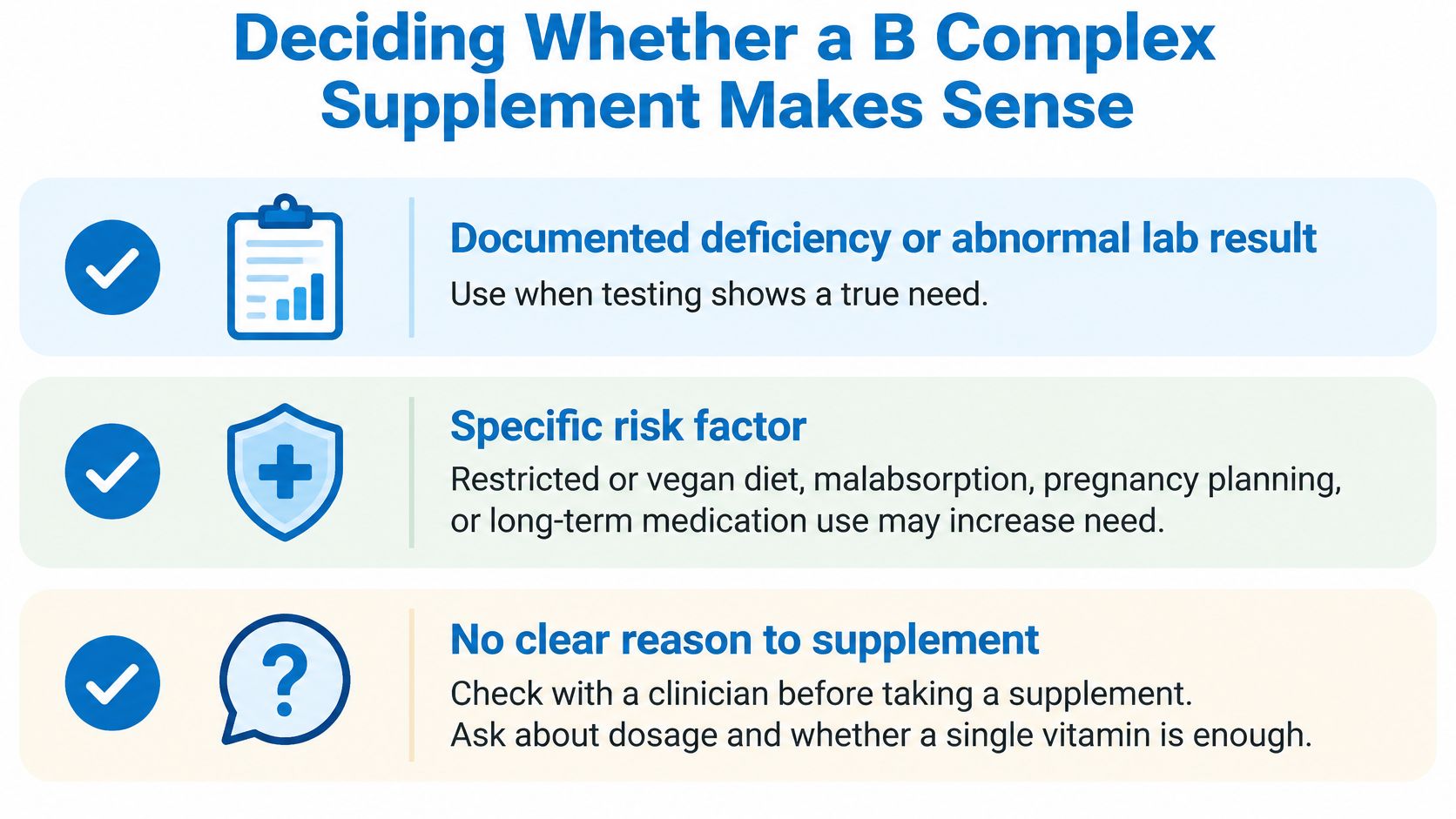
A B complex makes the most sense when someone has identified multiple likely gaps or a clinical reason for combined supplementation. A documented deficiency doesn't automatically mean a combination is the right treatment: a targeted nutrient, a different dose, or treatment for an absorption problem may be more appropriate.
Your decision usually falls into one of these situations.
Match the product to the reason
A documented deficiency or abnormal result calls for an interpretation and treatment plan. Ask what caused the result, what improvement is expected, and when follow-up is needed. Buying a broad formula shouldn't replace that discussion.
A specific risk factor can justify preventive planning without symptoms. A vegan may need reliable B12, someone planning pregnancy needs an appropriate folate strategy, and a person with malabsorption may need a specialized approach. None automatically needs every B vitamin at a high dose.
An already adequate diet without a particular risk factor provides a weaker reason for supplementation. If your goal is better concentration or less tiredness, first consider whether sleep, meal patterns, medication effects, or another health condition needs attention.
Use this checklist to keep the decision specific.
Check before you buy
- State the purpose. Name the deficiency, dietary gap, or clinical recommendation rather than writing “general energy.”
- Inspect folate and B12. Check the amount and chemical form, not just a front-label claim about potency.
- Look for overlap. Review B6 and niacin across everything you already take.
- Check medications and testing. Ask a pharmacist about interactions and disclose biotin before blood work.
- Agree on follow-up. Know whether the plan is temporary, ongoing prevention, or treatment that needs reassessment.
The guide to how to read a supplement label can help you organize that comparison. A clear label supports an informed choice, but it can't establish a diagnosis or prove that the formula fits your needs.
The most useful question isn't whether B vitamins are good for you. They're essential nutrients. It's whether a particular product solves a real problem without adding unnecessary exposure.
This week, gather photos of your supplement labels and bring them to a clinician or pharmacist. Ask whether testing is appropriate, whether a single vitamin would be enough, and what dose and duration fit your situation before buying another product.
CalVitamin offers vitamins, dietary supplements, and educational guides to help you compare wellness products. Visit CalVitamin to review available options, then check the nutrient amounts and forms against the plan you've discussed with your clinician.


