One package labeled “stevia powder” can be a leafy herbal powder, a concentrated extract, or a sugar-like blend diluted with another ingredient. Those products don't measure the same, taste the same, or replace sugar in the same way. The useful question isn't just whether a powder contains stevia. It's how much of its sweetness comes from steviol glycosides, and which glycosides are present.
For home cooks and careful buyers, that distinction affects everything from a pinch in coffee to a batch of muffins. Read the powder's composition first, then decide how to measure it.
Table of Contents
- Stevia Extract Powder Types at a Glance
- How Stevia Extract Powder Gets Its Sweetness
- Purity Benchmarks and Label Checks
- Sugar Substitution Ratios for Stevia Extract Powder
- Why Some Stevia Powders Taste Bitter and How to Fix It
- Daily Safety Limits and Regulatory Status
- Choose the Right Powder and Confirm the Label
Stevia Extract Powder Types at a Glance
“Stevia powder” covers products that differ widely in sweetness per gram, aftertaste, and ease of measuring. The word on the front of the package doesn't tell you which kind you're buying.
| Form | Typical glycoside purity | Best use | Main drawback |
|---|---|---|---|
| Whole-leaf stevia powder | Not standardized; varies widely | Herbal tea and home infusions | Unpredictable sweetness and leaf flecks |
| Partially purified extract | Often 50% to 80% | Budget sweetening and drinks | Stronger aftertaste and batch variation |
| High-purity extract powder | 95% or more total steviol glycosides | Tabletop use, beverages, and precise dosing | Tiny measures are easy to get wrong |
| Rebaudioside A powder | Often 95% or more rebaudioside A | Beverages and clean-tasting recipes | The name can hide a different total glycoside content |
| Bulked blend with erythritol or dextrose | Low glycoside share, diluted by the bulking agent | Cup-for-cup sugar swaps and baking | Calories and sugar alcohol effects come from the bulk |
The practical choice follows the job. Whole-leaf powder suits herbal tea and rough home infusions, where a leafy taste and uneven sweetness may be acceptable. A high-purity extract is more useful when you need a small, repeatable dose in a drink or recipe. A bulked blend adds volume, making it easier to measure as a sugar substitute, but the carrier contributes most of the bulk.
Read the purity column first. It tells you whether a pinch, a fraction of a teaspoon, or a spoonful is a sensible starting point. The next questions are how manufacturers produce the powder, how to verify the label, and how to adjust a recipe without assuming every product measures alike.
How Stevia Extract Powder Gets Its Sweetness
Stevia extract is a little like a concentrated espresso shot. A small amount can deliver a strong effect because extraction separates the target compounds from much of the leaf material. In stevia, the compounds responsible for intense sweetness are steviol glycosides, naturally found in the leaves of Stevia rebaudiana. Two familiar examples are stevioside and rebaudioside A.
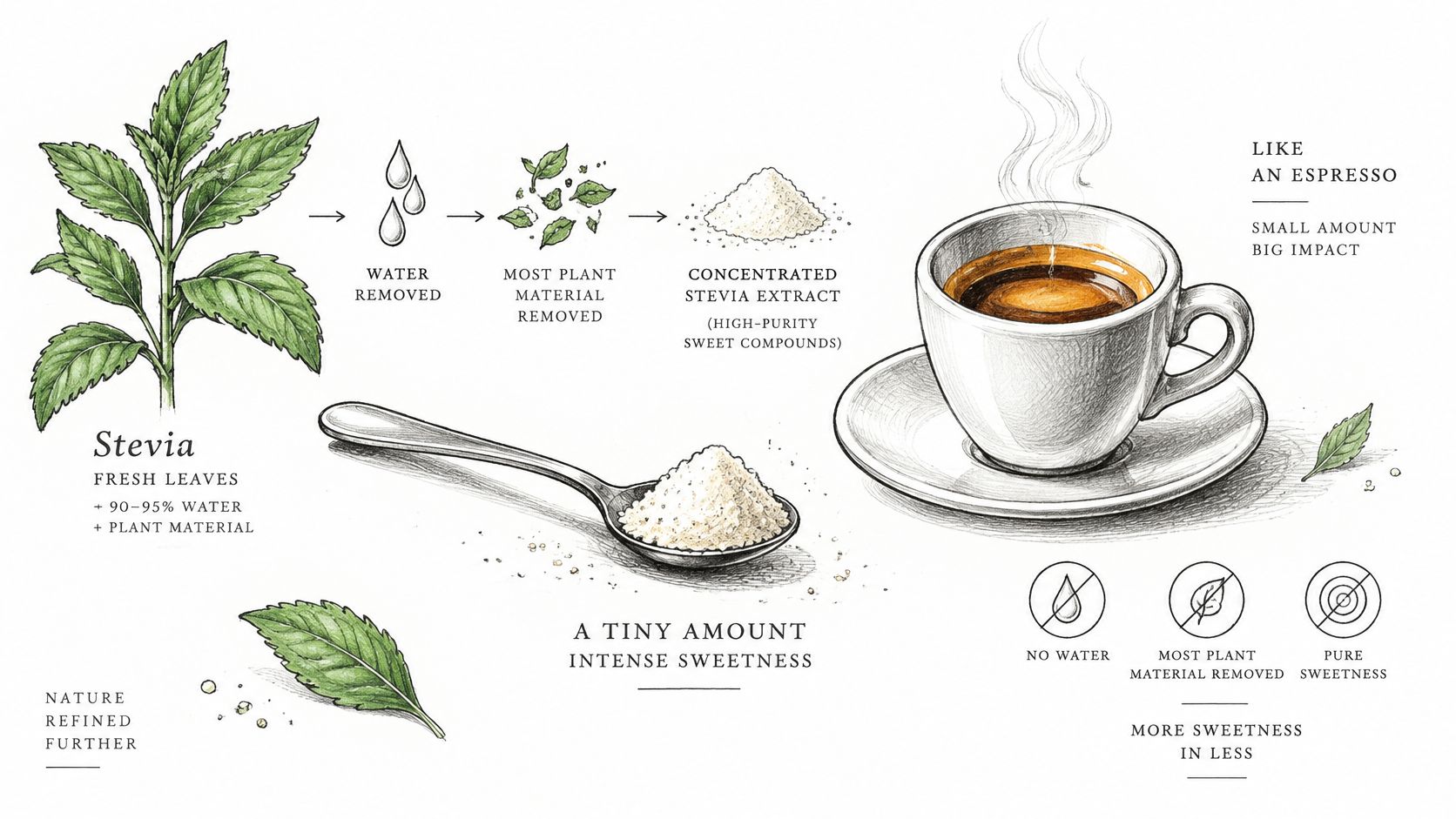
A typical production path begins with harvested, dried leaves. Manufacturers extract the glycosides with water, filter the liquid, then purify the compounds, often using processes such as resin separation or crystallization. Finally, they dry the purified material into powder. If processing stops after extraction and basic filtration, the result can retain more leaf components; additional purification produces a more standardized powder.
That sequence helps explain why powders from the same plant can behave differently. Each purification step changes the mix and concentration of glycosides, while the presence of leaf material or added carriers changes how much sweetness a gram delivers. The name “stevia extract” alone doesn't tell you where a powder sits on that spectrum.
The sweet compounds are potent enough that purified steviol glycosides can be roughly 200 to 300 times sweeter than sucrose by weight. This is why concentrated powders are measured in small amounts, and why an ordinary teaspoon can be far too much for a cup of coffee. Blends with erythritol or dextrose are less concentrated by weight because the carrier adds bulk.
The safety benchmark also reflects the difference between a standardized extract and an unstandardized leaf powder. In 2008, the Joint FAO/WHO Expert Committee on Food Additives' assessment established an acceptable daily intake of 0–4 milligrams per kilogram of body weight per day, expressed as steviol equivalents, for steviol glycosides meeting relevant specifications. That standard doesn't automatically apply to every powder made from stevia leaves.
A visual walkthrough can make the production stages easier to follow:
Purity Benchmarks and Label Checks
The word “stevia” isn't a purity measure. For a concentrated extract, look for a stated total steviol-glycoside percentage on a dry-weight basis. U.S. FDA-reviewed specifications for purified extracts commonly use a benchmark of at least 95% total steviol glycosides; the FDA response for a purified steviol glycoside preparation also documents specifications for moisture and contaminants. A product's certificate of analysis, or COA, should show what the finished powder contains, rather than relying on a vague front-label claim.
| Specification | Common benchmark | Why it matters |
|---|---|---|
| Total steviol glycosides (dry basis, HPLC) | At least 95% | Sets real sweetness per gram |
| Moisture | 6% to 10% | Higher moisture causes caking and faster quality loss |
| Lead | Below 1 mg/kg | Confirms the result against a heavy-metal specification |
| Arsenic | Below 0.2 to 1 mg/kg, depending on specification | Provides a contaminant result to check |
| Microbial limits | Defined in the supplier's specification | Confirms the powder meets the stated microbiological criteria |
| Glycoside profile (stevioside, rebaudioside A, rebaudioside M) | Stated ratio on the report | Helps explain bitterness and aftertaste |
Total glycosides aren't the same as rebaudioside A. A powder labeled as 95% total steviol glycosides may contain a mixture of compounds, including rebaudiosides E and M. The relative amounts influence sweetness and taste, so a useful COA reports both the total and the individual glycoside profile.
Moisture also matters in the kitchen. A powder with excess moisture can cake, flow poorly, and lose quality faster in storage. Keep the container sealed in a cool, dry place, and use a dry spoon.
Buyer check: Ask for a COA that shows total glycosides by HPLC, the individual glycoside profile, moisture, heavy metals, residual solvents, and microbiological results.
Before buying, check that the product identifies the glycoside percentage and says whether it's measured on a dry-weight basis. Look for named glycosides, a clear list of carriers such as erythritol or dextrose, and a serving size expressed by weight as well as by household measure. If the seller doesn't provide a COA or the listing gives no powder weight per serving, you can't reliably compare its potency with another product.
Sugar Substitution Ratios for Stevia Extract Powder
The working rule is simple: concentrated stevia is measured in fractions of a teaspoon, and the right amount depends on purity. The amounts below are starting points, not universal conversions. Brands can differ in glycoside concentration and composition, so begin low and taste.
| Powder type | Amount per 1 cup sugar | Notes |
|---|---|---|
| High-purity extract (95% or more) | About 1/8 teaspoon, roughly 0.5 to 1 gram | Start here and taste; sweetness varies by brand |
| Partially purified extract (about 60% to 80%) | About 1/6 to 1/4 teaspoon | Scale up if purity is lower; taste first |
| Bulked blend with erythritol | Follow the label's cup-for-cup ratio | Bulk replaces volume; the label ratio governs |
| Baking (cookies, cakes, muffins) | Bulked blend only | Sugar also browns and holds moisture; expect a drier, paler result |
| Coffee or tea (per cup) | A pinch to 1/8 teaspoon | Add a little, stir, then taste before adding more |
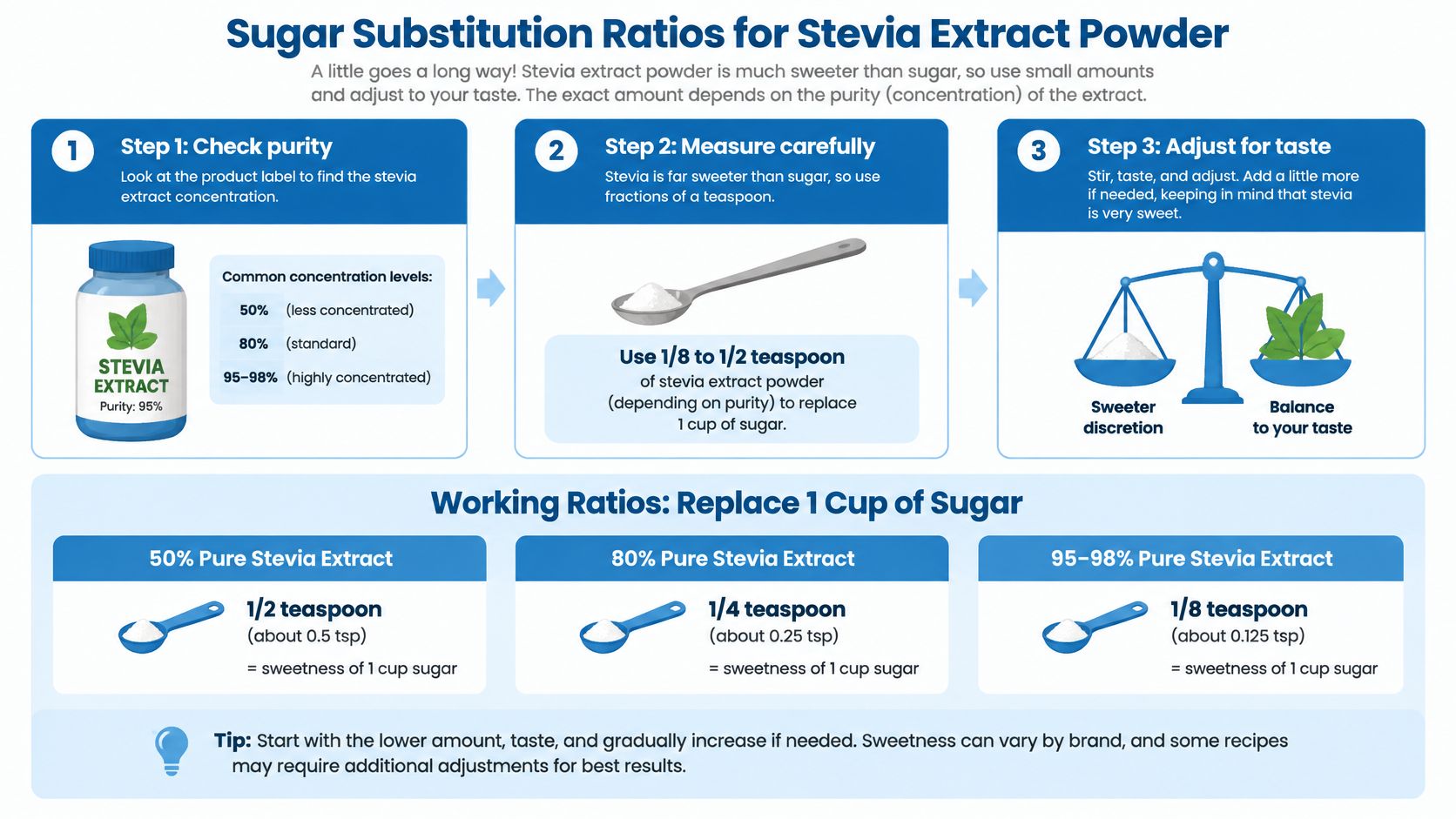
Use a quick scaling calculation when you know the powder's purity. If a powder is 60% glycosides rather than 95%, the simple ratio 95 ÷ 60 suggests using about 1.6 times as much to get a comparable amount of glycosides. Treat that as a first estimate, not a promise of identical sweetness, because the glycoside mix can differ too.
A good workflow is check purity, choose a starting ratio, scale the amount, taste, then adjust. In coffee or tea, stir in a pinch, let the powder dissolve, and taste before adding more. If you're choosing a different sweetener for a recipe, xylitol powder is another option, but it behaves differently from concentrated stevia and shouldn't be measured as if it were the same ingredient.
Baking needs more than sweetness
Sugar adds volume, helps baked goods brown, and holds moisture. Replacing it with a concentrated extract alone removes those functions, so cookies or muffins may turn out paler and drier even when the sweetness seems right. A bulked blend is usually easier to work with in baking because the carrier restores volume; still, the package's recipe guidance should take precedence over a teaspoon conversion.
Why Some Stevia Powders Taste Bitter and How to Fix It
Two jars both labeled stevia can behave like different sweeteners. That happens because stevia isn't one single compound: glycoside profile, degree of purification, concentration, and carriers all change the flavor. A FAO-indexed review of stevia's sensory profile reports that rebaudiosides D and M produced sweetness and bitterness responses closer to sucrose than rebaudioside A, although they also had a more persistent sweet aftertaste. Stevia powders are also commonly described as carrying bitter, metallic, or chemical notes, especially when the extract is less refined or the serving runs high.
A bitter cup doesn't automatically mean the powder has spoiled or that you're unusually sensitive to it. Check the likely causes and fix them one at a time:
- Glycoside profile: A powder with a less suitable mix may leave bitterness or a lingering sweet note. Try a different disclosed profile, or test a rebaudioside A-focused product in a small serving.
- Low purity: Leaf residue can add grassy or bitter notes. Use a more refined extract when you want a cleaner taste in a drink.
- Too much powder: Overdosing can make sweetness harsh. Reduce the amount, then add tiny increments until the drink tastes right.
- The food or drink: Strong coffee and acidic beverages can make off-notes more noticeable. In coffee, dissolve the powder fully before tasting; in shakes or baking, try pairing the sweetness with vanilla, cocoa, cinnamon, or a small pinch of salt.
Start with the dose before you blame the product. A smaller amount may solve the problem without changing the ingredient, which is why measuring by glycoside content matters more than measuring by the word stevia on the label. For protein drinks, choose a powder whose flavor works with your recipe, and consider protein options without artificial sweeteners if you're comparing formulations.
Daily Safety Limits and Regulatory Status
The principal benchmark for steviol glycosides is an acceptable daily intake of 0–4 mg per kilogram of body weight per day, expressed as steviol equivalents, a figure set by JECFA and described in an FDA-filed notice about purified steviol glycosides. Two words in that figure do most of the work: "steviol equivalents." A scoop size or a gram weight of finished powder can't express the limit directly, because two products that both say "stevia" on the front can deliver very different amounts of glycosides per teaspoon.
To find the upper end of the range for your body weight, multiply kilograms by four:
| Body weight | Upper daily intake (steviol equivalents) |
|---|---|
| 50 kg (110 lb) | 200 mg per day |
| 70 kg (154 lb) | 280 mg per day |
Those figures still aren't a powder dose. Turning them into a weight of commercial powder requires the supplier's assay plus a glycoside-to-steviol conversion, and the total glycoside percentage on its own doesn't complete that calculation. A refined extract and a whole-leaf powder sit far apart in steviol-equivalent terms even at identical serving weights. Count stevia from foods, drinks, and supplements together rather than treating one sweetened serving in isolation.
What the regulatory record means
Regulatory reviews apply to specific, characterized preparations, not every item sold as stevia powder. In the United States, regulators have reviewed a series of purified steviol glycoside preparations through the GRAS notice process, covering rebaudioside A and other glycosides. Those reviews don't make every leaf powder interchangeable, and they don't amount to a single approval covering all uses. A product's stated glycoside profile and purity still determine both its sweetness per gram and how much of your daily limit a serving consumes.
If you take medication for blood sugar or blood pressure, ask a clinician before adding a concentrated sweetener to your routine. That step makes sense whenever you change a regular dietary habit, especially if you're unsure how much stevia you already get from packaged foods.
Choose the Right Powder and Confirm the Label
Use this decision path before buying or adding stevia extract powder to a recipe:
- Match the form to the job. Choose whole-leaf powder for herbal infusions, a high-purity extract for precise dosing in drinks, or a bulked blend when a recipe needs sugar-like volume.
- Set a measured starting amount. Use the product's purity and serving details to estimate a dose, then taste and adjust in small increments.
- Check your overall intake. Add up stevia from foods, beverages, and supplements, and compare the total using the product's conversion information rather than treating a teaspoon as a standard dose.
- Verify the documentation. Read the label carefully, and use a practical supplement-label checklist to confirm the active ingredient, serving weight, carriers, and available quality information.
Write down the powder's total glycoside percentage, the amount used per cup, and your estimated daily total. Keep that record with the package, and update it when you open a new batch because purity and glycoside ratios can change between lots. If the seller can't provide the glycoside percentage, dry-weight basis, dominant glycosides, or a COA, choose a product with clearer documentation.
CalVitamin offers supplements and wellness products, including protein powders that use stevia extract as a sweetener, so shoppers can compare ingredient labels across formats. Visit CalVitamin to browse its catalog and check product details before choosing a stevia-sweetened option.