If a bottle says it supports bones, does that mean it will keep you from breaking one? Most labels skip that difference. Vitamins for bones work when they close a real shortfall in what you eat, not when they sit on the shelf as a fracture shield. Dose only makes sense once you add food, fortified drinks, and every capsule together.
Table of Contents
- Nutrients That Support Bone and Their Daily Targets
- How Calcium and Vitamin D Work as a Team
- Whether Vitamins Actually Prevent Fractures
- Vitamin K, Magnesium and Protein Beyond the Basics
- Upper Limits and When More Becomes Harmful
- Confirm Your Gap and Choose a Product
Nutrients That Support Bone and Their Daily Targets
Bone is living tissue. Cells break it down and rebuild it for life, so you need raw materials and the nutrients that tell those cells what to do. Calcium, phosphorus, protein, and vitamin C supply the mineral and the collagen scaffold. Vitamin D, vitamin K, magnesium, and vitamin A help decide where that mineral goes.
The NIH Office of Dietary Supplements notes that more than 53 million U.S. adults either have osteoporosis or are at risk of it, and that about 2.3 million osteoporotic fractures occurred in the United States in 2015. Those figures are why intake targets matter, especially after midlife. They don't turn a multivitamin into treatment. Resistance work, protein, fall prevention, and a personal risk review still sit beside any pill.
| Nutrient | Role in bone | Adult daily target | Main food sources |
|---|---|---|---|
| Calcium | Forms hydroxyapatite, the mineral that gives bone its strength | 1,000 mg (1,200 mg for women 51 and older and men 71 and older) | Dairy, fortified soy milk, canned sardines with bones |
| Vitamin D | Raises calcium and phosphate absorption from the gut | 600 IU (15 mcg), rising to 800 IU (20 mcg) at age 71 | Fatty fish, fortified milk, sunlight on skin |
| Vitamin K | Helps bone proteins bind calcium | 120 mcg for men, 90 mcg for women (adequate intake) | Leafy greens (K1), natto and aged cheese (K2) |
| Magnesium | Contributes to bone crystal formation and activates vitamin D | 400 mg men and 310 mg women ages 19–30; 420 mg men and 320 mg women ages 31–50 | Pumpkin seeds, almonds, black beans, whole grains |
| Phosphorus | Major mineral component of bone | 700 mg | Dairy, meat, eggs, legumes |
| Vitamin C | Required for collagen, the protein scaffold of bone | 90 mg for men, 75 mg for women | Citrus fruit, bell peppers, strawberries |
| Vitamin A | Helps regulate the cells that remodel bone | 900 mcg RAE for men, 700 mcg RAE for women | Carrots, sweet potato, spinach |
| Protein | Forms the collagen matrix that bone mineral sits within | 0.8 g per kg of body weight | Eggs, fish, legumes, dairy, poultry |
How to read the targets
These numbers are for healthy adults. Each one is a daily total from food plus supplements, not a capsule size. Calcium and vitamin D are the two people most often miss. Calcium generally rises to 1,200 mg for women 51 and older and men 71 and older, while adult vitamin D is commonly 600–800 IU by age.
A three-food self-check
Write down the three foods you eat most days. Mark which rows they cover. Yogurt, milk, and sardines with bones move calcium. Salmon and fortified milk move vitamin D. A salad moves vitamin K and some magnesium. If a row has no food next to it, that row is your candidate gap.
Practical rule: Name the shortfall before you buy anything. Later sections only make sense once you know which row is empty.
How Calcium and Vitamin D Work as a Team
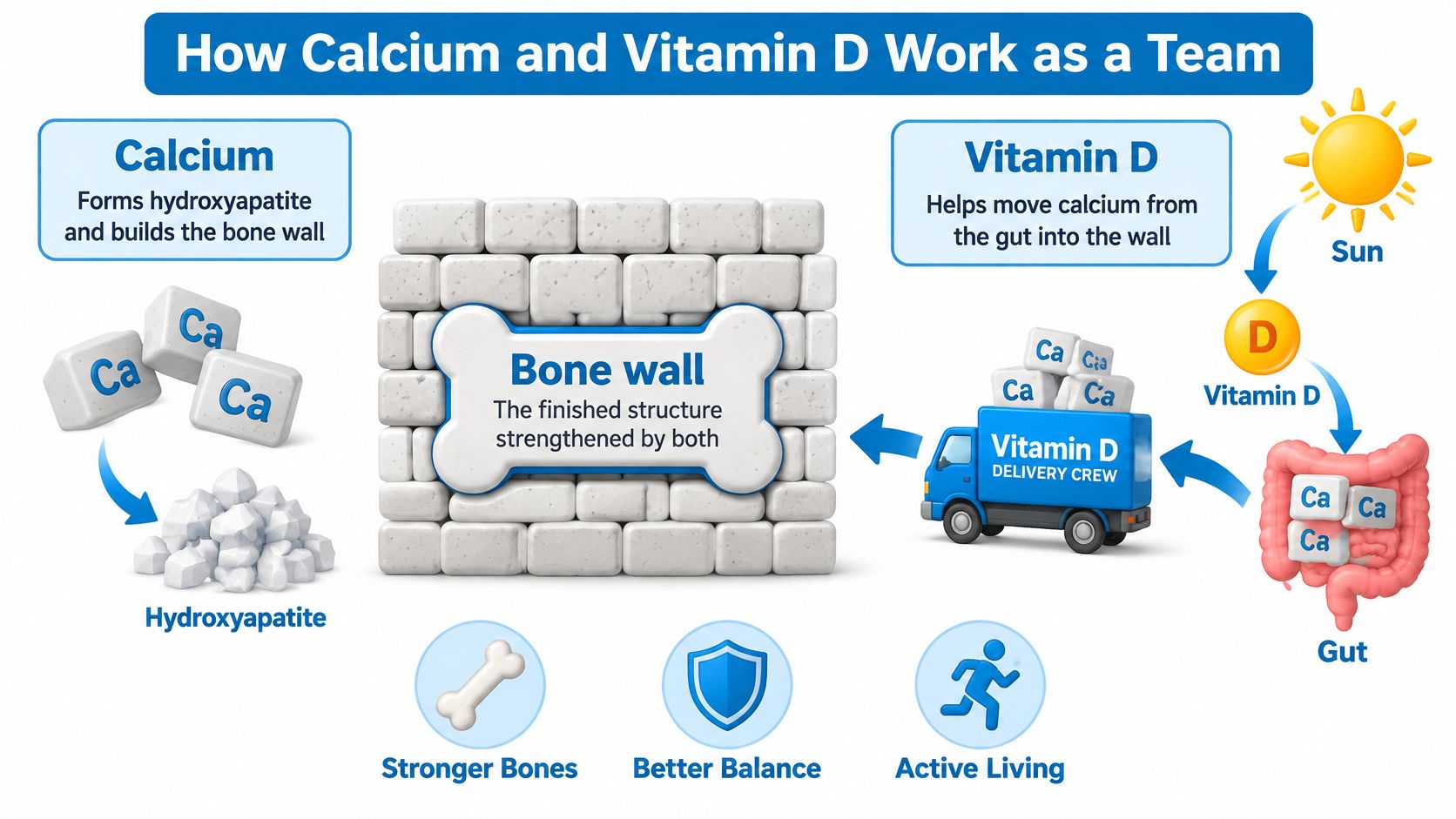
Calcium works like the brick in a wall, and vitamin D works like the crew that hauls bricks from the gut to the job site. Phosphate joins calcium in the same crystal. Without the crew, bricks stay in the meal and never reach the wall.
What happens when the crew is short
Only part of the calcium in a meal crosses the intestinal wall. Vitamin D raises that share by increasing absorption of both calcium and phosphate. Say someone eats little dairy, spends most days indoors, and skips fortified milk. Blood calcium can drift down. The parathyroid glands release more hormone. The kidneys hold onto calcium. Bone is then drawn down so the blood level stays steady.
The NIH vitamin D fact sheet for health professionals describes that chain as secondary hyperparathyroidism: the kidneys conserve calcium, but bone resorption speeds up to hold serum calcium steady.
A body short of vitamin D doesn't simply lose calcium from food. It borrows calcium from bone.
Where extra doses stop helping
Vitamin D earns its keep when deficiency, or too little calcium, is what limits mineralization. Once absorption is already working, a larger dose adds intake without adding mineral to bone. It isn't a universal fracture pill. Trials pairing vitamin D with calcium in older adults have produced mixed fracture results, and routine supplementation has not consistently meant fewer broken bones for people living independently.
That is why the dose question comes after the gap question. Add up calcium from food and fortified products, weigh sun exposure and current medicines, and only then decide whether a supplement fills a real shortfall. A serum 25-hydroxyvitamin D test belongs in that decision when a clinician orders it. Very high vitamin D can cause hypercalcemia. And if you are choosing a calcium salt, compare how calcium carbonate and citrate absorb before you assume a bigger tablet is a better brick.
Whether Vitamins Actually Prevent Fractures
Shoppers often treat vitamin D and calcium as automatic protection. The outcome that matters is a broken bone, not a slightly better scan.
The USPSTF 2025 final recommendation statement recommends against daily low-dose vitamin D (400 IU or less), with or without calcium (1,000 mg or less), for preventing fractures in postmenopausal women. It finds insufficient evidence for higher doses, and for men or premenopausal women.
NIH summaries of trials in community-dwelling adults point the same way. Supplements can produce small bone-density increases. Those trials have not consistently shown fewer fractures.
Four outcomes people mix up
- Correcting deficiency: Replacing a measured shortfall so absorption and mineralization can proceed.
- Supporting calcium absorption: Helping the gut take up calcium and phosphate you already eat.
- Raising bone mineral density: A scan number that can move a little without changing fracture counts.
- Preventing fractures: The clinical result, and the one routine low-dose pills have not reliably delivered in the groups above.
A density bump isn't the same as fewer breaks. Marketing often stops at the scan.
Who sits outside that advice
The general prevention statement doesn't stand in for every person. Evidence can differ for people in care settings, and for people with diagnosed osteoporosis, documented vitamin D deficiency, a prior fracture, malabsorption, or treatment a clinician is already directing.
A supplement justified by a measured gap is a different product decision from one bought for general fracture protection.
Before you talk about a capsule, name the risk group, what you eat, your medicines, any kidney-stone history, and whether anyone has measured a deficiency.
Vitamin K, Magnesium and Protein Beyond the Basics
Calcium and vitamin D get the label space. The matrix around them still needs other nutrients, and the evidence for each one isn't equal.
Vitamin K
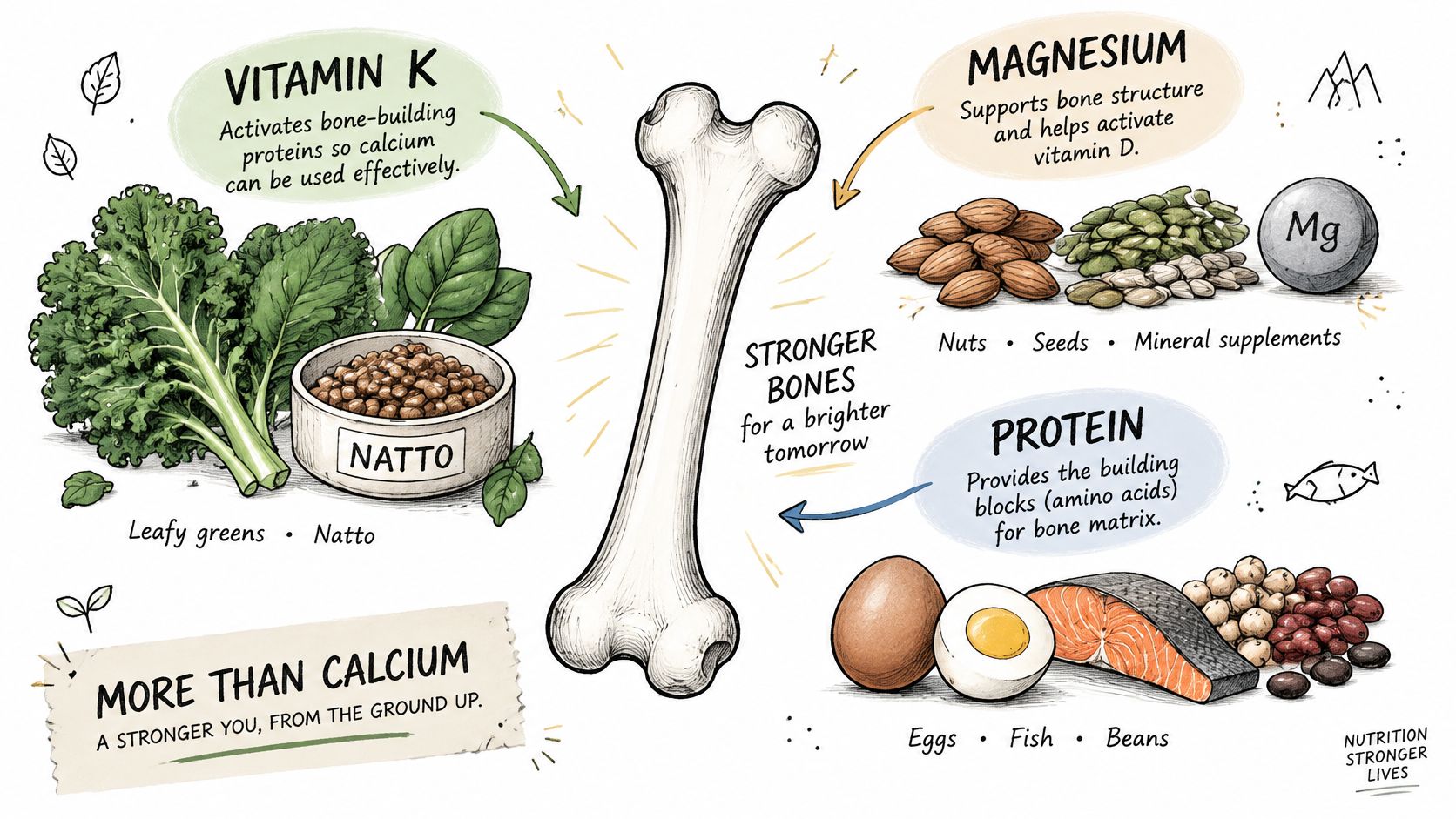
Leafy greens supply vitamin K1. Vitamin K2, mainly MK-4 and MK-7, shows up in natto, aged cheese, and eggs. K2 has the stronger bone research because it helps activate osteocalcin, the protein that binds calcium into the matrix. Trial results are mixed, so K2 isn't a stand-in for a measured calcium or vitamin D gap. Vitamin K can counteract warfarin. Anyone on that drug should ask a clinician before adding K1 or K2. A closer look at how vitamin D3 and K2 are used together helps when a label pairs them.
Magnesium and the collagen crew
A large share of body magnesium sits in bone. Low intake tracks with lower density. Pumpkin seeds, almonds, spinach, and black beans cover a normal day more reliably than a standalone magnesium capsule.
Protein builds the collagen matrix the mineral sits in. The adult RDA is 0.8 g per kg. Many researchers who work with older adults aim for 1.0 to 1.2 g per kg. A 70 kg adult lands near 56 g at the RDA and about 70 to 84 g in that higher range. That can be eggs at breakfast, fish or beans at lunch, and dairy or poultry at dinner.
Vitamin C is required to build collagen. A long shortfall weakens the scaffold even when calcium looks fine. Citrus, bell peppers, and berries usually meet the 75 to 90 mg adult targets.
This short clip walks through why the mineral and the protein matrix have to be built together.
Food comes first for all four. A supplement earns a place when a few days of intake show a clear miss, not because a bone formula lists every name.
Upper Limits and When More Becomes Harmful
More isn't automatically better. Upper limits below are adult ceilings. Except where noted, they count food and supplements together.
| Nutrient | Upper limit (adults) | Main risk above the limit | Practical note |
|---|---|---|---|
| Vitamin D | 100 mcg (4,000 IU) per day | Hypercalcemia and kidney damage | High-dose protocols need medical supervision and blood tests |
| Calcium | 2,500 mg ages 19–50; 2,000 mg ages 51 and older | Kidney stones and hypercalcemia | Count food calcium as well as supplements |
| Magnesium from supplements | 350 mg per day | Diarrhea and cramping | Food sources carry no upper limit |
| Preformed vitamin A | 3,000 mcg RAE (10,000 IU) per day | Liver toxicity and a bone-fracture association at high intake | Liver is very high in vitamin A |
| Vitamin C | 2,000 mg per day | Diarrhea and kidney stones from oxalate | Multivitamins and effervescent products add up quickly |
| Vitamin K | No upper limit established | Interference with warfarin | Clinician guidance is needed for anyone on anticoagulants |
How a normal cart stacks
A fortified cereal, a calcium chew, and a separate vitamin D capsule can pass a limit without any one label looking extreme. Gummies, tablets, and combination bottles make that easier to miss because each serving looks modest alone.
The USPSTF vitamin D and calcium bulletin notes increased kidney-stone risk among possible harms of these supplements, and that fracture prevention at lower doses isn't supported in the older groups it reviewed. Higher-dose combinations aren't settled either. Recommending the biggest dose overstates the research.
Questions worth answering before you add a bottle
Is food calcium enough already? If you still supplement, smaller doses with meals are easier to tolerate than one large tablet, so a 500 mg serving can replace a 1,000 mg one. Most multivitamins contain some vitamin D and often little calcium. Read that panel before you add another D or calcium product. People with kidney disease, stones, malabsorption, osteoporosis, or interacting medicines should get professional guidance first.
Add one full day from food, fortified products, and every supplement before you accept a per-serving dose. Buy for a documented need, not the largest number on the front.
Confirm Your Gap and Choose a Product
Buy only the gap you've confirmed. A bone blend that covers eight nutrients doesn't help if your shortfall is one of them, and it can push another past its ceiling.
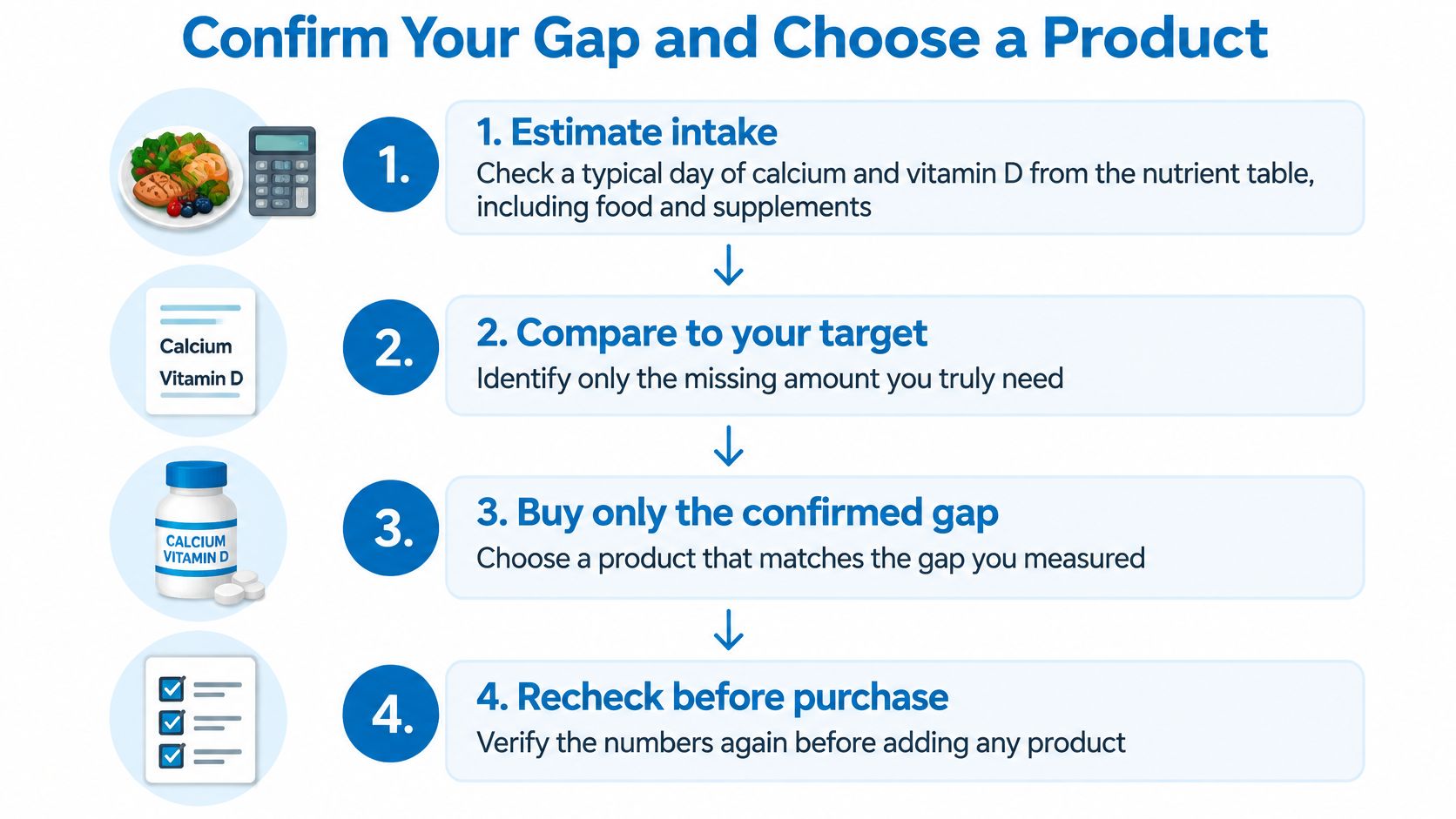
Four checks before a cart
- Estimate a typical day. Use the nutrient table and count food first. A cup of milk is roughly 300 mg of calcium. Fortified soy milk is in a similar range. Fatty fish and fortified milk are the realistic vitamin D foods. Sunlight counts as exposure, not as a number you can guess.
- List risk factors. Age over 50, little time outdoors, low body weight, a prior fracture, or a diet without dairy or fortified foods raises the chance of a real gap.
- Test when deficiency is likely. Ask a clinician about serum 25-hydroxyvitamin D instead of climbing from 1,000 IU to 5,000 IU on a hunch.
- Add only that gap. Pick a single-nutrient product sized to the missing amount. If food already supplies 800 mg of calcium and your target is 1,000 mg, you need about 200 mg, not a 1,000 mg chew.
Read elemental calcium, not the salt weight
Labels often print the weight of the whole salt. You absorb and count the elemental calcium.
| Calcium form | Elemental calcium | Absorption with food | Best suited for |
|---|---|---|---|
| Calcium carbonate | About 40% | Needs food for best absorption | Lowest cost; taken with meals |
| Calcium citrate | About 21% | Absorbed with or without food | People on acid-reducing medicines or with low stomach acid |
| Calcium lactate | About 13% | Absorbed with or without food | Those who need a gentler option and can take larger servings |
A 1,250 mg carbonate tablet is about 500 mg elemental. Citrate needs a larger pill for the same elemental amount, which is why people on acid reducers still choose it. Lactate needs still larger servings. For vitamin D, D3 (cholecalciferol) is the usual supplement form. D2 exists, but most bone-focused products use D3.
Label checks that prevent a bad order
Match the per-serving dose to your gap and to the adult ceiling. Look for USP, NSF, or ConsumerLab testing seals when the brand carries them. If you need gelatin-free or halal, those words have to be on the product, not assumed from the category. Gummies vary more from piece to piece, so use the labeled serving, not "one gummy." Learning how to read a supplement label saves you from counting salt weight as elemental calcium.
CalVitamin lists vitamin D and calcium products with labeled strengths and attributes such as gelatin-free or halal. Filter for the nutrient you lack, then confirm the serving before you add it. A 5,000 IU D3 softgel is a high dose, not a default, and it needs the same ceiling check as any other product.
When a clinician comes before the order
Stop and ask first if you have kidney disease or a kidney-stone history, malabsorption, active osteoporosis treatment, or you take corticosteroids, thiazide diuretics, or warfarin. Those situations change both the safe dose and whether a supplement belongs at all.
Recheck with a clinician or dietitian about three months after you start. Bring the same one-day food tally, not a new stack of bottles. The last step is narrow on purpose: buy the one product that fills the one confirmed gap.
CalVitamin carries vitamin D, calcium, and related mineral products with labeled strengths, serving sizes, and attributes such as gelatin-free or halal, so you can match a bottle to a gap you have already measured. Use the catalog to compare elemental calcium and vitamin D per serving instead of buying the largest dose on the shelf. Visit CalVitamin when you are ready to filter for that single confirmed nutrient.