The most common advice about protein powder vs mass gainer gets the choice backward: the higher-calorie tub isn't automatically the better muscle-building product. Protein powder helps when your diet falls short on protein; a mass gainer helps when you consistently struggle to eat enough total calories. Choose based on the bottleneck, not the label.
Table of Contents
- Protein Powder and Mass Gainer Side by Side
- Protein and Calorie Targets by Body Weight
- Where a Mass Gainer's Calories Really Come From
- Does a Mass Gainer Build More Muscle
- Who Should Choose Which Product by Goal
- Timing and Sample Days for Each Product
- Read the Label and Choose Your Product
Protein Powder and Mass Gainer Side by Side
Protein powder delivers a concentrated protein dose with relatively few calories. A mass gainer combines protein with a much larger carbohydrate and calorie load, making it a more energy-dense option.
| Attribute | Protein Powder | Mass Gainer |
|---|---|---|
| Typical serving | 30 g scoop | Label-defined serving |
| Calories per serving | About 100 to 140 kcal | About 250 to 1,250 kcal |
| Protein per serving | 20 to 30 g | 25 to 60 g |
| Carbohydrate per serving | 2 to 5 g | 50 to 250 g |
| Fat per serving | 1 to 5 g | 2 to 20 g |
| Main job | Close a protein gap | Close a protein and calorie gap |
| Best when | Calories from food are adequate | Appetite or time limits calorie intake |
These are typical label ranges, not specifications for every product. Brands differ, and the serving size printed on a gainer tub may represent a large portion. Compare the actual serving you plan to drink, rather than assuming that a scoop is a standard measure across products.
The calorie gap between categories is the practical point: a 30 g protein-powder scoop commonly fits into a diet with a modest energy footprint, while a gainer serving can supply several times as much energy. That means two products with similar protein amounts may affect your daily calorie intake very differently.
Choose according to what's missing from your diet: protein or total calories, not according to which product name sounds more powerful.
Protein and Calorie Targets by Body Weight
A mass gainer solves a calorie shortfall, not a high protein target by itself. Start by estimating the protein your body weight calls for, then compare that target with what your usual meals provide.
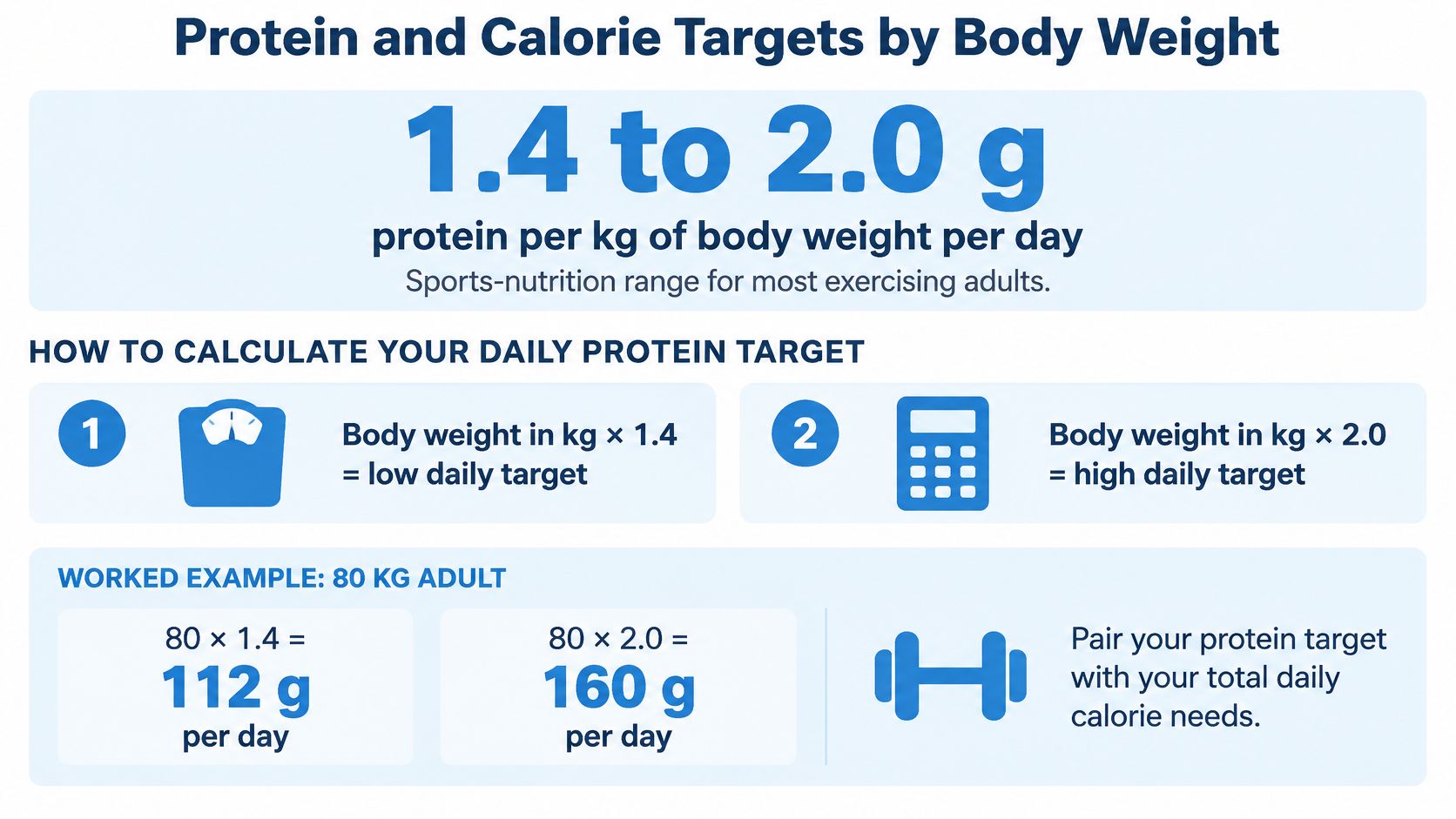
Daily protein target = body weight in kilograms × 1.4 to 2.0. The lower multiplier gives the bottom of the range; the higher gives the top. The International Society of Sports Nutrition position stand puts most exercising adults within this range per day. Count protein from food and supplements together.
| Body Weight | Daily Protein (1.4 to 2.0 g/kg) | Midpoint (1.6 g/kg) |
|---|---|---|
| 60 kg | 84 to 120 g | 96 g |
| 75 kg | 105 to 150 g | 120 g |
| 90 kg | 126 to 180 g | 144 g |
| 100 kg | 140 to 200 g | 160 g |
For a 75 kg adult, the daily range is 105 to 150 g. If meals supply 125 g, a shake with 25 g is not needed to reach the range. If meals supply 90 g, that same shake brings the total to 115 g. The relevant number is the gap between your usual intake and target, not the protein listed on a tub in isolation.
Protein and calorie targets answer different questions. Calories depend on maintenance needs, activity, training demands, and whether the goal is to maintain, lose, or gain weight. A higher protein target alone does not make a mass gainer the right choice. It becomes relevant when you also need more energy and struggle to get enough from meals.
Use this quick check:
- Estimate your daily protein from ordinary food.
- Subtract that amount from a reasonable target.
- Identify whether the remaining shortfall is a protein gap or a calorie gap.
Where a Mass Gainer's Calories Really Come From
Carbohydrate can support glycogen restoration, but adding it to an already adequate carbohydrate intake doesn't automatically make protein more effective. In a recovery analysis, carbohydrate intake of about 1.02 g/kg per hour increased muscle-glycogen resynthesis by 23.5 mmol/kg dry muscle per hour versus water. Adding protein to adequate carbohydrate produced a difference of just 0.4 mmol/kg dry muscle per hour, with p = 0.805, according to a systematic review of carbohydrate-protein recovery interventions.
For someone who eats enough carbohydrate at meals, extra gainer carbs may add calories without a meaningful glycogen-recovery advantage. The added carbohydrate is most relevant when training volume and recovery demands are high, or when it helps someone maintain a planned energy surplus.
Match the shake to the calorie gap
A gainer's portion size can make calorie control difficult. If you're aiming for a modest surplus, a full serving could push your intake well beyond your target. Measure the powder you use, and count it as part of the day's food rather than treating it as a bonus.
A protein shake blended with a measured amount of oats or fruit gives you more control over the calorie increase. You can adjust those additions separately, instead of accepting the carbohydrate and energy load built into a full gainer serving. For a closer look at what label numbers mean, see this guide to protein powder nutrition facts.
A high-volume athlete may have a good reason to prioritize convenient carbohydrate and calories. An under-eating beginner with low appetite may also value a drink that packs more energy into less food volume. If neither situation describes you, a high-calorie serving may solve a problem you don't have.
Does a Mass Gainer Build More Muscle
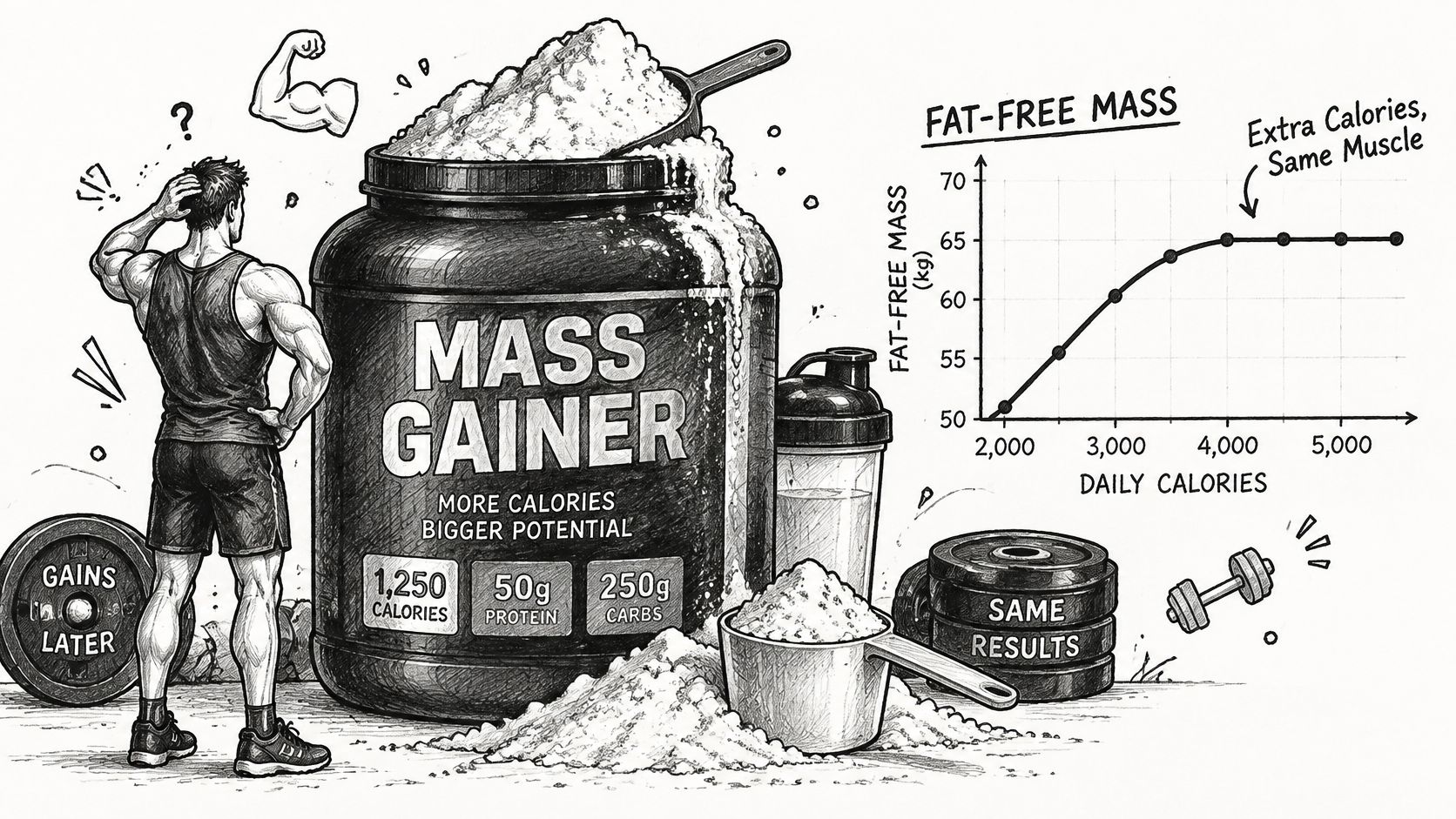
A higher-calorie product does not automatically build muscle faster. A resistance-training meta-analysis published in the British Journal of Sports Medicine found no further gains in fat-free mass once total protein reached about 1.62 g/kg per day. That finding helps distinguish a protein shortfall from a calorie shortfall. For more context on when supplements can help fill a protein gap, see this guide to whether protein supplements are worth it.
Calories still matter when daily intake is too low to support the goal. A mass gainer can help close that gap, especially when appetite or meal volume makes it hard to eat enough. It does not replace effective resistance training, and a larger serving does not guarantee more muscle.
The calorie surplus still needs a limit
A surplus can support muscle growth, but adding more energy than you need may raise body weight without a matching increase in muscle. Portion size therefore matters: a gainer is useful when it addresses an actual calorie gap, not merely because it contains more calories.
Consider two lifters. One weighs 70 kg, already gets 150 g of protein, and eats 3,000 kcal daily. Adding a gainer without identifying an energy shortfall may offer little benefit. Another has a low appetite and regularly misses meals; calories in a drink may help that person reach an intake that supports training.
The limiting factor is different for each person. Ask whether the main obstacle is protein, total energy, appetite, convenience or training quality. Choose a product to address the dietary gap you really have. Neither supplement can compensate for inadequate resistance training.
Who Should Choose Which Product by Goal
The goal matters, but the limiting factor decides the product. Use this table to match the supplement to the situation, then pay attention to the trade-off in the final column.
| Goal or Situation | Better Fit | Why | Watch For |
|---|---|---|---|
| Fat loss while training | Protein powder | Adds protein with about 100 to 140 kcal | Gainer calories can erase the deficit |
| Muscle gain with normal appetite | Protein powder | Covers the protein gap without extra energy | Extra calories may add fat rather than muscle |
| Bulking with low appetite | Mass gainer | Large calorie load in small volume | Surplus can exceed 500 kcal per day |
| Bulking with a high calorie target | Mass gainer or both | Covers energy needs with fewer meals | Track the total daily surplus |
| Older adults with low appetite | Protein powder first | Protein intake may be the shortfall | In one trial, fewer than half reached the protein-success threshold |
| Kidney, glucose or cardiometabolic concerns | Protein powder, reviewed with a clinician | Gainer carbohydrate and sugar content varies widely | Get medical advice before a high-protein plan |
If you're trying to lose fat while training, a protein powder is easier to fit into a calorie deficit. For muscle gain with a normal appetite, it can fill a protein shortfall while meals provide the rest of your energy. A gainer becomes more practical when eating enough is the challenge, but portion size still matters.
For older adults, start by checking whether regular meals provide enough protein and energy, rather than assuming that a supplement alone will fix intake. In a 2025 trial of adults aged 80 and above, supplementation increased protein intake, but only 47% reached the study's protein-success threshold, as summarized in a 2025 review in Frontiers in Nutrition. That result makes meal adequacy and appetite important parts of the decision.
The same review notes that greater scale weight doesn't necessarily mean greater lean mass. In its account of a systematic review of nine randomized trials involving 408 healthy women, protein supplementation combined with exercise increased fat-free mass by about 0.45 kg, with no significant changes in fat mass, body-fat percentage or waist circumference. Supplements can support a training plan, but they don't guarantee what kind of weight you gain.
If you have a kidney condition, monitor glucose or have cardiometabolic concerns, discuss your plan with a clinician. Mass gainers aren't a standardized clinical category, and their carbohydrate, serving-size and added-sugar profiles differ. Check the specific label rather than relying on the category name.
Timing and Sample Days for Each Product
Daily protein intake matters more than hitting a narrow post-workout window. A serving of about 20 to 40 g of high-quality protein, with roughly 10 to 12 g of essential amino acids, can support muscle-protein synthesis for about three to four hours, according to the ISSN position stand on protein and exercise. Place a shake where it helps you meet your daily needs or makes eating more manageable.
| Timing | Protein Powder | Mass Gainer | Why It Matters |
|---|---|---|---|
| After training | 1 scoop, 20 to 40 g protein | Half to one serving if calories are short | Protein alone can cover the protein need |
| Breakfast | 1 scoop in milk or water | Full serving if breakfast is small | Helps with a low-appetite start to the day |
| Between meals | 1 scoop as a snack | Split serving under 500 kcal | Spreads protein and calories across the day |
| Before bed | 1 scoop of slow-digesting protein | Not usually needed | Adds protein without a large calorie load |
| Pre-workout | Optional, small serving | Small serving 1 to 2 hours before | Avoids heavy volume right before training |
A protein shake after exercise is convenient, but it doesn't need to replace a meal. If you're trying to gain weight and a full gainer feels too heavy, split the serving or pair a smaller portion with a meal. For broader fueling principles, see this guide to sports performance nutrition.
Sample day one: muscle gain with adequate appetite
- Breakfast: oats with milk and eggs.
- Lunch: chicken and rice.
- After training: a protein shake if food intake leaves a gap.
- Dinner: fish and vegetables.
- Before bed: a casein shake if you still need protein.
Sample day two: bulking with low appetite
- Breakfast: a gainer mixed with milk if a regular meal is difficult.
- Lunch: rice and lean meat.
- Mid-afternoon: a second gainer serving if your calorie intake is still short.
- Dinner: a meal with an added carbohydrate source.
- Before bed: a smaller gainer portion only if you haven't met your calorie target.
Read the Label and Choose Your Product
Read the nutrition panel before comparing tubs. A large serving can make a product look more substantial, while a protein-dense powder may offer more protein for fewer calories. Use the same serving basis when comparing brands.
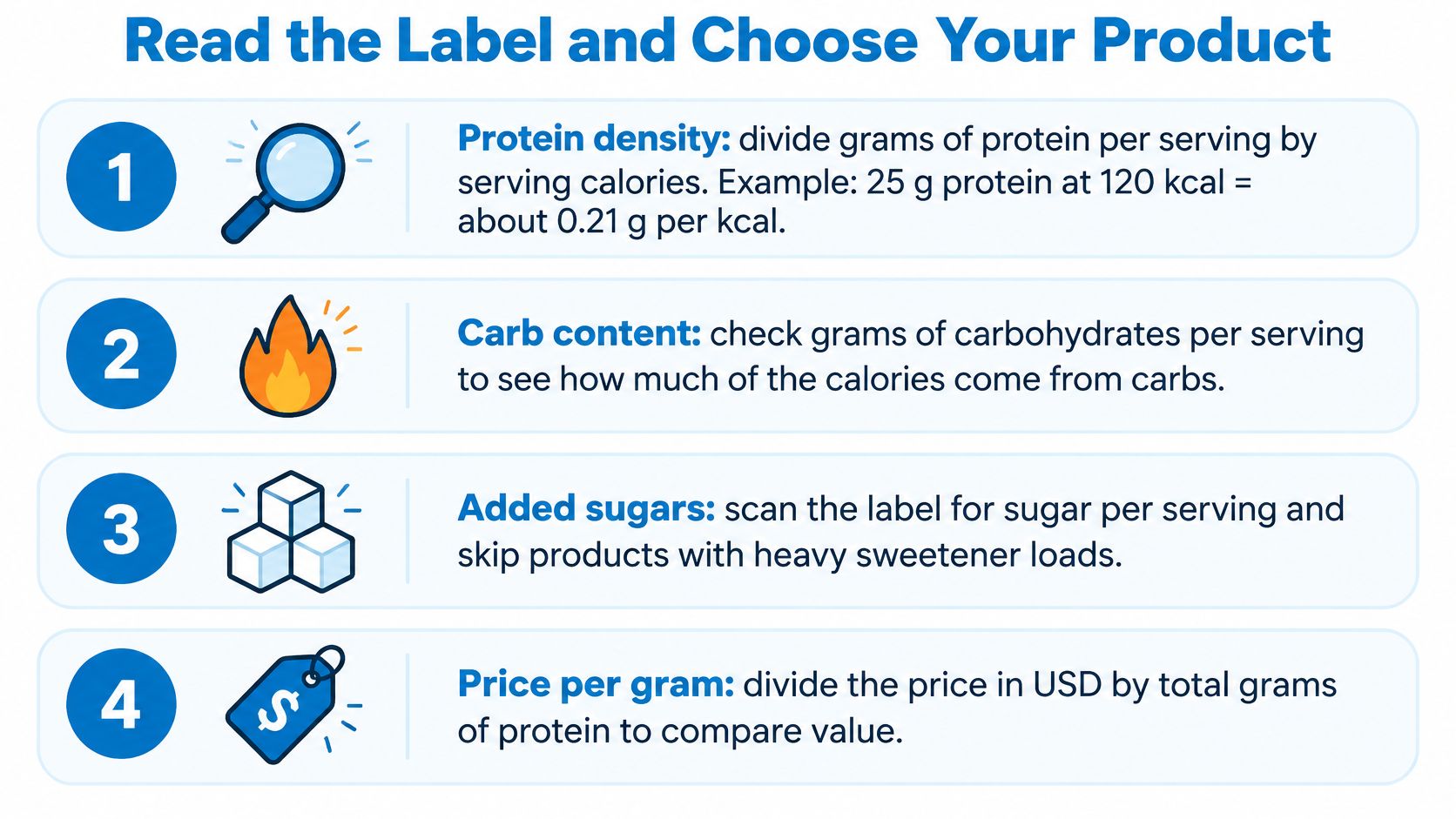
- Calculate protein density. Divide protein grams by serving calories. For example, 25 g of protein at 120 kcal is about 0.21 g per kcal. This helps show how much protein you're getting for the energy.
- Check carbohydrates and added sugars. Look at both the carbohydrate amount and the added-sugar line. A high-calorie serving may contain far more carbohydrate than you intended to add.
- Confirm the serving size. Check how many scoops or how much powder the label uses for one serving. A gainer serving may be much larger than the amount you'd naturally pour.
- Compare protein per gram of powder. Divide the protein grams by the product's serving weight. This is useful when tubs use different serving sizes.
- Compare cost per 25 g of protein. Use protein content and price rather than comparing tub prices alone. A lower-cost tub may provide fewer servings of the protein amount you need.
- Check product attributes that matter to you. Look for halal, gelatin-free or cruelty-free labels if those preferences affect your purchase.
Choose protein powder when protein is short and your food already supplies enough calories. Choose a mass gainer only when you consistently struggle to reach both your protein and energy needs.
Make this a two-week test. If you weigh 75 kg, use 105 to 150 g of protein daily as the range to assess, then select one product that matches the shortfall you've identified. Log your food, protein and calories for two weeks, and check whether the remaining gap is protein-sized or calorie-sized before changing the plan.
CalVitamin offers proteins and other dietary supplements alongside wellness products, with options that include items labeled halal, gelatin-free or cruelty-free. Visit CalVitamin to browse the range and compare products against the nutrition-label checks in this guide.