The familiar advice to choose shilajit by its fulvic-acid percentage skips the more useful question: what else is in the product? A prominent number on a label can help describe an extract, but it can't stand in for the identity, composition, and contaminant testing of the whole material.
Table of Contents
- What Is Shilajit Made Of Beyond One Ingredient
- How Mountain Deposits Form Shilajit
- Humic Substances Minerals and Marker Compounds
- Resin Powder and Capsules as Real Examples
- How to Choose a Shilajit Product
- Raw Purified and Lab Tested Safety Claims
- What to Do with the Composition Facts
What Is Shilajit Made Of Beyond One Ingredient
The shortest useful answer to what is shilajit made of is a mixture of transformed plant-derived material and geological minerals. Calling it fulvic acid is like describing a mixed extract by naming only one of its components. You haven't necessarily named something incorrectly, but you've left out much of what the buyer needs to understand.
The technical term is phytocomplex, a plant-derived mixture rather than a single purified chemical. In shilajit's case, that mixture has also undergone geological transformation and contact with mountain rock. Its identity therefore involves both its organic constituents and its mineral surroundings.
Think mixture rather than isolated ingredient
For a plain-language comparison, think about the difference between a whole mixed extract and an isolated ingredient taken from it. A measurement of the isolated ingredient tells you something useful, but it doesn't describe everything remaining in the mixture.
That distinction helps separate questions shoppers often combine:
- Identity: Is the material consistent with shilajit?
- Composition: Which organic fractions, minerals, and characteristic compounds were measured?
- Presentation: Is it sold as resin, powder, or a capsule?
- Verification: What evidence supports the product's purity claims?
These questions don't have interchangeable answers. A convenient serving form doesn't establish identity, and an ingredient name doesn't establish contaminant control.
Practical rule: Treat a headline ingredient claim as a starting point for questions, not a complete product specification.
A more useful shopping comparison connects the source material, the processing description, and the laboratory report. Rather than asking only which jar advertises more fulvic acid, ask whether the seller explains what was measured and which batch the measurement represents.
You don't need to recognize every chemical name to make that distinction. Understanding the broad organic and mineral fractions is enough to see why apparently similar products may deserve different questions. The detailed chemistry becomes useful when it helps you interpret a label, not when it merely makes the label sound impressive.
How Mountain Deposits Form Shilajit
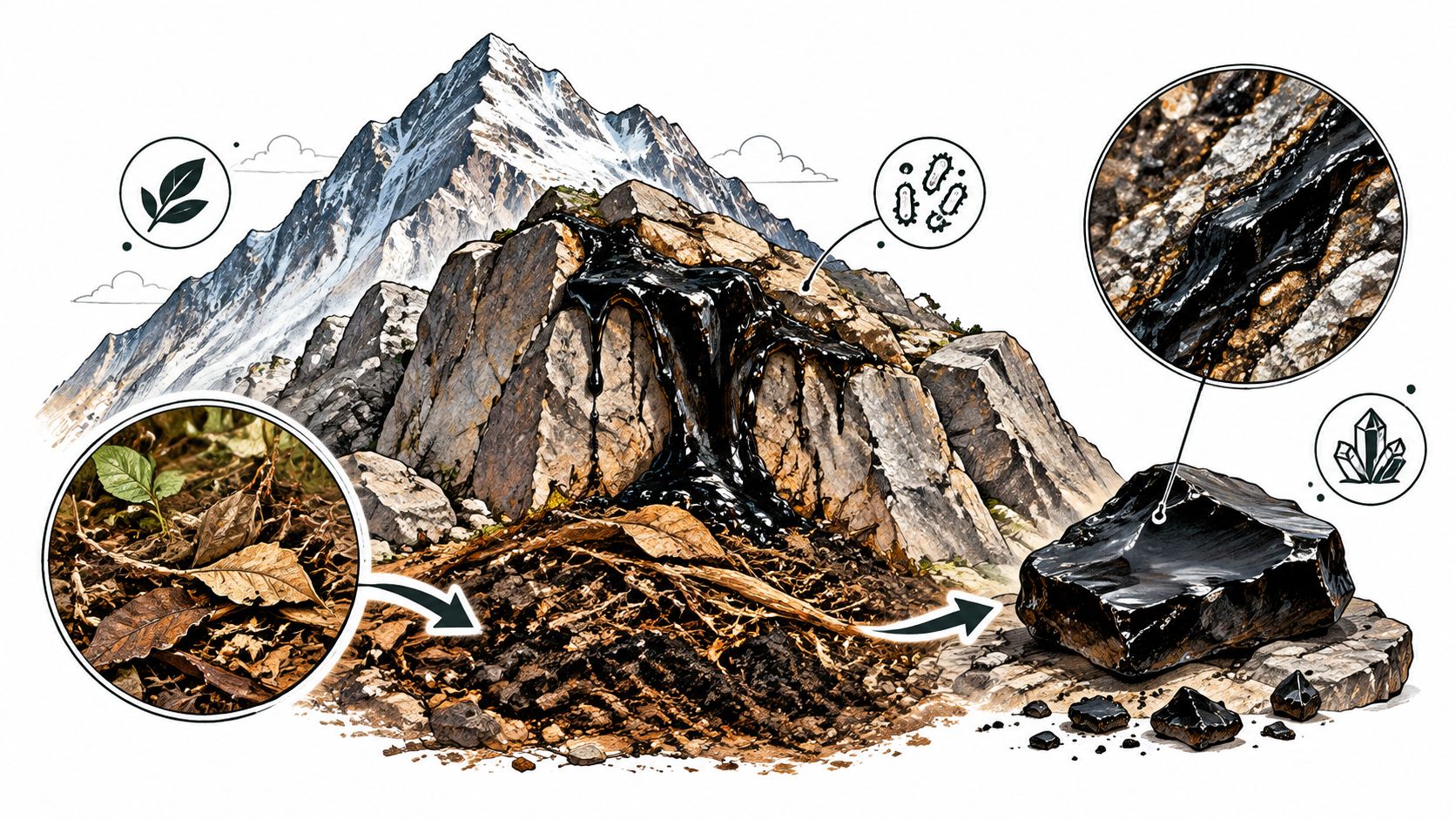
Shilajit begins with plant-derived organic matter that undergoes prolonged microbial degradation and transformation, compression, and storage within mountain rocks. Reviews describe the resulting material as a resin-like geological-organic mixture, with composition influenced by geography, extraction, and purification, as summarized in the review of shilajit's formation and broad composition.
A compost-to-rock analogy can make that process easier to follow. Microbes transform plant matter, but the analogy stops short of suggesting that garden compost becomes shilajit. The mountain setting, surrounding geology, and subsequent processing are part of the material's identity.
The illustration shows the relationship between plant material, microbial transformation, and rock crevices.
A broad pattern rather than a fixed recipe
The review linked above reports approximately 60–80% organic material and 20–40% inorganic mineral matter, while emphasizing that origin and processing affect the proportions. Those ranges describe a broad composition pattern, not a guaranteed specification for every finished supplement.
In this context, organic means the plant-derived chemical portion. It doesn't mean that a product has organic agricultural certification. Similarly, inorganic mineral matter describes a chemical fraction, not a promise that every constituent is nutritionally desirable.
The distinction matters because a shopper may interpret a composition range as a formula. It isn't one. You can't use those broad ranges to calculate the contents of a particular serving without product-specific analytical information.
- Geography and geology: Different deposits provide different starting materials and mineral surroundings.
- Extraction: The method used to obtain an extract can affect which constituents remain.
- Purification: Processing can alter the composition of the material ultimately sold.
These influences explain why a mountain name alone is an incomplete specification. Origin provides context, but it doesn't describe everything a manufacturer does between collection and packaging.
Consider two jars labeled shilajit, sourced from different deposits and processed differently. The shared ingredient name may be appropriate, yet it doesn't establish that their chemical profiles match. The useful expectation is a recognizable organic-mineral pattern, not identical contents across every jar.
Humic Substances Minerals and Marker Compounds
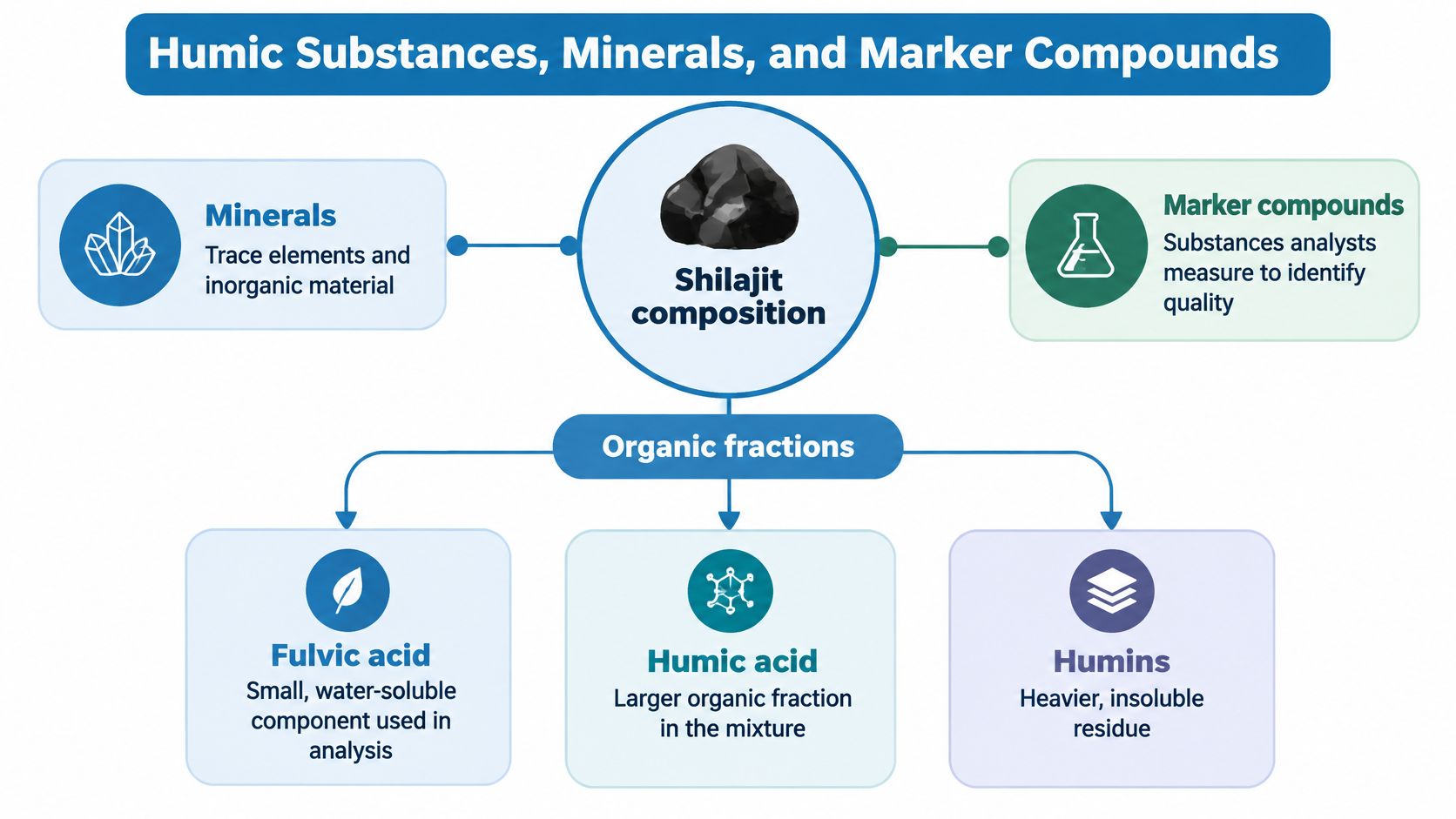
Laboratory descriptions become easier to read when you separate the main organic matrix from smaller characteristic compounds and the mineral fraction. The following diagram organizes those categories without treating any single constituent as the whole substance.
The organic matrix and its markers
Humic substances form the principal organic matrix: fulvic acid, humic acid, and humins. Smaller constituents include dibenzo-α-pyrones, steroids, alkaloids, lipids, polyphenols, amino acids, organic acids, resins, and wax-like substances. Fulvic acid is a water-soluble component that can form chemical complexes with minerals and other small molecules.
Dibenzo-α-pyrones are characteristic compounds that analysts can measure alongside humic constituents. Their conjugated chemical structures are relevant to discussions of redox activity, meaning chemical processes involving electron transfer. That chemistry isn't, by itself, evidence of a health outcome from a finished supplement.
One extract analysis measured fulvic acid at 215.4 ± 4.8 mg/g and dibenzo-α-pyrones at 12.7 ± 0.9 mg/g, while an elemental snapshot reported calcium, aluminum, potassium, magnesium, and sodium near 100 ppm each, with sulfur, phosphorus, and manganese around 50, 10, and 5 ppm, respectively. A separate comparison across ten samples found potassium as high as 61,450 mg/kg and calcium as high as 19,760 mg/kg, as detailed in the review of shilajit's constituents and sample-specific analytical results.
Reading the mineral results without overgeneralizing
The mineral fraction can include potassium, calcium, magnesium, sodium, sulfur, phosphorus, manganese, iron, aluminum, and other trace elements. These constituents largely reflect the geological matrix around the source material.
The contrast between the analytical results above is the important lesson. They're descriptions of particular materials, not competing universal recipes for shilajit. A seller shouldn't borrow a mineral result from a research sample and present it as the measured contents of an unrelated product.
- Milligrams per gram: A way to express the measured mass of a constituent relative to the sample mass.
- Parts per million: A concentration unit, often abbreviated as ppm.
- Milligrams per kilogram: Another mass-based concentration expression that may appear on laboratory reports.
Always read the unit with the result. A large-looking number without its unit, sample identity, and analytical context isn't a useful comparison.
A characteristic compound can help describe a material. Its presence alone doesn't establish the quality of everything else in the mixture.
The accompanying video provides another visual reference for the topic.
Resin Powder and Capsules as Real Examples
A resin jar, a pouch of powder, and a capsule bottle answer a presentation question before they answer a chemistry question. They're ways of supplying material to the buyer, not proof of distinct or equivalent chemical profiles.
The commercial forms are easy to recognize visually.
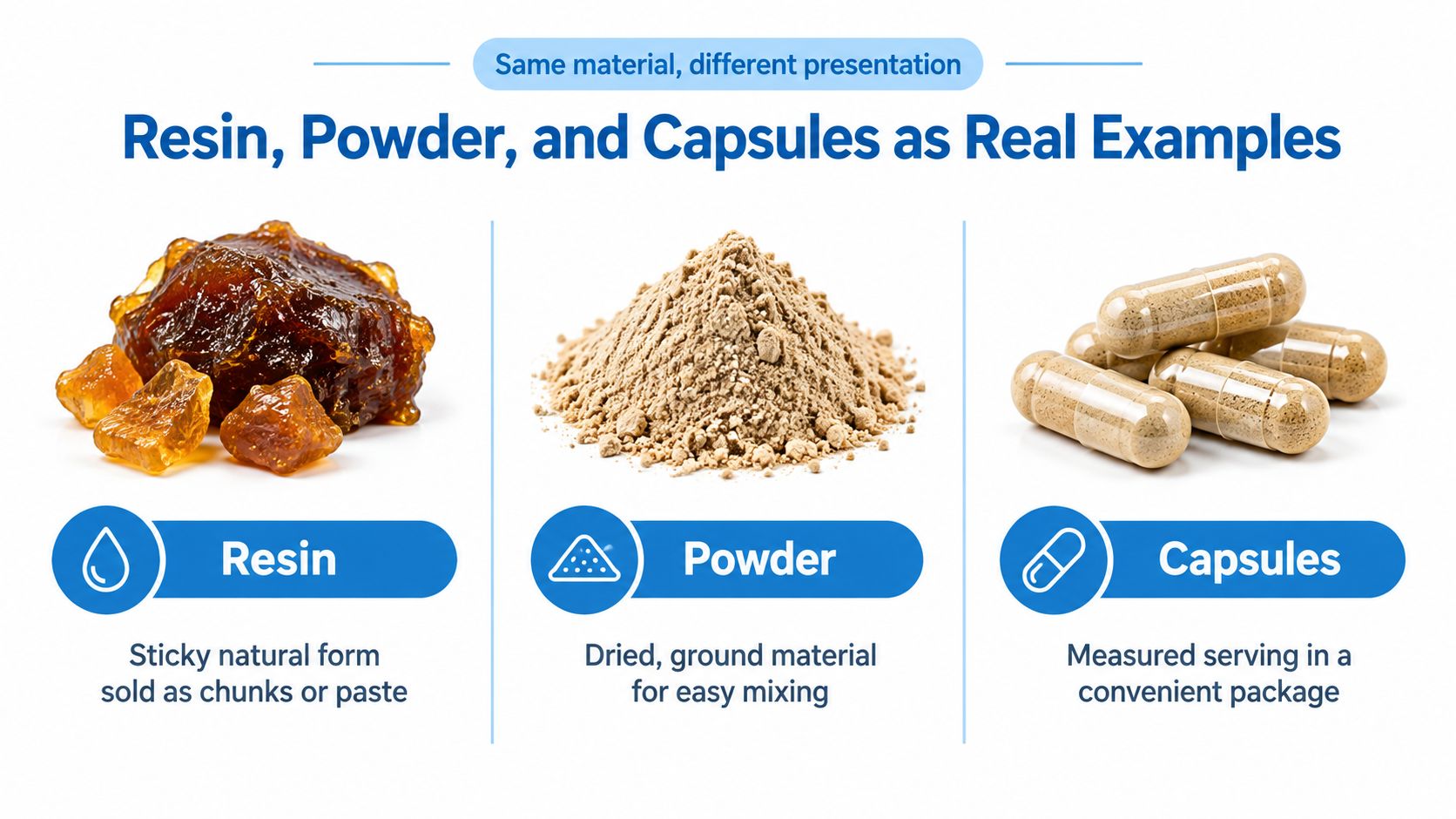
Resin retains the sticky presentation associated with the geological-organic material. Powder and capsules offer different handling and serving formats, but their appearance doesn't tell you whether their constituents match those of a particular resin.
Processing and moisture matter when interpreting concentration claims. Extracts with similar fulvic-acid measurements can differ in molecular-weight distribution, mineral profile, and other constituents, including dibenzo-α-pyrones and related chromoproteins, as explained in the chemical characterization discussion of shilajit identity and quality.
How Shilajit Forms Differ
| Form | What the buyer sees | What may change | What a label still cannot prove |
|---|---|---|---|
| Resin | Sticky material sold as paste or chunks; an amount of resin may be declared | Moisture and concentration through processing | Identity, detailed composition, or contaminant levels |
| Powder | Dry material; an extract amount or constituent claim may appear | Moisture and measured concentration | Whether it matches another extract's chemical profile |
| Capsules | A packaged serving; the contents should be described on the label | Serving presentation and processing of the enclosed material | The enclosed material's identity or purity |
What familiar label claims leave unanswered
Suppose you're comparing labels that mention total resin, fulvic acid, origin, and serving form. Each description can be useful, provided you don't ask it to prove something outside its scope.
- Total resin: Ask what material the declared amount represents. It isn't a full breakdown of its constituents.
- Fulvic acid: Ask how the value was measured and whether it applies to the current batch.
- Origin: Ask whether the source description is supported by traceable product information.
- Serving form: Choose the format you prefer, then evaluate the contents separately.
A purified shilajit product discussion can provide product context, but descriptive wording shouldn't replace a laboratory report. Likewise, a raw-looking texture isn't evidence that a resin is more complete or better controlled.
The sensible comparison isn't resin versus capsules in the abstract. It's the documented composition of one specific product versus the documented composition of another.
How to Choose a Shilajit Product
Start with the form you're comfortable using, then narrow your options by the quality of the information available. This keeps convenience separate from verification. You can prefer capsules without assuming encapsulation establishes quality, or prefer resin without treating its appearance as authentication.
Make a shortlist before comparing slogans
Use a practical sequence rather than ranking products by the largest printed claim:
- Choose your format. Decide whether handling resin, measuring powder, or taking a capsule suits your preferences.
- Read the full description. Look for origin, processing information, ingredient details, and a clear explanation of what the serving contains.
- Check dietary attributes individually. Verify any halal, gelatin-free, or cruelty-free wording on the specific item rather than assuming it applies across a retailer's catalog.
- Ask for batch documentation. Keep a product on your shortlist only if the seller can meaningfully address your identity and contaminant-testing questions.
Standardization means attempting to make batches more comparable against selected specifications. It helps to ask what the manufacturer has standardized, rather than treating the word as a general guarantee.
A fulvic-acid specification, for example, doesn't answer every question about the remaining material. Use the broader composition categories already described to decide which details are still missing.
Use retail information for the right purpose
CalVitamin is a Jacksonville, Florida online dietary-supplement retailer whose catalog includes herbal formulas and shilajit capsules alongside vitamins, minerals, proteins, and other wellness products. Shoppers can compare labeled forms, read ratings and reviews where available, and check select items for attributes such as halal, gelatin-free, or cruelty-free, as well as special or quantity-based pricing.
Those features help with product selection, but they serve different purposes from analytical documentation. Reviews can inform your expectations about the shopping experience or usability. They can't establish an unreported mineral profile or contaminant result.
A guide to comparing shilajit supplements can help you organize a shortlist. Keep the final decision product-specific, and don't assume that a retailer's general description establishes a particular origin, fulvic-acid value, or laboratory result.
Buying checkpoint: If you can describe why a format suits you but can't identify what evidence supports its contents, your comparison isn't finished.
Price and convenience can help you choose between adequately documented options. They shouldn't be substitutes for the documentation itself.
Raw Purified and Lab Tested Safety Claims
Natural, raw, purified, and lab tested aren't interchangeable safety claims. They describe different things, and none should function as an automatic reassurance.
Research has identified potentially toxic elements including lead, arsenic, cadmium, mercury, aluminum, and copper, with levels varying across samples. Some reports found concentrations below cited WHO or FDA limits, while others reported exceedances; a Himalayan sample with prominent potassium, calcium, and magnesium and only minimal toxic substances cannot validate all products, as discussed in the analysis of shilajit's elemental composition and contamination concerns.
The checklist distinguishes a material description from a processing claim and an analytical claim.
Processing isn't the same as demonstrated removal
Heating, filtering, or putting material into capsules may affect moisture, concentration, or presentation. Those steps don't, by themselves, establish that heavy metals were removed.
Similarly, purified should prompt a follow-up question: purified by what process, and verified against which results? Lab tested requires another: tested for what, in which batch, and using which method?
A laboratory report that addresses identity alone leaves contaminant questions open. A report listing metals without identifying the product batch leaves a different gap.
What to request from the seller
For US shoppers, the useful document is a recent, batch-specific certificate of analysis, often abbreviated as COA. Request a report that includes:
- Batch identification: A clear connection between the report and the product you're considering.
- Elemental results: Lead, arsenic, cadmium, and mercury, with reporting units visible.
- Microbial testing: Results addressing microbial contamination rather than a vague cleanliness statement.
- Identity testing: Evidence addressing what the material is.
- Laboratory details: The method used and enough information to understand the reported results.
If the document only says that the product passed, ask what was measured and which acceptance criteria were applied. If you can't interpret the report, ask the seller for an explanation rather than assuming technical formatting establishes safety.
A discussion of shilajit benefits and side effects can provide broader reading, but it doesn't replace evidence for the batch in your cart.
The balanced conclusion isn't that every raw product is dangerous or every purified product is safe. Transparency and relevant testing provide a stronger basis for evaluation than either blanket claim.
What to Do with the Composition Facts
The useful answer to what shilajit is made of isn't a single ingredient name. It's a way of connecting the material's origin, its measured constituents, its commercial presentation, and the evidence supplied for the finished batch.
The broad composition ranges discussed earlier describe the material category. The humic fractions and marker compounds provide more detail. Neither description should be mistaken for a complete specification of an individual supplement.
Turn the chemistry into a buying decision
You don't need to memorize the analytical figures to use this information. Keep a short set of questions beside the product page:
- What am I choosing for convenience? Identify the form you prefer without assigning it an automatic quality advantage.
- What does the seller disclose? Separate origin and processing information from broad promotional wording.
- What was measured? Look beyond a headline fulvic-acid claim to the scope of the report.
- Does the evidence match this batch? Check that the documentation belongs to the product being offered.
These questions also help you recognize an incomplete answer. A seller who responds to a contaminant question with a mineral list hasn't answered the question. A photograph of resin doesn't establish identity, and a customer review doesn't establish chemical composition.
Choose the presentation for usability. Judge the material by documentation.
Ask for the document before accepting the claim
Your immediate next step is straightforward: select a format, then request the current batch certificate of analysis before treating a purity slogan as proof. Ask for clarification if the report doesn't clearly connect the product, the tests, and the results.
When comparing herbal products and shilajit capsules, use labeled dietary attributes and available reviews to refine your preferences. Keep those preferences separate from the question of what the laboratory measured.
That distinction lets you compare two jars without assuming they're identical or declaring one superior from its appearance. The ingredient panel identifies what the seller says is present. Batch-specific testing addresses the composition and contamination questions that the panel alone can't resolve.
CalVitamin offers herbal supplements and shilajit capsules alongside a broader dietary-supplement catalog. Visit CalVitamin to compare labeled forms and available product details, then ask for current batch documentation before choosing a shilajit product.