

You've probably seen shilajit show up in a video, supplement ad, or online discussion as a dark resin people swear by for energy, performance, and hormone support. The appeal is obvious. It sounds ancient, powerful, and natural. It also sounds a little suspicious.
That mix of curiosity and caution is the right place to start. Shilajit may have real potential, but it's also one of those supplements where product quality matters as much as the ingredient itself. A purified, tested product is very different from raw or counterfeit material sold with vague promises.
If you want a clear, practical guide to Shilajit benefits and side effects, focus on two questions. First, what does the evidence support? Second, how do you avoid buying something contaminated or poorly processed?
Table of Contents
- What Is Shilajit and Why Is It Trending
- The Science-Backed Benefits of Shilajit
- Understanding the Side Effects and Safety Risks
- How to Choose a High-Quality Shilajit Supplement
- Recommended Dosage and How to Use Shilajit
- Potential Interactions and Contraindications
- Conclusion Is Shilajit Right for You
What Is Shilajit and Why Is It Trending
Shilajit is a tar-like natural substance traditionally used in Ayurvedic practice. It's commonly associated with high mountain regions and is valued for compounds such as fulvic acid and naturally occurring minerals. In modern wellness culture, it's often sold as resin, powder, or capsules.
What's driving interest now is simple. People want supplements that may support energy, resilience, and sexual wellness without sounding overly synthetic. Shilajit fits that story well, which is why it gets framed as an “ancient remedy” meeting modern performance goals.

There's also a lot of confusion around it. Some people think all shilajit is the same. It isn't. Some assume the darker, rawer, more “earthy” a product looks, the better it must be. That assumption can get people into trouble.
A useful way to think about shilajit is this:
- Traditional ingredient: It has a long history of use.
- Modern supplement: It now comes in standardized products and extracts.
- Quality-sensitive category: Purification and testing matter more here than clever marketing.
If you're comparing products or trying to understand why some forms cost more, a look at a purified shilajit product example can help you see how brands present purification, format, and ingredient details.
Practical rule: With shilajit, “natural” doesn't automatically mean “safe.” Raw material can be riskier than a purified extract.
That's the part many articles skip. They spend all their time on bold claims and very little time on the line that matters: purified shilajit and raw shilajit are not interchangeable.
The Science-Backed Benefits of Shilajit
A lot of supplement buzz starts with vague promises. Shilajit gets more interesting when you narrow the question to this: what has been studied, in whom, and with what kind of product?
That last point matters more than many readers realize. The human research is tied to purified, standardized shilajit, not raw material scraped from an unknown source and sold with a “natural” label. If you remember one idea from this section, make it that distinction.
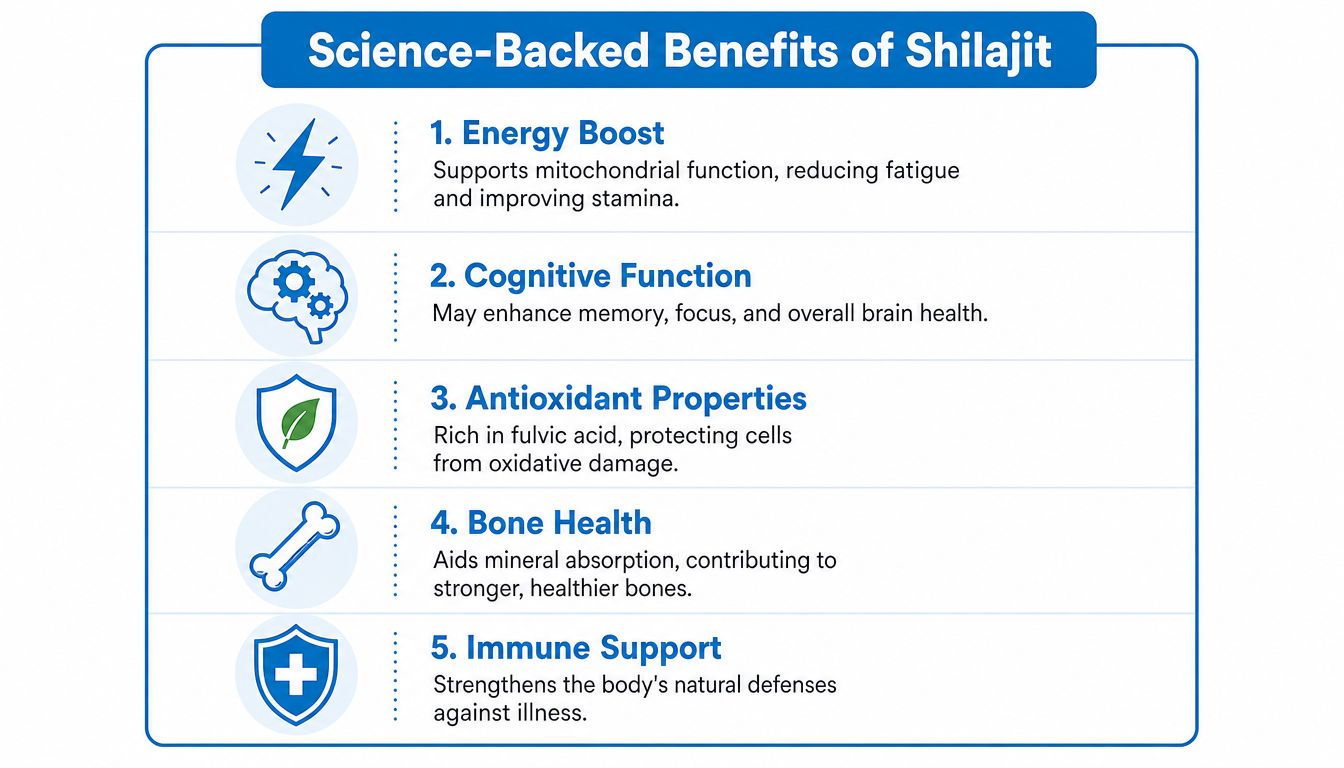
Hormone support and male fertility
The best-studied benefit is male reproductive health. According to Examine's shilajit research review, a clinical trial in infertile men found that 200 mg daily for 90 days of purified shilajit increased serum testosterone by 23.5%, from 4.85 ng/mL to 5.99 ng/mL, and increased FSH by 9.8%.
Those results are promising because they are specific. They involve a measured dose, a defined population, and tracked lab values. That is very different from broad claims that shilajit will “boost hormones” for everyone.
Context matters, though. The same review notes that the current evidence base is still fairly small and not strong enough to treat shilajit like a guaranteed testosterone solution. A fair takeaway is simpler: purified shilajit may help some men, especially in fertility-related settings, but the evidence is still early.
Energy, exercise, and recovery
This is the area that attracts athletes, busy professionals, and anyone who feels worn down by the afternoon. The theory is that shilajit may support mitochondrial function and recovery, which are both tied to how the body produces and uses energy.
A good way to understand that claim is to compare it to a car engine. Better fuel handling does not turn a compact car into a race car. It may help the system run more efficiently under stress. That is closer to what researchers are exploring with shilajit than the dramatic “instant energy” language used in ads.
Human findings in this area suggest potential benefits for exercise performance and fatigue resistance, especially with purified products used consistently over time. The research is encouraging, but it is not broad enough to say every healthy adult will feel a noticeable difference.
Metabolic and broader wellness effects
Some studies have also reported changes in markers tied to metabolic health, including blood sugar. That does not make shilajit a treatment for diabetes or a substitute for medical care. It suggests that its effects may extend beyond one narrow category.
This is also why fulvic acid gets so much attention. Fulvic compounds are often discussed as part of shilajit's possible role in mineral transport, antioxidant activity, and cellular processes. If you want background on that side of the topic, this article on humic and fulvic acid mineral support explains why these compounds show up so often in supplement discussions.
Mechanisms can be helpful, but they can also confuse people. A plausible mechanism is like a map. It shows a possible route. It does not prove you will reach the destination in every person, at every dose, with every product.
What the evidence supports right now
The strongest case for shilajit is not “it does everything.” The stronger case is much narrower and more useful.
Research currently supports cautious interest in purified shilajit for:
- male fertility and reproductive hormone markers
- exercise recovery and fatigue-related performance
- some broader metabolic effects that need more study
That narrower view protects you from two common mistakes. One is dismissing shilajit entirely because some marketing is exaggerated. The other is assuming raw and purified products offer the same risk-benefit profile. They do not.
The value here is practical. If you decide to try shilajit, judge it by the evidence attached to purified, tested forms, because that is where the meaningful human data exists.
Understanding the Side Effects and Safety Risks
Many supplement articles flatten safety into a simple message: “It's safe if used correctly.” That's too vague for shilajit. The primary issue is what kind of shilajit you're using.
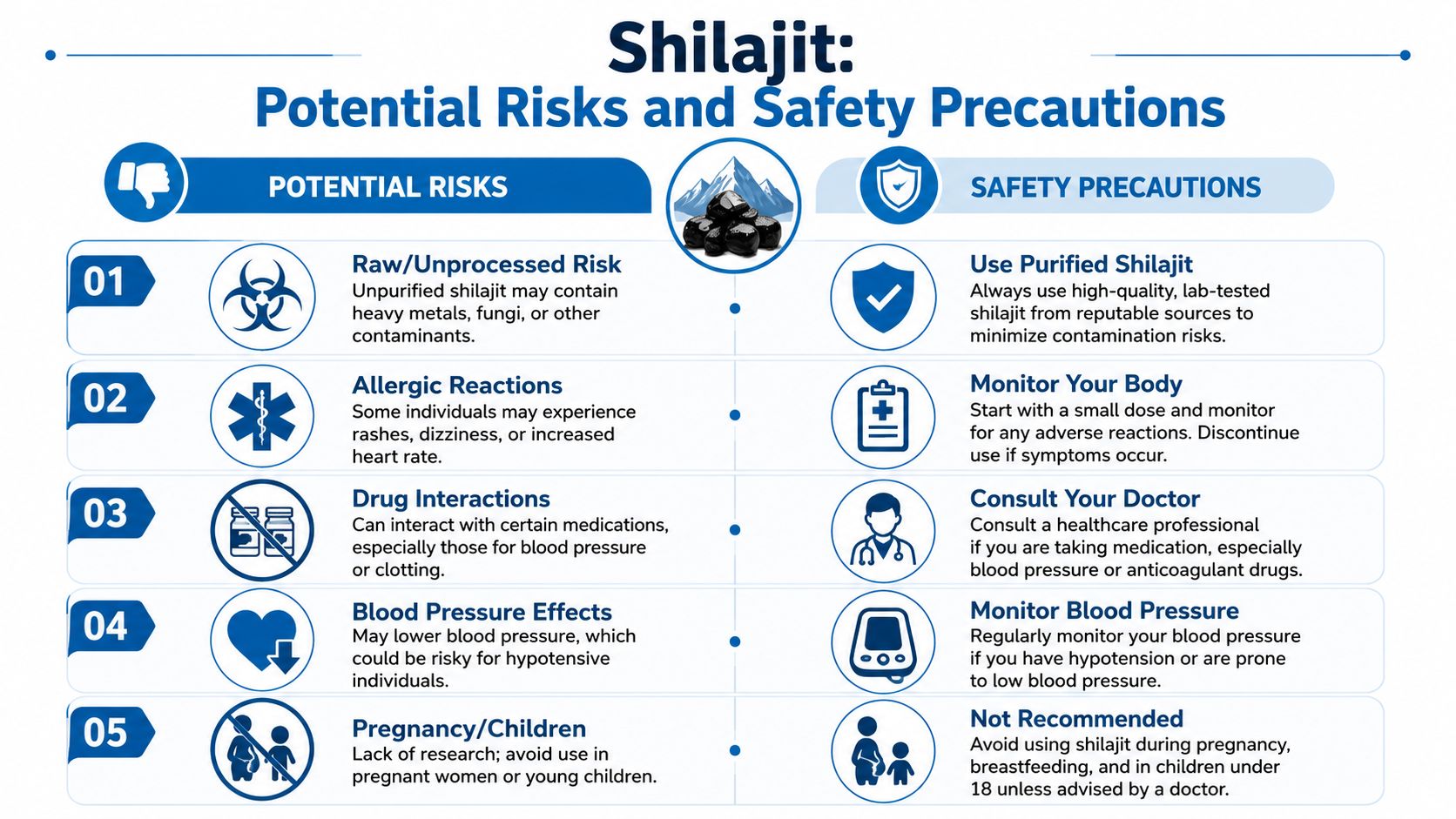
The biggest safety issue isn't the resin itself
According to this clinical safety summary from News-Medical, a human intervention using 2,000 mg daily for 45 days found no clinically significant changes in body weight, liver function biomarkers, kidney function, or cardiovascular performance. That's reassuring for purified shilajit at studied doses.
The same source also notes that 200 mg daily for 90 days in men was associated with a 7.8% decrease in serum creatinine, a 5.2% increase in hemoglobin, and a 6% increase in white blood cell count, without signs of toxicity.
Those findings don't mean every product on a marketplace is safe. The same evidence warns that unprocessed or counterfeit shilajit may contain heavy metals and mycotoxins. Verified samples such as PrimaVie® have been confirmed to stay within permissible heavy metal limits established by the FDA, which tells you where the dividing line is: purification and verification.
Who should be more cautious
Even purified products aren't “for everyone, no questions asked.” Because shilajit may influence hormones and blood sugar, people with hormone-sensitive conditions or those taking antidiabetic or antihypertensive medications should be more careful.
Some users also report mild reactions such as rash, dizziness, or feeling “off” when starting a new supplement. Those reactions aren't the main safety story here, but they still matter. If a product causes symptoms, stop using it and discuss it with a qualified clinician.
A quick way to frame the side-effect question is with this comparison:
| Product type | Main concern |
|---|---|
| Purified, tested shilajit | Possible individual sensitivity, medication interactions, and the need for appropriate use |
| Raw, unprocessed, or counterfeit shilajit | Contaminants such as heavy metals, mycotoxins, and other unsafe substances |
Don't judge shilajit safety by color, stickiness, or how “authentic” it looks in a jar. Judge it by purification and testing.
That single habit will prevent more problems than memorizing a list of mild side effects.
How to Choose a High-Quality Shilajit Supplement
Buying shilajit should feel more like evaluating a lab-tested supplement and less like shopping for an exotic tonic. The safest approach is boring in the best way. Read the label, verify the processing, and ignore mystical branding.
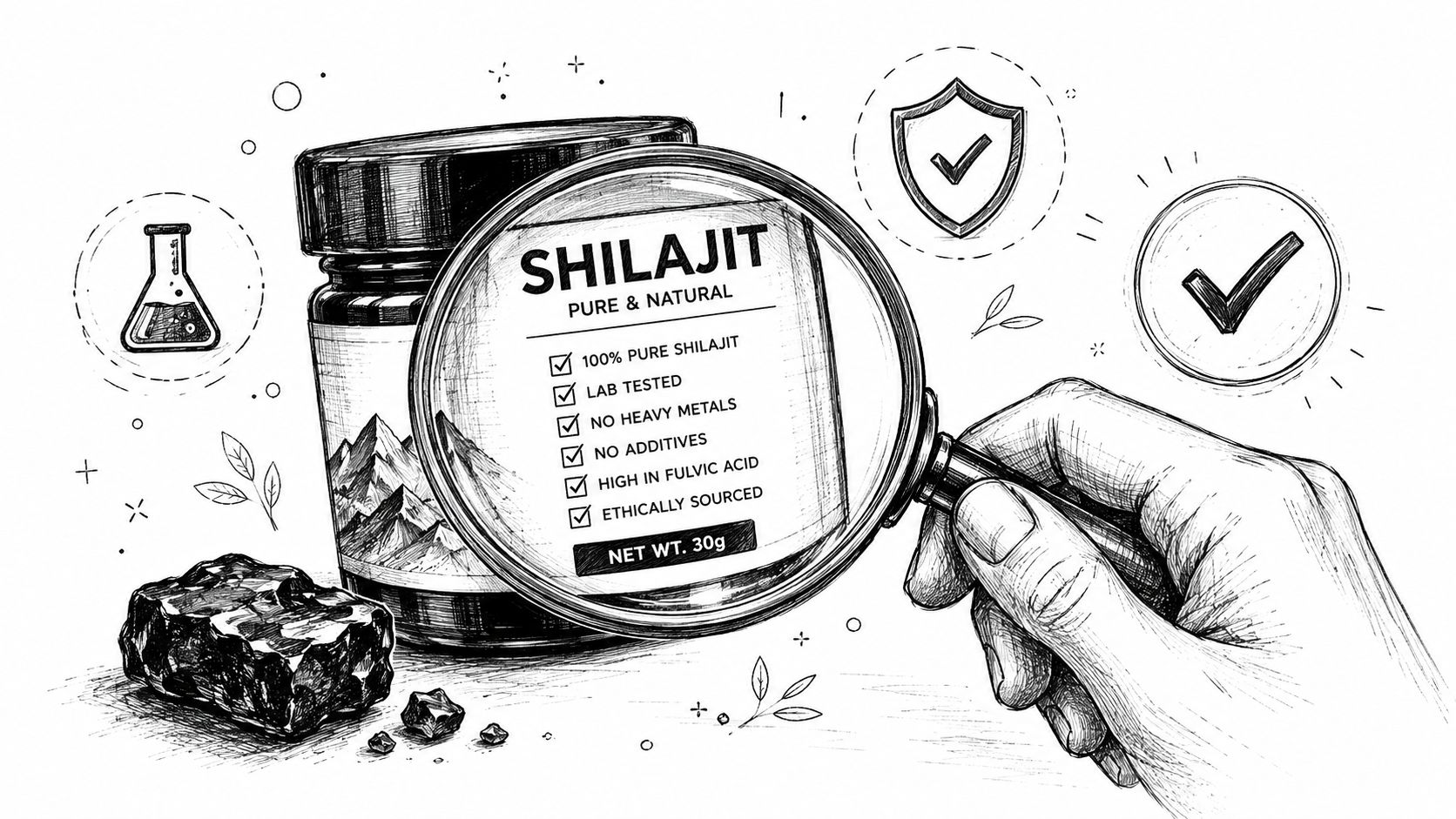
A simple buying checklist
The Cleveland Clinic highlights the key issue clearly in its guidance on shilajit benefits and safety. Purification is the critical distinction for safety. Unprocessed or counterfeit shilajit carries a documented risk of lead, arsenic, and mercury poisoning, while processed shilajit in the 100 to 2,000 mg/day range shows no significant toxicity. Unprocessed forms may also contain mycotoxins and oxidants that can cause intoxication.
Use that as your shopping filter:
- Look for purification language: The label should clearly say purified, processed, or standardized.
- Check for testing: You want evidence of heavy metal screening and contaminant testing.
- Prefer brands that identify the extract: Named extracts or well-characterized raw materials are easier to evaluate than vague “mountain resin” claims.
- Be skeptical of raw authenticity pitches: “Unfiltered,” “wild,” and “straight from the rock” are not safety benefits.
- Review the wider herb catalog carefully: If you're comparing formats and brands, a broad herbal supplements selection can help you see how products differ in labeling, dosage form, and transparency.
Choosing between resin, powder, and capsules
Form matters less than quality, but it still affects the user experience.
Resin appeals to people who want a traditional format. It can feel more hands-on, but dosing may be less convenient, and low-quality resin is easy to romanticize.
Powder is easier to mix into drinks, though taste can be strong. It works best for people who don't mind measuring and want flexibility.
Capsules are the most straightforward option. They're usually the easiest for consistent dosing, travel, and taste avoidance.
Here's a short video that helps make the shopping process less abstract:
A practical buyer usually does best with the format they'll take consistently. If resin feels exciting but inconvenient, capsules may lead to better real-world use.
Recommended Dosage and How to Use Shilajit
A common mistake is treating shilajit like a harmless tonic and eyeballing the dose. That approach makes little sense for a substance that can have real physiological effects and whose safety depends heavily on purification.
The safest starting point is simple. Use a purified shilajit product, follow the label, and begin at the lowest suggested serving rather than jumping to a full or aggressive dose. If a product does not clearly explain how much to take, what form the extract is in, and how it was purified, that is a reason to skip it, not improvise.
What research-based dosing can and cannot tell you
Human studies have used measured daily amounts of purified shilajit for weeks to months. That gives us a useful reference point. It does not mean every jar of resin sold online should be taken in the same way.
That distinction matters.
A studied dose of purified shilajit is more like using a kitchen measuring cup. Raw, poorly characterized shilajit is closer to scooping from an unlabeled container. The ingredient may sound the same, but the risk profile is not. Purification and testing are what make dose instructions meaningful in the first place.
For readers trying shilajit for the first time, a conservative routine is usually the smartest one:
- Start with the lowest labeled amount
- Stay with one product, not multiple formulas at once
- Give your body time to respond before increasing the dose
- Stop if you notice side effects or the product seems questionable
How to take each form
Your best format is the one you can dose accurately and use consistently.
Resin
- Measure only the amount listed on the label
- Dissolve it in warm water, tea, or another beverage if the product instructions allow
- Expect a strong earthy taste
- Be extra careful with resin because it is easier to overuse by guessing
Powder
- Use a proper measuring scoop, not an estimate
- Mix it as directed into water or another drink
- Powder can be convenient, but only if the serving size is clearly defined
Capsules
- Take the number of capsules listed on the bottle
- Swallow with water
- Capsules are often the easiest option for people who want more consistent dosing and less taste
If you are choosing between forms, accuracy matters more than tradition. Resin may feel more authentic to some buyers, but capsules or clearly measured powder often make it easier to stay within the intended dose.
Practical habits that reduce problems
Timing and consistency can make shilajit easier to evaluate.
- Take it earlier in the day if it feels stimulating or if you are using it for energy or vitality support
- Take it the same way each day so you can tell whether it is helping, doing nothing, or causing unwanted effects
- Avoid stacking it right away with testosterone boosters, blood sugar supplements, or multiple performance products
- Take it with food if needed if the product upsets your stomach
One more point is easy to miss. If a supplement causes headaches, digestive upset, dizziness, rash, or a general sense that something is off, do not force yourself to continue just because the label says it is natural. Recheck the product quality, the form, and the amount you used. With shilajit, purity comes before routine.
Potential Interactions and Contraindications
Shilajit isn't automatically risky, but it does deserve the same caution you'd give any supplement that may affect metabolism or hormones. The people most likely to run into problems are often those already managing a medical condition or prescription routine.
Medication interactions to think about
The available safety reporting notes concern for people taking antidiabetic or antihypertensive medications, because shilajit may influence blood sugar and blood pressure regulation. If you already take medication for either issue, adding a supplement with overlapping effects can complicate management.
Hormone-related effects matter too. Since shilajit has shown measurable influence on male reproductive hormones in some studies, anyone with a hormone-sensitive condition should get medical guidance before trying it.
When shilajit may not be a good fit
Some people should be more conservative even if they're otherwise interested in the potential benefits.
- People with hormone-sensitive conditions: Added hormonal effects may not be appropriate.
- Anyone on blood sugar or blood pressure medication: Interaction risk deserves professional review.
- People who can't verify product quality: If the seller can't show purification and testing, skip it.
- Pregnant or breastfeeding individuals and children: There isn't enough reliable evidence to recommend routine use.
This isn't about fear. It's about fit. A supplement can be promising and still not be right for your physiology, your medications, or the product options available to you.
If you take prescription medication, treat shilajit like an active supplement. Bring the label to your clinician, not just the product name.
That makes the conversation much more useful.
Conclusion Is Shilajit Right for You
Shilajit is one of the more interesting supplements in the wellness world because it sits between traditional use and emerging clinical evidence. There's credible support for some benefits, especially in male reproductive hormone support, exercise-related performance, and certain metabolic effects when purified products are used in studied doses.
But the biggest lesson isn't about testosterone or stamina. It's about quality control. The difference between purified and raw shilajit is not a minor detail. It's the main safety issue. A carefully processed, tested supplement belongs in a very different category from an unverified resin sold on image and mystique.
That's why the smartest approach is balanced. Be open to potential benefits. Stay skeptical of exaggerated claims. Read labels closely. Prioritize purification and contaminant testing over marketing language.
If you're healthy, careful, and interested in trying shilajit, it may be worth discussing with a healthcare professional who understands your medications, lab work, and goals. If you already manage a chronic condition, that conversation becomes even more important.
The best supplement choice is rarely the trendiest one. It's the one that fits your body, your risks, and your routine.
If you're comparing wellness products and want a reliable place to browse supplements, herbs, and performance support options, explore CalVitamin for a wide selection of products in multiple formats.






