
You're probably staring at two shilajit products right now that look almost identical. One says pure Himalayan resin, the other says premium fulvic mineral complex, and both promise energy, stamina, and “authentic” sourcing. One is cheap enough to feel suspicious. The other is expensive enough to feel like it must be better.
That's the trap.
Shoppers looking for the best shilajit supplements are comparing form, price, and fulvic acid claims first. They should be comparing lab proof first. Shilajit is one of those supplements where the wrong buying habit can put you on the wrong side of a contamination problem fast. If a brand can't show you what's in the batch you're buying, you're not choosing between good and better. You're choosing between verified and unverified.
I'm going to give you the filter I'd use myself. It's simple. Safety first. Verification second. Everything else after that.
Table of Contents
- Why Picking the Best Shilajit Supplements Is Harder Than It Looks
- What Shilajit Actually Is and Where It Comes From
- Why Safety and Heavy Metals Define Quality in 2026
- How to Judge a Shilajit Supplement Before You Buy
- Resin, Powder, Capsules, and Liquid Forms Compared
- Dosage, Timing, and Who Should Avoid Shilajit
- Your Shilajit Buying Checklist and Label Red Flags
- Quick Answers to the Questions Buyers Ask Last
- Is resin better than capsules?
- Should I choose the product with the highest fulvic acid?
- How do I read a COA quickly?
- Should I refrigerate shilajit?
- Can I take shilajit every day?
- How long should one container last?
- Do I need to cycle it?
- What's the biggest reason to reject a product?
- Should pregnant users or children take it?
- What's the final buying rule?
Why Picking the Best Shilajit Supplements Is Harder Than It Looks
Shilajit is sold with a lot of language that sounds meaningful and often isn't. Pure, authentic, Himalayan, gold grade, traditional, wild harvested. None of those words tell you whether the batch was properly purified, tested, or even standardized in a way that makes one jar comparable to another.
That's why buyers keep making the same four mistakes.
The four traps that waste money
- Trusting the brand name alone: A polished label and clean website don't prove the batch is clean.
- Chasing the highest fulvic acid number: A strong fulvic claim means little if the product also carries contamination risk.
- Ignoring the form: Resin, capsule, powder, and liquid aren't interchangeable in day-to-day use.
- Skipping the lab report: This is the biggest mistake. If the proof isn't available, the claim doesn't matter.
A lot of shilajit marketing leans on history, and to be fair, shilajit does have deep roots in Ayurvedic medicine. A peer-reviewed review notes it has been used for centuries as a rejuvenator and anti-aging compound, and a clinical paper ties that traditional use to Ayurvedic writings such as the Charaka Samhita. That same clinical line of research also matters because modern studies have focused on standardized purified extracts, not mystery tar from a random jar, including protocols using 250 mg twice daily in human research (Andrologia clinical reference).
Practical rule: If a product can't prove purification and testing, tradition doesn't rescue it.
What “best” should mean
For shilajit, “best” should mean one thing before anything else: the product is verified clean enough to consider taking at all.
After that, you can compare:
- source region
- fulvic content
- form factor
- convenience
- price per useful serving
But those are second-order decisions. Your first question should always be: What proof backs this bottle?
If you keep that one question in front of you, most bad products eliminate themselves quickly.
What Shilajit Actually Is and Where It Comes From
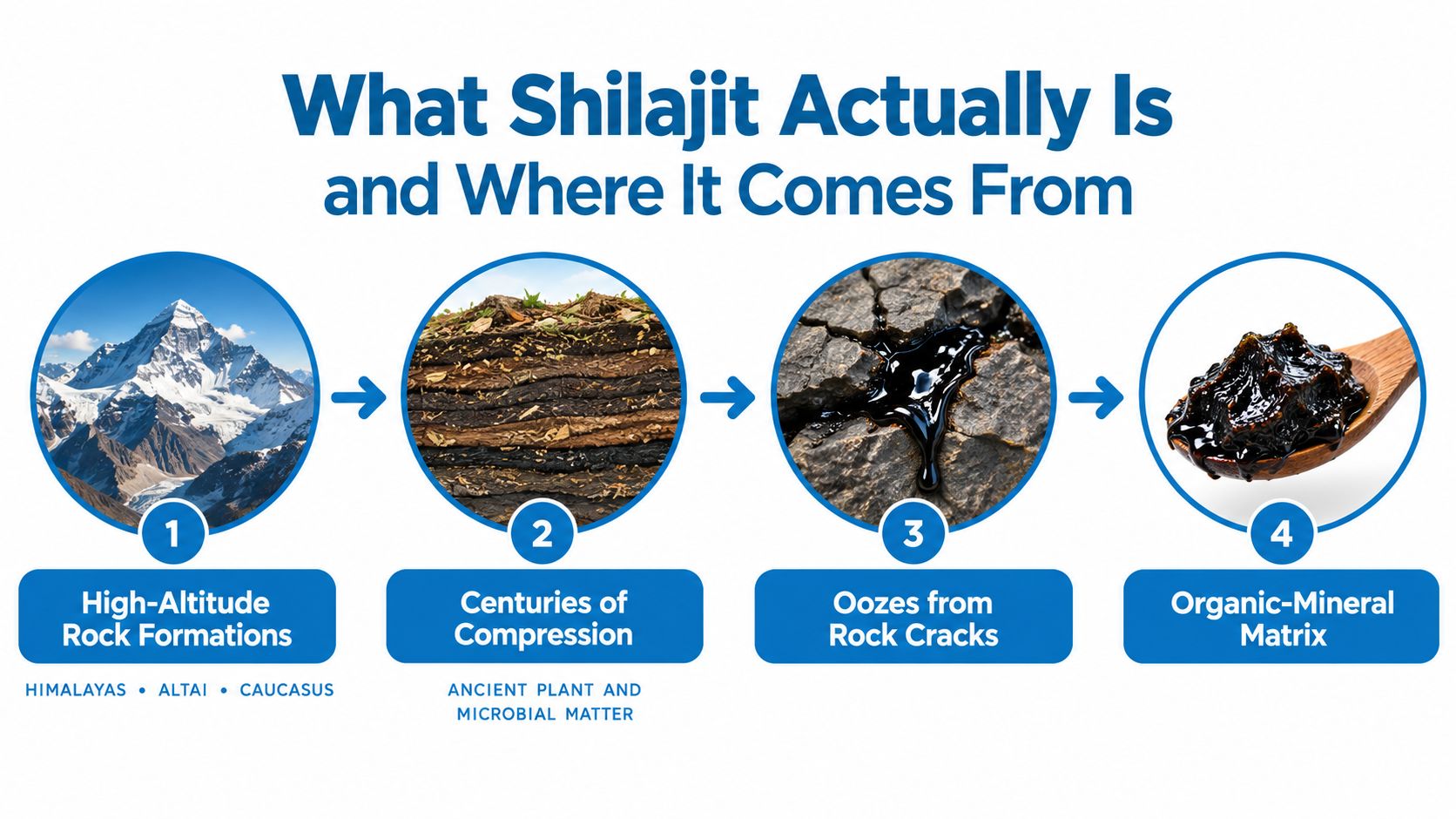
Shilajit isn't a plant extract in the normal supplement sense. It's an organic-mineral matrix formed over long periods as plant and microbial material breaks down and compresses between rock layers in high-altitude regions. People usually associate it with the Himalayas, but products also claim material from ranges such as the Altai and Caucasus.
When temperatures rise, this dark resinous material can seep from cracks in rock. Harvesters collect it, remove obvious debris, and then sell it either as raw resin or process it further into purified material used for powders, capsules, tablets, or liquid extracts.
The compounds that actually matter
The two names you'll see most often are fulvic acid and humic acids. Fulvic acid gets most of the attention because brands use it as a shorthand for potency and standardization.
A simple way to think about fulvic acid is this. It acts like a carrier sponge. It can bind to minerals and other compounds and help move them in biological systems. That's why so many labels fixate on the fulvic number.
But good shilajit isn't just “fulvic acid with branding.”
It also contains dibenzo-alpha-pyrones (often shortened to DBPs), plus trace minerals and other organic compounds. Those DBPs are often discussed for antioxidant activity, and they're part of why authentic shilajit is a matrix, not a single isolated ingredient.
Why source and processing matter
Buyers get sloppy. They treat all dark resin as interchangeable. It isn't.
Raw material can vary by region, rock composition, and how the material was cleaned and purified after harvesting. Then another layer of variation enters when brands convert that material into capsules, powders, or extracts. A resin with no verified standardization tells you very little. A capsule that declares standardization but won't show how it was tested also tells you very little.
Real potency comes from the combination of verified composition and verified cleanliness, not from one heroic number on the front label.
If you remember one thing from the chemistry side, remember this: a meaningful shilajit claim should trace back to documented source, verified processing, and measured content.
Why Safety and Heavy Metals Define Quality in 2026
If you think “natural” means safe, shilajit is the supplement that breaks that illusion.
Shilajit forms in rock. Rock is where metals live. That's the whole issue.
A 2024 review on shilajit safety and heavy metals summarized reference limits from WHO and FDA for metals including cadmium at 0.20 to 0.30 ppm, mercury at 1 ppm, arsenic and lead at 10 ppm, copper at 20 ppm, and zinc at 50 ppm, and concluded that some reported shilajit samples exceed permissible limits. The same review notes that related analyses of commercial products have also found samples exceeding FDA and WHO limits for lead, arsenic, and mercury. That's why buying untested shilajit is a bad gamble.
What buyers should demand first
You want a batch-specific Certificate of Analysis, not a generic promise. It should show actual results for:
- lead
- arsenic
- cadmium
- mercury
- thallium, when available in current testing practice
There's an underserved point here that most ranking articles miss. Recent buyer guidance has moved beyond the standard four-metal conversation. Independent review coverage has noted that shilajit can contain heavy metals, that some products can exceed contamination limits, and that a 2025 study measured thallium in supplements up to 0.5 µg/g, which is exactly why recent commentary pushes consumers to demand a five-metal panel COA rather than settle for broad “purified” claims (ConsumerLab shilajit review coverage).
If you want an example of the kind of product page language buyers should inspect closely, review pages like this purified shilajit product example and ask one question: does the brand show current, lot-specific proof or just polished copy?
Heavy metal limits buyers should expect in shilajit
| Metal | Target Upper Limit (ppm) | Why It Matters |
|---|---|---|
| Cadmium | 0.20 to 0.30 | A toxic metal that should be tightly controlled in naturally sourced materials |
| Mercury | 1 | A high-priority contaminant in mineral-derived supplements |
| Arsenic | 10 | Needs direct testing because geological materials can concentrate it |
| Lead | 10 | One of the first contaminants buyers should look for on a COA |
| Copper | 20 | Included in reference limits summarized in the safety review |
| Zinc | 50 | Included in reference limits summarized in the safety review |
The split in the market is obvious
One side of the market sells properly purified, documented material. The other side sells cheap jars, vague sourcing stories, and labels that lean hard on “ancient wisdom” because they can't lean on current testing.
Clinical safety data look much better for purified material. The same safety review notes a 28-day pilot study with improved performance outcomes and an excellent tolerability profile for purified shilajit. That distinction matters. Purified and verified material belongs in a different category from unverified raw resin.
Safety is the gate. Every other quality marker sits behind it.
How to Judge a Shilajit Supplement Before You Buy
You don't need a lab background to spot the serious products. You need a ranking system that puts the right things first. Most buyers do the reverse. They start with form, flavor, and flashy promises. Start with proof.
The ranking that actually matters
| Rank | Quality Marker | What to Verify | Disqualifying Failure |
|---|---|---|---|
| 1 | Batch-specific COA | Current lot number, heavy metal panel, dated report | No COA, outdated COA, or generic non-batch report |
| 2 | Independent lab testing | Third-party lab involvement, not just in-house claims | “Tested for purity” with no lab identity or document |
| 3 | Purification transparency | Clear statement that material is purified before sale | Raw resin sold with no purification detail |
| 4 | Fulvic acid disclosure | Declared fulvic content with a real test result | Fulvic claim with no supporting documentation |
| 5 | Source disclosure | Specific source region, not broad mythology | “Himalayan blend” or vague mountain language only |
| 6 | Form quality | Resin, capsule, powder, or liquid that matches your use case | Form used to distract from missing testing data |
How to read a COA fast
Here's the fast version. Open the COA and look for four things before you read anything else.
Lot match
The batch or lot number on the product should match the report. If it doesn't, the COA may be irrelevant.Date
Old reports are weak evidence. A brand should be able to produce recent lot documentation.Metal panel
You want lead, arsenic, cadmium, and mercury at minimum. Five-metal screening is better.Result format
Learn the difference between “not detected” and “below limit.” Both can be acceptable depending on the testing context, but either way the brand should show the actual result structure instead of hiding behind “passed.”
If the company makes you email customer service three times just to see a batch report, that's already useful information.
Fulvic acid claims are where buyers get fooled
A lot of labels throw around giant fulvic percentages because they know shoppers equate that with potency. That's not always a good sign. Sometimes it signals a formula built to sell a number rather than represent authentic shilajit character.
ConsumerLab pointed out a useful tension in this category. Some shilajit products tested with high fulvic acid, while heavy metals were generally below concern at one daily dose, yet some products could exceed strict lead limits if taken more than once per day. That's why dose-dependent risk matters more than simplistic “more fulvic is better” thinking (ConsumerLab on fulvic acid and dose-dependent lead concerns).
My five-minute buying rubric
Use this in order:
- Start with the COA: no current batch proof, no purchase.
- Check who tested it: in-house only is weaker than independent verification.
- Look for a real source statement: region-specific beats folklore.
- Inspect the fulvic claim: believable, documented numbers beat hype.
- Choose the form last: convenience matters, but only after verification.
If you're comparing actual shopping options, a straightforward product page like these shilajit capsules from CalVitamin is only worth considering if the documentation behind the item holds up. Product pages don't make a supplement good. Proof does.
Resin, Powder, Capsules, and Liquid Forms Compared
Form matters, but not as much as people think. Buyers love turning this into a purity debate. It's really a usability debate, assuming the product already cleared the testing hurdle.
Shilajit forms side-by-side
| Form | Dose Accuracy | Convenience | Contamination Risk | Cost Per Serving |
|---|---|---|---|---|
| Resin | Lower than pre-measured forms | Lowest convenience | Higher concern if poorly sourced or poorly purified | Varies widely |
| Powder | Moderate, depends on measuring | Good | Depends on processing quality and adulteration risk | Often moderate |
| Capsules | Highest for everyday use | Highest convenience | Depends on raw material quality and encapsulated extract integrity | Often predictable |
| Liquid | Variable | Easy to take | Can hide weak active content behind flavor systems | Often less transparent |
Who should choose what
Resin fits the buyer who wants the most traditional experience and doesn't mind mess, strong taste, or inconsistent scoop size. It also asks more from you. You need to dissolve it, portion it, and trust that the purification was real.
Powder is a middle ground. It's easier to mix than resin and can work well if you use a measured scoop or scale. The downside is that powder gives manufacturers more room to blend, dilute, or disguise.
Capsules are the easiest recommendation for most adults. They're portable, consistent, and much easier to fit into a daily routine. If a capsule product has strong documentation, I'd usually rank it above a romantic but weakly verified resin.
Liquid extracts sound modern and “high absorption,” but this category can get murky fast. Flavors, glycerin, and marketing language often do more work than the active shilajit content.
My blunt take on the format debate
People overrate tradition and underrate compliance. The best form is the one you'll take consistently after it passes the safety screen.
If you like browsing more raw and ingredient-focused options, the CalVitamin raws collection shows the kind of category where form differences become obvious. Just don't let form become the deciding factor before you've seen the COA.
Resin can be excellent. Capsules can be excellent. Powder can be fine. Liquid can be fine. Untested versions of all four are easy to reject.
Dosage, Timing, and Who Should Avoid Shilajit
Human shilajit research is still limited, so the smart move is boring: stick close to the dosing patterns used in purified-extract research, start low, and pay attention to how you respond.
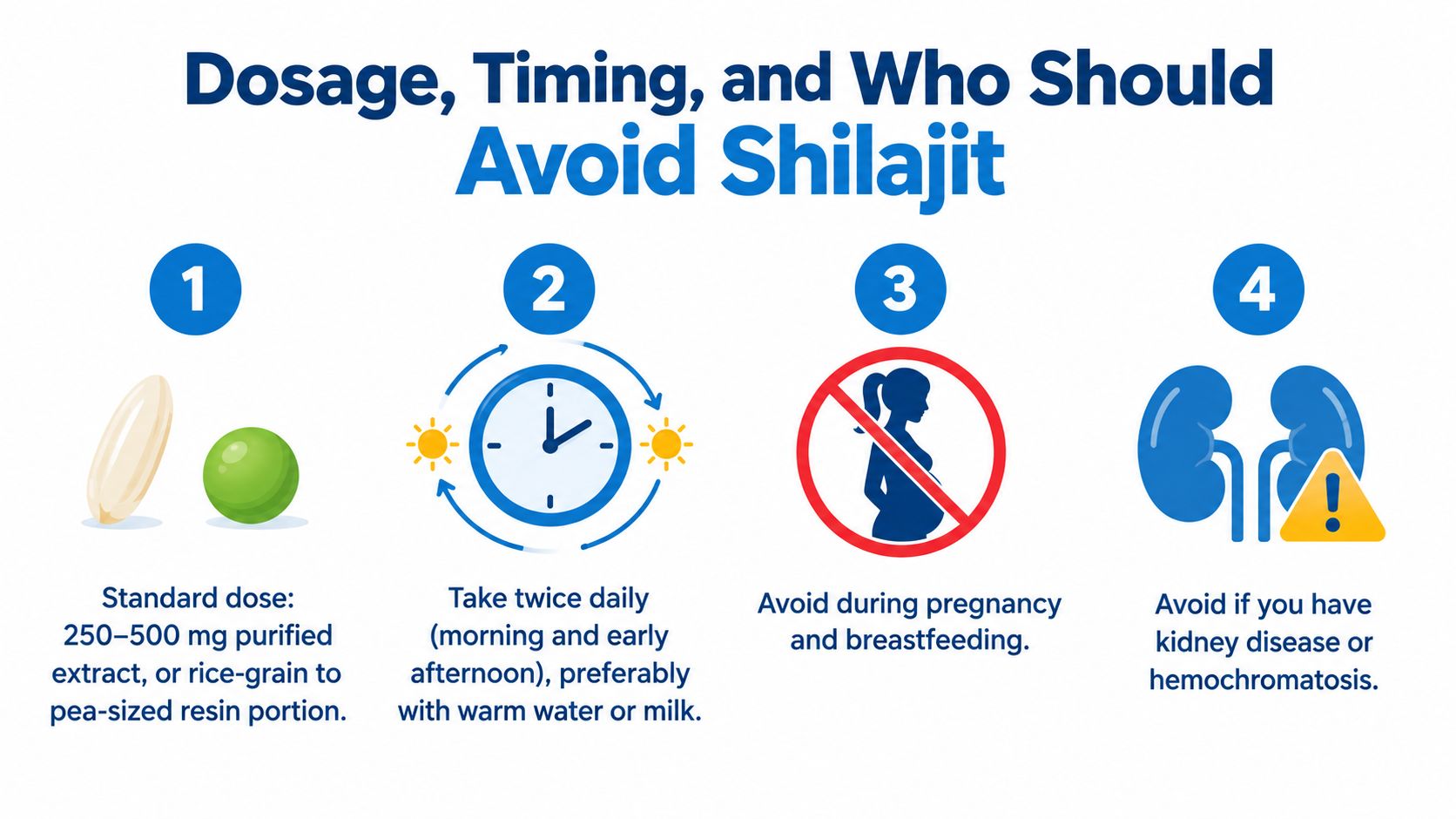
A practical starting point is 100 mg daily, then build up over a week or two if the product is purified and clearly labeled. Many human protocols with purified material have used 250 mg twice daily, and resin users often translate that into a small portion roughly in the rice-grain to pea-size range, depending on texture and concentration.
How to take it without making yourself miserable
- Take it with food: This reduces the chance of nausea or stomach irritation.
- Use earlier in the day first: Some users prefer morning or early afternoon use.
- Increase slowly: If you notice GI upset, headache, or sleep disruption, back off.
- Be careful with stimulant stacks: Pairing it with heavy caffeine or pre-workout use may not feel great for everyone.
Here's a practical walkthrough for timing and use:
Who should skip it or get clearance first
A lot of fluffy review articles fail the reader. They hand-wave safety and act like every herbal product belongs to everyone. It doesn't.
Be careful or avoid shilajit if any of these apply:
- Iron overload conditions: People with hemochromatosis should be cautious because shilajit is often discussed in the context of mineral handling.
- Active gout or elevated uric acid: This is a common caution point and worth discussing with a clinician.
- Pregnancy and lactation: Skip it. The safety case isn't established well enough.
- Upcoming surgery: Stop in advance and review all supplements with your care team.
- Medication use: Anticoagulants, antihypertensives, diabetes medications, and immunosuppressants deserve a pharmacist or clinician review before you add shilajit.
A natural supplement can still interact with medication. That's not a rare exception. That's normal pharmacology.
If you're healthy, using a purified product, and keeping the dose sensible, shilajit may be straightforward. If you're stacking multiple performance products or managing a condition, don't freestyle it.
Your Shilajit Buying Checklist and Label Red Flags
By the time you're at checkout, you shouldn't be wondering whether the product “feels premium.” You should be checking whether it survives a short list of hard filters.
The checkout checklist
Run through these before you buy:
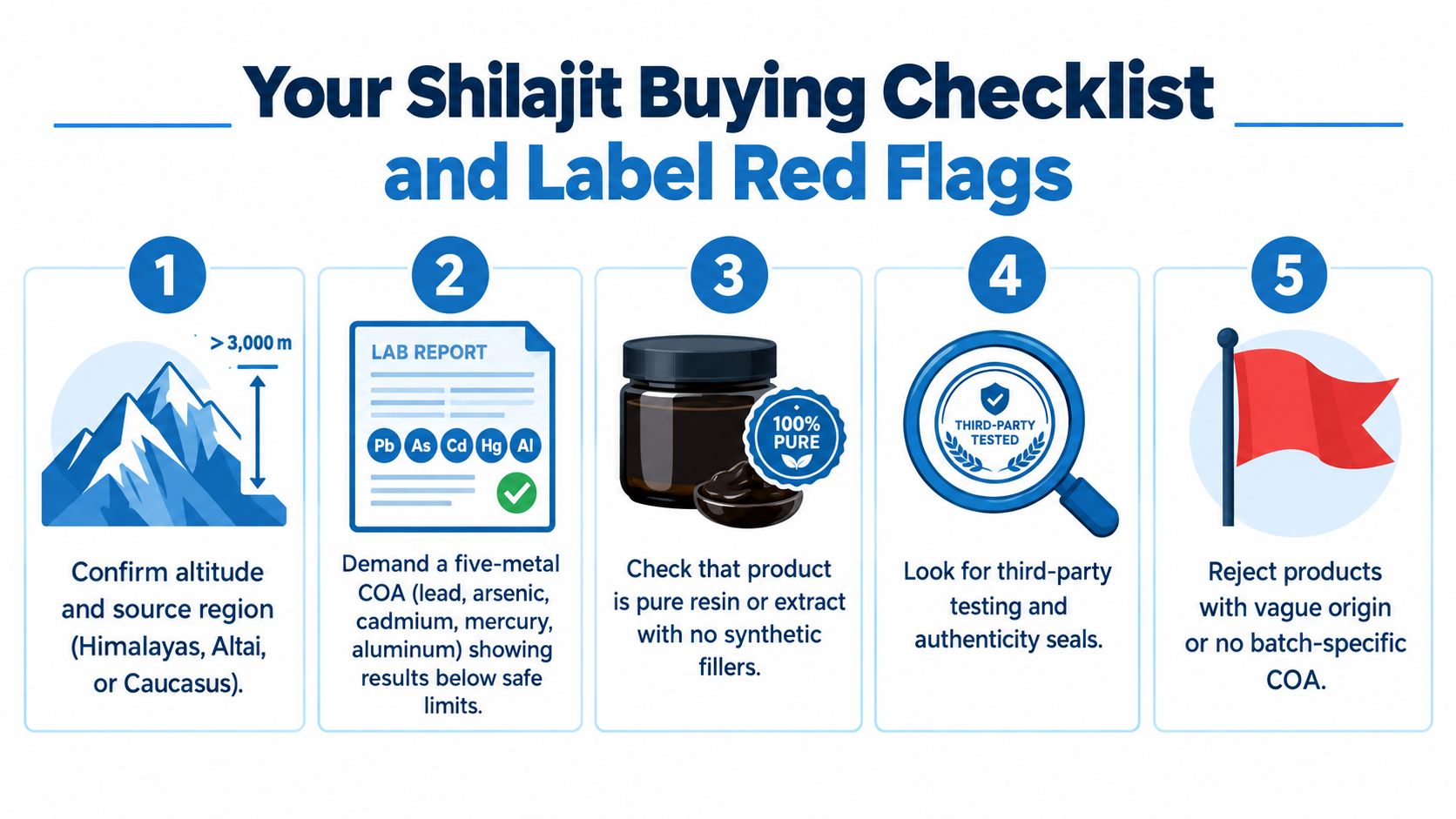
- Confirm the source region: The label should name the region clearly, not hide behind vague mountain branding.
- Demand a five-metal COA: Lead, arsenic, cadmium, mercury, and ideally thallium in current screening practice.
- Match the batch: The report should correspond to the product lot you're buying.
- Check the formula style: Pure resin or a clearly disclosed extract is easier to evaluate than a mystery blend.
- Inspect packaging logic: Shilajit should be sold in packaging that protects it from heat and moisture.
Red flags that should end the decision
Some labels tell you not to trust them if you know what to look for.
Vague origin language
“Himalayan blend” is weak. “Mountain sourced” is weaker. If a brand wants the authority of place, it should name the place.
No batch number
No batch number means weak traceability. Weak traceability means weak accountability.
Proprietary blends
If the label hides how much actual shilajit or fulvic-bearing material is in the product, move on. Shilajit is already hard enough to evaluate without brands making it opaque on purpose.
Generic purity claims
“Purified” without a report is just copywriting. Same for “lab tested” with no accessible documentation.
Filler-heavy formulas
Extra ingredients aren't automatically bad, but if the product is loaded with unnecessary fillers or looks like a capsule built around excipients more than the active, I'd rather buy something cleaner.
Exaggerated medical promises
Any label leaning too hard into dramatic testosterone, anti-aging, or disease-style promises is usually compensating for weak documentation.
Suspiciously low pricing
A rock-derived ingredient that needs purification and proper testing shouldn't look like a bargain-bin impulse buy. If the price is abnormally low, ask what corners got cut.
The simplest rule in the category
If you can't verify origin, purification, and a recent five-metal COA, you do not have enough information to call it one of the best shilajit supplements.
That doesn't mean the product is definitely bad. It means the seller hasn't earned your trust.
Quick Answers to the Questions Buyers Ask Last
Is resin better than capsules?
Not automatically. Resin is more traditional. Capsules are easier to dose consistently. If both are properly purified and backed by a batch-specific COA, choose based on routine, not mythology.
Should I choose the product with the highest fulvic acid?
No. A high fulvic claim without strong contaminant testing is weak value. Verification beats headline potency.
How do I read a COA quickly?
Check the lot number, test date, metal panel, and actual results first. If those don't line up, stop there.
Should I refrigerate shilajit?
Usually, controlled storage away from heat and moisture matters more than refrigeration. Follow the brand's storage instructions if they're specific and sensible.
Can I take shilajit every day?
Some adults do, but daily use only makes sense if the product is verified and you tolerate it well. If you're unsure, use a conservative dose and review it with a clinician.
How long should one container last?
That depends on serving size and form. The only useful answer is on the label and should match a realistic daily dose.
Do I need to cycle it?
There isn't a universal rule. Some people use it continuously, others prefer breaks. If you notice sleep disruption, GI issues, or stacking fatigue with other products, take that seriously.
What's the biggest reason to reject a product?
No recent accredited five-metal COA. Everything else is secondary.
Should pregnant users or children take it?
I wouldn't recommend it without direct medical guidance. This is not the category for guessing.
What's the final buying rule?
If a brand cannot produce a recent, lot-specific, accredited five-metal COA, walk away. Reviews, branding, and price do not fix missing proof.
If you want a place to compare wellness products without digging through random marketplace listings, CalVitamin offers a broad catalog that includes shilajit capsules, raw-format options, and other herbal supplements in one place. Use the standards in this guide when you shop there or anywhere else: check the form, inspect the label, and don't buy shilajit on vibes alone.






