A shake is a delivery tool, not a separate requirement. For most exercising adults, 20–30 g of protein can contribute to a daily total of roughly 1.4–2.0 g per kilogram of body weight, consistent with International Society of Sports Nutrition guidance. Meals count toward that same total, so check what you already eat before deciding what to put in the shaker.
The “drink protein immediately after exercise” rule skips two questions: how much protein have you had today, and what fuel did your session use? A strength athlete may use a shake mainly to top up protein. After a long or repeated endurance session, carbohydrate can matter as much as, or more than, protein for replacing fuel. The right mix depends on the day's gap and the workout.
Table of Contents
- How Much Protein Per Shake for Your Sport
- Do You Need a Shake? Check Your Protein Gap
- Whey, Plant and Hydrolysate Shakes Compared
- Timing Your Shake Around Training
- Carbohydrate Choices for Each Sport
- Four Basic Shake Recipes to Make at Home
How Much Protein Per Shake for Your Sport
A shake is a way to fill part of your daily protein target, not a target in itself. For most exercising adults, the broad daily range is 1.4–2.0 g per kilogram of body weight. A practical serving often falls around 20–30 g, while the amount that suits you depends on your size, meals, and training.
For a 75 kg athlete, that daily range works out to 105–150 g. A 25 g shake provides about one-sixth of the 150 g upper end. Use it like a portion in a meal plan: estimate what food already provides, then use a shake to cover some of the remaining amount. For endurance athletes, the shake may also need carbohydrate to help replace training fuel.
| Athlete profile | Protein per kg per day | Daily total at 75 kg | Shake serving |
|---|---|---|---|
| General fitness, 3–4 sessions a week | 1.4–2.0 g | 105–150 g | 20–25 g |
| Strength or muscle-building focus | 1.6–2.0 g | 120–150 g | 25–30 g |
| Endurance runner or cyclist | 1.4–2.0 g | 105–150 g | 20–25 g, paired with carbohydrate |
| Team sport, two sessions a day | 1.6–2.0 g | 120–150 g | 25–30 g |
| Cutting weight while training | 1.4–2.0 g | 105–150 g | 25–30 g |
These rows are planning examples, not separate prescriptions for each sport. The broad daily benchmark remains 1.4–2.0 g/kg for exercising adults. If you have a medical condition or a weight-class goal, ask a qualified professional to help set an individual target.
Put the daily total first
A 75 kg strength athlete aiming for 150 g per day might estimate that meals provide 120 g. One 30 g shake fills that arithmetic gap. If meals already meet the chosen target, another shake adds protein and calories without addressing a shortfall.
A serving guide of about 0.25 g/kg means 18.75 g for a 75 kg person: 75 × 0.25 = 18.75. The broader 20–40 g range allows for differences in body size and context; at 75 kg, 40 g equals about 0.53 g/kg, not 0.25 g/kg. These figures describe different-sized servings, not equivalent amounts for every athlete.
A single 50 g dose is not automatically better than two 25 g servings across the day. Choose servings that help you meet your daily total and fit your meals and training routine. For endurance training, check the carbohydrate in the shake too: replacing fuel may matter more than adding protein when your daily protein is already covered.
Start with your body weight and the daily range, then compare that target with a typical day of meals. The resulting gap, rather than the sport label alone, helps determine whether a shake and what serving size make sense.
Do You Need a Shake? Check Your Protein Gap
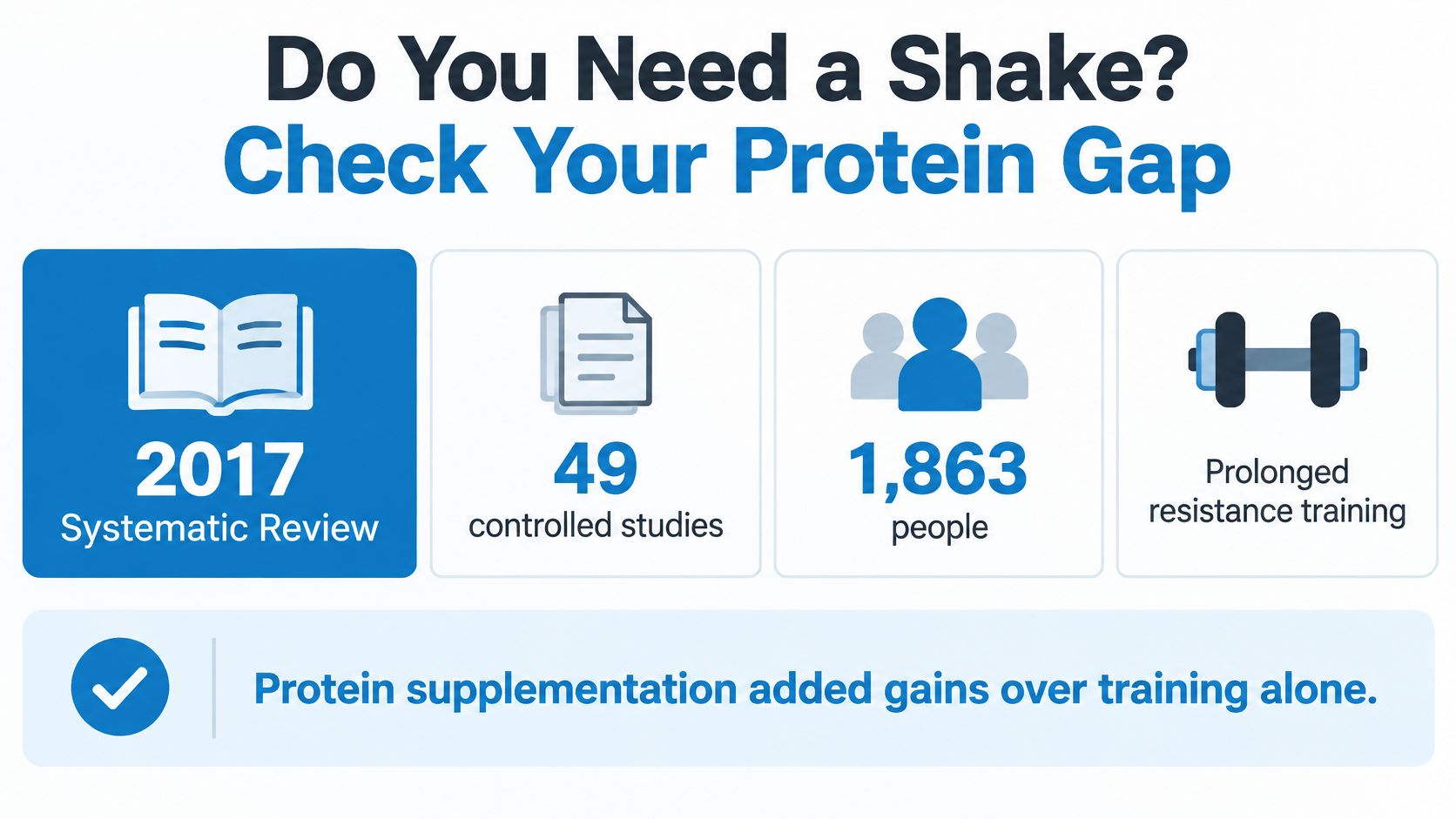
A shake can help close a protein shortfall, but adding one when your meals already meet your needs may just add more. A 2017 systematic review and meta-analysis of 49 controlled studies involving 1,863 people in prolonged resistance training found that protein supplementation was associated with average gains of 2.49 kg in one-repetition-maximum strength, 0.30 kg in fat-free mass, and 310 square micrometers in muscle-fiber cross-sectional area. The reported confidence intervals were 0.64–4.33 kg, 0.09–0.52 kg, and 51–570 square micrometers, respectively (systematic review and meta-analysis).
These are averages across studies, not a forecast for any one athlete. The review estimated that gains in fat-free mass stopped increasing measurably with added supplementation once total intake reached about 1.62 g/kg per day (systematic review and meta-analysis). That figure is a useful reference point, not a reason to add powder if your daily target is already covered.
Daily protein works like water in a tank: adding some can help when the level is low, but pouring in more once it is full does not keep raising it. A shake is a delivery tool for reaching an appropriate daily total. It does not replace progressive training, enough calories, or a varied diet. For endurance athletes, check the rest of the shake too: if your training calls for carbohydrate, that may matter more than adding extra protein.
Run this four-step check
Set a starting range. Multiply your weight in kilograms by 1.4 and 2.0 to find a broad daily target range for an exercising adult (ISSN position stand). Use it as a planning guide, not a personal medical prescription.
Count what you eat. Track protein from meals and snacks over three typical days, using labels or an app. Include dairy or alternatives, beans, eggs, meat, fish, tofu, and other protein sources. Three days gives a more useful picture than relying on memory from one meal.
Compare intake with your target. Subtract the protein in your food from the target you chose. If the gap is about 20–30 g, one shake in that range may cover it. For a larger gap, divide the amount across meals or servings instead of trying to fit it into one oversized shake. Choose a serving that matches your shortfall, rather than assuming every sport calls for the same shake size.
Decide whether a shake helps. If meals already meet your target, skip the extra shake or use it instead of another protein food. Keep room for carbohydrate, fruit, and vegetables. A shake can still be a convenient option during travel, when appetite is low, or when a meal is hard to access.
For more help weighing the convenience against the need, read this guide to whether protein supplements are worth it.
A shake earns its place by closing a gap in an otherwise adequate diet, not by automatically sitting on top of one.
Whey, Plant and Hydrolysate Shakes Compared
Protein powders differ in their dairy content, processing, digestion, taste, and cost. Their main job is to help you meet your daily protein total. For endurance athletes, the carbohydrate in a shake may matter more than the protein if the drink is also meant to support training fuel or recovery.
| Protein type | Lactose or processing | Typical use |
|---|---|---|
| Whey concentrate | Contains more lactose than isolate | A common post-training option for athletes who tolerate dairy |
| Whey isolate | Very low lactose | A dairy-based option for people who are sensitive to lactose |
| Whey hydrolysate | Pre-digested whey | A quick-mixing option, though it can cost more and taste bitter |
| Casein | Dairy protein that digests slowly | A shake before bed or during a long gap between meals |
| Pea, rice, or soy blend | Plant-based, with no dairy lactose | An option for athletes avoiding dairy |
For resistance-training recovery, a serving providing 20–25 g of high-quality protein and about 3–4 g of leucine is a practical example. Whey can provide that protein in a rapidly digested form and is naturally rich in leucine (review of whey use in athletes). Those figures describe a useful serving, not a reason to choose whey over every other powder. The amount needed depends on how the shake fits into the day's total.
Whey concentrate is a straightforward option if you tolerate dairy. Whey isolate has very low lactose, which may make it a better fit for someone who experiences trouble with lactose. Hydrolysate is pre-digested, but that processing does not make it necessary, and its taste or higher cost may put some athletes off.
Casein digests slowly, so it may suit a shake before bed or a long stretch without a meal. A pea, rice, or soy blend provides a dairy-free alternative. Plant-based proteins can support comparable long-term adaptations when total protein and leucine are matched. Choose based on dietary needs, taste, digestion, and price, rather than assuming a plant powder is automatically less useful.
A 2025 review in Nutrients reported different rates of whey use among rowers, soccer players, and basketball players in the groups it examined (review of whey use in athletes). Those differences show that use varies across groups; popularity alone does not show that an individual athlete needs whey.
Before buying, compare the protein amount and price per gram on the label, and check for third-party certification such as NSF Certified for Sport, which tests products for banned substances and contaminants. For more help comparing ingredients and formats, see this guide to choosing a protein powder.
Simple choice: Choose whey if dairy suits you, a plant blend if you avoid dairy, or casein when a slow-digesting option fits your routine. For endurance training, check the carbohydrate content too.
Timing Your Shake Around Training
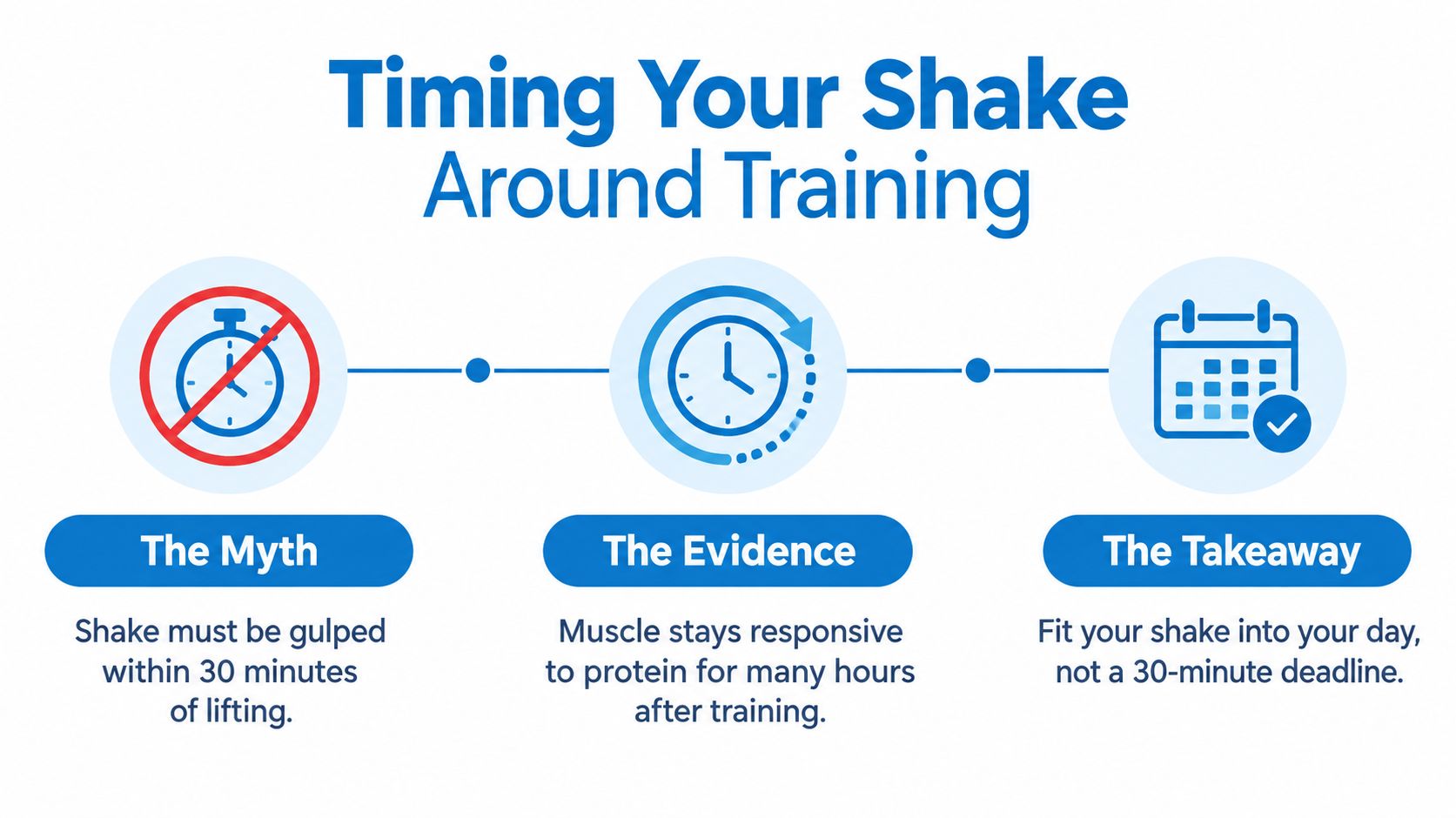
The anabolic-window myth sets a strict 30-minute deadline for drinking a shake after lifting. Protein timing is more flexible: a shake is a delivery tool for reaching your daily total and spreading protein across meals, not a countdown timer. If you ate protein before training, you don't need to rush to drink one the moment you finish.
After resistance training, a shake can be a convenient serving, while a meal can do the same job. For serving size and leucine guidance, see the whey section above. The right choice depends on body size, age, training load, and what you ate around the session.
Maya's training-day example
Maya weighs 75 kg and lifts at 18:00. She eats 30 g of protein at 07:00 and another 30 g at 12:30. She includes a 20 g shake at 17:00 because little protein has come from food by late afternoon, then has a 25 g shake at 18:30 and dinner with 30 g at 20:30.
That schedule adds up to about 135 g of protein. The 17:00 shake is part of the example, not an optional item in that total. If Maya skips it, the listed intake is about 115 g instead. Either way, the post-training shake is a convenient way to fill a gap, not a requirement tied to a 30-minute window.
For endurance athletes, the shake may need to deliver carbohydrate as well as protein, particularly after long or repeated sessions. In that case, the carbohydrate can matter more for refuelling than adding extra protein. Someone who is heavier, older, or training at higher volume may need a different amount or meal pattern. Use Maya's schedule as an example, then fit shakes around your own day.
Carbohydrate Choices for Each Sport
The shake with the most protein is not always the most useful after training. For an endurance athlete facing another long session, carbohydrate may matter more because it replaces fuel used during exercise. For a strength athlete, a shake may mainly help fill a daily protein gap.
A systematic review of 29 trials involving 246 participants found no significant increase in glycogen restoration when protein was added to carbohydrate if carbohydrate intake was already adequate. In the comparisons, one group received about 0.86 g of carbohydrate/kg/hour plus 0.27 g of protein/kg/hour, while the carbohydrate-only group received about 0.95 g of carbohydrate/kg/hour. The protein group therefore had less carbohydrate, which makes it difficult to attribute differences in glycogen restoration to protein alone (systematic review of glycogen resynthesis). When rapid refuelling matters, get enough carbohydrate, fluid, and energy overall.
A 2024 systematic review of endurance exercise found limited benefit from protein alone. Combining protein with carbohydrate was associated with improved performance, with a standardized mean difference of 0.36 and a 95% confidence interval of 0.11–0.61 (systematic review of protein and carbohydrate in endurance exercise). The review also reported better recovery, glycogen restoration, and fatigue outcomes when protein and carbohydrate were consumed immediately rather than later. Results varied by person and exercise type, so the findings do not establish one ideal shake for every athlete.
| Sport context | Recovery priority | Shake composition | Shake role |
|---|---|---|---|
| Distance running, long runs over 90 minutes | Replace fuel before the next run | Choose a carbohydrate-forward option; include protein if it helps meet your daily target | Refill energy stores |
| Cycling, back-to-back long rides | Replace carbohydrate and support recovery | A carbohydrate-containing drink or shake; add protein according to your needs | Support refuelling before the next ride |
| Swimming, daily long sessions | Replace fuel and fluid | A drink or shake with carbohydrate; include protein if useful | Help cover needs between sessions and meals |
| Interval or HIIT training | Support muscle repair and refuelling | Include protein, with carbohydrate to match the session and next meal | Contribute to daily intake |
| Team sport, matches and sprints | Replace fuel and support muscle recovery | Combine carbohydrate and protein, with a meal if needed | Cover both needs after demanding play |
| Strength training | Meet daily protein needs | A protein-containing shake if meals leave a gap | Add convenient protein |
These are options, not fixed prescriptions. A shake is a delivery tool: its value depends on which part of your daily intake is still missing. For an endurance athlete after a demanding session, carbohydrate may be the priority; for a lifter whose meals fall short on protein, protein may lead. See this guide to sports performance nutrition for more on matching intake to training.
If your next session depends on replacing fuel, choose a shake with carbohydrate. If your meals leave a protein gap, let protein take the lead.
Four Basic Shake Recipes to Make at Home
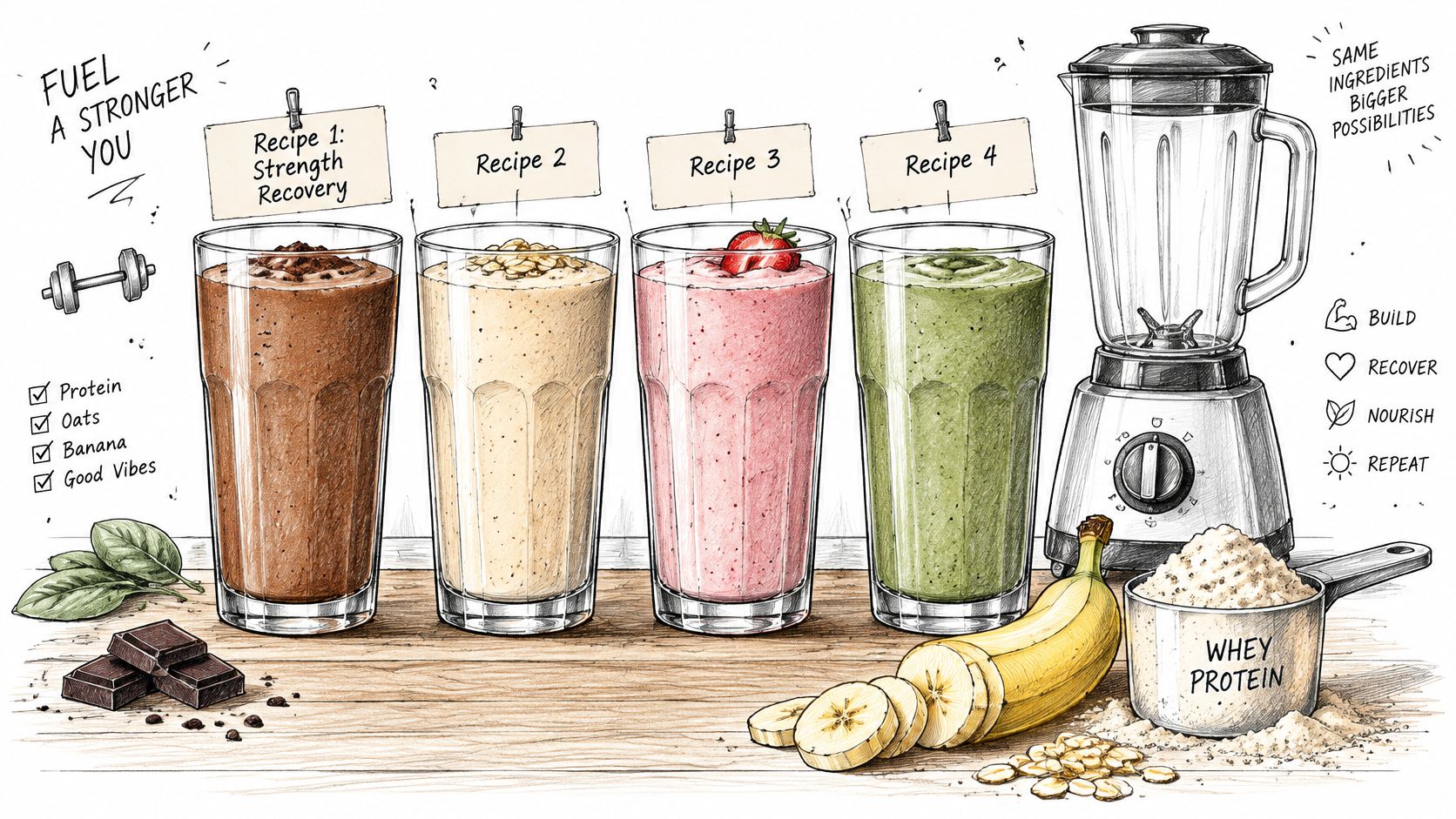
A shake is a delivery tool for your daily protein total, not a requirement after every workout. These four examples show how to pair protein with other ingredients: endurance athletes may need more carbohydrate for fuel, while a strength shake can keep protein in the lead. The totals are estimates because product labels vary.
Strength recovery
Purpose: A protein-led option after lifting.
- 25 g whey isolate
- 200 ml semi-skimmed milk
- ½ small banana
- 150 ml cold water
Approximate total: 29 g protein and 25 g carbohydrate. Blend until smooth, adding ice for a thicker texture. The protein sits within a 20–30 g serving; the banana and milk add some carbohydrate without making it the main focus.
Endurance refuel
Purpose: A carbohydrate-led shake after a demanding endurance session.
- 25 g whey concentrate
- 250 ml orange juice
- 1 large banana
- 40 g rolled oats
Approximate total: 28 g protein and 80 g carbohydrate. Blend until the oats are fully incorporated. Here, carbohydrate is the larger part of the recipe, which can help replenish fuel after a hard endurance session.
Dairy-free blend
Purpose: A plant-based choice for athletes avoiding dairy.
- 25 g pea and rice protein blend
- 300 ml unsweetened soy milk
- 100 g frozen berries
- 1 tablespoon ground flaxseed
Approximate total: 29 g protein. Blend the soy milk and powder first, then add the berries and flaxseed. Check the powder label, since protein per serving varies by product.
Slow evening shake
Purpose: A casein drink for an evening snack or a long gap before the next meal.
- 30 g casein
- 300 ml cold water
- 1 tablespoon peanut butter
- A handful of ice
Approximate total: 28 g protein. Blend until smooth and serve cold.
Use product labels to check protein per serving rather than treating recipe totals as exact. For a smoother drink, start with cold liquid, add ice for thickness, and blend oats for a full 30 seconds to limit clumps.
CalVitamin offers protein products alongside vitamins, minerals, and other wellness supplements. Compare serving information and ingredients with your daily protein target, then visit CalVitamin to explore its protein selection.